Measures of Morbidity and MortalityAkhilesh BhargavaMD, DHA, PGDHRMProfessor-Community Medicine& Director-SIHFW, Jaipur
Akhilesh Bhargava2The fundamental task in epidemiologic research is to quantify the occurrence of illnessThe goal is to evaluate causation of illness by relating disease occurrence to characteristics of people and their environmentRates, Ratios, and Standardized Rates are primary tools for quantifying occurrence of illness
Akhilesh Bhargava3What is a rate?“a measure of speed with which events are occurring in a population in a specified time period.”EssentialsA numeratorA denominator that “appropriately” relates the numerator to population at riskA “unit” such as per 1000, per 100,000 or per million
Akhilesh Bhargava4Why a rate?To ensure comparing apples with apples
Akhilesh Bhargava5Prevalence VS. IncidencePrevalence:	A “snapshot” of disease at a point in time in a population	Relevant for planning of health servicesIncidence:	A description of how new cases of disease are occurring.  “force of morbidity” “rate of flow” of cases from non disease to disease state	Relevant for exploring causal theories
Akhilesh Bhargava6Prevalence (P) and Incidence (I)P~I x dd=durationP= I x dIf the disease is stable, thatis, if the incidence and duration remains constant over time.
Akhilesh Bhargava7Prevalence          number of individuals with the disease P = -----------------------------------------------------            number of individuals at risk     Prevalence can be expressed either as a proportion or as a rate    Expressed as a proportion, prevalence is a number between 0 and 1    As a rate, prevalence can be expressed as per 1000, per 100,000, or per whatever
Akhilesh Bhargava8Prevalence: ExampleA sample of 1,000 women 70-74 years.  70 werefound to have the diagnosis of rheumatoid arthritis.The prevalence of arthritis is:          70P= ------------- = 0.07 for women age 70-741,000Or P= 70 per thousand for women age 70-74OrP= 7 percent for women age 70-74Or……….
Akhilesh Bhargava9Prevalence   Choice of scale of rate usually depends on the ubiquity of the disease.  Thus, more common disease prevalence may be presented as percentage   Rare disease prevalence may be presented as per 100,000 or per million
Akhilesh Bhargava10Incidence Rate: ExampleIn 1973 there were 29 cases of MI in Jaipur among men 40-44 years.  The number of person years was 41,532.The incidence rate is:       29 I = --------- =0.0007 per year    41,532		      = 0.7 per thousand per year		      = 7 per 10 thousand per year		      = 700 per million per yearTo be more accurate, we must add another qualifier, namely, “for men 40-44 years of age”
Akhilesh Bhargava11Incidence Rate    No. of new cases occurring during a period of timeI =----------------------------------------------------------------				“total person time” at riskWhat is “person time”:     The duration of time a person is at risk      Usually expressed as person years but can be expressed as anything, e.g., person months, person weeks, etc.
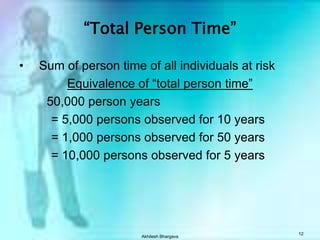
Akhilesh Bhargava12“Total Person Time” Sum of person time of all individuals at riskEquivalence of “total person time”        50,000 person years		= 5,000 persons observed for 10 years		= 1,000 persons observed for 50 years		= 10,000 persons observed for 5 years
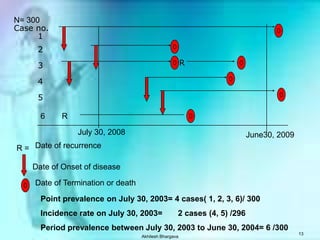
Akhilesh Bhargava13N= 300Case no.12R345R6July 30, 2008June30, 2009Date of recurrenceR =Date of Onset of diseaseDate of Termination or deathPoint prevalence on July 30, 2003= 4 cases( 1, 2, 3, 6)/ 300Incidence rate on July 30, 2003=       2 cases (4, 5) /296Period prevalence between July 30, 2003 to June 30, 2004= 6 /300
Akhilesh Bhargava14Crude and Specific Rates“Crude”:  Rates calculated for the “entire” population“Specific”:  Rates calculated for “specific” subpopulations.Ex:	Age-specific rates		Race-specific rates		Gender-specific rates
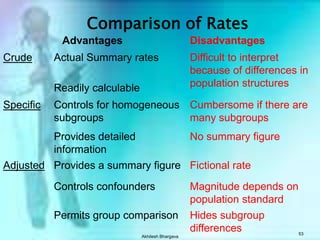
Akhilesh Bhargava15Comparing Apples with ApplesIn comparing populations (groups) oneshould recognize that populations (groups) can differ in two important respects:		Subpopulation-specific rates		Distribution of subpopulations
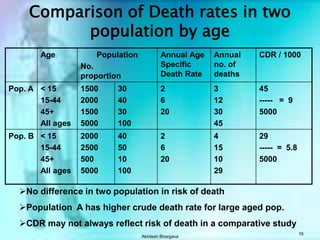
Akhilesh Bhargava16Comparison of Death rates in two population by ageNo difference in two population in risk of death
Population  A has higher crude death rate for large aged pop.
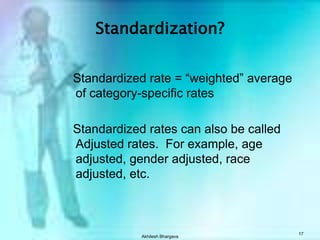
CDR may not always reflect risk of death in a comparative studyAkhilesh Bhargava17Standardization?    Standardized rate = “weighted” average of category-specific rates    Standardized rates can also be called Adjusted rates.  For example, age adjusted, gender adjusted, race adjusted, etc.
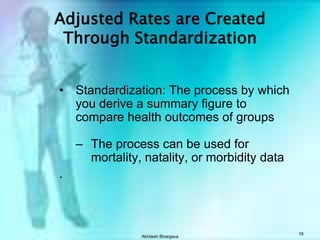
Akhilesh Bhargava18Adjusted Rates are Created Through StandardizationStandardization: The process by which you derive a summary figure to compare health outcomes of groupsThe process can be used for mortality, natality, or morbidity data.
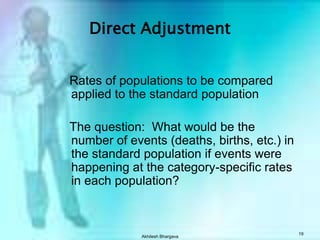
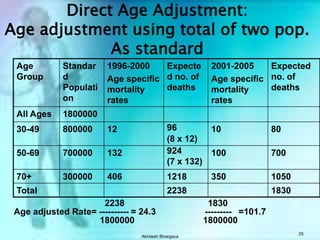
Akhilesh Bhargava19Direct Adjustment   Rates of populations to be compared applied to the standard population   The question:  What would be the number of events (deaths, births, etc.) in the standard population if events were happening at the category-specific rates in each population?
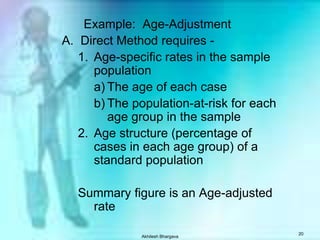
Akhilesh Bhargava20           Example:  Age-Adjustment Direct Method requires -Age-specific rates in the sample populationThe age of each caseThe population-at-risk for each age group in the sampleAge structure (percentage of cases in each age group) of a standard populationSummary figure is an Age-adjusted rate
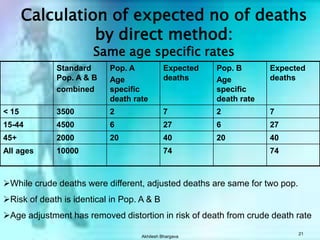
Akhilesh Bhargava21Calculation of expected no of deaths by direct method: Same age specific ratesWhile crude deaths were different, adjusted deaths are same for two pop.
Risk of death is identical in Pop. A & B
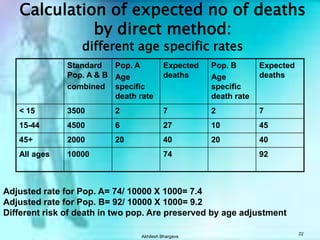
Age adjustment has removed distortion in risk of death from crude death rateAkhilesh Bhargava22Calculation of expected no of deaths by direct method: different age specific ratesAdjusted rate for Pop. A= 74/ 10000 X 1000= 7.4Adjusted rate for Pop. B= 92/ 10000 X 1000= 9.2Different risk of death in two pop. Are preserved by age adjustment
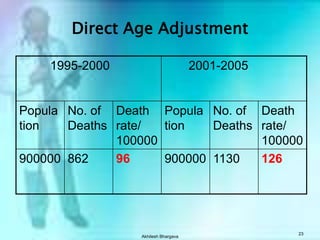
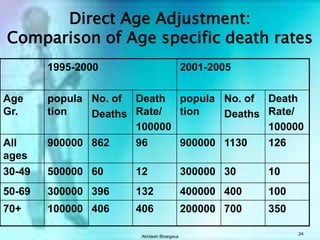
Akhilesh Bhargava23Direct Age Adjustment
Akhilesh Bhargava24Direct Age Adjustment:Comparison of Age specific death rates
Akhilesh Bhargava25Direct Age Adjustment:Age adjustment using total of two pop. As standard22381830Age adjusted Rate= ---------- = 24.3                    ---------   =101.71800000                            1800000
Akhilesh Bhargava26Indirect Adjustment    Rates of standard population applied to populations to be compared.   The question:  What would be the number of events (deaths, births, etc.) if the particular population was having events at the same category specific rates as the standard population?
Akhilesh Bhargava27Indirect method requires Age structure (percentage of cases in each age group) of the sample populationTotal deaths in the sample populationAge-specific rates for the standard populationSummary figure is aStandardized Mortality ratio
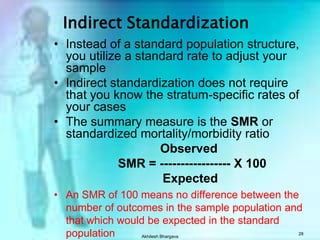
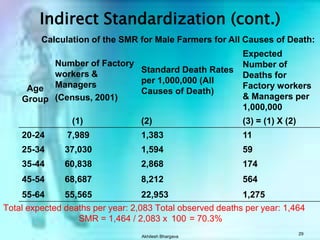
Akhilesh Bhargava28Indirect StandardizationInstead of a standard population structure, you utilize a standard rate to adjust your sampleIndirect standardization does not require that you know the stratum-specific rates of your casesThe summary measure is the SMR or standardized mortality/morbidity ratioObservedSMR = ----------------- X 100             ExpectedAn SMR of 100 means no difference between the number of outcomes in the sample population and that which would be expected in the standard populationAkhilesh Bhargava29Indirect Standardization (cont.)Total expected deaths per year: 2,083 Total observed deaths per year: 1,464	                          SMR = 1,464 / 2,083 x 100= 70.3%
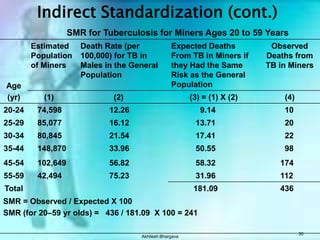
Akhilesh Bhargava30Indirect Standardization (cont.)
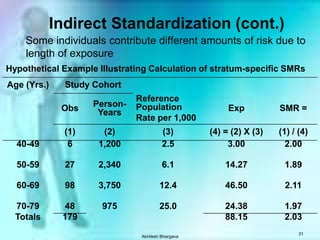
Akhilesh Bhargava31Indirect Standardization (cont.)    Some individuals contribute different amounts of risk due to length of exposure
Vital Statistics
Akhilesh Bhargava33Indicators of Public HealthMortality statisticsAge specific mortality ratesDisease specific mortality ratesCase-fatality Life ExpectancyMaternal mortality ratesInfant mortality rates Morbidity statisticsFertility ratesVaccination coverageHealth care utilization Health status indicators
Akhilesh Bhargava34Vital StatisticsSystems for collecting vital statisticsCivil registration systemAdvocated by the United NationsPresent in industrialized countriesCostly to develop and maintainAlternative methodsProbability area samplesPurposeful area samplesRecords-based surveys
Akhilesh Bhargava35Vital StatisticsPriority in Vital Statistics Collection – based on UN criteriaBirths and deathsMarriagesDivorcesFetal deathsAnnulmentsJudicial separationsadoptions
Akhilesh Bhargava36Vital StatisticsLegal documentationAssessment DemographyHealth
Akhilesh Bhargava37Vital StatisticsHistory U.S. census every 10 years since 1790Mid-point census since 1976Census Latin – to estimate or assessEnumerating the number of people in a given populationAge, sex, race, household relationships, marital status, number of rooms in house, length of time in residence, rental or ownership, value of homeSampling strategies for difficult to reach populations
Akhilesh Bhargava38Mortality DataComprehensiveMeasure of community healthTrack trends over time by regionProportionate mortalityInfant deathApplies to men and womenCohort analysisStandardization for comparison across populationsDemography
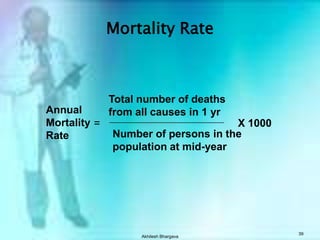
Akhilesh Bhargava39Mortality RateTotal number of deaths from all causes in 1 yrAnnual Mortality Rate=X 1000Number of persons in the population at mid-year
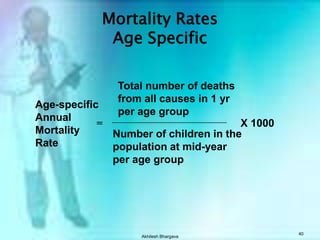
Akhilesh Bhargava40Mortality RatesAge SpecificTotal number of deaths from all causes in 1 yrper age groupAge-specificAnnual Mortality Rate=X 1000Number of children in the population at mid-year per age group
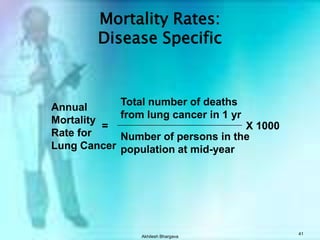
Akhilesh Bhargava41Mortality Rates:Disease SpecificTotal number of deaths from lung cancer in 1 yrAnnual Mortality Rate for Lung Cancer=X 1000Number of persons in the population at mid-year
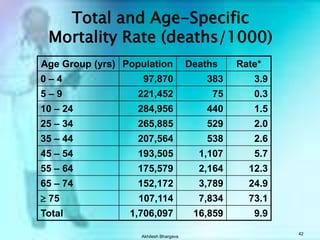
Akhilesh Bhargava42Total and Age-Specific Mortality Rate (deaths/1000)
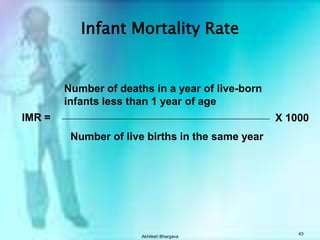
Akhilesh Bhargava43Infant Mortality RateNumber of deaths in a year of live-borninfants less than 1 year of ageIMR = Number of live births in the same yearX 1000
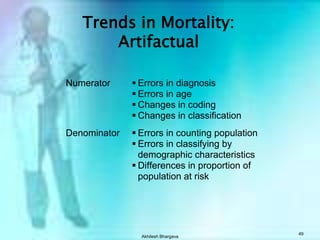
Akhilesh Bhargava44Source of Error in Mortality StatisticsFacts inaccurateDemographic- age, sex, race, ethnicityMarital status OccupationPlace of residence, not occurrence recordedCause of death - very inaccurate Immediate causeUnderlying conditionChanging taxonomy
Akhilesh Bhargava45Sources of InformationDeathsDeath certificateClinical recordsAutopsySurveillance programsVillage recordersPopulationCensusHospital admissionsFixed cohortsEstimates
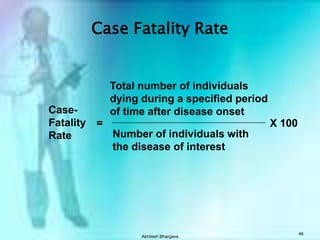
Akhilesh Bhargava46Case Fatality RateTotal number of individuals dying during a specified periodof time after disease onsetCase- Fatality Rate=X 100Number of individuals withthe disease of interest
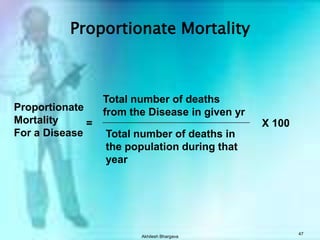
Akhilesh Bhargava47Proportionate MortalityTotal number of deaths from the Disease in given yrProportionate Mortality For a Disease=X 100Total number of deaths in the population during that year
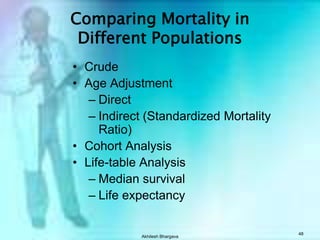
Akhilesh Bhargava48Comparing Mortality in Different PopulationsCrudeAge AdjustmentDirectIndirect (Standardized Mortality Ratio)Cohort AnalysisLife-table AnalysisMedian survivalLife expectancy
Akhilesh Bhargava49Trends in Mortality:Artifactual
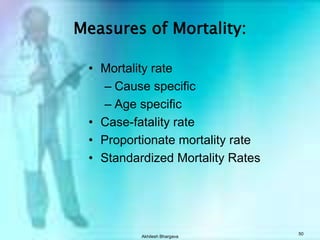
Akhilesh Bhargava50Measures of Mortality:Mortality rateCause specificAge specificCase-fatality rateProportionate mortality rateStandardized Mortality Rates
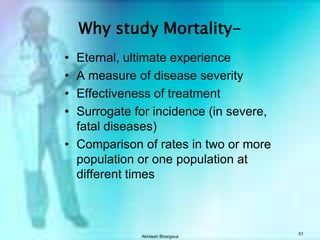
Akhilesh Bhargava51Why study Mortality-Eternal, ultimate experienceA measure of disease severityEffectiveness of treatmentSurrogate for incidence (in severe, fatal diseases)Comparison of rates in two or more population or one population at different times
Akhilesh Bhargava52Mortality Data- ProblemsChange in coding of ICD revisionsChanges in definitions of diseasesUnderlying cause of death excludes Information on immediate Cause & those in between two.Denominator may not be availableNumerator alone does not give rates and calls for standardization

Measures of Mortality

  • 1.
    Measures of Morbidityand MortalityAkhilesh BhargavaMD, DHA, PGDHRMProfessor-Community Medicine& Director-SIHFW, Jaipur
  • 2.
    Akhilesh Bhargava2The fundamentaltask in epidemiologic research is to quantify the occurrence of illnessThe goal is to evaluate causation of illness by relating disease occurrence to characteristics of people and their environmentRates, Ratios, and Standardized Rates are primary tools for quantifying occurrence of illness
  • 3.
    Akhilesh Bhargava3What isa rate?“a measure of speed with which events are occurring in a population in a specified time period.”EssentialsA numeratorA denominator that “appropriately” relates the numerator to population at riskA “unit” such as per 1000, per 100,000 or per million
  • 4.
    Akhilesh Bhargava4Why arate?To ensure comparing apples with apples
  • 5.
    Akhilesh Bhargava5Prevalence VS.IncidencePrevalence: A “snapshot” of disease at a point in time in a population Relevant for planning of health servicesIncidence: A description of how new cases of disease are occurring. “force of morbidity” “rate of flow” of cases from non disease to disease state Relevant for exploring causal theories
  • 6.
    Akhilesh Bhargava6Prevalence (P)and Incidence (I)P~I x dd=durationP= I x dIf the disease is stable, thatis, if the incidence and duration remains constant over time.
  • 7.
    Akhilesh Bhargava7Prevalence number of individuals with the disease P = ----------------------------------------------------- number of individuals at risk Prevalence can be expressed either as a proportion or as a rate Expressed as a proportion, prevalence is a number between 0 and 1 As a rate, prevalence can be expressed as per 1000, per 100,000, or per whatever
  • 8.
    Akhilesh Bhargava8Prevalence: ExampleAsample of 1,000 women 70-74 years. 70 werefound to have the diagnosis of rheumatoid arthritis.The prevalence of arthritis is: 70P= ------------- = 0.07 for women age 70-741,000Or P= 70 per thousand for women age 70-74OrP= 7 percent for women age 70-74Or……….
  • 9.
    Akhilesh Bhargava9Prevalence Choice of scale of rate usually depends on the ubiquity of the disease. Thus, more common disease prevalence may be presented as percentage Rare disease prevalence may be presented as per 100,000 or per million
  • 10.
    Akhilesh Bhargava10Incidence Rate:ExampleIn 1973 there were 29 cases of MI in Jaipur among men 40-44 years. The number of person years was 41,532.The incidence rate is: 29 I = --------- =0.0007 per year 41,532 = 0.7 per thousand per year = 7 per 10 thousand per year = 700 per million per yearTo be more accurate, we must add another qualifier, namely, “for men 40-44 years of age”
  • 11.
    Akhilesh Bhargava11Incidence Rate No. of new cases occurring during a period of timeI =---------------------------------------------------------------- “total person time” at riskWhat is “person time”: The duration of time a person is at risk Usually expressed as person years but can be expressed as anything, e.g., person months, person weeks, etc.
  • 12.
    Akhilesh Bhargava12“Total PersonTime” Sum of person time of all individuals at riskEquivalence of “total person time” 50,000 person years = 5,000 persons observed for 10 years = 1,000 persons observed for 50 years = 10,000 persons observed for 5 years
  • 13.
    Akhilesh Bhargava13N= 300Caseno.12R345R6July 30, 2008June30, 2009Date of recurrenceR =Date of Onset of diseaseDate of Termination or deathPoint prevalence on July 30, 2003= 4 cases( 1, 2, 3, 6)/ 300Incidence rate on July 30, 2003= 2 cases (4, 5) /296Period prevalence between July 30, 2003 to June 30, 2004= 6 /300
  • 14.
    Akhilesh Bhargava14Crude andSpecific Rates“Crude”: Rates calculated for the “entire” population“Specific”: Rates calculated for “specific” subpopulations.Ex: Age-specific rates Race-specific rates Gender-specific rates
  • 15.
    Akhilesh Bhargava15Comparing Appleswith ApplesIn comparing populations (groups) oneshould recognize that populations (groups) can differ in two important respects: Subpopulation-specific rates Distribution of subpopulations
  • 16.
    Akhilesh Bhargava16Comparison ofDeath rates in two population by ageNo difference in two population in risk of death
  • 17.
    Population Ahas higher crude death rate for large aged pop.
  • 18.
    CDR may notalways reflect risk of death in a comparative studyAkhilesh Bhargava17Standardization? Standardized rate = “weighted” average of category-specific rates Standardized rates can also be called Adjusted rates. For example, age adjusted, gender adjusted, race adjusted, etc.
  • 19.
    Akhilesh Bhargava18Adjusted Ratesare Created Through StandardizationStandardization: The process by which you derive a summary figure to compare health outcomes of groupsThe process can be used for mortality, natality, or morbidity data.
  • 20.
    Akhilesh Bhargava19Direct Adjustment Rates of populations to be compared applied to the standard population The question: What would be the number of events (deaths, births, etc.) in the standard population if events were happening at the category-specific rates in each population?
  • 21.
    Akhilesh Bhargava20 Example: Age-Adjustment Direct Method requires -Age-specific rates in the sample populationThe age of each caseThe population-at-risk for each age group in the sampleAge structure (percentage of cases in each age group) of a standard populationSummary figure is an Age-adjusted rate
  • 22.
    Akhilesh Bhargava21Calculation ofexpected no of deaths by direct method: Same age specific ratesWhile crude deaths were different, adjusted deaths are same for two pop.
  • 23.
    Risk of deathis identical in Pop. A & B
  • 24.
    Age adjustment hasremoved distortion in risk of death from crude death rateAkhilesh Bhargava22Calculation of expected no of deaths by direct method: different age specific ratesAdjusted rate for Pop. A= 74/ 10000 X 1000= 7.4Adjusted rate for Pop. B= 92/ 10000 X 1000= 9.2Different risk of death in two pop. Are preserved by age adjustment
  • 25.
  • 26.
    Akhilesh Bhargava24Direct AgeAdjustment:Comparison of Age specific death rates
  • 27.
    Akhilesh Bhargava25Direct AgeAdjustment:Age adjustment using total of two pop. As standard22381830Age adjusted Rate= ---------- = 24.3 --------- =101.71800000 1800000
  • 28.
    Akhilesh Bhargava26Indirect Adjustment Rates of standard population applied to populations to be compared. The question: What would be the number of events (deaths, births, etc.) if the particular population was having events at the same category specific rates as the standard population?
  • 29.
    Akhilesh Bhargava27Indirect methodrequires Age structure (percentage of cases in each age group) of the sample populationTotal deaths in the sample populationAge-specific rates for the standard populationSummary figure is aStandardized Mortality ratio
  • 30.
    Akhilesh Bhargava28Indirect StandardizationInsteadof a standard population structure, you utilize a standard rate to adjust your sampleIndirect standardization does not require that you know the stratum-specific rates of your casesThe summary measure is the SMR or standardized mortality/morbidity ratioObservedSMR = ----------------- X 100 ExpectedAn SMR of 100 means no difference between the number of outcomes in the sample population and that which would be expected in the standard populationAkhilesh Bhargava29Indirect Standardization (cont.)Total expected deaths per year: 2,083 Total observed deaths per year: 1,464 SMR = 1,464 / 2,083 x 100= 70.3%
  • 31.
  • 32.
    Akhilesh Bhargava31Indirect Standardization(cont.) Some individuals contribute different amounts of risk due to length of exposure
  • 33.
  • 34.
    Akhilesh Bhargava33Indicators ofPublic HealthMortality statisticsAge specific mortality ratesDisease specific mortality ratesCase-fatality Life ExpectancyMaternal mortality ratesInfant mortality rates Morbidity statisticsFertility ratesVaccination coverageHealth care utilization Health status indicators
  • 35.
    Akhilesh Bhargava34Vital StatisticsSystemsfor collecting vital statisticsCivil registration systemAdvocated by the United NationsPresent in industrialized countriesCostly to develop and maintainAlternative methodsProbability area samplesPurposeful area samplesRecords-based surveys
  • 36.
    Akhilesh Bhargava35Vital StatisticsPriorityin Vital Statistics Collection – based on UN criteriaBirths and deathsMarriagesDivorcesFetal deathsAnnulmentsJudicial separationsadoptions
  • 37.
    Akhilesh Bhargava36Vital StatisticsLegaldocumentationAssessment DemographyHealth
  • 38.
    Akhilesh Bhargava37Vital StatisticsHistoryU.S. census every 10 years since 1790Mid-point census since 1976Census Latin – to estimate or assessEnumerating the number of people in a given populationAge, sex, race, household relationships, marital status, number of rooms in house, length of time in residence, rental or ownership, value of homeSampling strategies for difficult to reach populations
  • 39.
    Akhilesh Bhargava38Mortality DataComprehensiveMeasureof community healthTrack trends over time by regionProportionate mortalityInfant deathApplies to men and womenCohort analysisStandardization for comparison across populationsDemography
  • 40.
    Akhilesh Bhargava39Mortality RateTotalnumber of deaths from all causes in 1 yrAnnual Mortality Rate=X 1000Number of persons in the population at mid-year
  • 41.
    Akhilesh Bhargava40Mortality RatesAgeSpecificTotal number of deaths from all causes in 1 yrper age groupAge-specificAnnual Mortality Rate=X 1000Number of children in the population at mid-year per age group
  • 42.
    Akhilesh Bhargava41Mortality Rates:DiseaseSpecificTotal number of deaths from lung cancer in 1 yrAnnual Mortality Rate for Lung Cancer=X 1000Number of persons in the population at mid-year
  • 43.
    Akhilesh Bhargava42Total andAge-Specific Mortality Rate (deaths/1000)
  • 44.
    Akhilesh Bhargava43Infant MortalityRateNumber of deaths in a year of live-borninfants less than 1 year of ageIMR = Number of live births in the same yearX 1000
  • 45.
    Akhilesh Bhargava44Source ofError in Mortality StatisticsFacts inaccurateDemographic- age, sex, race, ethnicityMarital status OccupationPlace of residence, not occurrence recordedCause of death - very inaccurate Immediate causeUnderlying conditionChanging taxonomy
  • 46.
    Akhilesh Bhargava45Sources ofInformationDeathsDeath certificateClinical recordsAutopsySurveillance programsVillage recordersPopulationCensusHospital admissionsFixed cohortsEstimates
  • 47.
    Akhilesh Bhargava46Case FatalityRateTotal number of individuals dying during a specified periodof time after disease onsetCase- Fatality Rate=X 100Number of individuals withthe disease of interest
  • 48.
    Akhilesh Bhargava47Proportionate MortalityTotalnumber of deaths from the Disease in given yrProportionate Mortality For a Disease=X 100Total number of deaths in the population during that year
  • 49.
    Akhilesh Bhargava48Comparing Mortalityin Different PopulationsCrudeAge AdjustmentDirectIndirect (Standardized Mortality Ratio)Cohort AnalysisLife-table AnalysisMedian survivalLife expectancy
  • 50.
    Akhilesh Bhargava49Trends inMortality:Artifactual
  • 51.
    Akhilesh Bhargava50Measures ofMortality:Mortality rateCause specificAge specificCase-fatality rateProportionate mortality rateStandardized Mortality Rates
  • 52.
    Akhilesh Bhargava51Why studyMortality-Eternal, ultimate experienceA measure of disease severityEffectiveness of treatmentSurrogate for incidence (in severe, fatal diseases)Comparison of rates in two or more population or one population at different times
  • 53.
    Akhilesh Bhargava52Mortality Data-ProblemsChange in coding of ICD revisionsChanges in definitions of diseasesUnderlying cause of death excludes Information on immediate Cause & those in between two.Denominator may not be availableNumerator alone does not give rates and calls for standardization
  • 54.