Interpersonal Communication & BCC


 State Institute of Health & Family Welfare, Jaipur
Listen to Learn


Learn to Listen


SIHFW: an ISO 9001: 2008 certified Institution   2
IEC

IEC –A one-way process
ØFocused on “messages”
ØImplicit assumption that awareness creation
 will automatically lead to behavior change
ØEmphasis on creating messages,
 entertainment and media


         SIHFW: an ISO 9001: 2008 certified Institution   3
BCC
BCC (Behaviour Change Communication)
ØOutcome oriented
ØResearch-based
ØConsultative process of addressing
 knowledge, attitudes, and practices through
     ØIdentifying
     ØAnalyzing
     ØSegmenting audiences and
      participants
     ØRelevant information and motivation
         SIHFW: an ISO 9001: 2008 certified Institution   4
ØUsing an appropriate mix of
 interpersonal, group and mass media
 channels

ØParticipatory methods


     SIHFW: an ISO 9001: 2008 certified Institution   5
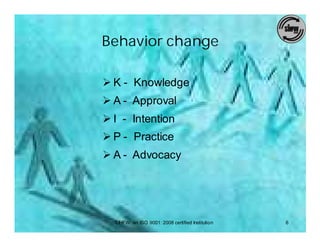
Behavior change

Ø K - Knowledge
Ø A - Approval
Ø I - Intention
Ø P - Practice
Ø A - Advocacy


  SIHFW: an ISO 9001: 2008 certified Institution   6
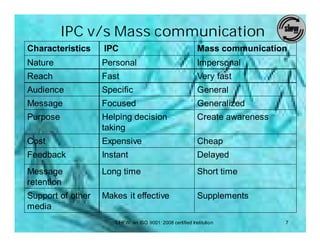
IPC v/s Mass communication
Characteristics    IPC                                      Mass communication
Nature             Personal                                 Impersonal
Reach              Fast                                     Very fast
Audience           Specific                                 General
Message            Focused                                  Generalized
Purpose            Helping decision                         Create awareness
                   taking
Cost               Expensive                                Cheap
Feedback           Instant                                  Delayed
Message            Long time                                Short time
retention
Support of other   Makes it effective                       Supplements
media
                      SIHFW: an ISO 9001: 2008 certified Institution           7
Classification of Communication
             Methods
Ø Inter-personal communication
      ØFriends / Neighbors/ Influential
      ØMahila mandals/Voluntary organizations
      ØHealth functionaries
Ø Use of traditional media
      ØPuppetry
      ØStreet plays/Dramas
      Ø Dances
      Ø Drum Beating
      ØTamashas/Story Telling
           SIHFW: an ISO 9001: 2008 certified Institution   8
Ø Group communication
     ØMeetings/Group Discussion/Lectures
     ØSeminars/Workshop/Panel Discussion
     ØMelas/Festivals/Exhibitions
     ØCampaigns
Ø Mass communication
     ØRadio
     ØTelevision
     ØPrinted Materials


         SIHFW: an ISO 9001: 2008 certified Institution   9
Process of communication

    Source
     ØKnowledgeable
     ØRespectable
     ØCredible
     ØTrustworthy
     ØFulfilling the promises


      SIHFW: an ISO 9001: 2008 certified Institution   10
Process of Communication

 Target audience
    ØHomogenous Group
    ØSegmentation of Audience
    ØIntended and Un-intended Audience
    ØSociological/Psychological/Cultural
     Value system
    ØKnowledge
    ØExposure to Media
    ØWillingness to change
    ØSocial Participation
       SIHFW: an ISO 9001: 2008 certified Institution   11
Attributes of message: 7C’s
   ØCommand Attention
   Ø Cater to the Heart and Head
   Ø Clarify the Message
   Ø Communicate a Benefit
   Ø Create Trust
   Ø Convey a Consistent Message
   Ø Call for Action


      SIHFW: an ISO 9001: 2008 certified Institution   12
IPC Skills
Listening
ØKeep your mind open
ØBe flexible
ØFind area of interest
ØListen to ideas
ØJudge content, not delivery
ØResist distractions
ØHold your fire
ØWork at listening
ØCapitalize on thought speed
      SIHFW: an ISO 9001: 2008 certified Institution   13
Speaking
ØFace the audience
ØMaintain eye contact
ØUse appropriate aids, if you can
ØUse appropriate language
ØFocus on the needs of the audience
ØBe brief, to the point, without ambiguity


        SIHFW: an ISO 9001: 2008 certified Institution   14
Interviewing/questioning
 ØUnderstand the audience profile
 ØPut questions in such a way the audience
  understand and reply favorably
 ØStart questions from simpler to complex
 ØThe way you ask questions is important
 ØDo not put questions in such a way which
  may embarrass you


       SIHFW: an ISO 9001: 2008 certified Institution   15
Initiating IPC
ØIntroduce yourself
ØExplain the purpose of visit
ØEstablish mutual understanding
ØAllow the audience to speak more and
 facilitate
ØWin the confidence of the audience
ØUnderstand his/her problems
ØAnalyze whether your interest and his/her
 problems are the same or different
ØDo not make false promises/pose yourself
         SIHFW: an ISO 9001: 2008 certified Institution   16
Sustaining IPC

ØCreate conducive atmosphere
ØBe knowledgeable about the subject
ØEnsure confidentiality of issues shared
ØClarify the queries raised
ØGive complete information
ØCheck whether the receiver has understood
 as explained


          SIHFW: an ISO 9001: 2008 certified Institution   17
Terminating IPC

ØLeave good impression of yourself
ØHave issues for next meeting
ØIdentify contact people/influencers
ØDevelop sense of belongingness
ØGive an opportunity for the audiences to
 come with their real problems


       SIHFW: an ISO 9001: 2008 certified Institution   18
Barriers to Behaviour Change
 Socio-Cultural Barriers
 Ø Gender discrimination; son preference
 Ø Norm of early child bearing/early
   marriage
 Ø Colostrums feeding & other new born
   care practices
 Ø Dietary pattern of eating two meals a
   day, women eat last

          SIHFW: an ISO 9001: 2008 certified Institution   19
Health Services
Ø Lack of regular outreach services at the
  village level
Ø Health provider attitude and low
  motivation levels
Ø Lack of trust in public sector services


        SIHFW: an ISO 9001: 2008 certified Institution   20
Socio-Economic and Infrastructure
Ø Transport constraints
Ø Households with food insecurity

BCC
Ø Too much focus on awareness creation
Ø Limited reach of mass media in rural areas
Ø Weak systems for BCC supervision
Ø Community based BCC (IPC, group
  meetings, community events) is limited
Ø Uncoordinated mass media campaigns

          SIHFW: an ISO 9001: 2008 certified Institution   21
Priority Areas for a BCC Strategy

   Ø Antenatal Care
   Ø Institutional Deliveries
   Ø Post Natal & New Born Care
   Ø Married Adolescents
   Ø Gender discrimination (female feticide,
     infant girl, under 5 girl, son preference
   Ø Unmet need for family planning
   Ø Nutrition through the life cycle (infant,
     under three, adolescent, woman)
            SIHFW: an ISO 9001: 2008 certified Institution   22
Ø Routine immunization
Ø Hygiene and safe water practices
Ø Marginalized groups and households
  including urban poor
Ø Need for supportive supervision of ASHAs
Ø Capacity building of BCC skills for service
  providers across NRHM
Ø Workload definition and structuring of
  workload for the ASHAs


           SIHFW: an ISO 9001: 2008 certified Institution   23
Messages to be addressed

Ø Age at marriage > 18 yrs
Ø Delay first pregnancy till 21 years
Ø Eat three times a day (women and
  adolescent girls)
Ø Eat 3-4 times a day (pregnant women)
Ø Early registration <12 weeks


         SIHFW: an ISO 9001: 2008 certified Institution   24
Ø 3 ANC check ups
Ø Institutional Delivery
Ø Stay in the hospital for 24 hrs after delivery
Ø Immediate health seeking behaviour
Ø Immediate and exclusive breast feeding
  within one hour of birth


           SIHFW: an ISO 9001: 2008 certified Institution   25
Ø Continue exclusive breast feeding up to six
  months
Ø Keep the newborn warm with skin to skin care
Ø Complete Immunization/ Booster / Vitamin A
Ø Complementary feeding from six months 4-5
  times a day in addition to breast feeding
Ø Wash hands with soap after defecation and prior
  to feeding child


             SIHFW: an ISO 9001: 2008 certified Institution   26
Ø Increase birth interval to three years
Ø Adopt any limiting method after two children
  even if both are girls
Ø Early detection of TB
Ø Empty and dry water containers once a
  week


          SIHFW: an ISO 9001: 2008 certified Institution   27
BCC Activities in Rajasthan
Ø MCHN Day
Ø Home visits by ASHA.
Ø Group meetings by ASHA and ANM
Ø Swasthya Camps at the block level with
  video vans (Pilot basis)
Ø Child to community BCC for hygiene
  behavior, routine immunization and
  prevention of mosquito breeding sites
Ø Folk performances and Nukkad Nataks

         SIHFW: an ISO 9001: 2008 certified Institution   28
Thank You

For more details log on to
www. sihfwrajasthan.com
             or
 contact : Director-SIHFW
            on

  sihfwraj@yahoo.co.in

Interpersonal Communication & BCC

  • 1.
    Interpersonal Communication &BCC State Institute of Health & Family Welfare, Jaipur
  • 2.
    Listen to Learn Learnto Listen SIHFW: an ISO 9001: 2008 certified Institution 2
  • 3.
    IEC IEC –A one-wayprocess ØFocused on “messages” ØImplicit assumption that awareness creation will automatically lead to behavior change ØEmphasis on creating messages, entertainment and media SIHFW: an ISO 9001: 2008 certified Institution 3
  • 4.
    BCC BCC (Behaviour ChangeCommunication) ØOutcome oriented ØResearch-based ØConsultative process of addressing knowledge, attitudes, and practices through ØIdentifying ØAnalyzing ØSegmenting audiences and participants ØRelevant information and motivation SIHFW: an ISO 9001: 2008 certified Institution 4
  • 5.
    ØUsing an appropriatemix of interpersonal, group and mass media channels ØParticipatory methods SIHFW: an ISO 9001: 2008 certified Institution 5
  • 6.
    Behavior change Ø K- Knowledge Ø A - Approval Ø I - Intention Ø P - Practice Ø A - Advocacy SIHFW: an ISO 9001: 2008 certified Institution 6
  • 7.
    IPC v/s Masscommunication Characteristics IPC Mass communication Nature Personal Impersonal Reach Fast Very fast Audience Specific General Message Focused Generalized Purpose Helping decision Create awareness taking Cost Expensive Cheap Feedback Instant Delayed Message Long time Short time retention Support of other Makes it effective Supplements media SIHFW: an ISO 9001: 2008 certified Institution 7
  • 8.
    Classification of Communication Methods Ø Inter-personal communication ØFriends / Neighbors/ Influential ØMahila mandals/Voluntary organizations ØHealth functionaries Ø Use of traditional media ØPuppetry ØStreet plays/Dramas Ø Dances Ø Drum Beating ØTamashas/Story Telling SIHFW: an ISO 9001: 2008 certified Institution 8
  • 9.
    Ø Group communication ØMeetings/Group Discussion/Lectures ØSeminars/Workshop/Panel Discussion ØMelas/Festivals/Exhibitions ØCampaigns Ø Mass communication ØRadio ØTelevision ØPrinted Materials SIHFW: an ISO 9001: 2008 certified Institution 9
  • 10.
    Process of communication Source ØKnowledgeable ØRespectable ØCredible ØTrustworthy ØFulfilling the promises SIHFW: an ISO 9001: 2008 certified Institution 10
  • 11.
    Process of Communication Target audience ØHomogenous Group ØSegmentation of Audience ØIntended and Un-intended Audience ØSociological/Psychological/Cultural Value system ØKnowledge ØExposure to Media ØWillingness to change ØSocial Participation SIHFW: an ISO 9001: 2008 certified Institution 11
  • 12.
    Attributes of message:7C’s ØCommand Attention Ø Cater to the Heart and Head Ø Clarify the Message Ø Communicate a Benefit Ø Create Trust Ø Convey a Consistent Message Ø Call for Action SIHFW: an ISO 9001: 2008 certified Institution 12
  • 13.
    IPC Skills Listening ØKeep yourmind open ØBe flexible ØFind area of interest ØListen to ideas ØJudge content, not delivery ØResist distractions ØHold your fire ØWork at listening ØCapitalize on thought speed SIHFW: an ISO 9001: 2008 certified Institution 13
  • 14.
    Speaking ØFace the audience ØMaintaineye contact ØUse appropriate aids, if you can ØUse appropriate language ØFocus on the needs of the audience ØBe brief, to the point, without ambiguity SIHFW: an ISO 9001: 2008 certified Institution 14
  • 15.
    Interviewing/questioning ØUnderstand theaudience profile ØPut questions in such a way the audience understand and reply favorably ØStart questions from simpler to complex ØThe way you ask questions is important ØDo not put questions in such a way which may embarrass you SIHFW: an ISO 9001: 2008 certified Institution 15
  • 16.
    Initiating IPC ØIntroduce yourself ØExplainthe purpose of visit ØEstablish mutual understanding ØAllow the audience to speak more and facilitate ØWin the confidence of the audience ØUnderstand his/her problems ØAnalyze whether your interest and his/her problems are the same or different ØDo not make false promises/pose yourself SIHFW: an ISO 9001: 2008 certified Institution 16
  • 17.
    Sustaining IPC ØCreate conduciveatmosphere ØBe knowledgeable about the subject ØEnsure confidentiality of issues shared ØClarify the queries raised ØGive complete information ØCheck whether the receiver has understood as explained SIHFW: an ISO 9001: 2008 certified Institution 17
  • 18.
    Terminating IPC ØLeave goodimpression of yourself ØHave issues for next meeting ØIdentify contact people/influencers ØDevelop sense of belongingness ØGive an opportunity for the audiences to come with their real problems SIHFW: an ISO 9001: 2008 certified Institution 18
  • 19.
    Barriers to BehaviourChange Socio-Cultural Barriers Ø Gender discrimination; son preference Ø Norm of early child bearing/early marriage Ø Colostrums feeding & other new born care practices Ø Dietary pattern of eating two meals a day, women eat last SIHFW: an ISO 9001: 2008 certified Institution 19
  • 20.
    Health Services Ø Lackof regular outreach services at the village level Ø Health provider attitude and low motivation levels Ø Lack of trust in public sector services SIHFW: an ISO 9001: 2008 certified Institution 20
  • 21.
    Socio-Economic and Infrastructure ØTransport constraints Ø Households with food insecurity BCC Ø Too much focus on awareness creation Ø Limited reach of mass media in rural areas Ø Weak systems for BCC supervision Ø Community based BCC (IPC, group meetings, community events) is limited Ø Uncoordinated mass media campaigns SIHFW: an ISO 9001: 2008 certified Institution 21
  • 22.
    Priority Areas fora BCC Strategy Ø Antenatal Care Ø Institutional Deliveries Ø Post Natal & New Born Care Ø Married Adolescents Ø Gender discrimination (female feticide, infant girl, under 5 girl, son preference Ø Unmet need for family planning Ø Nutrition through the life cycle (infant, under three, adolescent, woman) SIHFW: an ISO 9001: 2008 certified Institution 22
  • 23.
    Ø Routine immunization ØHygiene and safe water practices Ø Marginalized groups and households including urban poor Ø Need for supportive supervision of ASHAs Ø Capacity building of BCC skills for service providers across NRHM Ø Workload definition and structuring of workload for the ASHAs SIHFW: an ISO 9001: 2008 certified Institution 23
  • 24.
    Messages to beaddressed Ø Age at marriage > 18 yrs Ø Delay first pregnancy till 21 years Ø Eat three times a day (women and adolescent girls) Ø Eat 3-4 times a day (pregnant women) Ø Early registration <12 weeks SIHFW: an ISO 9001: 2008 certified Institution 24
  • 25.
    Ø 3 ANCcheck ups Ø Institutional Delivery Ø Stay in the hospital for 24 hrs after delivery Ø Immediate health seeking behaviour Ø Immediate and exclusive breast feeding within one hour of birth SIHFW: an ISO 9001: 2008 certified Institution 25
  • 26.
    Ø Continue exclusivebreast feeding up to six months Ø Keep the newborn warm with skin to skin care Ø Complete Immunization/ Booster / Vitamin A Ø Complementary feeding from six months 4-5 times a day in addition to breast feeding Ø Wash hands with soap after defecation and prior to feeding child SIHFW: an ISO 9001: 2008 certified Institution 26
  • 27.
    Ø Increase birthinterval to three years Ø Adopt any limiting method after two children even if both are girls Ø Early detection of TB Ø Empty and dry water containers once a week SIHFW: an ISO 9001: 2008 certified Institution 27
  • 28.
    BCC Activities inRajasthan Ø MCHN Day Ø Home visits by ASHA. Ø Group meetings by ASHA and ANM Ø Swasthya Camps at the block level with video vans (Pilot basis) Ø Child to community BCC for hygiene behavior, routine immunization and prevention of mosquito breeding sites Ø Folk performances and Nukkad Nataks SIHFW: an ISO 9001: 2008 certified Institution 28
  • 29.
    Thank You For moredetails log on to www. sihfwrajasthan.com or contact : Director-SIHFW on sihfwraj@yahoo.co.in