PRESENTRD BY
TULESHWAR PRATAP SINGH JAISWAL
B.SC.NURSING 4TH YEAR
 The National Urban Health Mission is
launched by ministry of health and family
welfare department of India in 1 may 2013.it is
seeks to improve the health status of the urban
population particularly slum dwellers and
other vulnerable system by facilitating their
access to quality health care and NUHM
would cover all state capitals,district
headquartes .
 Urban poor populaion living in listed and
unlisted slums.
 All vulnerable population such as homeless
ragpickers,street chilldren,rickshah
pullers,construction and bricks worker,sex
worker and other temporary migrants.
 Public health trust on sanitation,clean drinking
water and vectors control etc.
 Strengthening public health capicity are local
bodies
 Partnership with community and local bodies
for a more proactive involvement in planning,
implementation, and monitoring of health
activities.
 Availability of resources for providing
essential primary health care to urban poor.
 Partnerships with NGOs, for profit and not for
profit health service providers and other
stakeholders.
 Need based city specific urban health
care system to meet the diverse health
care needs of the urban poor and other
vulnerable sections.
 Institutional mechanism and management
systems to meet the health-related
challenges of a rapidly growing urban
population.
CONTINUE,,,,,,
♦ Strengthening existing primary public health
systems
♦ Public private partnership
♦ Capacity building of key stakeholders
♦ Special provision to include the most
vulnerable
♦ Monitoring of quality of services
♦ Community participation in planning and
management
♦Identification of target group,
NEED
 METERNAL HEALTH
 FAMILY WELFARE
 CHILD HEALTH AND NUTRITION
 RESPIRATORY TRACT INFECTION
 NUTRITIONAL HEALTH
 VECTOR-BORNE DISEASE
CONTROL
 MENTAL HEALTH
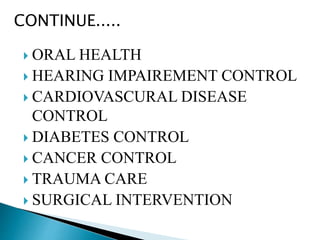
 ORAL HEALTH
 HEARING IMPAIREMENT CONTROL
 CARDIOVASCURAL DISEASE
CONTROL
 DIABETES CONTROL
 CANCER CONTROL
 TRAUMA CARE
 SURGICAL INTERVENTION
CONTINUE.....
REFERRAL LINKAGES
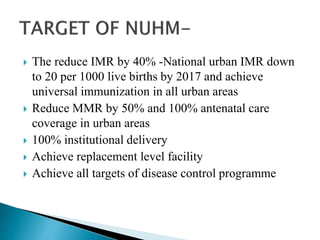
 The reduce IMR by 40% -National urban IMR down
to 20 per 1000 live births by 2017 and achieve
universal immunization in all urban areas
 Reduce MMR by 50% and 100% antenatal care
coverage in urban areas
 100% institutional delivery
 Achieve replacement level facility
 Achieve all targets of disease control programme
 1.3 Need for Mahila Arogya Samiti (MAS) MAS in one of the key interventions under National
Health Mission aimed at promoting community participation in health at all levels, including
planning, implementing and monitoring of health programmes. MAS is expected to take
collective action on issues related to Health, Nutrition, Water, Sanitation and social
determinants at the slum level. It is envisaged as being central to ‘local collective action’, which
would gradually develop to the process of decentralized health planning. About Mahila Arogya
Samiti (MAS) 1.4 Objectives of MAS The major objectives of MAS are to: a. Provide a platform
for convergent action on social determinants and all public services directly or indirectly
related to health. b. Provide a mechanism for the community to voice health needs,
experiences and issues with access to health services. Mahila Arogya Samiti (MAS): ™Local
women’s collective with an elected Chairperson and a Secretary ™Covers approximately 50-100
households in slum and slum like settlements ™Addresses local issues related to Health,
Nutrition, Water, Sanitation and social determinants of health at slum level ™Facilitated by the
ASHA who acts as the Member Secretary 2 Induction module for Mahila Arogya Samiti (MAS)
Chapter 1: Community Participation and Need for Mahila Arogya Samiti (MAS) 3 c. Generate
community level awareness on locally relevant health issues and to promote the acceptance of
best practices in health by the community. d. Focus on preventive and promotive health care
activities and management of untied fund. e. Support and facilitate the work of community
service providers like ASHA and other frontline workers who form a crucial interface between
the community and health institutions. f. Provide an institutional mechanism for the
community to be informed of various health programmes and other government initiatives and
to participate in the planning and implementation of these programmes, leading to better
health outcomes. g. Organize or facilitate community level services and referral linkages for
health services

Nuhm

  • 1.
    PRESENTRD BY TULESHWAR PRATAPSINGH JAISWAL B.SC.NURSING 4TH YEAR
  • 2.
     The NationalUrban Health Mission is launched by ministry of health and family welfare department of India in 1 may 2013.it is seeks to improve the health status of the urban population particularly slum dwellers and other vulnerable system by facilitating their access to quality health care and NUHM would cover all state capitals,district headquartes .
  • 3.
     Urban poorpopulaion living in listed and unlisted slums.  All vulnerable population such as homeless ragpickers,street chilldren,rickshah pullers,construction and bricks worker,sex worker and other temporary migrants.  Public health trust on sanitation,clean drinking water and vectors control etc.  Strengthening public health capicity are local bodies
  • 4.
     Partnership withcommunity and local bodies for a more proactive involvement in planning, implementation, and monitoring of health activities.  Availability of resources for providing essential primary health care to urban poor.  Partnerships with NGOs, for profit and not for profit health service providers and other stakeholders.
  • 5.
     Need basedcity specific urban health care system to meet the diverse health care needs of the urban poor and other vulnerable sections.  Institutional mechanism and management systems to meet the health-related challenges of a rapidly growing urban population. CONTINUE,,,,,,
  • 6.
    ♦ Strengthening existingprimary public health systems ♦ Public private partnership ♦ Capacity building of key stakeholders ♦ Special provision to include the most vulnerable ♦ Monitoring of quality of services ♦ Community participation in planning and management ♦Identification of target group,
  • 7.
  • 8.
     METERNAL HEALTH FAMILY WELFARE  CHILD HEALTH AND NUTRITION  RESPIRATORY TRACT INFECTION  NUTRITIONAL HEALTH  VECTOR-BORNE DISEASE CONTROL  MENTAL HEALTH
  • 9.
     ORAL HEALTH HEARING IMPAIREMENT CONTROL  CARDIOVASCURAL DISEASE CONTROL  DIABETES CONTROL  CANCER CONTROL  TRAUMA CARE  SURGICAL INTERVENTION CONTINUE.....
  • 10.
  • 12.
     The reduceIMR by 40% -National urban IMR down to 20 per 1000 live births by 2017 and achieve universal immunization in all urban areas  Reduce MMR by 50% and 100% antenatal care coverage in urban areas  100% institutional delivery  Achieve replacement level facility  Achieve all targets of disease control programme
  • 14.
     1.3 Needfor Mahila Arogya Samiti (MAS) MAS in one of the key interventions under National Health Mission aimed at promoting community participation in health at all levels, including planning, implementing and monitoring of health programmes. MAS is expected to take collective action on issues related to Health, Nutrition, Water, Sanitation and social determinants at the slum level. It is envisaged as being central to ‘local collective action’, which would gradually develop to the process of decentralized health planning. About Mahila Arogya Samiti (MAS) 1.4 Objectives of MAS The major objectives of MAS are to: a. Provide a platform for convergent action on social determinants and all public services directly or indirectly related to health. b. Provide a mechanism for the community to voice health needs, experiences and issues with access to health services. Mahila Arogya Samiti (MAS): ™Local women’s collective with an elected Chairperson and a Secretary ™Covers approximately 50-100 households in slum and slum like settlements ™Addresses local issues related to Health, Nutrition, Water, Sanitation and social determinants of health at slum level ™Facilitated by the ASHA who acts as the Member Secretary 2 Induction module for Mahila Arogya Samiti (MAS) Chapter 1: Community Participation and Need for Mahila Arogya Samiti (MAS) 3 c. Generate community level awareness on locally relevant health issues and to promote the acceptance of best practices in health by the community. d. Focus on preventive and promotive health care activities and management of untied fund. e. Support and facilitate the work of community service providers like ASHA and other frontline workers who form a crucial interface between the community and health institutions. f. Provide an institutional mechanism for the community to be informed of various health programmes and other government initiatives and to participate in the planning and implementation of these programmes, leading to better health outcomes. g. Organize or facilitate community level services and referral linkages for health services