National 
Tuberculosis 
Control 
Programme
Objectives:- 
The objectives of NTCP are as follows: 
1) To deal with the problem of tuberculosis 
through integrated health services. 
2) To give priority to the reduction of pool of 
infection, to case detection, treatment of cases 
and drug distribution. 
3) To give BCG vaccination to susceptible.
In 1992 Govt. of India along with WHO & SIDA 
received the TB situation in the country & came up 
with following conclusions: 
NTP though technically sound, suffered from 
managerial weakness. 
Inadequate funding. 
Over reliance on X-ray for diagnosis. 
Frequent interrupted supply of drugs. 
Low rate of treatment completion.
Objectives: 
The objectives of RNTCP are: 
Achievement of at least 85% cure rate of 
infectious cases of tuberculosis; though 
DOTS involving peripheral health 
functionaries. 
Augmentation of case finding activities 
through quality sputum microscopy to 
detect at least 70% of estimated cases.
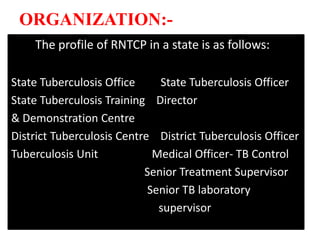
ORGANIZATION:- 
The profile of RNTCP in a state is as follows: 
State Tuberculosis Office State Tuberculosis Officer 
State Tuberculosis Training Director 
& Demonstration Centre 
District Tuberculosis Centre District Tuberculosis Officer 
Tuberculosis Unit Medical Officer- TB Control 
Senior Treatment Supervisor 
Senior TB laboratory 
supervisor
By the end of 1998, only 2% of total population 
of India was covered by RNTCP. Large scale 
implementation began in late 1998. The 
RNTCP has rapidly over the years and since 
March 2006, it covers the whole country. 
DOTS strategy adopted by Revised National TB 
Control Programme.
DOT THERAPY 
 Direct Observed Treatment is WHO recommended 
strategy emphasizes for global T.B. control. 
This strategy emphasizes adequate and efficient 
diagnosis and treatment. 
It means short course chemotherapy given under 
direct observation to at least all identified smear 
positive T.B. cases. 
Globally the DOT strategy has been recognized as 
the best approach to achieve a decrease in the 
disease burden and a reduction in the spread of 
infection.
BENEFITS:- 
Dots more than doubles the accuracy of TB 
diagnosis. 
Dots results in success rates upto 95%. 
Dots prevent the spread of tuberculosis bacilli, 
thus reducing the incidence and prevalence of 
TB. 
Dots helps in alleviating poverty by saving lives, 
reducing the duration of illness and presenting 
new infectious case.
Contd… 
Dots improve the quality of care and 
overcomes stigma. 
Dots prevents treatment failure and the 
emergence of MDR-TB by ensuring patient 
adherence and an un interrupted supply of 
Anti-TB drug. 
Dots lends credence to TB control efforts. 
Dots provides a model for strengthening 
health services.
Treatment under DOTS:- 
The WHO recommended treatment regimen for 
DOTS short course chemotherapy. It is divided into 
two phases the intensive and continuation phase. 
 In intensive phase(2-3 months), each dose 
given thrice a week is administered under direct 
observation. 
 In the continuation phase(4-5 months), at 
least one of thrice a week doses is administered 
under direct observation. 
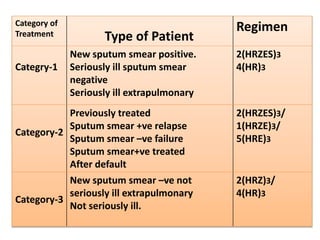
The actual treatment regimen and duration 
depend on the category of treatment of patient.
Category of 
Treatment Type of Patient 
Regimen 
Categry-1 
New sputum smear positive. 
Seriously ill sputum smear 
negative 
Seriously ill extrapulmonary 
2(HRZES)3 
4(HR)3 
Category-2 
Previously treated 
Sputum smear +ve relapse 
Sputum smear –ve failure 
Sputum smear+ve treated 
After default 
2(HRZES)3/ 
1(HRZE)3/ 
5(HRE)3 
Category-3 
New sputum smear –ve not 
seriously ill extrapulmonary 
Not seriously ill. 
2(HRZ)3/ 
4(HR)3
ROLE OF NURSE IN CARE OF T.B. PATIENT 
Tuberculosis is a social problem. A T.B. 
patient and family are very sensitive and 
do not wish their neighbours to know 
about the presence of T.B. in the family. 
T.B. is a chronic long lasting disease, 
hence most of the cases are treated at 
home. A nurse must keep in mind the 
principles of home visiting and priortising 
the case selection and care of the patient 
at home.
• Motivate the patient to take regular treatment, 
when the patient defaults in taking drugs, a visit 
must be paid and repeated till the patient becomes 
regular 
• In case of newly diagnosed patients, visit 
the home for initial motivation, instituting 
procedures designed to care for the patient and to 
prevent the spread of infection. 
• Frequent visit to the patients to ensure 
the proper disposal of sputum and precautions 
regarding protection of other members.
Contact Examination:- 
• All household contact must be advised for 
screening for exposure by the X-ray chest, sputum 
test and Mantaux test. 
• If the members do not show any infection, 
they can be given BCG and those who show early 
sign of infection, may be treated by small dose of 
Isoniazid(INH) and thiacetazone etc.
BIBLIOGRAPHY:- 
1. Park.K, “Parks Text Book of preventive and social 
medicine”, 22nd edition,Banarsidas bganot 
Publishers,(M.p.) India, Pp-394-400 
2. Gulani K.K , “Community Health Nursing”, 2nd 
edition,Kumar Publishing Home,Delhi,Pp-673-683. 
3. Swarnkar Keshab , “Community Health Nursing, 2nd 
edtion, N.R. Publishers, Pp-612-615. 
4. www.tbcindia.com
National tuberculosis control programme

National tuberculosis control programme

  • 3.
  • 4.
    Objectives:- The objectivesof NTCP are as follows: 1) To deal with the problem of tuberculosis through integrated health services. 2) To give priority to the reduction of pool of infection, to case detection, treatment of cases and drug distribution. 3) To give BCG vaccination to susceptible.
  • 5.
    In 1992 Govt.of India along with WHO & SIDA received the TB situation in the country & came up with following conclusions: NTP though technically sound, suffered from managerial weakness. Inadequate funding. Over reliance on X-ray for diagnosis. Frequent interrupted supply of drugs. Low rate of treatment completion.
  • 7.
    Objectives: The objectivesof RNTCP are: Achievement of at least 85% cure rate of infectious cases of tuberculosis; though DOTS involving peripheral health functionaries. Augmentation of case finding activities through quality sputum microscopy to detect at least 70% of estimated cases.
  • 8.
    ORGANIZATION:- The profileof RNTCP in a state is as follows: State Tuberculosis Office State Tuberculosis Officer State Tuberculosis Training Director & Demonstration Centre District Tuberculosis Centre District Tuberculosis Officer Tuberculosis Unit Medical Officer- TB Control Senior Treatment Supervisor Senior TB laboratory supervisor
  • 9.
    By the endof 1998, only 2% of total population of India was covered by RNTCP. Large scale implementation began in late 1998. The RNTCP has rapidly over the years and since March 2006, it covers the whole country. DOTS strategy adopted by Revised National TB Control Programme.
  • 11.
    DOT THERAPY Direct Observed Treatment is WHO recommended strategy emphasizes for global T.B. control. This strategy emphasizes adequate and efficient diagnosis and treatment. It means short course chemotherapy given under direct observation to at least all identified smear positive T.B. cases. Globally the DOT strategy has been recognized as the best approach to achieve a decrease in the disease burden and a reduction in the spread of infection.
  • 12.
    BENEFITS:- Dots morethan doubles the accuracy of TB diagnosis. Dots results in success rates upto 95%. Dots prevent the spread of tuberculosis bacilli, thus reducing the incidence and prevalence of TB. Dots helps in alleviating poverty by saving lives, reducing the duration of illness and presenting new infectious case.
  • 13.
    Contd… Dots improvethe quality of care and overcomes stigma. Dots prevents treatment failure and the emergence of MDR-TB by ensuring patient adherence and an un interrupted supply of Anti-TB drug. Dots lends credence to TB control efforts. Dots provides a model for strengthening health services.
  • 15.
    Treatment under DOTS:- The WHO recommended treatment regimen for DOTS short course chemotherapy. It is divided into two phases the intensive and continuation phase.  In intensive phase(2-3 months), each dose given thrice a week is administered under direct observation.  In the continuation phase(4-5 months), at least one of thrice a week doses is administered under direct observation. The actual treatment regimen and duration depend on the category of treatment of patient.
  • 16.
    Category of TreatmentType of Patient Regimen Categry-1 New sputum smear positive. Seriously ill sputum smear negative Seriously ill extrapulmonary 2(HRZES)3 4(HR)3 Category-2 Previously treated Sputum smear +ve relapse Sputum smear –ve failure Sputum smear+ve treated After default 2(HRZES)3/ 1(HRZE)3/ 5(HRE)3 Category-3 New sputum smear –ve not seriously ill extrapulmonary Not seriously ill. 2(HRZ)3/ 4(HR)3
  • 18.
    ROLE OF NURSEIN CARE OF T.B. PATIENT Tuberculosis is a social problem. A T.B. patient and family are very sensitive and do not wish their neighbours to know about the presence of T.B. in the family. T.B. is a chronic long lasting disease, hence most of the cases are treated at home. A nurse must keep in mind the principles of home visiting and priortising the case selection and care of the patient at home.
  • 19.
    • Motivate thepatient to take regular treatment, when the patient defaults in taking drugs, a visit must be paid and repeated till the patient becomes regular • In case of newly diagnosed patients, visit the home for initial motivation, instituting procedures designed to care for the patient and to prevent the spread of infection. • Frequent visit to the patients to ensure the proper disposal of sputum and precautions regarding protection of other members.
  • 21.
    Contact Examination:- •All household contact must be advised for screening for exposure by the X-ray chest, sputum test and Mantaux test. • If the members do not show any infection, they can be given BCG and those who show early sign of infection, may be treated by small dose of Isoniazid(INH) and thiacetazone etc.
  • 25.
    BIBLIOGRAPHY:- 1. Park.K,“Parks Text Book of preventive and social medicine”, 22nd edition,Banarsidas bganot Publishers,(M.p.) India, Pp-394-400 2. Gulani K.K , “Community Health Nursing”, 2nd edition,Kumar Publishing Home,Delhi,Pp-673-683. 3. Swarnkar Keshab , “Community Health Nursing, 2nd edtion, N.R. Publishers, Pp-612-615. 4. www.tbcindia.com