



Epidemic preparedness
                  &
        Outbreak Investigation


State Institute of Health & Family Welfare, Jaipur
Ø Epidemic- Occurrence of diseases cases in
  community clearly in excess to the normal
  expectation(measured as endemic level)

Ø Outbreak-Used interchangeably with Epidemic
  but applies to-
      ØDiseases with sudden onset
      ØShort incubation period


               SIHFW: an ISO 9001: 2008 certified Institution   2
Why do outbreaks occur?
• Single lapse in infection control in hosp.
• Lapse in surveillance
• A hidden pocket of infection
• Smuggled animals
• Single volume of international air traffic
• Rapid mutation & Adaptation in microbial
  world
• Emergence of New risk groups
• Modes of transmission can change
• Drug resistance – effect on treatment and
  prophylaxis

            SIHFW: an ISO 9001: 2008 certified Institution   3
Outbreak management….involves…
   •   Anticipating,
   •   Preventing,
   •   Preparing for,
   •   Detecting,
   •   Responding and
   •   Controlling disease outbreaks with the
       whole purpose of preventing or
       minimizing health and economic impacts
       of possible outbreaks


              SIHFW: an ISO 9001: 2008 certified Institution   4
Why preparedness in advance?
• Emergencies caused by epidemics are
  frequent
• Epidemics require urgent action and
• Epidemics may often lead to panic if
  preparedness is not adequate
• Response can be delayed, with possibility of
  fast spread, and avoidable loss to human
  lives, and economy


             SIHFW: an ISO 9001: 2008 certified Institution   5
Why Investigate?


•   Control and prevention measures
•   Knowledge of an agent
•   Training
•   Public concerns


       SIHFW: an ISO 9001: 2008 certified Institution   6
Epidemiological approaches

      •     Experimental

      •     Observational

             –    descriptive

             –     analytical


          SIHFW: an ISO 9001: 2008 certified Institution   7
Tools for Quantifying The Epidemic
    1. Case definition
    2. Epidemic curve
       · point source (common source & vehicle)
       · propagated
    3. Attack Rate
    4. Incubation period
    5. Herd immunity


              SIHFW: an ISO 9001: 2008 certified Institution   8
Getting At The Source:

 1.   Mode of transmission
 2.   Portal of entry
 3.   Reservoir
 4.   Vector
 5.   Vehicle
 6.   Agent


      SIHFW: an ISO 9001: 2008 certified Institution   9
Before Starting: Ask
• What’s your criteria/ Purpose for
  investigating an apparent outbreak?
   – Number of people affected
   – Unusual or severe clinical symptoms
   – Implement control measures
   – Prevent future outbreaks
   – Level of public concern, Political
     pressures, Legal obligations
   – Conduct research, potential to
     increase medical knowledge
   – Provide training

            SIHFW: an ISO 9001: 2008 certified Institution   10
Steps in Investigation

•   Prepare for field work
•   Establish existence of outbreak
•   Verify diagnosis
•   Define and identify cases
•   Perform descriptive epidemiology


              SIHFW: an ISO 9001: 2008 certified Institution   11
Steps in Investigation

• Develop hypotheses
• Evaluate hypotheses
• Refine hypotheses and conduct additional
  studies
• Implement control measures
• Communicate findings


           SIHFW: an ISO 9001: 2008 certified Institution   12
Prepare for Field Work
• Investigation
         Scientific knowledge--have it or get it!
         Supplies, equipment
         Assemble your team
• Administration
         Review local directives or plans
• Consultation
         Know your role, especially if off-base
• Sample questionnaires
• Key community contacts
• Laboratory containers and collection
  techniques
                SIHFW: an ISO 9001: 2008 certified Institution   13
Identify Outbreak Team

• Epidemiologist
• Laboratory workers
• Environmental health
  specialists
• Local health department
• Other state agencies


      SIHFW: an ISO 9001: 2008 certified Institution   14
2. Establish the Existence of An
              Outbreak
• Determine if disease incidence is higher than
  background level
• How do you determine background level ? -
  surveillance
• Reasons for Observed >Expected
       Change in reporting procedures
       Change in case definition
       Increased awareness or interest
       Improved diagnostics
       New clinician
       Change in Population
       True increase                                            15
               SIHFW: an ISO 9001: 2008 certified Institution
3.Verify the Diagnosis


• Review Clinical Data
     • Signs and symptoms
     • Onset dates
     • Common exposures
     • Obtain lab results, if any


         SIHFW: an ISO 9001: 2008 certified Institution   16
4. Define and Identify Cases
•   Outbreak Case Definition:
     • Clinical information (signs and
        symptoms)
           » Person
           » Place
           » Time
•   Case Definition Sources
     • Routine reporting:
           » Use Standard case definitions
     • Unknown etiology:
           » Make up your own case definition
             (make sure everyone uses the
              same case definition)
             SIHFW: an ISO 9001: 2008 certified Institution   17
Establish Case Definition

• Criteria to decide whether person is part
  of outbreak
   – time, place, person
   – clinical criteria
• Can change during investigation
• Keep open at first, restrict later


          SIHFW: an ISO 9001: 2008 certified Institution   18
Case Classification:

• Confirmed: laboratory results
• Probable: clinical criteria without lab
  verification
• Suspect: some clinical criteria


              SIHFW: an ISO 9001: 2008 certified Institution   19
Identify and Count Cases:


    •   Develop a wide network
    •   Initiate active surveillance
    •   Case: meets case definition
    •   Control: exposed, not ill


        SIHFW: an ISO 9001: 2008 certified Institution   20
Identify Population At Risk:

 • Survey hospitals
 • Review surveillance data
 • Question known cases to identify
   others
 • Review guest lists, enrollment records,
   etc.


         SIHFW: an ISO 9001: 2008 certified Institution   21
Questionnaires:
• Used to collect complete, uniform histories
• Identifiers
• Demographics
• Clinical information
• Risk factors
• Administer as soon as possible
   – disseminate
   – interview personally
• Both cases and controls
• Recall bias important
• Can summarize on line listing
             SIHFW: an ISO 9001: 2008 certified Institution   22
Line Listings


                     • Spreadsheet format
                     • One row = one case
                     • Columns = variables


SIHFW: an ISO 9001: 2008 certified Institution   23
5.Perform Descriptive Epidemiology

   • Describe outbreak by
     – time
     – place
     – person
   • Become familiar with data
   • Get clues about infectious agent


              SIHFW: an ISO 9001: 2008 certified Institution   24
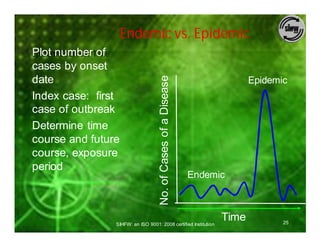
Endemic vs. Epidemic
Plot numberTime
Epidemic Curves: of
cases by onset
date


                                      No. of Cases of a Disease
                                                                               Epidemic
Index case: first
case of outbreak
Determine time
course and future
course, exposure
period
                                                                  Endemic


                  SIHFW: an ISO 9001: 2008 certified Institution
                                                                        Time          25
Point Source Transmission
                 12

                 10
  No. of cases


                 8

                 6

                 4                                                             Cases
                 2

                 0
                      1 2 3 4 5 6 7 8 9 10 11 12 13 14 15
                                           Time

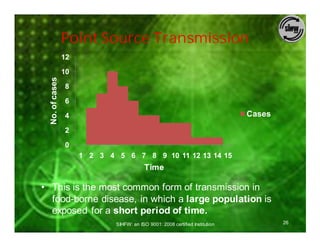
• This is the most common form of transmission in
  food-borne disease, in which a large population is
  exposed for a short period of time.
                              SIHFW: an ISO 9001: 2008 certified Institution           26
Point Source Outbreaks
• All exposed at one time
• Cases occur suddenly after minimum
  incubation time
• All cases occur within one incubation
  period
• Outbreak stops unless secondary spread
• Curves have steep upslope, more gradual
  down slope


           SIHFW: an ISO 9001: 2008 certified Institution   27
Continuous Common Source

• May begin suddenly or gradually
• Does not have an early peak (v/s Point
  source)
• Cases do not disappear because of
  secondary exposure
• Curves have gradual or steep
  upslope, plateau trickling down
  slope, and may repeat


           SIHFW: an ISO 9001: 2008 certified Institution   28
Continuing Common Source or
Intermittent Exposure
                 12
                 10
  No. of Cases


                 8
                 6
                 4
                 2
                 0
                      1 2 3 4 5 6 7 8 9 10 11 12 13 14 15 16 17 18 19 20
                                                  Time


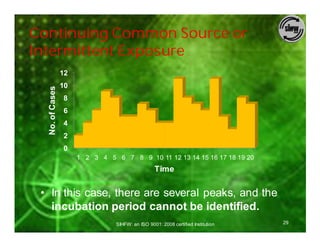
 • In this case, there are several peaks, and the
   incubation period cannot be identified.
                                 SIHFW: an ISO 9001: 2008 certified Institution   29
Propagated Outbreaks


• Typical of person-to-person outbreaks
• Secondary cases appear, at intervals
  corresponding to average incubation
  period after peak of first wave
• Taller successive waves of cases


          SIHFW: an ISO 9001: 2008 certified Institution   30
Spot Maps: Place


•   One spot = case
•   Community
•   Facilities
•   Recreational sites
•   Population density not reflected


      SIHFW: an ISO 9001: 2008 certified Institution   31
Person
• Host characteristics
  – age
  – sex
• Exposures
  – occupation
  – food consumption
  – leisure activities


    SIHFW: an ISO 9001: 2008 certified Institution   32
6. Developing Hypothesis


•   Requires familiarity with disease
•   Hypothesis should be testable
•   Still clueless?
•   Talk with cases again
•   Visit work sites or billeting area
•   Don’t forget outliers


          SIHFW: an ISO 9001: 2008 certified Institution   33
Develop Hypothesis
• Contact usual suspects!
• Type of agent
• Source of agent
• Mode of transmission
• Usual reservoirs
• Known risk factors
• Exposures that caused disease
• Look at person, place and time for
  clues
• Be able to test


          SIHFW: an ISO 9001: 2008 certified Institution   34
7. Evaluating Hypotheses:
  Analytic Epidemiology
• Quantify relationships between
  exposures and disease
• Test hypotheses about causes
• Comparison groups
   – cohort study
   – case-control study


        SIHFW: an ISO 9001: 2008 certified Institution   35
Evaluate Hypothesis
•   Determine exposure variables. Compare ill to not ill.
•   Construct a 2 X 2 table
•   Perform Cohort or Case Control Study
•   Use Cohort study when:
          Population at risk is known
            (you have a denominator)
          Interview “ill” and “not ill”
          Calculate attack rates - “ate” v/s “didn’t eat”
          Put on food-specific attack rate table


                    SIHFW: an ISO 9001: 2008 certified Institution   36
Cohort Studies

•   Defined population
•   Can contact all in timely manner
•   Calculate attack rate
•   Calculate risk ratio to determine risk of
    contracting illness from exposure (see
    table 6.4)


           SIHFW: an ISO 9001: 2008 certified Institution   37
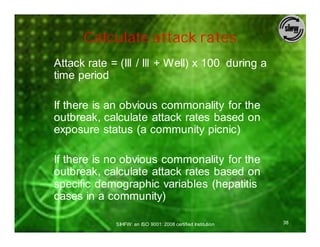
Calculate attack rates
Attack rate = (Ill / Ill + Well) x 100 during a
time period

If there is an obvious commonality for the
outbreak, calculate attack rates based on
exposure status (a community picnic)

If there is no obvious commonality for the
outbreak, calculate attack rates based on
specific demographic variables (hepatitis
cases in a community)

             SIHFW: an ISO 9001: 2008 certified Institution   38
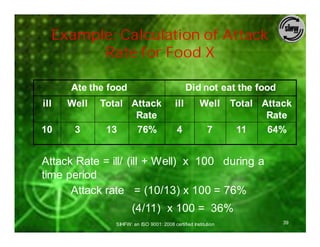
Example: Calculation of Attack
            Rate for Food X

        Ate the food                               Did not eat the food
ill     Well   Total Attack                  ill         Well      Total Attack
                      Rate                                                Rate
10       3      13    76%                     4             7       11    64%


Attack Rate = ill/ (ill + Well) x 100 during a
time period
      Attack rate = (10/13) x 100 = 76%
                         (4/11) x 100 = 36%
                  SIHFW: an ISO 9001: 2008 certified Institution             39
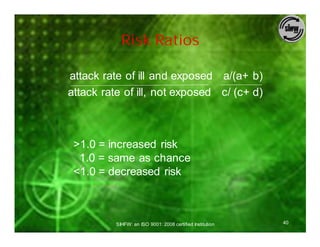
Risk Ratios

attack rate of ill and exposed a/(a+ b)
attack rate of ill, not exposed c/ (c+ d)


 >1.0 = increased risk
  1.0 = same as chance
 <1.0 = decreased risk


          SIHFW: an ISO 9001: 2008 certified Institution   40
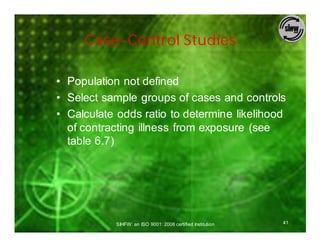
Case-Control Studies

• Population not defined
• Select sample groups of cases and controls
• Calculate odds ratio to determine likelihood
  of contracting illness from exposure (see
  table 6.7)


           SIHFW: an ISO 9001: 2008 certified Institution   41
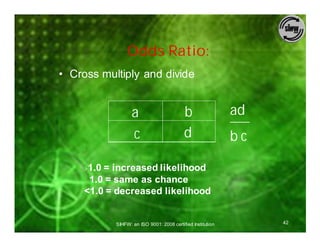
Odds Ratio:
• Cross multiply and divide


                   a                       b                 ad
                   c                       d                 bc

     >1.0= increased likelihood
      1.0 = same as chance
     <1.0 = decreased likelihood


            SIHFW: an ISO 9001: 2008 certified Institution        42
Step 8:
Additional Studies


  SIHFW: an ISO 9001: 2008 certified Institution   43
Clinical Specimens

•   Identifies agent and confirms cases
•   Obtain results if already collected
•   Collect specimens if necessary
•   Type of specimen depends on suspected
    agent, nature of outbreak


            SIHFW: an ISO 9001: 2008 certified Institution   44
Collect Clinical Specimens


 • Specimens must be labeled with
   patient’s name and collection date

 • Indicate on form that specimen is
   related to investigation


        SIHFW: an ISO 9001: 2008 certified Institution   45
Collect Clinical Specimens


• Submission form (s) must be completed
  and enclosed with specimen

• Local health department should collect
  and transport specimens to lab


           SIHFW: an ISO 9001: 2008 certified Institution   46
Environmental Investigation


• Help explain why outbreak occurred
• Begins when suspected mode of
  transmission identified
• Identifies vehicle of transmission
• Samples: food, water, air


          SIHFW: an ISO 9001: 2008 certified Institution   47
Step 9:
Implement Control Measures


       SIHFW: an ISO 9001: 2008 certified Institution   48
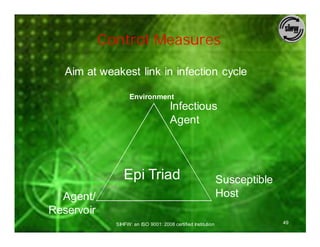
Control Measures

   Aim at weakest link in infection cycle

                    Environment
                                       Infectious
                                       Agent


                 Epi Triad                                     Susceptible
  Agent/                                                       Host
Reservoir
              SIHFW: an ISO 9001: 2008 certified Institution                 49
Possible Options

•   Post-exposure prophylaxis/treatment
•   Recalling/destroying food
•   Providing educational information
•   Closing an establishment
•   Exclusion (work, daycare, school)
•   Making public announcements


            SIHFW: an ISO 9001: 2008 certified Institution   50
Step 10:
Communicate Findings


    SIHFW: an ISO 9001: 2008 certified Institution   51
Investigation Report


                              • Outlines
                                investigation
                              • Agency analyzing
                                questionnaires
                                writes report


   SIHFW: an ISO 9001: 2008 certified Institution   52
Purpose of Report


•   Prevent similar outbreaks
•   Identify trends/causal factors
•   Justify resources used
•   Serves as public record


          SIHFW: an ISO 9001: 2008 certified Institution   53
Report Format

•   Cover page in memo format
•   Background
•   Epidemiologic investigation
•   Environmental assessment
•   Laboratory results
•   Conclusions


       SIHFW: an ISO 9001: 2008 certified Institution   54
Media Calls

• Confirm investigation underway
• Provide only confirmed or statistically
  proven information
• Be careful mentioning businesses
• Never speculate or provide identifiers
• Remain calm and do not be rushed


          SIHFW: an ISO 9001: 2008 certified Institution   55
Real-Life Examples


   SIHFW: an ISO 9001: 2008 certified Institution   56
Investigating an Epidemic:
On June 30,2009, the local health officer of
Jaipur, reported the occurrence of an outbreak of
acute gastrointestinal illness to the District Health
Officer. Dr.X, epidemiologist-in-training, was
assigned to conduct an investigation.
When Dr. X arrived in the field, he learned from the
health officer that all persons known to be ill had
attended a dinner at Hotel on June
30,2009. Family members who had not attended
the Dinner had not become ill. Accordingly, the
investigation was focused on the circumstances
related to the supper.
                SIHFW: an ISO 9001: 2008 certified Institution   57
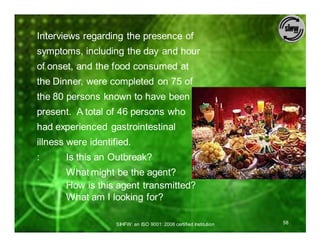
Interviews regarding the presence of
symptoms, including the day and hour
of onset, and the food consumed at
the Dinner, were completed on 75 of
the 80 persons known to have been
present. A total of 46 persons who
had experienced gastrointestinal
illness were identified.
:      Is this an Outbreak?
       What might be the agent?
       How is this agent transmitted?
       What am I looking for?

                    SIHFW: an ISO 9001: 2008 certified Institution   58
Select the correct case definition & find the error

1. All Invitees in Dinner held in Hotel on June 30,2009
   between 8:00 &11:00 PM; whether they attended
   Dinner or not; whether they participated in food
   preparation, transport, or distribution or not; whether
   they ate or not.
2. Persons who developed acute gastrointestinal
   symptoms within 72 hours of eating supper and who
   were among Invitees in Dinner held in Hotel on June
   30,2009.
3. Invitees who developed acute gastrointestinal
   symptoms within 24 hours of the Dinner held in Hotel
   on June 30,2009 between 8:00 & 11:00 PM
                    SIHFW: an ISO 9001: 2008 certified Institution   59
Select the correct case definition
            and find the error in the others:
1.         1. All invitees to the Marriage Dinner held in
            Hotel on June 30,2009 between 8:00 PM
   and 11:00 PM; whether they attended Marriage or
   not; whether they participated in food preparation,
   transport, or distribution or not; whether they ate or
   not. Missing definition of sickness
2. Persons who developed acute gastrointestinal
   symptoms within 24 hours of eating Dinner on June
   30,2009 and who were among invitees of the
   marriage dinner. CORRECT
3. Invitees who developed acute gastrointestinal
   symptoms within 24 hours Dinner on June 30,2009.
   Did not specify that they went to the dinner
                   SIHFW: an ISO 9001: 2008 certified Institution   60
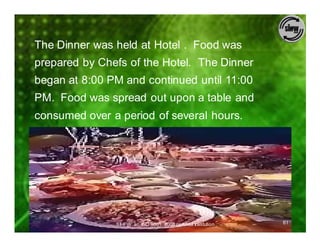
The Dinner was held at Hotel . Food was
prepared by Chefs of the Hotel. The Dinner
began at 8:00 PM and continued until 11:00
PM. Food was spread out upon a table and
consumed over a period of several hours.


               SIHFW: an ISO 9001: 2008 certified Institution   61
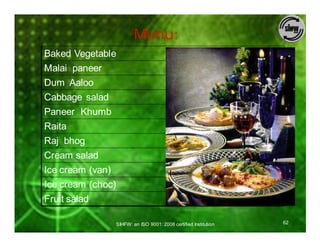
Menu:
Baked Vegetable
Malai paneer
Dum Aaloo
Cabbage salad
Paneer Khumb
Raita
Raj bhog
Cream salad
Ice cream (van)
Ice cream (choc)
Fruit salad

               SIHFW: an ISO 9001: 2008 certified Institution   62
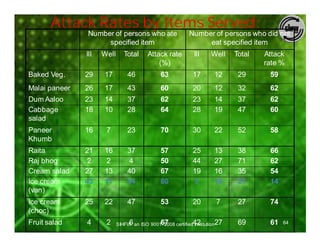
Which menu item (s) is the potential culprit?


To find out, calculate attack rates.


The foods that have the greatest difference in
attack rates may be the foods that were
responsible for the illness.


              SIHFW: an ISO 9001: 2008 certified Institution   63
Attack Rates by Items Served:
                Number of persons who ate                   Number of persons who did not
                     specified item                              eat specified item
               Ill   Well      Total     Attack rate          Ill    Well     Total   Attack
                                             (%)                                      rate %
Baked Veg.     29    17         46             63            17        12      29      59
Malai paneer   26    17         43             60            20        12      32      62
Dum Aaloo      23    14         37             62            23        14      37      62
Cabbage        18    10         28             64            28        19      47      60
salad
Paneer         16     7         23             70            30        22      52      58
Khumb
Raita          21    16         37             57            25        13      38      66
Raj bhog        2    2          4              50            44        27      71      62
Cream salad    27    13         40             67            19        16      35      54
Ice cream      43    11         54             80            3         18      21      14
(van)
Ice cream      25    22         47             53            20         7      27      74
(choc)
Fruit salad    4      2     SIHFW: an ISO 9001: 2008 certified42
                                 6            67              Institution27    69      61   64
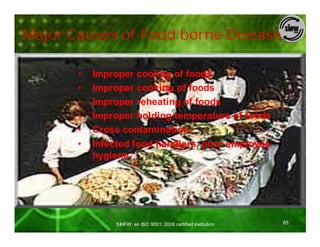
Major Causes of Food borne Disease

       •   Improper cooling of foods
       •   Improper cooking of foods
       •   Improper reheating of foods
       •   Improper holding temperature of foods
       •   Cross contamination
       •   Infected food handlers, poor employee
           hygiene


               SIHFW: an ISO 9001: 2008 certified Institution   65
Verify the outbreak
•   Determine whether this an outbreak – an
    excess number of cases from what would be
    expected

•   Establish a case definition
    – Non-ambiguous
    – Clinical / diagnostic verification
    – Person / Place / Time descriptions

•   Identify and count cases of illness
                SIHFW: an ISO 9001: 2008 certified Institution   66
Summary
The Epi Approach...

• Identify a problem
• Investigate and collect data
• Describe data in terms of
  person, place and time
• Formulate a hypothesis
• Test your hypothesis


        SIHFW: an ISO 9001: 2008 certified Institution   67
Bottom Line...

• Collect good descriptive data
• Be observant -- Be objective
• Keep Authority informed
• Be sure to collect data on both the “ill”
  and the “not ill”
• Ask for help
• Disease prevention!


          SIHFW: an ISO 9001: 2008 certified Institution   68
Conclusion

• An attack of gastroenteritis occurred
  following a Dinner at Hotel.

• The cause of the outbreak was
  contaminated vanilla ice cream.


         SIHFW: an ISO 9001: 2008 certified Institution   69
Remember:
• Only work in the field can uncover the way
  in which an agent links to a host in the real
  world (Environment) outside of the
  laboratory.
• Snow discovered the waterborne route as a
  major mode of communication of
  disease, which turned out to apply not only
  to cholera, but also to typhoid fever and
  other infections.

              SIHFW: an ISO 9001: 2008 certified Institution   70
Possible control measures for
      communicable diseases:
• ARI
  ØEarly recognition and treatment
  ØAll children with cough carefully assessed
  ØAssess signs of malnutrition
  ØRefer severely malnourished to hospital
  ØManage pneumonia with antibiotics
  ØFollow national treatment protocols
  ØSupportive measures
  ØVaccination against measles, diphtheria and
    whooping cough
               SIHFW: an ISO 9001: 2008 certified Institution   71
Cholera
• Prompt diagnosis and management
• Establish treatment centers with barrier nursing.
• Fecal material and vomit properly disinfected and
  disposed.
• Health Education on hygiene, safe water, safe
  food and hand washing.
• Funerals to be held quickly and near the place of
  death. Meticulous hand washing for those who
  handle the body.
• Promote washing hands with soap and water
  when food is being handled
                SIHFW: an ISO 9001: 2008 certified Institution   72
Typhoid
• Health education, clean water, food
  inspection, proper food handling and proper
  sewage disposal.
• Early detection and control are important in
  prevention of spread.
• Laboratory services are essential to know
  the outbreak strain and the anti microbial
  sensitivity pattern.


            SIHFW: an ISO 9001: 2008 certified Institution   73
Viral Hepatitis
• Enforcement of water and food
  sanitation.
• For Hepatitis B and C, all blood products
  should be screened for the two (and for
  HIV).
• Vaccination of target population groups
  for Hepatitis A recommended.
Diarrhea
• Provision of safe water supply
• Food safety

          SIHFW: an ISO 9001: 2008 certified Institution   74
Conjunctivitis
• Personal hygiene and hand washing.
• Vector control measures to reduce fly
  population.
• Disinfect articles contaminated by nasal and
  conjunctival discharges.
• Vigorous hand washing and proper disposal
  of infected material.


         SIHFW: an ISO 9001: 2008 certified Institution   75
Dengue
• Eliminate habitats of Aedes mosquitoes.
• Personal protection against mosquito bites
  during day time (clothes, repellants).
• In an outbreak use larvicide on all potential
  habitats of Aedes aegypti.
• Insecticides to reduce vector population.
• Social mobilization to eliminate breeding
  sites.


           SIHFW: an ISO 9001: 2008 certified Institution   76
Malaria
• Rapid diagnosis and effective case
  management.
• Use of insecticide treated nets.
• Indoor Residual Spraying.
• Environmental engineering
• Chemo prophylaxis to non-immune
  expatriates and Intermittent Presumptive
  Therapy for pregnant women.

        SIHFW: an ISO 9001: 2008 certified Institution   77
Tuberculosis
• Personal hygiene
• Avoid overcrowding
• Early diagnosis
• Drug compliance
HIV/AIDS
• Consistent & correct use of condoms
• Ensure blood safety
• Universal precautions to be used.
• Use of AD syringes
• Counseling and voluntary testing.
         SIHFW: an ISO 9001: 2008 certified Institution   78
H1N1
• Entry screening, aircraft
  disinfection, isolation of suspects, sample
  collection/transportation, contact
  tracing, quarantine, prophylaxis and case
  management
• Active search for contacts and cases
• Use of Personal protective gears
• Public health – mass prophylaxis
• Social distancing.


            SIHFW: an ISO 9001: 2008 certified Institution   79
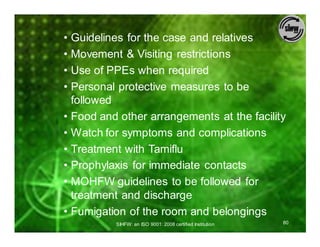
• Guidelines for the case and relatives
• Movement & Visiting restrictions
• Use of PPEs when required
• Personal protective measures to be
  followed
• Food and other arrangements at the facility
• Watch for symptoms and complications
• Treatment with Tamiflu
• Prophylaxis for immediate contacts
• MOHFW guidelines to be followed for
  treatment and discharge
• Fumigation of the room and belongings
          SIHFW: an ISO 9001: 2008 certified Institution   80
Thank You
 For more details log on to
 www. Sihfwrajasthan.com
              or
contact : Director-SIHFW on
   sihfwraj@yahoo.co.in

Epidemic Preparedness

  • 1.
    Epidemic preparedness & Outbreak Investigation State Institute of Health & Family Welfare, Jaipur
  • 2.
    Ø Epidemic- Occurrenceof diseases cases in community clearly in excess to the normal expectation(measured as endemic level) Ø Outbreak-Used interchangeably with Epidemic but applies to- ØDiseases with sudden onset ØShort incubation period SIHFW: an ISO 9001: 2008 certified Institution 2
  • 3.
    Why do outbreaksoccur? • Single lapse in infection control in hosp. • Lapse in surveillance • A hidden pocket of infection • Smuggled animals • Single volume of international air traffic • Rapid mutation & Adaptation in microbial world • Emergence of New risk groups • Modes of transmission can change • Drug resistance – effect on treatment and prophylaxis SIHFW: an ISO 9001: 2008 certified Institution 3
  • 4.
    Outbreak management….involves… • Anticipating, • Preventing, • Preparing for, • Detecting, • Responding and • Controlling disease outbreaks with the whole purpose of preventing or minimizing health and economic impacts of possible outbreaks SIHFW: an ISO 9001: 2008 certified Institution 4
  • 5.
    Why preparedness inadvance? • Emergencies caused by epidemics are frequent • Epidemics require urgent action and • Epidemics may often lead to panic if preparedness is not adequate • Response can be delayed, with possibility of fast spread, and avoidable loss to human lives, and economy SIHFW: an ISO 9001: 2008 certified Institution 5
  • 6.
    Why Investigate? • Control and prevention measures • Knowledge of an agent • Training • Public concerns SIHFW: an ISO 9001: 2008 certified Institution 6
  • 7.
    Epidemiological approaches • Experimental • Observational – descriptive – analytical SIHFW: an ISO 9001: 2008 certified Institution 7
  • 8.
    Tools for QuantifyingThe Epidemic 1. Case definition 2. Epidemic curve · point source (common source & vehicle) · propagated 3. Attack Rate 4. Incubation period 5. Herd immunity SIHFW: an ISO 9001: 2008 certified Institution 8
  • 9.
    Getting At TheSource: 1. Mode of transmission 2. Portal of entry 3. Reservoir 4. Vector 5. Vehicle 6. Agent SIHFW: an ISO 9001: 2008 certified Institution 9
  • 10.
    Before Starting: Ask •What’s your criteria/ Purpose for investigating an apparent outbreak? – Number of people affected – Unusual or severe clinical symptoms – Implement control measures – Prevent future outbreaks – Level of public concern, Political pressures, Legal obligations – Conduct research, potential to increase medical knowledge – Provide training SIHFW: an ISO 9001: 2008 certified Institution 10
  • 11.
    Steps in Investigation • Prepare for field work • Establish existence of outbreak • Verify diagnosis • Define and identify cases • Perform descriptive epidemiology SIHFW: an ISO 9001: 2008 certified Institution 11
  • 12.
    Steps in Investigation •Develop hypotheses • Evaluate hypotheses • Refine hypotheses and conduct additional studies • Implement control measures • Communicate findings SIHFW: an ISO 9001: 2008 certified Institution 12
  • 13.
    Prepare for FieldWork • Investigation Scientific knowledge--have it or get it! Supplies, equipment Assemble your team • Administration Review local directives or plans • Consultation Know your role, especially if off-base • Sample questionnaires • Key community contacts • Laboratory containers and collection techniques SIHFW: an ISO 9001: 2008 certified Institution 13
  • 14.
    Identify Outbreak Team •Epidemiologist • Laboratory workers • Environmental health specialists • Local health department • Other state agencies SIHFW: an ISO 9001: 2008 certified Institution 14
  • 15.
    2. Establish theExistence of An Outbreak • Determine if disease incidence is higher than background level • How do you determine background level ? - surveillance • Reasons for Observed >Expected Change in reporting procedures Change in case definition Increased awareness or interest Improved diagnostics New clinician Change in Population True increase 15 SIHFW: an ISO 9001: 2008 certified Institution
  • 16.
    3.Verify the Diagnosis •Review Clinical Data • Signs and symptoms • Onset dates • Common exposures • Obtain lab results, if any SIHFW: an ISO 9001: 2008 certified Institution 16
  • 17.
    4. Define andIdentify Cases • Outbreak Case Definition: • Clinical information (signs and symptoms) » Person » Place » Time • Case Definition Sources • Routine reporting: » Use Standard case definitions • Unknown etiology: » Make up your own case definition (make sure everyone uses the same case definition) SIHFW: an ISO 9001: 2008 certified Institution 17
  • 18.
    Establish Case Definition •Criteria to decide whether person is part of outbreak – time, place, person – clinical criteria • Can change during investigation • Keep open at first, restrict later SIHFW: an ISO 9001: 2008 certified Institution 18
  • 19.
    Case Classification: • Confirmed:laboratory results • Probable: clinical criteria without lab verification • Suspect: some clinical criteria SIHFW: an ISO 9001: 2008 certified Institution 19
  • 20.
    Identify and CountCases: • Develop a wide network • Initiate active surveillance • Case: meets case definition • Control: exposed, not ill SIHFW: an ISO 9001: 2008 certified Institution 20
  • 21.
    Identify Population AtRisk: • Survey hospitals • Review surveillance data • Question known cases to identify others • Review guest lists, enrollment records, etc. SIHFW: an ISO 9001: 2008 certified Institution 21
  • 22.
    Questionnaires: • Used tocollect complete, uniform histories • Identifiers • Demographics • Clinical information • Risk factors • Administer as soon as possible – disseminate – interview personally • Both cases and controls • Recall bias important • Can summarize on line listing SIHFW: an ISO 9001: 2008 certified Institution 22
  • 23.
    Line Listings • Spreadsheet format • One row = one case • Columns = variables SIHFW: an ISO 9001: 2008 certified Institution 23
  • 24.
    5.Perform Descriptive Epidemiology • Describe outbreak by – time – place – person • Become familiar with data • Get clues about infectious agent SIHFW: an ISO 9001: 2008 certified Institution 24
  • 25.
    Endemic vs. Epidemic PlotnumberTime Epidemic Curves: of cases by onset date No. of Cases of a Disease Epidemic Index case: first case of outbreak Determine time course and future course, exposure period Endemic SIHFW: an ISO 9001: 2008 certified Institution Time 25
  • 26.
    Point Source Transmission 12 10 No. of cases 8 6 4 Cases 2 0 1 2 3 4 5 6 7 8 9 10 11 12 13 14 15 Time • This is the most common form of transmission in food-borne disease, in which a large population is exposed for a short period of time. SIHFW: an ISO 9001: 2008 certified Institution 26
  • 27.
    Point Source Outbreaks •All exposed at one time • Cases occur suddenly after minimum incubation time • All cases occur within one incubation period • Outbreak stops unless secondary spread • Curves have steep upslope, more gradual down slope SIHFW: an ISO 9001: 2008 certified Institution 27
  • 28.
    Continuous Common Source •May begin suddenly or gradually • Does not have an early peak (v/s Point source) • Cases do not disappear because of secondary exposure • Curves have gradual or steep upslope, plateau trickling down slope, and may repeat SIHFW: an ISO 9001: 2008 certified Institution 28
  • 29.
    Continuing Common Sourceor Intermittent Exposure 12 10 No. of Cases 8 6 4 2 0 1 2 3 4 5 6 7 8 9 10 11 12 13 14 15 16 17 18 19 20 Time • In this case, there are several peaks, and the incubation period cannot be identified. SIHFW: an ISO 9001: 2008 certified Institution 29
  • 30.
    Propagated Outbreaks • Typicalof person-to-person outbreaks • Secondary cases appear, at intervals corresponding to average incubation period after peak of first wave • Taller successive waves of cases SIHFW: an ISO 9001: 2008 certified Institution 30
  • 31.
    Spot Maps: Place • One spot = case • Community • Facilities • Recreational sites • Population density not reflected SIHFW: an ISO 9001: 2008 certified Institution 31
  • 32.
    Person • Host characteristics – age – sex • Exposures – occupation – food consumption – leisure activities SIHFW: an ISO 9001: 2008 certified Institution 32
  • 33.
    6. Developing Hypothesis • Requires familiarity with disease • Hypothesis should be testable • Still clueless? • Talk with cases again • Visit work sites or billeting area • Don’t forget outliers SIHFW: an ISO 9001: 2008 certified Institution 33
  • 34.
    Develop Hypothesis • Contactusual suspects! • Type of agent • Source of agent • Mode of transmission • Usual reservoirs • Known risk factors • Exposures that caused disease • Look at person, place and time for clues • Be able to test SIHFW: an ISO 9001: 2008 certified Institution 34
  • 35.
    7. Evaluating Hypotheses: Analytic Epidemiology • Quantify relationships between exposures and disease • Test hypotheses about causes • Comparison groups – cohort study – case-control study SIHFW: an ISO 9001: 2008 certified Institution 35
  • 36.
    Evaluate Hypothesis • Determine exposure variables. Compare ill to not ill. • Construct a 2 X 2 table • Perform Cohort or Case Control Study • Use Cohort study when: Population at risk is known (you have a denominator) Interview “ill” and “not ill” Calculate attack rates - “ate” v/s “didn’t eat” Put on food-specific attack rate table SIHFW: an ISO 9001: 2008 certified Institution 36
  • 37.
    Cohort Studies • Defined population • Can contact all in timely manner • Calculate attack rate • Calculate risk ratio to determine risk of contracting illness from exposure (see table 6.4) SIHFW: an ISO 9001: 2008 certified Institution 37
  • 38.
    Calculate attack rates Attackrate = (Ill / Ill + Well) x 100 during a time period If there is an obvious commonality for the outbreak, calculate attack rates based on exposure status (a community picnic) If there is no obvious commonality for the outbreak, calculate attack rates based on specific demographic variables (hepatitis cases in a community) SIHFW: an ISO 9001: 2008 certified Institution 38
  • 39.
    Example: Calculation ofAttack Rate for Food X Ate the food Did not eat the food ill Well Total Attack ill Well Total Attack Rate Rate 10 3 13 76% 4 7 11 64% Attack Rate = ill/ (ill + Well) x 100 during a time period Attack rate = (10/13) x 100 = 76% (4/11) x 100 = 36% SIHFW: an ISO 9001: 2008 certified Institution 39
  • 40.
    Risk Ratios attack rateof ill and exposed a/(a+ b) attack rate of ill, not exposed c/ (c+ d) >1.0 = increased risk 1.0 = same as chance <1.0 = decreased risk SIHFW: an ISO 9001: 2008 certified Institution 40
  • 41.
    Case-Control Studies • Populationnot defined • Select sample groups of cases and controls • Calculate odds ratio to determine likelihood of contracting illness from exposure (see table 6.7) SIHFW: an ISO 9001: 2008 certified Institution 41
  • 42.
    Odds Ratio: • Crossmultiply and divide a b ad c d bc >1.0= increased likelihood 1.0 = same as chance <1.0 = decreased likelihood SIHFW: an ISO 9001: 2008 certified Institution 42
  • 43.
    Step 8: Additional Studies SIHFW: an ISO 9001: 2008 certified Institution 43
  • 44.
    Clinical Specimens • Identifies agent and confirms cases • Obtain results if already collected • Collect specimens if necessary • Type of specimen depends on suspected agent, nature of outbreak SIHFW: an ISO 9001: 2008 certified Institution 44
  • 45.
    Collect Clinical Specimens • Specimens must be labeled with patient’s name and collection date • Indicate on form that specimen is related to investigation SIHFW: an ISO 9001: 2008 certified Institution 45
  • 46.
    Collect Clinical Specimens •Submission form (s) must be completed and enclosed with specimen • Local health department should collect and transport specimens to lab SIHFW: an ISO 9001: 2008 certified Institution 46
  • 47.
    Environmental Investigation • Helpexplain why outbreak occurred • Begins when suspected mode of transmission identified • Identifies vehicle of transmission • Samples: food, water, air SIHFW: an ISO 9001: 2008 certified Institution 47
  • 48.
    Step 9: Implement ControlMeasures SIHFW: an ISO 9001: 2008 certified Institution 48
  • 49.
    Control Measures Aim at weakest link in infection cycle Environment Infectious Agent Epi Triad Susceptible Agent/ Host Reservoir SIHFW: an ISO 9001: 2008 certified Institution 49
  • 50.
    Possible Options • Post-exposure prophylaxis/treatment • Recalling/destroying food • Providing educational information • Closing an establishment • Exclusion (work, daycare, school) • Making public announcements SIHFW: an ISO 9001: 2008 certified Institution 50
  • 51.
    Step 10: Communicate Findings SIHFW: an ISO 9001: 2008 certified Institution 51
  • 52.
    Investigation Report • Outlines investigation • Agency analyzing questionnaires writes report SIHFW: an ISO 9001: 2008 certified Institution 52
  • 53.
    Purpose of Report • Prevent similar outbreaks • Identify trends/causal factors • Justify resources used • Serves as public record SIHFW: an ISO 9001: 2008 certified Institution 53
  • 54.
    Report Format • Cover page in memo format • Background • Epidemiologic investigation • Environmental assessment • Laboratory results • Conclusions SIHFW: an ISO 9001: 2008 certified Institution 54
  • 55.
    Media Calls • Confirminvestigation underway • Provide only confirmed or statistically proven information • Be careful mentioning businesses • Never speculate or provide identifiers • Remain calm and do not be rushed SIHFW: an ISO 9001: 2008 certified Institution 55
  • 56.
    Real-Life Examples SIHFW: an ISO 9001: 2008 certified Institution 56
  • 57.
    Investigating an Epidemic: OnJune 30,2009, the local health officer of Jaipur, reported the occurrence of an outbreak of acute gastrointestinal illness to the District Health Officer. Dr.X, epidemiologist-in-training, was assigned to conduct an investigation. When Dr. X arrived in the field, he learned from the health officer that all persons known to be ill had attended a dinner at Hotel on June 30,2009. Family members who had not attended the Dinner had not become ill. Accordingly, the investigation was focused on the circumstances related to the supper. SIHFW: an ISO 9001: 2008 certified Institution 57
  • 58.
    Interviews regarding thepresence of symptoms, including the day and hour of onset, and the food consumed at the Dinner, were completed on 75 of the 80 persons known to have been present. A total of 46 persons who had experienced gastrointestinal illness were identified. : Is this an Outbreak? What might be the agent? How is this agent transmitted? What am I looking for? SIHFW: an ISO 9001: 2008 certified Institution 58
  • 59.
    Select the correctcase definition & find the error 1. All Invitees in Dinner held in Hotel on June 30,2009 between 8:00 &11:00 PM; whether they attended Dinner or not; whether they participated in food preparation, transport, or distribution or not; whether they ate or not. 2. Persons who developed acute gastrointestinal symptoms within 72 hours of eating supper and who were among Invitees in Dinner held in Hotel on June 30,2009. 3. Invitees who developed acute gastrointestinal symptoms within 24 hours of the Dinner held in Hotel on June 30,2009 between 8:00 & 11:00 PM SIHFW: an ISO 9001: 2008 certified Institution 59
  • 60.
    Select the correctcase definition and find the error in the others: 1. 1. All invitees to the Marriage Dinner held in Hotel on June 30,2009 between 8:00 PM and 11:00 PM; whether they attended Marriage or not; whether they participated in food preparation, transport, or distribution or not; whether they ate or not. Missing definition of sickness 2. Persons who developed acute gastrointestinal symptoms within 24 hours of eating Dinner on June 30,2009 and who were among invitees of the marriage dinner. CORRECT 3. Invitees who developed acute gastrointestinal symptoms within 24 hours Dinner on June 30,2009. Did not specify that they went to the dinner SIHFW: an ISO 9001: 2008 certified Institution 60
  • 61.
    The Dinner washeld at Hotel . Food was prepared by Chefs of the Hotel. The Dinner began at 8:00 PM and continued until 11:00 PM. Food was spread out upon a table and consumed over a period of several hours. SIHFW: an ISO 9001: 2008 certified Institution 61
  • 62.
    Menu: Baked Vegetable Malai paneer DumAaloo Cabbage salad Paneer Khumb Raita Raj bhog Cream salad Ice cream (van) Ice cream (choc) Fruit salad SIHFW: an ISO 9001: 2008 certified Institution 62
  • 63.
    Which menu item(s) is the potential culprit? To find out, calculate attack rates. The foods that have the greatest difference in attack rates may be the foods that were responsible for the illness. SIHFW: an ISO 9001: 2008 certified Institution 63
  • 64.
    Attack Rates byItems Served: Number of persons who ate Number of persons who did not specified item eat specified item Ill Well Total Attack rate Ill Well Total Attack (%) rate % Baked Veg. 29 17 46 63 17 12 29 59 Malai paneer 26 17 43 60 20 12 32 62 Dum Aaloo 23 14 37 62 23 14 37 62 Cabbage 18 10 28 64 28 19 47 60 salad Paneer 16 7 23 70 30 22 52 58 Khumb Raita 21 16 37 57 25 13 38 66 Raj bhog 2 2 4 50 44 27 71 62 Cream salad 27 13 40 67 19 16 35 54 Ice cream 43 11 54 80 3 18 21 14 (van) Ice cream 25 22 47 53 20 7 27 74 (choc) Fruit salad 4 2 SIHFW: an ISO 9001: 2008 certified42 6 67 Institution27 69 61 64
  • 65.
    Major Causes ofFood borne Disease • Improper cooling of foods • Improper cooking of foods • Improper reheating of foods • Improper holding temperature of foods • Cross contamination • Infected food handlers, poor employee hygiene SIHFW: an ISO 9001: 2008 certified Institution 65
  • 66.
    Verify the outbreak • Determine whether this an outbreak – an excess number of cases from what would be expected • Establish a case definition – Non-ambiguous – Clinical / diagnostic verification – Person / Place / Time descriptions • Identify and count cases of illness SIHFW: an ISO 9001: 2008 certified Institution 66
  • 67.
    Summary The Epi Approach... •Identify a problem • Investigate and collect data • Describe data in terms of person, place and time • Formulate a hypothesis • Test your hypothesis SIHFW: an ISO 9001: 2008 certified Institution 67
  • 68.
    Bottom Line... • Collectgood descriptive data • Be observant -- Be objective • Keep Authority informed • Be sure to collect data on both the “ill” and the “not ill” • Ask for help • Disease prevention! SIHFW: an ISO 9001: 2008 certified Institution 68
  • 69.
    Conclusion • An attackof gastroenteritis occurred following a Dinner at Hotel. • The cause of the outbreak was contaminated vanilla ice cream. SIHFW: an ISO 9001: 2008 certified Institution 69
  • 70.
    Remember: • Only workin the field can uncover the way in which an agent links to a host in the real world (Environment) outside of the laboratory. • Snow discovered the waterborne route as a major mode of communication of disease, which turned out to apply not only to cholera, but also to typhoid fever and other infections. SIHFW: an ISO 9001: 2008 certified Institution 70
  • 71.
    Possible control measuresfor communicable diseases: • ARI ØEarly recognition and treatment ØAll children with cough carefully assessed ØAssess signs of malnutrition ØRefer severely malnourished to hospital ØManage pneumonia with antibiotics ØFollow national treatment protocols ØSupportive measures ØVaccination against measles, diphtheria and whooping cough SIHFW: an ISO 9001: 2008 certified Institution 71
  • 72.
    Cholera • Prompt diagnosisand management • Establish treatment centers with barrier nursing. • Fecal material and vomit properly disinfected and disposed. • Health Education on hygiene, safe water, safe food and hand washing. • Funerals to be held quickly and near the place of death. Meticulous hand washing for those who handle the body. • Promote washing hands with soap and water when food is being handled SIHFW: an ISO 9001: 2008 certified Institution 72
  • 73.
    Typhoid • Health education,clean water, food inspection, proper food handling and proper sewage disposal. • Early detection and control are important in prevention of spread. • Laboratory services are essential to know the outbreak strain and the anti microbial sensitivity pattern. SIHFW: an ISO 9001: 2008 certified Institution 73
  • 74.
    Viral Hepatitis • Enforcementof water and food sanitation. • For Hepatitis B and C, all blood products should be screened for the two (and for HIV). • Vaccination of target population groups for Hepatitis A recommended. Diarrhea • Provision of safe water supply • Food safety SIHFW: an ISO 9001: 2008 certified Institution 74
  • 75.
    Conjunctivitis • Personal hygieneand hand washing. • Vector control measures to reduce fly population. • Disinfect articles contaminated by nasal and conjunctival discharges. • Vigorous hand washing and proper disposal of infected material. SIHFW: an ISO 9001: 2008 certified Institution 75
  • 76.
    Dengue • Eliminate habitatsof Aedes mosquitoes. • Personal protection against mosquito bites during day time (clothes, repellants). • In an outbreak use larvicide on all potential habitats of Aedes aegypti. • Insecticides to reduce vector population. • Social mobilization to eliminate breeding sites. SIHFW: an ISO 9001: 2008 certified Institution 76
  • 77.
    Malaria • Rapid diagnosisand effective case management. • Use of insecticide treated nets. • Indoor Residual Spraying. • Environmental engineering • Chemo prophylaxis to non-immune expatriates and Intermittent Presumptive Therapy for pregnant women. SIHFW: an ISO 9001: 2008 certified Institution 77
  • 78.
    Tuberculosis • Personal hygiene •Avoid overcrowding • Early diagnosis • Drug compliance HIV/AIDS • Consistent & correct use of condoms • Ensure blood safety • Universal precautions to be used. • Use of AD syringes • Counseling and voluntary testing. SIHFW: an ISO 9001: 2008 certified Institution 78
  • 79.
    H1N1 • Entry screening,aircraft disinfection, isolation of suspects, sample collection/transportation, contact tracing, quarantine, prophylaxis and case management • Active search for contacts and cases • Use of Personal protective gears • Public health – mass prophylaxis • Social distancing. SIHFW: an ISO 9001: 2008 certified Institution 79
  • 80.
    • Guidelines forthe case and relatives • Movement & Visiting restrictions • Use of PPEs when required • Personal protective measures to be followed • Food and other arrangements at the facility • Watch for symptoms and complications • Treatment with Tamiflu • Prophylaxis for immediate contacts • MOHFW guidelines to be followed for treatment and discharge • Fumigation of the room and belongings SIHFW: an ISO 9001: 2008 certified Institution 80
  • 81.
    Thank You Formore details log on to www. Sihfwrajasthan.com or contact : Director-SIHFW on sihfwraj@yahoo.co.in