Dr. Akhilesh BhargavaMD, DHA, PGDHRMProf. Community Medicine &Director-SIHFW, JaipurEpidemiological studiesAkhilesh Bhargava1
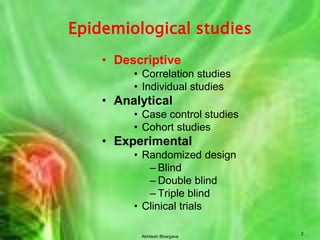
Akhilesh Bhargava2Epidemiological studiesDescriptiveCorrelation studiesIndividual studiesAnalyticalCase control studiesCohort studiesExperimentalRandomized designBlindDouble blindTriple blindClinical trials
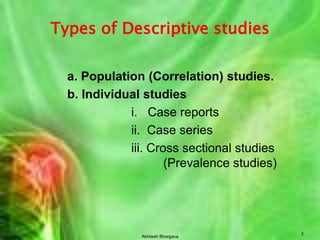
Akhilesh Bhargava3Types of Descriptive studiesa. Population (Correlation) studies.b. Individual studiesi.   Case reports			ii.  Case series			iii. Cross sectional studies 				(Prevalence studies)
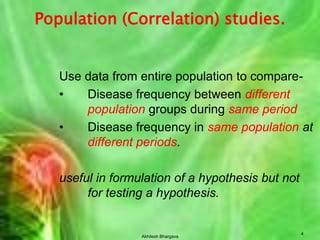
Akhilesh Bhargava4Population (Correlation) studies.Use data from entire population to compare-Disease frequency between different population groups during same periodDisease frequency insame population at different periods.useful in formulation of a hypothesis but not for testing a hypothesis.
Akhilesh Bhargava5Advantages and LimitationsExposure cannot be linked with disease as whole population is represented.Lack of ability to control the effects of potential confounding variables.Presence of a correlation does not necessarily mean a statistical association.Correlation data represent average exposure levels rather than actual individual levels Inexpensive in terms of Time & MoneyRoutinely available information can be used
Akhilesh Bhargava6Individual studiesCase reports (single patient)Case series (group of patients with similar diagnosis)
Akhilesh Bhargava7Individual studies:Advantages and LimitationsCases can be aggregated from different sources to generate hypotheses and describe syndromesStatistical association can not be established as there is no comparison group
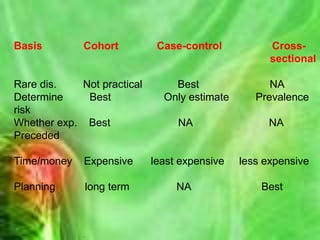
Akhilesh Bhargava8Cross sectional studiesMeasure disease and exposure simultaneously in a defined population over a defined periodprovide instant information about frequency and characteristics of a diseaseUseful in-Assessing health statusIdentifying health care needs.Providing data on Prevalence of Disease, disability and utilization of servicesProvide data for Health care planning and administration
Akhilesh Bhargava9Advantages and LimitationsShort term so less expensiveOffer starting point in prospective studiesAllow assessment of risk though less preciseStart from a reference population from where sample is drawn, generalization can be madeNot possible to ascertain whether exposure preceded or resulted from the disease.Since prevalence is assessed, results are affected by survival factors
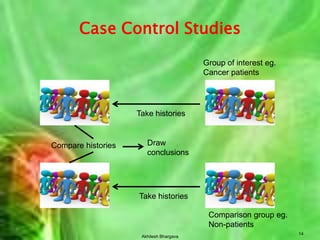
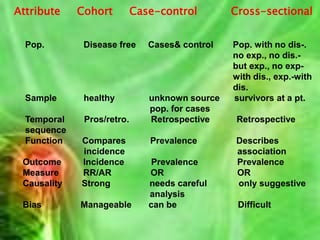
Akhilesh Bhargava10Case-Control studyA non-experimental Study, Subjects enrolled based on presence/absence of outcome,Cases/controls compared with regard to prior exposure to causal factors.
Akhilesh Bhargava11Designing: case-controlCriteria-		    Comparability of cases & controlsIssues –              	# Defining & selection of cases			# Selection of controls            	# Information on disease 		            exposure status
Akhilesh Bhargava12Case-control: strengths &limitationsStudy of diseases with long latent periodLow costShort timeApplicable to rare diseases alsoBias in selection/Reporting/Recording.
Akhilesh Bhargava13Case-control : selection of casesRequirements-A standard case definitionInclusion of likes, exclusion of dislikesA strict diagnostic criteria for homogeneityOnly newly diagnosed cases be included- Older cases  may distort the presentationSelection –Hospital based Pop. based
14Group of interest eg. Cancer patientsTake historiesDraw conclusionsCompare historiesTake historiesComparison group eg.Non-patientsCase Control StudiesAkhilesh Bhargava
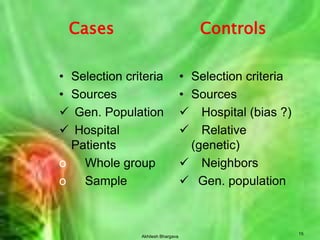
Akhilesh Bhargava15Cases                 ControlsSelection criteriaSources Gen. Population
 Hospital Patients
    Whole group
    SampleSelection criteriaSources   Hospital (bias ?)
   Relative (genetic)
   Neighbors
  Gen. populationAkhilesh Bhargava16Control selection criteriaCharacteristics and sources of Cases Need to obtain comparable information             from cases and controls Practicality Cost Representative of population from where cases are drawn
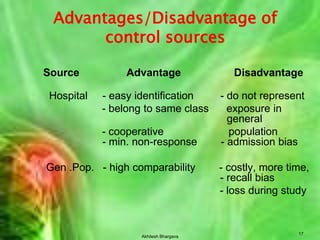
Akhilesh Bhargava17Advantages/Disadvantage of control sourcesSource                AdvantageDisadvantageHospital     - easy identification         - do not represent                     - belong to same class      exposure in 						        general                       - cooperative                      population                - min. non-response        - admission bias Gen .Pop.   - high comparability        - costly, more time,                                                        - recall bias                                                             - loss during study
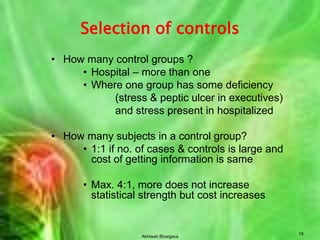
Akhilesh Bhargava18Selection of controlsHow many control groups ?Hospital – more than oneWhere one group has some deficiency			(stress & peptic ulcer in executives)			and stress present in hospitalizedHow many subjects in a control group?1:1 if no. of cases & controls is large and cost of getting information is sameMax. 4:1, more does not increase statistical strength but cost increases
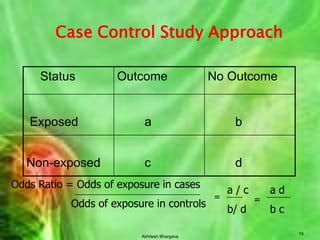
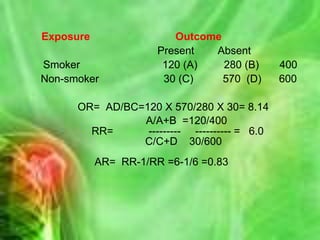
Akhilesh Bhargava19Case Control Study ApproachOdds Ratio = Odds of exposure in cases                  Odds of exposure in controls               a / cb/ da db c==
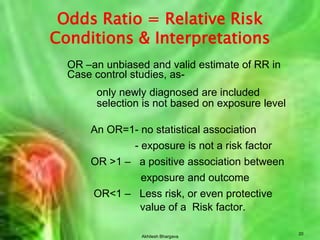
Akhilesh Bhargava20Odds Ratio = Relative RiskConditions & InterpretationsOR –an unbiased and valid estimate of RR inCase control studies, as-          only newly diagnosed are included          selection is not based on exposure level        An OR=1- no statistical association                       - exposure is not a risk factor        OR >1 –   a positive association between                          exposure and outcome         OR<1 –   Less risk, or even protective 			   value of a  Risk factor.
Akhilesh Bhargava21Bias and its play in Case Control study-Bias  “any systematic error in the study that results in an incorrect estimate of the association between exposure and risk of disease”.
Akhilesh Bhargava22Types of Bias-1. Selection Bias	a. Prevalence-Incidence Bias	b. Admission rate (Berkson’s) Bias	c. Non-response/ Refusal Bias2. Observational or Information Bias	a. Diagnostic Bias	b. Recall Bias
Akhilesh Bhargava23How Bias gets inDifferential surveillance,
Diagnosis & Referral during ascertaining status of subjects,		OR ,     for-Unwillingness to participate ,Non selection by investigator &
Replacement of originally selected
Selection bias- Refusal                           Non-response                          Self selection
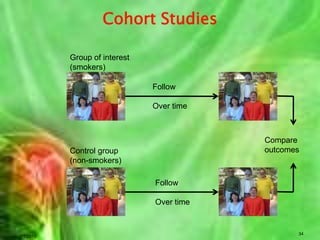
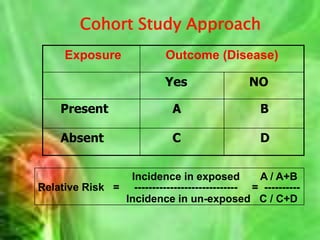
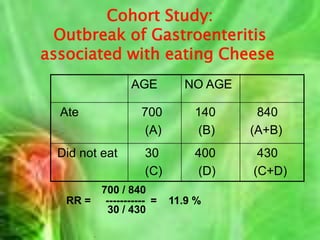
Cohortgroup with common experience Roman Army GroupsCohort study-“A non-experimental study, subjects enrolled based on exposure level to main independent variable, followed to determine development of the dependent variable”24.Akhilesh Bhargava
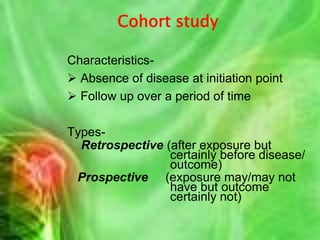
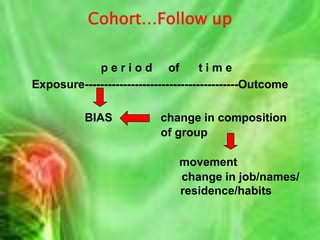
Cohort studyCharacteristics- Absence of disease at initiation point
 Follow up over a period of timeTypes-Retrospective (after exposure but 				  certainly before disease/ 			  outcome)Prospective     (exposure may/may not 			  have but outcome 				  certainly not)
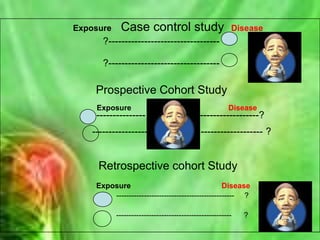
ExposureCase control studyDisease ?----------------------------------      ?---------------------------------- Prospective Cohort StudyExposure  Disease               ---------------                    ------------------?                -------------------                 ------------------- ?     Retrospective cohort StudyExposure                                           Disease-----------------------------------------------     ?                     ----------------------------------------------      ?
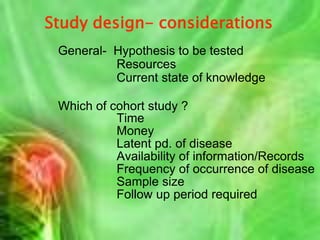
Study design- considerations  General-  Hypothesis to be tested                   Resources                   Current state of knowledge  Which of cohort study ?                   Time                   Money                   Latent pd. of disease                   Availability of information/Records                   Frequency of occurrence of disease                   Sample size                   Follow up period required
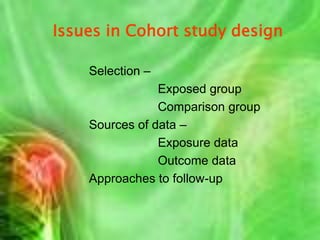
Issues in Cohort study design    Selection –                         Exposed group                        Comparison group    Sources of data –                        Exposure data                        Outcome data    Approaches to follow-up
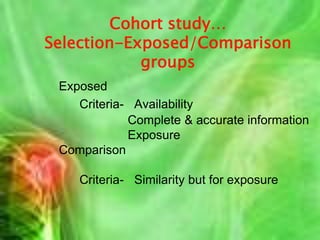
Cohort study…Selection-Exposed/Comparison groups   Exposed            Criteria-   Availability                       Complete & accurate information                       Exposure   Comparison         Criteria-   Similarity but for exposure
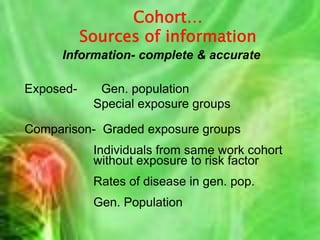
Cohort…Sources of information           Information- complete & accurateExposed-       Gen. population                    Special exposure groupsComparison-  Graded exposure groups                    Individuals from same work cohort                    without exposure to risk factor                    Rates of disease in gen. pop.                    Gen. Population
Cohort…Sources of exposure information Medical records
 Employment records

Epidemiological Studies

  • 1.
    Dr. Akhilesh BhargavaMD,DHA, PGDHRMProf. Community Medicine &Director-SIHFW, JaipurEpidemiological studiesAkhilesh Bhargava1
  • 2.
    Akhilesh Bhargava2Epidemiological studiesDescriptiveCorrelationstudiesIndividual studiesAnalyticalCase control studiesCohort studiesExperimentalRandomized designBlindDouble blindTriple blindClinical trials
  • 3.
    Akhilesh Bhargava3Types ofDescriptive studiesa. Population (Correlation) studies.b. Individual studiesi. Case reports ii. Case series iii. Cross sectional studies (Prevalence studies)
  • 4.
    Akhilesh Bhargava4Population (Correlation)studies.Use data from entire population to compare-Disease frequency between different population groups during same periodDisease frequency insame population at different periods.useful in formulation of a hypothesis but not for testing a hypothesis.
  • 5.
    Akhilesh Bhargava5Advantages andLimitationsExposure cannot be linked with disease as whole population is represented.Lack of ability to control the effects of potential confounding variables.Presence of a correlation does not necessarily mean a statistical association.Correlation data represent average exposure levels rather than actual individual levels Inexpensive in terms of Time & MoneyRoutinely available information can be used
  • 6.
    Akhilesh Bhargava6Individual studiesCasereports (single patient)Case series (group of patients with similar diagnosis)
  • 7.
    Akhilesh Bhargava7Individual studies:Advantagesand LimitationsCases can be aggregated from different sources to generate hypotheses and describe syndromesStatistical association can not be established as there is no comparison group
  • 8.
    Akhilesh Bhargava8Cross sectionalstudiesMeasure disease and exposure simultaneously in a defined population over a defined periodprovide instant information about frequency and characteristics of a diseaseUseful in-Assessing health statusIdentifying health care needs.Providing data on Prevalence of Disease, disability and utilization of servicesProvide data for Health care planning and administration
  • 9.
    Akhilesh Bhargava9Advantages andLimitationsShort term so less expensiveOffer starting point in prospective studiesAllow assessment of risk though less preciseStart from a reference population from where sample is drawn, generalization can be madeNot possible to ascertain whether exposure preceded or resulted from the disease.Since prevalence is assessed, results are affected by survival factors
  • 10.
    Akhilesh Bhargava10Case-Control studyAnon-experimental Study, Subjects enrolled based on presence/absence of outcome,Cases/controls compared with regard to prior exposure to causal factors.
  • 11.
    Akhilesh Bhargava11Designing: case-controlCriteria- Comparability of cases & controlsIssues – # Defining & selection of cases # Selection of controls # Information on disease exposure status
  • 12.
    Akhilesh Bhargava12Case-control: strengths&limitationsStudy of diseases with long latent periodLow costShort timeApplicable to rare diseases alsoBias in selection/Reporting/Recording.
  • 13.
    Akhilesh Bhargava13Case-control :selection of casesRequirements-A standard case definitionInclusion of likes, exclusion of dislikesA strict diagnostic criteria for homogeneityOnly newly diagnosed cases be included- Older cases may distort the presentationSelection –Hospital based Pop. based
  • 14.
    14Group of interesteg. Cancer patientsTake historiesDraw conclusionsCompare historiesTake historiesComparison group eg.Non-patientsCase Control StudiesAkhilesh Bhargava
  • 15.
    Akhilesh Bhargava15Cases ControlsSelection criteriaSources Gen. Population
  • 16.
  • 17.
    Whole group
  • 18.
    SampleSelection criteriaSources Hospital (bias ?)
  • 19.
    Relative (genetic)
  • 20.
    Neighbors
  • 21.
    Gen.populationAkhilesh Bhargava16Control selection criteriaCharacteristics and sources of Cases Need to obtain comparable information from cases and controls Practicality Cost Representative of population from where cases are drawn
  • 22.
    Akhilesh Bhargava17Advantages/Disadvantage ofcontrol sourcesSource AdvantageDisadvantageHospital - easy identification - do not represent - belong to same class exposure in general - cooperative population - min. non-response - admission bias Gen .Pop. - high comparability - costly, more time, - recall bias - loss during study
  • 23.
    Akhilesh Bhargava18Selection ofcontrolsHow many control groups ?Hospital – more than oneWhere one group has some deficiency (stress & peptic ulcer in executives) and stress present in hospitalizedHow many subjects in a control group?1:1 if no. of cases & controls is large and cost of getting information is sameMax. 4:1, more does not increase statistical strength but cost increases
  • 24.
    Akhilesh Bhargava19Case ControlStudy ApproachOdds Ratio = Odds of exposure in cases Odds of exposure in controls a / cb/ da db c==
  • 25.
    Akhilesh Bhargava20Odds Ratio= Relative RiskConditions & InterpretationsOR –an unbiased and valid estimate of RR inCase control studies, as- only newly diagnosed are included selection is not based on exposure level An OR=1- no statistical association - exposure is not a risk factor OR >1 – a positive association between exposure and outcome OR<1 – Less risk, or even protective value of a Risk factor.
  • 26.
    Akhilesh Bhargava21Bias andits play in Case Control study-Bias “any systematic error in the study that results in an incorrect estimate of the association between exposure and risk of disease”.
  • 27.
    Akhilesh Bhargava22Types ofBias-1. Selection Bias a. Prevalence-Incidence Bias b. Admission rate (Berkson’s) Bias c. Non-response/ Refusal Bias2. Observational or Information Bias a. Diagnostic Bias b. Recall Bias
  • 28.
    Akhilesh Bhargava23How Biasgets inDifferential surveillance,
  • 29.
    Diagnosis & Referralduring ascertaining status of subjects, OR , for-Unwillingness to participate ,Non selection by investigator &
  • 30.
  • 31.
    Selection bias- Refusal Non-response Self selection
  • 32.
    Cohortgroup with commonexperience Roman Army GroupsCohort study-“A non-experimental study, subjects enrolled based on exposure level to main independent variable, followed to determine development of the dependent variable”24.Akhilesh Bhargava
  • 33.
    Cohort studyCharacteristics- Absenceof disease at initiation point
  • 34.
    Follow upover a period of timeTypes-Retrospective (after exposure but certainly before disease/ outcome)Prospective (exposure may/may not have but outcome certainly not)
  • 35.
    ExposureCase control studyDisease?---------------------------------- ?---------------------------------- Prospective Cohort StudyExposure Disease --------------- ------------------? ------------------- ------------------- ? Retrospective cohort StudyExposure Disease----------------------------------------------- ? ---------------------------------------------- ?
  • 36.
    Study design- considerations General- Hypothesis to be tested Resources Current state of knowledge Which of cohort study ? Time Money Latent pd. of disease Availability of information/Records Frequency of occurrence of disease Sample size Follow up period required
  • 37.
    Issues in Cohortstudy design Selection – Exposed group Comparison group Sources of data – Exposure data Outcome data Approaches to follow-up
  • 38.
    Cohort study…Selection-Exposed/Comparison groups Exposed Criteria- Availability Complete & accurate information Exposure Comparison Criteria- Similarity but for exposure
  • 39.
    Cohort…Sources of information Information- complete & accurateExposed- Gen. population Special exposure groupsComparison- Graded exposure groups Individuals from same work cohort without exposure to risk factor Rates of disease in gen. pop. Gen. Population
  • 40.
    Cohort…Sources of exposureinformation Medical records
  • 41.