Principles of Epidemiology


    Dr. Akhilesh Bhargava
         MD, DHA, PGDHRM
      Prof. Community Medicine
                  &
       Director-SIHFW, Jaipur
Epidemiology
The study of distribution and
determinants of health problems in
specified populations and the application
of this study to the control of these
problems. It is the scientific method of
problem solving used by "disease
detectives"--epidemiologists, laboratory
scientists, statisticians, physicians and
other health care providers, and public
health professionals--to get to the root of
health problems in a community.


                                              2
               Akhilesh Bhargava
Epidemiology
        Define ?
vA study of all diseases/health events
 Øinfectious/non-infectious
 Øacute/chronic
 Øcommunicable/non-communicable.

vScience of rates expressed as
 probability
v“ Anything that happens to people”


                                         3
             Akhilesh Bhargava
Epidemiology:
       Gen. Objectives

• Explaining the Causal mechanism of
  disease and process of deviation in
  Health.
• Explaining the reason for Local disease
  occurrence.
• Effective planning and administration of
  Health Care Services.


                                             4
               Akhilesh Bhargava
Specific Objectives

1. Understanding causation of disease
   with specific purpose of--
   ØFormulation and selection/rejection
      of hypothesis.
   ØTesting hypothesis through
          *Survey
          *Observation studies


                                          5
             Akhilesh Bhargava
Specific Objectives…

2. Testing validity of rationale of
   control /intervention programs
3. Classify disease/disability based
   on :
        Distribution
         Causal factors, and
         Natural history of disease


                                       6
              Akhilesh Bhargava
Specific Objectives
4. Explaining local disease pattern
5. Administrative Guidance
  – In assessing Need, Utilization &
    Effectiveness
  – In monitoring & evaluation of control
    programs (cost effectiveness & cost benefit
    analysis)
  – In Logical Planning of
      • Services
      • Resources
      • Programs
      • Reach &
      • Risk Approach
                                                  7
               Akhilesh Bhargava
Planning: Terms

• Planning-“an act or process of
  choosing between alternatives to
  accomplish preset goals”.
• Plan denotes a blue print of action
• Program is a strategy with defined
  Objectives.


                                        8
              Akhilesh Bhargava
Goal:

• The proposed long-range benefits of
  the program for a specified area,
  defined in general terms. A goal is the
  ultimate objective; for example,
  “reducing the incidence of HIV in (a
  country).”


                                            9
              Akhilesh Bhargava
Purpose:

• The overall objective (also called
  strategic objective) of the program, for
  example, “to increase the accessibility
  to and use of palliative care facilities in
  (a particular geographic area).”
• ultimate measure of the program’s
  effectiveness.


                                                10
               Akhilesh Bhargava
Objectives:
• The anticipated outcomes or benefits that
  are the expected results of implementing
  a strategy. They are described in
  measurable terms and indicate a specific
  period of time during which these results
  will be achieved.
• Should be SMART
     •   specific,
     •   measurable,
     •   appropriate,
     •   realistic, and
     •   time-bound
                                              11
                   Akhilesh Bhargava
Strategy


• A strategy is a plan (to choose) to
  achieve a particular goal or result;
  and reveals the logic of your
  choices.


                                         12
             Akhilesh Bhargava
Approach:


 A statement that describes how the
program will achieve its objective. That
is, activities that will help the program
achieve its objectives most effectively
and feasibly.


                                            13
              Akhilesh Bhargava
Monitoring
• A methodological arm of evaluation that
  tracks the program’s incremental steps to
  its effect and informs the final evaluation
  report.
• A continual, routine effort requiring data
  gathering, analysis, and reporting on
  results at periodic intervals
• Periodic, regular
• Focuses on inputs, outputs, process
  outcomes, work plans
• Basic purpose is improve efficiency
  and adjust work plan

                                                14
                Akhilesh Bhargava
Evaluation
• A technical activity that measures the
  program’s impact and effectiveness
  as a whole.
• Is not about assigning a “grade” of
  success or failure at the end of a
  project.
• Episodic
• Focuses on effectiveness, relevance,
  impact, cost-effectiveness
• Basic purpose - improve
  effectiveness, impact, and future
  programming

                                           15
             Akhilesh Bhargava
Epidemiology: Basic approach

      •   Counts cases (events).
      •   Defines involved population.
      •   Determines rates/proportions
      •   Compares rates.
      •   Makes inferences


                                         16
                Akhilesh Bhargava
Epidemiology?


“Study of distribution and
determinants of health related
state or events & disease in human
population”

“Science of rates expressed as
probability”


                                     17
          Akhilesh Bhargava
Uses of Epidemiology

•   Describe Health events
•   Identify the cause of disease
•   Identify the Risk factors
•   Describe clinical pattern of disease and
    identify syndromes
•   Identify effective control and/or
    preventive measures
•   Risk Approach


                                           18
              Akhilesh Bhargava
Uses of Epidemiology

•   Take suitable administrative measures in-
     • Assessing Need, Utilization &
        Effectiveness
     • Monitoring & evaluation of control
        programs (cost effectiveness & cost
        benefit analysis)
     • Logical Planning of
           » Services
           » Resources
           » Programs
           » Reach &

                                                19
                     Akhilesh Bhargava
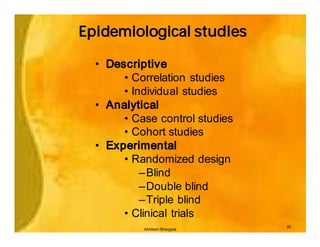
Epidemiological studies

  • Descriptive
       • Correlation studies
       • Individual studies
  • Analytical
       • Case control studies
       • Cohort studies
  • Experimental
       • Randomized design
           –Blind
           –Double blind
           –Triple blind
       • Clinical trials
                                20
           Akhilesh Bhargava
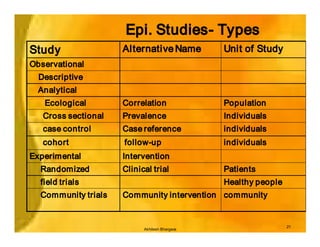
Epi. Studies- Types
Study                Alternative Name          Unit of Study
Observational
  Descriptive
  Analytical
   Ecological        Correlation               Population
   Cross sectional   Prevalence                Individuals
   case control      Case reference            individuals
   cohort            follow-up                 individuals
Experimental         Intervention
  Randomized         Clinical trial            Patients
  field trials                                 Healthy people
  Community trials   Community intervention community


                                                                21
                           Akhilesh Bhargava
Descriptive Epidemiology?

  Study of distribution of a disease in a
  population, and observing the basic
  features of its distribution in terms of
  time, place, and person.


                                             22
               Akhilesh Bhargava
Descriptive Epidemiology:
       Objectives

• To evaluate trends and allow comparison
  among different population groups
• To provide basis for planning, provision
  and evaluation of services
• To identify problems to be studied by
  analytical methods


                                         23
              Akhilesh Bhargava
Descriptive Epidemiology
       describes-

•   Who gets sick and who does not
•   Where Rates are highest and lowest
•   Temporal pattern of Disease
•   Seasonality
•   Secular trends decided by changes in-
       • Diagnostic techniques
       • Denominator data
       • Age distribution of population
       • Survival
       • Actual incidence
                                            24
               Akhilesh Bhargava
Reasons for changes in Trends:
             Real

   • Changes in Age distribution of
     population
   • Changes in Survival pattern
   • Changes in Actual incidence for
        • Genetic
        • Environmental factors


                                       25
               Akhilesh Bhargava
Reasons for changes in Trends:
          Artifactual
   • Errors in Numerator due to-
        • Changes in disease recognition
        • Change in classification of cause
        • Change in classification codes of cause of
          death
        • Changes in accuracy of reporting age at
          death
   • Errors in denominator due to errors of
     enumeration
   • ICD-10 has 8000 categories as
     compared to 4000 in ICD-9

                                                  26
                 Akhilesh Bhargava
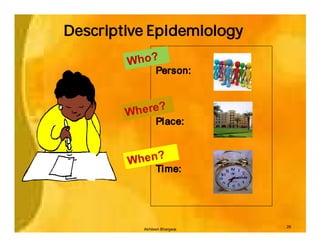
Descriptive Epidemiology


  Descriptive epidemiological approach
  attempts to describe the disease in
  terms of its attributes & variables and
  answers the questions like-
      • Who (Person)
      • Where (Place)
      • When (Time)


                                            27
              Akhilesh Bhargava
Descriptive Epidemiology

                Person:


                Place:


                Time:


                              28
          Akhilesh Bhargava
Who (Person) ?
Is getting the disease

 Attributes & Variables
 • Age
 • Sex
 • Ethnicity
 • Marital status
 • Occupation
 • Education
 • Income group…………

                            29
        Akhilesh Bhargava
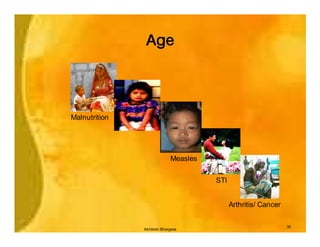
Age


Malnutrition


                            Measles

                                      STI


                                            Arthritis/ Cancer

                                                                30
               Akhilesh Bhargava
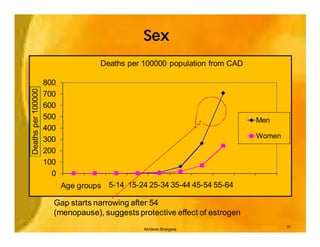
Sex
                                    Deaths per 100000 population from CAD

                    800
Deaths per 100000


                    700
                    600
                    500                                                     Men
                    400
                    300                                                     Women

                    200
                    100
                      0
                          Age groups 5-14 15-24 25-34 35-44 45-54 55-64
                            <1 1-4

                      Gap starts narrowing after 54
                      (menopause), suggests protective effect of estrogen
                                                                                    31
                                               Akhilesh Bhargava
Where (Place) ?
Where Rates are highest and
          lowest
     • Residence

     • Occupation/ Work place

     • At specific events

     • Geographic sites


                                32
       Akhilesh Bhargava
Time (When) ?
Reflects on trend

 •    Year
 •    Season
 •    Day
 •    Date of Onset
 •    Duration


                         33
     Akhilesh Bhargava
Time trends

• Secular (Changes that occur over
  long periods of time)
• Periodic (short term)
• Cyclic (Seasonal)
• Epidemic


                                     34
         Akhilesh Bhargava
Secular trend is influenced by:
• Changes in completeness of source of data
• Changes in diagnostic ability
     • Experience
     • Techniques
• Changes in data classification approach
  (ICD-9 to ICD-10)
• Demographic changes in population
• Changes in environment other than that
  which is related to disease
• Changes in clinical
  concepts, Diagnosis, Terminology
                                              35
                  Akhilesh Bhargava
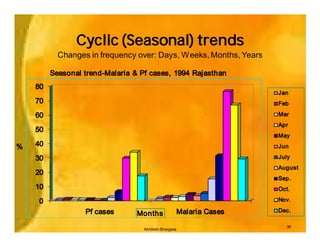
Cyclic (Seasonal) trends
           Changes in frequency over: Days, Weeks, Months, Years

         Seasonal trend-Malaria & Pf cases, 1994 Rajasthan
    80
                                                                       Jan
    70                                                                 Feb

    60                                                                 Mar
                                                                       Apr
    50
                                                                       May

%   40                                                                 Jun

    30                                                                 July
                                                                       August
    20
                                                                       Sep.
    10                                                                 Oct.

    0                                                                  Nov.

                  Pf cases                             Malaria Cases   Dec.
                                 Months
                                                                         36
                                   Akhilesh Bhargava
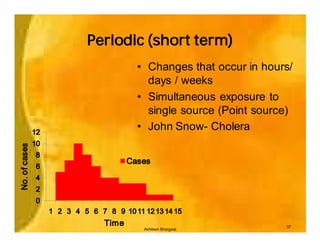
Periodic (short term)
                                           • Changes that occur in hours/
                                             days / weeks
                                           • Simultaneous exposure to
                                             single source (Point source)
               12
                                           • John Snow- Cholera
               10
No. of cases


               8
                                         Cases
               6
               4
               2
               0
                    1 2 3 4 5 6 7 8 9 10 11 12 13 14 15
                                  Time                                 37
                                             Akhilesh Bhargava
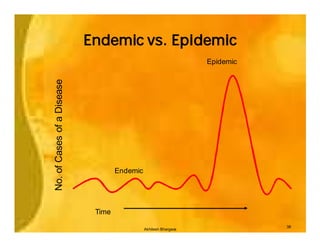
Endemic vs. Epidemic
No. of Cases of a Disease                                         Epidemic


                                    Endemic


                             Time
                                                                             38
                                              Akhilesh Bhargava
Let us make an educated guess:
         Hypotheses

   • Why some people get the disease and
     others do not
   • Why disease occurs in some places
     and not others
   • Why disease occurs at some time and
     not at others


                                           39
               Akhilesh Bhargava
Developing Hypotheses

•   Interrogate usual suspects!
•   Source of agent
•   Mode of transmission
•   Usual reservoirs
•   Known risk factors
•   Exposures that caused disease
•   Look at person, place and time for
    clues


                                         40
              Akhilesh Bhargava
Developing a hypotheses

 • Requires familiarity with disease

 • Hypothesis should be testable

 •   Still clueless?
 •   Talk with cases again
 •   Visit cases in their own situation
 •   Don’t forget outliers


                                          41
               Akhilesh Bhargava

General Epidemiology

  • 1.
    Principles of Epidemiology Dr. Akhilesh Bhargava MD, DHA, PGDHRM Prof. Community Medicine & Director-SIHFW, Jaipur
  • 2.
    Epidemiology The study ofdistribution and determinants of health problems in specified populations and the application of this study to the control of these problems. It is the scientific method of problem solving used by "disease detectives"--epidemiologists, laboratory scientists, statisticians, physicians and other health care providers, and public health professionals--to get to the root of health problems in a community. 2 Akhilesh Bhargava
  • 3.
    Epidemiology Define ? vA study of all diseases/health events Øinfectious/non-infectious Øacute/chronic Øcommunicable/non-communicable. vScience of rates expressed as probability v“ Anything that happens to people” 3 Akhilesh Bhargava
  • 4.
    Epidemiology: Gen. Objectives • Explaining the Causal mechanism of disease and process of deviation in Health. • Explaining the reason for Local disease occurrence. • Effective planning and administration of Health Care Services. 4 Akhilesh Bhargava
  • 5.
    Specific Objectives 1. Understandingcausation of disease with specific purpose of-- ØFormulation and selection/rejection of hypothesis. ØTesting hypothesis through *Survey *Observation studies 5 Akhilesh Bhargava
  • 6.
    Specific Objectives… 2. Testingvalidity of rationale of control /intervention programs 3. Classify disease/disability based on : Distribution Causal factors, and Natural history of disease 6 Akhilesh Bhargava
  • 7.
    Specific Objectives 4. Explaininglocal disease pattern 5. Administrative Guidance – In assessing Need, Utilization & Effectiveness – In monitoring & evaluation of control programs (cost effectiveness & cost benefit analysis) – In Logical Planning of • Services • Resources • Programs • Reach & • Risk Approach 7 Akhilesh Bhargava
  • 8.
    Planning: Terms • Planning-“anact or process of choosing between alternatives to accomplish preset goals”. • Plan denotes a blue print of action • Program is a strategy with defined Objectives. 8 Akhilesh Bhargava
  • 9.
    Goal: • The proposedlong-range benefits of the program for a specified area, defined in general terms. A goal is the ultimate objective; for example, “reducing the incidence of HIV in (a country).” 9 Akhilesh Bhargava
  • 10.
    Purpose: • The overallobjective (also called strategic objective) of the program, for example, “to increase the accessibility to and use of palliative care facilities in (a particular geographic area).” • ultimate measure of the program’s effectiveness. 10 Akhilesh Bhargava
  • 11.
    Objectives: • The anticipatedoutcomes or benefits that are the expected results of implementing a strategy. They are described in measurable terms and indicate a specific period of time during which these results will be achieved. • Should be SMART • specific, • measurable, • appropriate, • realistic, and • time-bound 11 Akhilesh Bhargava
  • 12.
    Strategy • A strategyis a plan (to choose) to achieve a particular goal or result; and reveals the logic of your choices. 12 Akhilesh Bhargava
  • 13.
    Approach: A statementthat describes how the program will achieve its objective. That is, activities that will help the program achieve its objectives most effectively and feasibly. 13 Akhilesh Bhargava
  • 14.
    Monitoring • A methodologicalarm of evaluation that tracks the program’s incremental steps to its effect and informs the final evaluation report. • A continual, routine effort requiring data gathering, analysis, and reporting on results at periodic intervals • Periodic, regular • Focuses on inputs, outputs, process outcomes, work plans • Basic purpose is improve efficiency and adjust work plan 14 Akhilesh Bhargava
  • 15.
    Evaluation • A technicalactivity that measures the program’s impact and effectiveness as a whole. • Is not about assigning a “grade” of success or failure at the end of a project. • Episodic • Focuses on effectiveness, relevance, impact, cost-effectiveness • Basic purpose - improve effectiveness, impact, and future programming 15 Akhilesh Bhargava
  • 16.
    Epidemiology: Basic approach • Counts cases (events). • Defines involved population. • Determines rates/proportions • Compares rates. • Makes inferences 16 Akhilesh Bhargava
  • 17.
    Epidemiology? “Study of distributionand determinants of health related state or events & disease in human population” “Science of rates expressed as probability” 17 Akhilesh Bhargava
  • 18.
    Uses of Epidemiology • Describe Health events • Identify the cause of disease • Identify the Risk factors • Describe clinical pattern of disease and identify syndromes • Identify effective control and/or preventive measures • Risk Approach 18 Akhilesh Bhargava
  • 19.
    Uses of Epidemiology • Take suitable administrative measures in- • Assessing Need, Utilization & Effectiveness • Monitoring & evaluation of control programs (cost effectiveness & cost benefit analysis) • Logical Planning of » Services » Resources » Programs » Reach & 19 Akhilesh Bhargava
  • 20.
    Epidemiological studies • Descriptive • Correlation studies • Individual studies • Analytical • Case control studies • Cohort studies • Experimental • Randomized design –Blind –Double blind –Triple blind • Clinical trials 20 Akhilesh Bhargava
  • 21.
    Epi. Studies- Types Study Alternative Name Unit of Study Observational Descriptive Analytical Ecological Correlation Population Cross sectional Prevalence Individuals case control Case reference individuals cohort follow-up individuals Experimental Intervention Randomized Clinical trial Patients field trials Healthy people Community trials Community intervention community 21 Akhilesh Bhargava
  • 22.
    Descriptive Epidemiology? Study of distribution of a disease in a population, and observing the basic features of its distribution in terms of time, place, and person. 22 Akhilesh Bhargava
  • 23.
    Descriptive Epidemiology: Objectives • To evaluate trends and allow comparison among different population groups • To provide basis for planning, provision and evaluation of services • To identify problems to be studied by analytical methods 23 Akhilesh Bhargava
  • 24.
    Descriptive Epidemiology describes- • Who gets sick and who does not • Where Rates are highest and lowest • Temporal pattern of Disease • Seasonality • Secular trends decided by changes in- • Diagnostic techniques • Denominator data • Age distribution of population • Survival • Actual incidence 24 Akhilesh Bhargava
  • 25.
    Reasons for changesin Trends: Real • Changes in Age distribution of population • Changes in Survival pattern • Changes in Actual incidence for • Genetic • Environmental factors 25 Akhilesh Bhargava
  • 26.
    Reasons for changesin Trends: Artifactual • Errors in Numerator due to- • Changes in disease recognition • Change in classification of cause • Change in classification codes of cause of death • Changes in accuracy of reporting age at death • Errors in denominator due to errors of enumeration • ICD-10 has 8000 categories as compared to 4000 in ICD-9 26 Akhilesh Bhargava
  • 27.
    Descriptive Epidemiology Descriptive epidemiological approach attempts to describe the disease in terms of its attributes & variables and answers the questions like- • Who (Person) • Where (Place) • When (Time) 27 Akhilesh Bhargava
  • 28.
    Descriptive Epidemiology Person: Place: Time: 28 Akhilesh Bhargava
  • 29.
    Who (Person) ? Isgetting the disease Attributes & Variables • Age • Sex • Ethnicity • Marital status • Occupation • Education • Income group………… 29 Akhilesh Bhargava
  • 30.
    Age Malnutrition Measles STI Arthritis/ Cancer 30 Akhilesh Bhargava
  • 31.
    Sex Deaths per 100000 population from CAD 800 Deaths per 100000 700 600 500 Men 400 300 Women 200 100 0 Age groups 5-14 15-24 25-34 35-44 45-54 55-64 <1 1-4 Gap starts narrowing after 54 (menopause), suggests protective effect of estrogen 31 Akhilesh Bhargava
  • 32.
    Where (Place) ? WhereRates are highest and lowest • Residence • Occupation/ Work place • At specific events • Geographic sites 32 Akhilesh Bhargava
  • 33.
    Time (When) ? Reflectson trend • Year • Season • Day • Date of Onset • Duration 33 Akhilesh Bhargava
  • 34.
    Time trends • Secular(Changes that occur over long periods of time) • Periodic (short term) • Cyclic (Seasonal) • Epidemic 34 Akhilesh Bhargava
  • 35.
    Secular trend isinfluenced by: • Changes in completeness of source of data • Changes in diagnostic ability • Experience • Techniques • Changes in data classification approach (ICD-9 to ICD-10) • Demographic changes in population • Changes in environment other than that which is related to disease • Changes in clinical concepts, Diagnosis, Terminology 35 Akhilesh Bhargava
  • 36.
    Cyclic (Seasonal) trends Changes in frequency over: Days, Weeks, Months, Years Seasonal trend-Malaria & Pf cases, 1994 Rajasthan 80 Jan 70 Feb 60 Mar Apr 50 May % 40 Jun 30 July August 20 Sep. 10 Oct. 0 Nov. Pf cases Malaria Cases Dec. Months 36 Akhilesh Bhargava
  • 37.
    Periodic (short term) • Changes that occur in hours/ days / weeks • Simultaneous exposure to single source (Point source) 12 • John Snow- Cholera 10 No. of cases 8 Cases 6 4 2 0 1 2 3 4 5 6 7 8 9 10 11 12 13 14 15 Time 37 Akhilesh Bhargava
  • 38.
    Endemic vs. Epidemic No.of Cases of a Disease Epidemic Endemic Time 38 Akhilesh Bhargava
  • 39.
    Let us makean educated guess: Hypotheses • Why some people get the disease and others do not • Why disease occurs in some places and not others • Why disease occurs at some time and not at others 39 Akhilesh Bhargava
  • 40.
    Developing Hypotheses • Interrogate usual suspects! • Source of agent • Mode of transmission • Usual reservoirs • Known risk factors • Exposures that caused disease • Look at person, place and time for clues 40 Akhilesh Bhargava
  • 41.
    Developing a hypotheses • Requires familiarity with disease • Hypothesis should be testable • Still clueless? • Talk with cases again • Visit cases in their own situation • Don’t forget outliers 41 Akhilesh Bhargava