Transforming Comprehensive Healthcare in India
INTEGRATED DISEASES SURVEILLANCE
PROGRAM
 DR.ANJALATCHI MUTHUKUMARAN
 VICE PRINCIPAL
 ERA COLLEGE OF NURSING
Transforming Comprehensive Healthcare in India
CONTENT OF THE CHAPTER
 Introduction
 Objectives
 Need for IDSP
 Components
 Surveillance
 Weekly report
 Administrative structure
 role of CHO officer
 Refernces
Transforming Comprehensive Healthcare in India
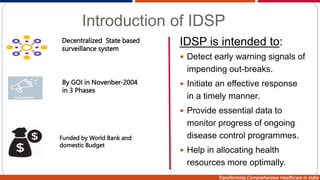
Introduction of IDSP
IDSP is intended to:
 Detect early warning signals of
impending out-breaks.
 Initiate an effective response
in a timely manner.
 Provide essential data to
monitor progress of ongoing
disease control programmes.
 Help in allocating health
resources more optimally.
Decentralized State based
surveillance system
By GOI in Novenber-2004
in 3 Phases
Funded by World Bank and
domestic Budget
Transforming Comprehensive Healthcare in India
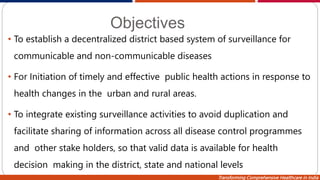
Objectives
• To establish a decentralized district based system of surveillance for
communicable and non-communicable diseases
• For Initiation of timely and effective public health actions in response to
health changes in the urban and rural areas.
• To integrate existing surveillance activities to avoid duplication and
facilitate sharing of information across all disease control programmes
and other stake holders, so that valid data is available for health
decision making in the district, state and national levels
Transforming Comprehensive Healthcare in India
Need for IDSP
 Separate data collection and use separately by the various program
managers
 Data was never used comprehensively at national level
 Huge resources were being used separately and sometimes
duplication of funds also occurred
 Epidemiological impact of the outbreak control measures can be expected
to be significant only if these measures are APPLIED IN TIME.
Transforming Comprehensive Healthcare in India
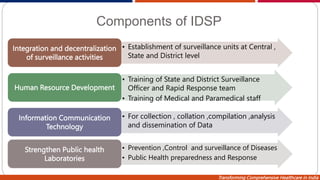
Components of IDSP
• Establishment of surveillance units at Central ,
State and District level
Integration and decentralization
of surveillance activities
• Training of State and District Surveillance
Officer and Rapid Response team
• Training of Medical and Paramedical staff
Human Resource Development
• For collection , collation ,compilation ,analysis
and dissemination of Data
Information Communication
Technology
• Prevention ,Control and surveillance of Diseases
• Public Health preparedness and Response
Strengthen Public health
Laboratories
Transforming Comprehensive Healthcare in India
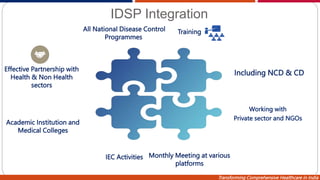
IDSP Integration
Effective Partnership with
Health & Non Health
sectors
Working with
Private sector and NGOs
All National Disease Control
Programmes
Including NCD & CD
Academic Institution and
Medical Colleges
IEC Activities
Training
Monthly Meeting at various
platforms
Transforming Comprehensive Healthcare in India
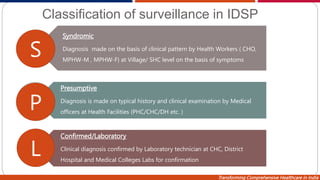
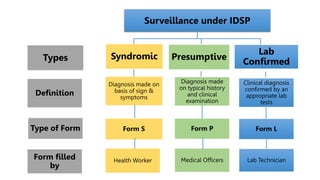
Classification of surveillance in IDSP
Syndromic
Diagnosis made on the basis of clinical pattern by Health Workers ( CHO,
MPHW-M , MPHW-F) at Village/ SHC level on the basis of symptoms
Presumptive
Diagnosis is made on typical history and clinical examination by Medical
officers at Health Facilities (PHC/CHC/DH etc. )
Confirmed/Laboratory
Clinical diagnosis confirmed by Laboratory technician at CHC, District
Hospital and Medical Colleges Labs for confirmation
P
S
L
Types Presumptive
Lab
Confirmed
Definition
Diagnosis made on
basis of sign &
symptoms
Diagnosis made
on typical history
and clinical
examination
Clinical diagnosis
confirmed by an
appropriate lab
tests
Type of Form Form S Form P Form L
Form filled
by
Health Worker Medical Officers Lab Technician
Types Syndromic
Surveillance under IDSP
Transforming Comprehensive Healthcare in India
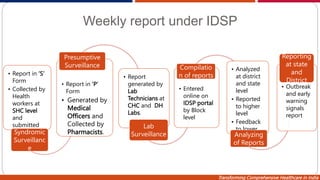
Weekly report under IDSP
• Report in ‘S’
Form
• Collected by
Health
workers at
SHC level
and
submitted
at CHC
level.
Syndromic
Surveillanc
e
• Report in ‘P’
Form
• Generated by
Medical
Officers and
Collected by
Pharmacists.
Presumptive
Surveillance
• Report
generated by
Lab
Technicians at
CHC and DH
Labs.
Lab
Surveillance
• Entered
online on
IDSP portal
by Block
level
Compilatio
n of reports
• Analyzed
at district
and state
level
• Reported
to higher
level
• Feedback
to lower
level
Analyzing
of Reports
• Outbreak
and early
warning
signals
report
Reporting
at state
and
District
Transforming Comprehensive Healthcare in India
11
Transforming Comprehensive Healthcare in India
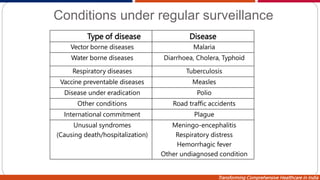
Conditions under regular surveillance
Type of disease Disease
Vector borne diseases Malaria
Water borne diseases Diarrhoea, Cholera, Typhoid
Respiratory diseases Tuberculosis
Vaccine preventable diseases Measles
Disease under eradication Polio
Other conditions Road traffic accidents
International commitment Plague
Unusual syndromes Meningo-encephalitis
(Causing death/hospitalization) Respiratory distress
Hemorrhagic fever
Other undiagnosed condition
Transforming Comprehensive Healthcare in India
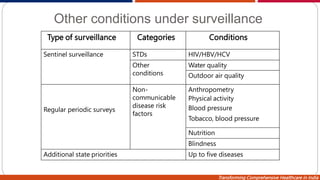
Other conditions under surveillance
Type of surveillance Categories Conditions
Sentinel surveillance STDs HIV/HBV/HCV
Other
conditions
Water quality
Outdoor air quality
Regular periodic surveys
Non-
communicable
disease risk
factors
Anthropometry
Physical activity
Blood pressure
Tobacco, blood pressure
Nutrition
Blindness
Additional state priorities Up to five diseases
Transforming Comprehensive Healthcare in India
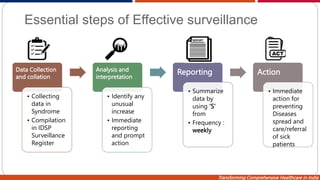
Essential steps of Effective surveillance
Data Collection
and collation
• Collecting
data in
Syndrome
• Compilation
in IDSP
Surveillance
Register
Analysis and
interpretation
• Identify any
unusual
increase
• Immediate
reporting
and prompt
action
Reporting
• Summarize
data by
using ‘S’
from
• Frequency :
weekly
Action
• Immediate
action for
preventing
Diseases
spread and
care/referral
of sick
patients
Transforming Comprehensive Healthcare in India
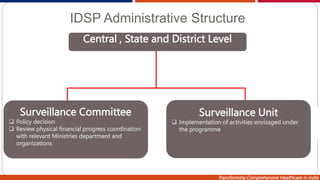
IDSP Administrative Structure
Central , State and District Level
Surveillance Committee
 Policy decision
 Review physical financial progress coordination
with relevant Ministries department and
organizations
Surveillance Unit
 Implementation of activities envisaged under
the programme
Transforming Comprehensive Healthcare in India
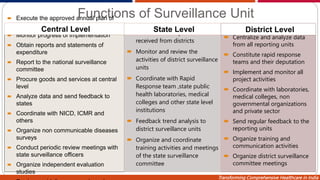
Functions of Surveillance Unit
 Execute the approved annual plan of
action
 Monitor progress of implementation
 Obtain reports and statements of
expenditure
 Report to the national surveillance
committee
 Procure goods and services at central
level
 Analyze data and send feedback to
states
 Coordinate with NICD, ICMR and
others
 Organize non communicable diseases
surveys
 Conduct periodic review meetings with
state surveillance officers
 Organize independent evaluation
studies
 Centralize and analyze data
from all reporting units
 Constitute rapid response
teams and their deputation
 Implement and monitor all
project activities
 Coordinate with laboratories,
medical colleges, non
governmental organizations
and private sector
 Send regular feedback to the
reporting units
 Organize training and
communication activities
 Organize district surveillance
committee meetings
 Collate and analyze data
received from districts
 Monitor and review the
activities of district surveillance
units
 Coordinate with Rapid
Response team ,state public
health laboratories, medical
colleges and other state level
institutions
 Feedback trend analysis to
district surveillance units
 Organize and coordinate
training activities and meetings
of the state surveillance
committee
State Level District Level
Central Level
Transforming Comprehensive Healthcare in India
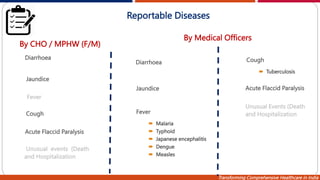
Reportable Diseases
Diarrhoea
Jaundice
Cough
Acute Flaccid Paralysis
Cough
 Tuberculosis
By CHO / MPHW (F/M)
By Medical Officers
Unusual events (Death
and Hospitalization
Diarrhoea
Jaundice
Fever
 Malaria
 Typhoid
 Japanese encephalitis
 Dengue
 Measles
Fever
Unusual Events (Death
and Hospitalization
Transforming Comprehensive Healthcare in India
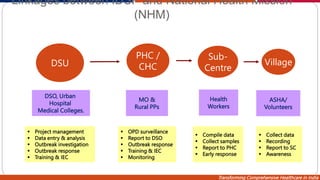
Linkages between IDSP and National Health Mission
(NHM)
Sub-
Centre
Village
DSU
PHC /
CHC
ASHA/
Volunteers
Health
Workers
MO &
Rural PPs
DSO, Urban
Hospital
Medical Colleges.
 Project management
 Data entry & analysis
 Outbreak investigation
 Outbreak response
 Training & IEC
 OPD surveillance
 Report to DSO
 Outbreak response
 Training & IEC
 Monitoring
 Compile data
 Collect samples
 Report to PHC
 Early response
 Collect data
 Recording
 Report to SC
 Awareness
Transforming Comprehensive Healthcare in India
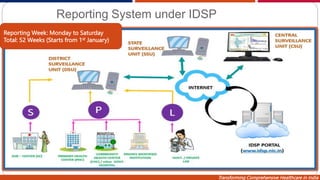
Reporting System under IDSP
Reporting Week: Monday to Saturday
Total: 52 Weeks (Starts from 1st January)
Transforming Comprehensive Healthcare in India
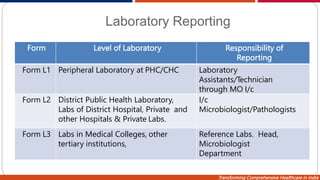
Form Level of Laboratory Responsibility of
Reporting
Form L1 Peripheral Laboratory at PHC/CHC Laboratory
Assistants/Technician
through MO I/c
Form L2 District Public Health Laboratory,
Labs of District Hospital, Private and
other Hospitals & Private Labs.
I/c
Microbiologist/Pathologists
Form L3 Labs in Medical Colleges, other
tertiary institutions,
Reference Labs. Head,
Microbiologist
Department
Laboratory Reporting
Transforming Comprehensive Healthcare in India
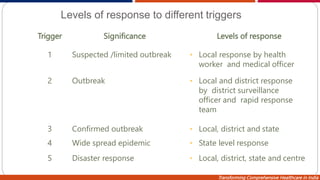
Levels of response to different triggers
Trigger Significance Levels of response
1 Suspected /limited outbreak • Local response by health
worker and medical officer
2 Outbreak • Local and district response
by district surveillance
officer and rapid response
team
3 Confirmed outbreak • Local, district and state
4 Wide spread epidemic • State level response
5 Disaster response • Local, district, state and centre
41
Transforming Comprehensive Healthcare in India
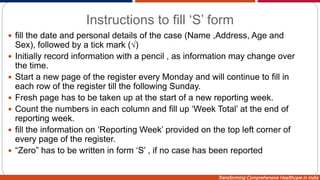
Instructions to fill ‘S’ form
 fill the date and personal details of the case (Name ,Address, Age and
Sex), followed by a tick mark (√)
 Initially record information with a pencil , as information may change over
the time.
 Start a new page of the register every Monday and will continue to fill in
each row of the register till the following Sunday.
 Fresh page has to be taken up at the start of a new reporting week.
 Count the numbers in each column and fill up ‘Week Total’ at the end of
reporting week.
 fill the information on ‘Reporting Week’ provided on the top left corner of
every page of the register.
 “Zero” has to be written in form ‘S’ , if no case has been reported
Transforming Comprehensive Healthcare in India
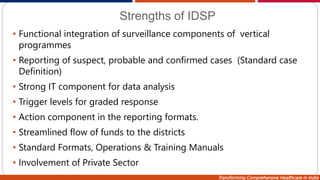
Strengths of IDSP
• Functional integration of surveillance components of vertical
programmes
• Reporting of suspect, probable and confirmed cases (Standard case
Definition)
• Strong IT component for data analysis
• Trigger levels for graded response
• Action component in the reporting formats.
• Streamlined flow of funds to the districts
• Standard Formats, Operations & Training Manuals
• Involvement of Private Sector
Transforming Comprehensive Healthcare in India
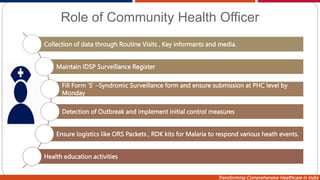
Role of Community Health Officer
Collection of data through Routine Visits , Key informants and media.
Maintain IDSP Surveillance Register
Fill Form ‘S’ –Syndromic Surveillance form and ensure submission at PHC level by
Monday
Detection of Outbreak and implement initial control measures
Ensure logistics like ORS Packets , RDK kits for Malaria to respond various heath events.
Health education activities
Transforming Comprehensive Healthcare in India
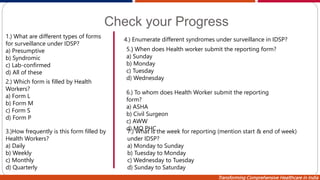
Check your Progress
1.) What are different types of forms
for surveillance under IDSP?
a) Presumptive
b) Syndromic
c) Lab-confirmed
d) All of these
2.) Which form is filled by Health
Workers?
a) Form L
b) Form M
c) Form S
d) Form P
3.)How frequently is this form filled by
Health Workers?
a) Daily
b) Weekly
c) Monthly
d) Quarterly
4.) Enumerate different syndromes under surveillance in IDSP?
5.) When does Health worker submit the reporting form?
a) Sunday
b) Monday
c) Tuesday
d) Wednesday
6.) To whom does Health Worker submit the reporting
form?
a) ASHA
b) Civil Surgeon
c) AWW
d) MO PHC
7.) What is the week for reporting (mention start & end of week)
under IDSP?
a) Monday to Sunday
b) Tuesday to Monday
c) Wednesday to Tuesday
d) Sunday to Saturday
Transforming Comprehensive Healthcare in India
References
• Park’s Textbook of Preventive and Social Medicine, K.Park, 24th Edition
, Bhanot Publisher
• Integrated Diseases Surveillance Programme- Manual for Health
Workers
• IDSP website- https://idsp.nic.in

IDSP.pptx

  • 1.
    Transforming Comprehensive Healthcarein India INTEGRATED DISEASES SURVEILLANCE PROGRAM  DR.ANJALATCHI MUTHUKUMARAN  VICE PRINCIPAL  ERA COLLEGE OF NURSING
  • 2.
    Transforming Comprehensive Healthcarein India CONTENT OF THE CHAPTER  Introduction  Objectives  Need for IDSP  Components  Surveillance  Weekly report  Administrative structure  role of CHO officer  Refernces
  • 3.
    Transforming Comprehensive Healthcarein India Introduction of IDSP IDSP is intended to:  Detect early warning signals of impending out-breaks.  Initiate an effective response in a timely manner.  Provide essential data to monitor progress of ongoing disease control programmes.  Help in allocating health resources more optimally. Decentralized State based surveillance system By GOI in Novenber-2004 in 3 Phases Funded by World Bank and domestic Budget
  • 4.
    Transforming Comprehensive Healthcarein India Objectives • To establish a decentralized district based system of surveillance for communicable and non-communicable diseases • For Initiation of timely and effective public health actions in response to health changes in the urban and rural areas. • To integrate existing surveillance activities to avoid duplication and facilitate sharing of information across all disease control programmes and other stake holders, so that valid data is available for health decision making in the district, state and national levels
  • 5.
    Transforming Comprehensive Healthcarein India Need for IDSP  Separate data collection and use separately by the various program managers  Data was never used comprehensively at national level  Huge resources were being used separately and sometimes duplication of funds also occurred  Epidemiological impact of the outbreak control measures can be expected to be significant only if these measures are APPLIED IN TIME.
  • 6.
    Transforming Comprehensive Healthcarein India Components of IDSP • Establishment of surveillance units at Central , State and District level Integration and decentralization of surveillance activities • Training of State and District Surveillance Officer and Rapid Response team • Training of Medical and Paramedical staff Human Resource Development • For collection , collation ,compilation ,analysis and dissemination of Data Information Communication Technology • Prevention ,Control and surveillance of Diseases • Public Health preparedness and Response Strengthen Public health Laboratories
  • 7.
    Transforming Comprehensive Healthcarein India IDSP Integration Effective Partnership with Health & Non Health sectors Working with Private sector and NGOs All National Disease Control Programmes Including NCD & CD Academic Institution and Medical Colleges IEC Activities Training Monthly Meeting at various platforms
  • 8.
    Transforming Comprehensive Healthcarein India Classification of surveillance in IDSP Syndromic Diagnosis made on the basis of clinical pattern by Health Workers ( CHO, MPHW-M , MPHW-F) at Village/ SHC level on the basis of symptoms Presumptive Diagnosis is made on typical history and clinical examination by Medical officers at Health Facilities (PHC/CHC/DH etc. ) Confirmed/Laboratory Clinical diagnosis confirmed by Laboratory technician at CHC, District Hospital and Medical Colleges Labs for confirmation P S L
  • 9.
    Types Presumptive Lab Confirmed Definition Diagnosis madeon basis of sign & symptoms Diagnosis made on typical history and clinical examination Clinical diagnosis confirmed by an appropriate lab tests Type of Form Form S Form P Form L Form filled by Health Worker Medical Officers Lab Technician Types Syndromic Surveillance under IDSP
  • 10.
    Transforming Comprehensive Healthcarein India Weekly report under IDSP • Report in ‘S’ Form • Collected by Health workers at SHC level and submitted at CHC level. Syndromic Surveillanc e • Report in ‘P’ Form • Generated by Medical Officers and Collected by Pharmacists. Presumptive Surveillance • Report generated by Lab Technicians at CHC and DH Labs. Lab Surveillance • Entered online on IDSP portal by Block level Compilatio n of reports • Analyzed at district and state level • Reported to higher level • Feedback to lower level Analyzing of Reports • Outbreak and early warning signals report Reporting at state and District
  • 11.
  • 12.
    Transforming Comprehensive Healthcarein India Conditions under regular surveillance Type of disease Disease Vector borne diseases Malaria Water borne diseases Diarrhoea, Cholera, Typhoid Respiratory diseases Tuberculosis Vaccine preventable diseases Measles Disease under eradication Polio Other conditions Road traffic accidents International commitment Plague Unusual syndromes Meningo-encephalitis (Causing death/hospitalization) Respiratory distress Hemorrhagic fever Other undiagnosed condition
  • 13.
    Transforming Comprehensive Healthcarein India Other conditions under surveillance Type of surveillance Categories Conditions Sentinel surveillance STDs HIV/HBV/HCV Other conditions Water quality Outdoor air quality Regular periodic surveys Non- communicable disease risk factors Anthropometry Physical activity Blood pressure Tobacco, blood pressure Nutrition Blindness Additional state priorities Up to five diseases
  • 14.
    Transforming Comprehensive Healthcarein India Essential steps of Effective surveillance Data Collection and collation • Collecting data in Syndrome • Compilation in IDSP Surveillance Register Analysis and interpretation • Identify any unusual increase • Immediate reporting and prompt action Reporting • Summarize data by using ‘S’ from • Frequency : weekly Action • Immediate action for preventing Diseases spread and care/referral of sick patients
  • 15.
    Transforming Comprehensive Healthcarein India IDSP Administrative Structure Central , State and District Level Surveillance Committee  Policy decision  Review physical financial progress coordination with relevant Ministries department and organizations Surveillance Unit  Implementation of activities envisaged under the programme
  • 16.
    Transforming Comprehensive Healthcarein India Functions of Surveillance Unit  Execute the approved annual plan of action  Monitor progress of implementation  Obtain reports and statements of expenditure  Report to the national surveillance committee  Procure goods and services at central level  Analyze data and send feedback to states  Coordinate with NICD, ICMR and others  Organize non communicable diseases surveys  Conduct periodic review meetings with state surveillance officers  Organize independent evaluation studies  Centralize and analyze data from all reporting units  Constitute rapid response teams and their deputation  Implement and monitor all project activities  Coordinate with laboratories, medical colleges, non governmental organizations and private sector  Send regular feedback to the reporting units  Organize training and communication activities  Organize district surveillance committee meetings  Collate and analyze data received from districts  Monitor and review the activities of district surveillance units  Coordinate with Rapid Response team ,state public health laboratories, medical colleges and other state level institutions  Feedback trend analysis to district surveillance units  Organize and coordinate training activities and meetings of the state surveillance committee State Level District Level Central Level
  • 17.
    Transforming Comprehensive Healthcarein India Reportable Diseases Diarrhoea Jaundice Cough Acute Flaccid Paralysis Acute Flaccid Paralysis Cough  Tuberculosis By CHO / MPHW (F/M) By Medical Officers Unusual events (Death and Hospitalization Diarrhoea Jaundice Fever  Malaria  Typhoid  Japanese encephalitis  Dengue  Measles Fever Unusual Events (Death and Hospitalization
  • 18.
    Transforming Comprehensive Healthcarein India Linkages between IDSP and National Health Mission (NHM) Sub- Centre Village DSU PHC / CHC ASHA/ Volunteers Health Workers MO & Rural PPs DSO, Urban Hospital Medical Colleges.  Project management  Data entry & analysis  Outbreak investigation  Outbreak response  Training & IEC  OPD surveillance  Report to DSO  Outbreak response  Training & IEC  Monitoring  Compile data  Collect samples  Report to PHC  Early response  Collect data  Recording  Report to SC  Awareness
  • 19.
    Transforming Comprehensive Healthcarein India Reporting System under IDSP Reporting Week: Monday to Saturday Total: 52 Weeks (Starts from 1st January)
  • 20.
    Transforming Comprehensive Healthcarein India Form Level of Laboratory Responsibility of Reporting Form L1 Peripheral Laboratory at PHC/CHC Laboratory Assistants/Technician through MO I/c Form L2 District Public Health Laboratory, Labs of District Hospital, Private and other Hospitals & Private Labs. I/c Microbiologist/Pathologists Form L3 Labs in Medical Colleges, other tertiary institutions, Reference Labs. Head, Microbiologist Department Laboratory Reporting
  • 21.
    Transforming Comprehensive Healthcarein India Levels of response to different triggers Trigger Significance Levels of response 1 Suspected /limited outbreak • Local response by health worker and medical officer 2 Outbreak • Local and district response by district surveillance officer and rapid response team 3 Confirmed outbreak • Local, district and state 4 Wide spread epidemic • State level response 5 Disaster response • Local, district, state and centre 41
  • 22.
    Transforming Comprehensive Healthcarein India Instructions to fill ‘S’ form  fill the date and personal details of the case (Name ,Address, Age and Sex), followed by a tick mark (√)  Initially record information with a pencil , as information may change over the time.  Start a new page of the register every Monday and will continue to fill in each row of the register till the following Sunday.  Fresh page has to be taken up at the start of a new reporting week.  Count the numbers in each column and fill up ‘Week Total’ at the end of reporting week.  fill the information on ‘Reporting Week’ provided on the top left corner of every page of the register.  “Zero” has to be written in form ‘S’ , if no case has been reported
  • 23.
    Transforming Comprehensive Healthcarein India Strengths of IDSP • Functional integration of surveillance components of vertical programmes • Reporting of suspect, probable and confirmed cases (Standard case Definition) • Strong IT component for data analysis • Trigger levels for graded response • Action component in the reporting formats. • Streamlined flow of funds to the districts • Standard Formats, Operations & Training Manuals • Involvement of Private Sector
  • 24.
    Transforming Comprehensive Healthcarein India Role of Community Health Officer Collection of data through Routine Visits , Key informants and media. Maintain IDSP Surveillance Register Fill Form ‘S’ –Syndromic Surveillance form and ensure submission at PHC level by Monday Detection of Outbreak and implement initial control measures Ensure logistics like ORS Packets , RDK kits for Malaria to respond various heath events. Health education activities
  • 25.
    Transforming Comprehensive Healthcarein India Check your Progress 1.) What are different types of forms for surveillance under IDSP? a) Presumptive b) Syndromic c) Lab-confirmed d) All of these 2.) Which form is filled by Health Workers? a) Form L b) Form M c) Form S d) Form P 3.)How frequently is this form filled by Health Workers? a) Daily b) Weekly c) Monthly d) Quarterly 4.) Enumerate different syndromes under surveillance in IDSP? 5.) When does Health worker submit the reporting form? a) Sunday b) Monday c) Tuesday d) Wednesday 6.) To whom does Health Worker submit the reporting form? a) ASHA b) Civil Surgeon c) AWW d) MO PHC 7.) What is the week for reporting (mention start & end of week) under IDSP? a) Monday to Sunday b) Tuesday to Monday c) Wednesday to Tuesday d) Sunday to Saturday
  • 26.
    Transforming Comprehensive Healthcarein India References • Park’s Textbook of Preventive and Social Medicine, K.Park, 24th Edition , Bhanot Publisher • Integrated Diseases Surveillance Programme- Manual for Health Workers • IDSP website- https://idsp.nic.in