1 | P a g e 
The University of Zambia 
School of veterinary medicine 
Department of paraclinical studies 
Name: Musalo Brian 
Computer #: 10008047 
Course code: VMP-4400 
Lab: Identification of ticks and mites 
Attention: Mr.chota 
Date: 10/03/14
Title: identification of insects 
Aim: to identify insects of the orders Diptera, Siphonaptera, Phthiraptera and Hemiptera of 
veterinary and medical importance. 
2 | P a g e 
INTRODUCTION 
The order Diptera also known as true flies are one of the most diverse orders of insects both 
morphologically & biologically. The order name means ‘two-winged’ and refers to the fact 
that the hind pair of wings is greatly modified and reduced. This order has over 120,000 species 
worldwide. Although flies with medical and veterinary significance constitute only a small 
fraction of these numbers, their diversity is impressive, ranging from mosquitoes, larvae that 
parasitize various animals, and species that help to decompose carrion or feces. No other 
group of insects has much impact on human and animal health as do the Diptera (Mullen G. & 
Durden L. 2002). 
The order Siphonaptera are fleas. These are morphologically unique ectoparasites that are 
unlikely to be confused with any other arthropods. They are a monophyletic group that has 
evolutionary ties with the mecopteroid insects order mecoptera and diptera. Fleas evolved 
from winged ancestors during the late Jurassic or early cretaceous period 125-150 million years 
ago. As a group, they have principally evolved as parasites of mammals on 94% of known 
species feed, representing 15 families and more than 200 genera of fleas. The remaining 6%, 
representing 5 families and 25 genera, are ectoparasites of birds (Mullen G. & Durden L. 2002). 
This is an appropriate appellation for these secondarily wingless insects whose mouthparts 
are adapted for piercing skin and sucking blood (http://www.cals.ncsu.edu/siphonaptera). 
The order Hemiptera includes all of the insects known as true bugs. Hemiptera are 
characterized as soft-bodied insects with piercing and sucking mouthparts and, usually, two 
pairs of wings. The order traditionally is divided into two major divisions: the Heteroptera and 
the Homoptera. The name Hemiptera means ‘half wings’ and is derived from the members of 
the Heteroptera (different wings), most of which have fore wings called Hemelytra. They are 
composed of the corium and clavus and a transparent, filmy distal portion as well as the 
membrane, hence the idea of a half wing. The hind wings are completely membranous. The 
difference in texture between the fore and hind wings in the heteropterans give this group its 
name. The true bugs have about 90,000 species worldwide and constitutes the largest 
exopterygote order of insects (Mullen G. & Durden L 2002). 
The order Phthiraptera are lice. These are a menace to humans, pets, and livestock, not only 
because of their blood-feeding or chewing habits, but also because of their ability to transmit 
pathogens. The human body louse has been indirectly responsible for influencing human
history through its ability to transmit the causative agent of typhus. However, most of the 
3200 known species of lice are ectoparasites of wild birds or mammals and have no known 
medical or veterinary importance. The order Phthiraptera is divided into two suborders: 
Anoplura (sucking lice) & Mallophaga (chewing or biting lice). All members of the Anoplura 
are obligate, hematophagous ectoparasites of placental mammals, whereas the more diverse 
Mallophaga include species that are obligate associates of birds, marsupials and placental 
mammals. Although certain chewing lice imbibe blood, most species ingest host feather, fur, 
skin, or skin products. Because of the different feeding strategies of the two groups, the blood 
feeding Anoplura are far more important than the Mallophaga in transmitting pathogens to 
their hosts (Mullen G. & Durden L. 2002). 
3 | P a g e 
MATERIAL 
Material: 
 Microscopes 
 Glass slide 
 Cover slip 
 70% preservative alcohol 
Specimens: 
Diptera 
 Nematocera: (mosquitoes-adult, larvae and pupa) 
 Brachycera- Tabanus species (adult) 
 Cyclorrhapha: (house fly-Musca domestica, Tsetse fly (glossina spp), stomoxys (stable 
fly)) 
Phthiraptera 
 Mallophaga: (Manacanthus spp) 
 Anoplura: (Haematopinus suis) 
Siphonaptera 
 Ctenocephalides felis 
 Ctenocephalides canis 
 Echinophaga gallinacean 
Hemiptera
4 | P a g e 
 Triatoma infestans 
 Cimex spp 
PROCEDURE 
All the provided specimens were observed grossly and microscopically and special/unique 
features that differentiate and help in the classification and identification of these insects on 
each specimen were observed 
RESULTS 
Observations Characteristics 
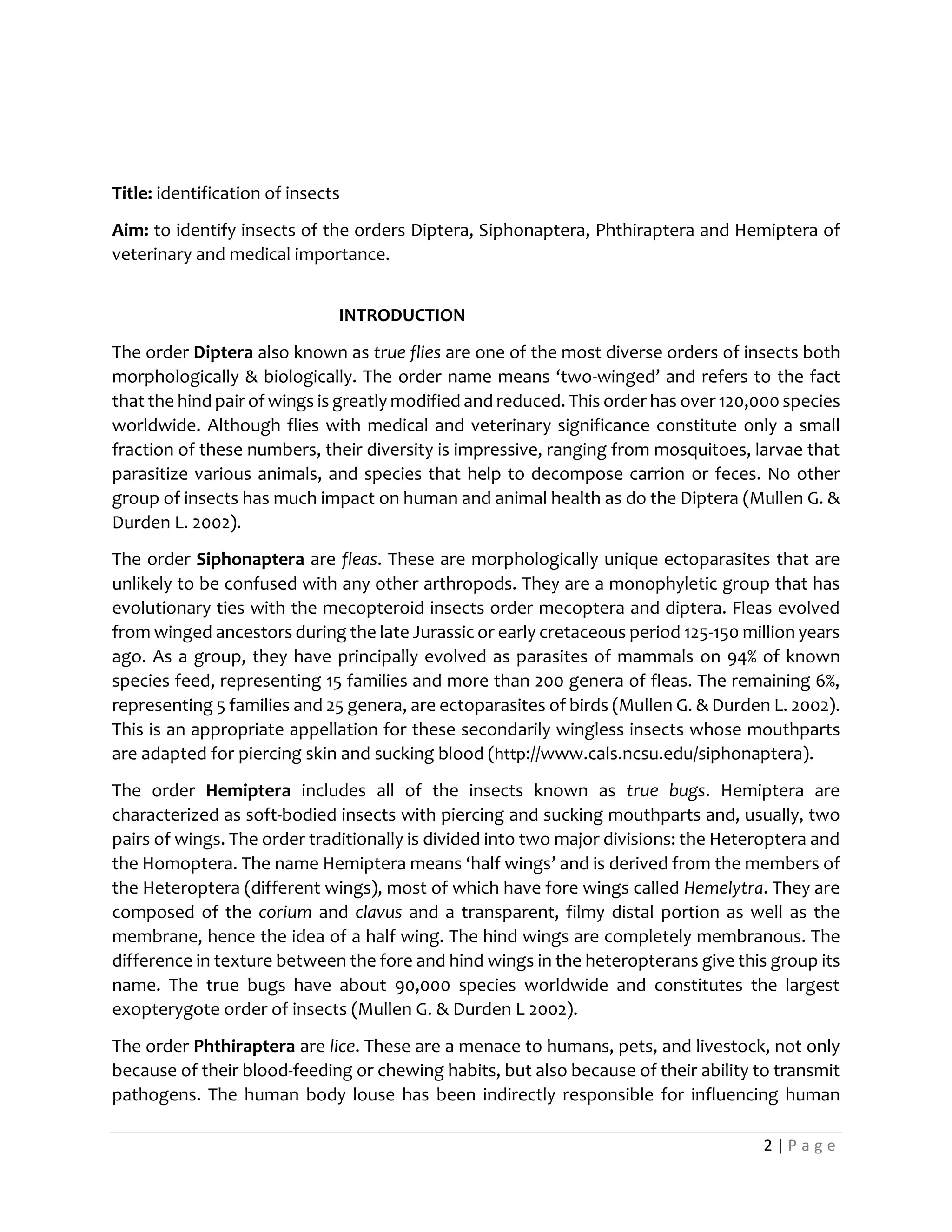
Sub-order: Nematocera 
Order: Diptera 
• Suborder of elongate flies with 
thin, segmented antennae (more 
than 6) & plumose in males, long 
and slender proboscis, wings long 
and narrow, mostly aquatic larvae, 
mostly consist of mosquitoes and 
midges 
• Have small spherical heads and long 
legs 
• Comprise families simuliidae, 
Anophilinae and culicinae 
Mouthparts: 
 piercing-sucking (biting flies) 
 sponging (house fly), some reduced 
or non-functional
5 | P a g e 
Sub-order: Brachycera 
Species: Tabanus 
 Tabanus Sp have cutting and 
lapping mouth parts 
 maggots have mouth hooks 
Wings: 
 One pair (two) wings on 
mesothorax, rearely absent. 
halteres of varying size on 
metathorax 
adults 
 2 wings- halteres on mesothorax 
 Characteristic body shape of three 
distinct body regions and small 
number abdominal segments. 
 antennae reduced to hair or very 
feathery (=plumose) in males 
larvae 
 maggot-like with no body features 
except mouth hooks 
 pupa: oval with tough exoskeleton 
covering (=puparium) 
Observations Characteristics 
Sub-order: Cyclorrhapha 
Species(spp): housefly-Musca domestica 
Order: Diptera 
Spp. M. domestica 
 Common housefly 
 Has sponging mouth parts adapted 
for imbibing liquid food 
 Its antenna has the 3rd segment 
bearing an arista which bilaterally 
plumose
6 | P a g e 
Species: tsetse fly-Glossina spp. 
 All belong to genus Glossina. 
 Commonly known as tsetse flies 
 Robust flies with various shades of 
brown, from yellowish to blackish-brown. 
 Both male and female haematophagus 
(male and female distinguished by 
presence of hypopygium on ventral 
posterior surface in male) 
Species: Stable fly-Stomoxys spp 
 Similar to Musca domestica abdomen 
is shorter and broader than that of a 
housefly & has 3 dark spots on each of 
the 2nd & 3rd segments 
 Proboscis is prominent 
 They are swift fliers but do not travel 
long distances 
 Both male and female haematophagus 
Species: Stable fly-Stomoxys spp
7 | P a g e 
The main landmarks of flea external morphology 
Order: Siphonaptera
8 | P a g e 
Comparative feature 
Observations Characteristics 
Sub-order: Ctenocephalides felis 
Order: Siphonaptera 
Commonly known as fleas 
• Comparative feature: 
- In C. felis the first tooth on the 
genocomb is as long as the second 
but in C. canis, the first tooth on the 
genocomb is half of the length of the 
second tooth 
- C. canis adults has a more bluntly 
rounded head than C. felis 
Immature 
 Body vermiform (maggot-like), 
sparsely covered with hairs 
 Head reduced, eyeless, mouthparts 
mandibulate 
Adults 
 Body bilaterally flattened 
 Mouthparts suctorial (haustellate) 
 Large bristles (ctenidia) often present 
on head or thorax (genal and 
pronotal combs) 
 Hind femur enlarged, adapted for 
jumping 
Sub-order: Ctenocephalides canis 
Sub-order: Echidnophaga gallinacean 
• Echidnophadga gallinacean 
- Has angular head 
- Ctenidia are absent
9 | P a g e 
Observations Characteristics 
Sub-order: Mallophaga 
Species (spp): Manacanthus spp 
Order: Phthiraptera 
Commonly known as lice 
 are wingless 
 Permanent, obligatory ecto-parasites 
spending their entire life 
cycle on the host 
 Generally host specific and limited to 
a single host species or closely 
related hosts 
• Lice of medical and veterinary 
significance belong to the suborders 
– Anoplura (sucking lice) and 
– Mallophaga (biting/chewing 
lice) 
Mouthparts: 
 chewing in biting & bird lice 
(Mallophaga) 
 piercing & sucking in blood feeders 
(Anoplura) 
Wings: 
 none 
Body characteristics: 
 body flattened top to bottom 
 legs have special claws to grasp host 
Sub-order: Anoplura 
Species(spp): Haematopinus suis
10 | P a g e 
Observations Characteristics 
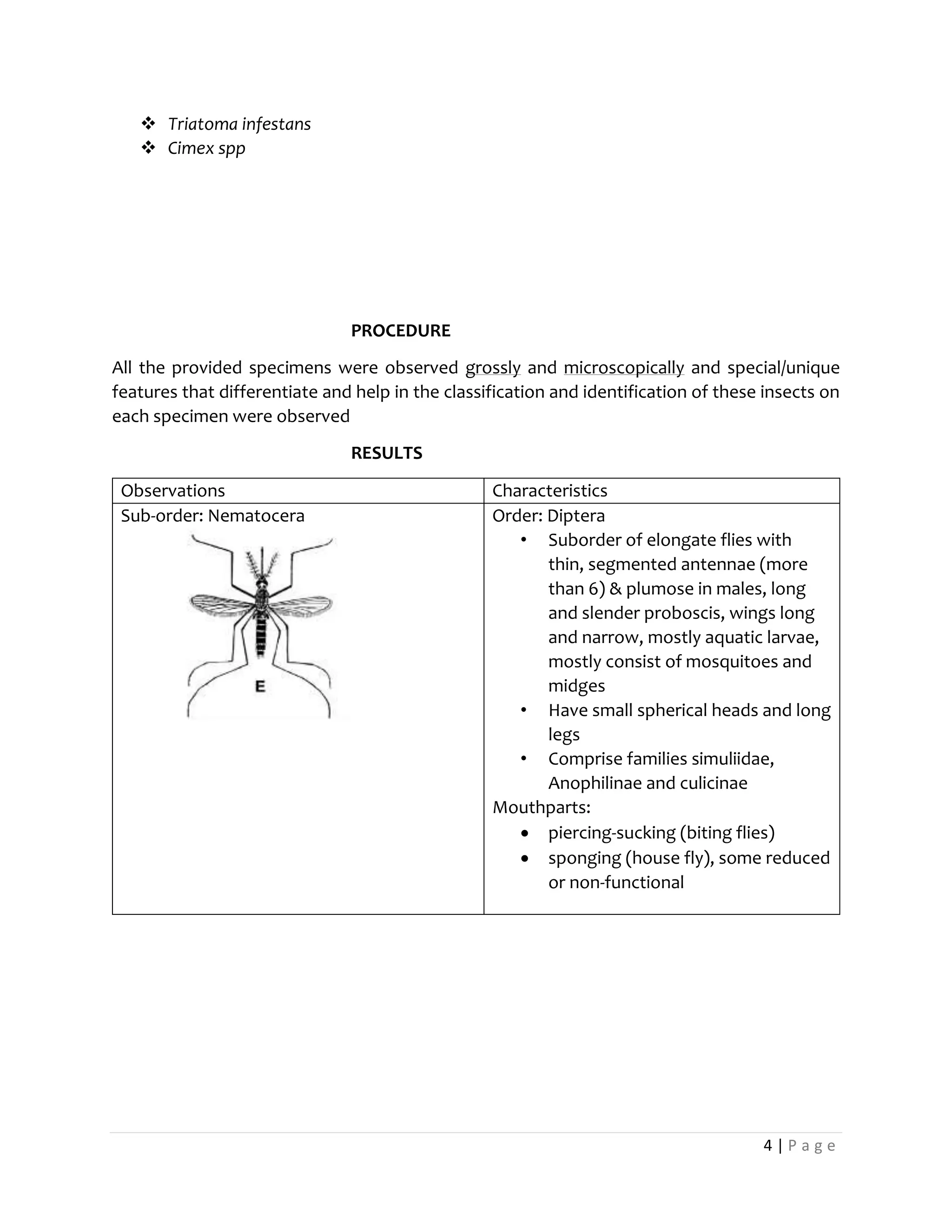
Species(spp): Cimex spp 
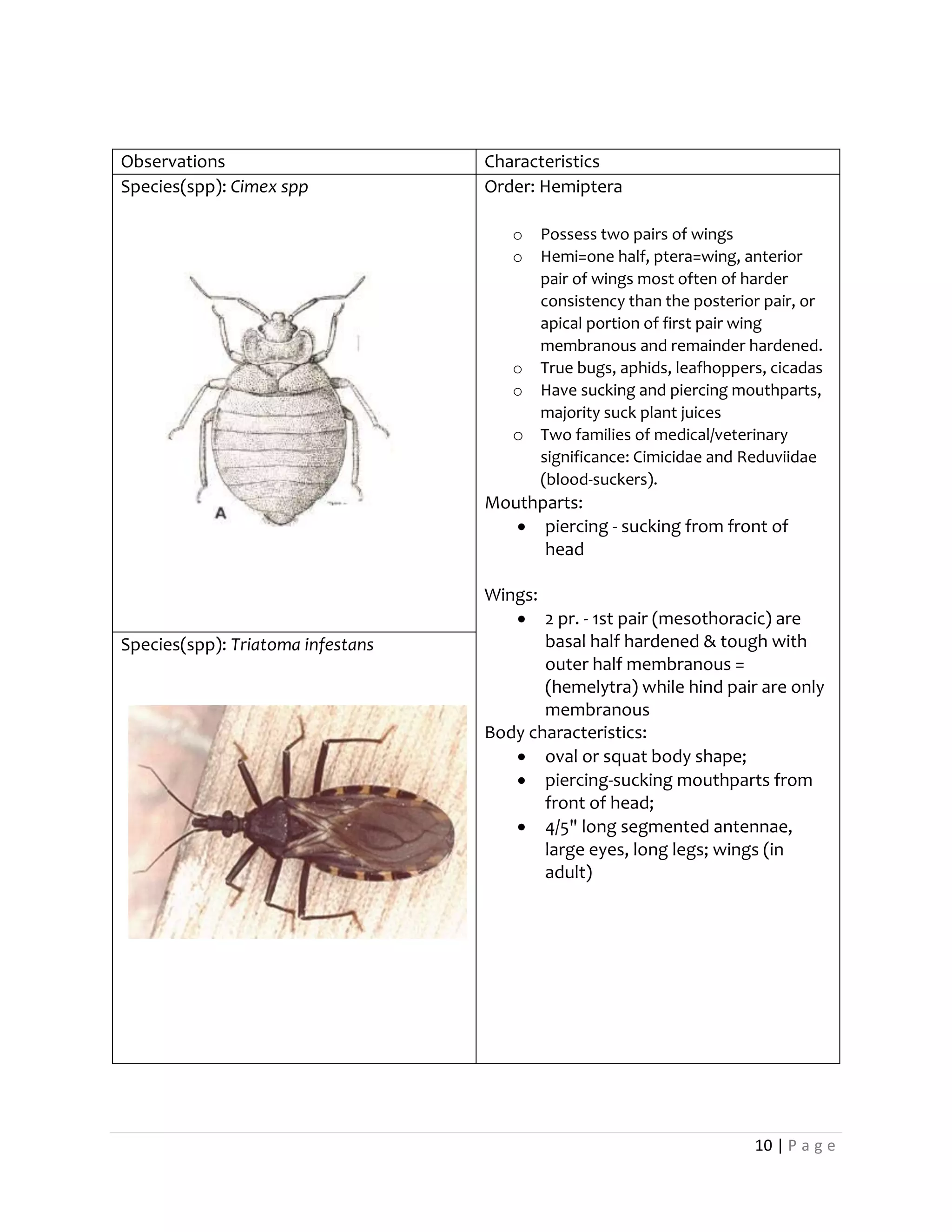
Order: Hemiptera 
o Possess two pairs of wings 
o Hemi=one half, ptera=wing, anterior 
pair of wings most often of harder 
consistency than the posterior pair, or 
apical portion of first pair wing 
membranous and remainder hardened. 
o True bugs, aphids, leafhoppers, cicadas 
o Have sucking and piercing mouthparts, 
majority suck plant juices 
o Two families of medical/veterinary 
significance: Cimicidae and Reduviidae 
(blood-suckers). 
Mouthparts: 
 piercing - sucking from front of 
head 
Wings: 
 2 pr. - 1st pair (mesothoracic) are 
basal half hardened & tough with 
outer half membranous = 
(hemelytra) while hind pair are only 
membranous 
Body characteristics: 
 oval or squat body shape; 
 piercing-sucking mouthparts from 
front of head; 
 4/5" long segmented antennae, 
large eyes, long legs; wings (in 
adult) 
Species(spp): Triatoma infestans
11 | P a g e 
DISCUSSION 
The order Diptera is the most important for veterinary entomologists, literally the means ‘two-winged’ 
and all adults have two wings with the exception of certain aberrant forms in the 
hippoboscidae (genus melophagus), (Whitlock J.H, 1960). Diptera order is divided into three 
suborders, Brachycera, Nematocera and Cyclorrhapha. 
The order Nematocera (thread-horns) are a suborder of elongated flies with thin, 
segmented antennae and mostly aquatic larvae, consisting of the mosquitoes, crane flies, 
gnats, and midges. Nematocera are typically characterized by filamentous, multi-segmented 
antennae which may be plumose in some males. Nematocera is a paraphyletic suborder, 
because one of its constituent families (Anisopodidae) is apparently a sister taxon to the 
entire suborder Brachycera. Examples of the Nematocera include the mosquitoes (Culicidae), 
crane flies (Tipulidae) and black flies (Simuliidae). Many of the remaining families (especially 
Mycetophilidae, Anisopodidae and Sciaridae), are called gnats, while others (especially 
Chironomidae, Cecidomyiidae and Ceratopogonidae) are called midges. The larvae are mostly 
aquatic and have distinct heads with mouthparts that may be modified for filter feeding. The 
pupae are orthorrhaphous (meaning adults emerge from the pupa through a straight seam in 
the pupal cuticle). The bodies and legs of the adults are usually elongate, and these flies often 
have relatively long abdomens. Many species form mating swarms of males, and in some of 
these, competition for females is extreme. Although many species (as larvae) have a strong 
association with water, even within a single family there may be a trend toward semiaquatic 
and terrestrial habitats (Wikipedia, 2014). 
Species of the genus Tabanus are the largest of the Tabanidae. Their wings are usually clear. 
The antennal flagellum is composed of five segments, with the first segment of flagellum 
bearing a horn-like projection. Stomoxys spp, Musca domestica and Glossina spp belong to the 
suborder Cyclorrhapha. These differ in that Stomoxys have the abdomen that is shorter and 
broader than that of Musca domestica and is also grey with three dark spots on the second 
and third abdominal segments. The projecting proboscis is sufficiently prominent to 
distinguish species of this genus from species of Musca. Glossina is the sole genus in the family
Glossinidae, species which are known as Tsetse flies. Tsetse is a small distinct genus of 22 
species, which feed exclusively on the blood of vertebrates (Veterinary Entomology, 1997). 
The order Siphonaptera are fleas. These are morphologically unique ectoparasites that are 
unlikely to be confused with any other arthropods. They are a monophyletic group that has 
evolutionary ties with the mecopteroid insects order mecoptera and diptera. The order 
Siphonaptera has Echidnophadga gallinacean, Ctenocephalides felis and Ctenocephalides 
canis were the species looked at in this practical, these being the cat and dog fleas 
respectively. They both have the genal and pronotal Ctenidia. In C. felis the first tooth of the 
genal comb is as long as the second whereas in C. canis the first tooth of the genal comb is 
shorter than the second. In Echidnophadga gallinacean spp, after fertilization the female 
burrows into the skin of the fowl, usually on the comb and wattles of birds, resulting in the 
formation of nodules in which the eggs are laid. Hatching occurs within the nodules, and the 
larvae drop to the ground to complete development. The skin over the nodules often 
becomes ulcerated, and young birds may be killed by heavy infections. Echidnophadga also 
attacks mammals, principally dogs, the nodules being for-med around the eyes and between 
the toes. 
The order Hemiptera includes all of the insects known as true bugs. Hemiptera are 
characterized as soft-bodied insects with piercing and sucking mouthparts and, usually, two 
pairs of wings. Cimex causes annoyance in human dwellings, severe irritation and anaemia in 
poultry. The female lays eggs in the dark crevices and the larvae hatch after 3-14 days at 
favourable conditions. Then after the five nymphal stages, adult develop within 8-13 weeks at 
favourable conditions. Drugs such as lindane chlordane and dieldrin are effective in bedbug 
control by spraying and dusting. Triatomidae in which Triatoma infestans belongs transmits 
Trypanosoma cruzi, the cause of human trypanosomiasis in South America. Control of 
Triatoma is difficult because these bugs fly long distances. 
The order Phthiraptera are lice. These are a menace to humans, pets, and livestock, not only 
because of their blood-feeding or chewing habits, but also because of their ability to transmit 
pathogens. The chicken body louse, Menacanthus stramineus often causes significant skin 
12 | P a g e
irritation and reddening through its persistent feeding. Occasionally the skin or soft quills 
bleed from their gnawing and scraping action, with the lice readily imbibing the resultant 
blood. Large infestations of chicken body lice, shaft lice, and other poultry lice may be 
injurious to the host by causing feather loss, lameness, low weight gains, inferior laying 
capacity, or even death (Mullen and Durden, 2002). Pediculosis is the infections caused by lice 
infestations. Organophosphates insecticides are used for treatment and control. Pour-on or 
spot on synthetic Pyrethroids, such as Cypermethrin, or parenteral Ivermectin are used. 
Ivermectin is ideal and more effective against sucking lice. 
13 | P a g e 
CONCLUSION 
Mosquitoes (adult, larvae and pupae) in the suborder Nematocera, Tabanus spp in the 
suborder Brachycera, Musca domestica, Glossina spp and Stomoxys spp in the suborder 
Cyclorrhapha; true bugs (e.g. Triatoma infestans) and Cimex spp of the Hemiptera; 
Echidinophaga gallinacean, Tunga penetrans, Ctenocephalide felis & Ctenocephalide canis in the 
order Siphonaptera and Haematopinus suis and Menacanthus spp in order Phthiraptera were 
identified. 
REFERENCES 
 Mullen G. & Durden L. (2002), Medical and Veterinary Entomology, Academic press, 
Elsevier, San Diego, California, USA. 
 Wall R. Shearer D., (1997) Veterinary Entomology, 1st edition, chapman & hall press, New 
York, USA. 
 Whitlock J.H, (1960), Diagnosis of veterinary parasitism, lea & febiger press, Philadelphia, 
USA. 
 http://www.cals.ncsu.edu/course/ent425/library/compendium/siphonaptera.html

Identification of insects

  • 1.
    1 | Pa g e The University of Zambia School of veterinary medicine Department of paraclinical studies Name: Musalo Brian Computer #: 10008047 Course code: VMP-4400 Lab: Identification of ticks and mites Attention: Mr.chota Date: 10/03/14
  • 2.
    Title: identification ofinsects Aim: to identify insects of the orders Diptera, Siphonaptera, Phthiraptera and Hemiptera of veterinary and medical importance. 2 | P a g e INTRODUCTION The order Diptera also known as true flies are one of the most diverse orders of insects both morphologically & biologically. The order name means ‘two-winged’ and refers to the fact that the hind pair of wings is greatly modified and reduced. This order has over 120,000 species worldwide. Although flies with medical and veterinary significance constitute only a small fraction of these numbers, their diversity is impressive, ranging from mosquitoes, larvae that parasitize various animals, and species that help to decompose carrion or feces. No other group of insects has much impact on human and animal health as do the Diptera (Mullen G. & Durden L. 2002). The order Siphonaptera are fleas. These are morphologically unique ectoparasites that are unlikely to be confused with any other arthropods. They are a monophyletic group that has evolutionary ties with the mecopteroid insects order mecoptera and diptera. Fleas evolved from winged ancestors during the late Jurassic or early cretaceous period 125-150 million years ago. As a group, they have principally evolved as parasites of mammals on 94% of known species feed, representing 15 families and more than 200 genera of fleas. The remaining 6%, representing 5 families and 25 genera, are ectoparasites of birds (Mullen G. & Durden L. 2002). This is an appropriate appellation for these secondarily wingless insects whose mouthparts are adapted for piercing skin and sucking blood (http://www.cals.ncsu.edu/siphonaptera). The order Hemiptera includes all of the insects known as true bugs. Hemiptera are characterized as soft-bodied insects with piercing and sucking mouthparts and, usually, two pairs of wings. The order traditionally is divided into two major divisions: the Heteroptera and the Homoptera. The name Hemiptera means ‘half wings’ and is derived from the members of the Heteroptera (different wings), most of which have fore wings called Hemelytra. They are composed of the corium and clavus and a transparent, filmy distal portion as well as the membrane, hence the idea of a half wing. The hind wings are completely membranous. The difference in texture between the fore and hind wings in the heteropterans give this group its name. The true bugs have about 90,000 species worldwide and constitutes the largest exopterygote order of insects (Mullen G. & Durden L 2002). The order Phthiraptera are lice. These are a menace to humans, pets, and livestock, not only because of their blood-feeding or chewing habits, but also because of their ability to transmit pathogens. The human body louse has been indirectly responsible for influencing human
  • 3.
    history through itsability to transmit the causative agent of typhus. However, most of the 3200 known species of lice are ectoparasites of wild birds or mammals and have no known medical or veterinary importance. The order Phthiraptera is divided into two suborders: Anoplura (sucking lice) & Mallophaga (chewing or biting lice). All members of the Anoplura are obligate, hematophagous ectoparasites of placental mammals, whereas the more diverse Mallophaga include species that are obligate associates of birds, marsupials and placental mammals. Although certain chewing lice imbibe blood, most species ingest host feather, fur, skin, or skin products. Because of the different feeding strategies of the two groups, the blood feeding Anoplura are far more important than the Mallophaga in transmitting pathogens to their hosts (Mullen G. & Durden L. 2002). 3 | P a g e MATERIAL Material:  Microscopes  Glass slide  Cover slip  70% preservative alcohol Specimens: Diptera  Nematocera: (mosquitoes-adult, larvae and pupa)  Brachycera- Tabanus species (adult)  Cyclorrhapha: (house fly-Musca domestica, Tsetse fly (glossina spp), stomoxys (stable fly)) Phthiraptera  Mallophaga: (Manacanthus spp)  Anoplura: (Haematopinus suis) Siphonaptera  Ctenocephalides felis  Ctenocephalides canis  Echinophaga gallinacean Hemiptera
  • 4.
    4 | Pa g e  Triatoma infestans  Cimex spp PROCEDURE All the provided specimens were observed grossly and microscopically and special/unique features that differentiate and help in the classification and identification of these insects on each specimen were observed RESULTS Observations Characteristics Sub-order: Nematocera Order: Diptera • Suborder of elongate flies with thin, segmented antennae (more than 6) & plumose in males, long and slender proboscis, wings long and narrow, mostly aquatic larvae, mostly consist of mosquitoes and midges • Have small spherical heads and long legs • Comprise families simuliidae, Anophilinae and culicinae Mouthparts:  piercing-sucking (biting flies)  sponging (house fly), some reduced or non-functional
  • 5.
    5 | Pa g e Sub-order: Brachycera Species: Tabanus  Tabanus Sp have cutting and lapping mouth parts  maggots have mouth hooks Wings:  One pair (two) wings on mesothorax, rearely absent. halteres of varying size on metathorax adults  2 wings- halteres on mesothorax  Characteristic body shape of three distinct body regions and small number abdominal segments.  antennae reduced to hair or very feathery (=plumose) in males larvae  maggot-like with no body features except mouth hooks  pupa: oval with tough exoskeleton covering (=puparium) Observations Characteristics Sub-order: Cyclorrhapha Species(spp): housefly-Musca domestica Order: Diptera Spp. M. domestica  Common housefly  Has sponging mouth parts adapted for imbibing liquid food  Its antenna has the 3rd segment bearing an arista which bilaterally plumose
  • 6.
    6 | Pa g e Species: tsetse fly-Glossina spp. Species: tsetse fly-Glossina spp.  All belong to genus Glossina.  Commonly known as tsetse flies  Robust flies with various shades of brown, from yellowish to blackish-brown.  Both male and female haematophagus (male and female distinguished by presence of hypopygium on ventral posterior surface in male) Species: Stable fly-Stomoxys spp  Similar to Musca domestica abdomen is shorter and broader than that of a housefly & has 3 dark spots on each of the 2nd & 3rd segments  Proboscis is prominent  They are swift fliers but do not travel long distances  Both male and female haematophagus Species: Stable fly-Stomoxys spp
  • 7.
    7 | Pa g e The main landmarks of flea external morphology Order: Siphonaptera
  • 8.
    8 | Pa g e Comparative feature Observations Characteristics Sub-order: Ctenocephalides felis Order: Siphonaptera Commonly known as fleas • Comparative feature: - In C. felis the first tooth on the genocomb is as long as the second but in C. canis, the first tooth on the genocomb is half of the length of the second tooth - C. canis adults has a more bluntly rounded head than C. felis Immature  Body vermiform (maggot-like), sparsely covered with hairs  Head reduced, eyeless, mouthparts mandibulate Adults  Body bilaterally flattened  Mouthparts suctorial (haustellate)  Large bristles (ctenidia) often present on head or thorax (genal and pronotal combs)  Hind femur enlarged, adapted for jumping Sub-order: Ctenocephalides canis Sub-order: Echidnophaga gallinacean • Echidnophadga gallinacean - Has angular head - Ctenidia are absent
  • 9.
    9 | Pa g e Observations Characteristics Sub-order: Mallophaga Species (spp): Manacanthus spp Order: Phthiraptera Commonly known as lice  are wingless  Permanent, obligatory ecto-parasites spending their entire life cycle on the host  Generally host specific and limited to a single host species or closely related hosts • Lice of medical and veterinary significance belong to the suborders – Anoplura (sucking lice) and – Mallophaga (biting/chewing lice) Mouthparts:  chewing in biting & bird lice (Mallophaga)  piercing & sucking in blood feeders (Anoplura) Wings:  none Body characteristics:  body flattened top to bottom  legs have special claws to grasp host Sub-order: Anoplura Species(spp): Haematopinus suis
  • 10.
    10 | Pa g e Observations Characteristics Species(spp): Cimex spp Order: Hemiptera o Possess two pairs of wings o Hemi=one half, ptera=wing, anterior pair of wings most often of harder consistency than the posterior pair, or apical portion of first pair wing membranous and remainder hardened. o True bugs, aphids, leafhoppers, cicadas o Have sucking and piercing mouthparts, majority suck plant juices o Two families of medical/veterinary significance: Cimicidae and Reduviidae (blood-suckers). Mouthparts:  piercing - sucking from front of head Wings:  2 pr. - 1st pair (mesothoracic) are basal half hardened & tough with outer half membranous = (hemelytra) while hind pair are only membranous Body characteristics:  oval or squat body shape;  piercing-sucking mouthparts from front of head;  4/5" long segmented antennae, large eyes, long legs; wings (in adult) Species(spp): Triatoma infestans
  • 11.
    11 | Pa g e DISCUSSION The order Diptera is the most important for veterinary entomologists, literally the means ‘two-winged’ and all adults have two wings with the exception of certain aberrant forms in the hippoboscidae (genus melophagus), (Whitlock J.H, 1960). Diptera order is divided into three suborders, Brachycera, Nematocera and Cyclorrhapha. The order Nematocera (thread-horns) are a suborder of elongated flies with thin, segmented antennae and mostly aquatic larvae, consisting of the mosquitoes, crane flies, gnats, and midges. Nematocera are typically characterized by filamentous, multi-segmented antennae which may be plumose in some males. Nematocera is a paraphyletic suborder, because one of its constituent families (Anisopodidae) is apparently a sister taxon to the entire suborder Brachycera. Examples of the Nematocera include the mosquitoes (Culicidae), crane flies (Tipulidae) and black flies (Simuliidae). Many of the remaining families (especially Mycetophilidae, Anisopodidae and Sciaridae), are called gnats, while others (especially Chironomidae, Cecidomyiidae and Ceratopogonidae) are called midges. The larvae are mostly aquatic and have distinct heads with mouthparts that may be modified for filter feeding. The pupae are orthorrhaphous (meaning adults emerge from the pupa through a straight seam in the pupal cuticle). The bodies and legs of the adults are usually elongate, and these flies often have relatively long abdomens. Many species form mating swarms of males, and in some of these, competition for females is extreme. Although many species (as larvae) have a strong association with water, even within a single family there may be a trend toward semiaquatic and terrestrial habitats (Wikipedia, 2014). Species of the genus Tabanus are the largest of the Tabanidae. Their wings are usually clear. The antennal flagellum is composed of five segments, with the first segment of flagellum bearing a horn-like projection. Stomoxys spp, Musca domestica and Glossina spp belong to the suborder Cyclorrhapha. These differ in that Stomoxys have the abdomen that is shorter and broader than that of Musca domestica and is also grey with three dark spots on the second and third abdominal segments. The projecting proboscis is sufficiently prominent to distinguish species of this genus from species of Musca. Glossina is the sole genus in the family
  • 12.
    Glossinidae, species whichare known as Tsetse flies. Tsetse is a small distinct genus of 22 species, which feed exclusively on the blood of vertebrates (Veterinary Entomology, 1997). The order Siphonaptera are fleas. These are morphologically unique ectoparasites that are unlikely to be confused with any other arthropods. They are a monophyletic group that has evolutionary ties with the mecopteroid insects order mecoptera and diptera. The order Siphonaptera has Echidnophadga gallinacean, Ctenocephalides felis and Ctenocephalides canis were the species looked at in this practical, these being the cat and dog fleas respectively. They both have the genal and pronotal Ctenidia. In C. felis the first tooth of the genal comb is as long as the second whereas in C. canis the first tooth of the genal comb is shorter than the second. In Echidnophadga gallinacean spp, after fertilization the female burrows into the skin of the fowl, usually on the comb and wattles of birds, resulting in the formation of nodules in which the eggs are laid. Hatching occurs within the nodules, and the larvae drop to the ground to complete development. The skin over the nodules often becomes ulcerated, and young birds may be killed by heavy infections. Echidnophadga also attacks mammals, principally dogs, the nodules being for-med around the eyes and between the toes. The order Hemiptera includes all of the insects known as true bugs. Hemiptera are characterized as soft-bodied insects with piercing and sucking mouthparts and, usually, two pairs of wings. Cimex causes annoyance in human dwellings, severe irritation and anaemia in poultry. The female lays eggs in the dark crevices and the larvae hatch after 3-14 days at favourable conditions. Then after the five nymphal stages, adult develop within 8-13 weeks at favourable conditions. Drugs such as lindane chlordane and dieldrin are effective in bedbug control by spraying and dusting. Triatomidae in which Triatoma infestans belongs transmits Trypanosoma cruzi, the cause of human trypanosomiasis in South America. Control of Triatoma is difficult because these bugs fly long distances. The order Phthiraptera are lice. These are a menace to humans, pets, and livestock, not only because of their blood-feeding or chewing habits, but also because of their ability to transmit pathogens. The chicken body louse, Menacanthus stramineus often causes significant skin 12 | P a g e
  • 13.
    irritation and reddeningthrough its persistent feeding. Occasionally the skin or soft quills bleed from their gnawing and scraping action, with the lice readily imbibing the resultant blood. Large infestations of chicken body lice, shaft lice, and other poultry lice may be injurious to the host by causing feather loss, lameness, low weight gains, inferior laying capacity, or even death (Mullen and Durden, 2002). Pediculosis is the infections caused by lice infestations. Organophosphates insecticides are used for treatment and control. Pour-on or spot on synthetic Pyrethroids, such as Cypermethrin, or parenteral Ivermectin are used. Ivermectin is ideal and more effective against sucking lice. 13 | P a g e CONCLUSION Mosquitoes (adult, larvae and pupae) in the suborder Nematocera, Tabanus spp in the suborder Brachycera, Musca domestica, Glossina spp and Stomoxys spp in the suborder Cyclorrhapha; true bugs (e.g. Triatoma infestans) and Cimex spp of the Hemiptera; Echidinophaga gallinacean, Tunga penetrans, Ctenocephalide felis & Ctenocephalide canis in the order Siphonaptera and Haematopinus suis and Menacanthus spp in order Phthiraptera were identified. REFERENCES  Mullen G. & Durden L. (2002), Medical and Veterinary Entomology, Academic press, Elsevier, San Diego, California, USA.  Wall R. Shearer D., (1997) Veterinary Entomology, 1st edition, chapman & hall press, New York, USA.  Whitlock J.H, (1960), Diagnosis of veterinary parasitism, lea & febiger press, Philadelphia, USA.  http://www.cals.ncsu.edu/course/ent425/library/compendium/siphonaptera.html