ASSIGNMENT
SUBMITTED BY :- FAISAL ALI
DEPARTMENT :- ENTOMOLOGY
TOPIC :- ORDER DIPTERA
(FLIES)
University: :- University of
Agriculture Faisalabad
Diptera (Flies)
Derivative :-
True flies are insects of the order Diptera
the name being derived from the Greek words
Di “Two”
Pteron “Wings”
 Insects in Order Diptera :-
Mosquitos & Flies
 Flies range in size from midges of little 1 mm to
robber flies of more than 7 cm.
Diptera (Flies)
Characteristics of Diptera:-
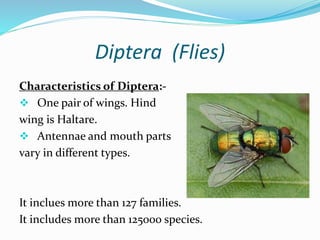
 One pair of wings. Hind
wing is Haltare.
 Antennae and mouth parts
vary in different types.
It inclues more than 127 families.
It includes more than 125000 species.
Diptera (Flies)
Scientific Classification of Diptera :-
Kingdom :- Animalia
Phylum :- Arthropoda
Class :- Insecta
Super order :- Panorpida
Order :- Diptera (Linnaeus 1758)
 Housefly has a life span of about 28 days.
Diptera (Flies)
Habitat :-
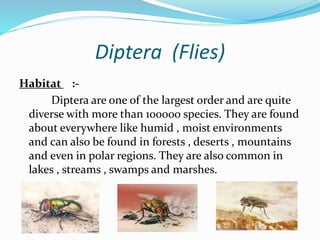
Diptera are one of the largest order and are quite
diverse with more than 100000 species. They are found
about everywhere like humid , moist environments
and can also be found in forests , deserts , mountains
and even in polar regions. They are also common in
lakes , streams , swamps and marshes.
Diptera (Flies)
Feeding :-
 Flies feed on diverse places from raw material to
processed material .
 Clean things to dirty things.
 Many adult brachycera feed on flowers. They
obtain their protein and all requirements from flowers
and their pollens.
Diptera (Flies)
Odd/Key Characters of Flies :-
 Housefly eggs are laid in almost any warm , moist
material that will supply suitable food for the larvae.
 The female may lay a total of five to six batches of 75
to 150 eggs over three to four days of period.
 Eggs hatch in 12 to 24 hours in warm weather.
 Life span of flies is about 28 days .
Diptera (Flies)
Evolution of Diptera :-
Of all flies in diptera housefly are more common
because it is found all over the world nearly at every
palace . The housefly (Muca domestica) is the fly of
the suborder Cyclorrhapha. It is believed to have
evolved in the Cenozoic era , possibly in the middle
east and has spread all over the world as a commensal
of humans . It is the most common fly in houses.
Diptera (Flies)
Role in Nature :-
 Advantages :-
1) Small maggots break down organic matter in
garbage to clean environment.
2) Adult flies pollinate our flowers and crops .
3) Adult flies act to recycle when they feed on decaying
waste such as dung and dead animals .
4) Flies feed on agricultural pests to ensure that food
supply is not eaten by insect pests.
Diptera (Flies)
 Disadvantages :-
1) Flies act as a great vector in spreading diseases from
one person to another .
2) Mosquitos and flies together become a source of
death of more than 1 million persons per year .
3) As the flies are dirty so where ever they sit make the
food dirty as the eject maggots on it .
Diptera (Flies)
Life cycle :-
Diptera go through a complete metamorphosis with four
distinct life stages – egg, larva, pupa and adult.
The number of eggs laid by a female varies from few to
thousands.
Mother doesn’t care her babies so she lays eggs on a food
supply for when they hatch.
 Larvae which often look like worms hatch from the
eggs have false legs called “prolegs” like little legs of
caterpillar. But diptera larvae lack true legs.
Diptera (Flies)
 Pupa take various forms .These pupa are called as obtect
having future appendages adhere to pupal body. The outer
surface of pupa is leathery and bear spines (respiratory
structures and locomotory organs). The outer surface is
puparium and actual pupa is concealed with in it.
 Adult stage is usually short, its function only to mate and
lay eggs. The genitalia of male flies are rotated to a varying
degree from the position found in other insects. In some
flies this is a temporary rotation during mating, but in
others, it is a permanent torsion of the organs that occurs
during the pupal stage.
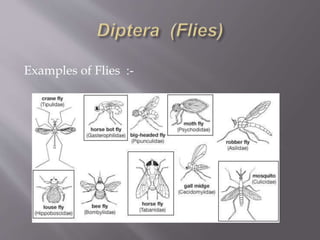
Examples of Flies :-
Diptera (Flies).pptx

Diptera (Flies).pptx

  • 2.
    ASSIGNMENT SUBMITTED BY :-FAISAL ALI DEPARTMENT :- ENTOMOLOGY TOPIC :- ORDER DIPTERA (FLIES) University: :- University of Agriculture Faisalabad
  • 3.
    Diptera (Flies) Derivative :- Trueflies are insects of the order Diptera the name being derived from the Greek words Di “Two” Pteron “Wings”  Insects in Order Diptera :- Mosquitos & Flies  Flies range in size from midges of little 1 mm to robber flies of more than 7 cm.
  • 4.
    Diptera (Flies) Characteristics ofDiptera:-  One pair of wings. Hind wing is Haltare.  Antennae and mouth parts vary in different types. It inclues more than 127 families. It includes more than 125000 species.
  • 5.
    Diptera (Flies) Scientific Classificationof Diptera :- Kingdom :- Animalia Phylum :- Arthropoda Class :- Insecta Super order :- Panorpida Order :- Diptera (Linnaeus 1758)  Housefly has a life span of about 28 days.
  • 6.
    Diptera (Flies) Habitat :- Dipteraare one of the largest order and are quite diverse with more than 100000 species. They are found about everywhere like humid , moist environments and can also be found in forests , deserts , mountains and even in polar regions. They are also common in lakes , streams , swamps and marshes.
  • 7.
    Diptera (Flies) Feeding :- Flies feed on diverse places from raw material to processed material .  Clean things to dirty things.  Many adult brachycera feed on flowers. They obtain their protein and all requirements from flowers and their pollens.
  • 8.
    Diptera (Flies) Odd/Key Charactersof Flies :-  Housefly eggs are laid in almost any warm , moist material that will supply suitable food for the larvae.  The female may lay a total of five to six batches of 75 to 150 eggs over three to four days of period.  Eggs hatch in 12 to 24 hours in warm weather.  Life span of flies is about 28 days .
  • 9.
    Diptera (Flies) Evolution ofDiptera :- Of all flies in diptera housefly are more common because it is found all over the world nearly at every palace . The housefly (Muca domestica) is the fly of the suborder Cyclorrhapha. It is believed to have evolved in the Cenozoic era , possibly in the middle east and has spread all over the world as a commensal of humans . It is the most common fly in houses.
  • 10.
    Diptera (Flies) Role inNature :-  Advantages :- 1) Small maggots break down organic matter in garbage to clean environment. 2) Adult flies pollinate our flowers and crops . 3) Adult flies act to recycle when they feed on decaying waste such as dung and dead animals . 4) Flies feed on agricultural pests to ensure that food supply is not eaten by insect pests.
  • 11.
    Diptera (Flies)  Disadvantages:- 1) Flies act as a great vector in spreading diseases from one person to another . 2) Mosquitos and flies together become a source of death of more than 1 million persons per year . 3) As the flies are dirty so where ever they sit make the food dirty as the eject maggots on it .
  • 12.
    Diptera (Flies) Life cycle:- Diptera go through a complete metamorphosis with four distinct life stages – egg, larva, pupa and adult. The number of eggs laid by a female varies from few to thousands. Mother doesn’t care her babies so she lays eggs on a food supply for when they hatch.  Larvae which often look like worms hatch from the eggs have false legs called “prolegs” like little legs of caterpillar. But diptera larvae lack true legs.
  • 13.
    Diptera (Flies)  Pupatake various forms .These pupa are called as obtect having future appendages adhere to pupal body. The outer surface of pupa is leathery and bear spines (respiratory structures and locomotory organs). The outer surface is puparium and actual pupa is concealed with in it.  Adult stage is usually short, its function only to mate and lay eggs. The genitalia of male flies are rotated to a varying degree from the position found in other insects. In some flies this is a temporary rotation during mating, but in others, it is a permanent torsion of the organs that occurs during the pupal stage.
  • 14.