University of Sulaimania
School of Science
Department of Biology
2nd Class Year


                                  23r d   La b.
                 Pterygotes - Neopteran Insects:

           Order Diptera
                           Lecturer: Farhad A. Khudhur
Objectives:
  - This lecture gives knowledge about the medically and
    ecologically important insect group (order Diptera),
    Mosquitoes and flies. Their classifications and
    identification keys.
  - Focusing on the most common and important families
    of dipteran insects.

  Scientific content:
  Order Diptera
  - General descriptions
  - Classification:
    Suborder: Nematocera
    Suborder: Brachycera
Suborders Nematocera and Brachycera
• In nematocerous families, the antennae are
  usually composed of many segments and are
  filiform, plumose, or pectinate
• whereas brachycerous flies typically have the
  first flagellomere enlarged and the remaining
  flagellomeres stylate or aristate
• The mouthparts of adult flies are vestigial or well
  developed of two general types:
   – (1) piercing and sucking, as seen in simuliids, culicids,
     and asilids, and
   – (2) lapping and sucking (Sponging), as seen in
     tipulids and most brachycerous groups.
• Pupa: Most brachyceran have puparim
  (Coactate), while nematocerance have different
  forms of pupae (some groups have obtect pupa
  or coma shape pupa).
Dipterans Larvae
• Larval Diptera are legless (apodous) and found in
  a variety of terrestrial and aquatic habitats.
• Most larvae are free-living and crawl or swim
  actively in:
  –   water (e.g., Simuliidae, Culicidae, Chironomidae)
  –   sediments (e.g.,Tipulidae, Psychodidae, Tabanidae),
  –   wood (e.g., Tipulidae),
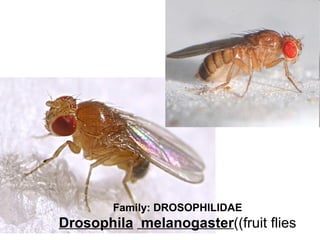
  –   fruit (e.g., Drosophilidae),
  –   decaying organic material (Muscidae, Sarcophagidae).

• Other larvae inhabit the tissues of living organisms
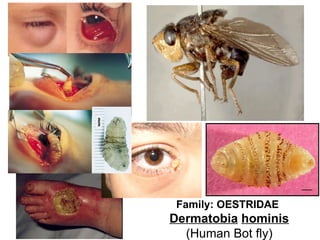
  (e.g., Oestridae).
Suborder: Nemtocera

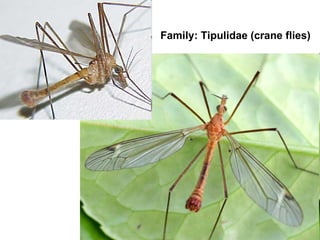
•   Family: TIPULIDAE (Crane flies)
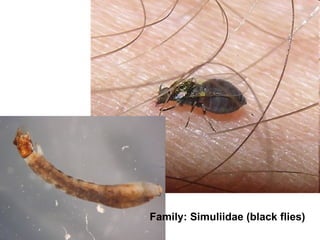
•   Family: SIMULIIDAE (Black flies)
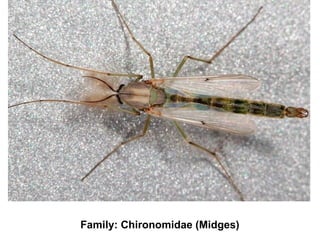
•   Family: CHIRONOMIDAE (Midges)
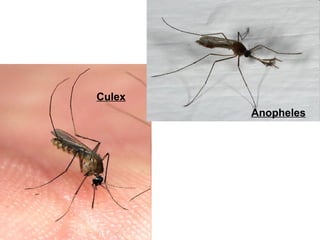
•   Family: CULICIDAE (mosquitoes)
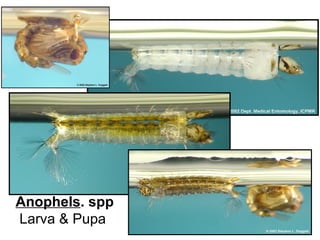
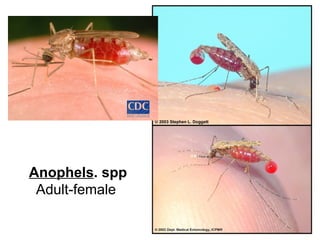
    – Anopheles sp.,
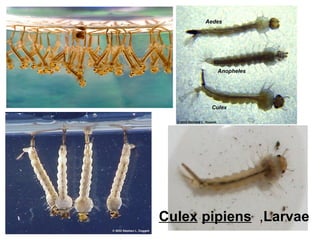
    – Culex pipiens ,
    – Aedes aegypti (Yellow fever mosquito)
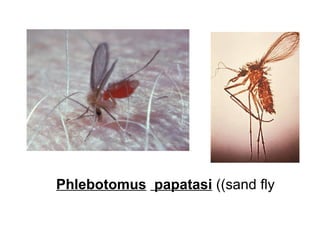
• Family: PSYCHODIDAE
    - Phlebotomus papatasi (sand fly)
Family: Tipulidae (crane flies)
Family: Simuliidae (black flies)
Family: Chironomidae (Midges)
Culex pipiens ,Larvae
Anophels. spp
Larva & Pupa
Anophels. spp
 Adult-female
Culex
        Anopheles
Phlebotomus papatasi ((sand fly
Suborder: Brachycera
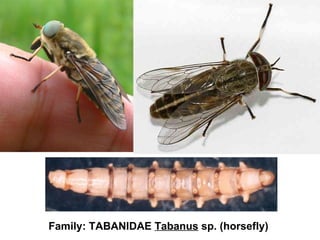
• Family: TABANIDAE Tabanus sp. (horse fly)
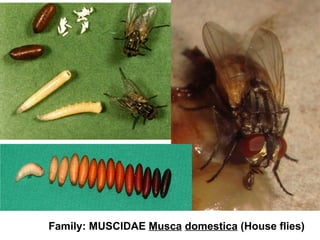
• Family: MUSCIDAE Musca domestica (House
  flies)
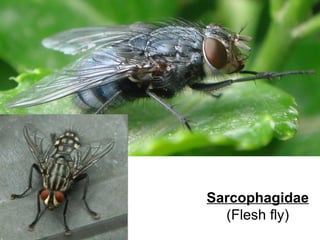
• Family: SARCOPHAGIDAE (Fleshfly)
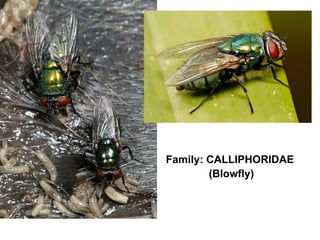
• Family: CALLIPHORIDAE (Blowfly)
• Family: OESTRIDAE Dermatobia hominis
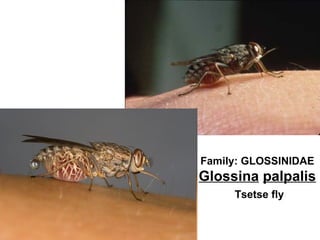
• Family: GLOSSINIDAE Glossina palpalis
• Family: DROSOPHILIDAE
  Drosophila melanogaster (fruit flies)
Family: TABANIDAE Tabanus sp. (horsefly)
Family: MUSCIDAE Musca domestica (House flies)
Sarcophagidae
  (Flesh fly)
Family: CALLIPHORIDAE
        (Blowfly)
Family: GLOSSINIDAE
Glossina palpalis
     Tsetse fly
Family: OESTRIDAE
Dermatobia hominis
  (Human Bot fly)
Family: DROSOPHILIDAE
Drosophila melanogaster((fruit flies
References:

   • David, B. V. and Ananthakrishnan, T. N. (2004). General
     and Applied Entomology. 2nd ed. Tata McGraw-hill
     Publishing Co. Ltd. New Delhi. India. 1184 p.
   • Elzinga, Richard J. (1997). Fundamentals of Entomology.
     4th ed. New Jersey, Prentice-Hall, Inc. 475 pp.
   • Gillot, Cedric. (2005). Entomology. 3rd ed. Springer,
     Dordrecht. The Netherlands. 831 pp.
   • Grzimek’s Animal Life Encyclopedia, 2nd edition. Volume
     3, Insects, edited by Michael Hutchins, Arthur V. Evans,
     Rosser W. Garrison.
   • Markle, Sandra. (2008). Mosquitoes: tiny insect
     troublemakers. Minneapolis, USA. Lerner Publications
     Company. 48 p.
   • Resh, Vincent H. & Cardé, Ring T. (2003). Encyclopedia of
     Insects. USA. Academic Press, Elsevier Science, 1266 pp.

Insect classification lab23

  • 1.
    University of Sulaimania Schoolof Science Department of Biology 2nd Class Year 23r d La b. Pterygotes - Neopteran Insects: Order Diptera Lecturer: Farhad A. Khudhur
  • 2.
    Objectives: -This lecture gives knowledge about the medically and ecologically important insect group (order Diptera), Mosquitoes and flies. Their classifications and identification keys. - Focusing on the most common and important families of dipteran insects. Scientific content: Order Diptera - General descriptions - Classification: Suborder: Nematocera Suborder: Brachycera
  • 3.
    Suborders Nematocera andBrachycera • In nematocerous families, the antennae are usually composed of many segments and are filiform, plumose, or pectinate • whereas brachycerous flies typically have the first flagellomere enlarged and the remaining flagellomeres stylate or aristate • The mouthparts of adult flies are vestigial or well developed of two general types: – (1) piercing and sucking, as seen in simuliids, culicids, and asilids, and – (2) lapping and sucking (Sponging), as seen in tipulids and most brachycerous groups. • Pupa: Most brachyceran have puparim (Coactate), while nematocerance have different forms of pupae (some groups have obtect pupa or coma shape pupa).
  • 4.
    Dipterans Larvae • LarvalDiptera are legless (apodous) and found in a variety of terrestrial and aquatic habitats. • Most larvae are free-living and crawl or swim actively in: – water (e.g., Simuliidae, Culicidae, Chironomidae) – sediments (e.g.,Tipulidae, Psychodidae, Tabanidae), – wood (e.g., Tipulidae), – fruit (e.g., Drosophilidae), – decaying organic material (Muscidae, Sarcophagidae). • Other larvae inhabit the tissues of living organisms (e.g., Oestridae).
  • 5.
    Suborder: Nemtocera • Family: TIPULIDAE (Crane flies) • Family: SIMULIIDAE (Black flies) • Family: CHIRONOMIDAE (Midges) • Family: CULICIDAE (mosquitoes) – Anopheles sp., – Culex pipiens , – Aedes aegypti (Yellow fever mosquito) • Family: PSYCHODIDAE - Phlebotomus papatasi (sand fly)
  • 6.
  • 7.
  • 8.
  • 9.
  • 10.
  • 11.
  • 12.
    Culex Anopheles
  • 13.
  • 14.
    Suborder: Brachycera • Family:TABANIDAE Tabanus sp. (horse fly) • Family: MUSCIDAE Musca domestica (House flies) • Family: SARCOPHAGIDAE (Fleshfly) • Family: CALLIPHORIDAE (Blowfly) • Family: OESTRIDAE Dermatobia hominis • Family: GLOSSINIDAE Glossina palpalis • Family: DROSOPHILIDAE Drosophila melanogaster (fruit flies)
  • 15.
  • 16.
    Family: MUSCIDAE Muscadomestica (House flies)
  • 17.
  • 18.
  • 19.
  • 20.
  • 21.
  • 22.
    References: • David, B. V. and Ananthakrishnan, T. N. (2004). General and Applied Entomology. 2nd ed. Tata McGraw-hill Publishing Co. Ltd. New Delhi. India. 1184 p. • Elzinga, Richard J. (1997). Fundamentals of Entomology. 4th ed. New Jersey, Prentice-Hall, Inc. 475 pp. • Gillot, Cedric. (2005). Entomology. 3rd ed. Springer, Dordrecht. The Netherlands. 831 pp. • Grzimek’s Animal Life Encyclopedia, 2nd edition. Volume 3, Insects, edited by Michael Hutchins, Arthur V. Evans, Rosser W. Garrison. • Markle, Sandra. (2008). Mosquitoes: tiny insect troublemakers. Minneapolis, USA. Lerner Publications Company. 48 p. • Resh, Vincent H. & Cardé, Ring T. (2003). Encyclopedia of Insects. USA. Academic Press, Elsevier Science, 1266 pp.