FORENSIC ENTOMOLOGY
By- Saniya Zedi
Assistant Professor, BU
HISTORY
• The importance of insects in crime-scene investigation that in 1235, a training manual on investigating death,
Washing Away of Wrongs, was written by Sung Tz’u. In this early medico-legal book it is recorded that attention paid
by a number of blow flies to a particular sickle caused a murderer to confess to murdering a fellow Chinese farm
worker with that sickle.
• Experiments by Redi (1668), an Italian,
who,usingthefleshofanumberofdifferentanimalspecies,demonstratedthatlarvae developed from eggs laid by flies, and
the work by Linnaeus (1735) developing a system of classification. In so doing, Linnaeus provided a means of insect
identification (including identifying such forensically important flies as Calliphora vomitoria Linnaeus). These
developments formed foundations from which determination of the length of the stages in the insect’s lifecycle could
be worked out and the indicators of time since death could be developed.
• The next significant point in the history of forensic entomology resulted from observations and conclusions made by
Megnin (1894). He related eight stages of human decomposition to the succession of insects colonising the body after
death.
• Research continues to be required in order to establish the accuracy levels of estimates of time since death and to
interpret variation in different biotopes.
• Buck Ruxton Case
• Forensic Entomologist use information about insect lifecycle and behaviour to help
interpret evidences in legal context relating to both humans and animals.
• the mandibles and mouthparts. Its most noticeable external features are the eyes,
antennae, and mouthparts. All of these are important characteristics used in the
identification of insects, and sometimes in the determination of sex. The shape of the
compound eyes, their location on the head, and whether or not they touch are all
characters sometimes used in identification.
• The mouth hooks of larvae often have a distinctive shape and can be used in the
identification of fly larvae to species.
ESTIMATION
• the developmental period is usually shortened as temperature increases, which is
why accurate climatic data are of utmost importance in the calculation and
estimation of the post-mortem interval based on insect evidence.
• The process of undergoing physical changes from one life stage to the next is known
as metamorphosis. This is accomplished by means of the insect “shedding its skin,”
or undergoing ecdysis, at certain times as it grows. The old shed skin that is left
behind is called an exuvium.
APPLICATIONS
• Infestation
• Insects have a role in crime scene investigations on both land and in water.
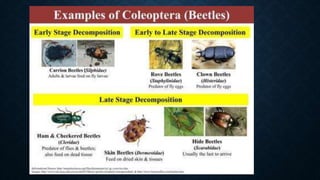
• Species that are forensically relevant- blow flies, flesh flies, cheese skippers, hide
and skin beetles, rove beetles and clown beetles.
FLIES AND TYPES
• larder beetles (Dermestidae)
• Moth flies (Psychodidae)
• Scuttle flies (Phoridae)
• Muscid flies (Muscidae)
• Blowflies (Calliphoridae)
• Flesh flies (Sarcophagidae)
• ants (Formicidae)
• Indian Meal Moth (Plodia interpunctella Hubner)
• The fruit fly (Drosophila melanogaster Meigen)
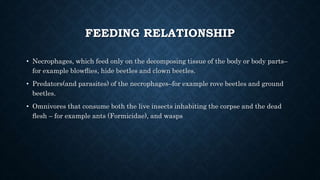
FEEDING RELATIONSHIP
• Necrophages, which feed only on the decomposing tissue of the body or body parts–
for example blowflies, hide beetles and clown beetles.
• Predators(and parasites) of the necrophages–for example rove beetles and ground
beetles.
• Omnivores that consume both the live insects inhabiting the corpse and the dead
flesh – for example ants (Formicidae), and wasps
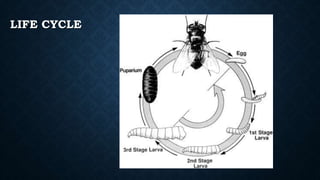
LIFE CYCLE
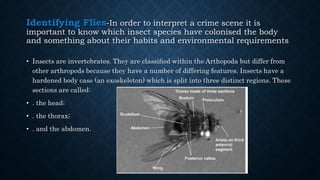
Identifying Flies-In order to interpret a crime scene it is
important to know which insect species have colonised the body
and something about their habits and environmental requirements
• Insects are invertebrates. They are classified within the Arthopoda but differ from
other arthropods because they have a number of differing features. Insects have a
hardened body case (an exoskeleton) which is split into three distinct regions. These
sections are called:
• . the head;
• . the thorax;
• . and the abdomen.
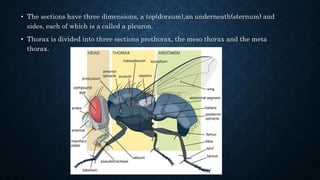
• The sections have three dimensions, a top(dorsum),an underneath(sternum) and
sides, each of which is a called a pleuron.
• Thorax is divided into three sections prothorax, the meso thorax and the meta
thorax.
• All insects have six legs (three pairs of jointed legs). Starting at the point nearest to
the body (the proximal region) we have sections called the coxa (plural coxae),
followed by the trochanter (a small section), the femur, tibia and the tarsus (plural
tarsi) and claws.
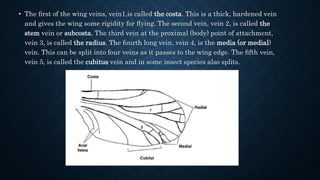
• The first of the wing veins, vein1,is called the costa. This is a thick, hardened vein
and gives the wing some rigidity for flying. The second vein, vein 2, is called the
stem vein or subcosta. The third vein at the proximal (body) point of attachment,
vein 3, is called the radius. The fourth long vein, vein 4, is the media (or medial)
vein. This can be split into four veins as it passes to the wing edge. The fifth vein,
vein 5, is called the cubitus vein and in some insect species also splits.
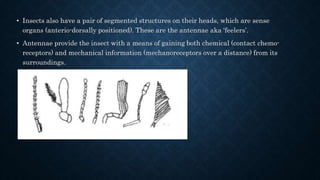
• Insects also have a pair of segmented structures on their heads, which are sense
organs (anterio-dorsally positioned). These are the antennae aka ‘feelers’.
• Antennae provide the insect with a means of gaining both chemical (contact chemo-
receptors) and mechanical information (mechanoreceptors over a distance) from its
surroundings.
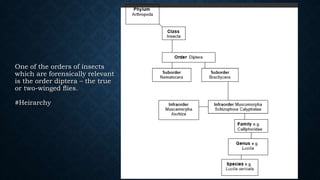
One of the orders of insects
which are forensically relevant
is the order diptera – the true
or two-winged flies.
#Heirarchy
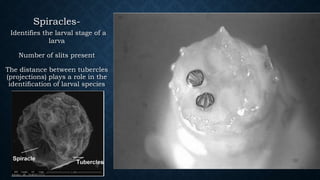
Spiracles-
Identifies the larval stage of a
larva
Number of slits present
The distance between tubercles
(projections) plays a role in the
identification of larval species
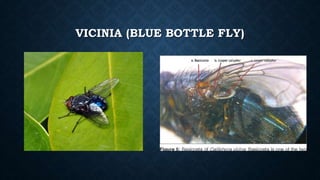
CALLIPHORA VICINA
• This is a large blowfly, which is between 9 and 11 mm in length.
• They are very common and associated with human activity and characterized by their loud
buzzing sound.
• Females can lay up to 500 eggs on decaying meat, and even fresh meat products
• The front thoracic spiracle is orange in color.. The head is black on top.
• Front and half of the check is reddish orange.
• Lower region of face is black.
• Thorax is black and have a greyish shine
• The abdomen is blue , silvery chequerboard effect.
• Basicosta in wing is yellow in color. Fades to yellow brown.
• Pupae are considerably smaller than the maggot and are dark brown in colour. The adult fly
emerges 2 weeks later.
VICINIA (BLUE BOTTLE FLY)
CALLIPHORA VOMITORIA
• Blue color bottle flies. They have longer life cylcles than the previous species..
• Basicosta is black in color. As opposed to orange in previous species.
• The base region of jowl is gingery orange.
• Spiracle is brown in color.
• The larvae of these two can be separated at third instar level as the spiracle width
of vomitoria is smaller and separated by great distance.
• Spiracles .33-.38mm and .23- .28mm
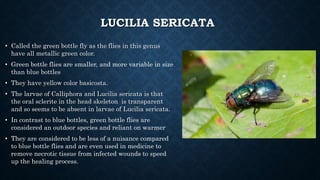
LUCILIA SERICATA
• Called the green bottle fly as the flies in this genus
have all metallic green color.
• Green bottle flies are smaller, and more variable in size
than blue bottles
• They have yellow color basicosta.
• The larvae of Calliphora and Lucilia sericata is that
the oral sclerite in the head skeleton is transparent
and so seems to be absent in larvae of Lucilia sericata.
• In contrast to blue bottles, green bottle flies are
considered an outdoor species and reliant on warmer
• They are considered to be less of a nuisance compared
to blue bottle flies and are even used in medicine to
remove necrotic tissue from infected wounds to speed
up the healing process.
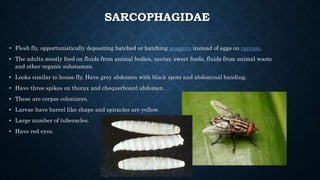
SARCOPHAGIDAE
• Flesh fly, opportunistically depositing hatched or hatching maggots instead of eggs on carrion.
• The adults mostly feed on fluids from animal bodies, nectar, sweet foods, fluids from animal waste
and other organic substances.
• Looks similar to house fly. Have grey abdomen with black spots and abdominal banding.
• Have three spikes on thorax and chequerboard abdomen.
• These are corpse colonizers.
• Larvae have barrel like shape and spiracles are yellow.
• Large number of tuberacles.
• Have red eyes.
Forensic entomology
Forensic entomology
Forensic entomology
Forensic entomology
Forensic entomology

Forensic entomology

  • 1.
    FORENSIC ENTOMOLOGY By- SaniyaZedi Assistant Professor, BU
  • 3.
    HISTORY • The importanceof insects in crime-scene investigation that in 1235, a training manual on investigating death, Washing Away of Wrongs, was written by Sung Tz’u. In this early medico-legal book it is recorded that attention paid by a number of blow flies to a particular sickle caused a murderer to confess to murdering a fellow Chinese farm worker with that sickle. • Experiments by Redi (1668), an Italian, who,usingthefleshofanumberofdifferentanimalspecies,demonstratedthatlarvae developed from eggs laid by flies, and the work by Linnaeus (1735) developing a system of classification. In so doing, Linnaeus provided a means of insect identification (including identifying such forensically important flies as Calliphora vomitoria Linnaeus). These developments formed foundations from which determination of the length of the stages in the insect’s lifecycle could be worked out and the indicators of time since death could be developed. • The next significant point in the history of forensic entomology resulted from observations and conclusions made by Megnin (1894). He related eight stages of human decomposition to the succession of insects colonising the body after death. • Research continues to be required in order to establish the accuracy levels of estimates of time since death and to interpret variation in different biotopes. • Buck Ruxton Case
  • 4.
    • Forensic Entomologistuse information about insect lifecycle and behaviour to help interpret evidences in legal context relating to both humans and animals. • the mandibles and mouthparts. Its most noticeable external features are the eyes, antennae, and mouthparts. All of these are important characteristics used in the identification of insects, and sometimes in the determination of sex. The shape of the compound eyes, their location on the head, and whether or not they touch are all characters sometimes used in identification. • The mouth hooks of larvae often have a distinctive shape and can be used in the identification of fly larvae to species.
  • 5.
    ESTIMATION • the developmentalperiod is usually shortened as temperature increases, which is why accurate climatic data are of utmost importance in the calculation and estimation of the post-mortem interval based on insect evidence. • The process of undergoing physical changes from one life stage to the next is known as metamorphosis. This is accomplished by means of the insect “shedding its skin,” or undergoing ecdysis, at certain times as it grows. The old shed skin that is left behind is called an exuvium.
  • 6.
    APPLICATIONS • Infestation • Insectshave a role in crime scene investigations on both land and in water. • Species that are forensically relevant- blow flies, flesh flies, cheese skippers, hide and skin beetles, rove beetles and clown beetles.
  • 7.
    FLIES AND TYPES •larder beetles (Dermestidae) • Moth flies (Psychodidae) • Scuttle flies (Phoridae) • Muscid flies (Muscidae) • Blowflies (Calliphoridae) • Flesh flies (Sarcophagidae) • ants (Formicidae) • Indian Meal Moth (Plodia interpunctella Hubner) • The fruit fly (Drosophila melanogaster Meigen)
  • 8.
    FEEDING RELATIONSHIP • Necrophages,which feed only on the decomposing tissue of the body or body parts– for example blowflies, hide beetles and clown beetles. • Predators(and parasites) of the necrophages–for example rove beetles and ground beetles. • Omnivores that consume both the live insects inhabiting the corpse and the dead flesh – for example ants (Formicidae), and wasps
  • 9.
  • 10.
    Identifying Flies-In orderto interpret a crime scene it is important to know which insect species have colonised the body and something about their habits and environmental requirements • Insects are invertebrates. They are classified within the Arthopoda but differ from other arthropods because they have a number of differing features. Insects have a hardened body case (an exoskeleton) which is split into three distinct regions. These sections are called: • . the head; • . the thorax; • . and the abdomen.
  • 11.
    • The sectionshave three dimensions, a top(dorsum),an underneath(sternum) and sides, each of which is a called a pleuron. • Thorax is divided into three sections prothorax, the meso thorax and the meta thorax.
  • 12.
    • All insectshave six legs (three pairs of jointed legs). Starting at the point nearest to the body (the proximal region) we have sections called the coxa (plural coxae), followed by the trochanter (a small section), the femur, tibia and the tarsus (plural tarsi) and claws.
  • 13.
    • The firstof the wing veins, vein1,is called the costa. This is a thick, hardened vein and gives the wing some rigidity for flying. The second vein, vein 2, is called the stem vein or subcosta. The third vein at the proximal (body) point of attachment, vein 3, is called the radius. The fourth long vein, vein 4, is the media (or medial) vein. This can be split into four veins as it passes to the wing edge. The fifth vein, vein 5, is called the cubitus vein and in some insect species also splits.
  • 14.
    • Insects alsohave a pair of segmented structures on their heads, which are sense organs (anterio-dorsally positioned). These are the antennae aka ‘feelers’. • Antennae provide the insect with a means of gaining both chemical (contact chemo- receptors) and mechanical information (mechanoreceptors over a distance) from its surroundings.
  • 15.
    One of theorders of insects which are forensically relevant is the order diptera – the true or two-winged flies. #Heirarchy
  • 16.
    Spiracles- Identifies the larvalstage of a larva Number of slits present The distance between tubercles (projections) plays a role in the identification of larval species
  • 17.
    CALLIPHORA VICINA • Thisis a large blowfly, which is between 9 and 11 mm in length. • They are very common and associated with human activity and characterized by their loud buzzing sound. • Females can lay up to 500 eggs on decaying meat, and even fresh meat products • The front thoracic spiracle is orange in color.. The head is black on top. • Front and half of the check is reddish orange. • Lower region of face is black. • Thorax is black and have a greyish shine • The abdomen is blue , silvery chequerboard effect. • Basicosta in wing is yellow in color. Fades to yellow brown. • Pupae are considerably smaller than the maggot and are dark brown in colour. The adult fly emerges 2 weeks later.
  • 18.
  • 19.
    CALLIPHORA VOMITORIA • Bluecolor bottle flies. They have longer life cylcles than the previous species.. • Basicosta is black in color. As opposed to orange in previous species. • The base region of jowl is gingery orange. • Spiracle is brown in color. • The larvae of these two can be separated at third instar level as the spiracle width of vomitoria is smaller and separated by great distance. • Spiracles .33-.38mm and .23- .28mm
  • 20.
    LUCILIA SERICATA • Calledthe green bottle fly as the flies in this genus have all metallic green color. • Green bottle flies are smaller, and more variable in size than blue bottles • They have yellow color basicosta. • The larvae of Calliphora and Lucilia sericata is that the oral sclerite in the head skeleton is transparent and so seems to be absent in larvae of Lucilia sericata. • In contrast to blue bottles, green bottle flies are considered an outdoor species and reliant on warmer • They are considered to be less of a nuisance compared to blue bottle flies and are even used in medicine to remove necrotic tissue from infected wounds to speed up the healing process.
  • 21.
    SARCOPHAGIDAE • Flesh fly,opportunistically depositing hatched or hatching maggots instead of eggs on carrion. • The adults mostly feed on fluids from animal bodies, nectar, sweet foods, fluids from animal waste and other organic substances. • Looks similar to house fly. Have grey abdomen with black spots and abdominal banding. • Have three spikes on thorax and chequerboard abdomen. • These are corpse colonizers. • Larvae have barrel like shape and spiracles are yellow. • Large number of tuberacles. • Have red eyes.