Rumala Morel
Dept. of Parasitology
Peradeniya
Y2S2
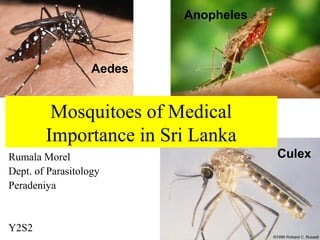
Mosquitoes of Medical
Importance in Sri Lanka
Aedes
Anopheles
Culex
MEDICAL ENTOMOLOGY
Study of insects and other
arthropods of medical importance
Insects: Mosquitoes, Flies, Midges,
Lice, Bugs, Fleas
Other arthropods: Ticks and Mites
Objectives:
 List the major mosquito borne diseases
that occur globally
 List the mosquitoes of medical importance
in Sri Lanka indicating the diseases they
transmit
 Outline the life cycle of a mosquito
 Describe the breeding & biting habits of
the medically important mosquitoes in Sri
Lanka
 Outline the strategies used for control of
these mosquito species in Sri Lanka
Anophelines
-Anopheles
Mosquitos – found globally in all climates
>3000 spp. only few of medical importance
 Culicines - Culex
- Aedes
- Mansonia
- Armigeres
Role of mosquitoes in disease transmission
2500 yrs ago Susruta suggested
transmission of malaria by mosquitoes
but no definite proof until end of 19th
C
1859- James Emerson Tennent in
‘Ceylon: An account of the island’
….retiring punctually at sunset and
sleeping under mosquito ‘curtain’ is a
valuable prophylactic against fevers…
Medical importance of Mosquitoes
 biting nuisance- pests/allergy
 vectors of disease
transmit disease causing organisms
Mosquitoes as biological vectors
Essential part of the life cycle takes place in
the vector- multiplication or development
or both
Specific time period necessary
before vector can infect another host
Mosquitoes as vectors of disease:
some important discoveries
1878 Patrick Manson- filarial
parasites
1897 Ronald Ross- malaria
1900 Reed & team- yellow fever
1902 Graham- dengue
Aedes aegypti Dengue Dengue viruses
Chikungunya Chikungunya virus
A.albopictus Dirofilariasis Dirofilaria repens
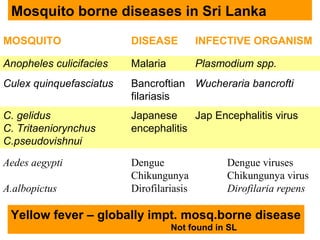
Mosquito borne diseases in Sri Lanka
MOSQUITO DISEASE INFECTIVE ORGANISM
Anopheles culicifacies Malaria Plasmodium spp.
Culex quinquefasciatus Bancroftian Wucheraria bancrofti
filariasis
C. gelidus Japanese Jap Encephalitis virus
C. Tritaeniorynchus encephalitis
C.pseudovishnui
Yellow fever – globally impt. mosq.borne disease
Not found in SL
Biological characteristics influencing
disease transmission
 only females suck blood (blood required for
egg maturation)
 breeding habits: preferred water type
 host preference – anthropophilic
- zoophilic
 blood sucking behavior- daytime/night
indoor/outdoor
 survival- 3-4 weeks (to allow development of
pathogen)
 flight range- 0.5 - 1.5 km
Morphology of adult mosquito
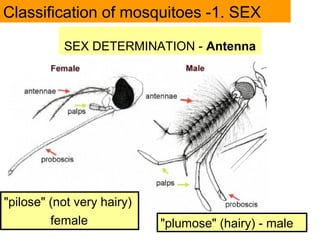
SEX DETERMINATION - Antenna
Classification of mosquitoes -1. SEX
"plumose" (hairy) - male
"pilose" (not very hairy)
female
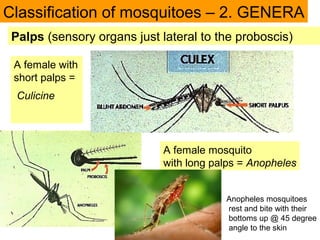
Palps (sensory organs just lateral to the proboscis)
Classification of mosquitoes – 2. GENERA
A female mosquito
with long palps = Anopheles
A female with
short palps =
Culicine
Anopheles mosquitoes
rest and bite with their
bottoms up @ 45 degree
angle to the skin
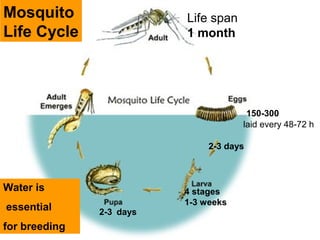
Life span
1 month
150-300
laid every 48-72 h
4 stages
1-3 weeks
2-3 days
2-3 days
Mosquito
Life Cycle
Water is
essential
for breeding
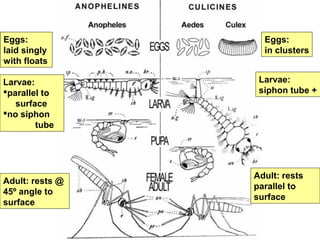
Eggs:
laid singly
with floats
Eggs:
in clusters
Larvae:
parallel to
surface
no siphon
tube
Larvae:
siphon tube +
Adult: rests @
45º angle to
surface
Adult: rests
parallel to
surface
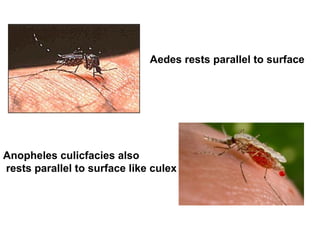
Aedes rests parallel to surface
Anopheles culicfacies also
rests parallel to surface like culex
Anopheles species of importance in Sri Lanka
An. culicifacies- major vector of malaria
vectors of minor importance
An. subpictus
An. annularis
An. vagus
An. tesselatus
Major vectors in other countries
An. gambiae- vector of human malaria and
Bancroftian filariasis in Africa
Characteristics of importance for a malarial vector
 density
 longevity
 biting habits- anthropophilic (man
biting)
- outdoor/indoor
night biting mosquitoes
Keys/charts used for species identification
Rests on walls – Indoor Residual Spraying
Effective control method
Anopheles culicifacies
Distribution: Sri Lanka, India, Myanmar
Pakistan, Middle East, Nepal, Thailand
Adult: small- medium
wings & female palps - banding
resting position culicine-like
Breeding: shallow, sunlit, clear fresh water
Eg. Edges of slow flowing streams/rivers;
rain water collections in ground pools and pits
Dry zone: endemic species
present throughout year but high
densities with rains (NE monsoon Oct-Jan)
Intermediate zone: seasonal breeding
Wet zone: not normally found but breeding
occur with failure of monsoons due to
pooling in river beds
Found up to 900 m height
Distribution in Sri Lanka
Anopheles culicifacies
Rain water collections in pits,
construction sites, hoof prints
in dry zone
Stream/river bed pools;
seepage pools at
margins of lakes,
reservoirs;
open irrigation canal
margins
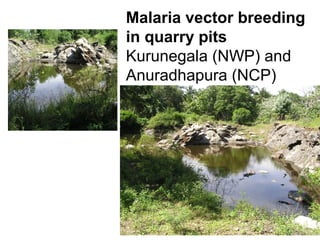
Malaria vector breeding
in quarry pits
Kurunegala (NWP) and
Anuradhapura (NCP)
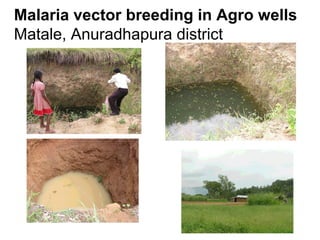
Malaria vector breeding in Agro wells
Matale, Anuradhapura district
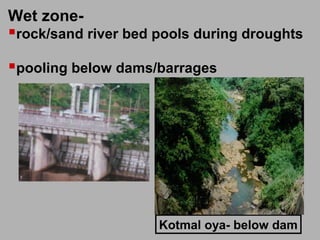
Wet zone-
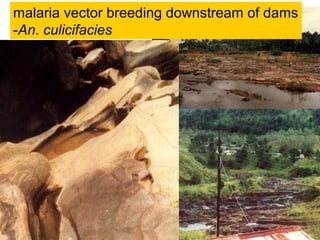
rock/sand river bed pools during droughts
pooling below dams/barrages
Kotmal oya- below dam
malaria vector breeding downstream of dams
-An. culicifacies
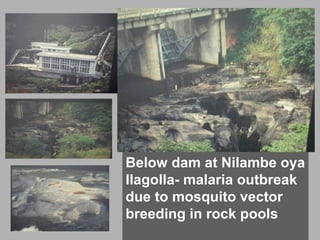
Below dam at Nilambe oya
Ilagolla- malaria outbreak
due to mosquito vector
breeding in rock pools
Culicines- 20 genera
In Sri Lanka > 115 species
 Culex
 Aedes
 Mansonia
 Armigeres
Culex quinquefasciatus
Very common urban domestic mosquito throughout
South/SE Asia- vector of bancroftian filariasis
Small, brown, absence of markings
Breeding: eggs in rafts (75-100 eggs)
highly polluted (organic matter) stagnant water
eg. blocked drains, cess pits, waste water pits
Habits: night biter, outdoor/indoor
bites man, cats/dogs
Rests in shade eg. indoors in dark corners
clothes, under furniture etc.
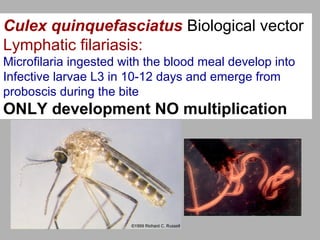
Culex quinquefasciatus Biological vector
Lymphatic filariasis:
Microfilaria ingested with the blood meal develop into
Infective larvae L3 in 10-12 days and emerge from
proboscis during the bite
ONLY development NO multiplication
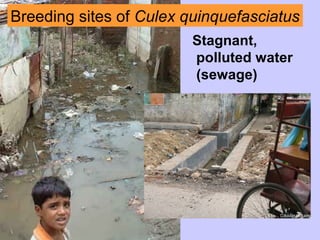
Breeding sites of Culex quinquefasciatus
Stagnant,
polluted water
(sewage)
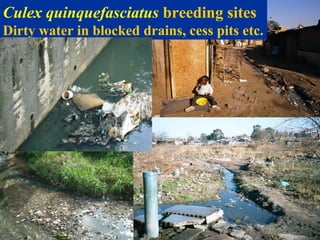
Culex quinquefasciatus breeding sites
Dirty water in blocked drains, cess pits etc.
Culex tritaeniorhynchus
Cx. gelidus
Cx. pseudovishnui
Breeding: paddy fields, marshes,
husk-soakage pits
Habits: night, outdoor/indoor
bites animals; pigs/cattle
(zoophilic)
Vectors of Japanese encephalitis
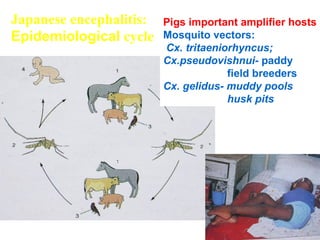
Japanese encephalitis:
Epidemiological cycle
Pigs important amplifier hosts
Mosquito vectors:
Cx. tritaeniorhyncus;
Cx.pseudovishnui- paddy
field breeders
Cx. gelidus- muddy pools
husk pits
Japanese Encephalitis
Culex gelidus
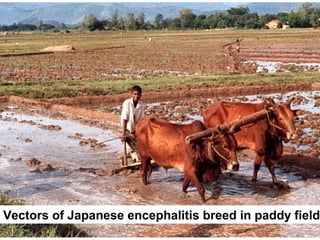
Vectors of Japanese encephalitis breed in paddy field
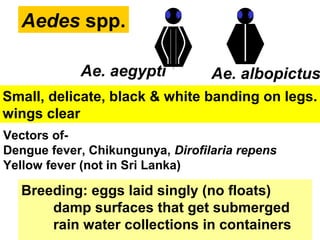
Aedes spp.
Ae. aegypti Ae. albopictus
Small, delicate, black & white banding on legs.
wings clear
Vectors of-
Dengue fever, Chikungunya, Dirofilaria repens
Yellow fever (not in Sri Lanka)
Breeding: eggs laid singly (no floats)
damp surfaces that get submerged
rain water collections in containers
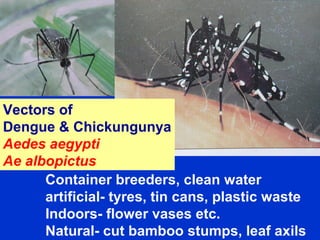
Vectors of
Dengue & Chickungunya
Aedes aegypti
Ae albopictus
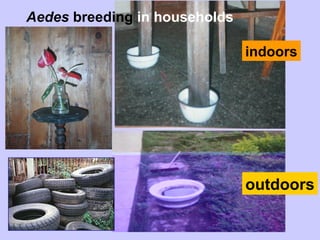
Container breeders, clean water
artificial- tyres, tin cans, plastic waste
Indoors- flower vases etc.
Natural- cut bamboo stumps, leaf axils
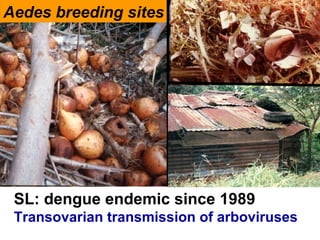
SL: dengue endemic since 1989
Transovarian transmission of arboviruses
Aedes breeding sites
Aedes breeding in households
indoors
outdoors
Aedes
Breeding
outdoors
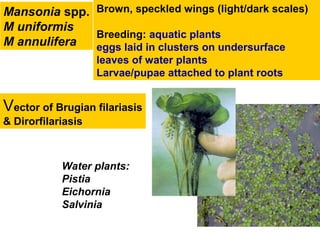
Vector of Brugian filariasis
& Dirorfilariasis
Water plants:
Pistia
Eichornia
Salvinia
Mansonia spp.
M uniformis
M annulifera
Brown, speckled wings (light/dark scales)
Breeding: aquatic plants
eggs laid in clusters on undersurface
leaves of water plants
Larvae/pupae attached to plant roots
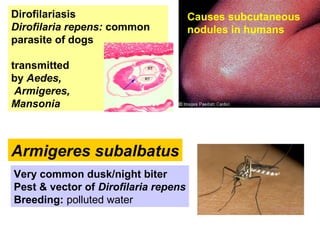
Armigeres subalbatus
Very common dusk/night biter
Pest & vector of Dirofilaria repens
Breeding: polluted water
Dirofilariasis
Dirofilaria repens: common
parasite of dogs
transmitted
by Aedes,
Armigeres,
Mansonia
Causes subcutaneous
nodules in humans
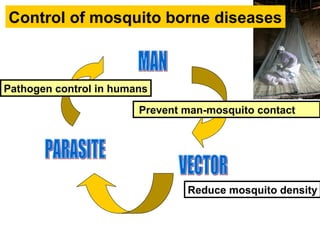
Reduce mosquito density
Pathogen control in humans
Prevent man-mosquito contact
Control of mosquito borne diseases
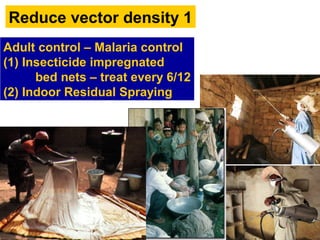
Reduce vector density 1
Adult control – Malaria control
(1) Insecticide impregnated
bed nets – treat every 6/12
(2) Indoor Residual Spraying
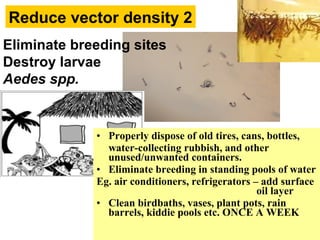
Reduce vector density 2
Eliminate breeding sites
Destroy larvae
Aedes spp.
• Properly dispose of old tires, cans, bottles,
water-collecting rubbish, and other
unused/unwanted containers.
• Eliminate breeding in standing pools of water
Eg. air conditioners, refrigerators – add surface
oil layer
• Clean birdbaths, vases, plant pots, rain
barrels, kiddie pools etc. ONCE A WEEK
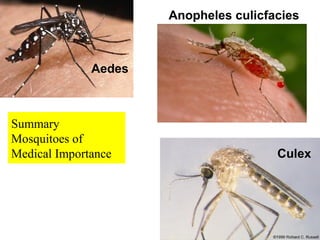
Summary
Mosquitoes of
Medical Importance
Aedes
Anopheles culicfacies
Culex

Mosquitoes

  • 1.
    Rumala Morel Dept. ofParasitology Peradeniya Y2S2 Mosquitoes of Medical Importance in Sri Lanka Aedes Anopheles Culex
  • 2.
    MEDICAL ENTOMOLOGY Study ofinsects and other arthropods of medical importance Insects: Mosquitoes, Flies, Midges, Lice, Bugs, Fleas Other arthropods: Ticks and Mites
  • 3.
    Objectives:  List themajor mosquito borne diseases that occur globally  List the mosquitoes of medical importance in Sri Lanka indicating the diseases they transmit  Outline the life cycle of a mosquito  Describe the breeding & biting habits of the medically important mosquitoes in Sri Lanka  Outline the strategies used for control of these mosquito species in Sri Lanka
  • 4.
    Anophelines -Anopheles Mosquitos – foundglobally in all climates >3000 spp. only few of medical importance  Culicines - Culex - Aedes - Mansonia - Armigeres
  • 5.
    Role of mosquitoesin disease transmission 2500 yrs ago Susruta suggested transmission of malaria by mosquitoes but no definite proof until end of 19th C 1859- James Emerson Tennent in ‘Ceylon: An account of the island’ ….retiring punctually at sunset and sleeping under mosquito ‘curtain’ is a valuable prophylactic against fevers…
  • 6.
    Medical importance ofMosquitoes  biting nuisance- pests/allergy  vectors of disease transmit disease causing organisms Mosquitoes as biological vectors Essential part of the life cycle takes place in the vector- multiplication or development or both Specific time period necessary before vector can infect another host
  • 7.
    Mosquitoes as vectorsof disease: some important discoveries 1878 Patrick Manson- filarial parasites 1897 Ronald Ross- malaria 1900 Reed & team- yellow fever 1902 Graham- dengue
  • 8.
    Aedes aegypti DengueDengue viruses Chikungunya Chikungunya virus A.albopictus Dirofilariasis Dirofilaria repens Mosquito borne diseases in Sri Lanka MOSQUITO DISEASE INFECTIVE ORGANISM Anopheles culicifacies Malaria Plasmodium spp. Culex quinquefasciatus Bancroftian Wucheraria bancrofti filariasis C. gelidus Japanese Jap Encephalitis virus C. Tritaeniorynchus encephalitis C.pseudovishnui Yellow fever – globally impt. mosq.borne disease Not found in SL
  • 9.
    Biological characteristics influencing diseasetransmission  only females suck blood (blood required for egg maturation)  breeding habits: preferred water type  host preference – anthropophilic - zoophilic  blood sucking behavior- daytime/night indoor/outdoor  survival- 3-4 weeks (to allow development of pathogen)  flight range- 0.5 - 1.5 km
  • 10.
  • 11.
    SEX DETERMINATION -Antenna Classification of mosquitoes -1. SEX "plumose" (hairy) - male "pilose" (not very hairy) female
  • 12.
    Palps (sensory organsjust lateral to the proboscis) Classification of mosquitoes – 2. GENERA A female mosquito with long palps = Anopheles A female with short palps = Culicine Anopheles mosquitoes rest and bite with their bottoms up @ 45 degree angle to the skin
  • 13.
    Life span 1 month 150-300 laidevery 48-72 h 4 stages 1-3 weeks 2-3 days 2-3 days Mosquito Life Cycle Water is essential for breeding
  • 14.
    Eggs: laid singly with floats Eggs: inclusters Larvae: parallel to surface no siphon tube Larvae: siphon tube + Adult: rests @ 45º angle to surface Adult: rests parallel to surface
  • 15.
    Aedes rests parallelto surface Anopheles culicfacies also rests parallel to surface like culex
  • 16.
    Anopheles species ofimportance in Sri Lanka An. culicifacies- major vector of malaria vectors of minor importance An. subpictus An. annularis An. vagus An. tesselatus Major vectors in other countries An. gambiae- vector of human malaria and Bancroftian filariasis in Africa
  • 17.
    Characteristics of importancefor a malarial vector  density  longevity  biting habits- anthropophilic (man biting) - outdoor/indoor night biting mosquitoes Keys/charts used for species identification Rests on walls – Indoor Residual Spraying Effective control method
  • 18.
    Anopheles culicifacies Distribution: SriLanka, India, Myanmar Pakistan, Middle East, Nepal, Thailand Adult: small- medium wings & female palps - banding resting position culicine-like Breeding: shallow, sunlit, clear fresh water Eg. Edges of slow flowing streams/rivers; rain water collections in ground pools and pits
  • 19.
    Dry zone: endemicspecies present throughout year but high densities with rains (NE monsoon Oct-Jan) Intermediate zone: seasonal breeding Wet zone: not normally found but breeding occur with failure of monsoons due to pooling in river beds Found up to 900 m height Distribution in Sri Lanka Anopheles culicifacies
  • 20.
    Rain water collectionsin pits, construction sites, hoof prints in dry zone Stream/river bed pools; seepage pools at margins of lakes, reservoirs; open irrigation canal margins
  • 21.
    Malaria vector breeding inquarry pits Kurunegala (NWP) and Anuradhapura (NCP)
  • 22.
    Malaria vector breedingin Agro wells Matale, Anuradhapura district
  • 23.
    Wet zone- rock/sand riverbed pools during droughts pooling below dams/barrages Kotmal oya- below dam
  • 24.
    malaria vector breedingdownstream of dams -An. culicifacies
  • 25.
    Below dam atNilambe oya Ilagolla- malaria outbreak due to mosquito vector breeding in rock pools
  • 26.
    Culicines- 20 genera InSri Lanka > 115 species  Culex  Aedes  Mansonia  Armigeres
  • 27.
    Culex quinquefasciatus Very commonurban domestic mosquito throughout South/SE Asia- vector of bancroftian filariasis Small, brown, absence of markings Breeding: eggs in rafts (75-100 eggs) highly polluted (organic matter) stagnant water eg. blocked drains, cess pits, waste water pits Habits: night biter, outdoor/indoor bites man, cats/dogs Rests in shade eg. indoors in dark corners clothes, under furniture etc.
  • 28.
    Culex quinquefasciatus Biologicalvector Lymphatic filariasis: Microfilaria ingested with the blood meal develop into Infective larvae L3 in 10-12 days and emerge from proboscis during the bite ONLY development NO multiplication
  • 29.
    Breeding sites ofCulex quinquefasciatus Stagnant, polluted water (sewage)
  • 30.
    Culex quinquefasciatus breedingsites Dirty water in blocked drains, cess pits etc.
  • 31.
    Culex tritaeniorhynchus Cx. gelidus Cx.pseudovishnui Breeding: paddy fields, marshes, husk-soakage pits Habits: night, outdoor/indoor bites animals; pigs/cattle (zoophilic) Vectors of Japanese encephalitis
  • 32.
    Japanese encephalitis: Epidemiological cycle Pigsimportant amplifier hosts Mosquito vectors: Cx. tritaeniorhyncus; Cx.pseudovishnui- paddy field breeders Cx. gelidus- muddy pools husk pits
  • 33.
  • 34.
    Vectors of Japaneseencephalitis breed in paddy field
  • 35.
    Aedes spp. Ae. aegyptiAe. albopictus Small, delicate, black & white banding on legs. wings clear Vectors of- Dengue fever, Chikungunya, Dirofilaria repens Yellow fever (not in Sri Lanka) Breeding: eggs laid singly (no floats) damp surfaces that get submerged rain water collections in containers
  • 36.
    Vectors of Dengue &Chickungunya Aedes aegypti Ae albopictus Container breeders, clean water artificial- tyres, tin cans, plastic waste Indoors- flower vases etc. Natural- cut bamboo stumps, leaf axils
  • 37.
    SL: dengue endemicsince 1989 Transovarian transmission of arboviruses Aedes breeding sites
  • 38.
    Aedes breeding inhouseholds indoors outdoors
  • 39.
  • 40.
    Vector of Brugianfilariasis & Dirorfilariasis Water plants: Pistia Eichornia Salvinia Mansonia spp. M uniformis M annulifera Brown, speckled wings (light/dark scales) Breeding: aquatic plants eggs laid in clusters on undersurface leaves of water plants Larvae/pupae attached to plant roots
  • 41.
    Armigeres subalbatus Very commondusk/night biter Pest & vector of Dirofilaria repens Breeding: polluted water Dirofilariasis Dirofilaria repens: common parasite of dogs transmitted by Aedes, Armigeres, Mansonia Causes subcutaneous nodules in humans
  • 42.
    Reduce mosquito density Pathogencontrol in humans Prevent man-mosquito contact Control of mosquito borne diseases
  • 43.
    Reduce vector density1 Adult control – Malaria control (1) Insecticide impregnated bed nets – treat every 6/12 (2) Indoor Residual Spraying
  • 44.
    Reduce vector density2 Eliminate breeding sites Destroy larvae Aedes spp. • Properly dispose of old tires, cans, bottles, water-collecting rubbish, and other unused/unwanted containers. • Eliminate breeding in standing pools of water Eg. air conditioners, refrigerators – add surface oil layer • Clean birdbaths, vases, plant pots, rain barrels, kiddie pools etc. ONCE A WEEK
  • 45.

Editor's Notes

  • #25 Since 1986, several outbreaks of malaria have occurred in the traditionally non-mal;rious areas. These were related to hydrological changes below dams causing pooling in the rocky and sandy river bed linked with water diversion and aggravated by droughts. In addition human migration between the downstream settlements and upper non malarious areas promoted parasite carriage.
  • #31 Infection is associated with prolific breeding of the vector in blocked drains, sewage pits and polluted stagnant water collections that are common in the poorly planned urban environment. such sites also favour breeding of Armigeres mosquitoes.
  • #35 the outdoor agricultural lifestyle and rural dwellings carry high risks of man-mosquito contact.
  • #38 The global emergence of dengue fevers as an urban public health problem is associated with Aedes breeding. Modern lifestyles with widespread use of 'thowaway containers that end up in refuse are ideal breeding sites. 90% of Aedes breeding in in Sri Lanka occur in discarded receptacles, empty coconut combs and used tyres made use of for varying purposes.