Class Insecta
Characteristics
1. Insect bodies are divided into three regions: head, thorax and abdomen.
2.There are three pair of jointed legs.
3. Insects usually have 1 or 2 pair of wings in the adult stage
4. Insects have both simple (called ocelli) and compound eyes
5. Coelom very much reduced
6. The circulatory system is an open system and like crustaceans includes a
hemocoel.
Sub-Class: Apterygota
Order 1. Thysanura – e.g. Bristle tails, silverfish
Order 2. Diplura- e.g. Two pronged bristle tails
Order 3. Protura- e.g. Proturans
Order 4. Collembola- e.g. Spring tails
Sub-Class: Pterygota
Division: Exopterygota
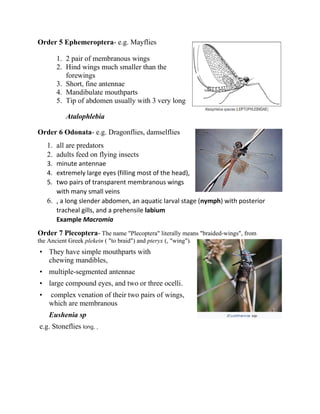
Order 5 Ephemeroptera- e.g. Mayflies
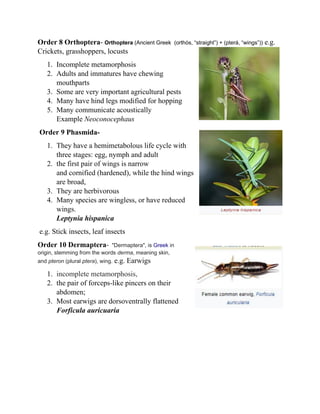
Order 6 Odonata- e.g. Dragonflies, damselflies
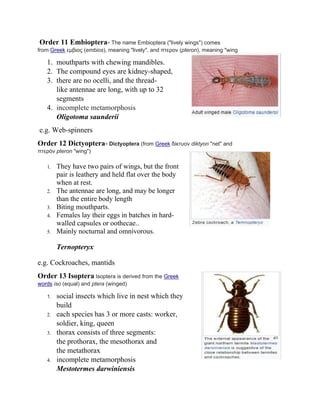
Order 7 Plecoptera- e.g. Stoneflies
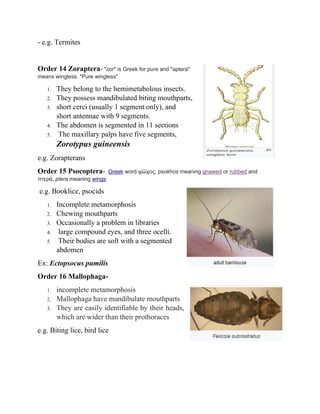
Order 8 Orthoptera- e.g. Crickets, grasshoppers, locusts
Order 9 Phasmida- e.g. Stick insects, leaf insects
Order 10 Dermaptera- e.g. Earwigs
Order 11 Embioptera- e.g. Web-spinners
Order 12 Dictyoptera- e.g. Cockroaches, mantids
Order 13 Isoptera- e.g. Termites
Order 14 Zoraptera- e.g. Zorapterans
Order 15 Psocoptera- e.g. Booklice, psocids
Order 16 Mallophaga- e.g. Biting lice, bird lice
Order 17 Siphunculata- e.g. Sucking lice
Order 18 Hemiptera- e.g. True bugs
Order 19 Homoptera- e.g. Leafhoppers, aphids, scale insects, cicadas
Order 20 Thysanoptera- e.g. Thrips
Division: Endopterygota
Order 21 Neuroptera- e.g. Lacewings, antlions
Order 22 Coleoptera- e.g. Beetles & weevils
Order 23 Strepsiptera- e.g. Stylopids
Order 24 Mecoptera- e.g. Scorpion flies
Order 25 Siphonaptera- e.g. Fleas
Order 26 Diptera- e.g. True flies
Order 27 Lepidoptera- e.g. Butterflies, moths
Order 28 Trichoptera- e.g. Caddis flies
Order 29 Hymenoptera- e.g. Ants, bees, wasps, sawflies
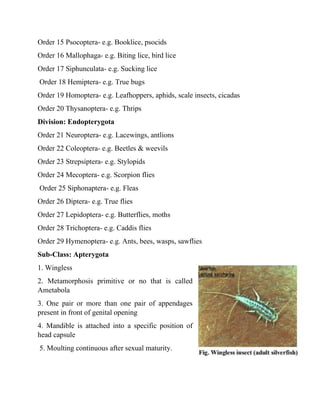
Sub-Class: Apterygota
1. Wingless
2. Metamorphosis primitive or no that is called
Ametabola
3. One pair or more than one pair of appendages
present in front of genital opening
4. Mandible is attached into a specific position of
head capsule
5. Moulting continuous after sexual maturity.
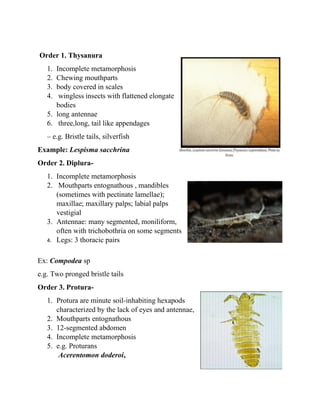
Order 1. Thysanura
1. Incomplete metamorphosis
2. Chewing mouthparts
3. body covered in scales
4. wingless insects with flattened elongate
bodies
5. long antennae
6. three,long, tail like appendages
– e.g. Bristle tails, silverfish
Example: Lespisma sacchrina
Order 2. Diplura-
1. Incomplete metamorphosis
2. Mouthparts entognathous , mandibles
(sometimes with pectinate lamellae);
maxillae; maxillary palps; labial palps
vestigial
3. Antennae: many segmented, moniliform,
often with trichobothria on some segments
4. Legs: 3 thoracic pairs
Ex: Compodea sp
e.g. Two pronged bristle tails
Order 3. Protura-
1. Protura are minute soil-inhabiting hexapods
characterized by the lack of eyes and antennae,
2. Mouthparts entognathous
3. 12-segmented abdomen
4. Incomplete metamorphosis
5. e.g. Proturans
Acerentomon doderoi,
Order 4. Collembola- e.g. Spring tails
1. Incomplete metamorphosis
2. Chewing mouthparts
3. spring-like mechanism at posterior end of
body
4. very common in damp soil, decaying leaves,
etc.
5. • very small insects
Example: Anurida
Sub-Class: Pterygota
1. Winged (alate) or secondarily wingless insects
2. Metamorphosis incomplete or complete
3. No appendage present in front of genital opening
4. Mandible is attached into two specific position of head capsule
5. Sexually matured adults do not moult.
Division: Exopterygota
1. Metamorphosis incomplete or simple that is called Hemimetabola [ 3
developmental stages include egg, nymph and adult]
2. Wings developed from external portion of the body
3. Pupal instar absent or rare
4. Young generalized as nymph
5. Immature insects similar with adults
Order 5 Ephemeroptera- e.g. Mayflies
1. 2 pair of membranous wings
2. Hind wings much smaller than the
forewings
3. Short, fine antennae
4. Mandibulate mouthparts
5. Tip of abdomen usually with 3 very long
Atalophlebia
Order 6 Odonata- e.g. Dragonflies, damselflies
1. all are predators
2. adults feed on flying insects
3. minute antennae
4. extremely large eyes (filling most of the head),
5. two pairs of transparent membranous wings
with many small veins
6. , a long slender abdomen, an aquatic larval stage (nymph) with posterior
tracheal gills, and a prehensile labium
Example Macromia
Order 7 Plecoptera- The name "Plecoptera" literally means "braided-wings", from
the Ancient Greek plekein ( "to braid") and pteryx (, "wing").
• They have simple mouthparts with
chewing mandibles,
• multiple-segmented antennae
• large compound eyes, and two or three ocelli.
• complex venation of their two pairs of wings,
which are membranous
Eushenia sp
e.g. Stoneflies long, ,
Order 8 Orthoptera- Orthoptera (Ancient Greek (orthós, “straight”) + (pterá, “wings”)) e.g.
Crickets, grasshoppers, locusts
1. Incomplete metamorphosis
2. Adults and immatures have chewing
mouthparts
3. Some are very important agricultural pests
4. Many have hind legs modified for hopping
5. Many communicate acoustically
Example Neoconocephaus
Order 9 Phasmida-
1. They have a hemimetabolous life cycle with
three stages: egg, nymph and adult
2. the first pair of wings is narrow
and cornified (hardened), while the hind wings
are broad,
3. They are herbivorous
4. Many species are wingless, or have reduced
wings.
Leptynia hispanica
e.g. Stick insects, leaf insects
Order 10 Dermaptera- "Dermaptera", is Greek in
origin, stemming from the words derma, meaning skin,
and pteron (plural ptera), wing. e.g. Earwigs
1. incomplete metamorphosis,
2. the pair of forceps-like pincers on their
abdomen;
3. Most earwigs are dorsoventrally flattened
Forficula auricuaria
Order 11 Embioptera- The name Embioptera ("lively wings") comes
from Greek εμβιος (embios), meaning "lively", and πτερον (pteron), meaning "wing
1. mouthparts with chewing mandibles.
2. The compound eyes are kidney-shaped,
3. there are no ocelli, and the thread-
like antennae are long, with up to 32
segments
4. incomplete metamorphosis
Oligotoma saunderii
e.g. Web-spinners
Order 12 Dictyoptera- Dictyoptera (from Greek δίκτυον diktyon "net" and
πτερόν pteron "wing")
1. They have two pairs of wings, but the front
pair is leathery and held flat over the body
when at rest.
2. The antennae are long, and may be longer
than the entire body length
3. Biting mouthparts.
4. Females lay their eggs in batches in hard-
walled capsules or oothecae..
5. Mainly nocturnal and omnivorous.
Ternopteryx
e.g. Cockroaches, mantids
Order 13 Isoptera Isoptera is derived from the Greek
words iso (equal) and ptera (winged)
1. social insects which live in nest which they
build
2. each species has 3 or more casts: worker,
soldier, king, queen
3. thorax consists of three segments:
the prothorax, the mesothorax and
the metathorax
4. incomplete metamorphosis
Mestotermes darwiniensis
- e.g. Termites
Order 14 Zoraptera- "zor" is Greek for pure and "aptera"
means wingless. "Pure wingless"
1. They belong to the hemimetabolous insects.
2. They possess mandibulated biting mouthparts,
3. short cerci (usually 1 segment only), and
short antennae with 9 segments.
4. The abdomen is segmented in 11 sections
5. The maxillary palps have five segments,
Zorotypus guineensis
e.g. Zorapterans
Order 15 Psocoptera- Greek word ψῶχος, psokhos meaning gnawed or rubbed and
πτερά, ptera meaning wings
e.g. Booklice, psocids
1. Incomplete metamorphosis
2. Chewing mouthparts
3. Occasionally a problem in libraries
4. large compound eyes, and three ocelli.
5. Their bodies are soft with a segmented
abdomen
Ex: Ectopsocus pumilis
Order 16 Mallophaga-
1. incomplete metamorphosis
2. Mallophaga have mandibulate mouthparts
3. They are easily identifiable by their heads,
which are wider than their prothoraces
e.g. Biting lice, bird lice
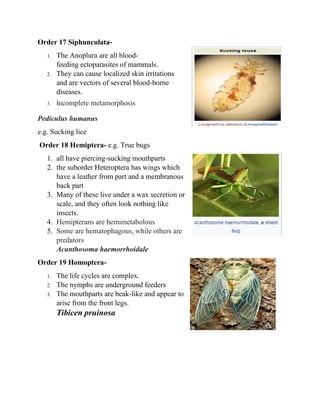
Order 17 Siphunculata-
1. The Anoplura are all blood-
feeding ectoparasites of mammals.
2. They can cause localized skin irritations
and are vectors of several blood-borne
diseases.
3. incomplete metamorphosis
Pediculus humanus
e.g. Sucking lice
Order 18 Hemiptera- e.g. True bugs
1. all have piercing-sucking mouthparts
2. the suborder Heteroptera has wings which
have a leather from part and a membranous
back part
3. Many of these live under a wax secretion or
scale, and they often look nothing like
insects.
4. Hemipterans are hemimetabolous
5. Some are hematophagous, while others are
predators
Acanthosoma haemorrhoidale
Order 19 Homoptera-
1. The life cycles are complex.
2. The nymphs are underground feeders
3. The mouthparts are beak-like and appear to
arise from the front legs.
Tibicen pruinosa
e.g. Leafhoppers, aphids, scale insects, cicadas
Order 20 Thysanoptera- e.g. Thrips
1. Incomplete metamorphosis
2. Rasping-sucking mouthparts
3. Some are very important agricultural pests
4. Most phytophagous; some predaceous
Franklinothips vespiformis
Division: Endopterygota
1. Metamorphosis complete or complex that is called holometabola [4
developmental stages such as egg, larva, pupa and adult]
2. Wings developed from the internal portion of the body
3. Always accompanied by larval and pupal instar
4. Young generalized as larva
5. Immature insects externally differ with adults
Order 21 Neuroptera- e.g. Lacewings, antlions
1. Complete metamorphosis
2. Adults and immatures have chewing
mouthparts
3. Some are very important biological control
organisms
4. They have large lateral compound eyes
Chrysopa perla
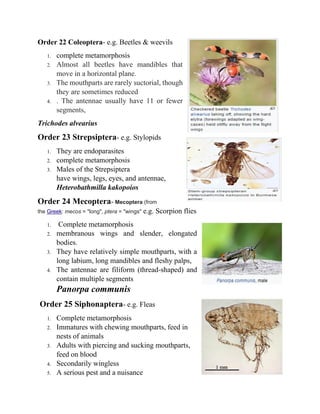
Order 22 Coleoptera- e.g. Beetles & weevils
1. complete metamorphosis
2. Almost all beetles have mandibles that
move in a horizontal plane.
3. The mouthparts are rarely suctorial, though
they are sometimes reduced
4. . The antennae usually have 11 or fewer
segments,
Trichodes alvearius
Order 23 Strepsiptera- e.g. Stylopids
1. They are endoparasites
2. complete metamorphosis
3. Males of the Strepsiptera
have wings, legs, eyes, and antennae,
Heterobathmilla kakopoios
Order 24 Mecoptera- Mecoptera (from
the Greek: mecos = "long", ptera = "wings" e.g. Scorpion flies
1. Complete metamorphosis
2. membranous wings and slender, elongated
bodies.
3. They have relatively simple mouthparts, with a
long labium, long mandibles and fleshy palps,
4. The antennae are filiform (thread-shaped) and
contain multiple segments
Panorpa communis
Order 25 Siphonaptera- e.g. Fleas
1. Complete metamorphosis
2. Immatures with chewing mouthparts, feed in
nests of animals
3. Adults with piercing and sucking mouthparts,
feed on blood
4. Secondarily wingless
5. A serious pest and a nuisance
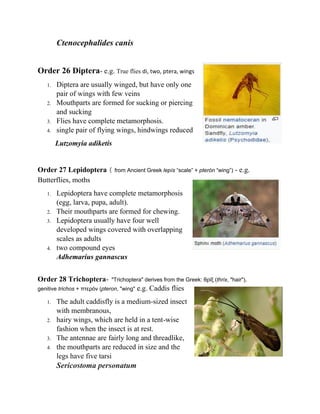
Ctenocephalides canis
Order 26 Diptera- e.g. True flies di, two, ptera, wings
1. Diptera are usually winged, but have only one
pair of wings with few veins
2. Mouthparts are formed for sucking or piercing
and sucking
3. Flies have complete metamorphosis.
4. single pair of flying wings, hindwings reduced
Lutzomyia adiketis
Order 27 Lepidoptera ( from Ancient Greek lepís “scale” + pterón “wing”) - e.g.
Butterflies, moths
1. Lepidoptera have complete metamorphosis
(egg, larva, pupa, adult).
2. Their mouthparts are formed for chewing.
3. Lepidoptera usually have four well
developed wings covered with overlapping
scales as adults
4. two compound eyes
Adhemarius gannascus
Order 28 Trichoptera- "Trichoptera" derives from the Greek: θρίξ (thrix, "hair"),
genitive trichos + πτερόν (pteron, "wing" e.g. Caddis flies
1. The adult caddisfly is a medium-sized insect
with membranous,
2. hairy wings, which are held in a tent-wise
fashion when the insect is at rest.
3. The antennae are fairly long and threadlike,
4. the mouthparts are reduced in size and the
legs have five tarsi
Sericostoma personatum
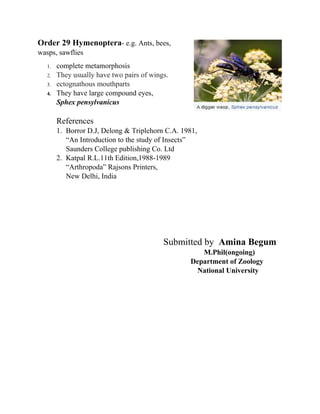
Order 29 Hymenoptera- e.g. Ants, bees,
wasps, sawflies
1. complete metamorphosis
2. They usually have two pairs of wings.
3. ectognathous mouthparts
4. They have large compound eyes,
Sphex pensylvanicus
References
1. Borror D.J, Delong & Triplehorn C.A. 1981,
“An Introduction to the study of Insects”
Saunders College publishing Co. Ltd
2. Katpal R.L.11th Edition,1988-1989
“Arthropoda” Rajsons Printers,
New Delhi, India
Submitted by Amina Begum
M.Phil(ongoing)
Department of Zoology
National University

Classification of insecta

  • 1.
    Class Insecta Characteristics 1. Insectbodies are divided into three regions: head, thorax and abdomen. 2.There are three pair of jointed legs. 3. Insects usually have 1 or 2 pair of wings in the adult stage 4. Insects have both simple (called ocelli) and compound eyes 5. Coelom very much reduced 6. The circulatory system is an open system and like crustaceans includes a hemocoel. Sub-Class: Apterygota Order 1. Thysanura – e.g. Bristle tails, silverfish Order 2. Diplura- e.g. Two pronged bristle tails Order 3. Protura- e.g. Proturans Order 4. Collembola- e.g. Spring tails Sub-Class: Pterygota Division: Exopterygota Order 5 Ephemeroptera- e.g. Mayflies Order 6 Odonata- e.g. Dragonflies, damselflies Order 7 Plecoptera- e.g. Stoneflies Order 8 Orthoptera- e.g. Crickets, grasshoppers, locusts Order 9 Phasmida- e.g. Stick insects, leaf insects Order 10 Dermaptera- e.g. Earwigs Order 11 Embioptera- e.g. Web-spinners Order 12 Dictyoptera- e.g. Cockroaches, mantids Order 13 Isoptera- e.g. Termites Order 14 Zoraptera- e.g. Zorapterans
  • 2.
    Order 15 Psocoptera-e.g. Booklice, psocids Order 16 Mallophaga- e.g. Biting lice, bird lice Order 17 Siphunculata- e.g. Sucking lice Order 18 Hemiptera- e.g. True bugs Order 19 Homoptera- e.g. Leafhoppers, aphids, scale insects, cicadas Order 20 Thysanoptera- e.g. Thrips Division: Endopterygota Order 21 Neuroptera- e.g. Lacewings, antlions Order 22 Coleoptera- e.g. Beetles & weevils Order 23 Strepsiptera- e.g. Stylopids Order 24 Mecoptera- e.g. Scorpion flies Order 25 Siphonaptera- e.g. Fleas Order 26 Diptera- e.g. True flies Order 27 Lepidoptera- e.g. Butterflies, moths Order 28 Trichoptera- e.g. Caddis flies Order 29 Hymenoptera- e.g. Ants, bees, wasps, sawflies Sub-Class: Apterygota 1. Wingless 2. Metamorphosis primitive or no that is called Ametabola 3. One pair or more than one pair of appendages present in front of genital opening 4. Mandible is attached into a specific position of head capsule 5. Moulting continuous after sexual maturity.
  • 3.
    Order 1. Thysanura 1.Incomplete metamorphosis 2. Chewing mouthparts 3. body covered in scales 4. wingless insects with flattened elongate bodies 5. long antennae 6. three,long, tail like appendages – e.g. Bristle tails, silverfish Example: Lespisma sacchrina Order 2. Diplura- 1. Incomplete metamorphosis 2. Mouthparts entognathous , mandibles (sometimes with pectinate lamellae); maxillae; maxillary palps; labial palps vestigial 3. Antennae: many segmented, moniliform, often with trichobothria on some segments 4. Legs: 3 thoracic pairs Ex: Compodea sp e.g. Two pronged bristle tails Order 3. Protura- 1. Protura are minute soil-inhabiting hexapods characterized by the lack of eyes and antennae, 2. Mouthparts entognathous 3. 12-segmented abdomen 4. Incomplete metamorphosis 5. e.g. Proturans Acerentomon doderoi,
  • 4.
    Order 4. Collembola-e.g. Spring tails 1. Incomplete metamorphosis 2. Chewing mouthparts 3. spring-like mechanism at posterior end of body 4. very common in damp soil, decaying leaves, etc. 5. • very small insects Example: Anurida Sub-Class: Pterygota 1. Winged (alate) or secondarily wingless insects 2. Metamorphosis incomplete or complete 3. No appendage present in front of genital opening 4. Mandible is attached into two specific position of head capsule 5. Sexually matured adults do not moult. Division: Exopterygota 1. Metamorphosis incomplete or simple that is called Hemimetabola [ 3 developmental stages include egg, nymph and adult] 2. Wings developed from external portion of the body 3. Pupal instar absent or rare 4. Young generalized as nymph 5. Immature insects similar with adults
  • 5.
    Order 5 Ephemeroptera-e.g. Mayflies 1. 2 pair of membranous wings 2. Hind wings much smaller than the forewings 3. Short, fine antennae 4. Mandibulate mouthparts 5. Tip of abdomen usually with 3 very long Atalophlebia Order 6 Odonata- e.g. Dragonflies, damselflies 1. all are predators 2. adults feed on flying insects 3. minute antennae 4. extremely large eyes (filling most of the head), 5. two pairs of transparent membranous wings with many small veins 6. , a long slender abdomen, an aquatic larval stage (nymph) with posterior tracheal gills, and a prehensile labium Example Macromia Order 7 Plecoptera- The name "Plecoptera" literally means "braided-wings", from the Ancient Greek plekein ( "to braid") and pteryx (, "wing"). • They have simple mouthparts with chewing mandibles, • multiple-segmented antennae • large compound eyes, and two or three ocelli. • complex venation of their two pairs of wings, which are membranous Eushenia sp e.g. Stoneflies long, ,
  • 6.
    Order 8 Orthoptera-Orthoptera (Ancient Greek (orthós, “straight”) + (pterá, “wings”)) e.g. Crickets, grasshoppers, locusts 1. Incomplete metamorphosis 2. Adults and immatures have chewing mouthparts 3. Some are very important agricultural pests 4. Many have hind legs modified for hopping 5. Many communicate acoustically Example Neoconocephaus Order 9 Phasmida- 1. They have a hemimetabolous life cycle with three stages: egg, nymph and adult 2. the first pair of wings is narrow and cornified (hardened), while the hind wings are broad, 3. They are herbivorous 4. Many species are wingless, or have reduced wings. Leptynia hispanica e.g. Stick insects, leaf insects Order 10 Dermaptera- "Dermaptera", is Greek in origin, stemming from the words derma, meaning skin, and pteron (plural ptera), wing. e.g. Earwigs 1. incomplete metamorphosis, 2. the pair of forceps-like pincers on their abdomen; 3. Most earwigs are dorsoventrally flattened Forficula auricuaria
  • 7.
    Order 11 Embioptera-The name Embioptera ("lively wings") comes from Greek εμβιος (embios), meaning "lively", and πτερον (pteron), meaning "wing 1. mouthparts with chewing mandibles. 2. The compound eyes are kidney-shaped, 3. there are no ocelli, and the thread- like antennae are long, with up to 32 segments 4. incomplete metamorphosis Oligotoma saunderii e.g. Web-spinners Order 12 Dictyoptera- Dictyoptera (from Greek δίκτυον diktyon "net" and πτερόν pteron "wing") 1. They have two pairs of wings, but the front pair is leathery and held flat over the body when at rest. 2. The antennae are long, and may be longer than the entire body length 3. Biting mouthparts. 4. Females lay their eggs in batches in hard- walled capsules or oothecae.. 5. Mainly nocturnal and omnivorous. Ternopteryx e.g. Cockroaches, mantids Order 13 Isoptera Isoptera is derived from the Greek words iso (equal) and ptera (winged) 1. social insects which live in nest which they build 2. each species has 3 or more casts: worker, soldier, king, queen 3. thorax consists of three segments: the prothorax, the mesothorax and the metathorax 4. incomplete metamorphosis Mestotermes darwiniensis
  • 8.
    - e.g. Termites Order14 Zoraptera- "zor" is Greek for pure and "aptera" means wingless. "Pure wingless" 1. They belong to the hemimetabolous insects. 2. They possess mandibulated biting mouthparts, 3. short cerci (usually 1 segment only), and short antennae with 9 segments. 4. The abdomen is segmented in 11 sections 5. The maxillary palps have five segments, Zorotypus guineensis e.g. Zorapterans Order 15 Psocoptera- Greek word ψῶχος, psokhos meaning gnawed or rubbed and πτερά, ptera meaning wings e.g. Booklice, psocids 1. Incomplete metamorphosis 2. Chewing mouthparts 3. Occasionally a problem in libraries 4. large compound eyes, and three ocelli. 5. Their bodies are soft with a segmented abdomen Ex: Ectopsocus pumilis Order 16 Mallophaga- 1. incomplete metamorphosis 2. Mallophaga have mandibulate mouthparts 3. They are easily identifiable by their heads, which are wider than their prothoraces e.g. Biting lice, bird lice
  • 9.
    Order 17 Siphunculata- 1.The Anoplura are all blood- feeding ectoparasites of mammals. 2. They can cause localized skin irritations and are vectors of several blood-borne diseases. 3. incomplete metamorphosis Pediculus humanus e.g. Sucking lice Order 18 Hemiptera- e.g. True bugs 1. all have piercing-sucking mouthparts 2. the suborder Heteroptera has wings which have a leather from part and a membranous back part 3. Many of these live under a wax secretion or scale, and they often look nothing like insects. 4. Hemipterans are hemimetabolous 5. Some are hematophagous, while others are predators Acanthosoma haemorrhoidale Order 19 Homoptera- 1. The life cycles are complex. 2. The nymphs are underground feeders 3. The mouthparts are beak-like and appear to arise from the front legs. Tibicen pruinosa
  • 10.
    e.g. Leafhoppers, aphids,scale insects, cicadas Order 20 Thysanoptera- e.g. Thrips 1. Incomplete metamorphosis 2. Rasping-sucking mouthparts 3. Some are very important agricultural pests 4. Most phytophagous; some predaceous Franklinothips vespiformis Division: Endopterygota 1. Metamorphosis complete or complex that is called holometabola [4 developmental stages such as egg, larva, pupa and adult] 2. Wings developed from the internal portion of the body 3. Always accompanied by larval and pupal instar 4. Young generalized as larva 5. Immature insects externally differ with adults Order 21 Neuroptera- e.g. Lacewings, antlions 1. Complete metamorphosis 2. Adults and immatures have chewing mouthparts 3. Some are very important biological control organisms 4. They have large lateral compound eyes Chrysopa perla
  • 11.
    Order 22 Coleoptera-e.g. Beetles & weevils 1. complete metamorphosis 2. Almost all beetles have mandibles that move in a horizontal plane. 3. The mouthparts are rarely suctorial, though they are sometimes reduced 4. . The antennae usually have 11 or fewer segments, Trichodes alvearius Order 23 Strepsiptera- e.g. Stylopids 1. They are endoparasites 2. complete metamorphosis 3. Males of the Strepsiptera have wings, legs, eyes, and antennae, Heterobathmilla kakopoios Order 24 Mecoptera- Mecoptera (from the Greek: mecos = "long", ptera = "wings" e.g. Scorpion flies 1. Complete metamorphosis 2. membranous wings and slender, elongated bodies. 3. They have relatively simple mouthparts, with a long labium, long mandibles and fleshy palps, 4. The antennae are filiform (thread-shaped) and contain multiple segments Panorpa communis Order 25 Siphonaptera- e.g. Fleas 1. Complete metamorphosis 2. Immatures with chewing mouthparts, feed in nests of animals 3. Adults with piercing and sucking mouthparts, feed on blood 4. Secondarily wingless 5. A serious pest and a nuisance
  • 12.
    Ctenocephalides canis Order 26Diptera- e.g. True flies di, two, ptera, wings 1. Diptera are usually winged, but have only one pair of wings with few veins 2. Mouthparts are formed for sucking or piercing and sucking 3. Flies have complete metamorphosis. 4. single pair of flying wings, hindwings reduced Lutzomyia adiketis Order 27 Lepidoptera ( from Ancient Greek lepís “scale” + pterón “wing”) - e.g. Butterflies, moths 1. Lepidoptera have complete metamorphosis (egg, larva, pupa, adult). 2. Their mouthparts are formed for chewing. 3. Lepidoptera usually have four well developed wings covered with overlapping scales as adults 4. two compound eyes Adhemarius gannascus Order 28 Trichoptera- "Trichoptera" derives from the Greek: θρίξ (thrix, "hair"), genitive trichos + πτερόν (pteron, "wing" e.g. Caddis flies 1. The adult caddisfly is a medium-sized insect with membranous, 2. hairy wings, which are held in a tent-wise fashion when the insect is at rest. 3. The antennae are fairly long and threadlike, 4. the mouthparts are reduced in size and the legs have five tarsi Sericostoma personatum
  • 13.
    Order 29 Hymenoptera-e.g. Ants, bees, wasps, sawflies 1. complete metamorphosis 2. They usually have two pairs of wings. 3. ectognathous mouthparts 4. They have large compound eyes, Sphex pensylvanicus References 1. Borror D.J, Delong & Triplehorn C.A. 1981, “An Introduction to the study of Insects” Saunders College publishing Co. Ltd 2. Katpal R.L.11th Edition,1988-1989 “Arthropoda” Rajsons Printers, New Delhi, India Submitted by Amina Begum M.Phil(ongoing) Department of Zoology National University