PRESENTATION
ON
‘STREPSIPTERA’
‘MECOPTERA’
‘SIPHONAPTERA’
Submitted to : Submitted by:
Prof. R. S. MEENA RANJEET VERMA
Deptt. Of Entomology and Agril. Zoology ID. No. 16EAZ14
IAS, BHU, VARANASI M.Sc. ( Ag) Pre.
ETYMOLOGY:-
Strepsiptera:- Greek words
strepsi = twisted
ptera = wings
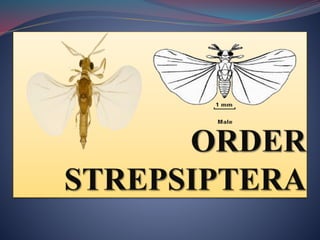
Common name:- Stylopids (twisted wing parasites)
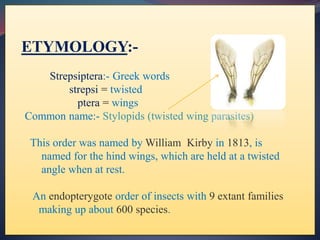
This order was named by William Kirby in 1813, is
named for the hind wings, which are held at a twisted
angle when at rest.
An endopterygote order of insects with 9 extant families
making up about 600 species.
 General characteristics:-
1. They are small endo-parasitic insects (male are free
living and female are parasitic)
2. Male insects have wings, legs, eyes and antennae, and
superficially look like a flies.
3. Antennae are flabellate type and 4-7 segmented.
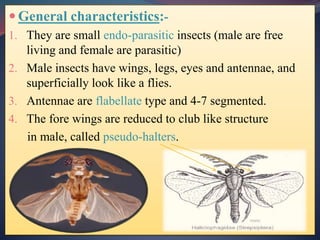
4. The fore wings are reduced to club like structure
in male, called pseudo-halters.
5. Hind wings in male are large, fan like and wing
venation is reduced.
6. Mouthparts are biting and chewing type in female.
7. Adults of male are very short-lived, usually surviving
< five hours, and don’t feed.
8. Most adult of females are wingless, legless, eyeless,
and look much like a grubs.
9. The larvae are very active and trochanter less.
10. Males have tiny heads with large eyes.
11. Females, in all families except, the Mengenillidae are
not known to leave their hosts & are neotenic in form.
12. The newly hatched (first instar) larva has both eyes and
female of Strepsiptera are unusually fecundative.
13. Each one may produce 2500-7000 offspring.
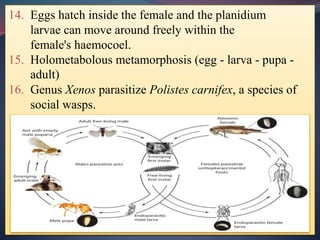
14. Eggs hatch inside the female and the planidium
larvae can move around freely within the
female's haemocoel.
15. Holometabolous metamorphosis (egg - larva - pupa -
adult)
16. Genus Xenos parasitize Polistes carnifex, a species of
social wasps.
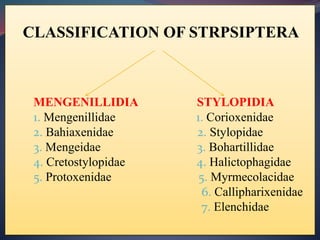
CLASSIFICATION OF STRPSIPTERA
MENGENILLIDIA STYLOPIDIA
1. Mengenillidae 1. Corioxenidae
2. Bahiaxenidae 2. Stylopidae
3. Mengeidae 3. Bohartillidae
4. Cretostylopidae 4. Halictophagidae
5. Protoxenidae 5. Myrmecolacidae
6. Callipharixenidae
7. Elenchidae
SUB ORDER
MENGENILLIDIA
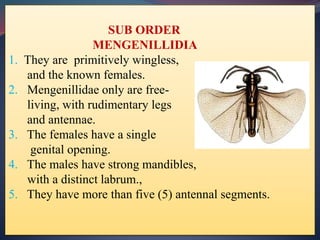
1. They are primitively wingless,
and the known females.
2. Mengenillidae only are free-
living, with rudimentary legs
and antennae.
3. The females have a single
genital opening.
4. The males have strong mandibles,
with a distinct labrum.,
5. They have more than five (5) antennal segments.
SUB ORDER
STYLOPIDIA
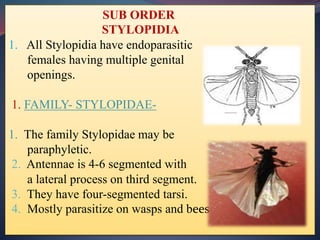
1. All Stylopidia have endoparasitic
females having multiple genital
openings.
1. FAMILY- STYLOPIDAE-
1. The family Stylopidae may be
paraphyletic.
2. Antennae is 4-6 segmented with
a lateral process on third segment.
3. They have four-segmented tarsi.
4. Mostly parasitize on wasps and bees.
2. FAMILY ELENCHIDAE-
1. Antennae is 4 segmented with a lateral
process on third segment.
2. Tarsi 2-segmented .
3. They are known as to parasitize Fulgoroidea.
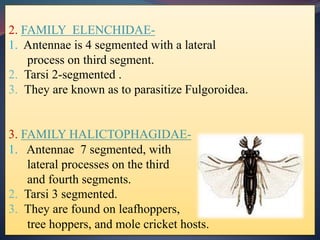
3. FAMILY HALICTOPHAGIDAE-
1. Antennae 7 segmented, with
lateral processes on the third
and fourth segments.
2. Tarsi 3 segmented.
3. They are found on leafhoppers,
tree hoppers, and mole cricket hosts.
ORDER
MECOPTERA
 ETYMOLOGY- Greek word
mecos = long
ptera = wings.
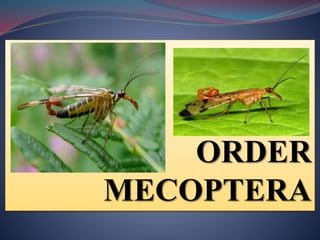
Common name- Scorpionfly (Panorpa communis)
Hangingflies (Bittacus strigosus)
 The Mecoptera were named by Alphe Hyatt and Jennie
Maria Arms in 1891.
 The European scorpionfly was named Panorpa
communis by Linnaeus in 1758.
 An entopterygote order with 600 extant species in 9 families.
 GENERAL CHARACTERISTICS-
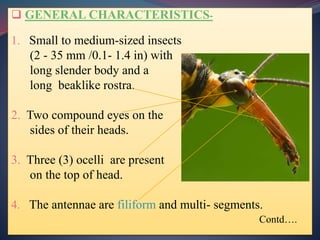
1. Small to medium-sized insects
(2 - 35 mm /0.1- 1.4 in) with
long slender body and a
long beaklike rostra.
2. Two compound eyes on the
sides of their heads.
3. Three (3) ocelli are present
on the top of head.
4. The antennae are filiform and multi- segments.
Contd….
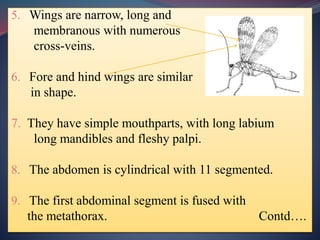
5. Wings are narrow, long and
membranous with numerous
cross-veins.
6. Fore and hind wings are similar
in shape.
7. They have simple mouthparts, with long labium
long mandibles and fleshy palpi.
8. The abdomen is cylindrical with 11 segmented.
9. The first abdominal segment is fused with
the metathorax. Contd….
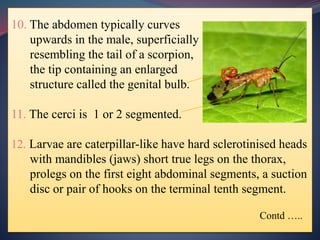
10. The abdomen typically curves
upwards in the male, superficially
resembling the tail of a scorpion,
the tip containing an enlarged
structure called the genital bulb.
11. The cerci is 1 or 2 segmented.
12. Larvae are caterpillar-like have hard sclerotinised heads
with mandibles (jaws) short true legs on the thorax,
prolegs on the first eight abdominal segments, a suction
disc or pair of hooks on the terminal tenth segment.
Contd …..
13. Larvae feed on vegetative matter.
14. The pupae are exarate and secured within a
cocoon.
15. Pupae passes with non-feeding through a diapause.
16. Adult are mostly scavengers, feeding on
decaying vegetation and the soft bodies
of dead invertebrates.
17. Metamorphosis is holometabolous (egg — larva—
pupa — adult)
 IMPORTANCE-
These insects may have played an important role
in pollinating extinct species
of gymnosperm before the evolution of other
insect pollinators such as the bees.
Adults of modern species are predators or
consumers of dead organisms.
CLASSIFICATION OF MECOPTERA
families
Panorpidae Bittacidae Boreidae Meropeidae
(Common scorpionflies) (Hangingflies) (Snow scorpionflies) (Earwigflies)
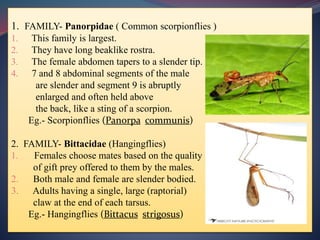
1. FAMILY- Panorpidae ( Common scorpionflies )
1. This family is largest.
2. They have long beaklike rostra.
3. The female abdomen tapers to a slender tip.
4. 7 and 8 abdominal segments of the male
are slender and segment 9 is abruptly
enlarged and often held above
the back, like a sting of a scorpion.
Eg.- Scorpionflies (Panorpa communis)
2. FAMILY- Bittacidae (Hangingflies)
1. Females choose mates based on the quality
of gift prey offered to them by the males.
2. Both male and female are slender bodied.
3. Adults having a single, large (raptorial)
claw at the end of each tarsus.
Eg.- Hangingflies (Bittacus strigosus)
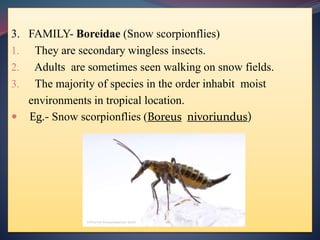
3. FAMILY- Boreidae (Snow scorpionflies)
1. They are secondary wingless insects.
2. Adults are sometimes seen walking on snow fields.
3. The majority of species in the order inhabit moist
environments in tropical location.
 Eg.- Snow scorpionflies (Boreus nivoriundus)
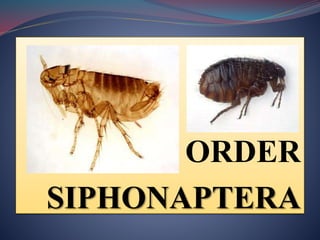
ORDER
SIPHONAPTERA
 ETYMOLOGY- Greek words
Synonyms- Aphaniptera
siphon= a tube or pipe.
aptera= wingless.
Common name- Flea
 This order was named by Latreille in 1825.
 This order is comprised into 4 suborder that
contain 9 families.
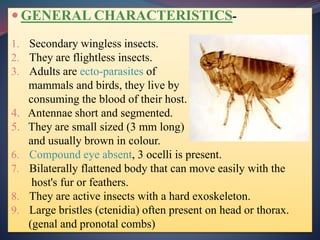
 GENERAL CHARACTERISTICS-
1. Secondary wingless insects.
2. They are flightless insects.
3. Adults are ecto-parasites of
mammals and birds, they live by
consuming the blood of their host.
4. Antennae short and segmented.
5. They are small sized (3 mm long)
and usually brown in colour.
6. Compound eye absent, 3 ocelli is present.
7. Bilaterally flattened body that can move easily with the
host's fur or feathers.
8. They are active insects with a hard exoskeleton.
9. Large bristles (ctenidia) often present on head or thorax.
(genal and pronotal combs)
10. Mouthparts are adapted for piercing skin and sucking
blood from their hosts.
12. Hind femur enlarged, adapted for jumping.
13. Tarsi is 5 segmented.
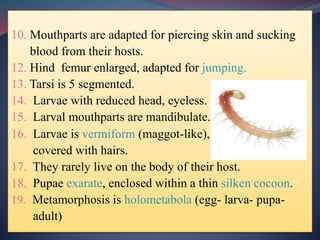
14. Larvae with reduced head, eyeless.
15. Larval mouthparts are mandibulate.
16. Larvae is vermiform (maggot-like),
covered with hairs.
17. They rarely live on the body of their host.
18. Pupae exarate, enclosed within a thin silken cocoon.
19. Metamorphosis is holometabola (egg- larva- pupa-
adult)
 IMPORTANCE-
Most species feed on mammals, although a few (less than
10%) live on birds.
In addition to their irritating bites, fleas may also transmit
pathogens that cause disease in humans and other
animals.
Examples- Cat and dog fleas,, are intermediate hosts for a
tapeworm (Dipylidium caninum) that infects dogs, cats,
and humans.
Rabbit fleas spread a myxomatosis virus within rabbit
populations, and the oriental rat flea is the primary vector
of Yersinia (=Pasturella) pestis, the bacterial pathogen
for bubonic plague.
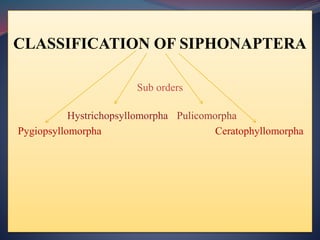
CLASSIFICATION OF SIPHONAPTERA
Sub orders
Hystrichopsyllomorpha Pulicomorpha
Pygiopsyllomorpha Ceratophyllomorpha
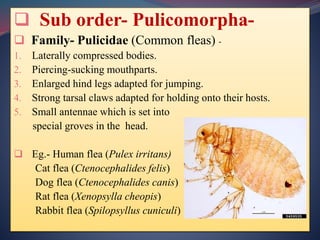
 Sub order- Pulicomorpha-
 Family- Pulicidae (Common fleas) -
1. Laterally compressed bodies.
2. Piercing-sucking mouthparts.
3. Enlarged hind legs adapted for jumping.
4. Strong tarsal claws adapted for holding onto their hosts.
5. Small antennae which is set into
special groves in the head.
 Eg.- Human flea (Pulex irritans)
Cat flea (Ctenocephalides felis)
Dog flea (Ctenocephalides canis)
Rat flea (Xenopsylla cheopis)
Rabbit flea (Spilopsyllus cuniculi)
Order strepsiptera, mecoptera and siphonaptera

Order strepsiptera, mecoptera and siphonaptera

  • 2.
    PRESENTATION ON ‘STREPSIPTERA’ ‘MECOPTERA’ ‘SIPHONAPTERA’ Submitted to :Submitted by: Prof. R. S. MEENA RANJEET VERMA Deptt. Of Entomology and Agril. Zoology ID. No. 16EAZ14 IAS, BHU, VARANASI M.Sc. ( Ag) Pre.
  • 4.
    ETYMOLOGY:- Strepsiptera:- Greek words strepsi= twisted ptera = wings Common name:- Stylopids (twisted wing parasites) This order was named by William Kirby in 1813, is named for the hind wings, which are held at a twisted angle when at rest. An endopterygote order of insects with 9 extant families making up about 600 species.
  • 5.
     General characteristics:- 1.They are small endo-parasitic insects (male are free living and female are parasitic) 2. Male insects have wings, legs, eyes and antennae, and superficially look like a flies. 3. Antennae are flabellate type and 4-7 segmented. 4. The fore wings are reduced to club like structure in male, called pseudo-halters.
  • 6.
    5. Hind wingsin male are large, fan like and wing venation is reduced. 6. Mouthparts are biting and chewing type in female. 7. Adults of male are very short-lived, usually surviving < five hours, and don’t feed. 8. Most adult of females are wingless, legless, eyeless, and look much like a grubs. 9. The larvae are very active and trochanter less. 10. Males have tiny heads with large eyes. 11. Females, in all families except, the Mengenillidae are not known to leave their hosts & are neotenic in form. 12. The newly hatched (first instar) larva has both eyes and female of Strepsiptera are unusually fecundative. 13. Each one may produce 2500-7000 offspring.
  • 7.
    14. Eggs hatchinside the female and the planidium larvae can move around freely within the female's haemocoel. 15. Holometabolous metamorphosis (egg - larva - pupa - adult) 16. Genus Xenos parasitize Polistes carnifex, a species of social wasps.
  • 8.
    CLASSIFICATION OF STRPSIPTERA MENGENILLIDIASTYLOPIDIA 1. Mengenillidae 1. Corioxenidae 2. Bahiaxenidae 2. Stylopidae 3. Mengeidae 3. Bohartillidae 4. Cretostylopidae 4. Halictophagidae 5. Protoxenidae 5. Myrmecolacidae 6. Callipharixenidae 7. Elenchidae
  • 9.
    SUB ORDER MENGENILLIDIA 1. Theyare primitively wingless, and the known females. 2. Mengenillidae only are free- living, with rudimentary legs and antennae. 3. The females have a single genital opening. 4. The males have strong mandibles, with a distinct labrum., 5. They have more than five (5) antennal segments.
  • 10.
    SUB ORDER STYLOPIDIA 1. AllStylopidia have endoparasitic females having multiple genital openings. 1. FAMILY- STYLOPIDAE- 1. The family Stylopidae may be paraphyletic. 2. Antennae is 4-6 segmented with a lateral process on third segment. 3. They have four-segmented tarsi. 4. Mostly parasitize on wasps and bees.
  • 11.
    2. FAMILY ELENCHIDAE- 1.Antennae is 4 segmented with a lateral process on third segment. 2. Tarsi 2-segmented . 3. They are known as to parasitize Fulgoroidea. 3. FAMILY HALICTOPHAGIDAE- 1. Antennae 7 segmented, with lateral processes on the third and fourth segments. 2. Tarsi 3 segmented. 3. They are found on leafhoppers, tree hoppers, and mole cricket hosts.
  • 12.
  • 13.
     ETYMOLOGY- Greekword mecos = long ptera = wings. Common name- Scorpionfly (Panorpa communis) Hangingflies (Bittacus strigosus)  The Mecoptera were named by Alphe Hyatt and Jennie Maria Arms in 1891.  The European scorpionfly was named Panorpa communis by Linnaeus in 1758.  An entopterygote order with 600 extant species in 9 families.
  • 14.
     GENERAL CHARACTERISTICS- 1.Small to medium-sized insects (2 - 35 mm /0.1- 1.4 in) with long slender body and a long beaklike rostra. 2. Two compound eyes on the sides of their heads. 3. Three (3) ocelli are present on the top of head. 4. The antennae are filiform and multi- segments. Contd….
  • 15.
    5. Wings arenarrow, long and membranous with numerous cross-veins. 6. Fore and hind wings are similar in shape. 7. They have simple mouthparts, with long labium long mandibles and fleshy palpi. 8. The abdomen is cylindrical with 11 segmented. 9. The first abdominal segment is fused with the metathorax. Contd….
  • 16.
    10. The abdomentypically curves upwards in the male, superficially resembling the tail of a scorpion, the tip containing an enlarged structure called the genital bulb. 11. The cerci is 1 or 2 segmented. 12. Larvae are caterpillar-like have hard sclerotinised heads with mandibles (jaws) short true legs on the thorax, prolegs on the first eight abdominal segments, a suction disc or pair of hooks on the terminal tenth segment. Contd …..
  • 17.
    13. Larvae feedon vegetative matter. 14. The pupae are exarate and secured within a cocoon. 15. Pupae passes with non-feeding through a diapause. 16. Adult are mostly scavengers, feeding on decaying vegetation and the soft bodies of dead invertebrates. 17. Metamorphosis is holometabolous (egg — larva— pupa — adult)
  • 18.
     IMPORTANCE- These insectsmay have played an important role in pollinating extinct species of gymnosperm before the evolution of other insect pollinators such as the bees. Adults of modern species are predators or consumers of dead organisms.
  • 19.
    CLASSIFICATION OF MECOPTERA families PanorpidaeBittacidae Boreidae Meropeidae (Common scorpionflies) (Hangingflies) (Snow scorpionflies) (Earwigflies)
  • 20.
    1. FAMILY- Panorpidae( Common scorpionflies ) 1. This family is largest. 2. They have long beaklike rostra. 3. The female abdomen tapers to a slender tip. 4. 7 and 8 abdominal segments of the male are slender and segment 9 is abruptly enlarged and often held above the back, like a sting of a scorpion. Eg.- Scorpionflies (Panorpa communis) 2. FAMILY- Bittacidae (Hangingflies) 1. Females choose mates based on the quality of gift prey offered to them by the males. 2. Both male and female are slender bodied. 3. Adults having a single, large (raptorial) claw at the end of each tarsus. Eg.- Hangingflies (Bittacus strigosus)
  • 21.
    3. FAMILY- Boreidae(Snow scorpionflies) 1. They are secondary wingless insects. 2. Adults are sometimes seen walking on snow fields. 3. The majority of species in the order inhabit moist environments in tropical location.  Eg.- Snow scorpionflies (Boreus nivoriundus)
  • 22.
  • 23.
     ETYMOLOGY- Greekwords Synonyms- Aphaniptera siphon= a tube or pipe. aptera= wingless. Common name- Flea  This order was named by Latreille in 1825.  This order is comprised into 4 suborder that contain 9 families.
  • 24.
     GENERAL CHARACTERISTICS- 1.Secondary wingless insects. 2. They are flightless insects. 3. Adults are ecto-parasites of mammals and birds, they live by consuming the blood of their host. 4. Antennae short and segmented. 5. They are small sized (3 mm long) and usually brown in colour. 6. Compound eye absent, 3 ocelli is present. 7. Bilaterally flattened body that can move easily with the host's fur or feathers. 8. They are active insects with a hard exoskeleton. 9. Large bristles (ctenidia) often present on head or thorax. (genal and pronotal combs)
  • 25.
    10. Mouthparts areadapted for piercing skin and sucking blood from their hosts. 12. Hind femur enlarged, adapted for jumping. 13. Tarsi is 5 segmented. 14. Larvae with reduced head, eyeless. 15. Larval mouthparts are mandibulate. 16. Larvae is vermiform (maggot-like), covered with hairs. 17. They rarely live on the body of their host. 18. Pupae exarate, enclosed within a thin silken cocoon. 19. Metamorphosis is holometabola (egg- larva- pupa- adult)
  • 26.
     IMPORTANCE- Most speciesfeed on mammals, although a few (less than 10%) live on birds. In addition to their irritating bites, fleas may also transmit pathogens that cause disease in humans and other animals. Examples- Cat and dog fleas,, are intermediate hosts for a tapeworm (Dipylidium caninum) that infects dogs, cats, and humans. Rabbit fleas spread a myxomatosis virus within rabbit populations, and the oriental rat flea is the primary vector of Yersinia (=Pasturella) pestis, the bacterial pathogen for bubonic plague.
  • 27.
    CLASSIFICATION OF SIPHONAPTERA Suborders Hystrichopsyllomorpha Pulicomorpha Pygiopsyllomorpha Ceratophyllomorpha
  • 28.
     Sub order-Pulicomorpha-  Family- Pulicidae (Common fleas) - 1. Laterally compressed bodies. 2. Piercing-sucking mouthparts. 3. Enlarged hind legs adapted for jumping. 4. Strong tarsal claws adapted for holding onto their hosts. 5. Small antennae which is set into special groves in the head.  Eg.- Human flea (Pulex irritans) Cat flea (Ctenocephalides felis) Dog flea (Ctenocephalides canis) Rat flea (Xenopsylla cheopis) Rabbit flea (Spilopsyllus cuniculi)