1 | P a g e 
The University of Zambia 
School of veterinary medicine 
Department of paraclinical studies 
Parasitology 
Name: Musalo Brian 
Comp #: 10008047 
Lab title: fecal sampling and examination 
Attention: Mr. Chota 
Lecturer: Dr. Sikasunge
Title: fecal examination and sampling 
Aim: to sample fecal sample and examine it quantitatively 
Introduction 
The veterinary student is taught to make a systematic and complete examination of an animal with 
a view to arriving at an accurate diagnosis. There are several examination samples such as blood, 
urine, but in this practical the sample of interest are the faeces in which eggs and some parasites 
are shed off from the definitive host. The feaces are examined for ripe segments of tapeworms 
(gravid proglottids) and the student should be familiar with their appearance, otherwise he or she 
may be at the loss to recognize these bodies. If a worm infection is suspected, a purgative may be 
given to cause the expulsion of segments in case they are not readily found (Monning H.O, 1950). 
Fecal samples should be preferably be collected from the rectum and examined fresh. If it is 
difficult to take rectal samples, fresh feces can be collected from the field or flow. A plastic glove 
can be used for collection, the glove being turned inside out to act as the receptacle. For small 
animals such as pets a thermometer or a glass rod can be used to collect fecal samples (George 
J.R, 1974). 
Feces should be stored in the refrigerator unless examination is carried out within the same day. 
But if the samples are to be transported it is advisable that the samples are put in an anaerobic 
container with water. This minimizes development/molting of eggs. Alternatively samples can also 
be stabilized using 10% formaldehyde solution (Shah F.M, 1989). 
There are several methods that are available for preparing feces for microscopic examination to as 
to detect the presence of eggs or larvae. However, whatever method of preparation is used the slide 
must first be examined under low power since most eggs can be detected at this magnification. If 
necessary, high power magnification can then be employed for measurement of eggs or more 
detailed morphological differentiation. An eye piece micrometer is very useful for sizing 
populations of eggs or larvae (George J.R, 1974). 
Prior to examination, scrutinize fecal sample for evidence of helminth infection the following 
parasites may be seen in faeces: Cattle: Moniezia segments, Oesophagostomum and Toxocara 
vitulorum. Sheep & goats: Moniezia, Stilesia and Thysanosoma segments & Oesophagostomum. 
Pig: Adult Ascaris & Oesophagostomum. Dogs & cats: Dipylidium & Taenia segments, Toxocara 
& toxascaris 
2 | P a g e
Many nematode eggs are alike and species such as Haemonchus, Ostertagia, Trichstrongylus, 
Cooperia, Bunostomum, and Oesophagostomum cannot be clearly differentiated from the eggs in 
fecal samples. Therefore, for these parasites, differentiation can be achieved by the use of fecal 
cultures. Fecal cultures provide a suitable environment for the hatching and development of 
helminth eggs into the infective stage (L3). 
There are several methods employed in fecal examination and these includes the direct smear, 
Qualitative test tube flotation, Simple test tube flotation and Sedimentation technique (for 
trematode eggs). 
Materials 
 Compound microscope 
 Mac master slide 
 Cover slips 
 Glass slides 
 Sugar solution 
 Salt solution 
 Tubes 
 Electron balance 
 Pasteur pipette 
 Beakers 
 Fecal samples 
Methods 
1. Direct smear 
 A small quantity of fecal material was smeared on a clean microscope slide. 
 Then a few drops of water or physiological saline were added and mixed 
 A coverslip was placed over the smear. 
 The fecal material was ensured that it was not left with a lump in the center of the coverslip 
but evenly spread so that the microscope illumination can shine through. 
 The slide was then examined under the microscope 
3 | P a g e
2. Mc masters method 
 3g of faeces were weighed using an electronic balance 
 Put into a tea strainer resting on a mortar to sieve 
 42ml of saturated salt solution was added 
 A pestle was used to grind the faeces into a suspension in the salt solution 
 fecal debris on the strainer were discarded 
 the suspension in the mortar was stirred with a Pasteur pipette & sufficient amount was 
withdrawn to fill one of the chambers in the McMaster slides (noting with care that no 
bubbles are were introduced) 
 the suspension was then stirred again & similarly the second chamber of the slide was filled 
 Using low power objective the mac master slide was focused and the ruled grid on each 
chamber & the number of eggs within each grid was counted 
 Calculation of results was the carried out as follows: Since 3g of fecal sample weighed is 
assumed to occupy 3ml, total volume (i.e. 3 + 42) = 45ml & the volume of suspension 
examined was 0.3ml (0.15ml under each of the 2 ruled grids on the McMaster slide), the 
number of eggs per g (e.p.g) of faeces is obtained by multiplying the total number of eggs 
under the two grids by 50. 
3. Simple floatation technique 
 3g of faeces were put into Container 1. 
 50 ml flotation fluid was then added into Container 1. 
 Mixed 
 The mixture was then sieve through a tea strainer or a double-layer of cheesecloth into 
Container 2. 
 The fecal suspension was then poured into a test tube from Container 2. 
 The test tube was then placed in test tube rack or stand. 
 The test tube was gently topped up with suspension, leaving a convex meniscus at top of 
tube and carefully a coverslip placed on top of test tube. 
 The test tube was let to stand for 20 minutes. 
 Carefully the coverslip was lifted off from the tube, together with the drop of fluid adhering 
to it, and immediately the coverslip was placed on a microscope slide. 
 Slide was viewed under the microscope 
4 | P a g e
4. Sedimentation 
 3 g of faeces were Weighed or measure into Container 1. 
 40-50 ml of tap water was poured into Container 1. 
 The mixture was stirred thoroughly with a stirring device (fork, tongue blade). 
 The fecal suspension was filtered through a tea strainer or double-layer of cheesecloth into 
Container 2. 
 The filtered material was poured into a test tube. 
 Allowed to sediment for 5 minutes. 
 The supernatant was carefully removed by pipetting 
 The sediment was resuspended in 5 ml of water. 
 Allowed to sediment for 5 minutes 
 The supernatant was carefully removed by pipetting 
 The sediment was stained by adding one drop of methylene blue. 
 Then the sediment was transferred to a microslide. 
 Then covered with a coverslip 
 Slide was viewed under the microscope 
Results & data collection 
Analysis 
Mc masters calculation 
5 | P a g e
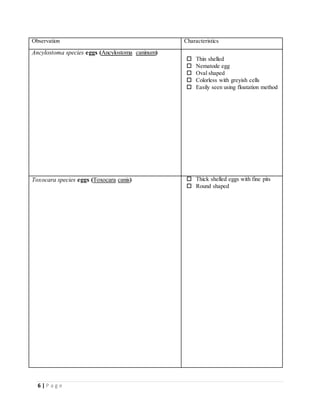
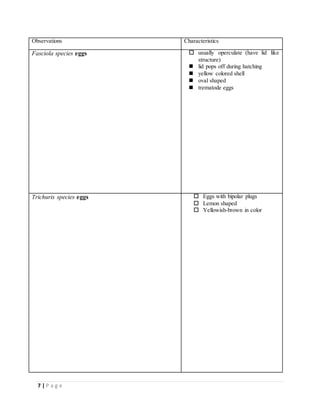
Observation Characteristics 
Ancylostoma species eggs (Ancylostoma caninum) 
6 | P a g e 
 Thin shelled 
 Nematode egg 
 Oval shaped 
 Colorless with greyish cells 
 Easily seen using floatation method 
Toxocara species eggs (Toxocara canis)  Thick shelled eggs with fine pits 
 Round shaped
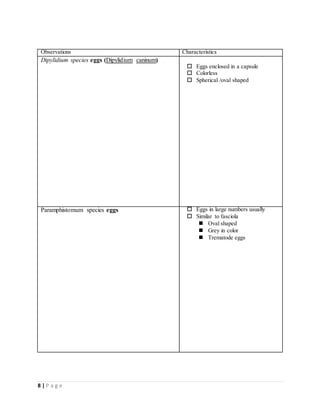
Observations Characteristics 
Fasciola species eggs  usually operculate (have lid like 
7 | P a g e 
structure) 
 lid pops off during hatching 
 yellow colored shell 
 oval shaped 
 trematode eggs 
Trichuris species eggs 
 Eggs with bipolar plugs 
 Lemon shaped 
 Yellowish-brown in color
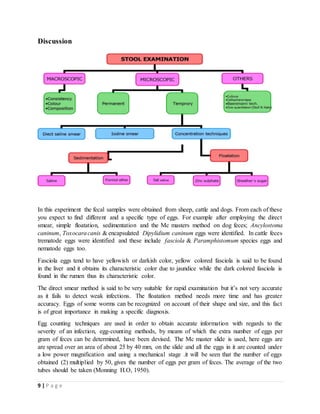
Observations Characteristics 
Dipylidium species eggs (Dipylidium caninum) 
8 | P a g e 
 Eggs enclosed in a capsule 
 Colorless 
 Spherical /oval shaped 
Paramphistomum species eggs  Eggs in large numbers usually 
 Similar to fasciola 
 Oval shaped 
 Grey in color 
 Trematode eggs
Discussion 
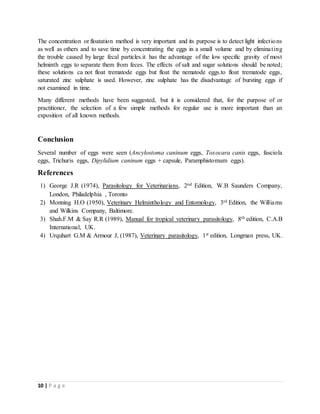
In this experiment the fecal samples were obtained from sheep, cattle and dogs. From each of these 
you expect to find different and a specific type of eggs. For example after employing the direct 
smear, simple floatation, sedimentation and the Mc masters method on dog feces; Ancylostoma 
caninum, Toxocara canis & encapsulated Dipylidium caninum eggs were identified. In cattle feces 
trematode eggs were identified and these include fasciola & Paramphistomum species eggs and 
nematode eggs too. 
Fasciola eggs tend to have yellowish or darkish color, yellow colored fasciola is said to be found 
in the liver and it obtains its characteristic color due to jaundice while the dark colored fasciola is 
found in the rumen thus its characteristic color. 
The direct smear method is said to be very suitable for rapid examination but it’s not very accurate 
as it fails to detect weak infections. The floatation method needs more time and has greater 
accuracy. Eggs of some worms can be recognized on account of their shape and size, and this fact 
is of great importance in making a specific diagnosis. 
Egg counting techniques are used in order to obtain accurate information with regards to the 
severity of an infection, egg-counting methods, by means of which the extra number of eggs per 
gram of feces can be determined, have been devised. The Mc master slide is used, here eggs are 
are spread over an area of about 25 by 40 mm, on the slide and all the eggs in it are counted under 
a low power magnification and using a mechanical stage .it will be seen that the number of eggs 
obtained (2) multiplied by 50, gives the number of eggs per gram of feces. The average of the two 
tubes should be taken (Monning H.O, 1950). 
9 | P a g e
The concentration or floatation method is very important and its purpose is to detect light infect ions 
as well as others and to save time by concentrating the eggs in a small volume and by elimina t ing 
the trouble caused by large fecal particles.it has the advantage of the low specific gravity of most 
helminth eggs to separate them from feces. The effects of salt and sugar solutions should be noted; 
these solutions ca not float trematode eggs but float the nematode eggs.to float trematode eggs, 
saturated zinc sulphate is used. However, zinc sulphate has the disadvantage of bursting eggs if 
not examined in time. 
Many different methods have been suggested, but it is considered that, for the purpose of or 
practitioner, the selection of a few simple methods for regular use is more important than an 
exposition of all known methods. 
Conclusion 
Several number of eggs were seen (Ancylostoma caninum eggs, Toxocara canis eggs, fasciola 
eggs, Trichuris eggs, Dipylidium caninum eggs + capsule, Paramphistomum eggs). 
References 
1) George J.R (1974), Parasitology for Veterinarians, 2nd Edition, W.B Saunders Company, 
London, Philadelphia , Toronto 
2) Monning H.O (1950), Veterinary Helminthology and Entomology, 3rd Edition, the Williams 
and Wilkins Company, Baltimore. 
3) Shah.F.M & Say R.R (1989), Manual for tropical veterinary parasitology, 8th edition, C.A.B 
International, UK. 
4) Urquhart G.M & Armour J, (1987), Veterinary parasitology, 1st edition, Longman press, UK. 
10 | P a g e

Fecal examination lab report

  • 1.
    1 | Pa g e The University of Zambia School of veterinary medicine Department of paraclinical studies Parasitology Name: Musalo Brian Comp #: 10008047 Lab title: fecal sampling and examination Attention: Mr. Chota Lecturer: Dr. Sikasunge
  • 2.
    Title: fecal examinationand sampling Aim: to sample fecal sample and examine it quantitatively Introduction The veterinary student is taught to make a systematic and complete examination of an animal with a view to arriving at an accurate diagnosis. There are several examination samples such as blood, urine, but in this practical the sample of interest are the faeces in which eggs and some parasites are shed off from the definitive host. The feaces are examined for ripe segments of tapeworms (gravid proglottids) and the student should be familiar with their appearance, otherwise he or she may be at the loss to recognize these bodies. If a worm infection is suspected, a purgative may be given to cause the expulsion of segments in case they are not readily found (Monning H.O, 1950). Fecal samples should be preferably be collected from the rectum and examined fresh. If it is difficult to take rectal samples, fresh feces can be collected from the field or flow. A plastic glove can be used for collection, the glove being turned inside out to act as the receptacle. For small animals such as pets a thermometer or a glass rod can be used to collect fecal samples (George J.R, 1974). Feces should be stored in the refrigerator unless examination is carried out within the same day. But if the samples are to be transported it is advisable that the samples are put in an anaerobic container with water. This minimizes development/molting of eggs. Alternatively samples can also be stabilized using 10% formaldehyde solution (Shah F.M, 1989). There are several methods that are available for preparing feces for microscopic examination to as to detect the presence of eggs or larvae. However, whatever method of preparation is used the slide must first be examined under low power since most eggs can be detected at this magnification. If necessary, high power magnification can then be employed for measurement of eggs or more detailed morphological differentiation. An eye piece micrometer is very useful for sizing populations of eggs or larvae (George J.R, 1974). Prior to examination, scrutinize fecal sample for evidence of helminth infection the following parasites may be seen in faeces: Cattle: Moniezia segments, Oesophagostomum and Toxocara vitulorum. Sheep & goats: Moniezia, Stilesia and Thysanosoma segments & Oesophagostomum. Pig: Adult Ascaris & Oesophagostomum. Dogs & cats: Dipylidium & Taenia segments, Toxocara & toxascaris 2 | P a g e
  • 3.
    Many nematode eggsare alike and species such as Haemonchus, Ostertagia, Trichstrongylus, Cooperia, Bunostomum, and Oesophagostomum cannot be clearly differentiated from the eggs in fecal samples. Therefore, for these parasites, differentiation can be achieved by the use of fecal cultures. Fecal cultures provide a suitable environment for the hatching and development of helminth eggs into the infective stage (L3). There are several methods employed in fecal examination and these includes the direct smear, Qualitative test tube flotation, Simple test tube flotation and Sedimentation technique (for trematode eggs). Materials  Compound microscope  Mac master slide  Cover slips  Glass slides  Sugar solution  Salt solution  Tubes  Electron balance  Pasteur pipette  Beakers  Fecal samples Methods 1. Direct smear  A small quantity of fecal material was smeared on a clean microscope slide.  Then a few drops of water or physiological saline were added and mixed  A coverslip was placed over the smear.  The fecal material was ensured that it was not left with a lump in the center of the coverslip but evenly spread so that the microscope illumination can shine through.  The slide was then examined under the microscope 3 | P a g e
  • 4.
    2. Mc mastersmethod  3g of faeces were weighed using an electronic balance  Put into a tea strainer resting on a mortar to sieve  42ml of saturated salt solution was added  A pestle was used to grind the faeces into a suspension in the salt solution  fecal debris on the strainer were discarded  the suspension in the mortar was stirred with a Pasteur pipette & sufficient amount was withdrawn to fill one of the chambers in the McMaster slides (noting with care that no bubbles are were introduced)  the suspension was then stirred again & similarly the second chamber of the slide was filled  Using low power objective the mac master slide was focused and the ruled grid on each chamber & the number of eggs within each grid was counted  Calculation of results was the carried out as follows: Since 3g of fecal sample weighed is assumed to occupy 3ml, total volume (i.e. 3 + 42) = 45ml & the volume of suspension examined was 0.3ml (0.15ml under each of the 2 ruled grids on the McMaster slide), the number of eggs per g (e.p.g) of faeces is obtained by multiplying the total number of eggs under the two grids by 50. 3. Simple floatation technique  3g of faeces were put into Container 1.  50 ml flotation fluid was then added into Container 1.  Mixed  The mixture was then sieve through a tea strainer or a double-layer of cheesecloth into Container 2.  The fecal suspension was then poured into a test tube from Container 2.  The test tube was then placed in test tube rack or stand.  The test tube was gently topped up with suspension, leaving a convex meniscus at top of tube and carefully a coverslip placed on top of test tube.  The test tube was let to stand for 20 minutes.  Carefully the coverslip was lifted off from the tube, together with the drop of fluid adhering to it, and immediately the coverslip was placed on a microscope slide.  Slide was viewed under the microscope 4 | P a g e
  • 5.
    4. Sedimentation 3 g of faeces were Weighed or measure into Container 1.  40-50 ml of tap water was poured into Container 1.  The mixture was stirred thoroughly with a stirring device (fork, tongue blade).  The fecal suspension was filtered through a tea strainer or double-layer of cheesecloth into Container 2.  The filtered material was poured into a test tube.  Allowed to sediment for 5 minutes.  The supernatant was carefully removed by pipetting  The sediment was resuspended in 5 ml of water.  Allowed to sediment for 5 minutes  The supernatant was carefully removed by pipetting  The sediment was stained by adding one drop of methylene blue.  Then the sediment was transferred to a microslide.  Then covered with a coverslip  Slide was viewed under the microscope Results & data collection Analysis Mc masters calculation 5 | P a g e
  • 6.
    Observation Characteristics Ancylostomaspecies eggs (Ancylostoma caninum) 6 | P a g e  Thin shelled  Nematode egg  Oval shaped  Colorless with greyish cells  Easily seen using floatation method Toxocara species eggs (Toxocara canis)  Thick shelled eggs with fine pits  Round shaped
  • 7.
    Observations Characteristics Fasciolaspecies eggs  usually operculate (have lid like 7 | P a g e structure)  lid pops off during hatching  yellow colored shell  oval shaped  trematode eggs Trichuris species eggs  Eggs with bipolar plugs  Lemon shaped  Yellowish-brown in color
  • 8.
    Observations Characteristics Dipylidiumspecies eggs (Dipylidium caninum) 8 | P a g e  Eggs enclosed in a capsule  Colorless  Spherical /oval shaped Paramphistomum species eggs  Eggs in large numbers usually  Similar to fasciola  Oval shaped  Grey in color  Trematode eggs
  • 9.
    Discussion In thisexperiment the fecal samples were obtained from sheep, cattle and dogs. From each of these you expect to find different and a specific type of eggs. For example after employing the direct smear, simple floatation, sedimentation and the Mc masters method on dog feces; Ancylostoma caninum, Toxocara canis & encapsulated Dipylidium caninum eggs were identified. In cattle feces trematode eggs were identified and these include fasciola & Paramphistomum species eggs and nematode eggs too. Fasciola eggs tend to have yellowish or darkish color, yellow colored fasciola is said to be found in the liver and it obtains its characteristic color due to jaundice while the dark colored fasciola is found in the rumen thus its characteristic color. The direct smear method is said to be very suitable for rapid examination but it’s not very accurate as it fails to detect weak infections. The floatation method needs more time and has greater accuracy. Eggs of some worms can be recognized on account of their shape and size, and this fact is of great importance in making a specific diagnosis. Egg counting techniques are used in order to obtain accurate information with regards to the severity of an infection, egg-counting methods, by means of which the extra number of eggs per gram of feces can be determined, have been devised. The Mc master slide is used, here eggs are are spread over an area of about 25 by 40 mm, on the slide and all the eggs in it are counted under a low power magnification and using a mechanical stage .it will be seen that the number of eggs obtained (2) multiplied by 50, gives the number of eggs per gram of feces. The average of the two tubes should be taken (Monning H.O, 1950). 9 | P a g e
  • 10.
    The concentration orfloatation method is very important and its purpose is to detect light infect ions as well as others and to save time by concentrating the eggs in a small volume and by elimina t ing the trouble caused by large fecal particles.it has the advantage of the low specific gravity of most helminth eggs to separate them from feces. The effects of salt and sugar solutions should be noted; these solutions ca not float trematode eggs but float the nematode eggs.to float trematode eggs, saturated zinc sulphate is used. However, zinc sulphate has the disadvantage of bursting eggs if not examined in time. Many different methods have been suggested, but it is considered that, for the purpose of or practitioner, the selection of a few simple methods for regular use is more important than an exposition of all known methods. Conclusion Several number of eggs were seen (Ancylostoma caninum eggs, Toxocara canis eggs, fasciola eggs, Trichuris eggs, Dipylidium caninum eggs + capsule, Paramphistomum eggs). References 1) George J.R (1974), Parasitology for Veterinarians, 2nd Edition, W.B Saunders Company, London, Philadelphia , Toronto 2) Monning H.O (1950), Veterinary Helminthology and Entomology, 3rd Edition, the Williams and Wilkins Company, Baltimore. 3) Shah.F.M & Say R.R (1989), Manual for tropical veterinary parasitology, 8th edition, C.A.B International, UK. 4) Urquhart G.M & Armour J, (1987), Veterinary parasitology, 1st edition, Longman press, UK. 10 | P a g e