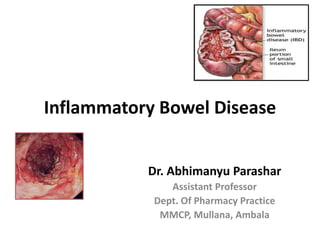
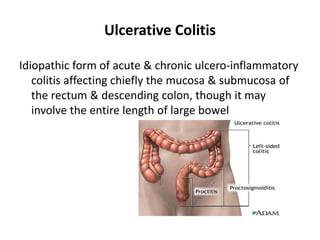
Inflammatory Bowel Disease 
Dr. Abhimanyu Parashar 
Assistant Professor 
Dept. Of Pharmacy Practice 
MMCP, Mullana, Ambala
IBD 
It is an idiopathic bowel disease which includes 
ulcerative colitis (UC) & crohn’s disease (CD) 
UC & CD are chronic, relapsing inflammatory 
diseases of the gut may be associated with a 
range of extra intestinal manifestations
CD or Regional enteritis 
It is an idiopathic chronic ulcerative IBD, 
characterised by transmural, non-caseating 
granulomatous inflammation affecting most 
commonly the segment of terminal ileum 
and/or colon though any part of the GIT may 
be involved
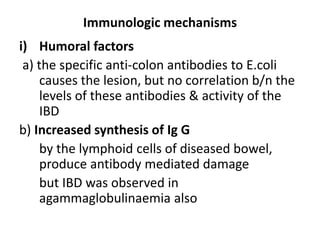
Ulcerative Colitis 
Idiopathic form of acute & chronic ulcero-inflammatory 
colitis affecting chiefly the mucosa & submucosa of 
the rectum & descending colon, though it may 
involve the entire length of large bowel
Etiopathogenesis 
1. Infectious mechanisms 
2. Immunologic mechanisms 
i) humoral factors 
ii) cell mediated immunologic factors 
iii) immunodeficiency 
3. Others 
i) psychological factors 
ii) genetic factors 
iii) racial factors 
iv) diet 
v) social habits 
vi) drugs
Infectious mechanisms 
Bacterial infections: 
mycobacteria 
dysentery bacilli 
chlamydia 
Viral infections: 
roatvirus 
EB virus 
intestinal cytopathic virus 
Certain protozoal & fungal infections
Immunologic mechanisms 
i) Humoral factors 
a) the specific anti-colon antibodies to E.coli 
causes the lesion, but no correlation b/n the 
levels of these antibodies & activity of the 
IBD 
b) Increased synthesis of Ig G 
by the lymphoid cells of diseased bowel, 
produce antibody mediated damage 
but IBD was observed in 
agammaglobulinaemia also
c) Circulating immune complexes 
produces extra intestinal lesions of IBD but their 
role in intestinal lesions of IBD is not established 
d) IgE mediated hypersensitivity reaction 
leads to excessive histamine release by mast cells 
in the bowel wall may cause oedema of bowel 
wall in IBD 
But administration of antihistamines does not 
alter the course of the disease
Cell mediated immunologic factors 
a) Decreased number of peripheral T cells. 
b) presence of T cells sensitized to various 
bowel antigens may be cytoyoxic to mucosa 
c) Antibody dependent cellular cytotoxicity 
(ADCC) may occur by interaction of K cells 
with humoral antibodies
immunodeficiency 
Immunodeficiency of IgA in crohn’s disease has 
been suggested more recently as possible 
immune mechanism for the lesion
Others 
Psychological factors: 
individuals who are sensitive, dependent on 
others & unable to express themselves suffer 
from irritable colon 
Genetic factors: 
certain HLA have also been found to be 
associated with IBD
Racial factors: 
high incidence of IBD have been identified in Jews & 
in whites 
Diet: 
milk, fibres & diet rich in CH provokes IBD 
Social habits: 
smokers are more prone to develop IBD 
Drugs: 
women who are on Ocs have increased risk of IBD
Pathologic changes - CD 
CD may involve any portion of GIT but affects 
most commonly 15-25 cms of terminal ileum 
which may extend into the caecum & 
sometimes into the ascending colon 
Transmural inflammatory cell infiltrate: 
It consists of chronic inflammatory cells 
(lymphocytes, plasma cells & macrophages) – 
the classical microscopic feature
Non-caseating, sarcoid- like granulomas 
Present in all layers of affected bowel & in 
regional lymph nodes 
Patchy ulceration of mucosa 
Which may form deep fissures, accompanied by 
inflammatory infiltrates of lymphocytes & 
plasma cells 
Widening of submucosa due to oedema & foci 
of lymphoid aggregates
In chronic condition, fibrosis is prominent in all 
the layers disrupting muscular layer 
Regardless of the site, bowel wall injury is 
excessive & intestinal lumen is often narrowed 
The mesentery first becomes thickened & 
oedematous & then fibrotic 
Ulcers tend to be deep & elongated & extend 
along the longitudinal axis of the bowel, atleast 
into the submucosa
The cobblestone appearance of the bowel wall 
results from deep mucosal ulceration 
intermingled with nodular submucosal 
thickening
Pathologic changes - UC 
The characteristic feature is the continuous 
involvement of rectum & colon without any 
uninvolved skip areas as seen in CD 
The appearance of colon may vary depending 
upon the stage & intensity of the disease 
because of remissions & exacerbations 
Mucosa shows linear & superficial ulcers, usually 
not penetrating the muscular layer
The intervening intact mucosa may form 
inflammatory pseudo polyps 
The muscle layer is thickened due to contraction 
producing shortening & narrowing of the 
affected colon with loss of normal haustral 
folds giving garden-hose appearance 
Because of remission & exacerbations it is 
characterised by alternating active disease 
process & resolving colitis
Crypt distortion, cryptitis & focal accumulations 
of neutrophils forming crypt abscesses 
Marked congestion, dilation & hemorrhages 
from mucosal capillaries 
Superficial mucosal ulcerations, usually not 
penetrating into the muscle coat, except in 
severe cases & is accompanied by nonspecific 
inflammatory cell infiltrate of lymphocytes, 
plasma cells, neutrophils, some eosinophils & 
mast cells in the lamina propria
Goblet cells are markedly diminished in cases of 
active disease 
Areas of mucosal regeneration & mucodeplition 
of lining cells 
In long-standing cases, epithilial cytologic atypia 
ranging from mild to marked dysplasia & some 
times developing into carcinoma in situ & 
frank carcinoma
Types of UC 
• Proctitis - ulcerative colitis affecting only the 
rectal mucosa. 
• Proctosigmoiditis – It involves rectum and the 
colon 
• Colitis- It involves other parts of the colon.
Complications - CD 
Malabsorption 
Fistula formation 
Stricture formation 
Carcinoma 
Bleeding 
Hypochromic anemia 
Systemic complications like, arthritis, iritis, skin 
lesions, liver disease, renal stones, gall stones, 
weight loss, growth failure
Complications of - UC 
Toxic megacolon 
Perianal fistula 
Carcinoma 
Stricture formation
CLINICAL PRESENTATION 
Clinical 
presentation 
Crohn’s disease Ulcerative colitis 
Malaise, fever Common Un common 
Abdominal 
tenderness 
Common May be present 
Rectal bleeding Less 100% 
Illeal Very common Rare 
Granulomas Common Rare 
Fistulas Common Rare
Management 
Goals: 
to induce remission in active disease 
to maintain remission / prevent relapse
CD 
Mild to moderate disease 
Active CD: oral/parenteral steroids- most 
effective & safer than oral aminosalicylates 
CD of colon: aminosalicylates 
Crohn’s ileitis- mesalazine should be used 
as 5 aminosalicylic acid is not released in the 
small bowel from sulfasalazine or olsalazine
Dose of aminosalicylates required for CD is more 
than of UC especially in small bowel disease 
Prednisolone/prednisone 20-60 mg PO/D for 8-12 
weeks 
Or 
budesonide CR 9 mg PO/D for 8-12 weeks 
Aminosalicylates: 
Sulfasalazine 2-4 g PO/d in DD 
Mesalazine 3-4.8 g PO/d in DD 
Olsalazine 2-3 g PO/d in DD
Metronidazole is as effective as sulfasalazine for colonic 
disease 
Metronidazole 20 mg/kg PO/d in DD 
Severe disease: 
Hydrocortisone 100 mg IV Q6H or 
Hydrocortisone 300-400 mg by CIVIF/d or 
Methylprednisolone 60-80 mg IV/d in DD or by CIVIF for 
5-10 days 
Oral steroids should be substituted when disease 
activity has subsided 
Prednisolone or prednisone 40-60 mg/d PO 
Gradually reducing to zero over 8-12 weeks
Chronically active disease: 
Patients who do not respond to steroids or 
require continuous steroids to control disease 
activity 
AZT 
6-MP 
Surgery should be considered if more than 5-10 
mg of prednisolone/d is required 
AZT 2-2.5 mg/kg PO/d or 
6-MP 1-1.5 mg/kg PO/d
Newer agents: 
Infliximab- monoclonal antibody directed against the 
proinflammatory cytokine TNF-alpha 
Effective in patients with refractory & acutely or chronically 
active disease 
Dose: 5 mg/kg IVIF 
Maintenance therapy: 
AZT & 6-MP effective as prophylactic agents in patients with 
frequent relapses & in those who are steroid dependent 
AZT 2-2.5 mg/kg/PO/d 
6-MP 1-1.5 mg/kg/PO/d
Management - UC 
Mild disease- topical therapy for proctitis 
Moderate/severe/more extensive- oral/IV 
Aminosalicylates: 
Effective in inducing remission in active colitis/proctitis 
Response is dose realted 
Sulfasalazine 6g/d 
Mesalazine 4g/d 
Olsalazine 3g/d 
ADRs of s & o are dose related hence should be started 
at low doses & titrated to recommended dose
Immunosupressive agents: 
AZT & 6-MP, effective for both remission induction & 
maintenance therapy 
Takes 3-6 months to achieve benefit 
Significant ADRs 
Active proctitis/distal colitis: 
I-line: 
Topical steroids alone or with oral aminosalicylates 
Prednisolone sod.phosphate 20 mg/100ml/d enema 
rectally at night or twice daily
Hydrocortisone acetate 10% foam rectally/d at night or 
twice daily or 
Prednisolone 5 mg rectally twice daily 
Along with, 
Sulfasalazine 2-4 g/PO/d in 3-4 DD 
Mesalazine 1-1.5 g/PO/d in 3 DD 
Olsalazine 1-1.5 g/PO/d in 2-3 DD 
CTE: 
5-aminosalicylic acid enemas are superior to topical 
steroids 
Combination oral & topical 5 AS therapy is more effective 
than either therapy alone
II-line: 
Addition of an oral CS to I-line 
Prednisolone or prednisone 20-60 mg/PO/d for 
8-12 weeks 
Extensive UC: 
Mild to moderate disease: 
Prednisolone or prednisone 20-60 mg/PO/d for 
8-12 weeks and/or 
Oral aminosalicylate
Severe disease: 
More than 6 bloody stools/d 
Temp more than 37.5 
Pulse more than 100 bpm 
Hb less than 100g/l 
S.Alb less than 35 g/l 
Fluid, electrolyte or blood replacement should 
be considered 
Early surgical consulatation is essential
Hydrocortisone 100 mg IV Q6H or by CIVIF or 
Methylprednisolone 60-100 mg IV/d in DD or by 
CIVIF 
For 5-10 days and should be substituted with 
oral steroids 
If deteriorating or failure to respond consider 
colectomy or IV cyclosporin 
Avoid: 
Loperamide & other antidiarrhoeals & 
anticholinergics in severe disease as it may 
leads to toxic megacolon
Chronically active disease: 
AZT, 6-MP, surgery 
AZT 2-2.5 mg/kg PO/d or 
6-MP 1-1.5 mg/kg PO/d 
ADRs of s&o are dose related hence should be 
started at low doses & titrated to 
recommended dose 
Proctocolectomy, ileal pouch anal anastomosis 
may be considered for the traetment of 
chronic refractory disease
Maintenance therapy: 
To reduce the relapse-aminosalicylates or 
immunosupressive agents 
Sulfasalazine 2-3 g/Po/d in 3-4 DD 
Incidence of ADRs increases with increase in 
dose 
Mesalazine 1-1.5g/PO/d in 3 DD 
Olsalazine 1-1.5 g/PO/d in 2-3 DD 
ADR: watery diarrhoea (10-15%)
Patients responded to topical AMS preparations may 
continue to use as maintenance therapy at reduced 
doses 
Mesalazine 2-4 g in 60 ml enema rectally 2-3 times a 
week 
A prolonged remission may be achieved with, 
AZT 2-2.5 mg/kg/Po/d or 
6-MP 1-1.5 mg/kg/PO/d
Pouchitis: 
In patients who have undergone ileal-pouch 
anal anastomosis may develop inflammation 
of ileal pouch 
Metronidazole 20mg/kg/po/d in DD, probiotic is 
also useful
Treatment approach for CD
Treatment approach for UC
DRUGS TreDaOStEment oMpAINtTiEoNAnNCsE 
DOSE 
SITE OF ACTION 
Sulfasalazine 3 – 4 gm/day 2 – 4 g/day colon 
Olsalazine 2 – 3 gm/day 1g/day colon 
Balsalazide 2 – 6.75 gm/day 2 – 6.75g/day colon 
Mesalamine 
(DR) 
2.4 – 4.8 gm/day 2.4-4.8g/day Distal ileum and 
colon 
Mesalamine (enema) 1 – 4 g/day 0.8 – 4.8 g/day Rectum and terminal 
colon 
Mesalamine (SR) 2 – 4 g/day 1.5 – 4 g/day Small bowel and 
colon 
Mesalamine suppository 1 – 1.5g/day 0.5 – 1 
gm/bedtime 
Rectum and terminal 
colon
corticosteroids 
DRUGS DOSE 
Methylprednisolone (IV) 40 – 60mg/day 
Prednisolone ( IV) 60 – 80 mg/day 
Hydrocortisone IV 300mg/day 
Prednisone( oral) 20 – 60mg/day 
Budesonide( oral) 9 mg/day 
Hydrocortisone enema 100 – 200 mg/day
DRUGS ROUTE REMISSION DOSE MAINTENANCE DOSE 
Azathioprine Oral 2–3 mg/kg/day 2–3 mg/kg/day 
6-Mercaptopurine Oral 1–1.5 mg/kg/day 1–1.5 mg/kg/day 
Cyclosporine IV 2–4 mg/kg/day Not indicated 
Oral 4–8 mg/kg/day Not indicated 
Tacrolimus IV 0.01 mg/kg/day Not indicated 
Oral 0.1–0.2 mg/kg/day Not indicated 
Methotrexate IM 25 mg/wk 25 mg/wk 
Oral 15–25 mg/wk 15–25 mg/wk 
Infliximab IV 5 mg/kg 5–10 mg/kg
ANTIMICROBIALS 
DRUGS REMISSION DOSE MAINTANANCE 
DOSE 
Metronidazole 
Oral 
10–20 mg/kg/day Not indicated 
Ciprofloxacin 
Oral 
1–1.5 g/day Not indicated
FOODS TO AVOID 
• Alcohol (Mixed Drinks, Beer, Wine) 
• Butter, Mayonnaise, Margarine, Oils 
• Carbonated Beverages 
• Coffee, Tea, Chocolate 
• Corn Husks 
• Dairy Products (If Lactose Intolerant) 
• Fatty Foods (Fried Foods) 
• Foods High In Fiber 
• Gas-producing Foods (Lentils, Beans, Legumes, Cabbage, Broccoli, Onions) 
• Nuts And Seeds (Peanut Butter, Other Nut Butters) 
• Raw Fruits 
• Raw Vegetables 
• Red Meat And Pork 
• Spicy Foods 
• Whole Grains And Bran
Inflammatory Bowel Disease

Inflammatory Bowel Disease

  • 1.
    Inflammatory Bowel Disease Dr. Abhimanyu Parashar Assistant Professor Dept. Of Pharmacy Practice MMCP, Mullana, Ambala
  • 2.
    IBD It isan idiopathic bowel disease which includes ulcerative colitis (UC) & crohn’s disease (CD) UC & CD are chronic, relapsing inflammatory diseases of the gut may be associated with a range of extra intestinal manifestations
  • 3.
    CD or Regionalenteritis It is an idiopathic chronic ulcerative IBD, characterised by transmural, non-caseating granulomatous inflammation affecting most commonly the segment of terminal ileum and/or colon though any part of the GIT may be involved
  • 4.
    Ulcerative Colitis Idiopathicform of acute & chronic ulcero-inflammatory colitis affecting chiefly the mucosa & submucosa of the rectum & descending colon, though it may involve the entire length of large bowel
  • 5.
    Etiopathogenesis 1. Infectiousmechanisms 2. Immunologic mechanisms i) humoral factors ii) cell mediated immunologic factors iii) immunodeficiency 3. Others i) psychological factors ii) genetic factors iii) racial factors iv) diet v) social habits vi) drugs
  • 6.
    Infectious mechanisms Bacterialinfections: mycobacteria dysentery bacilli chlamydia Viral infections: roatvirus EB virus intestinal cytopathic virus Certain protozoal & fungal infections
  • 7.
    Immunologic mechanisms i)Humoral factors a) the specific anti-colon antibodies to E.coli causes the lesion, but no correlation b/n the levels of these antibodies & activity of the IBD b) Increased synthesis of Ig G by the lymphoid cells of diseased bowel, produce antibody mediated damage but IBD was observed in agammaglobulinaemia also
  • 8.
    c) Circulating immunecomplexes produces extra intestinal lesions of IBD but their role in intestinal lesions of IBD is not established d) IgE mediated hypersensitivity reaction leads to excessive histamine release by mast cells in the bowel wall may cause oedema of bowel wall in IBD But administration of antihistamines does not alter the course of the disease
  • 9.
    Cell mediated immunologicfactors a) Decreased number of peripheral T cells. b) presence of T cells sensitized to various bowel antigens may be cytoyoxic to mucosa c) Antibody dependent cellular cytotoxicity (ADCC) may occur by interaction of K cells with humoral antibodies
  • 10.
    immunodeficiency Immunodeficiency ofIgA in crohn’s disease has been suggested more recently as possible immune mechanism for the lesion
  • 11.
    Others Psychological factors: individuals who are sensitive, dependent on others & unable to express themselves suffer from irritable colon Genetic factors: certain HLA have also been found to be associated with IBD
  • 12.
    Racial factors: highincidence of IBD have been identified in Jews & in whites Diet: milk, fibres & diet rich in CH provokes IBD Social habits: smokers are more prone to develop IBD Drugs: women who are on Ocs have increased risk of IBD
  • 13.
    Pathologic changes -CD CD may involve any portion of GIT but affects most commonly 15-25 cms of terminal ileum which may extend into the caecum & sometimes into the ascending colon Transmural inflammatory cell infiltrate: It consists of chronic inflammatory cells (lymphocytes, plasma cells & macrophages) – the classical microscopic feature
  • 14.
    Non-caseating, sarcoid- likegranulomas Present in all layers of affected bowel & in regional lymph nodes Patchy ulceration of mucosa Which may form deep fissures, accompanied by inflammatory infiltrates of lymphocytes & plasma cells Widening of submucosa due to oedema & foci of lymphoid aggregates
  • 15.
    In chronic condition,fibrosis is prominent in all the layers disrupting muscular layer Regardless of the site, bowel wall injury is excessive & intestinal lumen is often narrowed The mesentery first becomes thickened & oedematous & then fibrotic Ulcers tend to be deep & elongated & extend along the longitudinal axis of the bowel, atleast into the submucosa
  • 16.
    The cobblestone appearanceof the bowel wall results from deep mucosal ulceration intermingled with nodular submucosal thickening
  • 17.
    Pathologic changes -UC The characteristic feature is the continuous involvement of rectum & colon without any uninvolved skip areas as seen in CD The appearance of colon may vary depending upon the stage & intensity of the disease because of remissions & exacerbations Mucosa shows linear & superficial ulcers, usually not penetrating the muscular layer
  • 18.
    The intervening intactmucosa may form inflammatory pseudo polyps The muscle layer is thickened due to contraction producing shortening & narrowing of the affected colon with loss of normal haustral folds giving garden-hose appearance Because of remission & exacerbations it is characterised by alternating active disease process & resolving colitis
  • 19.
    Crypt distortion, cryptitis& focal accumulations of neutrophils forming crypt abscesses Marked congestion, dilation & hemorrhages from mucosal capillaries Superficial mucosal ulcerations, usually not penetrating into the muscle coat, except in severe cases & is accompanied by nonspecific inflammatory cell infiltrate of lymphocytes, plasma cells, neutrophils, some eosinophils & mast cells in the lamina propria
  • 20.
    Goblet cells aremarkedly diminished in cases of active disease Areas of mucosal regeneration & mucodeplition of lining cells In long-standing cases, epithilial cytologic atypia ranging from mild to marked dysplasia & some times developing into carcinoma in situ & frank carcinoma
  • 21.
    Types of UC • Proctitis - ulcerative colitis affecting only the rectal mucosa. • Proctosigmoiditis – It involves rectum and the colon • Colitis- It involves other parts of the colon.
  • 22.
    Complications - CD Malabsorption Fistula formation Stricture formation Carcinoma Bleeding Hypochromic anemia Systemic complications like, arthritis, iritis, skin lesions, liver disease, renal stones, gall stones, weight loss, growth failure
  • 23.
    Complications of -UC Toxic megacolon Perianal fistula Carcinoma Stricture formation
  • 24.
    CLINICAL PRESENTATION Clinical presentation Crohn’s disease Ulcerative colitis Malaise, fever Common Un common Abdominal tenderness Common May be present Rectal bleeding Less 100% Illeal Very common Rare Granulomas Common Rare Fistulas Common Rare
  • 26.
    Management Goals: toinduce remission in active disease to maintain remission / prevent relapse
  • 27.
    CD Mild tomoderate disease Active CD: oral/parenteral steroids- most effective & safer than oral aminosalicylates CD of colon: aminosalicylates Crohn’s ileitis- mesalazine should be used as 5 aminosalicylic acid is not released in the small bowel from sulfasalazine or olsalazine
  • 28.
    Dose of aminosalicylatesrequired for CD is more than of UC especially in small bowel disease Prednisolone/prednisone 20-60 mg PO/D for 8-12 weeks Or budesonide CR 9 mg PO/D for 8-12 weeks Aminosalicylates: Sulfasalazine 2-4 g PO/d in DD Mesalazine 3-4.8 g PO/d in DD Olsalazine 2-3 g PO/d in DD
  • 29.
    Metronidazole is aseffective as sulfasalazine for colonic disease Metronidazole 20 mg/kg PO/d in DD Severe disease: Hydrocortisone 100 mg IV Q6H or Hydrocortisone 300-400 mg by CIVIF/d or Methylprednisolone 60-80 mg IV/d in DD or by CIVIF for 5-10 days Oral steroids should be substituted when disease activity has subsided Prednisolone or prednisone 40-60 mg/d PO Gradually reducing to zero over 8-12 weeks
  • 30.
    Chronically active disease: Patients who do not respond to steroids or require continuous steroids to control disease activity AZT 6-MP Surgery should be considered if more than 5-10 mg of prednisolone/d is required AZT 2-2.5 mg/kg PO/d or 6-MP 1-1.5 mg/kg PO/d
  • 31.
    Newer agents: Infliximab-monoclonal antibody directed against the proinflammatory cytokine TNF-alpha Effective in patients with refractory & acutely or chronically active disease Dose: 5 mg/kg IVIF Maintenance therapy: AZT & 6-MP effective as prophylactic agents in patients with frequent relapses & in those who are steroid dependent AZT 2-2.5 mg/kg/PO/d 6-MP 1-1.5 mg/kg/PO/d
  • 32.
    Management - UC Mild disease- topical therapy for proctitis Moderate/severe/more extensive- oral/IV Aminosalicylates: Effective in inducing remission in active colitis/proctitis Response is dose realted Sulfasalazine 6g/d Mesalazine 4g/d Olsalazine 3g/d ADRs of s & o are dose related hence should be started at low doses & titrated to recommended dose
  • 33.
    Immunosupressive agents: AZT& 6-MP, effective for both remission induction & maintenance therapy Takes 3-6 months to achieve benefit Significant ADRs Active proctitis/distal colitis: I-line: Topical steroids alone or with oral aminosalicylates Prednisolone sod.phosphate 20 mg/100ml/d enema rectally at night or twice daily
  • 34.
    Hydrocortisone acetate 10%foam rectally/d at night or twice daily or Prednisolone 5 mg rectally twice daily Along with, Sulfasalazine 2-4 g/PO/d in 3-4 DD Mesalazine 1-1.5 g/PO/d in 3 DD Olsalazine 1-1.5 g/PO/d in 2-3 DD CTE: 5-aminosalicylic acid enemas are superior to topical steroids Combination oral & topical 5 AS therapy is more effective than either therapy alone
  • 35.
    II-line: Addition ofan oral CS to I-line Prednisolone or prednisone 20-60 mg/PO/d for 8-12 weeks Extensive UC: Mild to moderate disease: Prednisolone or prednisone 20-60 mg/PO/d for 8-12 weeks and/or Oral aminosalicylate
  • 36.
    Severe disease: Morethan 6 bloody stools/d Temp more than 37.5 Pulse more than 100 bpm Hb less than 100g/l S.Alb less than 35 g/l Fluid, electrolyte or blood replacement should be considered Early surgical consulatation is essential
  • 37.
    Hydrocortisone 100 mgIV Q6H or by CIVIF or Methylprednisolone 60-100 mg IV/d in DD or by CIVIF For 5-10 days and should be substituted with oral steroids If deteriorating or failure to respond consider colectomy or IV cyclosporin Avoid: Loperamide & other antidiarrhoeals & anticholinergics in severe disease as it may leads to toxic megacolon
  • 38.
    Chronically active disease: AZT, 6-MP, surgery AZT 2-2.5 mg/kg PO/d or 6-MP 1-1.5 mg/kg PO/d ADRs of s&o are dose related hence should be started at low doses & titrated to recommended dose Proctocolectomy, ileal pouch anal anastomosis may be considered for the traetment of chronic refractory disease
  • 39.
    Maintenance therapy: Toreduce the relapse-aminosalicylates or immunosupressive agents Sulfasalazine 2-3 g/Po/d in 3-4 DD Incidence of ADRs increases with increase in dose Mesalazine 1-1.5g/PO/d in 3 DD Olsalazine 1-1.5 g/PO/d in 2-3 DD ADR: watery diarrhoea (10-15%)
  • 40.
    Patients responded totopical AMS preparations may continue to use as maintenance therapy at reduced doses Mesalazine 2-4 g in 60 ml enema rectally 2-3 times a week A prolonged remission may be achieved with, AZT 2-2.5 mg/kg/Po/d or 6-MP 1-1.5 mg/kg/PO/d
  • 41.
    Pouchitis: In patientswho have undergone ileal-pouch anal anastomosis may develop inflammation of ileal pouch Metronidazole 20mg/kg/po/d in DD, probiotic is also useful
  • 42.
  • 43.
  • 44.
    DRUGS TreDaOStEment oMpAINtTiEoNAnNCsE DOSE SITE OF ACTION Sulfasalazine 3 – 4 gm/day 2 – 4 g/day colon Olsalazine 2 – 3 gm/day 1g/day colon Balsalazide 2 – 6.75 gm/day 2 – 6.75g/day colon Mesalamine (DR) 2.4 – 4.8 gm/day 2.4-4.8g/day Distal ileum and colon Mesalamine (enema) 1 – 4 g/day 0.8 – 4.8 g/day Rectum and terminal colon Mesalamine (SR) 2 – 4 g/day 1.5 – 4 g/day Small bowel and colon Mesalamine suppository 1 – 1.5g/day 0.5 – 1 gm/bedtime Rectum and terminal colon
  • 45.
    corticosteroids DRUGS DOSE Methylprednisolone (IV) 40 – 60mg/day Prednisolone ( IV) 60 – 80 mg/day Hydrocortisone IV 300mg/day Prednisone( oral) 20 – 60mg/day Budesonide( oral) 9 mg/day Hydrocortisone enema 100 – 200 mg/day
  • 46.
    DRUGS ROUTE REMISSIONDOSE MAINTENANCE DOSE Azathioprine Oral 2–3 mg/kg/day 2–3 mg/kg/day 6-Mercaptopurine Oral 1–1.5 mg/kg/day 1–1.5 mg/kg/day Cyclosporine IV 2–4 mg/kg/day Not indicated Oral 4–8 mg/kg/day Not indicated Tacrolimus IV 0.01 mg/kg/day Not indicated Oral 0.1–0.2 mg/kg/day Not indicated Methotrexate IM 25 mg/wk 25 mg/wk Oral 15–25 mg/wk 15–25 mg/wk Infliximab IV 5 mg/kg 5–10 mg/kg
  • 47.
    ANTIMICROBIALS DRUGS REMISSIONDOSE MAINTANANCE DOSE Metronidazole Oral 10–20 mg/kg/day Not indicated Ciprofloxacin Oral 1–1.5 g/day Not indicated
  • 48.
    FOODS TO AVOID • Alcohol (Mixed Drinks, Beer, Wine) • Butter, Mayonnaise, Margarine, Oils • Carbonated Beverages • Coffee, Tea, Chocolate • Corn Husks • Dairy Products (If Lactose Intolerant) • Fatty Foods (Fried Foods) • Foods High In Fiber • Gas-producing Foods (Lentils, Beans, Legumes, Cabbage, Broccoli, Onions) • Nuts And Seeds (Peanut Butter, Other Nut Butters) • Raw Fruits • Raw Vegetables • Red Meat And Pork • Spicy Foods • Whole Grains And Bran