Inflammatory Bowel Disease
Ulcerative Colitis and Crohn’s Disease
Roger Klein, MD, FACP
Definition
• Chronic immune mediated inflammation
of the gastrointestinal tract
• Two distinct diseases
• Overlapping clinical characteristics
• Affects 1.4 million people in the United
States
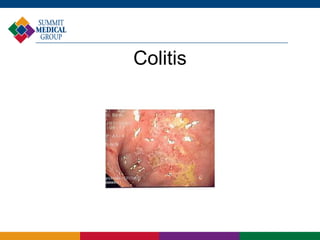
Ulcerative Colitis
• Inflammation of inner lining of Colon
• Does not involve small intestine
• Begins in rectum and extends upward
• Continuous disease
Colitis
Crohn’s Disease
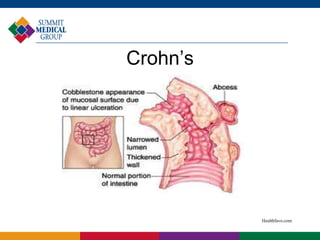
• Full thickness inflammation of bowel
wall
• Involves anywhere from mouth to anus
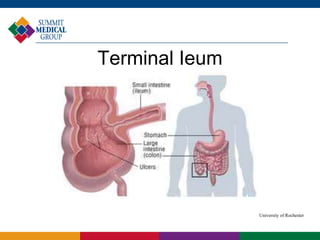
• Most commonly involves Ileum and
colon
• Skip areas of involvement
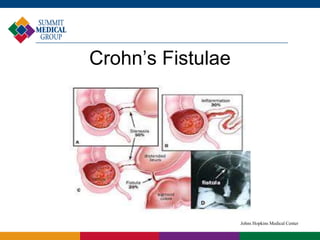
• Complicated by strictures and fistulae
The GI Tract
University of Rochester
Terminal Ieum
University of Rochester
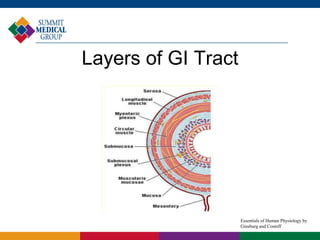
Layers of GI Tract
Essentials of Human Physiology by
Ginsburg and Costoff
Crohn’s
Healthfavo.com
Crohn’s Fistulae
Johns Hopkins Medical Center
Epidemiology
• UC 238/100,000
• CD 201/100,000
• Lower incidence in Asia and Middle East
• Mostly presents age 15-40
• Second peak age 60-80
• No difference between sexes
• More common in people of Jewish descent
Risk Factors
• Genetics
 10-25% have a relative with IBD
• Smoking and CD
• NSAID and aspirin
• Possible western diet
• Unknown environmental trigger
Genetic Risk
• Genetics contribute to susceptibility
• First degree relatives are at 3-20 X risk
• Children of 2 parents with IBD 33% risk
• Up to 160 genes involved
UC Presentation
• Gradual onset over weeks
• Diarrhea often bloody
• Abdominal cramping
• Tenesmus
• Extra intestinal manifestations
 Arthritis
 Skin/Eyes
 Liver
CD Presentation
• Often presents with chronic symptoms
• Abdominal cramping
• Intermittent diarrhea
• Obstruction
• Abscess/fistulae
• Weight loss/anemia/fatigue/fevers
Evaluation
• History and physical
• Stool studies to exclude infection
• Colonoscopy to ileum with biopsies
• Labs
 Anemia
 Markers of inflammation
 pANCA, ASCA
• Enterography/capsule endoscopy
Treatment
• One size does not fit all
• Mesalamine
• Antibiotics
• Steroids
• Immunomodulators
• Biologic/ Anti-TNF
• Surgery
Mesalamine
• First line therapy acts topically
• Oral “Packaged” to release in different
areas
• Rectal
 Suppository
 Enema
• Safe even in pregnancy
• Not effective in small bowel Crohn’s
Antibiotics
• Ciprofloxacin and Metronidazole
• Effective in Crohn’s
• No role in UC
• Issues with tolerance
• May lead to resistant bacteria
Steroids
• Can be given oral, rectal, or IV
• Very effective short term
• Not a maintenance drug
• Need a plan when starting
• Many serious side effects
 Diabetes
 Osteoporosis
Immunomodulators
• Azathioprine and 6-MP
• Target immune response
• Effective in both Crohn’s and UC
• Can take up to 3 months to work
• Need labs monitored regularly
• Not always tolerated
• May increase risk of certain cancers
Biologics
• Act by interfering with TNF
• Given by IV or injection
• Very effective
• Work quickly
• Used for moderate/severe UC
• May alter natural history if used early in
CD
Biologics-Risks
• Infectious complications
 TB/Fungal infections
 Hepatitis
• Cancer Risk
 Lymphoma
Surgery-UC
• Refractory disease
• Cancer
• Surgery is curative
• Remove entire colon
• IPAA or Ileostomy
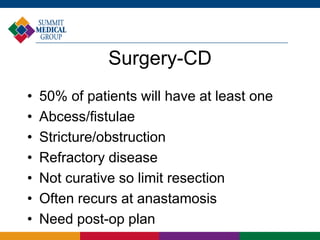
Surgery-CD
• 50% of patients will have at least one
• Abcess/fistulae
• Stricture/obstruction
• Refractory disease
• Not curative so limit resection
• Often recurs at anastamosis
• Need post-op plan
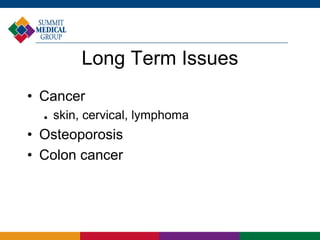
Long Term Issues
• Cancer
 skin, cervical, lymphoma
• Osteoporosis
• Colon cancer
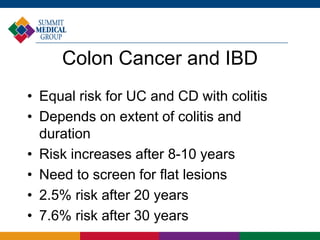
Colon Cancer and IBD
• Equal risk for UC and CD with colitis
• Depends on extent of colitis and
duration
• Risk increases after 8-10 years
• Need to screen for flat lesions
• 2.5% risk after 20 years
• 7.6% risk after 30 years
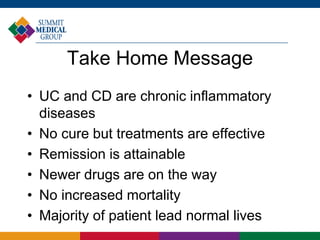
Take Home Message
• UC and CD are chronic inflammatory
diseases
• No cure but treatments are effective
• Remission is attainable
• Newer drugs are on the way
• No increased mortality
• Majority of patient lead normal lives

Inflammatory Bowel Disease (IBD)

  • 1.
    Inflammatory Bowel Disease UlcerativeColitis and Crohn’s Disease Roger Klein, MD, FACP
  • 2.
    Definition • Chronic immunemediated inflammation of the gastrointestinal tract • Two distinct diseases • Overlapping clinical characteristics • Affects 1.4 million people in the United States
  • 3.
    Ulcerative Colitis • Inflammationof inner lining of Colon • Does not involve small intestine • Begins in rectum and extends upward • Continuous disease
  • 4.
  • 5.
    Crohn’s Disease • Fullthickness inflammation of bowel wall • Involves anywhere from mouth to anus • Most commonly involves Ileum and colon • Skip areas of involvement • Complicated by strictures and fistulae
  • 6.
  • 7.
  • 8.
    Layers of GITract Essentials of Human Physiology by Ginsburg and Costoff
  • 9.
  • 10.
  • 11.
    Epidemiology • UC 238/100,000 •CD 201/100,000 • Lower incidence in Asia and Middle East • Mostly presents age 15-40 • Second peak age 60-80 • No difference between sexes • More common in people of Jewish descent
  • 12.
    Risk Factors • Genetics 10-25% have a relative with IBD • Smoking and CD • NSAID and aspirin • Possible western diet • Unknown environmental trigger
  • 13.
    Genetic Risk • Geneticscontribute to susceptibility • First degree relatives are at 3-20 X risk • Children of 2 parents with IBD 33% risk • Up to 160 genes involved
  • 14.
    UC Presentation • Gradualonset over weeks • Diarrhea often bloody • Abdominal cramping • Tenesmus • Extra intestinal manifestations  Arthritis  Skin/Eyes  Liver
  • 15.
    CD Presentation • Oftenpresents with chronic symptoms • Abdominal cramping • Intermittent diarrhea • Obstruction • Abscess/fistulae • Weight loss/anemia/fatigue/fevers
  • 16.
    Evaluation • History andphysical • Stool studies to exclude infection • Colonoscopy to ileum with biopsies • Labs  Anemia  Markers of inflammation  pANCA, ASCA • Enterography/capsule endoscopy
  • 17.
    Treatment • One sizedoes not fit all • Mesalamine • Antibiotics • Steroids • Immunomodulators • Biologic/ Anti-TNF • Surgery
  • 18.
    Mesalamine • First linetherapy acts topically • Oral “Packaged” to release in different areas • Rectal  Suppository  Enema • Safe even in pregnancy • Not effective in small bowel Crohn’s
  • 19.
    Antibiotics • Ciprofloxacin andMetronidazole • Effective in Crohn’s • No role in UC • Issues with tolerance • May lead to resistant bacteria
  • 20.
    Steroids • Can begiven oral, rectal, or IV • Very effective short term • Not a maintenance drug • Need a plan when starting • Many serious side effects  Diabetes  Osteoporosis
  • 21.
    Immunomodulators • Azathioprine and6-MP • Target immune response • Effective in both Crohn’s and UC • Can take up to 3 months to work • Need labs monitored regularly • Not always tolerated • May increase risk of certain cancers
  • 22.
    Biologics • Act byinterfering with TNF • Given by IV or injection • Very effective • Work quickly • Used for moderate/severe UC • May alter natural history if used early in CD
  • 23.
    Biologics-Risks • Infectious complications TB/Fungal infections  Hepatitis • Cancer Risk  Lymphoma
  • 24.
    Surgery-UC • Refractory disease •Cancer • Surgery is curative • Remove entire colon • IPAA or Ileostomy
  • 25.
    Surgery-CD • 50% ofpatients will have at least one • Abcess/fistulae • Stricture/obstruction • Refractory disease • Not curative so limit resection • Often recurs at anastamosis • Need post-op plan
  • 26.
    Long Term Issues •Cancer  skin, cervical, lymphoma • Osteoporosis • Colon cancer
  • 27.
    Colon Cancer andIBD • Equal risk for UC and CD with colitis • Depends on extent of colitis and duration • Risk increases after 8-10 years • Need to screen for flat lesions • 2.5% risk after 20 years • 7.6% risk after 30 years
  • 28.
    Take Home Message •UC and CD are chronic inflammatory diseases • No cure but treatments are effective • Remission is attainable • Newer drugs are on the way • No increased mortality • Majority of patient lead normal lives

Editor's Notes

  • #4 Involves mucosa, does not extend to deeper layers of colon
  • #7 University of Rochester Medical Center
  • #9 Essentials of Human Physiology by Ginsburg, JM and Costoff, A
  • #10 Healthfavo.com
  • #11 Johns Hopkins Medical Center
  • #13 Western diet-processed food, fried food , sugar
  • #15 Skin-Erythema nodosum, pyoderma Arthritis- large joint and ankylosing spondylitis Liver- sclerosing cholangitis
  • #17 Colonoscopy-continuous disease from rectum Inflammatory markers sed rate and CRP, stool calprotectin Anti-sacchromyces cervissiae, Anti-OmpC
  • #18 Treatment needs to be individualized based on extent of disease, severity and initial response
  • #20 Intolerance-metallic taste, parasthesias
  • #22 Intolerance due to nausea, pancreatitis, hepatitis Risk of lymphoma, skin cancer, cervical cancer due to HPV
  • #23 Adalibumab(Humira), Infliximab(Remicade)
  • #25 Ileal pouch anal anastamosis
  • #28 No increased risk for proctitis Chromoendoscopy