Inflammatory Bowel Disease   By Dr. Osman Bukhari
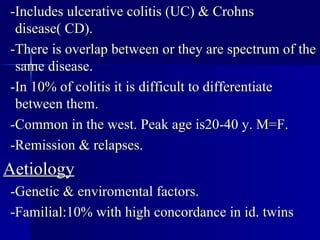
-Includes ulcerative colitis (UC) & Crohns disease( CD). -There is overlap between or they are spectrum of the same disease. -In 10% of colitis it is difficult to differentiate between them. -Common in the west. Peak age is20-40 y. M=F. -Remission & relapses. Aetiology -Genetic & enviromental factors. -Familial:10% with high concordance in id. twins


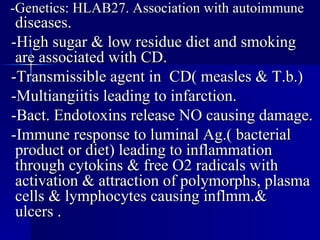
-Genetics: HLAB27. Association with autoimmune  diseases. -High sugar & low residue diet and smoking are associated with CD. -Transmissible agent in  CD( measles & T.b.) -Multiangiitis leading to infarction. -Bact. Endotoxins release NO causing damage. -Immune response to luminal Ag.( bacterial product or diet) leading to inflammation through cytokins & free O2 radicals with activation & attraction of polymorphs, plasma cells & lymphocytes causing inflmm.& ulcers .


Pathology -In CD whole GIT is involved. Terminal ileum & ascending colon being commonly affected. Rectal disease is rare. In UC proctitis is invariable & back wash ileitis is rare. -Macroscopically : In CD small bowel is thickened & narrowed. The lesions are skipped deep ulcers with enlarged L.nodes, abscesses, fissures & fistulae. Toxic colonic dilatation can follow fulminant colitis. -In UC colitis is continuous with ulceration & is more distally. Pseudopolyps are common.
toxic dilatation can follow fulminant colitis. -Microscopically: In CD there is transmural non casiating granuloma with normal goblet cells & infrequent crypt abscesses. In UC inflamm. is superficial with chronic inflamm. infiltrates, loss of goblet cells, frequent crypt abscesses. Displasia & Ca are more common. Clinical features of CD -  presentation is variable depending on the severity & extent of the disease. Mild cases lead normal life with repeated admission in severe cases.
-Major symptoms of abd. Pain, diarrhoea (80%) & weight loss. Abd. Pain is due to peritoneal involvement or obstruction. 10% present wuth acute pain in RIF. Diarrhoea is bloody in colitis & steatorrhoeic  in small bowel disease -Constitutional symptoms of anorexia, N, V, general illhealth & fatigue ( Anemia due to malabsorption of  Fe, FA,& B12). -Abdominal ex.=normal or tender or masses in  the RIF ( Inflm. Loops of bowel or abscesses).
-PR =perianal abscess, skin tags, fissures & fistulae sp. with colitis. -Sigmoidoscopy= rectum may be spared or may be indistinguishable from UC. Take biopsies. Clinical feature of UC -Presentation is variable depending on the extent & severity of the disease. -Bloody diarrhea  with mucus & occasionally only blood &mucus. Lower abdominal pain. -Urgency & tensmus in proctitis without constitutional symptom.
-Anorexia ;nausea & lethargy in total colitis. -Slight abdominal distension & tenderness. -PR= normal or tender with blood in the examining finger. -Mild colitis=up to 4 motions per day. -Mod. Colitis=4-6 motions per day. -Severe Colitis = more than 6 motions per day, patient very ill temp. >37.5, pulse >90, Hb <10 g./dl., ser. Albumin <30 g./l. & under nutrition. Anorexia, nausea
* Fulminent colitis may cause toxic mega- colon with perforation or septicemia. Extra-intestinal manifestations of IBS (Related to disease activity & more in UC.) -Clubbing of fingers, E. nodosum, pyoderma gangrenosum & oral aphthus ulcers. -Episcleritis, conjunctivitis, iritis & uveitis. -Monoarthritis, sacro-ilitis & ankylosing spondylitis. -Fatty liver, chronic hep., cirrhosis, autoimmune hep. scl.cholanhitis, cholanioCa.
-Portal pyaemia &liver abscess. -Auto-immune hemolytic anemia, vasculitis & thrombosis of portal & mesenteric veins. -Amyloidosis. * *** Relapses  in UC are precipitated by:- Stress, intercurrent infection, G.E, antibiotics & NSAIDs. Investigations in IBD. -anemia( multifactorial), raised WBC, ESR & CRP. -stools ex. To exclude bacterial ,protozal & helmithic infections.
-Low serum albumin & abnormal LFT. -Blood culture in suspected septicemia. -Stool culture if diarrhea persist despite Tr. -Plain abd. X-ray in toxic megacolon. -Ba.enema : shortening, narrowing & loss of haustrations of colon, granular appearance of colon, pseudopolyps & filling defects. Avoided in acute cases. -Sigmoidoscopy: engorged hyperemic mucosa which bleed spontaneously in severe cases. -Colonoscopy: assesses extent & severity of disease
and take multiple biopsies to distinguish between UC & CD. -Small bowel Ba. follow- through ( abn. Mucosal pattern, skipped lesions, deep ulcers & narrowing_string sign.) - US fore masses & CT for abscesses & bowel thickening. Diff. diag : - Small bowel disease: chronic diarrhea, malabsorption & malnutrition, ileocecal Tb.,
actinomycosis, yersinia, appendicitis & append. Abscess, lymphoma &Ca caecum. -Infective diarrhea :salmonella, shigella, campylobacter., E.coli hagic colitis, GN & Chlamydia proctitis, pseudomembraneous, herpes simplex & amebiasis. -Noninfecive colitis: ischemic, radiation, diffuse lymphoma, behcet, NSAID, diverticulitis & colonic Ca. Management of IBS. Medical :well balanced diet with protein   and energy. Maintain fluid & elect. balance.
-Low fat & milk if malabsorption. High fibre avoided in mall bowel disease, it is beneficial in proctitis & constipation. Iron, folic acid, B12,Vit. D & Ca supplements. -Drugs: Mild CD treated symptomatically with antidiarrheal.In acute CD admit for induction of remission with Prednsolone 40-60 mg/ day for 2W & reduce to 10-20mg for 6-8 w. Azathioprin  for maintenance of steroid induced remission or if Prednsolone fails. Sulphasalasine ( 5ASA) & mesalasine for maintenance of remiss. In colonic CD  . Methotrexate, ciclosp & TNF Abs.for those who do not respond to a.m. drugs.
-Antibiotics & Metronidazole bacterial  colonization & perianal disease. -Surgery is required in 80% CD but should be avoided & conservative with minim. resection ( stricture & fistulae, abscess, perforation , toxic megacolon & severe extensive colonic disease if no response to med . TR..). Unlike UC surgery is not curative. -Medical management in UC: In severe active colitis--- fluid & elect. correction, blood & plasma transfusion ,  nutrition, S/C heparin to prevent DVT, blood culture & antibiotics if septicemia is suspected.
-Parentral methylprednsolone or oral Prednsolone ( 40-60) for 2W to induce remission & maintain on (5ASA) to prevent relapse. If no response use azathioprin. If no response then surgery. Azathioprin is also used for patients who require high dose steroids for Maintaince. -Steroid suppositories for proctitis & steroid enema for mild proctocolitis. If no response or if the patient can not retain enema; use systemic steroids. 5ASA can induce remission in mild & mod. colitis but less effective.
- Surgery for UC : Emergency proctocolectomy or colectomy Ist.& later proctosigmoidectomy for toxic dilatation, perforation & hage ,. Acue severe UC failing to med. TR , colonic abscess stricture & long standing total colitis & severe extra-intestinal not responding to med. TR are another indications. Complications of IBS: -Fistulae, fissures, abscess & local perforation in CD. -Toxic colonic dilatation. - Perforation in toxic dilt.
-Massive hage is rare. -Ca colon (3-5%) specially in extensive colitis of > 10 years. -Amyloidosis. Course in IBS: - R elapses & remiss. Mortality is twice as common as in normals in CD & is associated with surgery. -Prognosis is good in proctitis & worse with severe colitis. Mortality 15-25 % in fulmin. colitis


-Low serum albumin & abnormal LFTs. -Blood culture in suspected septicemia. -Stool culture if diarrhea is persistent. =In colitis plain in toxic dilatation of colon, Ba enema : avoided in acute cases.There is narrowing, shoryening, loss of haustration , ulceration, pseudo polyps &granular appearance. -Sigmoidoscopy :engorged  hyperemic mucosa which bleeds spontaneously or or touch
-Colonoscopy: To assess extenty & severity of the disease, to distinguish between UC &CD & take multiple biopsies. -Small bowel follow through in CD( skipped lesions, abnormal mucosa, deep ulcerations & narrowing ( string sign) -CT for abscesses & bowel thickening & US for masses. Diff. Diagnosis: -CD of small bowel: chronic diarrhea, malabsorption, malnutrition, ileocecal Tb.,
actinomycosis, appendicitis &abscess, Yesinia ielitis, lymphoma & Ca cecum. -Colitis: infective colitis ( salmonella, shigella, campylobacter, E. coli hemorrhagic colitis, G.N.& Chlamydia proctitis, pseudomembr.colitis & amebiasis.) AND noninfective colitis ( ischemic, radiation, Behcets, NSAIDs, Ca colon & diverticulitis )


IBD includes UC & CD: -There is overlap between them & could be spectrum of the same disease & in 10% of colitis it is difficult to say which is which. -Common in the west .F=M. 20-40 ys. -Relapses & remissions. Aetiology Genetic & enviromental factors are implicated -Familial -Genetic associated with HLAB27. -  Dietary: low residue & high sugar diet.
- Smoking in CD. UC more common in non smokers. -Transmissible agent e.g. measels-mycob.Tb. -Multifocal angiitis—infarction. -Bacterial endotoxins liberating NO3 causing damage. -Luminal Ag. Evocing immune response causing inflammatory response through cytokins & free O2 radicals.
Pathogenesis Involves activation of macrophages in response to dietary element or bacterial product with release of inflammatory cytokins with activation &  attraction of polymorphs, plasma cells & lymphocytes leading to inflammation & ulceration. Pathology General: -In CD whole GIT is involved sp. Terminal ileum &
ascending colon are commonly affected while proctitis is rare. In UC proctitis is invariable & backwash ileitis is rare. Macroscopic: -In CD small bowel is thickened with skipped lesions & deep ulcers. Aphthus ulcers, abscesses & fistulae are common. Fulminant colitis & toxic diltation can occur. In UC there is confluent colitis with extensive ulceration  and pseudopolyps.
Microscopy In CD there is transmural non casiating granuloma of the bowl &L. nodes with infrequent crypts abscesses & normal goblet cells. In UC there is superficial chronic inflammatory infiltrate, no granuloma with loss of goblet cells & crypt abscesses. Clinical picture  In UC clinical picture is variable depending on the site, extent & severity of the disease.
-bloody diarrhoea with mucus. Occasionally only mucus & blood. There is lower abdominal  pain, distension & tenderness. -Urgency & tensmus without constitutional symptoms in proctitis. -Anorexia, malaise & lethergy in total colitis with aphthoid ulcers. *Mild colitis =Up to 4 motions/day. *Mod. Colitis = 4-6 motions/day. *Severe colitis=More than 6 motions/day. Pat. Is very ill , febrile, Hb < 10gm, pulse >90, albumin <30 gm & undernutrition. Fulminant colitis with diltation, perforation & septicaemia can occur.  PR= tender with blood.
In CD clinical picture is variable depending on the extent & severity of disease ranging from mild disease to severe disease with repeated admission. -Acute or chronic onset with abd. Pain & diarrhoea(80%) with constitutional symptoms of fever, fever,A, N,V, weight loss & fatigue. Colicky pain suggests obstruction. Pain RIF like acute appendicitis. -Features of malabsorption with anaemia, weihgt loss & vitamin deficiency. Aphth. Ulcer -Abd. Ex. Normal or tender with masses -Colitis in CD is similar to UC. -PR: skin tags, perianal abscesses, fissures & fistulae sp. In CD with colitis.
Extraintestinal manifestations of IBD. -Clubbing ,E. nodosum, Py. Gangrenosum, Aphthus ulcers & amyloidosis.  -A spondylitis, S/ Ilitis & monoarthritis. -Conjunctivitis, episcleritis, iritis & uveitis. -Fatty liver ,chronic hepatitis, cirrhosis, Scler cholangitis, cholangioCa, autoimmune hepatitis, portal pyemia &liver abscess. -Autoimmune hemolytic anemia, vasculitis, thrombosis including portal mesen. Thrombosis.
Investigations Aimed at confirming diagnosis, defining disease extent & activity and identifying complications. -Anemia: multifactorial, high ESR & CRP. -Low serum albumin & abn. Liver biochemst. -Stool culture to exclude infections & biood cultures in patients with IBD who develop fever. -Plain abdominal XR if toxic dilatation & perforation are suspected.
-BA. E nema: narrow & short colon, loss of haustrations, granular appearance, pseudopolyps & filling defects. Ba. Avoided in active disease. -Sigmoidoscopy: ranges from abnormal vascular pattern in mild colitis to engorged mucosa which may bleeds spontaneously or on touch. Take biopsies. Rectal sparing in CD. -Colonoscopy: In UC the pathology is continuous, while in CD it I patchy, ulcers are deep & strictures are common. Take multiple biopsies
-Small bowel follow-through in CD shows skipped lesions, deep ulcers & narrow segments ( string sign). -CT for bowel thickening & abscesses. -US to detect masses. Differential diagnosis -CD should be differentiated from other causes of chronic diarrhoea, malabsosption & malnutrition, ileocaecal Tb., actinomycosis, yersinia, appendicitis & append. Abscess, lymphomas & Ca caecum.
-Colitis in UC & CD should be differentiated from infective colitis ( bacterial or amoebic, & pseudomembraneous colitis ) Or non infective colitis ( ischemic, radiation, lymphoma, behcet, Ca & diverticulitis,). Management A-Medical of CD: -Fluid & electrolyte balance. Maintenance of nutrition with low fat & milk diet if there is malabsorption. Iron, folic acid, B12, vit. D & calcium supplements.


-Symptomatic treatment with antidiarrhoeals in mild cases. -For severe acute attacks, Prednsolone 40-60 mg. for 1-2 weeks reduced to 10-20 mg. for 6-8 weeks ( Budesonide has less S.E.).

Inflammatory Bowel Disease

  • 1.
    Inflammatory Bowel Disease By Dr. Osman Bukhari
  • 2.
    -Includes ulcerative colitis(UC) & Crohns disease( CD). -There is overlap between or they are spectrum of the same disease. -In 10% of colitis it is difficult to differentiate between them. -Common in the west. Peak age is20-40 y. M=F. -Remission & relapses. Aetiology -Genetic & enviromental factors. -Familial:10% with high concordance in id. twins
  • 3.
    -Genetics: HLAB27. Associationwith autoimmune diseases. -High sugar & low residue diet and smoking are associated with CD. -Transmissible agent in CD( measles & T.b.) -Multiangiitis leading to infarction. -Bact. Endotoxins release NO causing damage. -Immune response to luminal Ag.( bacterial product or diet) leading to inflammation through cytokins & free O2 radicals with activation & attraction of polymorphs, plasma cells & lymphocytes causing inflmm.& ulcers .
  • 4.
    Pathology -In CDwhole GIT is involved. Terminal ileum & ascending colon being commonly affected. Rectal disease is rare. In UC proctitis is invariable & back wash ileitis is rare. -Macroscopically : In CD small bowel is thickened & narrowed. The lesions are skipped deep ulcers with enlarged L.nodes, abscesses, fissures & fistulae. Toxic colonic dilatation can follow fulminant colitis. -In UC colitis is continuous with ulceration & is more distally. Pseudopolyps are common.
  • 5.
    toxic dilatation canfollow fulminant colitis. -Microscopically: In CD there is transmural non casiating granuloma with normal goblet cells & infrequent crypt abscesses. In UC inflamm. is superficial with chronic inflamm. infiltrates, loss of goblet cells, frequent crypt abscesses. Displasia & Ca are more common. Clinical features of CD - presentation is variable depending on the severity & extent of the disease. Mild cases lead normal life with repeated admission in severe cases.
  • 6.
    -Major symptoms ofabd. Pain, diarrhoea (80%) & weight loss. Abd. Pain is due to peritoneal involvement or obstruction. 10% present wuth acute pain in RIF. Diarrhoea is bloody in colitis & steatorrhoeic in small bowel disease -Constitutional symptoms of anorexia, N, V, general illhealth & fatigue ( Anemia due to malabsorption of Fe, FA,& B12). -Abdominal ex.=normal or tender or masses in the RIF ( Inflm. Loops of bowel or abscesses).
  • 7.
    -PR =perianal abscess,skin tags, fissures & fistulae sp. with colitis. -Sigmoidoscopy= rectum may be spared or may be indistinguishable from UC. Take biopsies. Clinical feature of UC -Presentation is variable depending on the extent & severity of the disease. -Bloody diarrhea with mucus & occasionally only blood &mucus. Lower abdominal pain. -Urgency & tensmus in proctitis without constitutional symptom.
  • 8.
    -Anorexia ;nausea &lethargy in total colitis. -Slight abdominal distension & tenderness. -PR= normal or tender with blood in the examining finger. -Mild colitis=up to 4 motions per day. -Mod. Colitis=4-6 motions per day. -Severe Colitis = more than 6 motions per day, patient very ill temp. >37.5, pulse >90, Hb <10 g./dl., ser. Albumin <30 g./l. & under nutrition. Anorexia, nausea
  • 9.
    * Fulminent colitismay cause toxic mega- colon with perforation or septicemia. Extra-intestinal manifestations of IBS (Related to disease activity & more in UC.) -Clubbing of fingers, E. nodosum, pyoderma gangrenosum & oral aphthus ulcers. -Episcleritis, conjunctivitis, iritis & uveitis. -Monoarthritis, sacro-ilitis & ankylosing spondylitis. -Fatty liver, chronic hep., cirrhosis, autoimmune hep. scl.cholanhitis, cholanioCa.
  • 10.
    -Portal pyaemia &liverabscess. -Auto-immune hemolytic anemia, vasculitis & thrombosis of portal & mesenteric veins. -Amyloidosis. * *** Relapses in UC are precipitated by:- Stress, intercurrent infection, G.E, antibiotics & NSAIDs. Investigations in IBD. -anemia( multifactorial), raised WBC, ESR & CRP. -stools ex. To exclude bacterial ,protozal & helmithic infections.
  • 11.
    -Low serum albumin& abnormal LFT. -Blood culture in suspected septicemia. -Stool culture if diarrhea persist despite Tr. -Plain abd. X-ray in toxic megacolon. -Ba.enema : shortening, narrowing & loss of haustrations of colon, granular appearance of colon, pseudopolyps & filling defects. Avoided in acute cases. -Sigmoidoscopy: engorged hyperemic mucosa which bleed spontaneously in severe cases. -Colonoscopy: assesses extent & severity of disease
  • 12.
    and take multiplebiopsies to distinguish between UC & CD. -Small bowel Ba. follow- through ( abn. Mucosal pattern, skipped lesions, deep ulcers & narrowing_string sign.) - US fore masses & CT for abscesses & bowel thickening. Diff. diag : - Small bowel disease: chronic diarrhea, malabsorption & malnutrition, ileocecal Tb.,
  • 13.
    actinomycosis, yersinia, appendicitis& append. Abscess, lymphoma &Ca caecum. -Infective diarrhea :salmonella, shigella, campylobacter., E.coli hagic colitis, GN & Chlamydia proctitis, pseudomembraneous, herpes simplex & amebiasis. -Noninfecive colitis: ischemic, radiation, diffuse lymphoma, behcet, NSAID, diverticulitis & colonic Ca. Management of IBS. Medical :well balanced diet with protein and energy. Maintain fluid & elect. balance.
  • 14.
    -Low fat &milk if malabsorption. High fibre avoided in mall bowel disease, it is beneficial in proctitis & constipation. Iron, folic acid, B12,Vit. D & Ca supplements. -Drugs: Mild CD treated symptomatically with antidiarrheal.In acute CD admit for induction of remission with Prednsolone 40-60 mg/ day for 2W & reduce to 10-20mg for 6-8 w. Azathioprin for maintenance of steroid induced remission or if Prednsolone fails. Sulphasalasine ( 5ASA) & mesalasine for maintenance of remiss. In colonic CD . Methotrexate, ciclosp & TNF Abs.for those who do not respond to a.m. drugs.
  • 15.
    -Antibiotics & Metronidazolebacterial colonization & perianal disease. -Surgery is required in 80% CD but should be avoided & conservative with minim. resection ( stricture & fistulae, abscess, perforation , toxic megacolon & severe extensive colonic disease if no response to med . TR..). Unlike UC surgery is not curative. -Medical management in UC: In severe active colitis--- fluid & elect. correction, blood & plasma transfusion , nutrition, S/C heparin to prevent DVT, blood culture & antibiotics if septicemia is suspected.
  • 16.
    -Parentral methylprednsolone ororal Prednsolone ( 40-60) for 2W to induce remission & maintain on (5ASA) to prevent relapse. If no response use azathioprin. If no response then surgery. Azathioprin is also used for patients who require high dose steroids for Maintaince. -Steroid suppositories for proctitis & steroid enema for mild proctocolitis. If no response or if the patient can not retain enema; use systemic steroids. 5ASA can induce remission in mild & mod. colitis but less effective.
  • 17.
    - Surgery forUC : Emergency proctocolectomy or colectomy Ist.& later proctosigmoidectomy for toxic dilatation, perforation & hage ,. Acue severe UC failing to med. TR , colonic abscess stricture & long standing total colitis & severe extra-intestinal not responding to med. TR are another indications. Complications of IBS: -Fistulae, fissures, abscess & local perforation in CD. -Toxic colonic dilatation. - Perforation in toxic dilt.
  • 18.
    -Massive hage israre. -Ca colon (3-5%) specially in extensive colitis of > 10 years. -Amyloidosis. Course in IBS: - R elapses & remiss. Mortality is twice as common as in normals in CD & is associated with surgery. -Prognosis is good in proctitis & worse with severe colitis. Mortality 15-25 % in fulmin. colitis
  • 19.
  • 20.
  • 21.
  • 22.
  • 23.
  • 24.
  • 25.
  • 26.
  • 27.
  • 28.
  • 29.
  • 30.
  • 31.
  • 32.
  • 33.
  • 34.
  • 35.
  • 36.
  • 37.
  • 38.
  • 39.
  • 40.
  • 41.
  • 42.
  • 43.
  • 44.
  • 45.
  • 46.
  • 47.
  • 48.
  • 49.
  • 50.
  • 51.
  • 52.
  • 53.
  • 54.
  • 55.
  • 56.
  • 57.
  • 58.
  • 59.
  • 60.
  • 61.
  • 62.
  • 63.
  • 64.
  • 65.
  • 66.
  • 67.
  • 68.
  • 69.
  • 70.
  • 71.
  • 72.
  • 73.
  • 74.
  • 75.
  • 76.
  • 77.
  • 78.
  • 79.
  • 80.
  • 81.
  • 82.
  • 83.
  • 84.
  • 85.
  • 86.
  • 87.
  • 88.
  • 89.
  • 90.
  • 91.
  • 92.
  • 93.
  • 94.
  • 95.
  • 96.
  • 97.
  • 98.
  • 99.
  • 100.
  • 101.
  • 102.
  • 103.
  • 104.
  • 105.
  • 106.
  • 107.
  • 108.
  • 109.
  • 110.
  • 111.
  • 112.
  • 113.
  • 114.
  • 115.
  • 116.
  • 117.
  • 118.
  • 119.
  • 120.
  • 121.
  • 122.
  • 123.
  • 124.
    -Low serum albumin& abnormal LFTs. -Blood culture in suspected septicemia. -Stool culture if diarrhea is persistent. =In colitis plain in toxic dilatation of colon, Ba enema : avoided in acute cases.There is narrowing, shoryening, loss of haustration , ulceration, pseudo polyps &granular appearance. -Sigmoidoscopy :engorged hyperemic mucosa which bleeds spontaneously or or touch
  • 125.
    -Colonoscopy: To assessextenty & severity of the disease, to distinguish between UC &CD & take multiple biopsies. -Small bowel follow through in CD( skipped lesions, abnormal mucosa, deep ulcerations & narrowing ( string sign) -CT for abscesses & bowel thickening & US for masses. Diff. Diagnosis: -CD of small bowel: chronic diarrhea, malabsorption, malnutrition, ileocecal Tb.,
  • 126.
    actinomycosis, appendicitis &abscess,Yesinia ielitis, lymphoma & Ca cecum. -Colitis: infective colitis ( salmonella, shigella, campylobacter, E. coli hemorrhagic colitis, G.N.& Chlamydia proctitis, pseudomembr.colitis & amebiasis.) AND noninfective colitis ( ischemic, radiation, Behcets, NSAIDs, Ca colon & diverticulitis )
  • 127.
  • 128.
  • 129.
  • 130.
  • 131.
  • 132.
  • 133.
  • 134.
    IBD includes UC& CD: -There is overlap between them & could be spectrum of the same disease & in 10% of colitis it is difficult to say which is which. -Common in the west .F=M. 20-40 ys. -Relapses & remissions. Aetiology Genetic & enviromental factors are implicated -Familial -Genetic associated with HLAB27. - Dietary: low residue & high sugar diet.
  • 135.
    - Smoking inCD. UC more common in non smokers. -Transmissible agent e.g. measels-mycob.Tb. -Multifocal angiitis—infarction. -Bacterial endotoxins liberating NO3 causing damage. -Luminal Ag. Evocing immune response causing inflammatory response through cytokins & free O2 radicals.
  • 136.
    Pathogenesis Involves activationof macrophages in response to dietary element or bacterial product with release of inflammatory cytokins with activation & attraction of polymorphs, plasma cells & lymphocytes leading to inflammation & ulceration. Pathology General: -In CD whole GIT is involved sp. Terminal ileum &
  • 137.
    ascending colon arecommonly affected while proctitis is rare. In UC proctitis is invariable & backwash ileitis is rare. Macroscopic: -In CD small bowel is thickened with skipped lesions & deep ulcers. Aphthus ulcers, abscesses & fistulae are common. Fulminant colitis & toxic diltation can occur. In UC there is confluent colitis with extensive ulceration and pseudopolyps.
  • 138.
    Microscopy In CDthere is transmural non casiating granuloma of the bowl &L. nodes with infrequent crypts abscesses & normal goblet cells. In UC there is superficial chronic inflammatory infiltrate, no granuloma with loss of goblet cells & crypt abscesses. Clinical picture In UC clinical picture is variable depending on the site, extent & severity of the disease.
  • 139.
    -bloody diarrhoea withmucus. Occasionally only mucus & blood. There is lower abdominal pain, distension & tenderness. -Urgency & tensmus without constitutional symptoms in proctitis. -Anorexia, malaise & lethergy in total colitis with aphthoid ulcers. *Mild colitis =Up to 4 motions/day. *Mod. Colitis = 4-6 motions/day. *Severe colitis=More than 6 motions/day. Pat. Is very ill , febrile, Hb < 10gm, pulse >90, albumin <30 gm & undernutrition. Fulminant colitis with diltation, perforation & septicaemia can occur. PR= tender with blood.
  • 140.
    In CD clinicalpicture is variable depending on the extent & severity of disease ranging from mild disease to severe disease with repeated admission. -Acute or chronic onset with abd. Pain & diarrhoea(80%) with constitutional symptoms of fever, fever,A, N,V, weight loss & fatigue. Colicky pain suggests obstruction. Pain RIF like acute appendicitis. -Features of malabsorption with anaemia, weihgt loss & vitamin deficiency. Aphth. Ulcer -Abd. Ex. Normal or tender with masses -Colitis in CD is similar to UC. -PR: skin tags, perianal abscesses, fissures & fistulae sp. In CD with colitis.
  • 141.
    Extraintestinal manifestations ofIBD. -Clubbing ,E. nodosum, Py. Gangrenosum, Aphthus ulcers & amyloidosis. -A spondylitis, S/ Ilitis & monoarthritis. -Conjunctivitis, episcleritis, iritis & uveitis. -Fatty liver ,chronic hepatitis, cirrhosis, Scler cholangitis, cholangioCa, autoimmune hepatitis, portal pyemia &liver abscess. -Autoimmune hemolytic anemia, vasculitis, thrombosis including portal mesen. Thrombosis.
  • 142.
    Investigations Aimed atconfirming diagnosis, defining disease extent & activity and identifying complications. -Anemia: multifactorial, high ESR & CRP. -Low serum albumin & abn. Liver biochemst. -Stool culture to exclude infections & biood cultures in patients with IBD who develop fever. -Plain abdominal XR if toxic dilatation & perforation are suspected.
  • 143.
    -BA. E nema:narrow & short colon, loss of haustrations, granular appearance, pseudopolyps & filling defects. Ba. Avoided in active disease. -Sigmoidoscopy: ranges from abnormal vascular pattern in mild colitis to engorged mucosa which may bleeds spontaneously or on touch. Take biopsies. Rectal sparing in CD. -Colonoscopy: In UC the pathology is continuous, while in CD it I patchy, ulcers are deep & strictures are common. Take multiple biopsies
  • 144.
    -Small bowel follow-throughin CD shows skipped lesions, deep ulcers & narrow segments ( string sign). -CT for bowel thickening & abscesses. -US to detect masses. Differential diagnosis -CD should be differentiated from other causes of chronic diarrhoea, malabsosption & malnutrition, ileocaecal Tb., actinomycosis, yersinia, appendicitis & append. Abscess, lymphomas & Ca caecum.
  • 145.
    -Colitis in UC& CD should be differentiated from infective colitis ( bacterial or amoebic, & pseudomembraneous colitis ) Or non infective colitis ( ischemic, radiation, lymphoma, behcet, Ca & diverticulitis,). Management A-Medical of CD: -Fluid & electrolyte balance. Maintenance of nutrition with low fat & milk diet if there is malabsorption. Iron, folic acid, B12, vit. D & calcium supplements.
  • 146.
  • 147.
  • 148.
  • 149.
  • 150.
  • 151.
  • 152.
  • 153.
  • 154.
  • 155.
  • 156.
  • 157.
  • 158.
  • 159.
  • 160.
  • 161.
  • 162.
  • 163.
  • 164.
  • 165.
  • 166.
  • 167.
  • 168.
  • 169.
  • 170.
  • 171.
  • 172.
  • 173.
  • 174.
  • 175.
  • 176.
  • 177.
  • 178.
  • 179.
  • 180.
  • 181.
  • 182.
  • 183.
  • 184.
  • 185.
  • 186.
  • 187.
  • 188.
  • 189.
  • 190.
  • 191.
  • 192.
  • 193.
  • 194.
  • 195.
  • 196.
  • 197.
  • 198.
  • 199.
  • 200.
  • 201.
  • 202.
  • 203.
  • 204.
  • 205.
  • 206.
  • 207.
  • 208.
  • 209.
  • 210.
  • 211.
  • 212.
  • 213.
  • 214.
  • 215.
  • 216.
  • 217.
  • 218.
  • 219.
  • 220.
  • 221.
  • 222.
  • 223.
  • 224.
  • 225.
  • 226.
  • 227.
  • 228.
  • 229.
  • 230.
  • 231.
  • 232.
  • 233.
  • 234.
  • 235.
  • 236.
  • 237.
  • 238.
  • 239.
  • 240.
  • 241.
  • 242.
  • 243.
  • 244.
  • 245.
  • 246.
  • 247.
  • 248.
  • 249.
  • 250.
  • 251.
  • 252.
  • 253.
  • 254.
  • 255.
  • 256.
  • 257.
  • 258.
  • 259.
  • 260.
  • 261.
  • 262.
  • 263.
  • 264.
  • 265.
  • 266.
  • 267.
  • 268.
  • 269.
  • 270.
  • 271.
  • 272.
  • 273.
  • 274.
  • 275.
  • 276.
  • 277.
  • 278.
  • 279.
  • 280.
  • 281.
  • 282.
  • 283.
  • 284.
  • 285.
  • 286.
  • 287.
  • 288.
  • 289.
  • 290.
  • 291.
  • 292.
  • 293.
  • 294.
  • 295.
  • 296.
  • 297.
  • 298.
  • 299.
  • 300.
  • 301.
  • 302.
  • 303.
  • 304.
  • 305.
  • 306.
  • 307.
  • 308.
  • 309.
  • 310.
  • 311.
  • 312.
  • 313.
  • 314.
  • 315.
  • 316.
  • 317.
  • 318.
  • 319.
  • 320.
  • 321.
  • 322.
  • 323.
  • 324.
  • 325.
  • 326.
  • 327.
  • 328.
  • 329.
  • 330.
  • 331.
  • 332.
  • 333.
  • 334.
  • 335.
  • 336.
  • 337.
  • 338.
  • 339.
  • 340.
  • 341.
  • 342.
  • 343.
  • 344.
  • 345.
  • 346.
  • 347.
  • 348.
  • 349.
  • 350.
  • 351.
  • 352.
  • 353.
  • 354.
  • 355.
  • 356.
  • 357.
  • 358.
  • 359.
  • 360.
  • 361.
  • 362.
  • 363.
  • 364.
  • 365.
  • 366.
  • 367.
  • 368.
  • 369.
  • 370.
  • 371.
  • 372.
  • 373.
  • 374.
  • 375.
  • 376.
  • 377.
  • 378.
  • 379.
  • 380.
  • 381.
  • 382.
  • 383.
  • 384.
  • 385.
  • 386.
  • 387.
  • 388.
  • 389.
  • 390.
  • 391.
  • 392.
  • 393.
  • 394.
  • 395.
    -Symptomatic treatment withantidiarrhoeals in mild cases. -For severe acute attacks, Prednsolone 40-60 mg. for 1-2 weeks reduced to 10-20 mg. for 6-8 weeks ( Budesonide has less S.E.).