
INFLAMMATORY
BOWEL DISEASE
BY GODFREY DIJOE
INTRODUCTION
It is a chronic inflammatory disorder of the GIT due to
inappropriate immune response characterized by a relapsing and
remitting course.
Types of IBD
• Crohn’s disease – involves any part of the GIT from mouth to
anus
• Ulcerative colitis – involves only colon
FACTORS ASSOCIATED WITH DEVELOPMENT
OF IBD
ENVIRONMENTAL:
• Ulcerative colitis is more common in non smoker and ex-smokers
• Crohn’s disease is more common in smoker
• Crohn’s disease is associated with a low-residue, high-refined
sugar diet
• Commensal gut microbiota are altered in UC and CD
• Appendicectomy protects against UC
GENETICS:
• Common in Ashkenazi Jews
• 10% have first degree relatives
• High concordance in identical twins
• CD is associated with genetic defects in innate and autophagy
• HLA-DR 103 is associated with severe UC
PATHOPHYSIOLOGY
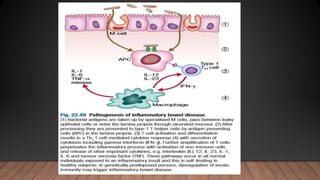
• environmental triggers abnormal host response in
genetically susceptible individuals.
• inflammation of the intestine occurs due to innate and adaptive
immune cell response leading to tissue damage.
• association between microbial dysbiosis and IBD present
• In both disease the intestinal wall is infiltrated with acute and
chronic inflammatory cells
ULCERATIVE COLITIS
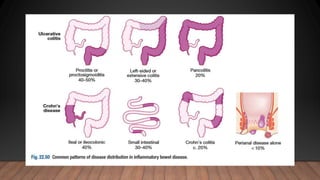
• Inflammation involves the rectum and spreads proximally in
some cases(pancolitis).
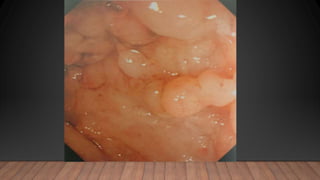
• In long standing pancolitis , the bowel become shortened and
develop post inflammatory pseudopolyps ( hypertrophied residual
mucosa within areas of atrophy)
• Limited to mucosa and spare deep layers of bowel wall
• Both acute and chronic cell infiltrate lamina propria and crypts
• Dysplasia, nuclear atypia and increased mitotic rate, may
predispose the development of colon cancer
CROHN’S DISEASE
• The most common sites are terminal ileum and right
side of colon, colon alone, terminal ileum alone, ileum
and jejunum.
• Entire wall of the bowel is oedematous and thickened
• Deep ulcers often appear as linear fissure; thus the
mucosa between them is described as cobblestone.
• Patchy distribution and inflammatory process is
interrupted by normal mucosa
CLINICAL FEATURES
ULCERATIVE COLITIS:
• Rectal bleeding with passage of mucus and bloody diarrhoea
• Tenesmus
• First attack is the most severe and is followed by relapses and
remission
• Some patient pass frequent, small-volume fluid stool while others
pass pellety stools due to constipation upstream of the inflamed
rectum
• In severe cases, anorexia, malaise, weight loss and abdominal
pain occur and the patient is toxic , with fever , tachycardia and
signs of peritoneal inflammation.
CLINICAL FEATURES
CROHN’S DISEASE:
• The major symptoms are abdominal pain,diarrhoea and
weight loss
• Ileal crohn’s disease may cause subacute or acute intestinal
obstruction
• Watery stool and does not contain blood or mucus
• Eating provokes pain
• Abdominal tenderness
DIFFERENTIAL DIAGNOSIS
INFECTIVE:
Bacterial:
• Salmonella
• Shigella
• Campylobacter jejuni
• Escherichia coli
Viral:
• Herpes simplex proctitis
• Cytomegalovirus
Protozoal;
• Amoebiasis
NON-INFECTIVE
• Ischaemic colitis
• Collagenous colitis
• Diverticulitis
• Radiation proctitis
• behcet’s disease
• Colonic carinoma
COMPLICATION
• Life threatening colonic inflammation
• Haemorrhage
• Fistulas
• Cancers
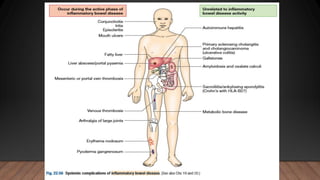
• Extra intestinal complications
INVESTIGATION
• Complete blood count-anaemia, leukocytosis
• ESR and CRP increased
Stool examination:
• Stool microscopy, culture, examination for ova and parasite.
Sigmoidoscopy :
• UC-Loss of vascular pattern, granularity, friability and contact
bleeding with or without ulceration.
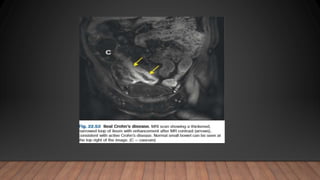
• Cd-patchy inflammation,discrete deep ulcers, strictures perianal
disease
Mucosal biopsy-confirm the diagnosis
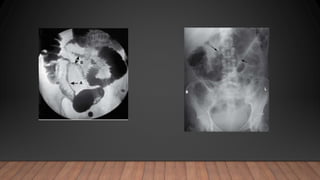
Barium enema
• Contraindicated in megacolon
• In UC-loss of haustration, ulceration, pseudopolyp,shortening of bowel
• In CD-linear fissures throughout bowel, cobble stone appearance ,concentric lesions are
seen.
Plain abdominal x-ray
Colonoscopy-assessing the progression of proctitis and colitis
Upper GI endoscopy-differentiating cohn’s disease of duodenum fom peptic ulcer
MANAGEMENT
The key aims are
• Treat acute attacks
• Prevent relapses
• Detect carcinoma at an early stage
• Select appropriate patient for surgery
MANAGEMENT OF ULCERATIVE COLITIS
• Active proctitis: 1g mesalazine suppository +/- oral 5-
aminosalicylate.(Topical glucocorticoids are reserved )
• Extensive ulcerative colitis: Oral 5-ASA+topical 5-ASA.
• Topical is withdrawn after 1 month but oral 5-ASA is continued.
• If unresponsive then oral prednisolone 40mg daily tampered
5mg/week over 8weeks is indicated
Severe ulcerative colitis:
• I.V fluids +enteral nutritional support .
• I.V methylprednisolone 60 mg or hydrocortisone 400mg/day
• Ciclosporin or infliximab if unresponsive to glucocorticoids.
• Coloctomy –who do not respond to medical therapy
Maintenance therapy:
• life long maintenance therapy is required in extensive ulcerative
colitis.
• oral 5-ASA OD are preferred first line agents.
• Sulfasalazine is effective but higher incidence of side effects
• Biologic therapy with anti TNF or anti-α4ᵦ7 integrin antibodies
MANAGEMENT OF CROHN’S DISEASE
principle of treatment:
• To induce remission and maintain glucocorticoid-free remission
with normal quality of life
Induction of remission:
• Glucocorticoids - mainstay of treatment
• Drug of choice in patient with ileal disease is budesonide
(regimen is 9mg once daily for 6weeks with gradual reduction in
dose. )
• If no response - switched to prednisolone 40mg daily
• Calcium and vitamin d
Maintenance therapy:
• Immunosuppressive treatment with azathioprine or
mercaptopurine
• Methotrexate orally or S.C is also effective
• Combination therapy with anti TNF antibodies is effective but
costly
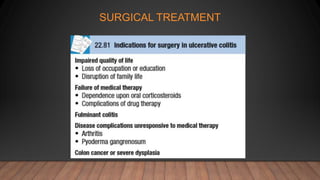
SURGICAL TREATMENT
Ulcerative colitis:
• 60% patients with extensive ulcerative colitis eventually require
surgery
• Surgery involves removal of entire colon and rectum
• The choice of procedure is either panproctocolectomy with
ileostomy, or proctocolectomy with ileal-anal pouch anastomosis
Crohn’s disease:
• Operation are often necessary to deal with fistulae, abscesses
and peri anal disease and also to relieve bowel obstruction.
• Localized segments of crohn’s disease are managed by
segmental resection and multiple stricturoplasties, in which
stricture is not resected but instead incised in its longitudinal axis
and sutured transversely.
THANK YOU

inflammatory bowel disease

  • 1.
  • 2.
    INTRODUCTION It is achronic inflammatory disorder of the GIT due to inappropriate immune response characterized by a relapsing and remitting course. Types of IBD • Crohn’s disease – involves any part of the GIT from mouth to anus • Ulcerative colitis – involves only colon
  • 3.
    FACTORS ASSOCIATED WITHDEVELOPMENT OF IBD ENVIRONMENTAL: • Ulcerative colitis is more common in non smoker and ex-smokers • Crohn’s disease is more common in smoker • Crohn’s disease is associated with a low-residue, high-refined sugar diet • Commensal gut microbiota are altered in UC and CD • Appendicectomy protects against UC
  • 4.
    GENETICS: • Common inAshkenazi Jews • 10% have first degree relatives • High concordance in identical twins • CD is associated with genetic defects in innate and autophagy • HLA-DR 103 is associated with severe UC
  • 5.
    PATHOPHYSIOLOGY • environmental triggersabnormal host response in genetically susceptible individuals. • inflammation of the intestine occurs due to innate and adaptive immune cell response leading to tissue damage. • association between microbial dysbiosis and IBD present • In both disease the intestinal wall is infiltrated with acute and chronic inflammatory cells
  • 7.
    ULCERATIVE COLITIS • Inflammationinvolves the rectum and spreads proximally in some cases(pancolitis). • In long standing pancolitis , the bowel become shortened and develop post inflammatory pseudopolyps ( hypertrophied residual mucosa within areas of atrophy) • Limited to mucosa and spare deep layers of bowel wall • Both acute and chronic cell infiltrate lamina propria and crypts • Dysplasia, nuclear atypia and increased mitotic rate, may predispose the development of colon cancer
  • 9.
    CROHN’S DISEASE • Themost common sites are terminal ileum and right side of colon, colon alone, terminal ileum alone, ileum and jejunum. • Entire wall of the bowel is oedematous and thickened • Deep ulcers often appear as linear fissure; thus the mucosa between them is described as cobblestone. • Patchy distribution and inflammatory process is interrupted by normal mucosa
  • 11.
    CLINICAL FEATURES ULCERATIVE COLITIS: •Rectal bleeding with passage of mucus and bloody diarrhoea • Tenesmus • First attack is the most severe and is followed by relapses and remission • Some patient pass frequent, small-volume fluid stool while others pass pellety stools due to constipation upstream of the inflamed rectum • In severe cases, anorexia, malaise, weight loss and abdominal pain occur and the patient is toxic , with fever , tachycardia and signs of peritoneal inflammation.
  • 12.
    CLINICAL FEATURES CROHN’S DISEASE: •The major symptoms are abdominal pain,diarrhoea and weight loss • Ileal crohn’s disease may cause subacute or acute intestinal obstruction • Watery stool and does not contain blood or mucus • Eating provokes pain • Abdominal tenderness
  • 13.
    DIFFERENTIAL DIAGNOSIS INFECTIVE: Bacterial: • Salmonella •Shigella • Campylobacter jejuni • Escherichia coli Viral: • Herpes simplex proctitis • Cytomegalovirus Protozoal; • Amoebiasis
  • 14.
    NON-INFECTIVE • Ischaemic colitis •Collagenous colitis • Diverticulitis • Radiation proctitis • behcet’s disease • Colonic carinoma
  • 15.
    COMPLICATION • Life threateningcolonic inflammation • Haemorrhage • Fistulas • Cancers • Extra intestinal complications
  • 17.
    INVESTIGATION • Complete bloodcount-anaemia, leukocytosis • ESR and CRP increased Stool examination: • Stool microscopy, culture, examination for ova and parasite. Sigmoidoscopy : • UC-Loss of vascular pattern, granularity, friability and contact bleeding with or without ulceration. • Cd-patchy inflammation,discrete deep ulcers, strictures perianal disease Mucosal biopsy-confirm the diagnosis
  • 19.
    Barium enema • Contraindicatedin megacolon • In UC-loss of haustration, ulceration, pseudopolyp,shortening of bowel • In CD-linear fissures throughout bowel, cobble stone appearance ,concentric lesions are seen. Plain abdominal x-ray Colonoscopy-assessing the progression of proctitis and colitis Upper GI endoscopy-differentiating cohn’s disease of duodenum fom peptic ulcer
  • 21.
    MANAGEMENT The key aimsare • Treat acute attacks • Prevent relapses • Detect carcinoma at an early stage • Select appropriate patient for surgery
  • 22.
    MANAGEMENT OF ULCERATIVECOLITIS • Active proctitis: 1g mesalazine suppository +/- oral 5- aminosalicylate.(Topical glucocorticoids are reserved ) • Extensive ulcerative colitis: Oral 5-ASA+topical 5-ASA. • Topical is withdrawn after 1 month but oral 5-ASA is continued. • If unresponsive then oral prednisolone 40mg daily tampered 5mg/week over 8weeks is indicated
  • 23.
    Severe ulcerative colitis: •I.V fluids +enteral nutritional support . • I.V methylprednisolone 60 mg or hydrocortisone 400mg/day • Ciclosporin or infliximab if unresponsive to glucocorticoids. • Coloctomy –who do not respond to medical therapy
  • 24.
    Maintenance therapy: • lifelong maintenance therapy is required in extensive ulcerative colitis. • oral 5-ASA OD are preferred first line agents. • Sulfasalazine is effective but higher incidence of side effects • Biologic therapy with anti TNF or anti-α4ᵦ7 integrin antibodies
  • 25.
    MANAGEMENT OF CROHN’SDISEASE principle of treatment: • To induce remission and maintain glucocorticoid-free remission with normal quality of life Induction of remission: • Glucocorticoids - mainstay of treatment • Drug of choice in patient with ileal disease is budesonide (regimen is 9mg once daily for 6weeks with gradual reduction in dose. ) • If no response - switched to prednisolone 40mg daily • Calcium and vitamin d
  • 26.
    Maintenance therapy: • Immunosuppressivetreatment with azathioprine or mercaptopurine • Methotrexate orally or S.C is also effective • Combination therapy with anti TNF antibodies is effective but costly
  • 27.
  • 28.
    Ulcerative colitis: • 60%patients with extensive ulcerative colitis eventually require surgery • Surgery involves removal of entire colon and rectum • The choice of procedure is either panproctocolectomy with ileostomy, or proctocolectomy with ileal-anal pouch anastomosis
  • 29.
    Crohn’s disease: • Operationare often necessary to deal with fistulae, abscesses and peri anal disease and also to relieve bowel obstruction. • Localized segments of crohn’s disease are managed by segmental resection and multiple stricturoplasties, in which stricture is not resected but instead incised in its longitudinal axis and sutured transversely.
  • 31.