IRRITABLE BOWEL SYNDROME
& ULCERATIVE COLITIS
GUIDED BY:
DR. NIBEDITA MAHAPATRA MAAM (HOD DEPT OF KAYA CHIKITSA)
DR. KABI CHANDRA SAHU SIR (LECTURER OF KAYA CHIKITSA)
PRESENTED BY:
ANKITA DASH
(4TH PROFESSIONAL BAMS)
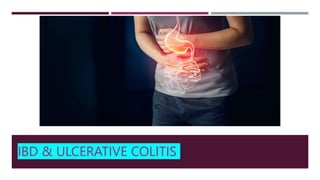
IBD & ULCERATIVE COLITIS
DEFINITION
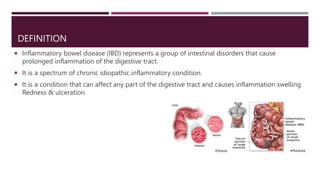
 Inflammatory bowel disease (IBD) represents a group of intestinal disorders that cause
prolonged inflammation of the digestive tract.
 It is a spectrum of chronic idiopathic inflammatory condition.
 It is a condition that can affect any part of the digestive tract and causes inflammation swelling
Redness & ulceration.
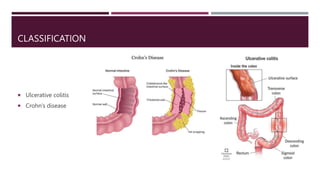
CLASSIFICATION
 Ulcerative colitis
 Crohn’s disease
ETIOLOGY
 Infectious agents
 Viruses (Measles)
 Bacteria (Mycobacteria)
 Genetics
 Environmental factors
 Diet
 Smoking
 Psychological factors
 Stress
 Emotional or physical trauma
 Mucosal immune response
 • Inflammatory cells
 • In IBD, activated CD4+Tcells are present in the lamina propria and in the peripheral blood
 • These cells either activate other inflammatory cells like macrophages, and B cells or recruit
more inflammatory cells by stimulation of homing receptors on leukocytes and vascular
endothelial cells
PATHOPHYSIOLOGY
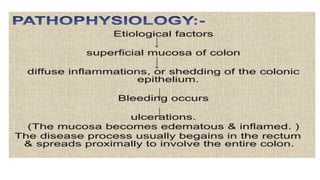
1. Inflammatory process usually confined to rectum and sigmoid colon
2. Inflammation leads to mucosal hemorrhages and abscess formation, which
leads to necrosis and sloughing of bowel mucosa.
3. Mucosa becomes red, friable, and ulcerated; bleeding is common
4. Chronic inflammation leads to atrophy, narrowing, and shortening of colon.
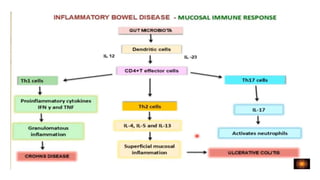
PATHOPHYSIOLOGY
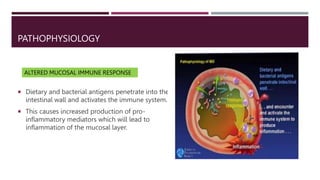
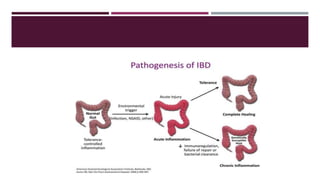
 Dietary and bacterial antigens penetrate into the
intestinal wall and activates the immune system.
 This causes increased production of pro-
inflammatory mediators which will lead to
inflammation of the mucosal layer.
ALTERED MUCOSAL IMMUNE RESPONSE
ULCERATIVE COLITIS
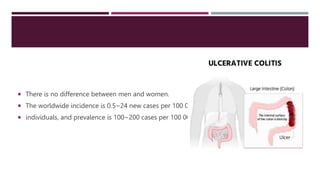
 Ulcerative colitis is an inflammatory bowel disease (IBD).
 Ulcerative colitis occurs when the lining of your large intestine (also called the colon),
rectum, or both becomes inflamed.
 This inflammation produces tiny sores called ulcers on the lining of your colon. It usually
begins in the rectum and spreads upward. It can involve your entire colon.
 Ulcerative colitis can be debilitating and can sometimes lead to life-threatening
complications. While it has no known cure, treatment can greatly reduce signs and
symptoms of the disease and bring about long-term remission.
 There is no difference between men and women.
 The worldwide incidence is 0.5~24 new cases per 100 000
 individuals, and prevalence is 100~200 cases per 100 000.
ETIOLOGY
 The cause of UC remains unclear, although interplay of genetic, microbial, and
immunologic factors clearly exists.
 A limited number of environmental factors have clearly been proven to either modify the
disease or regulate the lifetime risk of developing it.
 These include:
 Tobacco use. Appendectomy.
 Oral contraceptive pills. Antibiotic use.
SYMPTOMS
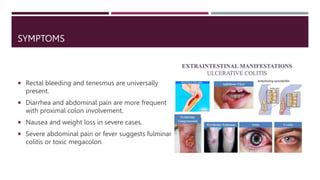
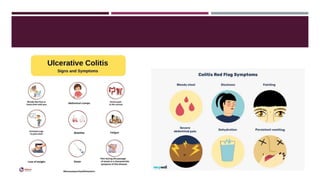
 Rectal bleeding and tenesmus are universally
present.
 Diarrhea and abdominal pain are more frequent
with proximal colon involvement.
 Nausea and weight loss in severe cases.
 Severe abdominal pain or fever suggests fulminant
colitis or toxic megacolon.
CLINICAL FEATURES
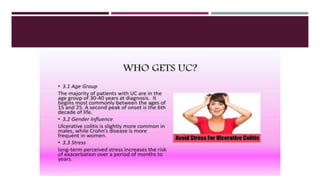
 Age: Ulcerative colitis presents at a young age, often in
adolescence. The median age of diagnosis is the fourth decade of
life.
 Onset: acute or subacute.
 Course: - Most patients experience intermittent exacerbations with
nearly complete remissions between attacks.
 About 5-10% of patients have one attack without subsequent
tsymptoms for decades
SIGN
 Pallor may be evident.
 Mild abdominal tenderness most localized in the hypogastrium or left lower quadrant.
 PR examination may disclose visible red blood.
 Signs of malnutrition.
 Severe tenderness, fever, or tachycardia suggests fulminant disease.
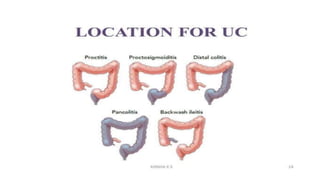
TYPES OF UC
 Ulcerative proctitis:limited nited to the rectum, diarrhea, bloody stool, pain in the rectal
area, and a sense of urgency to empty the bowel.
 Proctosigmoiditis: rectum and the sigmoid colon.diarrhea, bloody stool, cramps and pain
in the rectal area, and moderate pain on the left side of the abdomen
 Left-sided colitis: Left-sided colitis affects the entire left side of the colon, from the rectum
to splenic flexure. Diarrhea, bleeding, weight loss, loss of appetite, and sometimes severe
pain on the left side of abdomen.
 Pancolitis: If the entire colon is affected, the term pancolitis is used (“pan” meaning total).
COMPLICATIONS
 Severe bleeding
 A hole in the colon (perforated colon)
 Severe dehydration
 Bone loss (osteoporosis)
 Inflammation of the skin, joints and eyes
 An increased risk of colon cancer
 A rapidly swelling colon (toxic megacolon)
 Increased risk of blood clots in veins and arteries
WHEN DO WE SUSPECT INFLAMMATORY BOWEL DISEASE
Chronic diarrhoea
Rectal bleeding
Unexplained weight loss, joint problems & skin problems
Family history
Children with family history who exhibit any of the above symptoms
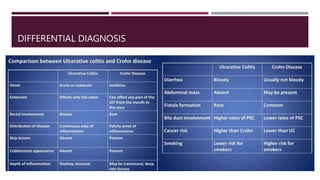
DIFFERENTIAL DIAGNOSIS
DIAGNOSIS
 Physical Examination
 Endoscopy
 Biopsy
 Radiology
 Blood Test
 PHYSICAL EXAMINATION
The main features to look for are: oral aphtosis, abdominal tenderness and masses, anal tags, fissure and
fistulae, nutritional deficiency.
An important feature in children retardation. Is growth
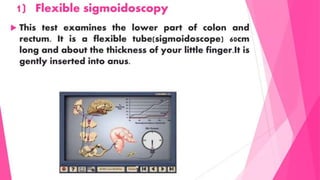
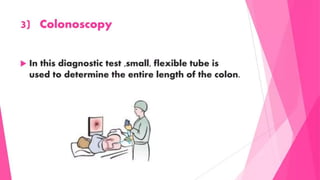
ENDOSCOPY/ COLONOSCOPY/SIGMOIDOSCOPY
Colonoscopy helps to determine the pattern and severity of colonic and terminal ileum inflammation and
allows biopsies to be obtained.
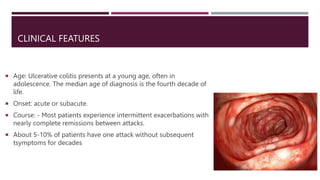
Endoscopic features are aphtous ulcers, deeper ulceration, postinflammatory polyps (which indicate previous
severe inflammation), but always accompanied by intervening normal mucosa, which is an important
differential feature between CD and UC.
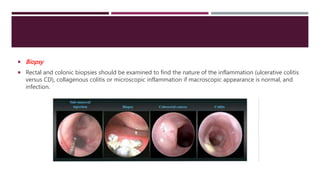
 Biopsy
 Rectal and colonic biopsies should be examined to find the nature of the inflammation (ulcerative colitis
versus CD), collagenous colitis or microscopic inflammation if macroscopic appearance is normal, and
infection.
 Barium enema
 Barium inserted into rectum
 Fluoroscopy used to image bowel
 Rarely used due to colonoscopy
 Useful for identifying colonic strictures or colonic fistulae
Radiology
 Blood test
 Anemia may be present due to blood loss (iron deficiency), chronic
inflammation or B12 malabsorption (macrocytic)
 .Hypoalbuminemia suggests severe disease with denutrition.The best
markers of inflammation severity are elevation of the C-reactive protein
and platelet count.
 Anti-saccharomyces cerevisiae antibodies (ASCA) are positive in 50-
60% of CD patients while anti-neutrophil polynuclear antibodies
(ANCA) are positive in 50-60% of UC patients.
NON PHARMACOLOGICAL TREATMENT
 To avoid smoking cessation
 To reduce alcohol consumption
 To avoid the use of NSAIDs
 To avoid spicy and fried/oily food
 To take fiber rich diet as tolerated that include tender cooked vegetables, canned or cooked fruits,
and starches like cooked cereals and whole wheat noodles and tortillas.
 To incorporate more omega-3 fatty acids in the diet. These fats may have an anti-inflammatory
effect. They are found most probably in fish.
SURGERY FOR ULCERATIVE COLITIS
 Proctocolectomy (removing the colon and rectum) with ileostomy: If UC is severe, surgery may be
required to remove the entire colon and rectum, plus bring the ileum (end of the small intestine) through
a stoma (opening) in the abdominal wall to allow drainage of intestinal waste out of the body. The
second part of the procedure is called ileostomy. After the procedure, an external bag must be worn over
the opening to collect waste.
 Restorative proctocolectomy, also known as ileoanal pouch anal anastomosis (IPAA): It involves
removing the colon and rectum, but the patient can continue to pass stool through the anus in place of
an ileostomy, the ileum is fashioned into a pouch and pulled down and connected to the anus.
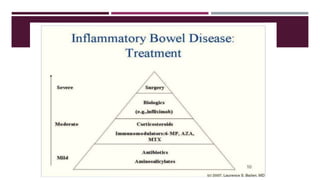
PHARMACOLOGICAL TREATMENT
 The major types of drug therapy used in IBD include
 Aminosalicylates
 Corticosteroids
 Immunosuppressive agents
 TNF-Tumor Necrosis Factor Inhibitor
 Antimicrobials
AMINOSALICYLATES/5-ASA
These agents have anti-inflammatory effects. They are used to maintain remission and to
induce remission of mild flares of disease.
Egs., Sulfasalazine, Mesalamine
Sulfasalazine and mesalamine are used to treat mild to moderate disease and to maintain
remission induced by corticosteroids.
Sulfasalazine is useful for ileocolonic and colonic disease.
CORTICOSTEROIDS
 Corticosteroids (1 mg/kg/day) are effective in decreasing disease activity and inducing
remission in most patients.
 Oral or parenteral corticosteroids are indicated for the treatment of ambulatory patients with
moderate to severe colitis whose symptoms cannot be controlled by aminosalicylates.
 The adverse effects include cosmetic effects, suppression of linear growth in children and
osteopenia.
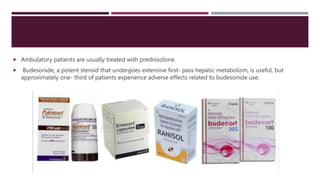
 Egs., Prednisolone, Budenoside
 Ambulatory patients are usually treated with prednisolone.
 Budesonide, a potent steroid that undergoes extensive first- pass hepatic metabolism, is useful, but
approximately one- third of patients experience adverse effects related to budesonide use.
IMMUNE SUPRESSIVE AGENTS
If it is impossible to taper corticosteroids or frequent relapses occur, immunomodulating therapy should be
considered. However, the use of immunomodulators is not approved by the national health insurance
scheme.
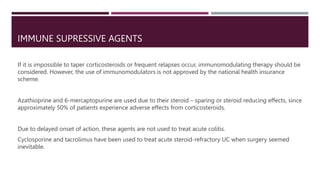
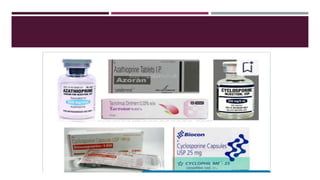
Azathioprine and 6-mercaptopurine are used due to their steroid – sparing or steroid reducing effects, since
approximately 50% of patients experience adverse effects from corticosteroids.
Due to delayed onset of action, these agents are not used to treat acute colitis.
Cyclosporine and tacrolimus have been used to treat acute steroid-refractory UC when surgery seemed
inevitable.
TNF INHIBITORS
Increased production of inflammatory cytokines, especially tumor necrosis factor alpha
(TNF-α), has been described in both normal and inflamed mucosa.
These agents prevent the endogenous cytokine from binding to the cell surface
receptor and exerting biological activity. These agents adversely affect normal immune
responses.
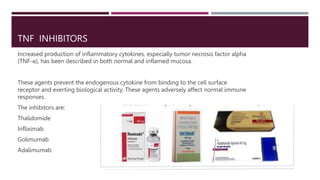
The inhibitors are:
Thalidomide
Infliximab
Golimumab
Adalimumab
ANTI MICROBIAL AGENTS
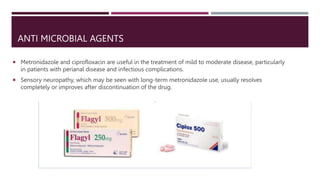
 Metronidazole and ciprofloxacin are useful in the treatment of mild to moderate disease, particularly
in patients with perianal disease and infectious complications.
 Sensory neuropathy, which may be seen with long-term metronidazole use, usually resolves
completely or improves after discontinuation of the drug.
AYURVEDIC MANAGEMENT
 Deepaniya drugs: Pippali, Pippali-moola, Chavya, Chitrak, Shringavera, Amlavetas, Marich, Ajmoda,
Bhallatak asthi, and Hingu niryas.
 Ama pachaka drugs:
 Paneeya – Shunti,, Panchakola, Jeeraka + Dhanyaka
 Kashaya – Amrutottara kashaya, Drakshadi kashaya
 Churna-Taleesadi churna ,Hingvashtaka churna, Ajamodadi churna,
 Vati –Agnitundi vati, Chitrakaadi vati, Sanjeevini vati, Laghumalini vasanta
 Arishta –Amrutaarishta – the best
 Sthambaka drugs:
 Tulasi beeja,Mishri,kutaja,synoka,lodhradi gana etc.
IBD CONCLUSION
 It is a chronic disorders.
 Need to exclude other possibilities
 Need to differentiate between the two
 Need long term management with primary goal to induce then maintain remission and
prevent complications of both the disease and drugs.
IBD and ulcerative colitis for the science

IBD and ulcerative colitis for the science

  • 1.
    IRRITABLE BOWEL SYNDROME &ULCERATIVE COLITIS GUIDED BY: DR. NIBEDITA MAHAPATRA MAAM (HOD DEPT OF KAYA CHIKITSA) DR. KABI CHANDRA SAHU SIR (LECTURER OF KAYA CHIKITSA) PRESENTED BY: ANKITA DASH (4TH PROFESSIONAL BAMS)
  • 19.
  • 20.
    DEFINITION  Inflammatory boweldisease (IBD) represents a group of intestinal disorders that cause prolonged inflammation of the digestive tract.  It is a spectrum of chronic idiopathic inflammatory condition.  It is a condition that can affect any part of the digestive tract and causes inflammation swelling Redness & ulceration.
  • 21.
  • 22.
    ETIOLOGY  Infectious agents Viruses (Measles)  Bacteria (Mycobacteria)  Genetics  Environmental factors  Diet  Smoking  Psychological factors  Stress  Emotional or physical trauma
  • 23.
     Mucosal immuneresponse  • Inflammatory cells  • In IBD, activated CD4+Tcells are present in the lamina propria and in the peripheral blood  • These cells either activate other inflammatory cells like macrophages, and B cells or recruit more inflammatory cells by stimulation of homing receptors on leukocytes and vascular endothelial cells
  • 25.
    PATHOPHYSIOLOGY 1. Inflammatory processusually confined to rectum and sigmoid colon 2. Inflammation leads to mucosal hemorrhages and abscess formation, which leads to necrosis and sloughing of bowel mucosa. 3. Mucosa becomes red, friable, and ulcerated; bleeding is common 4. Chronic inflammation leads to atrophy, narrowing, and shortening of colon.
  • 26.
    PATHOPHYSIOLOGY  Dietary andbacterial antigens penetrate into the intestinal wall and activates the immune system.  This causes increased production of pro- inflammatory mediators which will lead to inflammation of the mucosal layer. ALTERED MUCOSAL IMMUNE RESPONSE
  • 28.
    ULCERATIVE COLITIS  Ulcerativecolitis is an inflammatory bowel disease (IBD).  Ulcerative colitis occurs when the lining of your large intestine (also called the colon), rectum, or both becomes inflamed.  This inflammation produces tiny sores called ulcers on the lining of your colon. It usually begins in the rectum and spreads upward. It can involve your entire colon.  Ulcerative colitis can be debilitating and can sometimes lead to life-threatening complications. While it has no known cure, treatment can greatly reduce signs and symptoms of the disease and bring about long-term remission.
  • 29.
     There isno difference between men and women.  The worldwide incidence is 0.5~24 new cases per 100 000  individuals, and prevalence is 100~200 cases per 100 000.
  • 31.
    ETIOLOGY  The causeof UC remains unclear, although interplay of genetic, microbial, and immunologic factors clearly exists.  A limited number of environmental factors have clearly been proven to either modify the disease or regulate the lifetime risk of developing it.  These include:  Tobacco use. Appendectomy.  Oral contraceptive pills. Antibiotic use.
  • 33.
    SYMPTOMS  Rectal bleedingand tenesmus are universally present.  Diarrhea and abdominal pain are more frequent with proximal colon involvement.  Nausea and weight loss in severe cases.  Severe abdominal pain or fever suggests fulminant colitis or toxic megacolon.
  • 34.
    CLINICAL FEATURES  Age:Ulcerative colitis presents at a young age, often in adolescence. The median age of diagnosis is the fourth decade of life.  Onset: acute or subacute.  Course: - Most patients experience intermittent exacerbations with nearly complete remissions between attacks.  About 5-10% of patients have one attack without subsequent tsymptoms for decades
  • 35.
    SIGN  Pallor maybe evident.  Mild abdominal tenderness most localized in the hypogastrium or left lower quadrant.  PR examination may disclose visible red blood.  Signs of malnutrition.  Severe tenderness, fever, or tachycardia suggests fulminant disease.
  • 37.
    TYPES OF UC Ulcerative proctitis:limited nited to the rectum, diarrhea, bloody stool, pain in the rectal area, and a sense of urgency to empty the bowel.  Proctosigmoiditis: rectum and the sigmoid colon.diarrhea, bloody stool, cramps and pain in the rectal area, and moderate pain on the left side of the abdomen  Left-sided colitis: Left-sided colitis affects the entire left side of the colon, from the rectum to splenic flexure. Diarrhea, bleeding, weight loss, loss of appetite, and sometimes severe pain on the left side of abdomen.  Pancolitis: If the entire colon is affected, the term pancolitis is used (“pan” meaning total).
  • 39.
    COMPLICATIONS  Severe bleeding A hole in the colon (perforated colon)  Severe dehydration  Bone loss (osteoporosis)  Inflammation of the skin, joints and eyes  An increased risk of colon cancer  A rapidly swelling colon (toxic megacolon)  Increased risk of blood clots in veins and arteries
  • 40.
    WHEN DO WESUSPECT INFLAMMATORY BOWEL DISEASE Chronic diarrhoea Rectal bleeding Unexplained weight loss, joint problems & skin problems Family history Children with family history who exhibit any of the above symptoms
  • 41.
  • 42.
    DIAGNOSIS  Physical Examination Endoscopy  Biopsy  Radiology  Blood Test
  • 43.
     PHYSICAL EXAMINATION Themain features to look for are: oral aphtosis, abdominal tenderness and masses, anal tags, fissure and fistulae, nutritional deficiency. An important feature in children retardation. Is growth ENDOSCOPY/ COLONOSCOPY/SIGMOIDOSCOPY Colonoscopy helps to determine the pattern and severity of colonic and terminal ileum inflammation and allows biopsies to be obtained. Endoscopic features are aphtous ulcers, deeper ulceration, postinflammatory polyps (which indicate previous severe inflammation), but always accompanied by intervening normal mucosa, which is an important differential feature between CD and UC.
  • 44.
     Biopsy  Rectaland colonic biopsies should be examined to find the nature of the inflammation (ulcerative colitis versus CD), collagenous colitis or microscopic inflammation if macroscopic appearance is normal, and infection.
  • 45.
     Barium enema Barium inserted into rectum  Fluoroscopy used to image bowel  Rarely used due to colonoscopy  Useful for identifying colonic strictures or colonic fistulae Radiology
  • 46.
     Blood test Anemia may be present due to blood loss (iron deficiency), chronic inflammation or B12 malabsorption (macrocytic)  .Hypoalbuminemia suggests severe disease with denutrition.The best markers of inflammation severity are elevation of the C-reactive protein and platelet count.  Anti-saccharomyces cerevisiae antibodies (ASCA) are positive in 50- 60% of CD patients while anti-neutrophil polynuclear antibodies (ANCA) are positive in 50-60% of UC patients.
  • 47.
    NON PHARMACOLOGICAL TREATMENT To avoid smoking cessation  To reduce alcohol consumption  To avoid the use of NSAIDs  To avoid spicy and fried/oily food  To take fiber rich diet as tolerated that include tender cooked vegetables, canned or cooked fruits, and starches like cooked cereals and whole wheat noodles and tortillas.  To incorporate more omega-3 fatty acids in the diet. These fats may have an anti-inflammatory effect. They are found most probably in fish.
  • 49.
    SURGERY FOR ULCERATIVECOLITIS  Proctocolectomy (removing the colon and rectum) with ileostomy: If UC is severe, surgery may be required to remove the entire colon and rectum, plus bring the ileum (end of the small intestine) through a stoma (opening) in the abdominal wall to allow drainage of intestinal waste out of the body. The second part of the procedure is called ileostomy. After the procedure, an external bag must be worn over the opening to collect waste.  Restorative proctocolectomy, also known as ileoanal pouch anal anastomosis (IPAA): It involves removing the colon and rectum, but the patient can continue to pass stool through the anus in place of an ileostomy, the ileum is fashioned into a pouch and pulled down and connected to the anus.
  • 50.
    PHARMACOLOGICAL TREATMENT  Themajor types of drug therapy used in IBD include  Aminosalicylates  Corticosteroids  Immunosuppressive agents  TNF-Tumor Necrosis Factor Inhibitor  Antimicrobials
  • 51.
    AMINOSALICYLATES/5-ASA These agents haveanti-inflammatory effects. They are used to maintain remission and to induce remission of mild flares of disease. Egs., Sulfasalazine, Mesalamine Sulfasalazine and mesalamine are used to treat mild to moderate disease and to maintain remission induced by corticosteroids. Sulfasalazine is useful for ileocolonic and colonic disease.
  • 52.
    CORTICOSTEROIDS  Corticosteroids (1mg/kg/day) are effective in decreasing disease activity and inducing remission in most patients.  Oral or parenteral corticosteroids are indicated for the treatment of ambulatory patients with moderate to severe colitis whose symptoms cannot be controlled by aminosalicylates.  The adverse effects include cosmetic effects, suppression of linear growth in children and osteopenia.  Egs., Prednisolone, Budenoside
  • 53.
     Ambulatory patientsare usually treated with prednisolone.  Budesonide, a potent steroid that undergoes extensive first- pass hepatic metabolism, is useful, but approximately one- third of patients experience adverse effects related to budesonide use.
  • 54.
    IMMUNE SUPRESSIVE AGENTS Ifit is impossible to taper corticosteroids or frequent relapses occur, immunomodulating therapy should be considered. However, the use of immunomodulators is not approved by the national health insurance scheme. Azathioprine and 6-mercaptopurine are used due to their steroid – sparing or steroid reducing effects, since approximately 50% of patients experience adverse effects from corticosteroids. Due to delayed onset of action, these agents are not used to treat acute colitis. Cyclosporine and tacrolimus have been used to treat acute steroid-refractory UC when surgery seemed inevitable.
  • 56.
    TNF INHIBITORS Increased productionof inflammatory cytokines, especially tumor necrosis factor alpha (TNF-α), has been described in both normal and inflamed mucosa. These agents prevent the endogenous cytokine from binding to the cell surface receptor and exerting biological activity. These agents adversely affect normal immune responses. The inhibitors are: Thalidomide Infliximab Golimumab Adalimumab
  • 57.
    ANTI MICROBIAL AGENTS Metronidazole and ciprofloxacin are useful in the treatment of mild to moderate disease, particularly in patients with perianal disease and infectious complications.  Sensory neuropathy, which may be seen with long-term metronidazole use, usually resolves completely or improves after discontinuation of the drug.
  • 58.
    AYURVEDIC MANAGEMENT  Deepaniyadrugs: Pippali, Pippali-moola, Chavya, Chitrak, Shringavera, Amlavetas, Marich, Ajmoda, Bhallatak asthi, and Hingu niryas.  Ama pachaka drugs:  Paneeya – Shunti,, Panchakola, Jeeraka + Dhanyaka  Kashaya – Amrutottara kashaya, Drakshadi kashaya  Churna-Taleesadi churna ,Hingvashtaka churna, Ajamodadi churna,  Vati –Agnitundi vati, Chitrakaadi vati, Sanjeevini vati, Laghumalini vasanta  Arishta –Amrutaarishta – the best  Sthambaka drugs:  Tulasi beeja,Mishri,kutaja,synoka,lodhradi gana etc.
  • 59.
    IBD CONCLUSION  Itis a chronic disorders.  Need to exclude other possibilities  Need to differentiate between the two  Need long term management with primary goal to induce then maintain remission and prevent complications of both the disease and drugs.