Inflammatory Bowel
Disease
INTRODUCTION
• IBD is an idiopathic disease , probably involving an
immune reaction of the body to its own intestinal tract
• Crohn’s disease (CD)
• Ulcerative colitis (UC)
INTRODUCTION
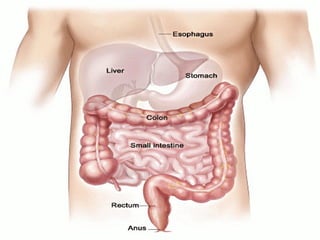
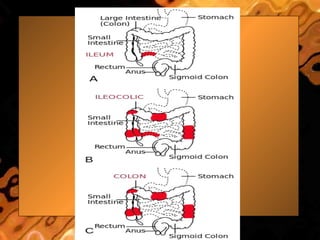
• CD is a condition of chronic granulomatous
inflammation potentially involving any location of the
GIT from mouth to anus.
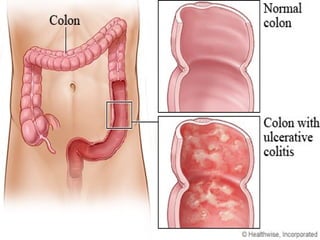
• UC is an non granulomatous inflammatory disorder
that affects the rectum and extends proximally to
affect variable extent of the colon.
EPIDEMIOLOGY
• UC:
15-40 yrs (Young adults)
No variation between between men and women or
between socioeconomic group
High incidence areas: USA and northern-western
Europe
More common in non-smokers
EPIDEMIOLOGY
CD
1st
peak 15-30 years of age, 2nd
peak around 60 y
Marginally more common in females
High incidence areas: North America, UK,northern
Europe
More common in smokers
ETIOLOGY
• Immunology
• Initiating pathogen
• Environmental Factors
• Genetic factors
SYMPTOMS
UC:
• Rectal bleeding or bloody diarrhea
• Pain of colonic origin, often left sided and related to
defecation
CD:
• Diarrhea
• Recurrent abdominal pain
• Anorectal lesions, Anorexia, Anemia
• Malnutrition (weight loss)
• Fever
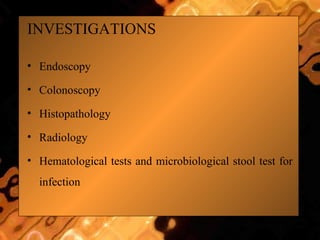
INVESTIGATIONS
• Endoscopy
• Colonoscopy
• Histopathology
• Radiology
• Hematological tests and microbiological stool test for
infection
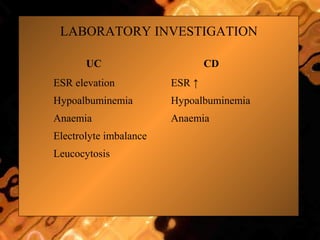
UC CD
ESR elevation
Hypoalbuminemia
Anaemia
Electrolyte imbalance
Leucocytosis
ESR ↑
Hypoalbuminemia
Anaemia
LABORATORY INVESTIGATION
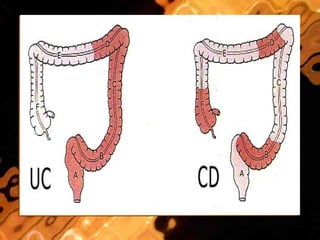
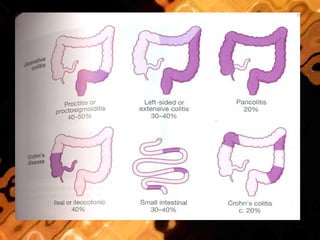
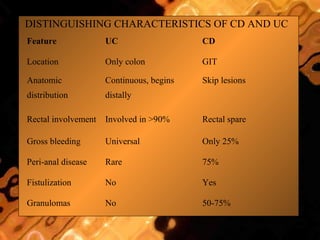
Feature UC CD
Location Only colon GIT
Anatomic
distribution
Continuous, begins
distally
Skip lesions
Rectal involvement Involved in >90% Rectal spare
Gross bleeding Universal Only 25%
Peri-anal disease Rare 75%
Fistulization No Yes
Granulomas No 50-75%
DISTINGUISHING CHARACTERISTICS OF CD AND UC
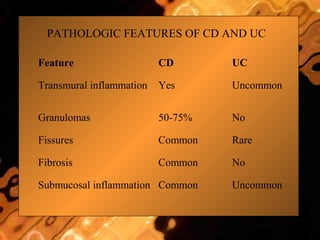
Feature CD UC
Transmural inflammation Yes Uncommon
Granulomas 50-75% No
Fissures Common Rare
Fibrosis Common No
Submucosal inflammation Common Uncommon
PATHOLOGIC FEATURES OF CD AND UC
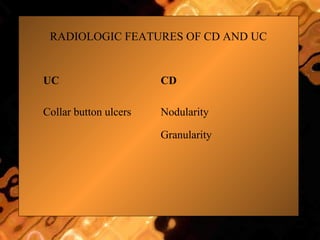
UC CD
Collar button ulcers Nodularity
Granularity
RADIOLOGIC FEATURES OF CD AND UC
PATHOPHYSIOLOGY
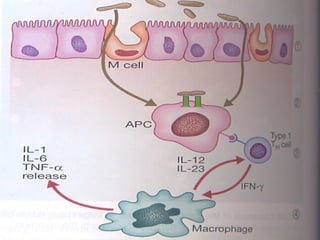
• Bacterial antigens are taken up by specialized M cells, pass
between leaky epithelial cells or enter the lamina propria
through ulcerated mucosa
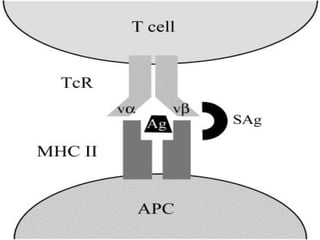
• After processing they are presented on type 1 T-helper cells by
antigen presenting cells (APC) in the lamina propria.
• T-cell activation and differentiation results in Th1 T cell
mediated cytokine response
• With the secretion of cytokines including gamma interferon
(IFN )ƴ
PATHOPHYSIOLOGY
• Further amplification of T cells perpetuates the inflammatory
process with activation of non immune cells and release of the
important cytokines.
• Eg: IL-12, IL-23, IL-1, IL-6 and tumor necrosis factor (TNF)
• These pathways occur in all normal individual exposed to
inflammatory insults and this is self limiting in healthy subjects
• In genetically predisposed persons, dysregulation of innate
immunity may trigger inflammatory bowel disease.
MANAGEMENT OF IBD
Non-pharmacological
• Initial tretment is nonoperative Stop Smoking (for
crohn’s disease)
• Nutrition
PHARMACOLOGICAL
• Aminosalicilates (5-ASA): sulfasalazine, mesalazine,
olsalazine
• Corticosteroids : Budesonide, presnisolone,
methylprednisolone
• Immunosuppressants: azathioprine , 6-mercaptopurine
• Antibiotics : metronidazole, ciprofloxacin
• Anti diarrhoals : loperamide, Diphenoxylate &
atropine
PHARMACOLOGICAL
• Antispasmodic agent: Dicyclomine
• Immunoglobulin - İnfliximab
• Miscellaneous( Total or supplementary parenteral
nutrition, fish oils, sodium cromoglycate, lidocaine,
nicotine trans dermally)
• Surgical management

INFLAMMATORY BOWEL DISEASE

  • 1.
  • 2.
    INTRODUCTION • IBD isan idiopathic disease , probably involving an immune reaction of the body to its own intestinal tract • Crohn’s disease (CD) • Ulcerative colitis (UC)
  • 3.
    INTRODUCTION • CD isa condition of chronic granulomatous inflammation potentially involving any location of the GIT from mouth to anus. • UC is an non granulomatous inflammatory disorder that affects the rectum and extends proximally to affect variable extent of the colon.
  • 8.
    EPIDEMIOLOGY • UC: 15-40 yrs(Young adults) No variation between between men and women or between socioeconomic group High incidence areas: USA and northern-western Europe More common in non-smokers
  • 9.
    EPIDEMIOLOGY CD 1st peak 15-30 yearsof age, 2nd peak around 60 y Marginally more common in females High incidence areas: North America, UK,northern Europe More common in smokers
  • 10.
    ETIOLOGY • Immunology • Initiatingpathogen • Environmental Factors • Genetic factors
  • 11.
    SYMPTOMS UC: • Rectal bleedingor bloody diarrhea • Pain of colonic origin, often left sided and related to defecation CD: • Diarrhea • Recurrent abdominal pain • Anorectal lesions, Anorexia, Anemia • Malnutrition (weight loss) • Fever
  • 13.
    INVESTIGATIONS • Endoscopy • Colonoscopy •Histopathology • Radiology • Hematological tests and microbiological stool test for infection
  • 14.
    UC CD ESR elevation Hypoalbuminemia Anaemia Electrolyteimbalance Leucocytosis ESR ↑ Hypoalbuminemia Anaemia LABORATORY INVESTIGATION
  • 15.
    Feature UC CD LocationOnly colon GIT Anatomic distribution Continuous, begins distally Skip lesions Rectal involvement Involved in >90% Rectal spare Gross bleeding Universal Only 25% Peri-anal disease Rare 75% Fistulization No Yes Granulomas No 50-75% DISTINGUISHING CHARACTERISTICS OF CD AND UC
  • 16.
    Feature CD UC Transmuralinflammation Yes Uncommon Granulomas 50-75% No Fissures Common Rare Fibrosis Common No Submucosal inflammation Common Uncommon PATHOLOGIC FEATURES OF CD AND UC
  • 17.
    UC CD Collar buttonulcers Nodularity Granularity RADIOLOGIC FEATURES OF CD AND UC
  • 18.
    PATHOPHYSIOLOGY • Bacterial antigensare taken up by specialized M cells, pass between leaky epithelial cells or enter the lamina propria through ulcerated mucosa • After processing they are presented on type 1 T-helper cells by antigen presenting cells (APC) in the lamina propria. • T-cell activation and differentiation results in Th1 T cell mediated cytokine response • With the secretion of cytokines including gamma interferon (IFN )ƴ
  • 21.
    PATHOPHYSIOLOGY • Further amplificationof T cells perpetuates the inflammatory process with activation of non immune cells and release of the important cytokines. • Eg: IL-12, IL-23, IL-1, IL-6 and tumor necrosis factor (TNF) • These pathways occur in all normal individual exposed to inflammatory insults and this is self limiting in healthy subjects • In genetically predisposed persons, dysregulation of innate immunity may trigger inflammatory bowel disease.
  • 22.
    MANAGEMENT OF IBD Non-pharmacological •Initial tretment is nonoperative Stop Smoking (for crohn’s disease) • Nutrition
  • 23.
    PHARMACOLOGICAL • Aminosalicilates (5-ASA):sulfasalazine, mesalazine, olsalazine • Corticosteroids : Budesonide, presnisolone, methylprednisolone • Immunosuppressants: azathioprine , 6-mercaptopurine • Antibiotics : metronidazole, ciprofloxacin • Anti diarrhoals : loperamide, Diphenoxylate & atropine
  • 24.
    PHARMACOLOGICAL • Antispasmodic agent:Dicyclomine • Immunoglobulin - İnfliximab • Miscellaneous( Total or supplementary parenteral nutrition, fish oils, sodium cromoglycate, lidocaine, nicotine trans dermally) • Surgical management