Chronic Pancreatitis
Abdullatiff Sami A-Rashed
Block 4.1 (GIT Week)
College of Medicine, King Faisal University
Al-Ahsa, Saudi Arabia
Definition
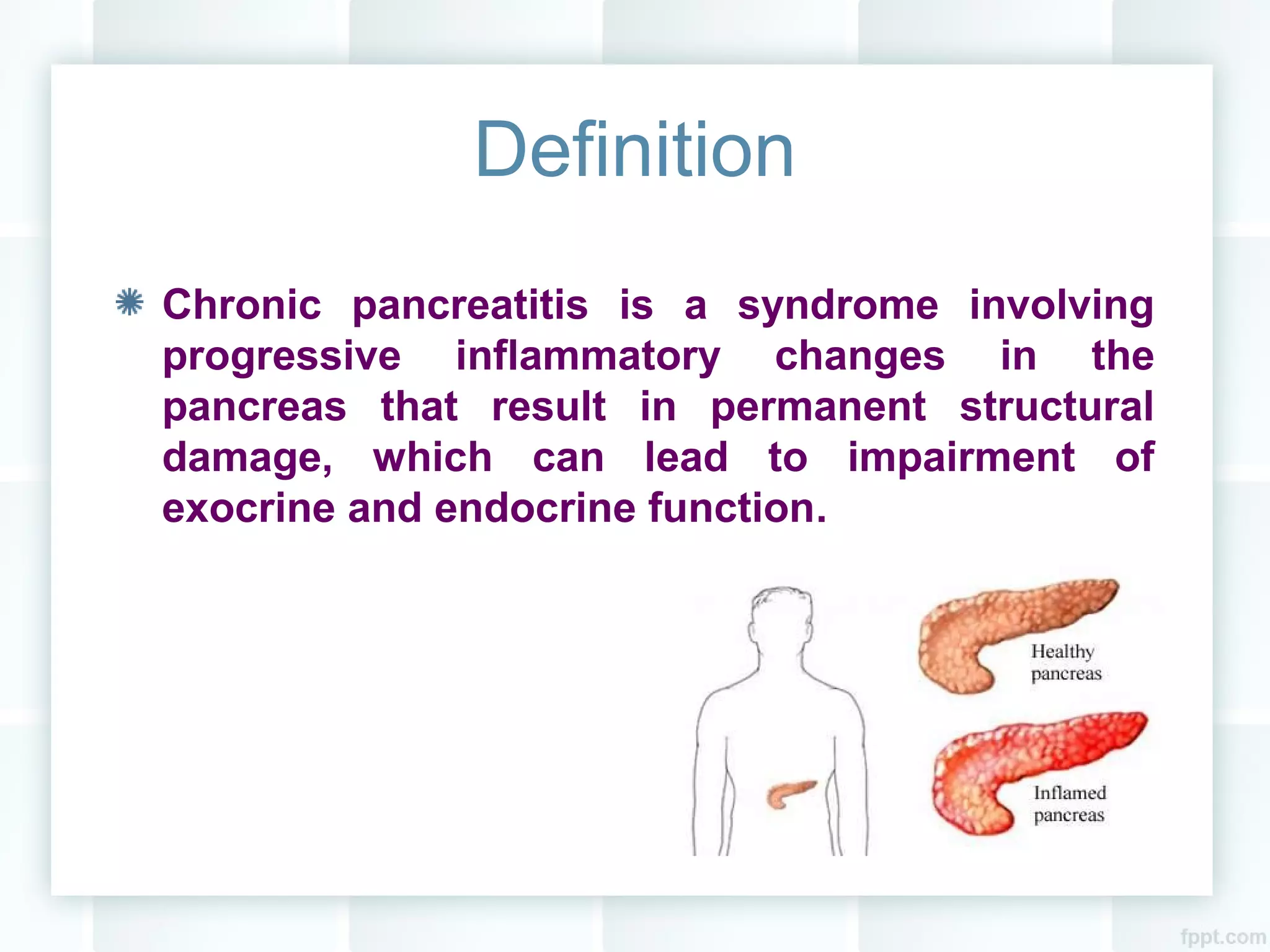
Chronic pancreatitis is a syndrome involving
progressive inflammatory changes in the
pancreas that result in permanent structural
damage, which can lead to impairment of
exocrine and endocrine function.
Etiology
Clinical Manifestations
The two primary clinical manifestations
of chronic pancreatitis are:
&
Clinical Manifestations
• The pain is typically epigastric,
often radiates to the back.
• Occasionally associated with
nausea and vomiting, anorexia
and weight loss
• May be partially relieved by sitting
upright or leaning forward.
• The pain is often worse 15 to 30
minutes after eating.
• In addition, although abdominal
pain is the most consistent
finding in patients with chronic
pancreatitis, it may be absent in
some cases.
ABDOMINAL PAIN
Clinical Manifestations
• Patients with severe pancreatic
exocrine dysfunction cannot properly
digest complex foods or absorb
partially digested breakdown
products.
• Nevertheless, clinically significant
protein and fat deficiencies do not
occur until over 90 percent of
pancreatic function is lost
PANCREATIC
INSUFFICIENCY
Clinical Manifestations
• The clinical manifestations of fat
malabsorption include loose, greasy,
foul smelling stools that are difficult
to flush.
• Malabsorption of the fat soluble
vitamins (A, D, E, K) and vitamin
B12 may also occur, although
clinically symptomatic vitamin
deficiency is rare.
FAT MALABSORPTION
steatorrhea
Clinical Manifestations
• Glucose intolerance occurs with
some frequency in chronic
pancreatitis, but overt diabetes
mellitus usually occurs late in the
course of disease.
• Diabetes which develops in patients
with chronic pancreatitis is usually
insulin requiring.
PANCREATIC DIABETES
Diagnosis
History
Physical Examination
In most cases, the standard physical examination does not
help to establish a diagnosis of chronic pancreatitis; however, a
few points are noteworthy:
1. Epigastric tenderness during acute exacerbations.
2. In advanced cases, there may be an abdominal mass from a
pseudocyst or pancreatic cancer, or splenomegaly from splenic
vein thrombosis.
3. Patients with advanced disease (ie, patients with steatorrhea)
exhibit decreased subcutaneous fat, temporal wasting, sunken
supraclavicular fossa, and other physical signs of malnutrition.
Investigations
Serum Amylase and
Lipase
Levels may be elevated
Fecal Elastase
Level will be abnormal in
most cases
CBC, Electrolytes, and
LFT
Normal
A 72-hour Quantitative
Fecal Fat Determination
Gold standard for mal-
absorption diagnosis
Autoimmune Markers
ESR, IgG4, rheumatoid
factor, ANA, and anti-
smooth muscle antibody
titer.
Gene Mutation Studies
In selected cases in
whom the etiology is
uncertain
Investigations
Trans-abdominal
ultrasound
For initial assessment
Contract CT
shows calcifications, ductal
dilatation, enlargement of
the pancreas, and fluid
collections (eg,
pseudocysts) adjacent to
the gland
MRCP
Gold standard for
diagnosis of pancreatitis
Diagnostic ERCP
Has been replaced by
MRCP
Endoscopic ultrasound
If the diagnosis remains
unclear after other imaging
tests
Differential Diagnosis
Pancreatic malignancy.
Autoimmune pancreatitis.
Lymphoma.
Pancreatic endocrine tumors.
Acute pancreatitis may also be difficult to
distinguish from chronic pancreatitis in some
patients.
Complications
Treatment
General treatment lines:
References
Chronic Pancreatitis

Chronic Pancreatitis

  • 1.
    Chronic Pancreatitis Abdullatiff SamiA-Rashed Block 4.1 (GIT Week) College of Medicine, King Faisal University Al-Ahsa, Saudi Arabia
  • 2.
    Definition Chronic pancreatitis isa syndrome involving progressive inflammatory changes in the pancreas that result in permanent structural damage, which can lead to impairment of exocrine and endocrine function.
  • 3.
  • 4.
    Clinical Manifestations The twoprimary clinical manifestations of chronic pancreatitis are: &
  • 5.
    Clinical Manifestations • Thepain is typically epigastric, often radiates to the back. • Occasionally associated with nausea and vomiting, anorexia and weight loss • May be partially relieved by sitting upright or leaning forward. • The pain is often worse 15 to 30 minutes after eating. • In addition, although abdominal pain is the most consistent finding in patients with chronic pancreatitis, it may be absent in some cases. ABDOMINAL PAIN
  • 6.
    Clinical Manifestations • Patientswith severe pancreatic exocrine dysfunction cannot properly digest complex foods or absorb partially digested breakdown products. • Nevertheless, clinically significant protein and fat deficiencies do not occur until over 90 percent of pancreatic function is lost PANCREATIC INSUFFICIENCY
  • 7.
    Clinical Manifestations • Theclinical manifestations of fat malabsorption include loose, greasy, foul smelling stools that are difficult to flush. • Malabsorption of the fat soluble vitamins (A, D, E, K) and vitamin B12 may also occur, although clinically symptomatic vitamin deficiency is rare. FAT MALABSORPTION steatorrhea
  • 8.
    Clinical Manifestations • Glucoseintolerance occurs with some frequency in chronic pancreatitis, but overt diabetes mellitus usually occurs late in the course of disease. • Diabetes which develops in patients with chronic pancreatitis is usually insulin requiring. PANCREATIC DIABETES
  • 9.
  • 10.
  • 11.
    Physical Examination In mostcases, the standard physical examination does not help to establish a diagnosis of chronic pancreatitis; however, a few points are noteworthy: 1. Epigastric tenderness during acute exacerbations. 2. In advanced cases, there may be an abdominal mass from a pseudocyst or pancreatic cancer, or splenomegaly from splenic vein thrombosis. 3. Patients with advanced disease (ie, patients with steatorrhea) exhibit decreased subcutaneous fat, temporal wasting, sunken supraclavicular fossa, and other physical signs of malnutrition.
  • 12.
    Investigations Serum Amylase and Lipase Levelsmay be elevated Fecal Elastase Level will be abnormal in most cases CBC, Electrolytes, and LFT Normal A 72-hour Quantitative Fecal Fat Determination Gold standard for mal- absorption diagnosis Autoimmune Markers ESR, IgG4, rheumatoid factor, ANA, and anti- smooth muscle antibody titer. Gene Mutation Studies In selected cases in whom the etiology is uncertain
  • 13.
    Investigations Trans-abdominal ultrasound For initial assessment ContractCT shows calcifications, ductal dilatation, enlargement of the pancreas, and fluid collections (eg, pseudocysts) adjacent to the gland MRCP Gold standard for diagnosis of pancreatitis Diagnostic ERCP Has been replaced by MRCP Endoscopic ultrasound If the diagnosis remains unclear after other imaging tests
  • 14.
    Differential Diagnosis Pancreatic malignancy. Autoimmunepancreatitis. Lymphoma. Pancreatic endocrine tumors. Acute pancreatitis may also be difficult to distinguish from chronic pancreatitis in some patients.
  • 15.
  • 16.
  • 17.

Editor's Notes

  • #4 The majority of cases of chronic pancreatitis are due to the following disorders: Alcohol abuse Genetic causes (mutations in the cystic fibrosis gene, hereditary pancreatitis ciliac disease) Ductal obstruction (eg, trauma, pseudocysts, stones, tumors, possibly pancreas divisum) Tropical pancreatitis Systemic disease such as systemic lupus erythematosus, hypertriglyceridemia, possibly hyperparathyroidism Autoimmune pancreatitis Idiopathic pancreatitis