MARK4210, 2014 Spring, L1/L2
[Class #3]
Quantitative Analysis in
Marketing
MARK4210: Strategic Marketing
2014 Spring, Section L1/L2
2
MARK4210, 2014 Spring, L1/L2
Agenda
 Basic Terminology and Analysis
 Exercise
3
MARK4210, 2014 Spring, L1/L2
The Importance of Quantitative Analysis
 Marketing Strategy = Science + Art
• Quantitative analysis forms the scientific aspect
• But you need good judgment to make the final decision
(that’s the art!)
 Quantitative analysis is instrumental in making
marketing decisions
• Quantify marketing mix variables
• Provide profit implications of different strategies
• Convincing yourself & management – “how do you make
money”
4
MARK4210, 2014 Spring, L1/L2
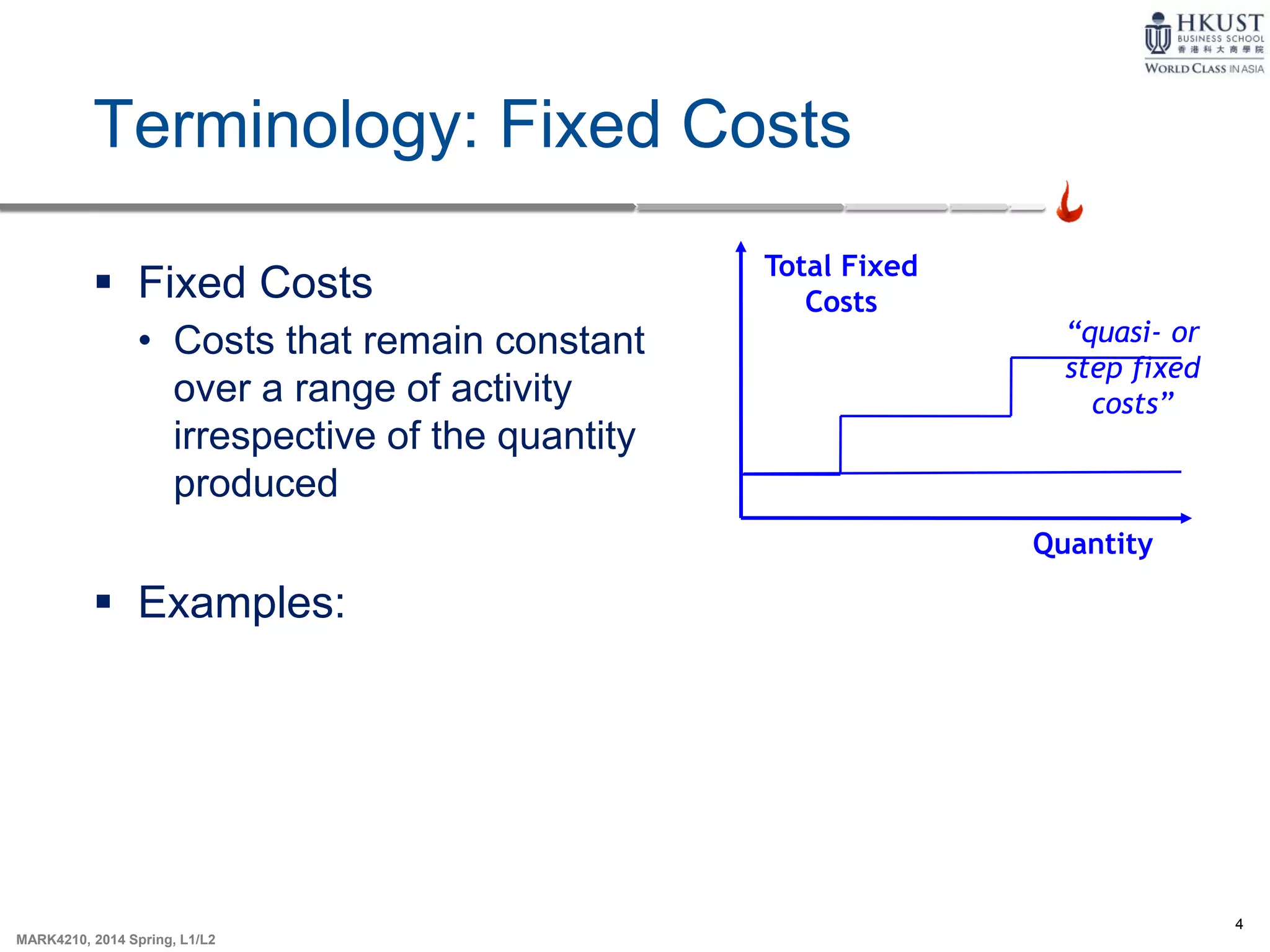
Terminology: Fixed Costs
 Fixed Costs
• Costs that remain constant
over a range of activity
irrespective of the quantity
produced
 Examples:
Total Fixed
Costs
Quantity
“quasi- or
step fixed
costs”
5
MARK4210, 2014 Spring, L1/L2
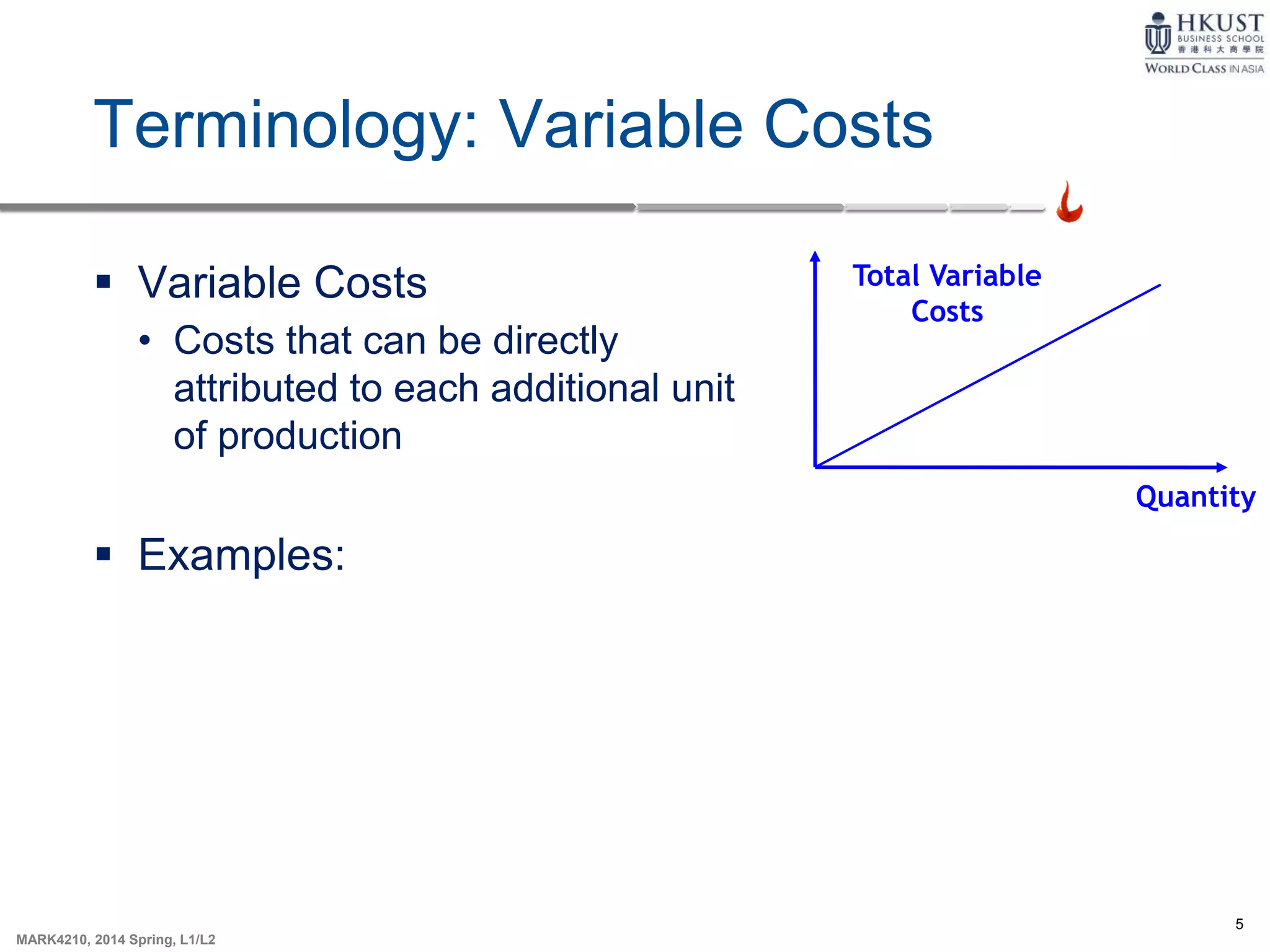
Terminology: Variable Costs
 Variable Costs
• Costs that can be directly
attributed to each additional unit
of production
 Examples:
Quantity
Total Variable
Costs
6
MARK4210, 2014 Spring, L1/L2
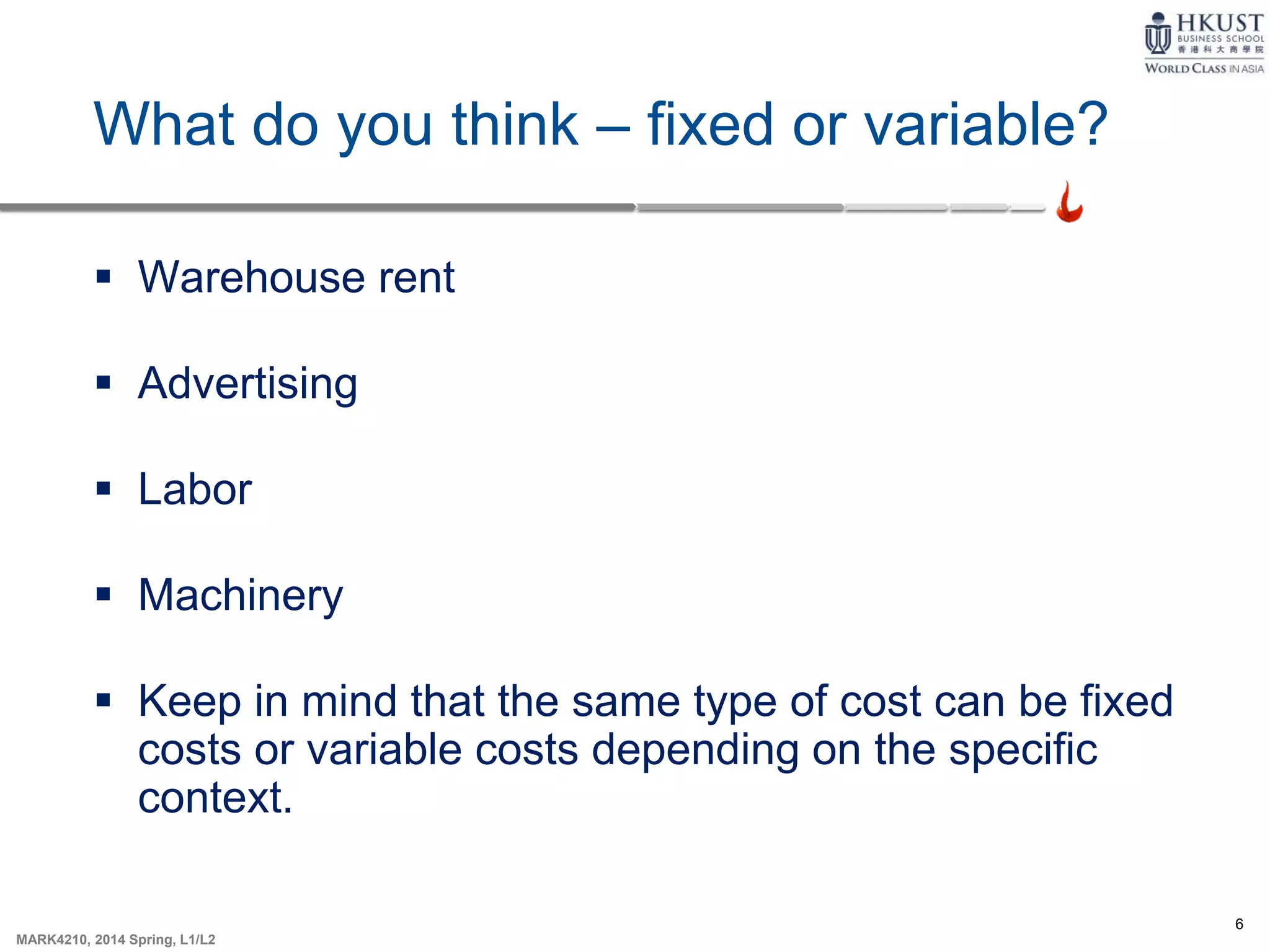
What do you think – fixed or variable?
 Warehouse rent
 Advertising
 Labor
 Machinery
 Keep in mind that the same type of cost can be fixed
costs or variable costs depending on the specific
context.
7
MARK4210, 2014 Spring, L1/L2
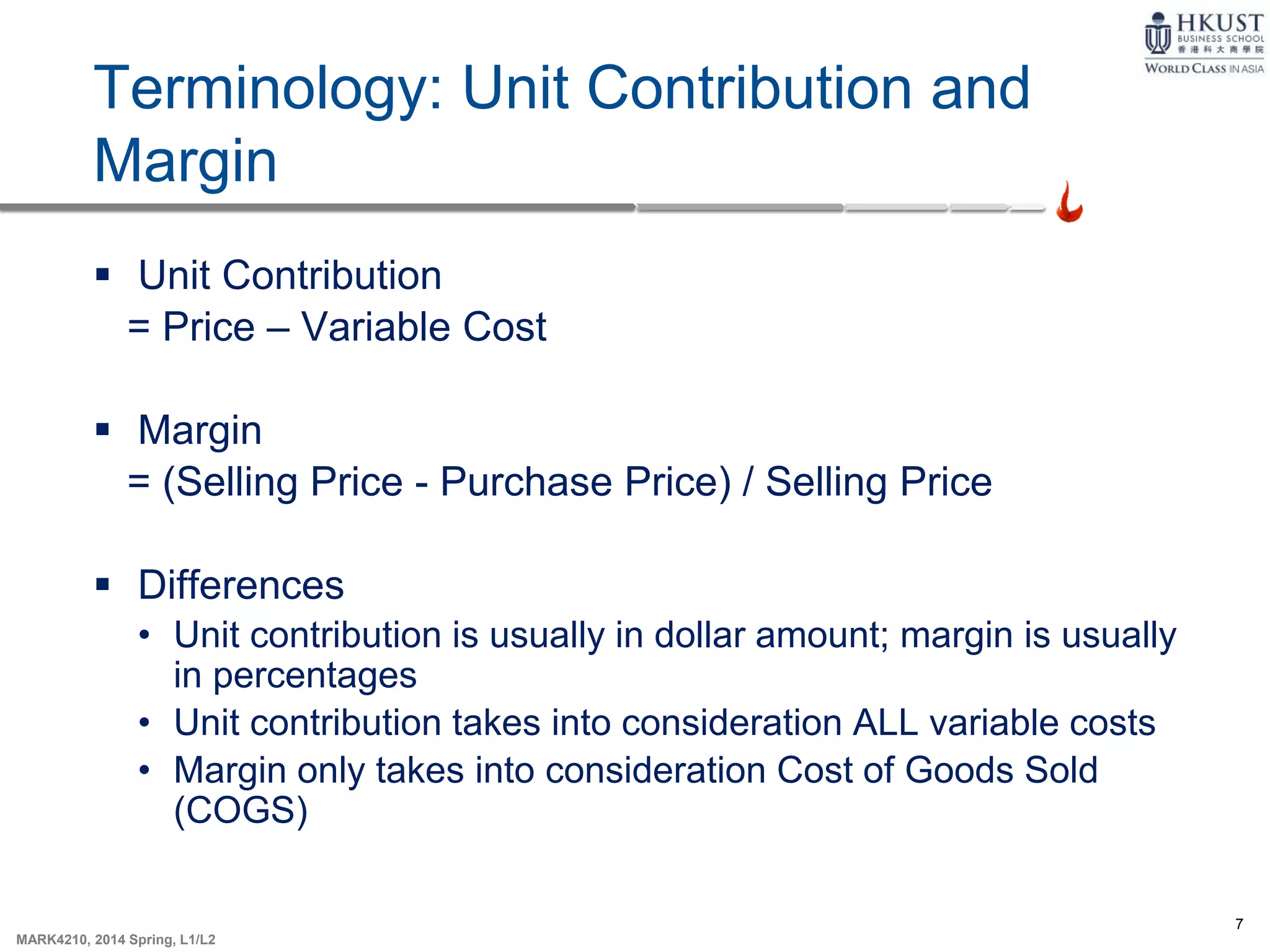
Terminology: Unit Contribution and
Margin
 Unit Contribution
= Price – Variable Cost
 Margin
= (Selling Price - Purchase Price) / Selling Price
 Differences
• Unit contribution is usually in dollar amount; margin is usually
in percentages
• Unit contribution takes into consideration ALL variable costs
• Margin only takes into consideration Cost of Goods Sold
(COGS)
8
MARK4210, 2014 Spring, L1/L2
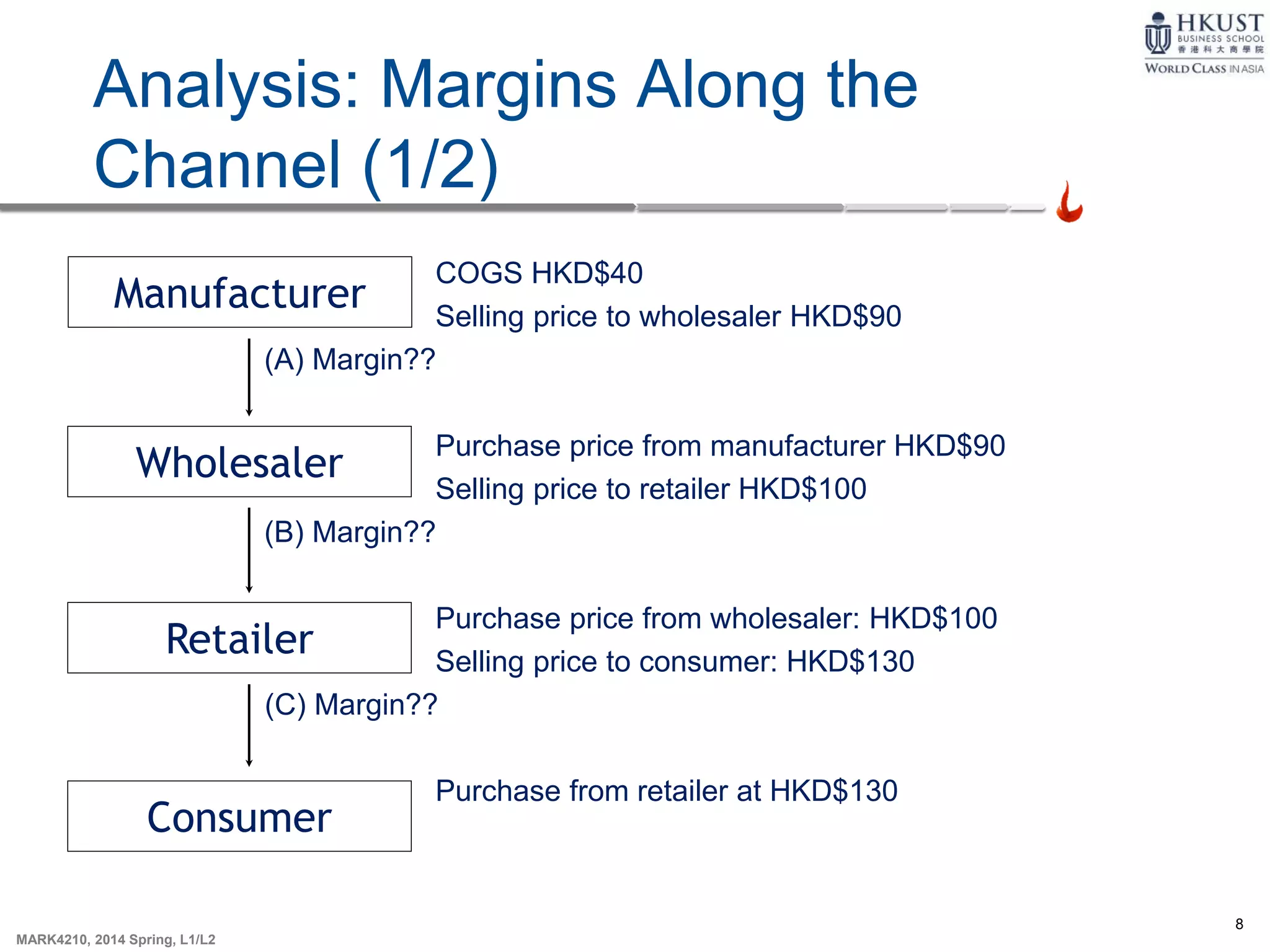
Analysis: Margins Along the
Channel (1/2)
COGS HKD$40
Selling price to wholesaler HKD$90
(A) Margin??
Purchase price from manufacturer HKD$90
Selling price to retailer HKD$100
(B) Margin??
Purchase price from wholesaler: HKD$100
Selling price to consumer: HKD$130
(C) Margin??
Purchase from retailer at HKD$130
Retailer
Wholesaler
Manufacturer
Consumer
9
MARK4210, 2014 Spring, L1/L2
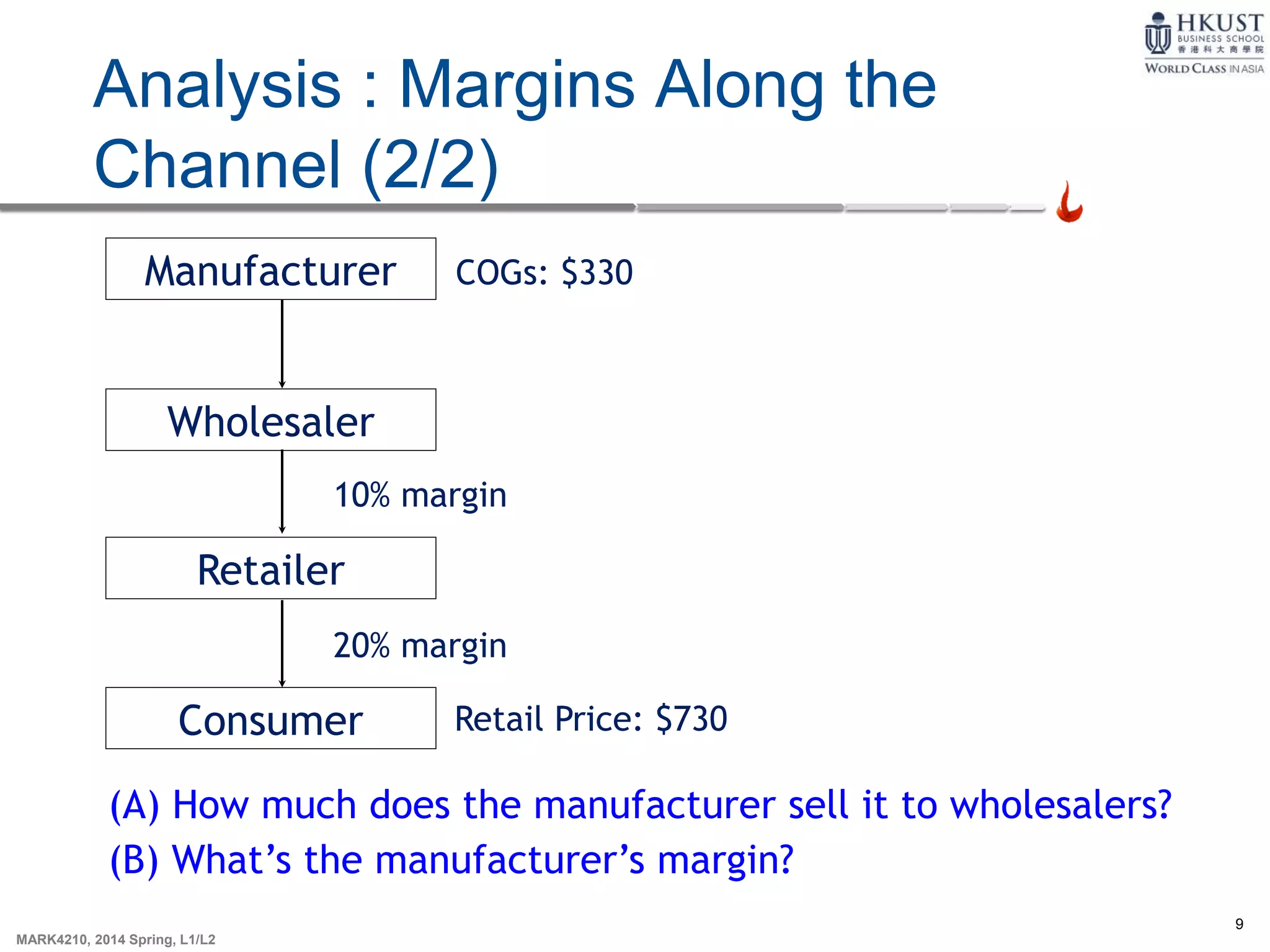
Retailer
Wholesaler
Manufacturer
Consumer Retail Price: $730
(A) How much does the manufacturer sell it to wholesalers?
(B) What’s the manufacturer’s margin?
Analysis : Margins Along the
Channel (2/2)
COGs: $330
10% margin
20% margin
10
MARK4210, 2014 Spring, L1/L2
Break-Even Analysis
 Break-even point is the point of production at which:
Total Revenue = Total Cost
 Break-even volume (BEV) is the volume required to
recover total cost
 BEV = ???
11
MARK4210, 2014 Spring, L1/L2
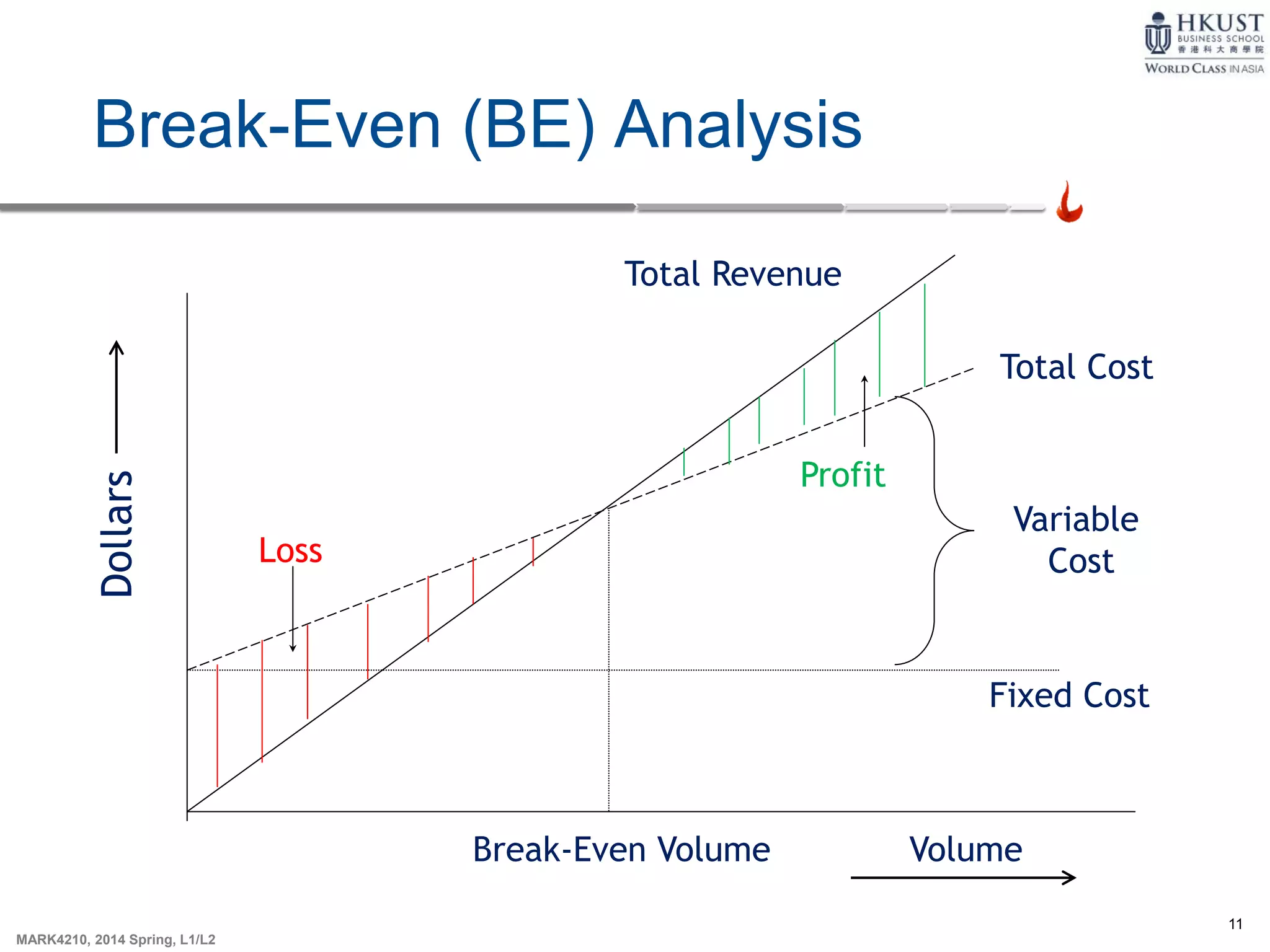
Break-Even (BE) Analysis
Volume
Dollars
Break-Even Volume
Total Revenue
Total Cost
Fixed Cost
Loss
Profit
Variable
Cost
12
MARK4210, 2014 Spring, L1/L2
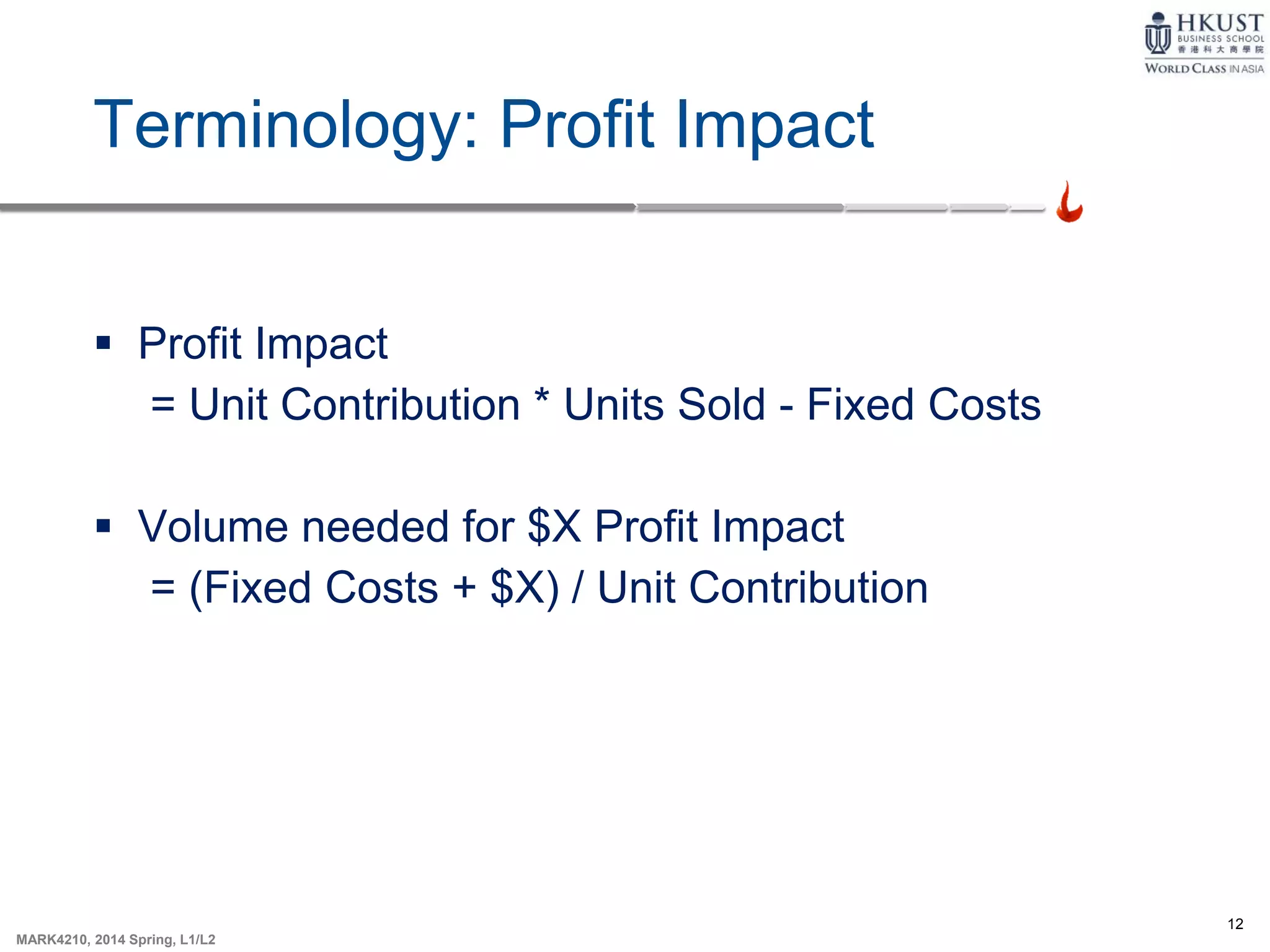
Terminology: Profit Impact
 Profit Impact
= Unit Contribution * Units Sold - Fixed Costs
 Volume needed for $X Profit Impact
= (Fixed Costs + $X) / Unit Contribution
13
MARK4210, 2014 Spring, L1/L2
Break-Even (BE) Market Share Analysis
 Represent BEV as a share of the market
 Why do we do market share analysis???
 How to assess whether it is feasible or not???
MARK4210, 2014 Spring, L1/L2
Class Exercise
Note on Marketing Arithmetic and Related
Marketing Terms
15
MARK4210, 2014 Spring, L1/L2
Exercise
 Horatio Alger has just become product manager for Brand
X. Brand X is a consumer product with a retail price of
$1.00. Retail margins on the product are 33%, while
wholesalers take a 12% margin.
 Brand X and its direct competitors sell a total of 20 million
units annually; Brand X has 24% of this market.
 Variable manufacturing costs for Brand X are $0.09 per
unit. Fixed manufacturing costs are $900,000.
 The advertising budget for Brand X is $500,000. The Brand
X product manager’s salary and expenses total $35,000.
Salespeople are paid entirely by a 10% commission.
Shipping costs, breakage, insurance, and so forth are
$0.02 per unit.
16
MARK4210, 2014 Spring, L1/L2
1. What is the unit contribution for
brand X?
17
MARK4210, 2014 Spring, L1/L2
2. What is Brand X’s break-even
point?
18
MARK4210, 2014 Spring, L1/L2
3. What market share does Brand X
need to break even?
19
MARK4210, 2014 Spring, L1/L2
4. What is Brand X’s profit impact?
20
MARK4210, 2014 Spring, L1/L2
5. Industry demand increase to 23 M; advertising
budget to $1M: (a) If ad budget raised, what is new
Brand X breakeven units?
21
MARK4210, 2014 Spring, L1/L2
5. Industry demand increase to 23 M; advertising
budget to $1M: (b) Brand X units to sell to achieve the
same profit impact?
22
MARK4210, 2014 Spring, L1/L2
5. Industry demand increase to 23 M; advertising
budget to $1M: (c) Brand X’s market share needed to
maintain profit impact?
23
MARK4210, 2014 Spring, L1/L2
5. Industry demand increase to 23 M; advertising
budget to $1M: (d) Brand X’s market share needed for
$1M profit impact?
24
MARK4210, 2014 Spring, L1/L2
6. Retailer margins to 40%, by lower price to retailers
while Wholesaler margins remain 12%: (a) If retailer
margins at 40%, what is Brand X breakeven?
25
MARK4210, 2014 Spring, L1/L2
6. Retailer margins to 40%, by lower price to retailers
while Wholesaler margins remain 12%: (b) Brand X
units to maintain profit impact?
26
MARK4210, 2014 Spring, L1/L2
6. Retailer margins to 40%, by lower price to retailers
while Wholesaler margins remain 12%: (c) Brand X’s
market share to maintain profit impact?
27
MARK4210, 2014 Spring, L1/L2
6. Retailer margins to 40%, by lower price to retailers
while Wholesaler margins remain 12%: (d) Brand X’s
share to generate profit impact of $350,000?
28
MARK4210, 2014 Spring, L1/L2
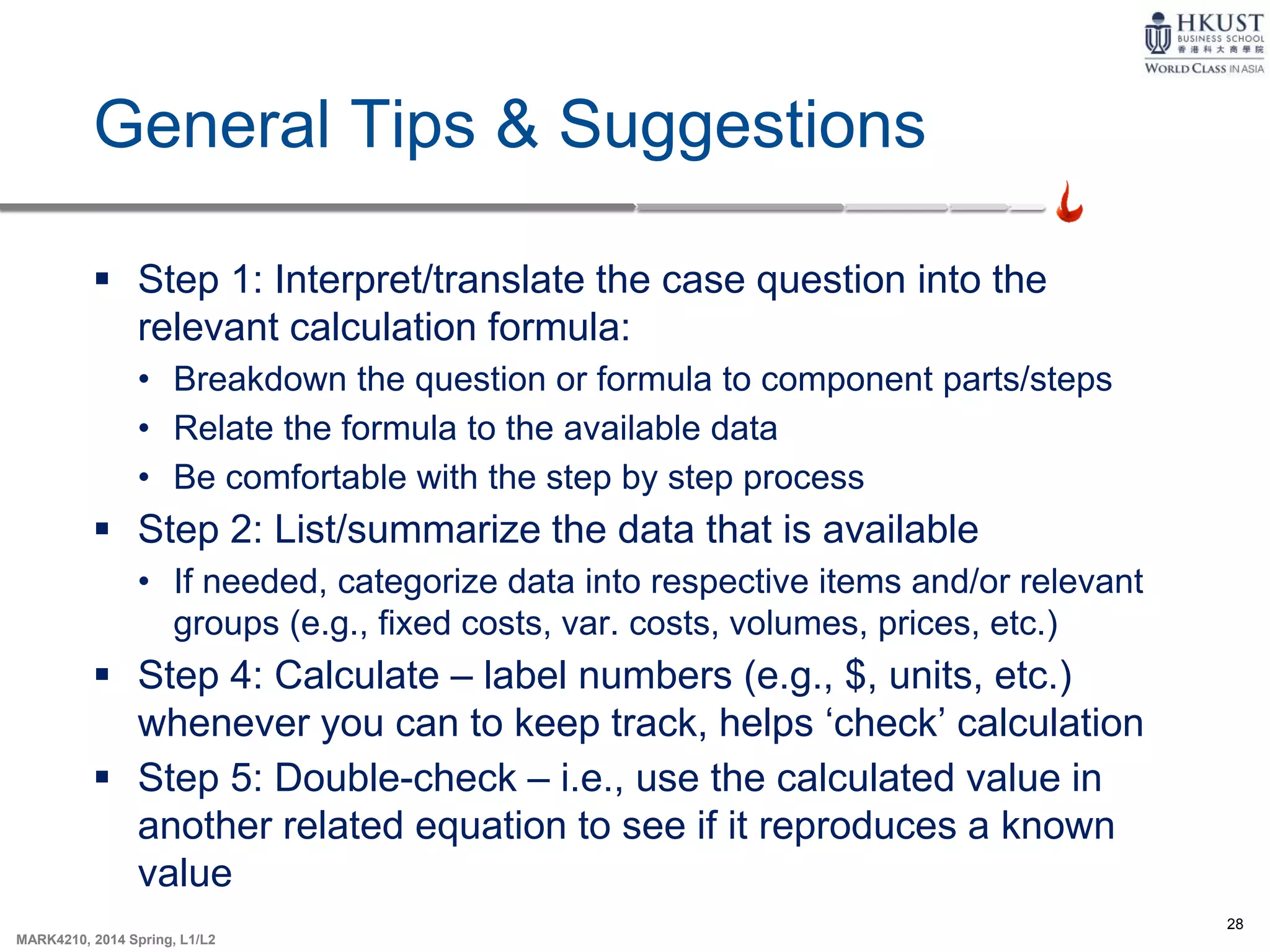
General Tips & Suggestions
 Step 1: Interpret/translate the case question into the
relevant calculation formula:
• Breakdown the question or formula to component parts/steps
• Relate the formula to the available data
• Be comfortable with the step by step process
 Step 2: List/summarize the data that is available
• If needed, categorize data into respective items and/or relevant
groups (e.g., fixed costs, var. costs, volumes, prices, etc.)
 Step 4: Calculate – label numbers (e.g., $, units, etc.)
whenever you can to keep track, helps ‘check’ calculation
 Step 5: Double-check – i.e., use the calculated value in
another related equation to see if it reproduces a known
value
29
MARK4210, 2014 Spring, L1/L2
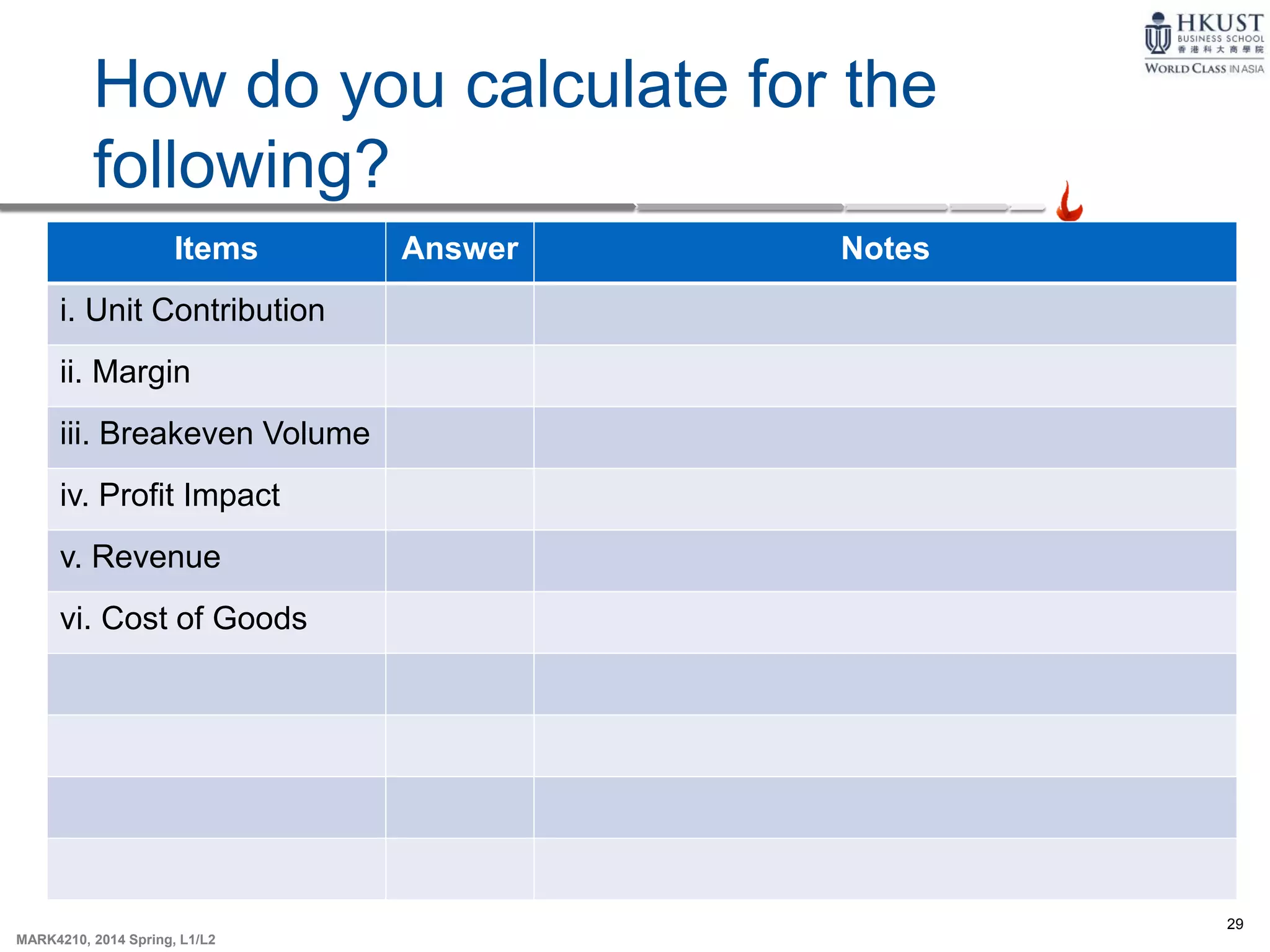
How do you calculate for the
following?
Items Answer Notes
i. Unit Contribution
ii. Margin
iii. Breakeven Volume
iv. Profit Impact
v. Revenue
vi. Cost of Goods

quantitative analysis(4210)

  • 1.
    MARK4210, 2014 Spring,L1/L2 [Class #3] Quantitative Analysis in Marketing MARK4210: Strategic Marketing 2014 Spring, Section L1/L2
  • 2.
    2 MARK4210, 2014 Spring,L1/L2 Agenda  Basic Terminology and Analysis  Exercise
  • 3.
    3 MARK4210, 2014 Spring,L1/L2 The Importance of Quantitative Analysis  Marketing Strategy = Science + Art • Quantitative analysis forms the scientific aspect • But you need good judgment to make the final decision (that’s the art!)  Quantitative analysis is instrumental in making marketing decisions • Quantify marketing mix variables • Provide profit implications of different strategies • Convincing yourself & management – “how do you make money”
  • 4.
    4 MARK4210, 2014 Spring,L1/L2 Terminology: Fixed Costs  Fixed Costs • Costs that remain constant over a range of activity irrespective of the quantity produced  Examples: Total Fixed Costs Quantity “quasi- or step fixed costs”
  • 5.
    5 MARK4210, 2014 Spring,L1/L2 Terminology: Variable Costs  Variable Costs • Costs that can be directly attributed to each additional unit of production  Examples: Quantity Total Variable Costs
  • 6.
    6 MARK4210, 2014 Spring,L1/L2 What do you think – fixed or variable?  Warehouse rent  Advertising  Labor  Machinery  Keep in mind that the same type of cost can be fixed costs or variable costs depending on the specific context.
  • 7.
    7 MARK4210, 2014 Spring,L1/L2 Terminology: Unit Contribution and Margin  Unit Contribution = Price – Variable Cost  Margin = (Selling Price - Purchase Price) / Selling Price  Differences • Unit contribution is usually in dollar amount; margin is usually in percentages • Unit contribution takes into consideration ALL variable costs • Margin only takes into consideration Cost of Goods Sold (COGS)
  • 8.
    8 MARK4210, 2014 Spring,L1/L2 Analysis: Margins Along the Channel (1/2) COGS HKD$40 Selling price to wholesaler HKD$90 (A) Margin?? Purchase price from manufacturer HKD$90 Selling price to retailer HKD$100 (B) Margin?? Purchase price from wholesaler: HKD$100 Selling price to consumer: HKD$130 (C) Margin?? Purchase from retailer at HKD$130 Retailer Wholesaler Manufacturer Consumer
  • 9.
    9 MARK4210, 2014 Spring,L1/L2 Retailer Wholesaler Manufacturer Consumer Retail Price: $730 (A) How much does the manufacturer sell it to wholesalers? (B) What’s the manufacturer’s margin? Analysis : Margins Along the Channel (2/2) COGs: $330 10% margin 20% margin
  • 10.
    10 MARK4210, 2014 Spring,L1/L2 Break-Even Analysis  Break-even point is the point of production at which: Total Revenue = Total Cost  Break-even volume (BEV) is the volume required to recover total cost  BEV = ???
  • 11.
    11 MARK4210, 2014 Spring,L1/L2 Break-Even (BE) Analysis Volume Dollars Break-Even Volume Total Revenue Total Cost Fixed Cost Loss Profit Variable Cost
  • 12.
    12 MARK4210, 2014 Spring,L1/L2 Terminology: Profit Impact  Profit Impact = Unit Contribution * Units Sold - Fixed Costs  Volume needed for $X Profit Impact = (Fixed Costs + $X) / Unit Contribution
  • 13.
    13 MARK4210, 2014 Spring,L1/L2 Break-Even (BE) Market Share Analysis  Represent BEV as a share of the market  Why do we do market share analysis???  How to assess whether it is feasible or not???
  • 14.
    MARK4210, 2014 Spring,L1/L2 Class Exercise Note on Marketing Arithmetic and Related Marketing Terms
  • 15.
    15 MARK4210, 2014 Spring,L1/L2 Exercise  Horatio Alger has just become product manager for Brand X. Brand X is a consumer product with a retail price of $1.00. Retail margins on the product are 33%, while wholesalers take a 12% margin.  Brand X and its direct competitors sell a total of 20 million units annually; Brand X has 24% of this market.  Variable manufacturing costs for Brand X are $0.09 per unit. Fixed manufacturing costs are $900,000.  The advertising budget for Brand X is $500,000. The Brand X product manager’s salary and expenses total $35,000. Salespeople are paid entirely by a 10% commission. Shipping costs, breakage, insurance, and so forth are $0.02 per unit.
  • 16.
    16 MARK4210, 2014 Spring,L1/L2 1. What is the unit contribution for brand X?
  • 17.
    17 MARK4210, 2014 Spring,L1/L2 2. What is Brand X’s break-even point?
  • 18.
    18 MARK4210, 2014 Spring,L1/L2 3. What market share does Brand X need to break even?
  • 19.
    19 MARK4210, 2014 Spring,L1/L2 4. What is Brand X’s profit impact?
  • 20.
    20 MARK4210, 2014 Spring,L1/L2 5. Industry demand increase to 23 M; advertising budget to $1M: (a) If ad budget raised, what is new Brand X breakeven units?
  • 21.
    21 MARK4210, 2014 Spring,L1/L2 5. Industry demand increase to 23 M; advertising budget to $1M: (b) Brand X units to sell to achieve the same profit impact?
  • 22.
    22 MARK4210, 2014 Spring,L1/L2 5. Industry demand increase to 23 M; advertising budget to $1M: (c) Brand X’s market share needed to maintain profit impact?
  • 23.
    23 MARK4210, 2014 Spring,L1/L2 5. Industry demand increase to 23 M; advertising budget to $1M: (d) Brand X’s market share needed for $1M profit impact?
  • 24.
    24 MARK4210, 2014 Spring,L1/L2 6. Retailer margins to 40%, by lower price to retailers while Wholesaler margins remain 12%: (a) If retailer margins at 40%, what is Brand X breakeven?
  • 25.
    25 MARK4210, 2014 Spring,L1/L2 6. Retailer margins to 40%, by lower price to retailers while Wholesaler margins remain 12%: (b) Brand X units to maintain profit impact?
  • 26.
    26 MARK4210, 2014 Spring,L1/L2 6. Retailer margins to 40%, by lower price to retailers while Wholesaler margins remain 12%: (c) Brand X’s market share to maintain profit impact?
  • 27.
    27 MARK4210, 2014 Spring,L1/L2 6. Retailer margins to 40%, by lower price to retailers while Wholesaler margins remain 12%: (d) Brand X’s share to generate profit impact of $350,000?
  • 28.
    28 MARK4210, 2014 Spring,L1/L2 General Tips & Suggestions  Step 1: Interpret/translate the case question into the relevant calculation formula: • Breakdown the question or formula to component parts/steps • Relate the formula to the available data • Be comfortable with the step by step process  Step 2: List/summarize the data that is available • If needed, categorize data into respective items and/or relevant groups (e.g., fixed costs, var. costs, volumes, prices, etc.)  Step 4: Calculate – label numbers (e.g., $, units, etc.) whenever you can to keep track, helps ‘check’ calculation  Step 5: Double-check – i.e., use the calculated value in another related equation to see if it reproduces a known value
  • 29.
    29 MARK4210, 2014 Spring,L1/L2 How do you calculate for the following? Items Answer Notes i. Unit Contribution ii. Margin iii. Breakeven Volume iv. Profit Impact v. Revenue vi. Cost of Goods