PRICING DECISIONS
Session Coverage-Pricing Decisions
Importance of Pricing
External and Internal Factors Affecting
pricing decisions
Pricing Objectives
Pricing Approaches
Cost Based Pricing
Buyer Based Pricing
p
g
Competition Based Pricing
Session Coverage-Pricing Decisions
New Product Pricing Strategies
Product-mix Pricing Strategies
Price Adjustment St t i
P i Adj t
t Strategies
Price Changes
PRICE
Price is amount of money and/or other
items with utility needed t acquire a
it
ith tilit
d d to
i
product.
The Importance of Price to Marketers
• Pricing only element that produces
Revenue ; Other elements produce
costs
• Prices are the easiest marketing – mix
element to adjust
• Price communicates to the market the
company's intended value positioning of
its product or brand
Purpose of Pricing
The purpose of price is not to recover
costs,
costs but to capture the perceived value
of the product in the minds of the
customer.
customer
(
(Nimer)
)

Is this all?
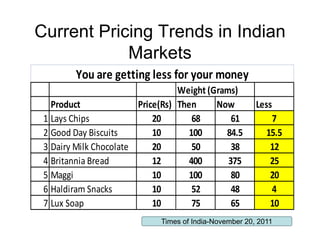
Current Pricing Trends in Indian
Markets
You are getting less for your money
You are getting less for your money
Weight (Grams)
Product
Price(Rs) Then
( )
Now
1 Lays Chips
20
68
61
2 Good Day Biscuits
10
100
84.5
3 Dairy Milk Chocolate
20
50
38
4 Britannia Bread
12
400
375
5 Maggi
10
100
80
6 Haldiram Snacks
10
52
48
7L S
Lux Soap
10
75
65

Less
7
15.5
12
25
20
4
10

Times of India-November 20, 2011
CUSTOMER’S MIND
•

Some customers interested in low prices,
while other segment interested in
service, quality, value and brand image.
• R
Research id tifi d 4 segment of
h identified
t f
shoppers
Brand loyal: relatively uninterested in price
System beaters: prefer certain brands but
y
p
buy them at reduced price.
Deal shoppers: Driven by low prices
CUSTOMER’S MIND
•Uninvolved: Not motivated by either a
Uninvolved:
brand or low price.
Study had differentiation in demographics.
So, psychographic factors responsible for
different degree of price sensitivity. Value is
also very important
Importance of Pricing-McKinsey
Research
Pricing is extremely important, small
changes in price can translate into huge
p
p
y
improvements in profitability.

A study of 1000 companies:
McKinsey found that a 1% increase
in price would improve profits by
7% assuming no change in sales
volume.
Factors Affecting Pricing Decisions
• Two Types of Factors:
1. Internal Factors
2. External Factors
INTERNAL FACTORS
Aim is to recover cost of manufacturing and
marketing through price.
1.
2.
2
3.
4.
4
5.

Corporate & Marketing objective of firm
Image sought by firm through Pricing
Characteristics of Product
Price l ti it f demand
P i elasticity of d
d
Stage of product in its life cycle
INTERNAL FACTORS
6.
6
7.
8.
8
9.

Cost of manufacturing and marketing
Extent of differentiation practiced
Composition of product li of products
C
iti
f
d t line f
d t
Other elements of market mix of firm and
their interaction with pricing.
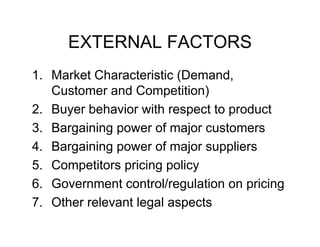
EXTERNAL FACTORS
1.
1 Market Characteristic (Demand
(Demand,
Customer and Competition)
2.
2 Buyer behavior with respect to product
3. Bargaining power of major customers
4. Bargaining power of major suppliers
5. Competitors p
p
pricing p y
g policy
6. Government control/regulation on pricing
7.
7 Other relevant legal aspects
EXTERNAL FACTORS
8.
8 Societal (Social) Considerations
9. Understanding reached if any with price
cartels.
cartels
Where does the money go?
Why do textbooks cost so much???
Authors + Publishers
=
75%
Retailers
R t il
=
25%
Suppose price of book is Rs 50 (37.50
&12.5)
Author gets 10-15% of wholesale price
g
p
Author s
Author’s Share = Rs 3.75-6.63
3 75 6 63
Publisher’s Share= Rs 31.87-33.75
Where does the money go?
Author: Takes 3 long years to develop book.
Revised Editions- takes 1-1.5 years
Publishers share looks more (Rs 32-33) they
32-33),
cover cost of MR, Art, Design, Production,
Distribution, Salaries of sales force, distribution
,
,
of promotional material AND
OVERHEAD Costs-Office, Computers etc
Spend 15-20 lakh upfront.
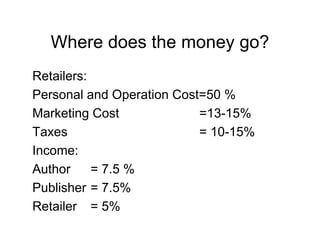
Where does the money go?
Retailers:
Personal and Operation Cost=50 %
Marketing Cost
=13-15%
Taxes
= 10-15%
Income:
Author
=75%
7.5
Publisher = 7.5%
Retailer = 5%
%
PRICING SURVEY RESEARCH
9 % Companies GUESS about Price
37% C
Companies match what
i
t h h t
COMPETITORS Charge for similar offerings
52% Companies choose p
p
price that cover
costs and provide fair profit.
Setting Pricing Policy
1.
1 PRICING OBJECTIVES
1.
1 Profit maximization in short term
2. Profit optimization (to make something
as good as it can b ) i l
d
be) in long t
term.
g
3. Achieving a particular market share
4. Deeper penetration in the market
5.
5 Entering new markets
6. Keeping parity with competition
PRICING OBJECTIVES
7.Providing
7 Providing commodities at prices affordable by
weaker sections.
8.Providing
8 Providing commodities at a price that
stimulate economic development.
These 2 objectives are relevant only to
providers of essential commodities and public
utility services
services.
Firms seek to meet basket of returns through
pricing policies NO FIRM IS SATISFIED WITH
policies.
SINGLE OBJECTIVE
Firms use pricing for Variety of
Objectives-AP, BA and LG
Obj i
AP
d
• Asian Paints (Uses Price to Protect MS)
• M.Leader, 33% Share, but industry highly competitive.
Has reduced prices of all items to protect MS.

• British Airways (Enhance Profitability)
• Started focusing of Business/Executive & Economy
Class.
Class Have reduced no of seats in Economy
Economy.

• LG (MS to Profitability)-Came in 2001-Objective was
volume/MS.Profits came down to 2% of sales in 2005.
Now objective is Profitability.
• Have increased the prices and working on differentiation
Setting the Price
2. Determining Demand
ee
g e a d
– Price sensitivity
– Total Cost of Ownership
– Estimating Demand Curves
– Price Elasticity of Demand
• Inelastic
• Elastic
Setting the Price
3. Estimating Cost
g
– Types of Cost and Levels of Production
• Fixed costs
• Variable cost
• Total cost
• Average cost
•

Fixed cost:
– Does not change with production
• Examples: Rent, Overhead, Salaries

– Variable Cost
Changes with production
Can be eliminated in the short run
Examples: Cost of materials that go directly into the product, wages

Average Cost (= Total cost / No of units in Production)
Setting the Price

Selecting a Pricing

Method

PRICING METHODS/STRATEGIES
1. Cost based pricing
2. Demand B
2 D
d Based P i i
d Pricing
3. Competition Based pricing
4. Value Pricing
5.
5 Product line oriented pricing
6. Tender Pricing
7. Differentiated Pricing
7 Diff
ti t d P i i
COST BASED PRICING-2
Following methods are commonly used:
1. Mark-up Pricing/Cost plus pricing
2. Absorption cost pricing/full cost pricing
2 Ab
ti
t i i /f ll
t i i
3. Target rate of return pricing
COST BASED PRICING-3
Mark-up Pricing/Cost plus pricing:
Selling price of product is fixed by adding
margin to its cost price.
price
•Slower the turnaround, larger mark-up
•Used by companies, who do not have
y
p
,
manufacturing of their own.
Mark-up or Cost Plus Pricing-4
• TO SET PRICE:
• 1) Estimate Total Cost Per Unit
Formula
• 2) Apply the “Formula”
– e.g., TOTAL COST + 30-50% or anything%

• Problem
– IGNORES demand

• Advantage
– SIMPLE
COST BASED PRICING-5
2. Absorption cost pricing (Full Cost Pricing)
COST BASED PRICING-6
1. Target rate of return pricing
Estimated Unit Cost = Rs12 50
Rs12.50
b. Estimated Sales Volume = 80,000 units
c. TOTAL COST = R 10 00 0 00
Rs 10,00,0,00
d. Target ROI = 20%
.20 x Rs10,000,00 =Rs 2,000,00 Needed
Profit
COST BASED PRICING 7
PRICING-7
Needed (Target) Revenue =
Total Cost + Profit
= R 10 000 00 + R 2 000 00 =
Rs10,000,00 Rs 2,000,00
Rs12,000,00
Unit Price
= REVENUE / VOLUME
= Rs12,000,00 / 80,000
=Rs15.00
=Rs15 00 / Unit Price
Break Even
Break-Even Chart
Break Even
Break-Even
• Cost Volume Price and Profits
Cost, Volume,
interrelated
• A particular volume level and its
associated cost level generates a
particular profit level
level.
• When we consider different price level, we
have diff
h
different profit l
t
fit levels.
l
• Firm can accordingly project profits at
different price levels and chose the one
that suits them the most.
Review Break Even
Break Even Point
(in Units)
=

5,71,428 units
, ,

FC
(SP-VC)
5000000
(15.00-6.25)
Review Break Even
Break Even Point
(in Rupees)

FC
= 1-(VC/SP)
5,000,000
5 000 000
1-(6.25/15)
Rs 85 71 429
85,71,429
2. DEMAND BASED PRICING-1
1. What
1 “What the traffic can bear?”
bear?
2. Skimming Pricing
3. Penetration Pricing
3 P
t ti P i i
DEMAND BASED PRICING-2
1. What
1 “What the traffic can bear?”
bear?
•
•
•

Maximum price th t a customer can pay.
M i
i that
t
Safe when demand is inelastic.
Buyer opposition or new firms will create
y
difficulty.
DEMAND BASED PRICING-3
2.
2 Skimming Pricing
High Price+High profits at early stages, later
settles down at low prices
prices.
For example: I-Pod, Mobile Phones
2.DEMAND BASED PRICING-4
3.Penetration
3 Penetration Pricing:
Penetration through low prices when new
product is not a luxury product
product.
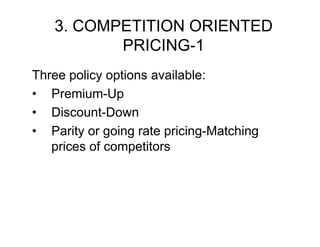
3. COMPETITION ORIENTED
PRICING-1
PRICING 1
Three policy options available:
• Premium-Up
• Di
Discount-Down
tD
• Parity or going rate pricing-Matching
prices of competitors
Perceived Value Pricing (Offer more value than competitor and demonstrate it)
Perceived Value Price = F ( buyer’s image of product, channel deliverables, warranty quality,
customer support, firm reputation, trustworthiness)

Value Pricing
Low price for high quality offering e.g. WalMart.
It is as much a philosophy as a method
One pricing strategy based on Value Pricing is EDLP

Going Rate Pricing
Go by competitor’s prices
competitor s
Charge same as, less than or more than competitor’s prices
Follow h l d
F ll the leader pricing is another example as in Commodity oligopolies such as
i i i
h
l
i C
di
li
li
h
steel, paper, fertilizers
Value Pricing-Essence
Value>Price>Costs (Loss to Seller)
Price>Value>Costs (Loss of Market Share)
Price>Cost>Value (Bi L
Pi
C t V l (Big Looser)
)
Price=Value>Cost (Good)
PRICE ADJUSTMENT
•
•
•
•
•

Geographical Pricing
Promotional Pricing
Discriminatory P i i
Di i i t
Pricing
Discounts and Allowances
Product Mix Pricing
– Product Line Pricing
Setting the Price

Selecting the Final Price
g
– Psychological Pricing
• Reference price
p
• Brands with average relative quality but high relative
advertising budgets charge premium prices
• Brands with high relative quality and high relative
advertising budgets obtained the highest prices
• The positive relationship between high advertising
budgets and high prices held most strongly in the
later stages of the product life cycle for market
leaders
– Company Pricing Policies
– Impact of Price on Other Parties
– Geographical Pricing
– Discriminatory Pricing
Adapting the Price
• Promotional Pricing
– Loss-leader pricing
– Special event pricing
Special-event
– Cash rebates
–L
Low-interest financing
i t
t fi
i
– Longer payment terms
–W
Warranties and service contracts
ti
d
i
t t
– Psychological discounting
Price Adaptations

-- Promotional pricing
- loss leader pricing, special event pricing ( Going to school program of Bata), Cash rebates (as in
jeweler shops) low interest financing (0% for 12 months), longer payment terms,
warranties / service contracts, psychological discounting (price high and then discount)
-- Geographical Pricing
-- Price Discounts and Allowances
- Cash discount quantity discount functional discount (given to intermediaries if they perform
discount,
discount,
certain functions), seasonal discount (off-peak buying), allowances (trade allowance
to resellers for participating in trade-ins, promotion allowance given to resellers for
participating in advertisement and promotion programs of the firm)
-- Price discrimination
-- Product Mix Pricing
pricing
car)
- Product line pricing, optional feature pricing (power windows for car), captive product pricing (razor
is low price and blade is high price), two part pricing (Mobile Phones)

Pricing decisions 19-11-13

  • 1.
  • 2.
    Session Coverage-Pricing Decisions Importanceof Pricing External and Internal Factors Affecting pricing decisions Pricing Objectives Pricing Approaches Cost Based Pricing Buyer Based Pricing p g Competition Based Pricing
  • 3.
    Session Coverage-Pricing Decisions NewProduct Pricing Strategies Product-mix Pricing Strategies Price Adjustment St t i P i Adj t t Strategies Price Changes
  • 4.
    PRICE Price is amountof money and/or other items with utility needed t acquire a it ith tilit d d to i product.
  • 5.
    The Importance ofPrice to Marketers • Pricing only element that produces Revenue ; Other elements produce costs • Prices are the easiest marketing – mix element to adjust • Price communicates to the market the company's intended value positioning of its product or brand
  • 6.
    Purpose of Pricing Thepurpose of price is not to recover costs, costs but to capture the perceived value of the product in the minds of the customer. customer ( (Nimer) ) Is this all?
  • 7.
    Current Pricing Trendsin Indian Markets You are getting less for your money You are getting less for your money Weight (Grams) Product Price(Rs) Then ( ) Now 1 Lays Chips 20 68 61 2 Good Day Biscuits 10 100 84.5 3 Dairy Milk Chocolate 20 50 38 4 Britannia Bread 12 400 375 5 Maggi 10 100 80 6 Haldiram Snacks 10 52 48 7L S Lux Soap 10 75 65 Less 7 15.5 12 25 20 4 10 Times of India-November 20, 2011
  • 8.
    CUSTOMER’S MIND • Some customersinterested in low prices, while other segment interested in service, quality, value and brand image. • R Research id tifi d 4 segment of h identified t f shoppers Brand loyal: relatively uninterested in price System beaters: prefer certain brands but y p buy them at reduced price. Deal shoppers: Driven by low prices
  • 9.
    CUSTOMER’S MIND •Uninvolved: Notmotivated by either a Uninvolved: brand or low price. Study had differentiation in demographics. So, psychographic factors responsible for different degree of price sensitivity. Value is also very important
  • 10.
    Importance of Pricing-McKinsey Research Pricingis extremely important, small changes in price can translate into huge p p y improvements in profitability. A study of 1000 companies: McKinsey found that a 1% increase in price would improve profits by 7% assuming no change in sales volume.
  • 11.
    Factors Affecting PricingDecisions • Two Types of Factors: 1. Internal Factors 2. External Factors
  • 12.
    INTERNAL FACTORS Aim isto recover cost of manufacturing and marketing through price. 1. 2. 2 3. 4. 4 5. Corporate & Marketing objective of firm Image sought by firm through Pricing Characteristics of Product Price l ti it f demand P i elasticity of d d Stage of product in its life cycle
  • 13.
    INTERNAL FACTORS 6. 6 7. 8. 8 9. Cost ofmanufacturing and marketing Extent of differentiation practiced Composition of product li of products C iti f d t line f d t Other elements of market mix of firm and their interaction with pricing.
  • 14.
    EXTERNAL FACTORS 1. 1 MarketCharacteristic (Demand (Demand, Customer and Competition) 2. 2 Buyer behavior with respect to product 3. Bargaining power of major customers 4. Bargaining power of major suppliers 5. Competitors p p pricing p y g policy 6. Government control/regulation on pricing 7. 7 Other relevant legal aspects
  • 15.
    EXTERNAL FACTORS 8. 8 Societal(Social) Considerations 9. Understanding reached if any with price cartels. cartels
  • 16.
    Where does themoney go? Why do textbooks cost so much??? Authors + Publishers = 75% Retailers R t il = 25% Suppose price of book is Rs 50 (37.50 &12.5) Author gets 10-15% of wholesale price g p Author s Author’s Share = Rs 3.75-6.63 3 75 6 63 Publisher’s Share= Rs 31.87-33.75
  • 17.
    Where does themoney go? Author: Takes 3 long years to develop book. Revised Editions- takes 1-1.5 years Publishers share looks more (Rs 32-33) they 32-33), cover cost of MR, Art, Design, Production, Distribution, Salaries of sales force, distribution , , of promotional material AND OVERHEAD Costs-Office, Computers etc Spend 15-20 lakh upfront.
  • 18.
    Where does themoney go? Retailers: Personal and Operation Cost=50 % Marketing Cost =13-15% Taxes = 10-15% Income: Author =75% 7.5 Publisher = 7.5% Retailer = 5% %
  • 19.
    PRICING SURVEY RESEARCH 9% Companies GUESS about Price 37% C Companies match what i t h h t COMPETITORS Charge for similar offerings 52% Companies choose p p price that cover costs and provide fair profit.
  • 20.
  • 21.
    1. 1 PRICING OBJECTIVES 1. 1Profit maximization in short term 2. Profit optimization (to make something as good as it can b ) i l d be) in long t term. g 3. Achieving a particular market share 4. Deeper penetration in the market 5. 5 Entering new markets 6. Keeping parity with competition
  • 22.
    PRICING OBJECTIVES 7.Providing 7 Providingcommodities at prices affordable by weaker sections. 8.Providing 8 Providing commodities at a price that stimulate economic development. These 2 objectives are relevant only to providers of essential commodities and public utility services services. Firms seek to meet basket of returns through pricing policies NO FIRM IS SATISFIED WITH policies. SINGLE OBJECTIVE
  • 23.
    Firms use pricingfor Variety of Objectives-AP, BA and LG Obj i AP d • Asian Paints (Uses Price to Protect MS) • M.Leader, 33% Share, but industry highly competitive. Has reduced prices of all items to protect MS. • British Airways (Enhance Profitability) • Started focusing of Business/Executive & Economy Class. Class Have reduced no of seats in Economy Economy. • LG (MS to Profitability)-Came in 2001-Objective was volume/MS.Profits came down to 2% of sales in 2005. Now objective is Profitability. • Have increased the prices and working on differentiation
  • 24.
    Setting the Price 2.Determining Demand ee g e a d – Price sensitivity – Total Cost of Ownership – Estimating Demand Curves – Price Elasticity of Demand • Inelastic • Elastic
  • 25.
    Setting the Price 3.Estimating Cost g – Types of Cost and Levels of Production • Fixed costs • Variable cost • Total cost • Average cost • Fixed cost: – Does not change with production • Examples: Rent, Overhead, Salaries – Variable Cost Changes with production Can be eliminated in the short run Examples: Cost of materials that go directly into the product, wages Average Cost (= Total cost / No of units in Production)
  • 26.
    Setting the Price Selectinga Pricing Method PRICING METHODS/STRATEGIES 1. Cost based pricing 2. Demand B 2 D d Based P i i d Pricing 3. Competition Based pricing 4. Value Pricing 5. 5 Product line oriented pricing 6. Tender Pricing 7. Differentiated Pricing 7 Diff ti t d P i i
  • 27.
    COST BASED PRICING-2 Followingmethods are commonly used: 1. Mark-up Pricing/Cost plus pricing 2. Absorption cost pricing/full cost pricing 2 Ab ti t i i /f ll t i i 3. Target rate of return pricing
  • 28.
    COST BASED PRICING-3 Mark-upPricing/Cost plus pricing: Selling price of product is fixed by adding margin to its cost price. price •Slower the turnaround, larger mark-up •Used by companies, who do not have y p , manufacturing of their own.
  • 29.
    Mark-up or CostPlus Pricing-4 • TO SET PRICE: • 1) Estimate Total Cost Per Unit Formula • 2) Apply the “Formula” – e.g., TOTAL COST + 30-50% or anything% • Problem – IGNORES demand • Advantage – SIMPLE
  • 30.
    COST BASED PRICING-5 2.Absorption cost pricing (Full Cost Pricing)
  • 31.
    COST BASED PRICING-6 1.Target rate of return pricing Estimated Unit Cost = Rs12 50 Rs12.50 b. Estimated Sales Volume = 80,000 units c. TOTAL COST = R 10 00 0 00 Rs 10,00,0,00 d. Target ROI = 20% .20 x Rs10,000,00 =Rs 2,000,00 Needed Profit
  • 32.
    COST BASED PRICING7 PRICING-7 Needed (Target) Revenue = Total Cost + Profit = R 10 000 00 + R 2 000 00 = Rs10,000,00 Rs 2,000,00 Rs12,000,00 Unit Price = REVENUE / VOLUME = Rs12,000,00 / 80,000 =Rs15.00 =Rs15 00 / Unit Price
  • 33.
  • 34.
    Break Even Break-Even • CostVolume Price and Profits Cost, Volume, interrelated • A particular volume level and its associated cost level generates a particular profit level level. • When we consider different price level, we have diff h different profit l t fit levels. l • Firm can accordingly project profits at different price levels and chose the one that suits them the most.
  • 35.
    Review Break Even BreakEven Point (in Units) = 5,71,428 units , , FC (SP-VC) 5000000 (15.00-6.25)
  • 36.
    Review Break Even BreakEven Point (in Rupees) FC = 1-(VC/SP) 5,000,000 5 000 000 1-(6.25/15) Rs 85 71 429 85,71,429
  • 37.
    2. DEMAND BASEDPRICING-1 1. What 1 “What the traffic can bear?” bear? 2. Skimming Pricing 3. Penetration Pricing 3 P t ti P i i
  • 38.
    DEMAND BASED PRICING-2 1.What 1 “What the traffic can bear?” bear? • • • Maximum price th t a customer can pay. M i i that t Safe when demand is inelastic. Buyer opposition or new firms will create y difficulty.
  • 39.
    DEMAND BASED PRICING-3 2. 2Skimming Pricing High Price+High profits at early stages, later settles down at low prices prices. For example: I-Pod, Mobile Phones
  • 40.
    2.DEMAND BASED PRICING-4 3.Penetration 3Penetration Pricing: Penetration through low prices when new product is not a luxury product product.
  • 41.
    3. COMPETITION ORIENTED PRICING-1 PRICING1 Three policy options available: • Premium-Up • Di Discount-Down tD • Parity or going rate pricing-Matching prices of competitors
  • 42.
    Perceived Value Pricing(Offer more value than competitor and demonstrate it) Perceived Value Price = F ( buyer’s image of product, channel deliverables, warranty quality, customer support, firm reputation, trustworthiness) Value Pricing Low price for high quality offering e.g. WalMart. It is as much a philosophy as a method One pricing strategy based on Value Pricing is EDLP Going Rate Pricing Go by competitor’s prices competitor s Charge same as, less than or more than competitor’s prices Follow h l d F ll the leader pricing is another example as in Commodity oligopolies such as i i i h l i C di li li h steel, paper, fertilizers
  • 43.
    Value Pricing-Essence Value>Price>Costs (Lossto Seller) Price>Value>Costs (Loss of Market Share) Price>Cost>Value (Bi L Pi C t V l (Big Looser) ) Price=Value>Cost (Good)
  • 44.
    PRICE ADJUSTMENT • • • • • Geographical Pricing PromotionalPricing Discriminatory P i i Di i i t Pricing Discounts and Allowances Product Mix Pricing – Product Line Pricing
  • 45.
    Setting the Price Selectingthe Final Price g – Psychological Pricing • Reference price p • Brands with average relative quality but high relative advertising budgets charge premium prices • Brands with high relative quality and high relative advertising budgets obtained the highest prices • The positive relationship between high advertising budgets and high prices held most strongly in the later stages of the product life cycle for market leaders – Company Pricing Policies – Impact of Price on Other Parties – Geographical Pricing – Discriminatory Pricing
  • 46.
    Adapting the Price •Promotional Pricing – Loss-leader pricing – Special event pricing Special-event – Cash rebates –L Low-interest financing i t t fi i – Longer payment terms –W Warranties and service contracts ti d i t t – Psychological discounting
  • 47.
    Price Adaptations -- Promotionalpricing - loss leader pricing, special event pricing ( Going to school program of Bata), Cash rebates (as in jeweler shops) low interest financing (0% for 12 months), longer payment terms, warranties / service contracts, psychological discounting (price high and then discount) -- Geographical Pricing -- Price Discounts and Allowances - Cash discount quantity discount functional discount (given to intermediaries if they perform discount, discount, certain functions), seasonal discount (off-peak buying), allowances (trade allowance to resellers for participating in trade-ins, promotion allowance given to resellers for participating in advertisement and promotion programs of the firm) -- Price discrimination -- Product Mix Pricing pricing car) - Product line pricing, optional feature pricing (power windows for car), captive product pricing (razor is low price and blade is high price), two part pricing (Mobile Phones)