TiE Young Entrepreneurs  (TYE) A TiE-Boston Chapter Initiative MARKETING PART II | 31 January 2009   SESSION 3:  What is an Break-even Analysis                                    
Recap of what you have learnt… What  is Marketing (4 P’s) Why  do Marketing (Purpose) How  to do  effective  Marketing  Need to develop Vision to drive business  Analyze consumers by segment  Focus your brand Understand key concepts/elements to be effective Market Research  Competitive strategies/advantages Advertising & Publicity Break-even analysis  Can you afford your marketing plan &  How to calculate it
What  is Break-even Analysis? Key element of marketing plan Answers: Can you afford your Marketing Plan?  Sell enough units to cover its cost!  Marketing is a fixed cost  It is not affected by the number of units sold Break-even unit formula =  Fixed operating cost / Gross profit per unit
Why  Break-even Analysis Businesses do this analysis to help them arrive at a price   allow them to   make some profit know   when that will happen  in the future It is done for  all  businesses – little or big  Main reason is to have some idea of  how much to sell   before you can start making a profit  If the number you are trying to get is too difficult then maybe you can  change  it  increasing your price or cutting your cost  …  that is the key to the analysis  Understand this,  makes you more competitive in the market place
Example: Basic Calculations Sum  Calculation Price Item Description $26 - $6 $50 - $24 $100 - 50 $50 + $0 25 * $2 $4 * 25 $20 Net Profit [Pre-Tax Net Profit – Tax] $6 Tax $26 Pre-Tax Net Profit [Gross Profit – Total Fixed Cost] $24 Total Fixed Cost (Marketing) $50 Gross Profit [Revenue – Total Variable Cost] $50 Total Variable Cost [COGS + Other VC] $0 Other Variable Costs $50 COGS [Units Sold * Cost of Unit] $100 Revenue [Unit Sale Price * Units Sold] 25 Total Units Sold $4 Sale Price of unit $2 Cost of Each unit
Specifics: Break-even Units $20 $26 - $6 Net Profit [Pre-Tax Net Profit – Tax] $6 Tax $24 Total Fixed Cost (Marketing) $26 $50 - $24 Pre-Tax Net Profit [Gross Profit – Total Fixed Cost] $50 + $0 $50 Total Variable Cost [COGS + Other VC] 25 * $2 $50 COGS [Units Sold * Cost of Unit] $0 Other Variable Costs Sum  Calculation Price Item Description $24/$2 $50/25 $100 * $50 $4 * 25 $12 Break-even Units = Fixed Operating Cost/Gross Profit Per Unit $2 Gross Profit Per Unit = Total Gross Profits/Units Sold $50 Gross Profit [Revenue – Total Variable Cost] $100 Revenue [Unit Sale Price * Units Sold] 25 Total Units Sold $4 Sale Price of unit $2 Cost of Each unit
Change in Units Sold $12 $24/$2 Break-even Units = Fixed Operating Cost/Gross Profit Per Unit $0 $0 - $0 Net Profit [Pre-Tax Net Profit – Tax] $0 Tax $0 $24  - $24 Pre-Tax Net Profit [Gross Profit – Total Fixed Cost] $24 Total Fixed Cost (Marketing) $24 + $0 $24 Total Variable Cost [COGS + Other VC] $0 Other Variable Costs 12  * $2 $24 COGS [Units Sold * Cost of Unit] Sum  Calculation Price Item Description $24/12 $48 - $24 $4 *  12 $2 Gross Profit Per Unit = Total Gross Profits/Units Sold $24 Gross Profit [Revenue – Total Variable Cost] $48 Revenue [Unit Sale Price * Units Sold] 12 Total Units Sold $4 Sale Price of unit $2 Cost of Each unit
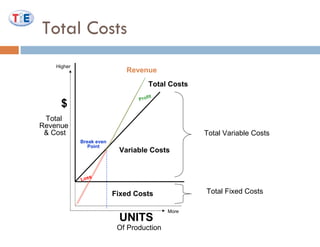
At break-even point Business operates at  no   profit and no loss Any unit sold  below  the break-even units will bring  loss  to business, and  Any unit sold  above  the break-even units will bring  profit  to business
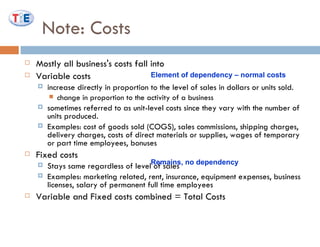
Note: Costs Mostly all business's costs fall into Variable costs  increase directly in proportion to the level of sales in dollars or units sold. change in proportion to the activity of a business sometimes referred to as unit-level costs since they vary with the number of units produced. Examples: cost of goods sold (COGS), sales commissions, shipping charges, delivery charges, costs of direct materials or supplies, wages of temporary or part time employees, bonuses  Fixed costs  Stays same regardless of level of sales Examples: marketing related, rent, insurance, equipment expenses, business licenses, salary of permanent full time employees Variable and Fixed costs combined = Total Costs Element of dependency – normal costs Remains, no dependency
Total Costs Fixed Costs Variable Costs Total Costs Of Production Total  Revenue  & Cost Total Variable Costs Total Fixed Costs Loss Profit Break even Point Revenue UNITS $ More Higher
Note on Break-even …  it requires  estimating  a  single  per-unit variable cost, and a  single  per-unit price or revenue, for the entire business  .. it is  hard  to do in a business that has a  collection  of products or services to sell
In a nut shell… In the "REAL WORLD" true costs are difficult to calculate there are many things that can go wrong  mistakes can happen  All that can affect the calculation numbers  Break-even analysis is sometimes difficult to calculate mathematics does not allow for  calculating "COMPETITIVE ENVIRONMENT"  This is why   competition  may  cause you to make change like lower your price , or  the demand itself may change   What does this mean?  You will have to change your calculation  about  WHEN  you break even!
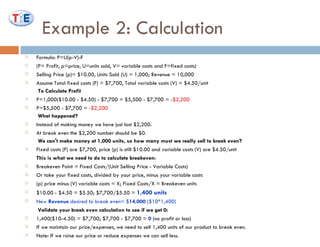
Example 2: Calculation Formula: P=U(p-V)-F  (P= Profit, p=price, U=units sold, V= variable costs and F=fixed costs) Selling Price (p)= $10.00, Units Sold (U) = 1,000; Revenue = 10,000 Assume Total fixed costs (F) = $7,700, Total variable costs (V) = $4.50/unit To Calculate Profit P=1,000($10.00 - $4.50) - $7,700 = $5,500 - $7,700 =  -$2,200  P=$5,500 - $7,700 =  -$2,200 What happened?  Instead of making money we have just lost $2,200. At break even the $2,200 number should be $0. We can't make money at 1,000 units, so how many must we really sell to break even?  Fixed costs (F) are $7,700, price (p) is still $10.00 and variable costs (V) are $4.50/unit  This is what we need to do to calculate breakeven:  Breakeven Point = Fixed Costs/(Unit Selling Price - Variable Costs)  Or take your fixed costs, divided by your price, minus your variable costs  (p) price minus (V) variable costs = X; Fixed Costs/X = Breakeven units $10.00 - $4.50 = $5.50; $7,700/$5.50 =  1,400 units  New  Revenue  desired to break even= $ 14,000  ($10*1,400)   Validate your break even calculation to see if we get 0: 1,400($10-4.50) = $7,700; $7,700 - $7,700 =  0  (no profit or loss) If we maintain our price/expenses, we need to sell 1,400 units of our product to break even.  Note: If we raise our price or reduce expenses we can sell less.
Q&A ? ? ? ? ?

Marketing II: Break-Even Analysis

  • 1.
    TiE Young Entrepreneurs (TYE) A TiE-Boston Chapter Initiative MARKETING PART II | 31 January 2009 SESSION 3: What is an Break-even Analysis                                    
  • 2.
    Recap of whatyou have learnt… What is Marketing (4 P’s) Why do Marketing (Purpose) How to do effective Marketing Need to develop Vision to drive business Analyze consumers by segment Focus your brand Understand key concepts/elements to be effective Market Research Competitive strategies/advantages Advertising & Publicity Break-even analysis Can you afford your marketing plan & How to calculate it
  • 3.
    What isBreak-even Analysis? Key element of marketing plan Answers: Can you afford your Marketing Plan? Sell enough units to cover its cost! Marketing is a fixed cost It is not affected by the number of units sold Break-even unit formula = Fixed operating cost / Gross profit per unit
  • 4.
    Why Break-evenAnalysis Businesses do this analysis to help them arrive at a price allow them to make some profit know when that will happen in the future It is done for all businesses – little or big Main reason is to have some idea of how much to sell before you can start making a profit If the number you are trying to get is too difficult then maybe you can change it increasing your price or cutting your cost … that is the key to the analysis Understand this, makes you more competitive in the market place
  • 5.
    Example: Basic CalculationsSum Calculation Price Item Description $26 - $6 $50 - $24 $100 - 50 $50 + $0 25 * $2 $4 * 25 $20 Net Profit [Pre-Tax Net Profit – Tax] $6 Tax $26 Pre-Tax Net Profit [Gross Profit – Total Fixed Cost] $24 Total Fixed Cost (Marketing) $50 Gross Profit [Revenue – Total Variable Cost] $50 Total Variable Cost [COGS + Other VC] $0 Other Variable Costs $50 COGS [Units Sold * Cost of Unit] $100 Revenue [Unit Sale Price * Units Sold] 25 Total Units Sold $4 Sale Price of unit $2 Cost of Each unit
  • 6.
    Specifics: Break-even Units$20 $26 - $6 Net Profit [Pre-Tax Net Profit – Tax] $6 Tax $24 Total Fixed Cost (Marketing) $26 $50 - $24 Pre-Tax Net Profit [Gross Profit – Total Fixed Cost] $50 + $0 $50 Total Variable Cost [COGS + Other VC] 25 * $2 $50 COGS [Units Sold * Cost of Unit] $0 Other Variable Costs Sum Calculation Price Item Description $24/$2 $50/25 $100 * $50 $4 * 25 $12 Break-even Units = Fixed Operating Cost/Gross Profit Per Unit $2 Gross Profit Per Unit = Total Gross Profits/Units Sold $50 Gross Profit [Revenue – Total Variable Cost] $100 Revenue [Unit Sale Price * Units Sold] 25 Total Units Sold $4 Sale Price of unit $2 Cost of Each unit
  • 7.
    Change in UnitsSold $12 $24/$2 Break-even Units = Fixed Operating Cost/Gross Profit Per Unit $0 $0 - $0 Net Profit [Pre-Tax Net Profit – Tax] $0 Tax $0 $24 - $24 Pre-Tax Net Profit [Gross Profit – Total Fixed Cost] $24 Total Fixed Cost (Marketing) $24 + $0 $24 Total Variable Cost [COGS + Other VC] $0 Other Variable Costs 12 * $2 $24 COGS [Units Sold * Cost of Unit] Sum Calculation Price Item Description $24/12 $48 - $24 $4 * 12 $2 Gross Profit Per Unit = Total Gross Profits/Units Sold $24 Gross Profit [Revenue – Total Variable Cost] $48 Revenue [Unit Sale Price * Units Sold] 12 Total Units Sold $4 Sale Price of unit $2 Cost of Each unit
  • 8.
    At break-even pointBusiness operates at no profit and no loss Any unit sold below the break-even units will bring loss to business, and Any unit sold above the break-even units will bring profit to business
  • 9.
    Note: Costs Mostlyall business's costs fall into Variable costs increase directly in proportion to the level of sales in dollars or units sold. change in proportion to the activity of a business sometimes referred to as unit-level costs since they vary with the number of units produced. Examples: cost of goods sold (COGS), sales commissions, shipping charges, delivery charges, costs of direct materials or supplies, wages of temporary or part time employees, bonuses Fixed costs Stays same regardless of level of sales Examples: marketing related, rent, insurance, equipment expenses, business licenses, salary of permanent full time employees Variable and Fixed costs combined = Total Costs Element of dependency – normal costs Remains, no dependency
  • 10.
    Total Costs FixedCosts Variable Costs Total Costs Of Production Total Revenue & Cost Total Variable Costs Total Fixed Costs Loss Profit Break even Point Revenue UNITS $ More Higher
  • 11.
    Note on Break-even… it requires estimating a single  per-unit variable cost, and a single per-unit price or revenue, for the entire business .. it is hard to do in a business that has a  collection of products or services to sell
  • 12.
    In a nutshell… In the "REAL WORLD" true costs are difficult to calculate there are many things that can go wrong mistakes can happen All that can affect the calculation numbers Break-even analysis is sometimes difficult to calculate mathematics does not allow for calculating "COMPETITIVE ENVIRONMENT" This is why competition may cause you to make change like lower your price , or the demand itself may change What does this mean? You will have to change your calculation about WHEN you break even!
  • 13.
    Example 2: CalculationFormula: P=U(p-V)-F (P= Profit, p=price, U=units sold, V= variable costs and F=fixed costs) Selling Price (p)= $10.00, Units Sold (U) = 1,000; Revenue = 10,000 Assume Total fixed costs (F) = $7,700, Total variable costs (V) = $4.50/unit To Calculate Profit P=1,000($10.00 - $4.50) - $7,700 = $5,500 - $7,700 = -$2,200 P=$5,500 - $7,700 = -$2,200 What happened? Instead of making money we have just lost $2,200. At break even the $2,200 number should be $0. We can't make money at 1,000 units, so how many must we really sell to break even? Fixed costs (F) are $7,700, price (p) is still $10.00 and variable costs (V) are $4.50/unit This is what we need to do to calculate breakeven: Breakeven Point = Fixed Costs/(Unit Selling Price - Variable Costs) Or take your fixed costs, divided by your price, minus your variable costs (p) price minus (V) variable costs = X; Fixed Costs/X = Breakeven units $10.00 - $4.50 = $5.50; $7,700/$5.50 = 1,400 units New Revenue desired to break even= $ 14,000 ($10*1,400)   Validate your break even calculation to see if we get 0: 1,400($10-4.50) = $7,700; $7,700 - $7,700 = 0 (no profit or loss) If we maintain our price/expenses, we need to sell 1,400 units of our product to break even. Note: If we raise our price or reduce expenses we can sell less.
  • 14.
    Q&A ? ?? ? ?