MARK4210, 2014 Spring, L1/L2
MARK4210: Strategic Marketing
2014 Spring, Section L1/L2
[Class #23]
Competing in a Global
Market
Agenda
 Global Marketing Strategic Approaches
 Global Marketing Mix
 Price
 Product
 Place
 Promotion
2
Global Marketing Strategic
Approaches
 Three main international strategies:
 Multi-domestic
 Global
 Transnational
 Each strategy involves a different approach to
build efficiency across nations and
responsiveness to variation in customer
preferences and market conditions across
nations
3
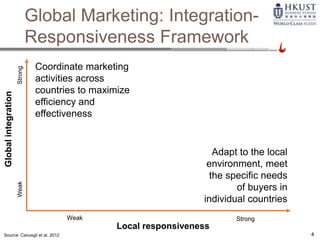
4
Globalintegration
WeakStrong
Local responsiveness
Weak Strong
Source: Cavusgil et al. 2012
Coordinate marketing
activities across
countries to maximize
efficiency and
effectiveness
Adapt to the local
environment, meet
the specific needs
of buyers in
individual countries
Global Marketing: Integration-
Responsiveness Framework
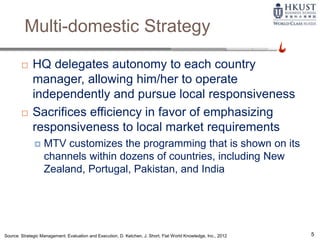
Multi-domestic Strategy
 HQ delegates autonomy to each country
manager, allowing him/her to operate
independently and pursue local responsiveness
 Sacrifices efficiency in favor of emphasizing
responsiveness to local market requirements
 MTV customizes the programming that is shown on its
channels within dozens of countries, including New
Zealand, Portugal, Pakistan, and India
Source: Strategic Management: Evaluation and Execution, D. Ketchen, J. Short, Flat World Knowledge, Inc., 2012 5
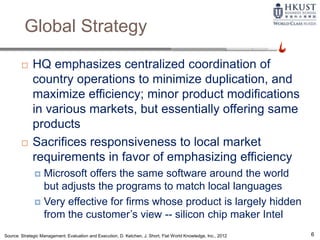
Global Strategy
 HQ emphasizes centralized coordination of
country operations to minimize duplication, and
maximize efficiency; minor product modifications
in various markets, but essentially offering same
products
 Sacrifices responsiveness to local market
requirements in favor of emphasizing efficiency
 Microsoft offers the same software around the world
but adjusts the programs to match local languages
 Very effective for firms whose product is largely hidden
from the customer’s view -- silicon chip maker Intel
Source: Strategic Management: Evaluation and Execution, D. Ketchen, J. Short, Flat World Knowledge, Inc., 2012 6
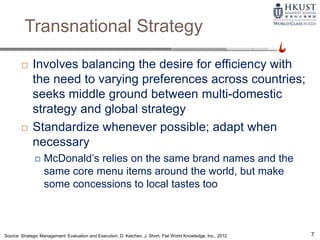
Transnational Strategy
 Involves balancing the desire for efficiency with
the need to varying preferences across countries;
seeks middle ground between multi-domestic
strategy and global strategy
 Standardize whenever possible; adapt when
necessary
 McDonald’s relies on the same brand names and the
same core menu items around the world, but make
some concessions to local tastes too
Source: Strategic Management: Evaluation and Execution, D. Ketchen, J. Short, Flat World Knowledge, Inc., 2012 7
8
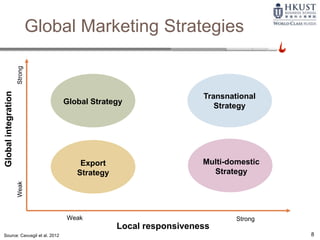
Globalintegration
WeakStrong
Local responsiveness
Weak Strong
Global Strategy
Transnational
Strategy
Export
Strategy
Multi-domestic
Strategy
Source: Cavusgil et al. 2012
Global Marketing Strategies
9
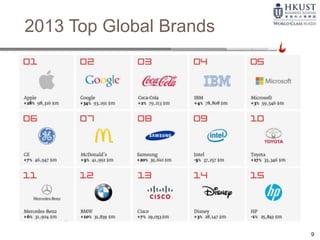
2013 Top Global Brands
4P’s: Approaches to Global
Pricing
 Ethnocentric Pricing
 Polycentric Pricing
 Geocentric Pricing
10
Ethnocentric Pricing
 Per-unit price of an item is the same no matter
where in the world the buyer is located
 Importer must absorb freight and import duties
 Potential problems?
11
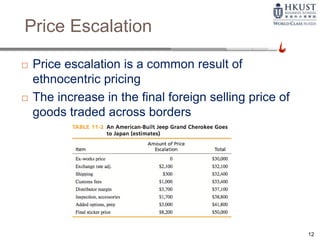
Price Escalation
 Price escalation is a common result of
ethnocentric pricing
 The increase in the final foreign selling price of
goods traded across borders
12
Price Escalation – How to
lessen the Problem?
 Rearrange the distribution channel
 Eliminate costly features or downsize the product
 Production in local or a low-cost market
13
Polycentric Pricing
 Permits affiliate managers or independent
distributors to establish price as they feel is most
desirable in their circumstances
14
Geocentric Pricing
 Global pricing with local adjustments
 Allows firms to take into account global markets
and global competitors in establishing prices, but
also local factors
 Local costs
 Income levels
 Competition
 Local marketing strategy
15
16
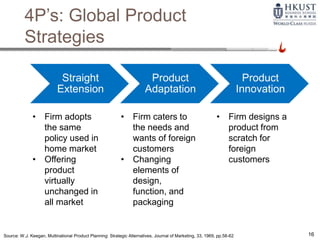
4P’s: Global Product
Strategies
• Firm adopts
the same
policy used in
home market
• Offering
product
virtually
unchanged in
all market
• Firm caters to
the needs and
wants of foreign
customers
• Changing
elements of
design,
function, and
packaging
• Firm designs a
product from
scratch for
foreign
customers
Source: W.J. Keegan, Multinational Product Planning: Strategic Alternatives, Journal of Marketing, 33, 1969, pp.58-62
Straight
Extension
Product
Adaptation
Product
Innovation
Source: Kotabe and Helsen 2012
4P’s: Global Product Strategies
17
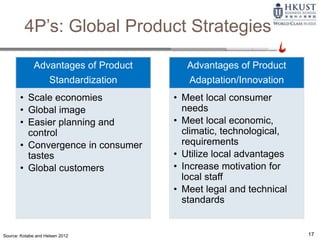
Advantages of Product
Standardization
• Scale economies
• Global image
• Easier planning and
control
• Convergence in consumer
tastes
• Global customers
Advantages of Product
Adaptation/Innovation
• Meet local consumer
needs
• Meet local economic,
climatic, technological,
requirements
• Utilize local advantages
• Increase motivation for
local staff
• Meet legal and technical
standards
18
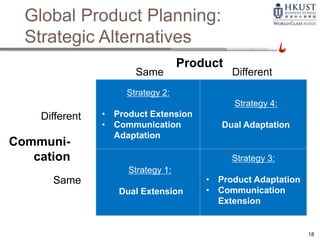
Global Product Planning:
Strategic Alternatives
Product
Same Different
Communi-
cation
Different
Same
Strategy 1:
Dual Extension
Strategy 2:
• Product Extension
• Communication
Adaptation
Strategy 4:
Dual Adaptation
Strategy 3:
• Product Adaptation
• Communication
Extension
19
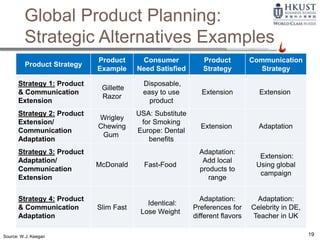
Global Product Planning:
Strategic Alternatives Examples
Product Strategy
Product
Example
Consumer
Need Satisfied
Product
Strategy
Communication
Strategy
Strategy 1: Product
& Communication
Extension
Gillette
Razor
Disposable,
easy to use
product
Extension Extension
Strategy 2: Product
Extension/
Communication
Adaptation
Wrigley
Chewing
Gum
USA: Substitute
for Smoking
Europe: Dental
benefits
Extension Adaptation
Strategy 3: Product
Adaptation/
Communication
Extension
McDonald Fast-Food
Adaptation:
Add local
products to
range
Extension:
Using global
campaign
Strategy 4: Product
& Communication
Adaptation
Slim Fast
Identical:
Lose Weight
Adaptation:
Preferences for
different flavors
Adaptation:
Celebrity in DE,
Teacher in UK
Source: W.J. Keegan
20
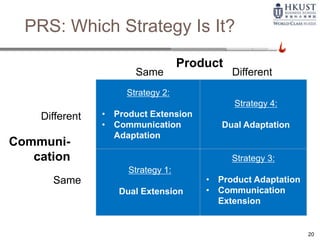
PRS: Which Strategy Is It?
Product
Same Different
Communi-
cation
Different
Same
Strategy 1:
Dual Extension
Strategy 2:
• Product Extension
• Communication
Adaptation
Strategy 4:
Dual Adaptation
Strategy 3:
• Product Adaptation
• Communication
Extension
21
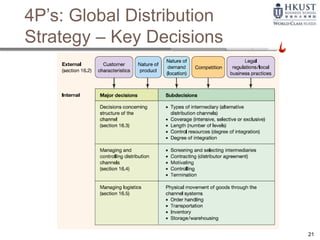
4P’s: Global Distribution
Strategy – Key Decisions
Guidelines for international
distributors
 Select distributors – do not let them select you
 Look for distributors capable of developing markets
 Treat the local distributors as long-term partners
 Support market entry by committing money, managers
and proven marketing ideas
 Maintain control over marketing strategy
 Make sure distributors provide you with detailed market
and financial performance data
 Build links among national distributors at the earliest
opportunity
22
23Source: adapted from Cavusgil et al. (1995)
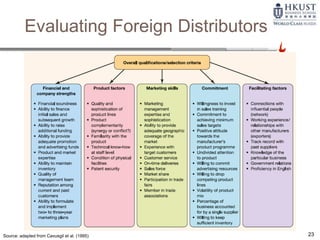
Evaluating Foreign Distributors
24
Source: Paliwoda (1993, p. 300). Reprinted with permission from Butterworth-Heinemann Publishers, a division of Reed Educational & Professional
Publishing Ltd.
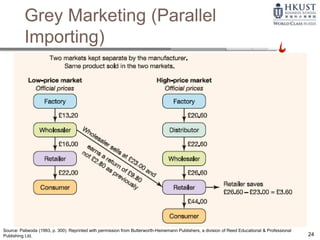
Grey Marketing (Parallel
Importing)
Strategies to Reduce
Grey Marketing
 Seek legal redress
 Change the marketing mix
– Product strategy
– Pricing strategy
– Warranty strategy
25
26
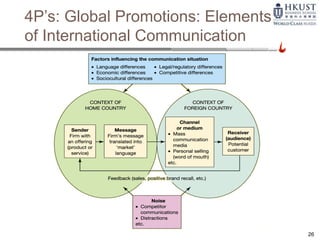
4P’s: Global Promotions: Elements
of International Communication
Standardization vs. Adaptation of
Advertising Strategy: Benefits
 Standardization reduces costs: No duplication of
effort for each market
 Individual (customized) campaigns delay product
launches
 Consumers increasingly share similar frames of
references with regard to products and
consumption
27
Barriers to Standardization
 Communication infrastructure
 Agencies might not serve a particular market
 Consumer literacy
 Legal restrictions and self-regulation
 Differing values and purchase motivations
 Attitudes toward product country of origin
 Promotional mix elements
28
Reminders: PharmaSim
 PharmaSim Team Live Play Round 2
 Started April 22 @ 7am
 Ends May 8 @ 8pm
 Periods 0-8
 NO replay, NO restarts, NO consultation
 PharmaSim Final Report by May 14, 9AM
 Peer Evaluations (excluding self)
 7 Points (%) to Final Grade
 Based on contribution to team effort
 Anonymous, online link (http://ipeer.ust.hk) will be
posted by May 9
29
Reminders: Finals
 When: May 17, Saturday, 16:40 to 18:10
 90 minutes exam time
 Please arrive at venue by 16:25 (15 minutes before exam starts) to
look for your assigned seats
 Where: HALL
 G/F Entrance of Sports Hall Complex is blocked
 Use the open staircase between the Library and Lift No.3 only
 What: Lectures/discussions from Class #9 (Product
Strategies) onwards
 Open notes (handwritten notes, class slides, course packet)
 Bring your own calculator (no borrowing, no laptops, no
smartphones)
30

competing in a global market(4210)

  • 1.
    MARK4210, 2014 Spring,L1/L2 MARK4210: Strategic Marketing 2014 Spring, Section L1/L2 [Class #23] Competing in a Global Market
  • 2.
    Agenda  Global MarketingStrategic Approaches  Global Marketing Mix  Price  Product  Place  Promotion 2
  • 3.
    Global Marketing Strategic Approaches Three main international strategies:  Multi-domestic  Global  Transnational  Each strategy involves a different approach to build efficiency across nations and responsiveness to variation in customer preferences and market conditions across nations 3
  • 4.
    4 Globalintegration WeakStrong Local responsiveness Weak Strong Source:Cavusgil et al. 2012 Coordinate marketing activities across countries to maximize efficiency and effectiveness Adapt to the local environment, meet the specific needs of buyers in individual countries Global Marketing: Integration- Responsiveness Framework
  • 5.
    Multi-domestic Strategy  HQdelegates autonomy to each country manager, allowing him/her to operate independently and pursue local responsiveness  Sacrifices efficiency in favor of emphasizing responsiveness to local market requirements  MTV customizes the programming that is shown on its channels within dozens of countries, including New Zealand, Portugal, Pakistan, and India Source: Strategic Management: Evaluation and Execution, D. Ketchen, J. Short, Flat World Knowledge, Inc., 2012 5
  • 6.
    Global Strategy  HQemphasizes centralized coordination of country operations to minimize duplication, and maximize efficiency; minor product modifications in various markets, but essentially offering same products  Sacrifices responsiveness to local market requirements in favor of emphasizing efficiency  Microsoft offers the same software around the world but adjusts the programs to match local languages  Very effective for firms whose product is largely hidden from the customer’s view -- silicon chip maker Intel Source: Strategic Management: Evaluation and Execution, D. Ketchen, J. Short, Flat World Knowledge, Inc., 2012 6
  • 7.
    Transnational Strategy  Involvesbalancing the desire for efficiency with the need to varying preferences across countries; seeks middle ground between multi-domestic strategy and global strategy  Standardize whenever possible; adapt when necessary  McDonald’s relies on the same brand names and the same core menu items around the world, but make some concessions to local tastes too Source: Strategic Management: Evaluation and Execution, D. Ketchen, J. Short, Flat World Knowledge, Inc., 2012 7
  • 8.
    8 Globalintegration WeakStrong Local responsiveness Weak Strong GlobalStrategy Transnational Strategy Export Strategy Multi-domestic Strategy Source: Cavusgil et al. 2012 Global Marketing Strategies
  • 9.
  • 10.
    4P’s: Approaches toGlobal Pricing  Ethnocentric Pricing  Polycentric Pricing  Geocentric Pricing 10
  • 11.
    Ethnocentric Pricing  Per-unitprice of an item is the same no matter where in the world the buyer is located  Importer must absorb freight and import duties  Potential problems? 11
  • 12.
    Price Escalation  Priceescalation is a common result of ethnocentric pricing  The increase in the final foreign selling price of goods traded across borders 12
  • 13.
    Price Escalation –How to lessen the Problem?  Rearrange the distribution channel  Eliminate costly features or downsize the product  Production in local or a low-cost market 13
  • 14.
    Polycentric Pricing  Permitsaffiliate managers or independent distributors to establish price as they feel is most desirable in their circumstances 14
  • 15.
    Geocentric Pricing  Globalpricing with local adjustments  Allows firms to take into account global markets and global competitors in establishing prices, but also local factors  Local costs  Income levels  Competition  Local marketing strategy 15
  • 16.
    16 4P’s: Global Product Strategies •Firm adopts the same policy used in home market • Offering product virtually unchanged in all market • Firm caters to the needs and wants of foreign customers • Changing elements of design, function, and packaging • Firm designs a product from scratch for foreign customers Source: W.J. Keegan, Multinational Product Planning: Strategic Alternatives, Journal of Marketing, 33, 1969, pp.58-62 Straight Extension Product Adaptation Product Innovation
  • 17.
    Source: Kotabe andHelsen 2012 4P’s: Global Product Strategies 17 Advantages of Product Standardization • Scale economies • Global image • Easier planning and control • Convergence in consumer tastes • Global customers Advantages of Product Adaptation/Innovation • Meet local consumer needs • Meet local economic, climatic, technological, requirements • Utilize local advantages • Increase motivation for local staff • Meet legal and technical standards
  • 18.
    18 Global Product Planning: StrategicAlternatives Product Same Different Communi- cation Different Same Strategy 1: Dual Extension Strategy 2: • Product Extension • Communication Adaptation Strategy 4: Dual Adaptation Strategy 3: • Product Adaptation • Communication Extension
  • 19.
    19 Global Product Planning: StrategicAlternatives Examples Product Strategy Product Example Consumer Need Satisfied Product Strategy Communication Strategy Strategy 1: Product & Communication Extension Gillette Razor Disposable, easy to use product Extension Extension Strategy 2: Product Extension/ Communication Adaptation Wrigley Chewing Gum USA: Substitute for Smoking Europe: Dental benefits Extension Adaptation Strategy 3: Product Adaptation/ Communication Extension McDonald Fast-Food Adaptation: Add local products to range Extension: Using global campaign Strategy 4: Product & Communication Adaptation Slim Fast Identical: Lose Weight Adaptation: Preferences for different flavors Adaptation: Celebrity in DE, Teacher in UK Source: W.J. Keegan
  • 20.
    20 PRS: Which StrategyIs It? Product Same Different Communi- cation Different Same Strategy 1: Dual Extension Strategy 2: • Product Extension • Communication Adaptation Strategy 4: Dual Adaptation Strategy 3: • Product Adaptation • Communication Extension
  • 21.
  • 22.
    Guidelines for international distributors Select distributors – do not let them select you  Look for distributors capable of developing markets  Treat the local distributors as long-term partners  Support market entry by committing money, managers and proven marketing ideas  Maintain control over marketing strategy  Make sure distributors provide you with detailed market and financial performance data  Build links among national distributors at the earliest opportunity 22
  • 23.
    23Source: adapted fromCavusgil et al. (1995) Evaluating Foreign Distributors
  • 24.
    24 Source: Paliwoda (1993,p. 300). Reprinted with permission from Butterworth-Heinemann Publishers, a division of Reed Educational & Professional Publishing Ltd. Grey Marketing (Parallel Importing)
  • 25.
    Strategies to Reduce GreyMarketing  Seek legal redress  Change the marketing mix – Product strategy – Pricing strategy – Warranty strategy 25
  • 26.
    26 4P’s: Global Promotions:Elements of International Communication
  • 27.
    Standardization vs. Adaptationof Advertising Strategy: Benefits  Standardization reduces costs: No duplication of effort for each market  Individual (customized) campaigns delay product launches  Consumers increasingly share similar frames of references with regard to products and consumption 27
  • 28.
    Barriers to Standardization Communication infrastructure  Agencies might not serve a particular market  Consumer literacy  Legal restrictions and self-regulation  Differing values and purchase motivations  Attitudes toward product country of origin  Promotional mix elements 28
  • 29.
    Reminders: PharmaSim  PharmaSimTeam Live Play Round 2  Started April 22 @ 7am  Ends May 8 @ 8pm  Periods 0-8  NO replay, NO restarts, NO consultation  PharmaSim Final Report by May 14, 9AM  Peer Evaluations (excluding self)  7 Points (%) to Final Grade  Based on contribution to team effort  Anonymous, online link (http://ipeer.ust.hk) will be posted by May 9 29
  • 30.
    Reminders: Finals  When:May 17, Saturday, 16:40 to 18:10  90 minutes exam time  Please arrive at venue by 16:25 (15 minutes before exam starts) to look for your assigned seats  Where: HALL  G/F Entrance of Sports Hall Complex is blocked  Use the open staircase between the Library and Lift No.3 only  What: Lectures/discussions from Class #9 (Product Strategies) onwards  Open notes (handwritten notes, class slides, course packet)  Bring your own calculator (no borrowing, no laptops, no smartphones) 30