PRICINGPRICING ( for SIKSIL 2017)( for SIKSIL 2017)
Maxwell RanasingheMaxwell Ranasinghe
B.Sc. ( Business Administration)B.Sc. ( Business Administration)
Hons. MAAT, Attorney at Law,Hons. MAAT, Attorney at Law,
CPM ( New Haven- USA)CPM ( New Haven- USA)
PRICINGPRICING
• IMPORTANCE OF PRICING
• PRICING OBJECTIVES
• FACTORS TO CONSIDER IN PRICING
• CONCEPTS OF COSTING FOR PRICING
• PRICING STRATEGIES
• SETTING THE FINAL PRICE
Pricing the revenue makerPricing the revenue maker
• The Price is the amount of
money, goods or services
that must be offered to get
a product ( sum of all the
values that consumers
exchange for the benefit of
having or using the
product or service)
• Price is expressed in
different terms such as
Rent, Tuition fees, fare,
interest, premium, salary,
taxes and commissions
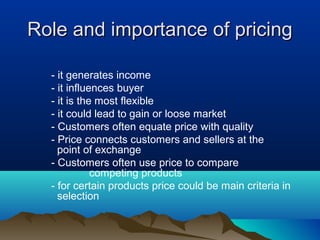
Role and importance of pricingRole and importance of pricing
- it generates income
- it influences buyer
- it is the most flexible
- it could lead to gain or loose market
- Customers often equate price with quality
- Price connects customers and sellers at the
point of exchange
- Customers often use price to compare
competing products
- for certain products price could be main criteria in
selection
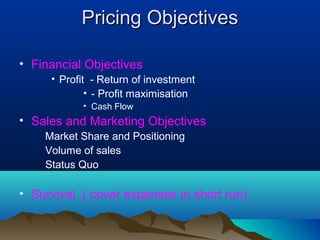
Pricing ObjectivesPricing Objectives
• Financial Objectives
• Profit - Return of investment
• - Profit maximisation
• Cash Flow
• Sales and Marketing Objectives
Market Share and Positioning
Volume of sales
Status Quo
• Survival ( cover expenses in short run)
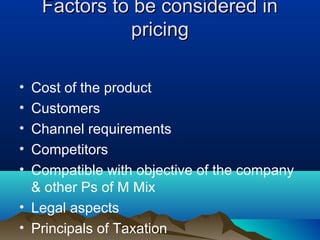
Factors to be considered inFactors to be considered in
pricingpricing
• Cost of the product
• Customers
• Channel requirements
• Competitors
• Compatible with objective of the company
& other Ps of M Mix
• Legal aspects
• Principals of Taxation
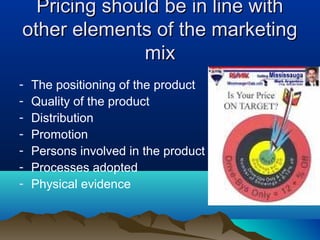
Pricing should be in line withPricing should be in line with
other elements of the marketingother elements of the marketing
mixmix
- The positioning of the product
- Quality of the product
- Distribution
- Promotion
- Persons involved in the product
- Processes adopted
- Physical evidence
Now talkNow talk
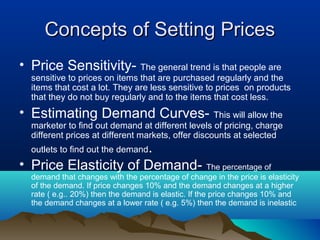
Concepts of Setting PricesConcepts of Setting Prices
• Price Sensitivity- The general trend is that people are
sensitive to prices on items that are purchased regularly and the
items that cost a lot. They are less sensitive to prices on products
that they do not buy regularly and to the items that cost less.
• Estimating Demand Curves- This will allow the
marketer to find out demand at different levels of pricing, charge
different prices at different markets, offer discounts at selected
outlets to find out the demand.
• Price Elasticity of Demand- The percentage of
demand that changes with the percentage of change in the price is elasticity
of the demand. If price changes 10% and the demand changes at a higher
rate ( e.g.. 20%) then the demand is elastic. If the price changes 10% and
the demand changes at a lower rate ( e.g. 5%) then the demand is inelastic
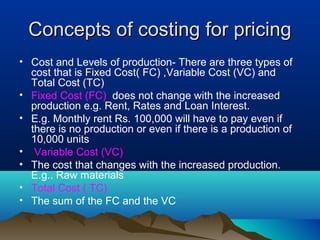
Concepts of costing for pricingConcepts of costing for pricing
• Cost and Levels of production- There are three types of
cost that is Fixed Cost( FC) ,Variable Cost (VC) and
Total Cost (TC)
• Fixed Cost (FC) does not change with the increased
production e.g. Rent, Rates and Loan Interest.
• E.g. Monthly rent Rs. 100,000 will have to pay even if
there is no production or even if there is a production of
10,000 units
• Variable Cost (VC)
• The cost that changes with the increased production.
E.g.. Raw materials
• Total Cost ( TC)
• The sum of the FC and the VC
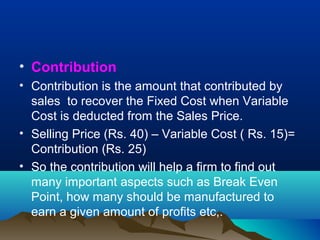
• Contribution
• Contribution is the amount that contributed by
sales to recover the Fixed Cost when Variable
Cost is deducted from the Sales Price.
• Selling Price (Rs. 40) – Variable Cost ( Rs. 15)=
Contribution (Rs. 25)
• So the contribution will help a firm to find out
many important aspects such as Break Even
Point, how many should be manufactured to
earn a given amount of profits etc,.
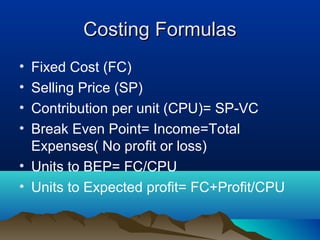
Costing FormulasCosting Formulas
• Fixed Cost (FC)
• Selling Price (SP)
• Contribution per unit (CPU)= SP-VC
• Break Even Point= Income=Total
Expenses( No profit or loss)
• Units to BEP= FC/CPU
• Units to Expected profit= FC+Profit/CPU
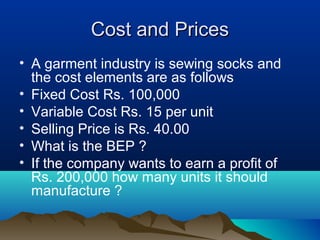
Cost and PricesCost and Prices
• A garment industry is sewing socks and
the cost elements are as follows
• Fixed Cost Rs. 100,000
• Variable Cost Rs. 15 per unit
• Selling Price is Rs. 40.00
• What is the BEP ?
• If the company wants to earn a profit of
Rs. 200,000 how many units it should
manufacture ?
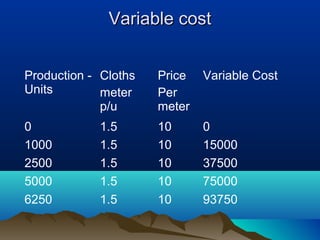
Variable costVariable cost
Production -
Units
Cloths
meter
p/u
Price
Per
meter
Variable Cost
0 1.5 10 0
1000 1.5 10 15000
2500 1.5 10 37500
5000 1.5 10 75000
6250 1.5 10 93750
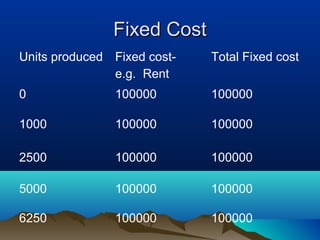
Fixed CostFixed Cost
Units produced Fixed cost-
e.g. Rent
Total Fixed cost
0 100000 100000
1000 100000 100000
2500 100000 100000
5000 100000 100000
6250 100000 100000
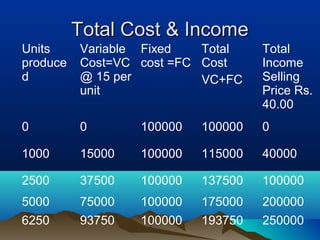
Total Cost & IncomeTotal Cost & Income
Units
produce
d
Variable
Cost=VC
@ 15 per
unit
Fixed
cost =FC
Total
Cost
VC+FC
Total
Income
Selling
Price Rs.
40.00
0 0 100000 100000 0
1000 15000 100000 115000 40000
2500 37500 100000 137500 100000
5000 75000 100000 175000 200000
6250 93750 100000 193750 250000
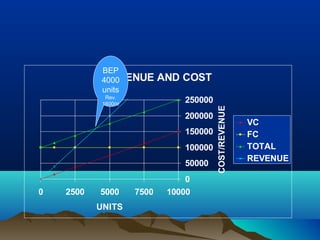
REVENUE AND COST
0
50000
100000
150000
200000
250000
0 2500 5000 7500 10000
UNITS
COST/REVENUE
VC
FC
TOTAL
REVENUE
BEP
4000
units
Rev.
160000
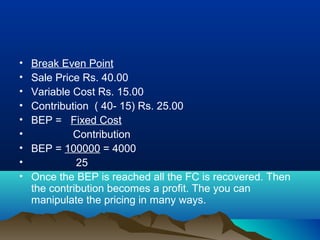
• Break Even Point
• Sale Price Rs. 40.00
• Variable Cost Rs. 15.00
• Contribution ( 40- 15) Rs. 25.00
• BEP = Fixed Cost
• Contribution
• BEP = 100000 = 4000
• 25
• Once the BEP is reached all the FC is recovered. Then
the contribution becomes a profit. The you can
manipulate the pricing in many ways.
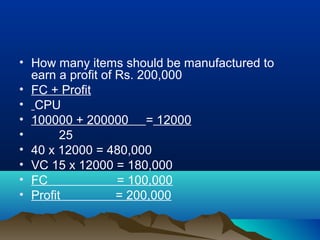
• How many items should be manufactured to
earn a profit of Rs. 200,000
• FC + Profit
• CPU
• 100000 + 200000 = 12000
• 25
• 40 x 12000 = 480,000
• VC 15 x 12000 = 180,000
• FC = 100,000
• Profit = 200,000
Now talkNow talk
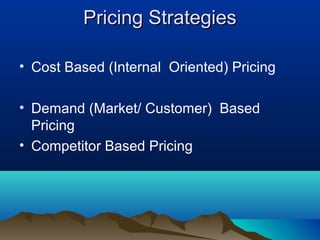
Pricing StrategiesPricing Strategies
• Cost Based (Internal Oriented) Pricing
• Demand (Market/ Customer) Based
Pricing
• Competitor Based Pricing
Cost or Company Oriented PricingCost or Company Oriented Pricing
• Cost plus pricing/ Mark up pricing. ( determine the sellers
total cost and then add a specified amount of percentage.
A company may have an idea of what profit it should
earn. Therefore after taking all internal cost factors into
consideration, this predetermined profit margin from the
cost will be added to the cost. It is called the mark up )
• . E.g. What would be the price of a product costing Rs.
16.00, if Markup on cost is 20%
• Mark up on cost : 16 x 1+.20 = 19.20
• Margin on sales price pricing
• The difference in this calculation is that
profit margin is based on sales price not
the cost of the product is given for
calculation
• Cost Rs. 16.00 calculate the price with a
mark up/ margin of 20% on sales
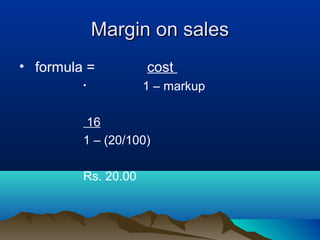
Margin on salesMargin on sales
• formula = cost
• 1 – markup
16
1 – (20/100)
Rs. 20.00
Customer Oriented PricingCustomer Oriented Pricing
StrategyStrategy
• Market Skimming ( innovative, inelastic
demand, high value, high demand and
low supply – e.g.. celltel)
• Market Penetrating( “mee too” products,
quick entry into market, greater volume to
achieve to get economies of scale, greater
market to catch)
• Psychological ( emotional factor, image,
quality e.g.. Bata 999.90 rather than Rs.
1000 , Rolex very high price and image)
• Value based ( customer perceived value,
find out how much customers are willing to pay
for the product through market research)
• Promotional Pricing Strategy ( Cash
rebates- Special event pricing- Loss leader
( setting low prices on certain items and attracting
customers and assuming they will by other products at
normal prices)- Low Interest Deals – Group Pricing
Competitor Oriented PricingCompetitor Oriented Pricing
• Competitive bid pricing( matching or improving
over the competitors price. Especially used in Tenders.
You need to know the market well and the requirements
of the customer well to quote price in this format)
• Competitive advantage pricing ( Price may be
the same but you offer additional services E.g. Petrol
shed offers free window cleaning for customer who
pump petrol in their station)
Now talkNow talk
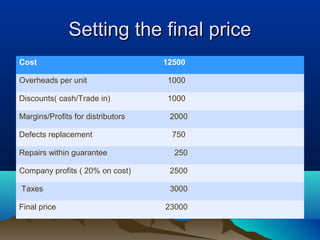
Setting the final priceSetting the final price
Cost 12500
Overheads per unit 1000
Discounts( cash/Trade in) 1000
Margins/Profits for distributors 2000
Defects replacement 750
Repairs within guarantee 250
Company profits ( 20% on cost) 2500
Taxes 3000
Final price 23000
Questions and Answers andQuestions and Answers and
Exam TechniqueExam Technique
Vibagayak Nethiwa Pass karanne nedda ?
Vibage fail vunath marketing karanna
puluwni !!!!!!
Hope u got the idea of pricingHope u got the idea of pricing
End
PCM GSS BK

Pricing the Revenue Maker

  • 1.
    PRICINGPRICING ( forSIKSIL 2017)( for SIKSIL 2017) Maxwell RanasingheMaxwell Ranasinghe B.Sc. ( Business Administration)B.Sc. ( Business Administration) Hons. MAAT, Attorney at Law,Hons. MAAT, Attorney at Law, CPM ( New Haven- USA)CPM ( New Haven- USA)
  • 2.
    PRICINGPRICING • IMPORTANCE OFPRICING • PRICING OBJECTIVES • FACTORS TO CONSIDER IN PRICING • CONCEPTS OF COSTING FOR PRICING • PRICING STRATEGIES • SETTING THE FINAL PRICE
  • 3.
    Pricing the revenuemakerPricing the revenue maker • The Price is the amount of money, goods or services that must be offered to get a product ( sum of all the values that consumers exchange for the benefit of having or using the product or service) • Price is expressed in different terms such as Rent, Tuition fees, fare, interest, premium, salary, taxes and commissions
  • 4.
    Role and importanceof pricingRole and importance of pricing - it generates income - it influences buyer - it is the most flexible - it could lead to gain or loose market - Customers often equate price with quality - Price connects customers and sellers at the point of exchange - Customers often use price to compare competing products - for certain products price could be main criteria in selection
  • 5.
    Pricing ObjectivesPricing Objectives •Financial Objectives • Profit - Return of investment • - Profit maximisation • Cash Flow • Sales and Marketing Objectives Market Share and Positioning Volume of sales Status Quo • Survival ( cover expenses in short run)
  • 6.
    Factors to beconsidered inFactors to be considered in pricingpricing • Cost of the product • Customers • Channel requirements • Competitors • Compatible with objective of the company & other Ps of M Mix • Legal aspects • Principals of Taxation
  • 7.
    Pricing should bein line withPricing should be in line with other elements of the marketingother elements of the marketing mixmix - The positioning of the product - Quality of the product - Distribution - Promotion - Persons involved in the product - Processes adopted - Physical evidence
  • 8.
  • 9.
    Concepts of SettingPricesConcepts of Setting Prices • Price Sensitivity- The general trend is that people are sensitive to prices on items that are purchased regularly and the items that cost a lot. They are less sensitive to prices on products that they do not buy regularly and to the items that cost less. • Estimating Demand Curves- This will allow the marketer to find out demand at different levels of pricing, charge different prices at different markets, offer discounts at selected outlets to find out the demand. • Price Elasticity of Demand- The percentage of demand that changes with the percentage of change in the price is elasticity of the demand. If price changes 10% and the demand changes at a higher rate ( e.g.. 20%) then the demand is elastic. If the price changes 10% and the demand changes at a lower rate ( e.g. 5%) then the demand is inelastic
  • 10.
    Concepts of costingfor pricingConcepts of costing for pricing • Cost and Levels of production- There are three types of cost that is Fixed Cost( FC) ,Variable Cost (VC) and Total Cost (TC) • Fixed Cost (FC) does not change with the increased production e.g. Rent, Rates and Loan Interest. • E.g. Monthly rent Rs. 100,000 will have to pay even if there is no production or even if there is a production of 10,000 units • Variable Cost (VC) • The cost that changes with the increased production. E.g.. Raw materials • Total Cost ( TC) • The sum of the FC and the VC
  • 11.
    • Contribution • Contributionis the amount that contributed by sales to recover the Fixed Cost when Variable Cost is deducted from the Sales Price. • Selling Price (Rs. 40) – Variable Cost ( Rs. 15)= Contribution (Rs. 25) • So the contribution will help a firm to find out many important aspects such as Break Even Point, how many should be manufactured to earn a given amount of profits etc,.
  • 12.
    Costing FormulasCosting Formulas •Fixed Cost (FC) • Selling Price (SP) • Contribution per unit (CPU)= SP-VC • Break Even Point= Income=Total Expenses( No profit or loss) • Units to BEP= FC/CPU • Units to Expected profit= FC+Profit/CPU
  • 13.
    Cost and PricesCostand Prices • A garment industry is sewing socks and the cost elements are as follows • Fixed Cost Rs. 100,000 • Variable Cost Rs. 15 per unit • Selling Price is Rs. 40.00 • What is the BEP ? • If the company wants to earn a profit of Rs. 200,000 how many units it should manufacture ?
  • 14.
    Variable costVariable cost Production- Units Cloths meter p/u Price Per meter Variable Cost 0 1.5 10 0 1000 1.5 10 15000 2500 1.5 10 37500 5000 1.5 10 75000 6250 1.5 10 93750
  • 15.
    Fixed CostFixed Cost Unitsproduced Fixed cost- e.g. Rent Total Fixed cost 0 100000 100000 1000 100000 100000 2500 100000 100000 5000 100000 100000 6250 100000 100000
  • 16.
    Total Cost &IncomeTotal Cost & Income Units produce d Variable Cost=VC @ 15 per unit Fixed cost =FC Total Cost VC+FC Total Income Selling Price Rs. 40.00 0 0 100000 100000 0 1000 15000 100000 115000 40000 2500 37500 100000 137500 100000 5000 75000 100000 175000 200000 6250 93750 100000 193750 250000
  • 17.
    REVENUE AND COST 0 50000 100000 150000 200000 250000 02500 5000 7500 10000 UNITS COST/REVENUE VC FC TOTAL REVENUE BEP 4000 units Rev. 160000
  • 18.
    • Break EvenPoint • Sale Price Rs. 40.00 • Variable Cost Rs. 15.00 • Contribution ( 40- 15) Rs. 25.00 • BEP = Fixed Cost • Contribution • BEP = 100000 = 4000 • 25 • Once the BEP is reached all the FC is recovered. Then the contribution becomes a profit. The you can manipulate the pricing in many ways.
  • 19.
    • How manyitems should be manufactured to earn a profit of Rs. 200,000 • FC + Profit • CPU • 100000 + 200000 = 12000 • 25 • 40 x 12000 = 480,000 • VC 15 x 12000 = 180,000 • FC = 100,000 • Profit = 200,000
  • 20.
  • 21.
    Pricing StrategiesPricing Strategies •Cost Based (Internal Oriented) Pricing • Demand (Market/ Customer) Based Pricing • Competitor Based Pricing
  • 22.
    Cost or CompanyOriented PricingCost or Company Oriented Pricing • Cost plus pricing/ Mark up pricing. ( determine the sellers total cost and then add a specified amount of percentage. A company may have an idea of what profit it should earn. Therefore after taking all internal cost factors into consideration, this predetermined profit margin from the cost will be added to the cost. It is called the mark up ) • . E.g. What would be the price of a product costing Rs. 16.00, if Markup on cost is 20% • Mark up on cost : 16 x 1+.20 = 19.20
  • 23.
    • Margin onsales price pricing • The difference in this calculation is that profit margin is based on sales price not the cost of the product is given for calculation • Cost Rs. 16.00 calculate the price with a mark up/ margin of 20% on sales
  • 24.
    Margin on salesMarginon sales • formula = cost • 1 – markup 16 1 – (20/100) Rs. 20.00
  • 25.
    Customer Oriented PricingCustomerOriented Pricing StrategyStrategy • Market Skimming ( innovative, inelastic demand, high value, high demand and low supply – e.g.. celltel) • Market Penetrating( “mee too” products, quick entry into market, greater volume to achieve to get economies of scale, greater market to catch) • Psychological ( emotional factor, image, quality e.g.. Bata 999.90 rather than Rs. 1000 , Rolex very high price and image)
  • 26.
    • Value based( customer perceived value, find out how much customers are willing to pay for the product through market research) • Promotional Pricing Strategy ( Cash rebates- Special event pricing- Loss leader ( setting low prices on certain items and attracting customers and assuming they will by other products at normal prices)- Low Interest Deals – Group Pricing
  • 27.
    Competitor Oriented PricingCompetitorOriented Pricing • Competitive bid pricing( matching or improving over the competitors price. Especially used in Tenders. You need to know the market well and the requirements of the customer well to quote price in this format) • Competitive advantage pricing ( Price may be the same but you offer additional services E.g. Petrol shed offers free window cleaning for customer who pump petrol in their station)
  • 28.
  • 29.
    Setting the finalpriceSetting the final price Cost 12500 Overheads per unit 1000 Discounts( cash/Trade in) 1000 Margins/Profits for distributors 2000 Defects replacement 750 Repairs within guarantee 250 Company profits ( 20% on cost) 2500 Taxes 3000 Final price 23000
  • 30.
    Questions and AnswersandQuestions and Answers and Exam TechniqueExam Technique Vibagayak Nethiwa Pass karanne nedda ? Vibage fail vunath marketing karanna puluwni !!!!!!
  • 31.
    Hope u gotthe idea of pricingHope u got the idea of pricing End PCM GSS BK