MARK4210, 2014 Spring, L1/L2
MARK4210: Strategic Marketing
2014 Spring, Section L1/L2
[Class #18]
Promotion Strategies
2
MARK4210, 2014 Spring, L1/L2
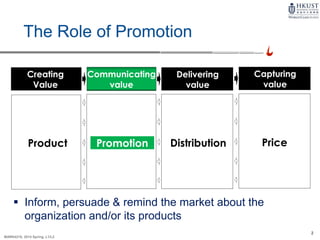
Communicating
Promotion
Communicating
value
Creating
Value
Product Price
Capturing
value
Distribution
Delivering
value
The Role of Promotion
 Inform, persuade & remind the market about the
organization and/or its products
3
MARK4210, 2014 Spring, L1/L2
Promotional Mix Elements
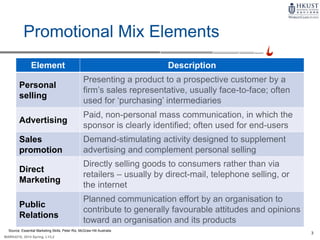
Element Description
Personal
selling
Presenting a product to a prospective customer by a
firm’s sales representative, usually face-to-face; often
used for ‘purchasing’ intermediaries
Advertising
Paid, non-personal mass communication, in which the
sponsor is clearly identified; often used for end-users
Sales
promotion
Demand-stimulating activity designed to supplement
advertising and complement personal selling
Direct
Marketing
Directly selling goods to consumers rather than via
retailers – usually by direct-mail, telephone selling, or
the internet
Public
Relations
Planned communication effort by an organisation to
contribute to generally favourable attitudes and opinions
toward an organisation and its products
Source: Essential Marketing Skills, Peter Rix, McGraw Hill Australia
4
MARK4210, 2014 Spring, L1/L2
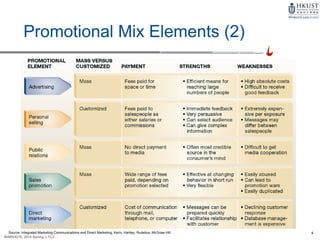
Promotional Mix Elements (2)
Source: Integrated Marketing Communications and Direct Marketing, Kerin, Hartley, Rudelius, McGraw-Hill
5
MARK4210, 2014 Spring, L1/L2
9-5
Choosing the Right Promotional
Element – Considerations (1)
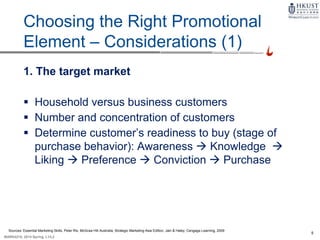
1. The target market
 Household versus business customers
 Number and concentration of customers
 Determine customer’s readiness to buy (stage of
purchase behavior): Awareness  Knowledge 
Liking  Preference  Conviction  Purchase
Sources: Essential Marketing Skills, Peter Rix, McGraw Hill Australia; Strategic Marketing Asia Edition, Jain & Haley, Cengage Learning, 2009
6
MARK4210, 2014 Spring, L1/L2
9-5
Choosing the Right Promotional
Element – Considerations (2)
2. The nature of the product
 Durable versus non-durable
 Unit value of the product (purchase amount)
 Amount of product customization
 Amount of pre-sale and post-sale service required
 Perceived risks
Sources: Essential Marketing Skills, Peter Rix, McGraw Hill Australia; Strategic Marketing Asia Edition, Jain & Haley, Cengage Learning, 2009
7
MARK4210, 2014 Spring, L1/L2
9-5
Choosing the Right Promotional
Element – Considerations (3)
3. The stage of the product’s life cycle
 Market share
 Industry concentration
 Intensity of competition
 Product demand
4. Budget
Sources: Essential Marketing Skills, Peter Rix, McGraw Hill Australia; Strategic Marketing Asia Edition, Jain & Haley, Cengage Learning, 2009
8
MARK4210, 2014 Spring, L1/L2
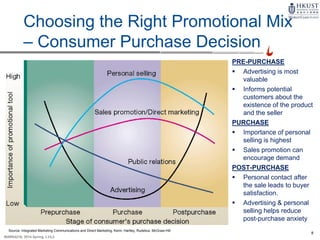
Choosing the Right Promotional Mix
– Consumer Purchase Decision
PRE-PURCHASE
 Advertising is most
valuable
 Informs potential
customers about the
existence of the product
and the seller
PURCHASE
 Importance of personal
selling is highest
 Sales promotion can
encourage demand
POST-PURCHASE
 Personal contact after
the sale leads to buyer
satisfaction.
 Advertising & personal
selling helps reduce
post-purchase anxiety
Source: Integrated Marketing Communications and Direct Marketing, Kerin, Hartley, Rudelius, McGraw-Hill
9
MARK4210, 2014 Spring, L1/L2
9-8
Push vs. Pull Strategy: Push
Strategy Characteristics
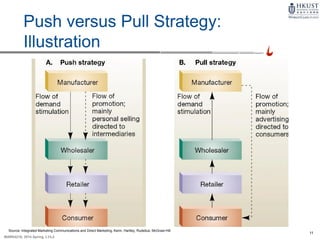
 Producer creates demand for product
 Aims promotional activity to channel member(s)
 Each channel member promotes to next channel
member
 Demand ‘pushed’ down distribution channel
 Consumer influenced by retailer’s advertising
Source: Essential Marketing Skills, Peter Rix, McGraw Hill Australia
10
MARK4210, 2014 Spring, L1/L2
Push vs. Pull Strategy: Pull Strategy
Characteristics
 Producer creates demand for product
 Aims promotional activity directly at the consumer
 Consumer demands product from retailer
 Demand ‘pulled’ up the distribution channel
Source: Essential Marketing Skills, Peter Rix, McGraw Hill Australia
11
MARK4210, 2014 Spring, L1/L2
Push versus Pull Strategy:
Illustration
Source: Integrated Marketing Communications and Direct Marketing, Kerin, Hartley, Rudelius, McGraw-Hill
12
MARK4210, 2014 Spring, L1/L2
Push vs. Pull Strategy:
Considerations on When to Use
 Degree of brand loyalty
 Degree of brand differentiation
 Purchase behavior – planned or impulsive
 Whether sales assistance is needed in making the
choice/ purchase
Source: Marketing Management, Kotler & Keller, Pearson, 2012
13
MARK4210, 2014 Spring, L1/L2
Setting the Promotional Budget
 Percentage of sales method
• Determine past or anticipated sales and apply a
percentage
 All available funds (or what can be afforded)
• Use all available funds on the promotional campaign
 Competitive Parity
• Match competition – promotions based on market share
of competitors, or actual expenditure if known
 Task or objective method (build-up)
• Determine needed promotion tasks or objectives
• Determine cost to perform tasks or meet objective
Source: Essential Marketing Skills, Peter Rix, McGraw Hill Australia
14
MARK4210, 2014 Spring, L1/L2
Personal Selling: Sales Force
Strategic Considerations
 Priority/emphasis between maintaining existing
accounts versus converting new customers
 Increasing sales force productivity, e.g., leveraging
technology and innovative sales techniques
 Targeting the ‘right’ people in the customer
organization
 Sales force size
 Sales force motivation (financial, non-financial
incentives)
 Sales force supervision – includes territory
assignment, control, and communication
Source: Strategic Marketing Asia Edition, Jain & Haley, Cengage Learning, 2009
15
MARK4210, 2014 Spring, L1/L2
Advertising: Types
 Consumer versus business advertising
 Emotional & rational vs informational
 Product versus institutional advertising
 Focus on particular product or brand, and
information and goodwill to company
 Stimulate demand for generic or specific brands
 Primary-demand versus selective-demand (brand)
advertising
Source: Essential Marketing Skills, Peter Rix, McGraw Hill Australia
16
MARK4210, 2014 Spring, L1/L2
Advertising and the Product Life
Cycle
 Informative advertising
• Build initial demand during introductory phase of life cycle
 Persuasive advertising
• Improve the competitive status of a product, usually
during growth and maturity stages of product life cycle
 Comparative advertising
• Compares products directly with their competitors
 Reminder-oriented advertising
• Maintain awareness of the importance and usefulness of
a product, especially during late maturity or decline
stages of product life cycle
Source: Contemporary Business, David L. Kurtz, Louis E. Boone, Cengage Learning, 2009
17
MARK4210, 2014 Spring, L1/L2
Advertising: Measuring Effectiveness
 Direct tests
• Measure or predict the sales volume stemming from an
advertising campaign
• Tabulate number of inquiries from a direct-response
campaign
 Indirect tests
• Measures something other than actual sales (e.g., recall
tests)
Source: Essential Marketing Skills, Peter Rix, McGraw Hill Australia
18
MARK4210, 2014 Spring, L1/L2
Sales Promotions: Considerations
 What are our promotional objectives?
 Who is our target market?
 Can our product be sampled?
 What will it cost to use the right promotional tool?
 What is the current economic condition?
Source: Essential Marketing Skills, Peter Rix, McGraw Hill Australia
19
MARK4210, 2014 Spring, L1/L2
Sales Promotions: Consumer-
oriented
 Premiums, Coupons, Rebates, Samples
• Coupons attract customers but focus on price rather than
brand loyalty
• Rebates increase purchase rates, promote multiple
purchases, and reward product users
 Games, Contests, and Sweepstakes
• Introduction of new products
• Subject to legal restrictions
 Specialty Advertising
• Gift of useful merchandise carrying the name, logo, or
slogan of an organization
Source: Contemporary Business, David L. Kurtz, Louis E. Boone, Cengage Learning, 2009
20
MARK4210, 2014 Spring, L1/L2
Sales Promotions: Trade-oriented
 Sales promotions geared to distribution
intermediaries (NOT consumers)
 Objectives:
• To encourage stocking of new products
• To encourage continued stocking of existing products
• To encourage (sometimes “pressure”) intermediaries to
promote products to consumers
Source: Contemporary Business, David L. Kurtz, Louis E. Boone, Cengage Learning, 2009
21
MARK4210, 2014 Spring, L1/L2
Public Relations: Examples
 Supporting charitable projects
 Supplying volunteers or other resources
 Participating in community-service events
 Sponsorship
 Providing information to customers via newsletters.
 Publicity can be achieved by:
• structured news-release to the media
• coordinating personal communication with a group
• coordinating one-to-one personal communication
(lobbying)
Source: Essential Marketing Skills, Peter Rix, McGraw Hill Australia
22
MARK4210, 2014 Spring, L1/L2
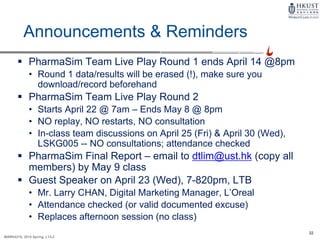
Announcements & Reminders
 PharmaSim Team Live Play Round 1 ends April 14 @8pm
• Round 1 data/results will be erased (!), make sure you
download/record beforehand
 PharmaSim Team Live Play Round 2
• Starts April 22 @ 7am – Ends May 8 @ 8pm
• NO replay, NO restarts, NO consultation
• In-class team discussions on April 25 (Fri) & April 30 (Wed),
LSKG005 -- NO consultations; attendance checked
 PharmaSim Final Report – email to dtlim@ust.hk (copy all
members) by May 9 class
 Guest Speaker on April 23 (Wed), 7-820pm, LTB
• Mr. Larry CHAN, Digital Marketing Manager, L’Oreal
• Attendance checked (or valid documented excuse)
• Replaces afternoon session (no class)

promotion strategies(4210)

  • 1.
    MARK4210, 2014 Spring,L1/L2 MARK4210: Strategic Marketing 2014 Spring, Section L1/L2 [Class #18] Promotion Strategies
  • 2.
    2 MARK4210, 2014 Spring,L1/L2 Communicating Promotion Communicating value Creating Value Product Price Capturing value Distribution Delivering value The Role of Promotion  Inform, persuade & remind the market about the organization and/or its products
  • 3.
    3 MARK4210, 2014 Spring,L1/L2 Promotional Mix Elements Element Description Personal selling Presenting a product to a prospective customer by a firm’s sales representative, usually face-to-face; often used for ‘purchasing’ intermediaries Advertising Paid, non-personal mass communication, in which the sponsor is clearly identified; often used for end-users Sales promotion Demand-stimulating activity designed to supplement advertising and complement personal selling Direct Marketing Directly selling goods to consumers rather than via retailers – usually by direct-mail, telephone selling, or the internet Public Relations Planned communication effort by an organisation to contribute to generally favourable attitudes and opinions toward an organisation and its products Source: Essential Marketing Skills, Peter Rix, McGraw Hill Australia
  • 4.
    4 MARK4210, 2014 Spring,L1/L2 Promotional Mix Elements (2) Source: Integrated Marketing Communications and Direct Marketing, Kerin, Hartley, Rudelius, McGraw-Hill
  • 5.
    5 MARK4210, 2014 Spring,L1/L2 9-5 Choosing the Right Promotional Element – Considerations (1) 1. The target market  Household versus business customers  Number and concentration of customers  Determine customer’s readiness to buy (stage of purchase behavior): Awareness  Knowledge  Liking  Preference  Conviction  Purchase Sources: Essential Marketing Skills, Peter Rix, McGraw Hill Australia; Strategic Marketing Asia Edition, Jain & Haley, Cengage Learning, 2009
  • 6.
    6 MARK4210, 2014 Spring,L1/L2 9-5 Choosing the Right Promotional Element – Considerations (2) 2. The nature of the product  Durable versus non-durable  Unit value of the product (purchase amount)  Amount of product customization  Amount of pre-sale and post-sale service required  Perceived risks Sources: Essential Marketing Skills, Peter Rix, McGraw Hill Australia; Strategic Marketing Asia Edition, Jain & Haley, Cengage Learning, 2009
  • 7.
    7 MARK4210, 2014 Spring,L1/L2 9-5 Choosing the Right Promotional Element – Considerations (3) 3. The stage of the product’s life cycle  Market share  Industry concentration  Intensity of competition  Product demand 4. Budget Sources: Essential Marketing Skills, Peter Rix, McGraw Hill Australia; Strategic Marketing Asia Edition, Jain & Haley, Cengage Learning, 2009
  • 8.
    8 MARK4210, 2014 Spring,L1/L2 Choosing the Right Promotional Mix – Consumer Purchase Decision PRE-PURCHASE  Advertising is most valuable  Informs potential customers about the existence of the product and the seller PURCHASE  Importance of personal selling is highest  Sales promotion can encourage demand POST-PURCHASE  Personal contact after the sale leads to buyer satisfaction.  Advertising & personal selling helps reduce post-purchase anxiety Source: Integrated Marketing Communications and Direct Marketing, Kerin, Hartley, Rudelius, McGraw-Hill
  • 9.
    9 MARK4210, 2014 Spring,L1/L2 9-8 Push vs. Pull Strategy: Push Strategy Characteristics  Producer creates demand for product  Aims promotional activity to channel member(s)  Each channel member promotes to next channel member  Demand ‘pushed’ down distribution channel  Consumer influenced by retailer’s advertising Source: Essential Marketing Skills, Peter Rix, McGraw Hill Australia
  • 10.
    10 MARK4210, 2014 Spring,L1/L2 Push vs. Pull Strategy: Pull Strategy Characteristics  Producer creates demand for product  Aims promotional activity directly at the consumer  Consumer demands product from retailer  Demand ‘pulled’ up the distribution channel Source: Essential Marketing Skills, Peter Rix, McGraw Hill Australia
  • 11.
    11 MARK4210, 2014 Spring,L1/L2 Push versus Pull Strategy: Illustration Source: Integrated Marketing Communications and Direct Marketing, Kerin, Hartley, Rudelius, McGraw-Hill
  • 12.
    12 MARK4210, 2014 Spring,L1/L2 Push vs. Pull Strategy: Considerations on When to Use  Degree of brand loyalty  Degree of brand differentiation  Purchase behavior – planned or impulsive  Whether sales assistance is needed in making the choice/ purchase Source: Marketing Management, Kotler & Keller, Pearson, 2012
  • 13.
    13 MARK4210, 2014 Spring,L1/L2 Setting the Promotional Budget  Percentage of sales method • Determine past or anticipated sales and apply a percentage  All available funds (or what can be afforded) • Use all available funds on the promotional campaign  Competitive Parity • Match competition – promotions based on market share of competitors, or actual expenditure if known  Task or objective method (build-up) • Determine needed promotion tasks or objectives • Determine cost to perform tasks or meet objective Source: Essential Marketing Skills, Peter Rix, McGraw Hill Australia
  • 14.
    14 MARK4210, 2014 Spring,L1/L2 Personal Selling: Sales Force Strategic Considerations  Priority/emphasis between maintaining existing accounts versus converting new customers  Increasing sales force productivity, e.g., leveraging technology and innovative sales techniques  Targeting the ‘right’ people in the customer organization  Sales force size  Sales force motivation (financial, non-financial incentives)  Sales force supervision – includes territory assignment, control, and communication Source: Strategic Marketing Asia Edition, Jain & Haley, Cengage Learning, 2009
  • 15.
    15 MARK4210, 2014 Spring,L1/L2 Advertising: Types  Consumer versus business advertising  Emotional & rational vs informational  Product versus institutional advertising  Focus on particular product or brand, and information and goodwill to company  Stimulate demand for generic or specific brands  Primary-demand versus selective-demand (brand) advertising Source: Essential Marketing Skills, Peter Rix, McGraw Hill Australia
  • 16.
    16 MARK4210, 2014 Spring,L1/L2 Advertising and the Product Life Cycle  Informative advertising • Build initial demand during introductory phase of life cycle  Persuasive advertising • Improve the competitive status of a product, usually during growth and maturity stages of product life cycle  Comparative advertising • Compares products directly with their competitors  Reminder-oriented advertising • Maintain awareness of the importance and usefulness of a product, especially during late maturity or decline stages of product life cycle Source: Contemporary Business, David L. Kurtz, Louis E. Boone, Cengage Learning, 2009
  • 17.
    17 MARK4210, 2014 Spring,L1/L2 Advertising: Measuring Effectiveness  Direct tests • Measure or predict the sales volume stemming from an advertising campaign • Tabulate number of inquiries from a direct-response campaign  Indirect tests • Measures something other than actual sales (e.g., recall tests) Source: Essential Marketing Skills, Peter Rix, McGraw Hill Australia
  • 18.
    18 MARK4210, 2014 Spring,L1/L2 Sales Promotions: Considerations  What are our promotional objectives?  Who is our target market?  Can our product be sampled?  What will it cost to use the right promotional tool?  What is the current economic condition? Source: Essential Marketing Skills, Peter Rix, McGraw Hill Australia
  • 19.
    19 MARK4210, 2014 Spring,L1/L2 Sales Promotions: Consumer- oriented  Premiums, Coupons, Rebates, Samples • Coupons attract customers but focus on price rather than brand loyalty • Rebates increase purchase rates, promote multiple purchases, and reward product users  Games, Contests, and Sweepstakes • Introduction of new products • Subject to legal restrictions  Specialty Advertising • Gift of useful merchandise carrying the name, logo, or slogan of an organization Source: Contemporary Business, David L. Kurtz, Louis E. Boone, Cengage Learning, 2009
  • 20.
    20 MARK4210, 2014 Spring,L1/L2 Sales Promotions: Trade-oriented  Sales promotions geared to distribution intermediaries (NOT consumers)  Objectives: • To encourage stocking of new products • To encourage continued stocking of existing products • To encourage (sometimes “pressure”) intermediaries to promote products to consumers Source: Contemporary Business, David L. Kurtz, Louis E. Boone, Cengage Learning, 2009
  • 21.
    21 MARK4210, 2014 Spring,L1/L2 Public Relations: Examples  Supporting charitable projects  Supplying volunteers or other resources  Participating in community-service events  Sponsorship  Providing information to customers via newsletters.  Publicity can be achieved by: • structured news-release to the media • coordinating personal communication with a group • coordinating one-to-one personal communication (lobbying) Source: Essential Marketing Skills, Peter Rix, McGraw Hill Australia
  • 22.
    22 MARK4210, 2014 Spring,L1/L2 Announcements & Reminders  PharmaSim Team Live Play Round 1 ends April 14 @8pm • Round 1 data/results will be erased (!), make sure you download/record beforehand  PharmaSim Team Live Play Round 2 • Starts April 22 @ 7am – Ends May 8 @ 8pm • NO replay, NO restarts, NO consultation • In-class team discussions on April 25 (Fri) & April 30 (Wed), LSKG005 -- NO consultations; attendance checked  PharmaSim Final Report – email to dtlim@ust.hk (copy all members) by May 9 class  Guest Speaker on April 23 (Wed), 7-820pm, LTB • Mr. Larry CHAN, Digital Marketing Manager, L’Oreal • Attendance checked (or valid documented excuse) • Replaces afternoon session (no class)