METHODS OF PRICING
Group 10 | Marketing Management II
26 November 2015
Submitted By-
Rohit Kawade (133)
Simmy S Nigam(135)
Swagat debbarma(137)
Debojyoti Sanyal(141)
Anurag Sarode(143)
Abhishek Tigga (145)
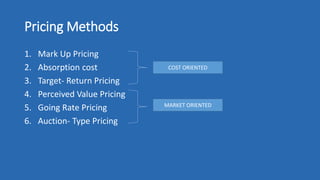
Pricing Methods
1. Mark Up Pricing
2. Absorption cost
3. Target- Return Pricing
4. Perceived Value Pricing
5. Going Rate Pricing
6. Auction- Type Pricing
COST ORIENTED
MARKET ORIENTED
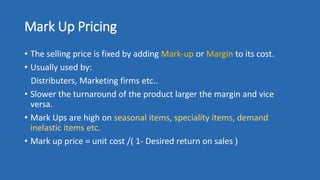
Mark Up Pricing
• The selling price is fixed by adding Mark-up or Margin to its cost.
• Usually used by:
Distributers, Marketing firms etc..
• Slower the turnaround of the product larger the margin and vice
versa.
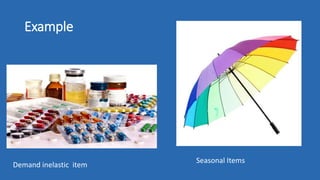
• Mark Ups are high on seasonal items, speciality items, demand
inelastic items etc.
• Mark up price = unit cost /( 1- Desired return on sales )
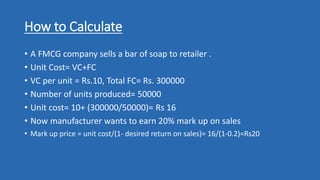
How to Calculate
• A FMCG company sells a bar of soap to retailer .
• Unit Cost= VC+FC
• VC per unit = Rs.10, Total FC= Rs. 300000
• Number of units produced= 50000
• Unit cost= 10+ (300000/50000)= Rs 16
• Now manufacturer wants to earn 20% mark up on sales
• Mark up price = unit cost/(1- desired return on sales)= 16/(1-0.2)=Rs20
Example
Demand inelastic item
Seasonal Items
Example
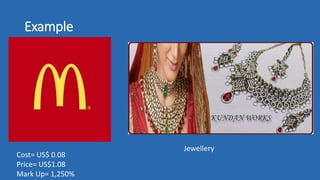
Cost= US$ 0.08
Price= US$1.08
Mark Up= 1,250%
Jewellery
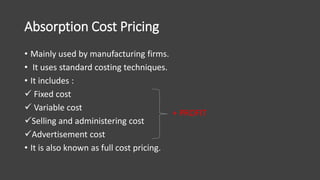
Absorption Cost Pricing
• Mainly used by manufacturing firms.
• It uses standard costing techniques.
• It includes :
 Fixed cost
 Variable cost
Selling and administering cost
Advertisement cost
• It is also known as full cost pricing.
+ PROFIT
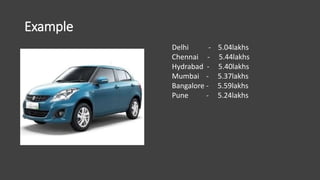
Example
Delhi - 5.04lakhs
Chennai - 5.44lakhs
Hydrabad - 5.40lakhs
Mumbai - 5.37lakhs
Bangalore - 5.59lakhs
Pune - 5.24lakhs
Target –Return Pricing
• Similar to Absorption cost pricing.
• The difference is in fixing the profit margin.
• The profit margin/ mark up is fixed by considering the ROI.
• Firm will have return objectives, like 5% of invested capital, or 10% of
sales revenue.
• Then you arrange your price structure so as to achieve these target
rates of return.
• Market leaders or monopolists uses this pricing strategy.
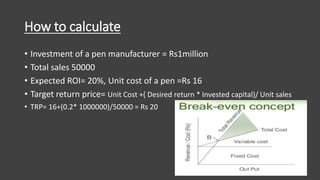
How to calculate
• Investment of a pen manufacturer = Rs1million
• Total sales 50000
• Expected ROI= 20%, Unit cost of a pen =Rs 16
• Target return price= Unit Cost +( Desired return * Invested capital)/ Unit sales
• TRP= 16+(0.2* 1000000)/50000 = Rs 20
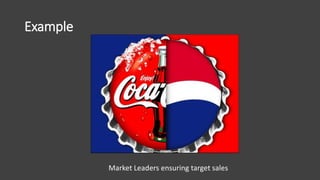
Example
Market Leaders ensuring target sales
Example
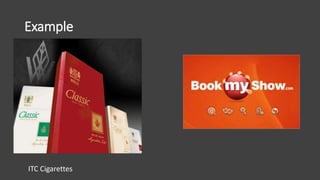
ITC Cigarettes
Perceived Value Pricing
• Pricing on Perception
• To increase prices without damaging customer relationships is by
adding to the perceived value of your product or service
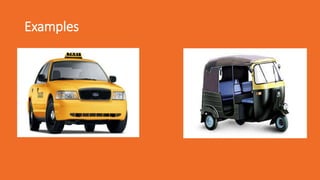
Examples
Examples
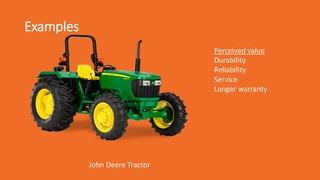
John Deere Tractor
Perceived value
Durability
Reliability
Service
Longer warranty
Examples
Going Rate Pricing
• Setting a price based on market price basis.
• Used for homogenous products/ Oligopolistic market
• Costs are difficult to measure/competitive response is uncertain
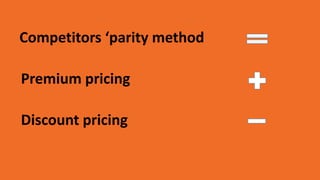
Competitors ‘parity method
Premium pricing
Discount pricing
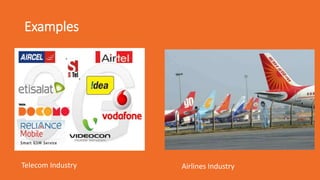
Examples
Telecom Industry Airlines Industry
Examples
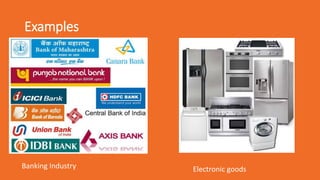
Banking Industry Electronic goods
Auction Type Pricing
• electronic market places are selling a diverse range of products to dispose of
inventories and goods
• Three major types of auctions-
English Auctions (one seller many buyers)
Dutch auctions (one seller many buyers and vice versa)
Sealed bid Auctions (supplier submit only 1 bid) Example- Government
Biddings
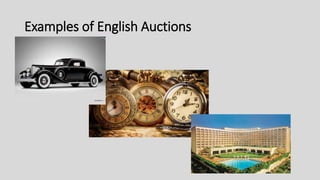
Examples of English Auctions
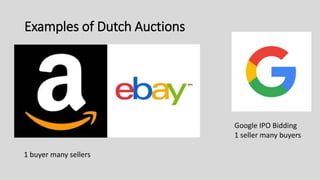
Examples of Dutch Auctions
1 buyer many sellers
Google IPO Bidding
1 seller many buyers
Thank You!!!

Methods of pricing

  • 1.
    METHODS OF PRICING Group10 | Marketing Management II 26 November 2015 Submitted By- Rohit Kawade (133) Simmy S Nigam(135) Swagat debbarma(137) Debojyoti Sanyal(141) Anurag Sarode(143) Abhishek Tigga (145)
  • 2.
    Pricing Methods 1. MarkUp Pricing 2. Absorption cost 3. Target- Return Pricing 4. Perceived Value Pricing 5. Going Rate Pricing 6. Auction- Type Pricing COST ORIENTED MARKET ORIENTED
  • 3.
    Mark Up Pricing •The selling price is fixed by adding Mark-up or Margin to its cost. • Usually used by: Distributers, Marketing firms etc.. • Slower the turnaround of the product larger the margin and vice versa. • Mark Ups are high on seasonal items, speciality items, demand inelastic items etc. • Mark up price = unit cost /( 1- Desired return on sales )
  • 4.
    How to Calculate •A FMCG company sells a bar of soap to retailer . • Unit Cost= VC+FC • VC per unit = Rs.10, Total FC= Rs. 300000 • Number of units produced= 50000 • Unit cost= 10+ (300000/50000)= Rs 16 • Now manufacturer wants to earn 20% mark up on sales • Mark up price = unit cost/(1- desired return on sales)= 16/(1-0.2)=Rs20
  • 5.
  • 6.
    Example Cost= US$ 0.08 Price=US$1.08 Mark Up= 1,250% Jewellery
  • 7.
    Absorption Cost Pricing •Mainly used by manufacturing firms. • It uses standard costing techniques. • It includes :  Fixed cost  Variable cost Selling and administering cost Advertisement cost • It is also known as full cost pricing. + PROFIT
  • 8.
    Example Delhi - 5.04lakhs Chennai- 5.44lakhs Hydrabad - 5.40lakhs Mumbai - 5.37lakhs Bangalore - 5.59lakhs Pune - 5.24lakhs
  • 9.
    Target –Return Pricing •Similar to Absorption cost pricing. • The difference is in fixing the profit margin. • The profit margin/ mark up is fixed by considering the ROI. • Firm will have return objectives, like 5% of invested capital, or 10% of sales revenue. • Then you arrange your price structure so as to achieve these target rates of return. • Market leaders or monopolists uses this pricing strategy.
  • 10.
    How to calculate •Investment of a pen manufacturer = Rs1million • Total sales 50000 • Expected ROI= 20%, Unit cost of a pen =Rs 16 • Target return price= Unit Cost +( Desired return * Invested capital)/ Unit sales • TRP= 16+(0.2* 1000000)/50000 = Rs 20
  • 11.
  • 12.
  • 13.
    Perceived Value Pricing •Pricing on Perception • To increase prices without damaging customer relationships is by adding to the perceived value of your product or service
  • 14.
  • 15.
    Examples John Deere Tractor Perceivedvalue Durability Reliability Service Longer warranty
  • 16.
  • 17.
    Going Rate Pricing •Setting a price based on market price basis. • Used for homogenous products/ Oligopolistic market • Costs are difficult to measure/competitive response is uncertain
  • 18.
    Competitors ‘parity method Premiumpricing Discount pricing
  • 19.
  • 20.
  • 21.
    Auction Type Pricing •electronic market places are selling a diverse range of products to dispose of inventories and goods • Three major types of auctions- English Auctions (one seller many buyers) Dutch auctions (one seller many buyers and vice versa) Sealed bid Auctions (supplier submit only 1 bid) Example- Government Biddings
  • 22.
  • 23.
    Examples of DutchAuctions 1 buyer many sellers Google IPO Bidding 1 seller many buyers
  • 24.