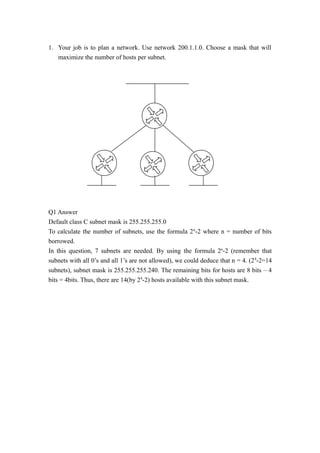
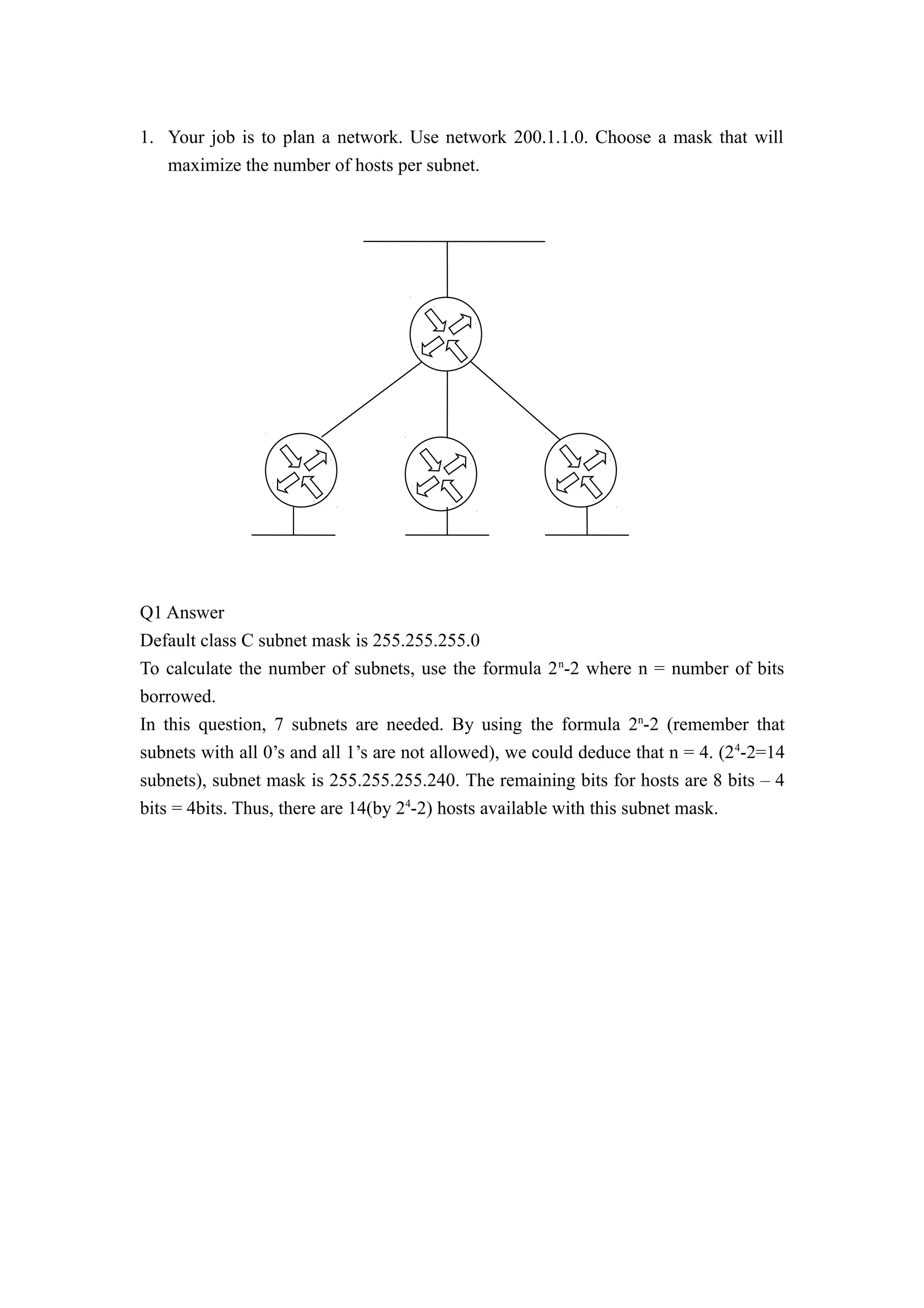
1. Your job is to plan a network. Use network 200.1.1.0. Choose a mask that will
maximize the number of hosts per subnet.
Q1 Answer
Default class C subnet mask is 255.255.255.0
To calculate the number of subnets, use the formula 2n
-2 where n = number of bits
borrowed.
In this question, 7 subnets are needed. By using the formula 2n
-2 (remember that
subnets with all 0’s and all 1’s are not allowed), we could deduce that n = 4. (24
-2=14
subnets), subnet mask is 255.255.255.240. The remaining bits for hosts are 8 bits – 4
bits = 4bits. Thus, there are 14(by 24
-2) hosts available with this subnet mask.
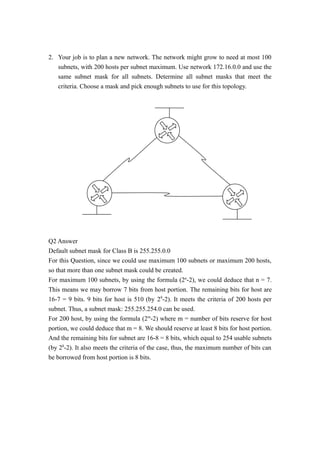
2. Your job is to plan a new network. The network might grow to need at most 100
subnets, with 200 hosts per subnet maximum. Use network 172.16.0.0 and use the
same subnet mask for all subnets. Determine all subnet masks that meet the
criteria. Choose a mask and pick enough subnets to use for this topology.
Q2 Answer
Default subnet mask for Class B is 255.255.0.0
For this Question, since we could use maximum 100 subnets or maximum 200 hosts,
so that more than one subnet mask could be created.
For maximum 100 subnets, by using the formula (2n
-2), we could deduce that n = 7.
This means we may borrow 7 bits from host portion. The remaining bits for host are
16-7 = 9 bits. 9 bits for host is 510 (by 29
-2). It meets the criteria of 200 hosts per
subnet. Thus, a subnet mask: 255.255.254.0 can be used.
For 200 host, by using the formula (2m
-2) where m = number of bits reserve for host
portion, we could deduce that m = 8. We should reserve at least 8 bits for host portion.
And the remaining bits for subnet are 16-8 = 8 bits, which equal to 254 usable subnets
(by 28
-2). It also meets the criteria of the case, thus, the maximum number of bits can
be borrowed from host portion is 8 bits.
3. Your school acquired a class B address, 178.13.0.0. You need to create a
subnetting scheme to provide the following:
 40 subnets with each subnet 220 hosts
 24 subnets with each subnet 90 hosts
 15 subnets with each subnet 80 hosts
What is the minimum and maximum number of bits can be borrowed?
Q3 Answer
A class B network is used: 178.13.0.0, default subnet mask is 255.255.0.0
Here we have 40+24+15 (79) subnets in our network and the maximum number of
hosts in a subnet are 220.
For 79 subnets, by using the formula (2n
-2), we could deduce that n = 7. The
remaining bits for host are 16-7 = 9 bits, which equal to 510 usable hosts (by 29
-2). It
meets the criteria: 79 subnets and 220 host per subnet, and so the minimum number of
bits can be borrowed from host portion is 7 bits.
For 220 host, by using the formula (2m
-2), we could deduce that m = 8. We should
reserve at least 8 bits for host portion. And the remaining bits for subnet are 16-8 = 8
bits, which equal to 254 usable subnets (by 28
-2). It also meets the criteria of the case,
thus, the maximum number of bits can be borrowed from host portion is 8 bits.
4. In a class C network 192.5.12.0 with subnet mask 255.255.255.224, to which
subnet would host 192.5.12.135 belong?
Q4 Answer
Class C network 192.5.12.0 with subnet mask 255.255.255.224
Convert the last octet from the IP address 192.5.12.135, we have 10000111, as the
first 3 bits is the subnet ID (224 in decimal = 11100000 in binary). By using ANDing
operation, we find that this IP address should belong to subnetwork 10000000 (the
last octet in binary) or 192.5.12.128.
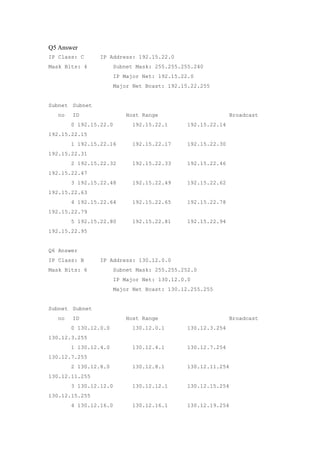
Q5 Answer
IP Class: C IP Address: 192.15.22.0
Mask Bits: 4 Subnet Mask: 255.255.255.240
IP Major Net: 192.15.22.0
Major Net Bcast: 192.15.22.255
Subnet Subnet
no ID Host Range Broadcast
0 192.15.22.0 192.15.22.1 192.15.22.14
192.15.22.15
1 192.15.22.16 192.15.22.17 192.15.22.30
192.15.22.31
2 192.15.22.32 192.15.22.33 192.15.22.46
192.15.22.47
3 192.15.22.48 192.15.22.49 192.15.22.62
192.15.22.63
4 192.15.22.64 192.15.22.65 192.15.22.78
192.15.22.79
5 192.15.22.80 192.15.22.81 192.15.22.94
192.15.22.95
Q6 Answer
IP Class: B IP Address: 130.12.0.0
Mask Bits: 6 Subnet Mask: 255.255.252.0
IP Major Net: 130.12.0.0
Major Net Bcast: 130.12.255.255
Subnet Subnet
no ID Host Range Broadcast
0 130.12.0.0 130.12.0.1 130.12.3.254
130.12.3.255
1 130.12.4.0 130.12.4.1 130.12.7.254
130.12.7.255
2 130.12.8.0 130.12.8.1 130.12.11.254
130.12.11.255
3 130.12.12.0 130.12.12.1 130.12.15.254
130.12.15.255
4 130.12.16.0 130.12.16.1 130.12.19.254
130.12.19.255
5 130.12.20.0 130.12.20.1 130.12.23.254
130.12.23.255
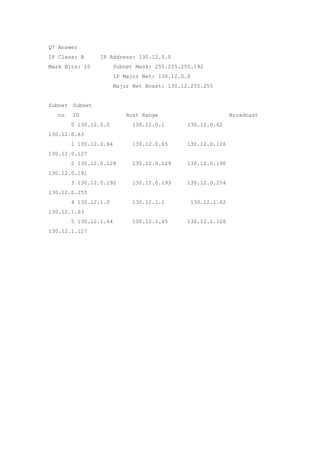
Q7 Answer
IP Class: B IP Address: 130.12.0.0
Mask Bits: 10 Subnet Mask: 255.255.255.192
IP Major Net: 130.12.0.0
Major Net Bcast: 130.12.255.255
Subnet Subnet
no ID Host Range Broadcast
0 130.12.0.0 130.12.0.1 130.12.0.62
130.12.0.63
1 130.12.0.64 130.12.0.65 130.12.0.126
130.12.0.127
2 130.12.0.128 130.12.0.129 130.12.0.190
130.12.0.191
3 130.12.0.192 130.12.0.193 130.12.0.254
130.12.0.255
4 130.12.1.0 130.12.1.1 130.12.1.62
130.12.1.63
5 130.12.1.64 130.12.1.65 130.12.1.126
130.12.1.127
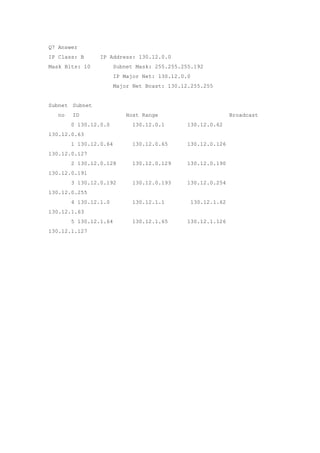
Q7 Answer
IP Class: B IP Address: 130.12.0.0
Mask Bits: 10 Subnet Mask: 255.255.255.192
IP Major Net: 130.12.0.0
Major Net Bcast: 130.12.255.255
Subnet Subnet
no ID Host Range Broadcast
0 130.12.0.0 130.12.0.1 130.12.0.62
130.12.0.63
1 130.12.0.64 130.12.0.65 130.12.0.126
130.12.0.127
2 130.12.0.128 130.12.0.129 130.12.0.190
130.12.0.191
3 130.12.0.192 130.12.0.193 130.12.0.254
130.12.0.255
4 130.12.1.0 130.12.1.1 130.12.1.62
130.12.1.63
5 130.12.1.64 130.12.1.65 130.12.1.126
130.12.1.127

Subnet questions with ans(networking)

  • 1.
    1. Your jobis to plan a network. Use network 200.1.1.0. Choose a mask that will maximize the number of hosts per subnet. Q1 Answer Default class C subnet mask is 255.255.255.0 To calculate the number of subnets, use the formula 2n -2 where n = number of bits borrowed. In this question, 7 subnets are needed. By using the formula 2n -2 (remember that subnets with all 0’s and all 1’s are not allowed), we could deduce that n = 4. (24 -2=14 subnets), subnet mask is 255.255.255.240. The remaining bits for hosts are 8 bits – 4 bits = 4bits. Thus, there are 14(by 24 -2) hosts available with this subnet mask.
  • 2.
    2. Your jobis to plan a new network. The network might grow to need at most 100 subnets, with 200 hosts per subnet maximum. Use network 172.16.0.0 and use the same subnet mask for all subnets. Determine all subnet masks that meet the criteria. Choose a mask and pick enough subnets to use for this topology. Q2 Answer Default subnet mask for Class B is 255.255.0.0 For this Question, since we could use maximum 100 subnets or maximum 200 hosts, so that more than one subnet mask could be created. For maximum 100 subnets, by using the formula (2n -2), we could deduce that n = 7. This means we may borrow 7 bits from host portion. The remaining bits for host are 16-7 = 9 bits. 9 bits for host is 510 (by 29 -2). It meets the criteria of 200 hosts per subnet. Thus, a subnet mask: 255.255.254.0 can be used. For 200 host, by using the formula (2m -2) where m = number of bits reserve for host portion, we could deduce that m = 8. We should reserve at least 8 bits for host portion. And the remaining bits for subnet are 16-8 = 8 bits, which equal to 254 usable subnets (by 28 -2). It also meets the criteria of the case, thus, the maximum number of bits can be borrowed from host portion is 8 bits.
  • 3.
    3. Your schoolacquired a class B address, 178.13.0.0. You need to create a subnetting scheme to provide the following:  40 subnets with each subnet 220 hosts  24 subnets with each subnet 90 hosts  15 subnets with each subnet 80 hosts What is the minimum and maximum number of bits can be borrowed? Q3 Answer A class B network is used: 178.13.0.0, default subnet mask is 255.255.0.0 Here we have 40+24+15 (79) subnets in our network and the maximum number of hosts in a subnet are 220. For 79 subnets, by using the formula (2n -2), we could deduce that n = 7. The remaining bits for host are 16-7 = 9 bits, which equal to 510 usable hosts (by 29 -2). It meets the criteria: 79 subnets and 220 host per subnet, and so the minimum number of bits can be borrowed from host portion is 7 bits. For 220 host, by using the formula (2m -2), we could deduce that m = 8. We should reserve at least 8 bits for host portion. And the remaining bits for subnet are 16-8 = 8 bits, which equal to 254 usable subnets (by 28 -2). It also meets the criteria of the case, thus, the maximum number of bits can be borrowed from host portion is 8 bits. 4. In a class C network 192.5.12.0 with subnet mask 255.255.255.224, to which subnet would host 192.5.12.135 belong? Q4 Answer Class C network 192.5.12.0 with subnet mask 255.255.255.224 Convert the last octet from the IP address 192.5.12.135, we have 10000111, as the first 3 bits is the subnet ID (224 in decimal = 11100000 in binary). By using ANDing operation, we find that this IP address should belong to subnetwork 10000000 (the last octet in binary) or 192.5.12.128.
  • 4.
    Q5 Answer IP Class:C IP Address: 192.15.22.0 Mask Bits: 4 Subnet Mask: 255.255.255.240 IP Major Net: 192.15.22.0 Major Net Bcast: 192.15.22.255 Subnet Subnet no ID Host Range Broadcast 0 192.15.22.0 192.15.22.1 192.15.22.14 192.15.22.15 1 192.15.22.16 192.15.22.17 192.15.22.30 192.15.22.31 2 192.15.22.32 192.15.22.33 192.15.22.46 192.15.22.47 3 192.15.22.48 192.15.22.49 192.15.22.62 192.15.22.63 4 192.15.22.64 192.15.22.65 192.15.22.78 192.15.22.79 5 192.15.22.80 192.15.22.81 192.15.22.94 192.15.22.95 Q6 Answer IP Class: B IP Address: 130.12.0.0 Mask Bits: 6 Subnet Mask: 255.255.252.0 IP Major Net: 130.12.0.0 Major Net Bcast: 130.12.255.255 Subnet Subnet no ID Host Range Broadcast 0 130.12.0.0 130.12.0.1 130.12.3.254 130.12.3.255 1 130.12.4.0 130.12.4.1 130.12.7.254 130.12.7.255 2 130.12.8.0 130.12.8.1 130.12.11.254 130.12.11.255 3 130.12.12.0 130.12.12.1 130.12.15.254 130.12.15.255 4 130.12.16.0 130.12.16.1 130.12.19.254
  • 5.
    130.12.19.255 5 130.12.20.0 130.12.20.1130.12.23.254 130.12.23.255
  • 6.
    Q7 Answer IP Class:B IP Address: 130.12.0.0 Mask Bits: 10 Subnet Mask: 255.255.255.192 IP Major Net: 130.12.0.0 Major Net Bcast: 130.12.255.255 Subnet Subnet no ID Host Range Broadcast 0 130.12.0.0 130.12.0.1 130.12.0.62 130.12.0.63 1 130.12.0.64 130.12.0.65 130.12.0.126 130.12.0.127 2 130.12.0.128 130.12.0.129 130.12.0.190 130.12.0.191 3 130.12.0.192 130.12.0.193 130.12.0.254 130.12.0.255 4 130.12.1.0 130.12.1.1 130.12.1.62 130.12.1.63 5 130.12.1.64 130.12.1.65 130.12.1.126 130.12.1.127
  • 7.
    Q7 Answer IP Class:B IP Address: 130.12.0.0 Mask Bits: 10 Subnet Mask: 255.255.255.192 IP Major Net: 130.12.0.0 Major Net Bcast: 130.12.255.255 Subnet Subnet no ID Host Range Broadcast 0 130.12.0.0 130.12.0.1 130.12.0.62 130.12.0.63 1 130.12.0.64 130.12.0.65 130.12.0.126 130.12.0.127 2 130.12.0.128 130.12.0.129 130.12.0.190 130.12.0.191 3 130.12.0.192 130.12.0.193 130.12.0.254 130.12.0.255 4 130.12.1.0 130.12.1.1 130.12.1.62 130.12.1.63 5 130.12.1.64 130.12.1.65 130.12.1.126 130.12.1.127