MARK4210, 2014 Spring, L1/L2
MARK4210: Strategic Marketing
2014 Spring, Section L1/L2
[Class #9]
Product Strategies
2
MARK4210, 2014 Spring, L1/L2
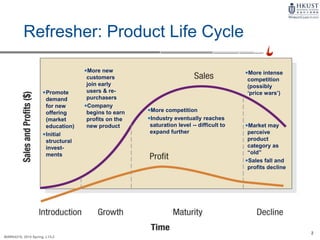
Refresher: Product Life Cycle
Promote
demand
for new
offering
(market
education)
Initial
structural
invest-
ments
More new
customers
join early
users & re-
purchasers
Company
begins to earn
profits on the
new product
More competition
Industry eventually reaches
saturation level -- difficult to
expand further
More intense
competition
(possibly
‘price wars’)
Market may
perceive
product
category as
“old”
Sales fall and
profits decline
3
MARK4210, 2014 Spring, L1/L2
Product Strategies
 Specifies market needs that may be served by
different product offerings
 Directly linked to market strategy
 Deals with number and diversity of products, product
innovations, design, etc.
Source: Strategic Marketing Asia Edition, Jain & Haley, Cengage Learning, 2009
4
MARK4210, 2014 Spring, L1/L2
Product Strategies
 BCG Matrix – Product Resource Allocation Strategy
 Product Re-positioning Strategy
 Product Overlap Strategies
 Product Design Strategies
 New Product Strategies
Source: Strategic Marketing Asia Edition, Jain & Haley, Cengage Learning, 2009
5
MARK4210, 2014 Spring, L1/L2
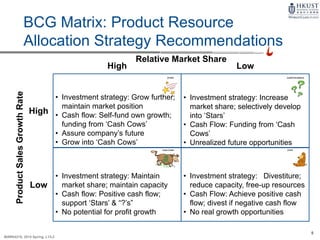
BCG Matrix: Product Resource
Allocation Strategy Recommendations
High Low
High
Low
ProductSalesGrowthRate
Relative Market Share
• Investment strategy: Grow further;
maintain market position
• Cash flow: Self-fund own growth;
funding from ‘Cash Cows’
• Assure company’s future
• Grow into ‘Cash Cows’
• Investment strategy: Increase
market share; selectively develop
into ‘Stars’
• Cash Flow: Funding from ‘Cash
Cows’
• Unrealized future opportunities
• Investment strategy: Maintain
market share; maintain capacity
• Cash flow: Positive cash flow;
support ‘Stars’ & “?’s”
• No potential for profit growth
• Investment strategy: Divestiture;
reduce capacity, free-up resources
• Cash Flow: Achieve positive cash
flow; divest if negative cash flow
• No real growth opportunities
6
MARK4210, 2014 Spring, L1/L2
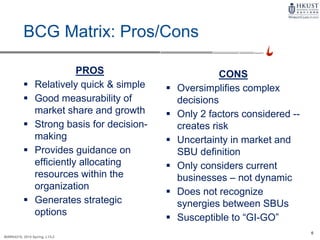
BCG Matrix: Pros/Cons
PROS
 Relatively quick & simple
 Good measurability of
market share and growth
 Strong basis for decision-
making
 Provides guidance on
efficiently allocating
resources within the
organization
 Generates strategic
options
CONS
 Oversimplifies complex
decisions
 Only 2 factors considered --
creates risk
 Uncertainty in market and
SBU definition
 Only considers current
businesses – not dynamic
 Does not recognize
synergies between SBUs
 Susceptible to “GI-GO”
7
MARK4210, 2014 Spring, L1/L2
Product Re-positioning Strategy
 Product may need repositioning if:
• Competitive entry has been positioned next to the brand
• Consumer preferences have changed
• New customer-preference clusters have been discovered
with promising opportunities
• Mistake has been made in the original positioning
Source: Strategic Marketing Asia Edition, Jain & Haley, Cengage Learning, 2009
8
MARK4210, 2014 Spring, L1/L2
Product Re-positioning: Ways to
Reposition a Product
Repositioning Description
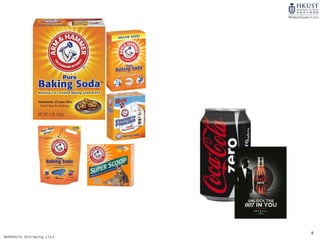
Among existing
customers
• Involves promoting new & alternative
product uses
• Revitalizes product by building a new
character
• In some instances, leads to a new sub-
category
To new
consumers
• Presenting product with a different twist to
entice new consumers, and minimize
alienating current users
• In some instances, leads to a new category
Source: Strategic Marketing Asia Edition, Jain & Haley, Cengage Learning, 2009
9
MARK4210, 2014 Spring, L1/L2
10
MARK4210, 2014 Spring, L1/L2
Product Overlap Strategy
 Company decides to compete with its own brand
 Common strategies:
• Promote competing lines
• Provide private labeling
• Original equipment manufacturers (OEM)
Source: Strategic Marketing Asia Edition, Jain & Haley, Cengage Learning, 2009
11
MARK4210, 2014 Spring, L1/L2
Product Overlap: Promote Competing
Lines – Risks & Opportunities
 While cannibalism occurs, overall sales usually
increase substantially
 Two competing brands from same company
provides more aggressive front against other
competitors
 Often used to transition new products into the
market – existing product maintained until new
product establishes market, thus minimize
competitive switches
Source: Strategic Marketing Asia Edition, Jain & Haley, Cengage Learning, 2009
12
MARK4210, 2014 Spring, L1/L2
13
MARK4210, 2014 Spring, L1/L2
Product Overlap: Provide Private
Labeling
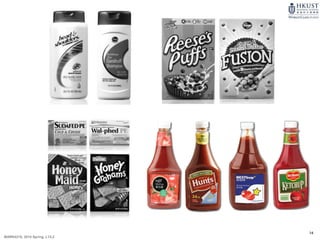
 Manufacture product for another company
Pros Cons
• Represents large (usually
growing) market segment
• Economies of scale (e.g.,
manufacturing, distribution, etc.)
• Improves trade relationships
• Control over technology and raw
materials reduces overall risks
• Clear consumer segmentation
between branded and unbranded
• Helps eliminate small, local
competitors
• Compete on price vs. competitors
• Increases shelf space
• Market share growth at expense
of profitability (more price
sensitive, lower margins)
• Discloses cost information to
traders
• To displace existing private label
suppliers, risk of starting price war
• Affects consumer perception of
branded business
Source: Strategic Marketing Asia Edition, Jain & Haley, Cengage Learning, 2009
14
MARK4210, 2014 Spring, L1/L2
15
MARK4210, 2014 Spring, L1/L2
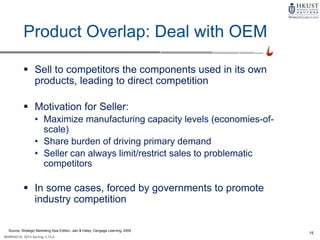
Product Overlap: Deal with OEM
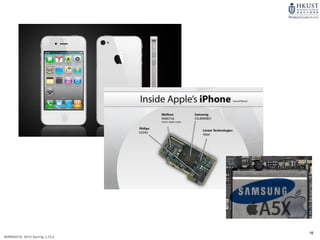
 Sell to competitors the components used in its own
products, leading to direct competition
 Motivation for Seller:
• Maximize manufacturing capacity levels (economies-of-
scale)
• Share burden of driving primary demand
• Seller can always limit/restrict sales to problematic
competitors
 In some cases, forced by governments to promote
industry competition
Source: Strategic Marketing Asia Edition, Jain & Haley, Cengage Learning, 2009
16
MARK4210, 2014 Spring, L1/L2
17
MARK4210, 2014 Spring, L1/L2
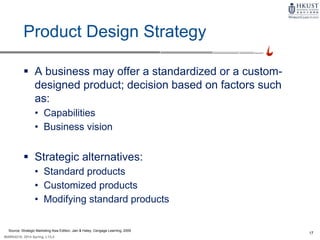
Product Design Strategy
 A business may offer a standardized or a custom-
designed product; decision based on factors such
as:
• Capabilities
• Business vision
 Strategic alternatives:
• Standard products
• Customized products
• Modifying standard products
Source: Strategic Marketing Asia Edition, Jain & Haley, Cengage Learning, 2009
18
MARK4210, 2014 Spring, L1/L2
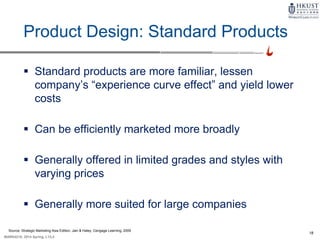
Product Design: Standard Products
 Standard products are more familiar, lessen
company’s “experience curve effect” and yield lower
costs
 Can be efficiently marketed more broadly
 Generally offered in limited grades and styles with
varying prices
 Generally more suited for large companies
Source: Strategic Marketing Asia Edition, Jain & Haley, Cengage Learning, 2009
19
MARK4210, 2014 Spring, L1/L2
20
MARK4210, 2014 Spring, L1/L2
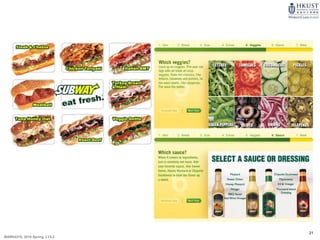
Product Design: Customized Products
 Based on the extent that the product meets customer
specifications – usually by working closely with
customers from development to completion
 Price is less of a factor versus standard products
 Depending on nature/complexity of the product, generally
more suitable for smaller, flexible, specialized companies
 Recent rise of “mass customization” – “build-to-order”
Source: Strategic Marketing Asia Edition, Jain & Haley, Cengage Learning, 2009
21
MARK4210, 2014 Spring, L1/L2
22
MARK4210, 2014 Spring, L1/L2
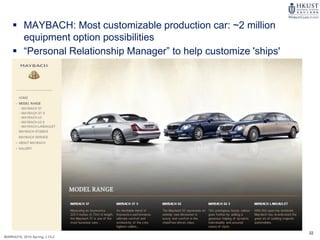
 MAYBACH: Most customizable production car: ~2 million
equipment option possibilities
 “Personal Relationship Manager” to help customize 'ships'
23
MARK4210, 2014 Spring, L1/L2
Product Design: Modifying Standard
Products
 Customers can specify a limited number of desired
modifications to a standard product
 Manufacturing base product provides economies-of-
scale, while modifications allow product certain level
of individualization based on customer requirements
Source: Strategic Marketing Asia Edition, Jain & Haley, Cengage Learning, 2009
24
MARK4210, 2014 Spring, L1/L2
25
MARK4210, 2014 Spring, L1/L2
New Product Strategy
 New-product development is essential for
companies seeking growth
 Facilitated by technological innovations and
customer willingness to accept new things
 Strategic alternatives:
• Product innovation
• Product imitation
• Product improvement/modification
Source: Strategic Marketing Asia Edition, Jain & Haley, Cengage Learning, 2009
26
MARK4210, 2014 Spring, L1/L2
New Product: Product Innovation
 Introduce offering with a completely new approach in
fulfilling customer desires, or replace existing ways to
satisfying customer desires
 Involves major financial commitment, heavy
management effort, and often risky
 Ways to encourage innovation:
• Smaller divisions (better interaction amongst team)
• Willingness to tolerate failure (experimentation, risk taking)
• Champions are motivated (encouragements, incentives)
• Close liaison with customer
• Technology is widely shared
• Projects are sustained despite initial discouragements
Source: Strategic Marketing Asia Edition, Jain & Haley, Cengage Learning, 2009
27
MARK4210, 2014 Spring, L1/L2
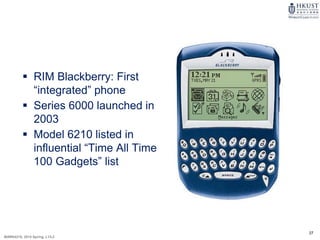
 RIM Blackberry: First
“integrated” phone
 Series 6000 launched in
2003
 Model 6210 listed in
influential “Time All Time
100 Gadgets” list
28
MARK4210, 2014 Spring, L1/L2
New Product: Product Imitation
 Introducing product with existing characteristics in
the market, but new to the company
 “Follower” strategy by letting other companies take
the riskier first move, and learning the lessons
 Saves investment in R&D or costly acquisitions,
especially for companies with limited resources
 Also used by companies to leverage unique
capability or competency from one product category
to another (e.g., distribution)
 Caution on patents and trademarks
Source: Strategic Marketing Asia Edition, Jain & Haley, Cengage Learning, 2009
29
MARK4210, 2014 Spring, L1/L2
??
?
30
MARK4210, 2014 Spring, L1/L2
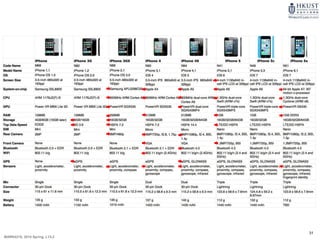
New Product: Product Improvement/
Modification
 Introducing new or improved version of existing
product, usually by:
• adding new features/styles
• changing processing requirements
• altering ingredients
 Usually when existing products become mature, and
ceased to provide adequate return, and/or
competitive pressure has reduced existing product
to “me-too”
Source: Strategic Marketing Asia Edition, Jain & Haley, Cengage Learning, 2009
31
MARK4210, 2014 Spring, L1/L2
32
MARK4210, 2014 Spring, L1/L2
Guide Questions: The Birth of
Swatch
1. Prior to Swatch, what was the watch industry like in various
historical stages (prior to 1950s, between 1950s-1970s,
1970s-1980s)? Consider various aspects of the category
(e.g., the positioning of the category, marketing mix, and
consumer behavior).
2. Why did Swatch became a success, what are the key
elements of their marketing plan (positioning, marketing
mix) that contributed to their success?
3. How has Swatch influenced/impacted the watch industry in
terms of how people view the category and consumer
behavior
33
MARK4210, 2014 Spring, L1/L2
Reminder: Mid-term Exam
 When: March 19 (Wednesday) 7:00-8:20pm
• No lecture during the day
• Pls try to arrive at 650pm to find your assigned seat
 Where: LSK1001, LSK1003, LSK1005
• Assigned seating plan will be posted outside rooms by
650pm
 What: Classes up to STP (including STP & JBC)
• Open-notes
• Bring your own calculator (NO borrowing allowed)
• Short scenarios questions based on discussed concepts
& methodologies
34
MARK4210, 2014 Spring, L1/L2
OPTIONAL Tutorial for Mid-term
Exam
 Entirely OPTIONAL, NO attendance check, NO
participation points
 NO new slides/concepts NOR preset discussion
plan, will be based review of past classes and slides
depending on student questions
 March 12, Wednesday, 6-8pm
• Please arrive on time
• BUT, you can leave early if your concerns are addressed
 If interested to attend, please register by 7pm of
March 11 with your question/topic request (see
course announcement for details)
MARK4210, 2014 Spring, L1/L2
End
Next Class: March 7, Friday
Pre-reading/Case Analysis:
“The Birth of Swatch” Case

product and brand strategies(4210)

  • 1.
    MARK4210, 2014 Spring,L1/L2 MARK4210: Strategic Marketing 2014 Spring, Section L1/L2 [Class #9] Product Strategies
  • 2.
    2 MARK4210, 2014 Spring,L1/L2 Refresher: Product Life Cycle Promote demand for new offering (market education) Initial structural invest- ments More new customers join early users & re- purchasers Company begins to earn profits on the new product More competition Industry eventually reaches saturation level -- difficult to expand further More intense competition (possibly ‘price wars’) Market may perceive product category as “old” Sales fall and profits decline
  • 3.
    3 MARK4210, 2014 Spring,L1/L2 Product Strategies  Specifies market needs that may be served by different product offerings  Directly linked to market strategy  Deals with number and diversity of products, product innovations, design, etc. Source: Strategic Marketing Asia Edition, Jain & Haley, Cengage Learning, 2009
  • 4.
    4 MARK4210, 2014 Spring,L1/L2 Product Strategies  BCG Matrix – Product Resource Allocation Strategy  Product Re-positioning Strategy  Product Overlap Strategies  Product Design Strategies  New Product Strategies Source: Strategic Marketing Asia Edition, Jain & Haley, Cengage Learning, 2009
  • 5.
    5 MARK4210, 2014 Spring,L1/L2 BCG Matrix: Product Resource Allocation Strategy Recommendations High Low High Low ProductSalesGrowthRate Relative Market Share • Investment strategy: Grow further; maintain market position • Cash flow: Self-fund own growth; funding from ‘Cash Cows’ • Assure company’s future • Grow into ‘Cash Cows’ • Investment strategy: Increase market share; selectively develop into ‘Stars’ • Cash Flow: Funding from ‘Cash Cows’ • Unrealized future opportunities • Investment strategy: Maintain market share; maintain capacity • Cash flow: Positive cash flow; support ‘Stars’ & “?’s” • No potential for profit growth • Investment strategy: Divestiture; reduce capacity, free-up resources • Cash Flow: Achieve positive cash flow; divest if negative cash flow • No real growth opportunities
  • 6.
    6 MARK4210, 2014 Spring,L1/L2 BCG Matrix: Pros/Cons PROS  Relatively quick & simple  Good measurability of market share and growth  Strong basis for decision- making  Provides guidance on efficiently allocating resources within the organization  Generates strategic options CONS  Oversimplifies complex decisions  Only 2 factors considered -- creates risk  Uncertainty in market and SBU definition  Only considers current businesses – not dynamic  Does not recognize synergies between SBUs  Susceptible to “GI-GO”
  • 7.
    7 MARK4210, 2014 Spring,L1/L2 Product Re-positioning Strategy  Product may need repositioning if: • Competitive entry has been positioned next to the brand • Consumer preferences have changed • New customer-preference clusters have been discovered with promising opportunities • Mistake has been made in the original positioning Source: Strategic Marketing Asia Edition, Jain & Haley, Cengage Learning, 2009
  • 8.
    8 MARK4210, 2014 Spring,L1/L2 Product Re-positioning: Ways to Reposition a Product Repositioning Description Among existing customers • Involves promoting new & alternative product uses • Revitalizes product by building a new character • In some instances, leads to a new sub- category To new consumers • Presenting product with a different twist to entice new consumers, and minimize alienating current users • In some instances, leads to a new category Source: Strategic Marketing Asia Edition, Jain & Haley, Cengage Learning, 2009
  • 9.
  • 10.
    10 MARK4210, 2014 Spring,L1/L2 Product Overlap Strategy  Company decides to compete with its own brand  Common strategies: • Promote competing lines • Provide private labeling • Original equipment manufacturers (OEM) Source: Strategic Marketing Asia Edition, Jain & Haley, Cengage Learning, 2009
  • 11.
    11 MARK4210, 2014 Spring,L1/L2 Product Overlap: Promote Competing Lines – Risks & Opportunities  While cannibalism occurs, overall sales usually increase substantially  Two competing brands from same company provides more aggressive front against other competitors  Often used to transition new products into the market – existing product maintained until new product establishes market, thus minimize competitive switches Source: Strategic Marketing Asia Edition, Jain & Haley, Cengage Learning, 2009
  • 12.
  • 13.
    13 MARK4210, 2014 Spring,L1/L2 Product Overlap: Provide Private Labeling  Manufacture product for another company Pros Cons • Represents large (usually growing) market segment • Economies of scale (e.g., manufacturing, distribution, etc.) • Improves trade relationships • Control over technology and raw materials reduces overall risks • Clear consumer segmentation between branded and unbranded • Helps eliminate small, local competitors • Compete on price vs. competitors • Increases shelf space • Market share growth at expense of profitability (more price sensitive, lower margins) • Discloses cost information to traders • To displace existing private label suppliers, risk of starting price war • Affects consumer perception of branded business Source: Strategic Marketing Asia Edition, Jain & Haley, Cengage Learning, 2009
  • 14.
  • 15.
    15 MARK4210, 2014 Spring,L1/L2 Product Overlap: Deal with OEM  Sell to competitors the components used in its own products, leading to direct competition  Motivation for Seller: • Maximize manufacturing capacity levels (economies-of- scale) • Share burden of driving primary demand • Seller can always limit/restrict sales to problematic competitors  In some cases, forced by governments to promote industry competition Source: Strategic Marketing Asia Edition, Jain & Haley, Cengage Learning, 2009
  • 16.
  • 17.
    17 MARK4210, 2014 Spring,L1/L2 Product Design Strategy  A business may offer a standardized or a custom- designed product; decision based on factors such as: • Capabilities • Business vision  Strategic alternatives: • Standard products • Customized products • Modifying standard products Source: Strategic Marketing Asia Edition, Jain & Haley, Cengage Learning, 2009
  • 18.
    18 MARK4210, 2014 Spring,L1/L2 Product Design: Standard Products  Standard products are more familiar, lessen company’s “experience curve effect” and yield lower costs  Can be efficiently marketed more broadly  Generally offered in limited grades and styles with varying prices  Generally more suited for large companies Source: Strategic Marketing Asia Edition, Jain & Haley, Cengage Learning, 2009
  • 19.
  • 20.
    20 MARK4210, 2014 Spring,L1/L2 Product Design: Customized Products  Based on the extent that the product meets customer specifications – usually by working closely with customers from development to completion  Price is less of a factor versus standard products  Depending on nature/complexity of the product, generally more suitable for smaller, flexible, specialized companies  Recent rise of “mass customization” – “build-to-order” Source: Strategic Marketing Asia Edition, Jain & Haley, Cengage Learning, 2009
  • 21.
  • 22.
    22 MARK4210, 2014 Spring,L1/L2  MAYBACH: Most customizable production car: ~2 million equipment option possibilities  “Personal Relationship Manager” to help customize 'ships'
  • 23.
    23 MARK4210, 2014 Spring,L1/L2 Product Design: Modifying Standard Products  Customers can specify a limited number of desired modifications to a standard product  Manufacturing base product provides economies-of- scale, while modifications allow product certain level of individualization based on customer requirements Source: Strategic Marketing Asia Edition, Jain & Haley, Cengage Learning, 2009
  • 24.
  • 25.
    25 MARK4210, 2014 Spring,L1/L2 New Product Strategy  New-product development is essential for companies seeking growth  Facilitated by technological innovations and customer willingness to accept new things  Strategic alternatives: • Product innovation • Product imitation • Product improvement/modification Source: Strategic Marketing Asia Edition, Jain & Haley, Cengage Learning, 2009
  • 26.
    26 MARK4210, 2014 Spring,L1/L2 New Product: Product Innovation  Introduce offering with a completely new approach in fulfilling customer desires, or replace existing ways to satisfying customer desires  Involves major financial commitment, heavy management effort, and often risky  Ways to encourage innovation: • Smaller divisions (better interaction amongst team) • Willingness to tolerate failure (experimentation, risk taking) • Champions are motivated (encouragements, incentives) • Close liaison with customer • Technology is widely shared • Projects are sustained despite initial discouragements Source: Strategic Marketing Asia Edition, Jain & Haley, Cengage Learning, 2009
  • 27.
    27 MARK4210, 2014 Spring,L1/L2  RIM Blackberry: First “integrated” phone  Series 6000 launched in 2003  Model 6210 listed in influential “Time All Time 100 Gadgets” list
  • 28.
    28 MARK4210, 2014 Spring,L1/L2 New Product: Product Imitation  Introducing product with existing characteristics in the market, but new to the company  “Follower” strategy by letting other companies take the riskier first move, and learning the lessons  Saves investment in R&D or costly acquisitions, especially for companies with limited resources  Also used by companies to leverage unique capability or competency from one product category to another (e.g., distribution)  Caution on patents and trademarks Source: Strategic Marketing Asia Edition, Jain & Haley, Cengage Learning, 2009
  • 29.
  • 30.
    30 MARK4210, 2014 Spring,L1/L2 New Product: Product Improvement/ Modification  Introducing new or improved version of existing product, usually by: • adding new features/styles • changing processing requirements • altering ingredients  Usually when existing products become mature, and ceased to provide adequate return, and/or competitive pressure has reduced existing product to “me-too” Source: Strategic Marketing Asia Edition, Jain & Haley, Cengage Learning, 2009
  • 31.
  • 32.
    32 MARK4210, 2014 Spring,L1/L2 Guide Questions: The Birth of Swatch 1. Prior to Swatch, what was the watch industry like in various historical stages (prior to 1950s, between 1950s-1970s, 1970s-1980s)? Consider various aspects of the category (e.g., the positioning of the category, marketing mix, and consumer behavior). 2. Why did Swatch became a success, what are the key elements of their marketing plan (positioning, marketing mix) that contributed to their success? 3. How has Swatch influenced/impacted the watch industry in terms of how people view the category and consumer behavior
  • 33.
    33 MARK4210, 2014 Spring,L1/L2 Reminder: Mid-term Exam  When: March 19 (Wednesday) 7:00-8:20pm • No lecture during the day • Pls try to arrive at 650pm to find your assigned seat  Where: LSK1001, LSK1003, LSK1005 • Assigned seating plan will be posted outside rooms by 650pm  What: Classes up to STP (including STP & JBC) • Open-notes • Bring your own calculator (NO borrowing allowed) • Short scenarios questions based on discussed concepts & methodologies
  • 34.
    34 MARK4210, 2014 Spring,L1/L2 OPTIONAL Tutorial for Mid-term Exam  Entirely OPTIONAL, NO attendance check, NO participation points  NO new slides/concepts NOR preset discussion plan, will be based review of past classes and slides depending on student questions  March 12, Wednesday, 6-8pm • Please arrive on time • BUT, you can leave early if your concerns are addressed  If interested to attend, please register by 7pm of March 11 with your question/topic request (see course announcement for details)
  • 35.
    MARK4210, 2014 Spring,L1/L2 End Next Class: March 7, Friday Pre-reading/Case Analysis: “The Birth of Swatch” Case