OpticalDistortion, Inc.Group Presentation:Khaula Al Houqani, Barbara Di Cesare, Vittoria Ferratini, Le Bau Chau, Priscilla Martella, Claudia Rossi, Beatrice Ruospo
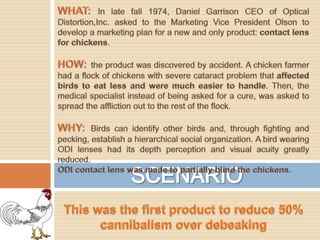
SCENARIOWHAT:In late fall 1974, Daniel Garrison CEO of OpticalDistortion,Inc. askedto the Marketing Vice PresidentOlsontodevelop a marketing planfor a new and onlyproduct: contactlensforchickens.HOW: the productwasdiscoveredbyaccident. A chickenfarmerhad a flock of chickenswith severe cataractproblemthataffectedbirdstoeatless and weremucheasiertohandle. Then, the medicalspecialistinstead of beingaskedfor a cure, wasaskedto spread the affliction out to the rest of the flock.    WHY: Birds can identifyotherbirds and, throughfighting and pecking, establish a hierarchical social organization. A birdwearing ODI lenseshaditsdepthperception and visualacuitygreatlyreduced. ODI contactlenswasmadetopartiallyblind the chickens.Thiswas the first productto reduce 50% cannibalismoverdebeaking
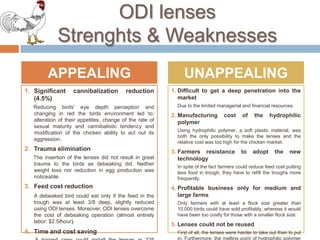
ODI lensesStrenghts & WeaknessesSignificant cannibalization reduction (4.5%)      Reducing birds' eye depth perception and changing in red the birds environment led to: alteration of their appetites, change of the rate of sexual maturity and cannibalistic tendency and modification of the chicken ability to act out its aggression. Trauma eliminationThe insertion of the lenses did not result in great trauma to the birds as debeaking did. Neither weight loss nor reduction in egg production was noticeable.Feed cost reductionA debeaked bird could eat only if the feed in the trough was at least 3/8 deep, slightly reduced using ODI lenses. Moreover, ODI lenses overcome the cost of debeaking operation (almost entirely labor: $2.5/hour).Time and cost savingA trained crew could install the lenses in 225 chickens per hour compared to 220 chickens debeaked per hour.Difficult to get a deep penetration into the market Due to the limited managerial and financial resources.Manufacturing cost of the hydrophilic polymerUsing hydrophilic polymer, a soft plastic material, was both the only possibility to make the lenses and the relative cost was too high for the chicken market. Farmers resistance to adopt the new technology In spite of the fact farmers could reduce feed cost putting less food in trough, they have to refill the troughs more frequently. Profitable business only for medium and large farmsOnly farmers with at least a flock size greater than 10.000 birds could have sold profitably, whereas it would have been too costly for those with a smaller flock size.Lenses could not be reusedFirst of all, the lenses were harder to take out than to put in. Furthermore, the melting point of hydrophilic polymer in lens was very close to the sterilization temperature. Therefore, contact lenses could easily end up with a mass of hydrophilic polymer.APPEALINGUNAPPEALING
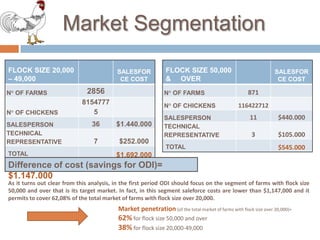
Market SegmentationDifferenceofcost (savingsfor ODI)= $1.147.000 As it turns out clear from this analysis, in the first period ODI should focus on the segment of farms with flock size 50,000 and over that is its target market. In fact, in this segment saleforce costs are lower than $1,147,000 and it permits to cover 62,08% of the total market of farms with flock size over 20,000.Market penetration(of the total market of farms with flock size over 20,000)= 62%for flock size 50,000 and over38% for flock size 20,000-49,000
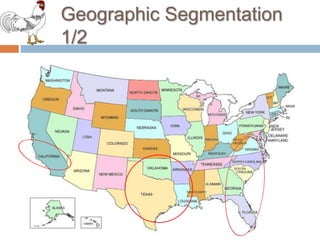
GeographicSegmentation 1/2
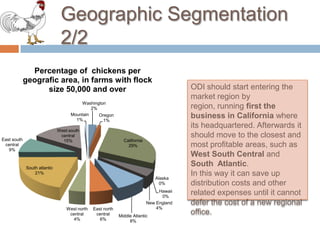
GeographicSegmentation 2/2ODI should start entering the market regionbyregion, runningfirst the business in California whereitsheadquartered. Afterwards it shouldmoveto the closest and mostprofitableareas, suchasWest South Centraland South  Atlantic. In this way it can save up distributioncosts and otherrelatedexpensesuntil it cannotdefer the costof a newregional office.
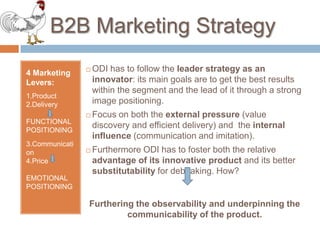
B2B Marketing Strategy4 Marketing Levers:1.Product2.DeliveryFUNCTIONAL POSITIONING3.Communication4.PriceEMOTIONALPOSITIONINGODI hastofollow the leader strategyasaninnovator: itsmaingoals are toget the best resultswithin the segment and the leadof it through a strong imagepositioning.Focus on both the externalpressure(valuediscovery and efficient delivery) and  the internalinfluence(communication and imitation).Furthermore ODI hastofosterboth the relative advantageofits innovative productand itsbettersubstitutabilityfordebeaking. How?Furthering the observability and underpinning the communicabilityof the product.
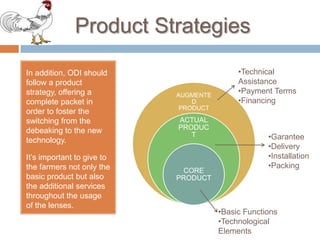
ProductStrategiesIn addition, ODI shouldfollow a productstrategy, offering a complete packet in ordertofoster the switchingfrom the debeakingto the newtechnology. It’s importanttogiveto the farmersnotonly the basicproductbutalso the additionalservicesthroughout the usageof the lenses.TechnicalAssistance
PaymentTerms
Financing
Garantee
Delivery
Installation
Packing
BasicFunctions
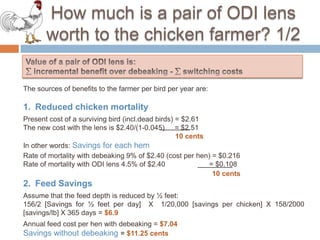
TechnologicalElementsHow muchis a pair of ODI lensworthto the chickenfarmer? 1/2 Value of a pair of ODI lensis: incremental benefit overdebeaking -  switchingcostsThe sources of benefitsto the farmer per bird per year are:ReducedchickenmortalityPresentcost of a survivingbird (incl.deadbirds) = $2.61 The newcostwith the lensis $2.40/(1-0.045)     = $2.51                                                                            10 centsIn otherwords: Savingsforeach hemRate of mortalitywithdebeaking 9% of $2.40 (cost per hen) = $0.216Rate of mortalitywith ODI lens 4.5% of $2.40                      = $0.108  10 centsFeed Savings Assume that the feed depth is reduced by ½ feet:156/2 [Savings for ½ feet per day]  X  1/20,000 [savings per chicken] X 158/2000 [savings/lb] X 365 days =$6.9 Annual feed cost per hen with debeaking = $7.04 Savings without debeaking= $11.25 cents   
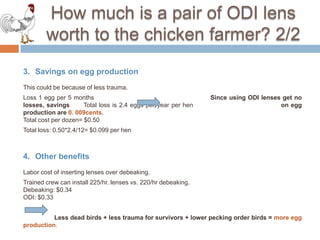
How muchis a pair of ODI lensworthto the chickenfarmer? 2/2Savings on egg production This could be because of less trauma.  Loss 1 egg per 5 months                                                    Since using ODI lenses get no losses, savings      Total loss is 2.4 eggs per year per hen                                      on egg production are0. 009cents.Total cost per dozen= $0.50Total loss: 0.50*2.4/12= $0.099 per henOther benefits Labor cost of inserting lenses over debeaking.  Trained crew can install 225/hr. lenses vs. 220/hr debeaking.            Debeaking: $0.34 ODI: $0.33                  Less dead birds + less trauma for survivors + lower pecking order birds =more egg production. 
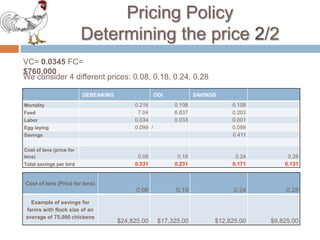
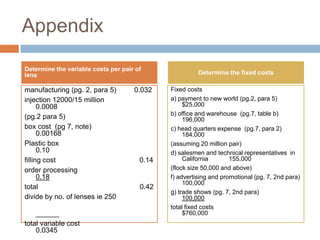
PricingPolicyDeterminingtheprice 2/2VC=0.0345 FC=$760,000 Weconsider 4 differentprices: 0.08, 0.18, 0.24, 0.28
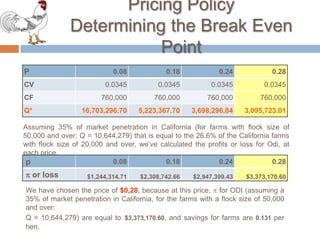
Pricing PolicyDetermining the Break Even Point Assuming 35% of market penetration in California (for farms with flock size of 50,000 and over: Q = 10,644,279) that is equal to the 26.6% of the California farms with flock size of 20,000 and over, we’ve calculated the profits or loss for Odi, at each price.We have chosen the price of $0,28, because at this price,  for ODI (assuming a 35% of market penetration in California, for the farms with a flock size of 50,000 and over: Q = 10,644,279) are equal to$3,373,170.60, and savings for farms are 0.131 per hen.
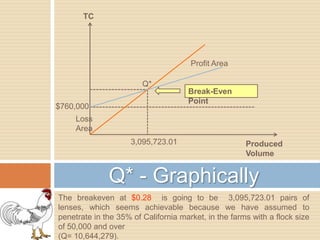
Q* - GraphicallyTCProfit AreaQ*Break-Even Point$760,000Loss Area3,095,723.01Produced VolumeThe breakeven at $0.28  is going to be 3,095,723.01 pairs of lenses, which seems achievable because we have assumed to penetrate in the 35% of California market, in the farms with a flock size of 50,000 and over (Q= 10,644,279).

Optical distortion, inc

  • 1.
    OpticalDistortion, Inc.Group Presentation:KhaulaAl Houqani, Barbara Di Cesare, Vittoria Ferratini, Le Bau Chau, Priscilla Martella, Claudia Rossi, Beatrice Ruospo
  • 2.
    SCENARIOWHAT:In late fall1974, Daniel Garrison CEO of OpticalDistortion,Inc. askedto the Marketing Vice PresidentOlsontodevelop a marketing planfor a new and onlyproduct: contactlensforchickens.HOW: the productwasdiscoveredbyaccident. A chickenfarmerhad a flock of chickenswith severe cataractproblemthataffectedbirdstoeatless and weremucheasiertohandle. Then, the medicalspecialistinstead of beingaskedfor a cure, wasaskedto spread the affliction out to the rest of the flock. WHY: Birds can identifyotherbirds and, throughfighting and pecking, establish a hierarchical social organization. A birdwearing ODI lenseshaditsdepthperception and visualacuitygreatlyreduced. ODI contactlenswasmadetopartiallyblind the chickens.Thiswas the first productto reduce 50% cannibalismoverdebeaking
  • 3.
    ODI lensesStrenghts &WeaknessesSignificant cannibalization reduction (4.5%) Reducing birds' eye depth perception and changing in red the birds environment led to: alteration of their appetites, change of the rate of sexual maturity and cannibalistic tendency and modification of the chicken ability to act out its aggression. Trauma eliminationThe insertion of the lenses did not result in great trauma to the birds as debeaking did. Neither weight loss nor reduction in egg production was noticeable.Feed cost reductionA debeaked bird could eat only if the feed in the trough was at least 3/8 deep, slightly reduced using ODI lenses. Moreover, ODI lenses overcome the cost of debeaking operation (almost entirely labor: $2.5/hour).Time and cost savingA trained crew could install the lenses in 225 chickens per hour compared to 220 chickens debeaked per hour.Difficult to get a deep penetration into the market Due to the limited managerial and financial resources.Manufacturing cost of the hydrophilic polymerUsing hydrophilic polymer, a soft plastic material, was both the only possibility to make the lenses and the relative cost was too high for the chicken market. Farmers resistance to adopt the new technology In spite of the fact farmers could reduce feed cost putting less food in trough, they have to refill the troughs more frequently. Profitable business only for medium and large farmsOnly farmers with at least a flock size greater than 10.000 birds could have sold profitably, whereas it would have been too costly for those with a smaller flock size.Lenses could not be reusedFirst of all, the lenses were harder to take out than to put in. Furthermore, the melting point of hydrophilic polymer in lens was very close to the sterilization temperature. Therefore, contact lenses could easily end up with a mass of hydrophilic polymer.APPEALINGUNAPPEALING
  • 4.
    Market SegmentationDifferenceofcost (savingsforODI)= $1.147.000 As it turns out clear from this analysis, in the first period ODI should focus on the segment of farms with flock size 50,000 and over that is its target market. In fact, in this segment saleforce costs are lower than $1,147,000 and it permits to cover 62,08% of the total market of farms with flock size over 20,000.Market penetration(of the total market of farms with flock size over 20,000)= 62%for flock size 50,000 and over38% for flock size 20,000-49,000
  • 5.
  • 6.
    GeographicSegmentation 2/2ODI shouldstart entering the market regionbyregion, runningfirst the business in California whereitsheadquartered. Afterwards it shouldmoveto the closest and mostprofitableareas, suchasWest South Centraland South Atlantic. In this way it can save up distributioncosts and otherrelatedexpensesuntil it cannotdefer the costof a newregional office.
  • 7.
    B2B Marketing Strategy4Marketing Levers:1.Product2.DeliveryFUNCTIONAL POSITIONING3.Communication4.PriceEMOTIONALPOSITIONINGODI hastofollow the leader strategyasaninnovator: itsmaingoals are toget the best resultswithin the segment and the leadof it through a strong imagepositioning.Focus on both the externalpressure(valuediscovery and efficient delivery) and the internalinfluence(communication and imitation).Furthermore ODI hastofosterboth the relative advantageofits innovative productand itsbettersubstitutabilityfordebeaking. How?Furthering the observability and underpinning the communicabilityof the product.
  • 8.
    ProductStrategiesIn addition, ODIshouldfollow a productstrategy, offering a complete packet in ordertofoster the switchingfrom the debeakingto the newtechnology. It’s importanttogiveto the farmersnotonly the basicproductbutalso the additionalservicesthroughout the usageof the lenses.TechnicalAssistance
  • 9.
  • 10.
  • 11.
  • 12.
  • 13.
  • 14.
  • 15.
  • 16.
    TechnologicalElementsHow muchis apair of ODI lensworthto the chickenfarmer? 1/2 Value of a pair of ODI lensis: incremental benefit overdebeaking -  switchingcostsThe sources of benefitsto the farmer per bird per year are:ReducedchickenmortalityPresentcost of a survivingbird (incl.deadbirds) = $2.61 The newcostwith the lensis $2.40/(1-0.045) = $2.51 10 centsIn otherwords: Savingsforeach hemRate of mortalitywithdebeaking 9% of $2.40 (cost per hen) = $0.216Rate of mortalitywith ODI lens 4.5% of $2.40 = $0.108 10 centsFeed Savings Assume that the feed depth is reduced by ½ feet:156/2 [Savings for ½ feet per day] X 1/20,000 [savings per chicken] X 158/2000 [savings/lb] X 365 days =$6.9 Annual feed cost per hen with debeaking = $7.04 Savings without debeaking= $11.25 cents   
  • 17.
    How muchis apair of ODI lensworthto the chickenfarmer? 2/2Savings on egg production This could be because of less trauma. Loss 1 egg per 5 months Since using ODI lenses get no losses, savings Total loss is 2.4 eggs per year per hen on egg production are0. 009cents.Total cost per dozen= $0.50Total loss: 0.50*2.4/12= $0.099 per henOther benefits Labor cost of inserting lenses over debeaking. Trained crew can install 225/hr. lenses vs. 220/hr debeaking. Debeaking: $0.34 ODI: $0.33 Less dead birds + less trauma for survivors + lower pecking order birds =more egg production. 
  • 18.
    PricingPolicyDeterminingtheprice 2/2VC=0.0345 FC=$760,000Weconsider 4 differentprices: 0.08, 0.18, 0.24, 0.28
  • 19.
    Pricing PolicyDetermining theBreak Even Point Assuming 35% of market penetration in California (for farms with flock size of 50,000 and over: Q = 10,644,279) that is equal to the 26.6% of the California farms with flock size of 20,000 and over, we’ve calculated the profits or loss for Odi, at each price.We have chosen the price of $0,28, because at this price,  for ODI (assuming a 35% of market penetration in California, for the farms with a flock size of 50,000 and over: Q = 10,644,279) are equal to$3,373,170.60, and savings for farms are 0.131 per hen.
  • 20.
    Q* - GraphicallyTCProfitAreaQ*Break-Even Point$760,000Loss Area3,095,723.01Produced VolumeThe breakeven at $0.28 is going to be 3,095,723.01 pairs of lenses, which seems achievable because we have assumed to penetrate in the 35% of California market, in the farms with a flock size of 50,000 and over (Q= 10,644,279).