Decision-Making
in PharmaSim
MARK4210 Spring 2014, L1/L2
2
Marketing Planning
Situation Analysis
Use company reports and marketing research
to better understand your current position.
Uncover problems and opportunities.
Marketing Selection
How will we segment the market?
What are the characteristics of each segment?
Who and how should we target?
Marketing Mix
Specifics decisions: products, price, sales force,
promotion, advertising budget and message?
3
3Cs: Customers
• Nature of Demand
– What benefits do they want?
– Where do they buy?
– What criteria do they go by?
• Extent of Demand
– Market size and growth
– Market penetration and average usage
• Analyze on both an aggregate level and a segmented
basis
4
3Cs: Competitors
• Track your competitors’ marketing mix decisions and
competitive position
• Whether you should benchmark with your competitor or
not?
5
3Cs: Company
• Think about your products
– How well are they doing (e.g., sales, market share,
contribution)
– How do your consumers perceive your products (e.g., brand
awareness, perception, satisfaction)
• Your budget is based on your overall performance in
the last period – leftover budget is only carried over to
next period as net income (not carried over to new
budget)
• How well is your management team doing? How do you
divide workload? How do you make decisions?
6
Segmentation, Targeting, Positioning
• Segmentation
– Life stage and benefits sought
– What are the characteristics of different segments?
– (e.g., decision criteria, brand perception, price sensitivity,
etc.)
• Targeting
– Which segment(s) to target?
• Positioning
– Price, benefits emphasized
7
4Ps: Pricing
MSRP Manufacturer’s
Suggested Retail Price
Volume Discounts
Discounts (%) to
purchaser based on
quantity ordered
8
4Ps: Pricing
• MSRP (Manufacturer’s Suggested Retail Price)
– Sets a reference price in the minds of consumers & retailers
– Basis for all discounts and allowances (always stated as % of
MSRP)
– Will rarely be the actual selling price
• Volume Discounts
– Provides incentives to purchase a larger quantity
– Provides larger discounts to more important, high volume,
channels
– Discount reflects % off MSRP
9
4Ps: Pricing
• How to Determine Price to Charge?
– Customer (decision criteria, perception, price sensitivity)
– Competition
– Channel
– Economic situation (e.g., inflation)
• Which reports will help you understand these
dimensions?
10
4Ps: Pricing
• The Decision Criteria
report under SURVEY
provides insight as to
what is important to
the customer when
choosing a particular
brand
• This report is
available on a cross-
section basis
11
4Ps: Pricing
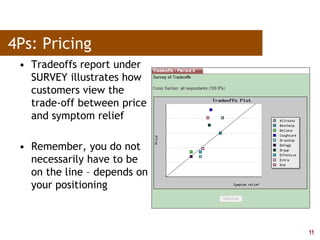
• Tradeoffs report under
SURVEY illustrates how
customers view the
trade-off between price
and symptom relief
• Remember, you do not
necessarily have to be
on the line – depends on
your positioning
12
4Ps: Pricing
• Test Market study
(under Market)
estimates the impact
of changing price,
advertising and/or
promotion on
awareness, market
share & net
contribution
• Note that Test Market
is based on last
period’s decisions and
competition
13
4Ps: Pricing
• Pricing Report under
MARKET provides the
MSRP and actual
average retail price in
each channel
• Provides information
on competitor pricing
and channel markups
14
4Ps: Pricing
• And do not forget about expected increases in
competitor’s prices and inflation
Average Price Increase
for OTC Cold Medication
Inflation Rate
Your costs will increase by
the general inflation rate
15
4Ps: Promotion (Advertising)
Advertising Budget
Total budget available for
marketing expenditures
Agency
Choice of agency and
related cost (% of budget)
Target Segments
Provides guidance to
agency for media choice
and message
16
4Ps: Promotion (Advertising)
Comparison
Choice of one other brand
for head to head
comparison
Ad Message
% of effort allocated to
each message type (adds
to 100%)
Benefits to Promote
Select the benefits to
associate with your brand
17
4Ps: Promotion (Advertising)
• How to determine advertising budget?
– Consider competition: Advertising Report provides the media
expenditures for each brand on the market
– Consider share of voice: your / industry expenditures
– Consider the marginal benefit of your advertising expenditure
– Test market: estimate the impact of changes in your overall
advertising spending on awareness, market share, net
contribution (Note: competitive & environmental factors, sales
force not considered; based on previous message and targets)
18
4Ps: Promotion (Advertising)
• One way to measure
the strength of
advertising vs. in-
store and trade
promotion is to look at
the Purchase
Intentions report
• What does it mean if
intended is higher
than bought?
19
4Ps: Promotion (Consumer, Trade)
• How much to allocate to promotion and which
promotional vehicles to emphasize?
– Promotion Report provides a comparison of consumer and trade
promotions used in the market during the past year
– Another approach is to base promotional spending on a % of
sales target
– Whether to emphasize on pull vs. push?
– Remember to monitor the results of your promotion activities
(the Promotion Report under COMPANY)
20
4Ps: Promotion (Consumer)
• Consumer promotion (POP display, trial size, coupon)
– When should you use each type? (repurchase vs. trial)
Choose which channels get
POP displays and the
coupon amount
How much to allocate for
POP displays, trial size, and
coupons
21
4Ps: Promotion (Trade)
• Trade promotion (promotional allowance, co-op
advertising)
– Use Share of Channel sales report under MARKET to see how
your brand / competitors are selling in different channels
– Use Shelf Space report under MARKET to see how your brand’s
shelf space compares with other brands
Co-op Advertising
Budget
How much to make
available to the selected
channels
Promotion Allowance
Additional discount off
MSRP for each channel
(must be 10-20%)
22
4Ps: Channel
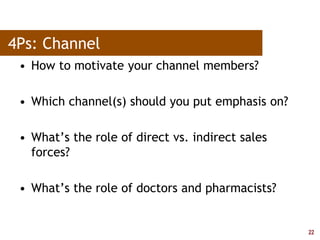
• How to motivate your channel members?
• Which channel(s) should you put emphasis on?
• What’s the role of direct vs. indirect sales
forces?
• What’s the role of doctors and pharmacists?
23
4Ps: Channel (Sales force)
Direct Sales Force
Number of Sales people who
work directly with a
particular channel
Indirect Sales Force
Wholesale support,
merchandisers and detailers
Salary, Expenses and
Training Costs are
automatically calculated and
deducted from your overall
budget; also note, the these
costs will increase over time
due to inflation
24
4Ps: Channel (Sales force)
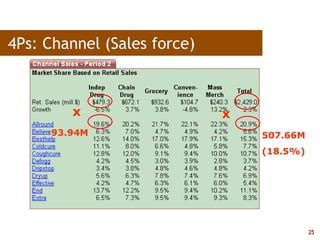
• How much to allocate to sales force and which channels
and activities to support?
– Use the Shopping Habits report to see which channels sell the
highest volume of each type of medicine
– You can also allocate based on your sales volume by channel –
Use the Channel Sales report under MARKET
25
4Ps: Channel (Sales force)
x x
93.94M 507.66M
(18.5%)
26
4Ps: Product
• You have 4 opportunities to change your
product line:
– Reformulation of Allround in period 1 or 2
– Introduction of a line extension in period 3 or 4
– New product launch in period 5 or 6
– Reformulation of Allround in period 7
27
4Ps: Product
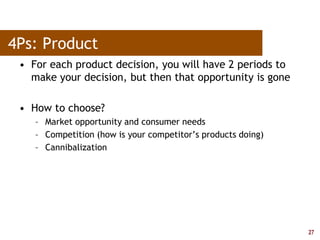
• For each product decision, you will have 2 periods to
make your decision, but then that opportunity is gone
• How to choose?
– Market opportunity and consumer needs
– Competition (how is your competitor’s products doing)
– Cannibalization
28
Analysis (What if…?)
Don’t forget to check the budget allocation which helps you see at a
glance how you’ve allocated budget across products and “Ps”
What if analysis allows you to
calculate projected income
based on your decisions
and projected sales before
the simulation is advanced
29
PharmaSim Grading
• Performance
– 50% of the PharmaSim grade
– Calculated based Stock price
• Related to both Financials & Market share
– The goal is to maximize overall performance
– Points will be based on performance curve
across the course (ALL sections of Mark4210)
30
PharmaSim Grading
• Final Report
– 50% of the PharmaSim grade
– Due: Last class, May 9, beginning of class
– See LMES for details
• ~4 pages report
• Using case concepts and methodologies, provide
rationale for your strategy/decisions (hint: assign
good secretary(s))
• Details to follow
31
Grading: Peer Evaluation
• PharmaSim team members rate each
other (excluding self)
– 7 Points (%) to Final Grade
– Based on contribution to team effort
– Anonymous
– Online, details TBA later
32
PharmaSim Tips
• Discover market drivers
• Think quantitatively and qualitatively:
understand the reasons & implications behind
the numbers
• But there are unknowns… your job is to make
the best decisions in an
ambiguous environment
• Don’t underestimate the importance
of teamwork
33
Key Dates (Round 1)
• March 22 (Sat): Individual Practice End
• PharmaSim Team Live Play Round 1
– March 24 (Mon) @ 7am – April 14 (Mon) @ 8pm
– Periods 0-8; No replays, NO restarts
– Consultations (in class & appointment) ends April 11 (Fri), 6pm
(NOTE: NO consultations in Round 2)
• In-class team discussions (LSKG005) during Round 1
– April 2 (Wed)
– April 4 (Fri)
– Team internal discussions; individual team consultations
• [Round 2, April 22 @ 7am – May 8 @ 8pm; NO replay,
NO restarts, NO consultation]
34
Let the Game Begin 
34
35
Announcement – Guest Speaker &
Class Schedule Change
• Guest Speaker on April 23, Wednesday, 7-
820pm, venue TBA
– Mr. Larry CHAN, Digital Marketing Manager, L’Oreal
– Attendance checked (or valid documented excuse)
– Replaces afternoon session (no class)
• Class schedule (see course website for updated
syllabus) Wed 4.23 TBD Guest Speaker
– Apr 25: PharmaSim, in-class team discussions
– Apr 30: PharmaSim, in-class team discussions
– May 2: Competing in a Global Market
36
End of Class
Next Class: March 26, Wednesday
Pricing Strategies

Pharmasim

  • 1.
  • 2.
    2 Marketing Planning Situation Analysis Usecompany reports and marketing research to better understand your current position. Uncover problems and opportunities. Marketing Selection How will we segment the market? What are the characteristics of each segment? Who and how should we target? Marketing Mix Specifics decisions: products, price, sales force, promotion, advertising budget and message?
  • 3.
    3 3Cs: Customers • Natureof Demand – What benefits do they want? – Where do they buy? – What criteria do they go by? • Extent of Demand – Market size and growth – Market penetration and average usage • Analyze on both an aggregate level and a segmented basis
  • 4.
    4 3Cs: Competitors • Trackyour competitors’ marketing mix decisions and competitive position • Whether you should benchmark with your competitor or not?
  • 5.
    5 3Cs: Company • Thinkabout your products – How well are they doing (e.g., sales, market share, contribution) – How do your consumers perceive your products (e.g., brand awareness, perception, satisfaction) • Your budget is based on your overall performance in the last period – leftover budget is only carried over to next period as net income (not carried over to new budget) • How well is your management team doing? How do you divide workload? How do you make decisions?
  • 6.
    6 Segmentation, Targeting, Positioning •Segmentation – Life stage and benefits sought – What are the characteristics of different segments? – (e.g., decision criteria, brand perception, price sensitivity, etc.) • Targeting – Which segment(s) to target? • Positioning – Price, benefits emphasized
  • 7.
    7 4Ps: Pricing MSRP Manufacturer’s SuggestedRetail Price Volume Discounts Discounts (%) to purchaser based on quantity ordered
  • 8.
    8 4Ps: Pricing • MSRP(Manufacturer’s Suggested Retail Price) – Sets a reference price in the minds of consumers & retailers – Basis for all discounts and allowances (always stated as % of MSRP) – Will rarely be the actual selling price • Volume Discounts – Provides incentives to purchase a larger quantity – Provides larger discounts to more important, high volume, channels – Discount reflects % off MSRP
  • 9.
    9 4Ps: Pricing • Howto Determine Price to Charge? – Customer (decision criteria, perception, price sensitivity) – Competition – Channel – Economic situation (e.g., inflation) • Which reports will help you understand these dimensions?
  • 10.
    10 4Ps: Pricing • TheDecision Criteria report under SURVEY provides insight as to what is important to the customer when choosing a particular brand • This report is available on a cross- section basis
  • 11.
    11 4Ps: Pricing • Tradeoffsreport under SURVEY illustrates how customers view the trade-off between price and symptom relief • Remember, you do not necessarily have to be on the line – depends on your positioning
  • 12.
    12 4Ps: Pricing • TestMarket study (under Market) estimates the impact of changing price, advertising and/or promotion on awareness, market share & net contribution • Note that Test Market is based on last period’s decisions and competition
  • 13.
    13 4Ps: Pricing • PricingReport under MARKET provides the MSRP and actual average retail price in each channel • Provides information on competitor pricing and channel markups
  • 14.
    14 4Ps: Pricing • Anddo not forget about expected increases in competitor’s prices and inflation Average Price Increase for OTC Cold Medication Inflation Rate Your costs will increase by the general inflation rate
  • 15.
    15 4Ps: Promotion (Advertising) AdvertisingBudget Total budget available for marketing expenditures Agency Choice of agency and related cost (% of budget) Target Segments Provides guidance to agency for media choice and message
  • 16.
    16 4Ps: Promotion (Advertising) Comparison Choiceof one other brand for head to head comparison Ad Message % of effort allocated to each message type (adds to 100%) Benefits to Promote Select the benefits to associate with your brand
  • 17.
    17 4Ps: Promotion (Advertising) •How to determine advertising budget? – Consider competition: Advertising Report provides the media expenditures for each brand on the market – Consider share of voice: your / industry expenditures – Consider the marginal benefit of your advertising expenditure – Test market: estimate the impact of changes in your overall advertising spending on awareness, market share, net contribution (Note: competitive & environmental factors, sales force not considered; based on previous message and targets)
  • 18.
    18 4Ps: Promotion (Advertising) •One way to measure the strength of advertising vs. in- store and trade promotion is to look at the Purchase Intentions report • What does it mean if intended is higher than bought?
  • 19.
    19 4Ps: Promotion (Consumer,Trade) • How much to allocate to promotion and which promotional vehicles to emphasize? – Promotion Report provides a comparison of consumer and trade promotions used in the market during the past year – Another approach is to base promotional spending on a % of sales target – Whether to emphasize on pull vs. push? – Remember to monitor the results of your promotion activities (the Promotion Report under COMPANY)
  • 20.
    20 4Ps: Promotion (Consumer) •Consumer promotion (POP display, trial size, coupon) – When should you use each type? (repurchase vs. trial) Choose which channels get POP displays and the coupon amount How much to allocate for POP displays, trial size, and coupons
  • 21.
    21 4Ps: Promotion (Trade) •Trade promotion (promotional allowance, co-op advertising) – Use Share of Channel sales report under MARKET to see how your brand / competitors are selling in different channels – Use Shelf Space report under MARKET to see how your brand’s shelf space compares with other brands Co-op Advertising Budget How much to make available to the selected channels Promotion Allowance Additional discount off MSRP for each channel (must be 10-20%)
  • 22.
    22 4Ps: Channel • Howto motivate your channel members? • Which channel(s) should you put emphasis on? • What’s the role of direct vs. indirect sales forces? • What’s the role of doctors and pharmacists?
  • 23.
    23 4Ps: Channel (Salesforce) Direct Sales Force Number of Sales people who work directly with a particular channel Indirect Sales Force Wholesale support, merchandisers and detailers Salary, Expenses and Training Costs are automatically calculated and deducted from your overall budget; also note, the these costs will increase over time due to inflation
  • 24.
    24 4Ps: Channel (Salesforce) • How much to allocate to sales force and which channels and activities to support? – Use the Shopping Habits report to see which channels sell the highest volume of each type of medicine – You can also allocate based on your sales volume by channel – Use the Channel Sales report under MARKET
  • 25.
    25 4Ps: Channel (Salesforce) x x 93.94M 507.66M (18.5%)
  • 26.
    26 4Ps: Product • Youhave 4 opportunities to change your product line: – Reformulation of Allround in period 1 or 2 – Introduction of a line extension in period 3 or 4 – New product launch in period 5 or 6 – Reformulation of Allround in period 7
  • 27.
    27 4Ps: Product • Foreach product decision, you will have 2 periods to make your decision, but then that opportunity is gone • How to choose? – Market opportunity and consumer needs – Competition (how is your competitor’s products doing) – Cannibalization
  • 28.
    28 Analysis (What if…?) Don’tforget to check the budget allocation which helps you see at a glance how you’ve allocated budget across products and “Ps” What if analysis allows you to calculate projected income based on your decisions and projected sales before the simulation is advanced
  • 29.
    29 PharmaSim Grading • Performance –50% of the PharmaSim grade – Calculated based Stock price • Related to both Financials & Market share – The goal is to maximize overall performance – Points will be based on performance curve across the course (ALL sections of Mark4210)
  • 30.
    30 PharmaSim Grading • FinalReport – 50% of the PharmaSim grade – Due: Last class, May 9, beginning of class – See LMES for details • ~4 pages report • Using case concepts and methodologies, provide rationale for your strategy/decisions (hint: assign good secretary(s)) • Details to follow
  • 31.
    31 Grading: Peer Evaluation •PharmaSim team members rate each other (excluding self) – 7 Points (%) to Final Grade – Based on contribution to team effort – Anonymous – Online, details TBA later
  • 32.
    32 PharmaSim Tips • Discovermarket drivers • Think quantitatively and qualitatively: understand the reasons & implications behind the numbers • But there are unknowns… your job is to make the best decisions in an ambiguous environment • Don’t underestimate the importance of teamwork
  • 33.
    33 Key Dates (Round1) • March 22 (Sat): Individual Practice End • PharmaSim Team Live Play Round 1 – March 24 (Mon) @ 7am – April 14 (Mon) @ 8pm – Periods 0-8; No replays, NO restarts – Consultations (in class & appointment) ends April 11 (Fri), 6pm (NOTE: NO consultations in Round 2) • In-class team discussions (LSKG005) during Round 1 – April 2 (Wed) – April 4 (Fri) – Team internal discussions; individual team consultations • [Round 2, April 22 @ 7am – May 8 @ 8pm; NO replay, NO restarts, NO consultation]
  • 34.
    34 Let the GameBegin  34
  • 35.
    35 Announcement – GuestSpeaker & Class Schedule Change • Guest Speaker on April 23, Wednesday, 7- 820pm, venue TBA – Mr. Larry CHAN, Digital Marketing Manager, L’Oreal – Attendance checked (or valid documented excuse) – Replaces afternoon session (no class) • Class schedule (see course website for updated syllabus) Wed 4.23 TBD Guest Speaker – Apr 25: PharmaSim, in-class team discussions – Apr 30: PharmaSim, in-class team discussions – May 2: Competing in a Global Market
  • 36.
    36 End of Class NextClass: March 26, Wednesday Pricing Strategies