MARK4210, 2014 Spring, L1/L2
MARK4210: Strategic Marketing
2014 Spring, Section L1/L2
[Class #24]
Consumer Behavior
2
MARK4210, 2014 Spring, L1/L2
Consumer Buying Behavior
Marketing for Hospitality and Tourism, Kotler, Bowen, and Makens, Pearson Education, Inc.
 Consumer Buying Behavior refers to the buying
behavior of final consumers – individuals &
households who buy goods and services for
personal consumption
 The central question for marketers is: “How do
consumers respond to various marketing
efforts the company might use?”
3
MARK4210, 2014 Spring, L1/L2
Five ‘Premises’ of Consumer
Behavior – Basis for Analysis
Marketing Management, Kotler, Keller, Pearson Education, Inc., 2009
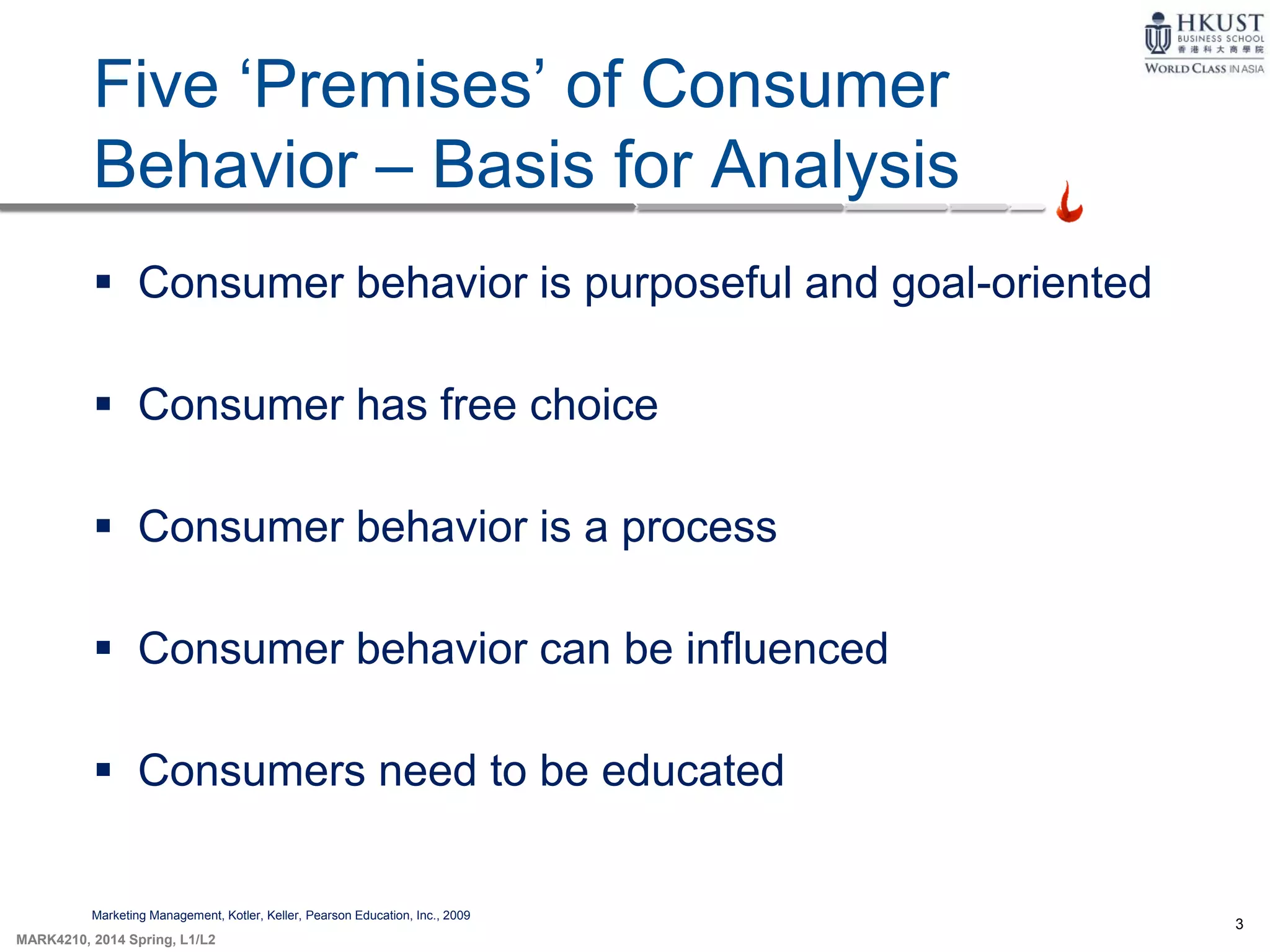
 Consumer behavior is purposeful and goal-oriented
 Consumer has free choice
 Consumer behavior is a process
 Consumer behavior can be influenced
 Consumers need to be educated
4
MARK4210, 2014 Spring, L1/L2
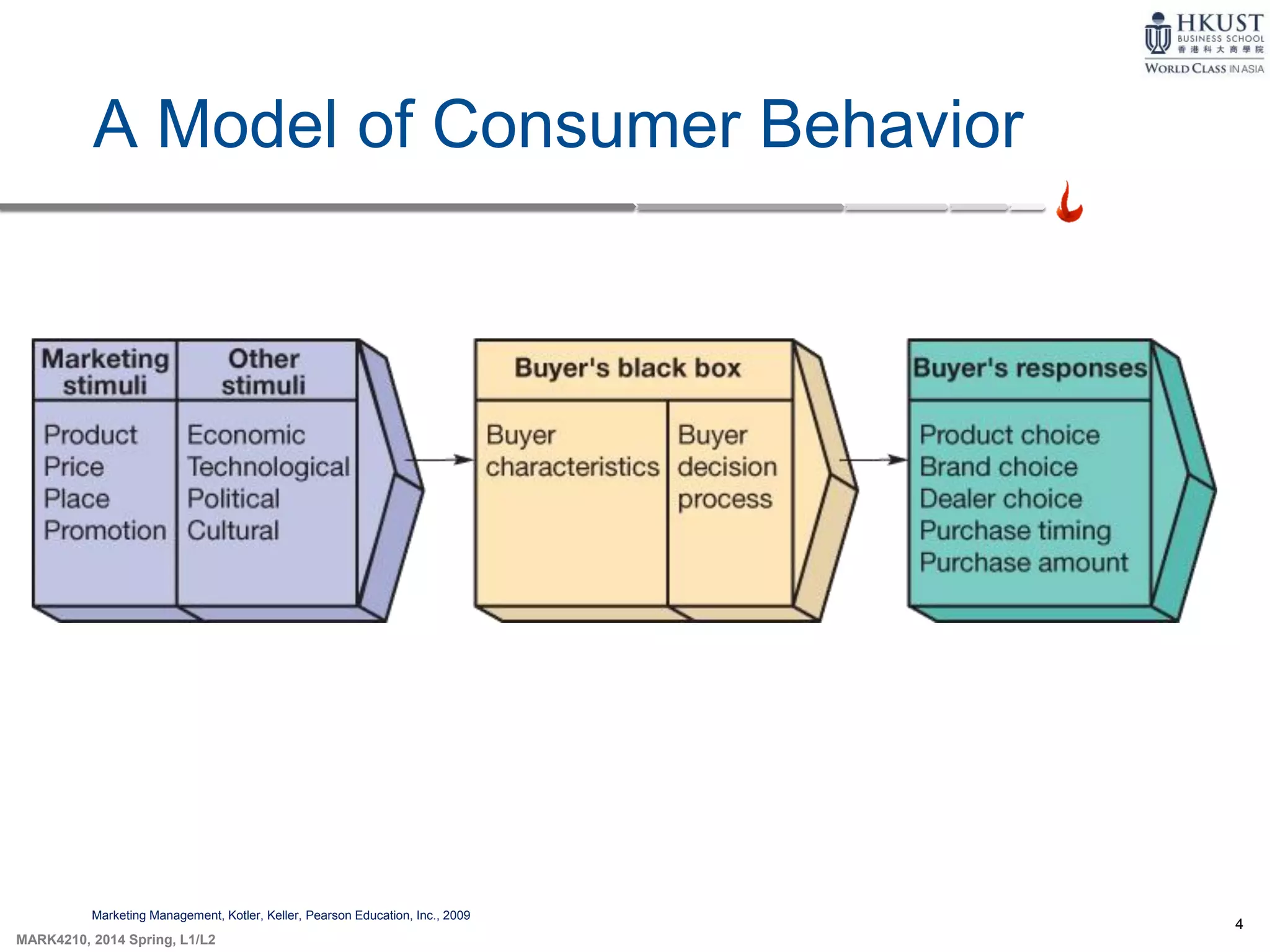
A Model of Consumer Behavior
Marketing Management, Kotler, Keller, Pearson Education, Inc., 2009
5
MARK4210, 2014 Spring, L1/L2
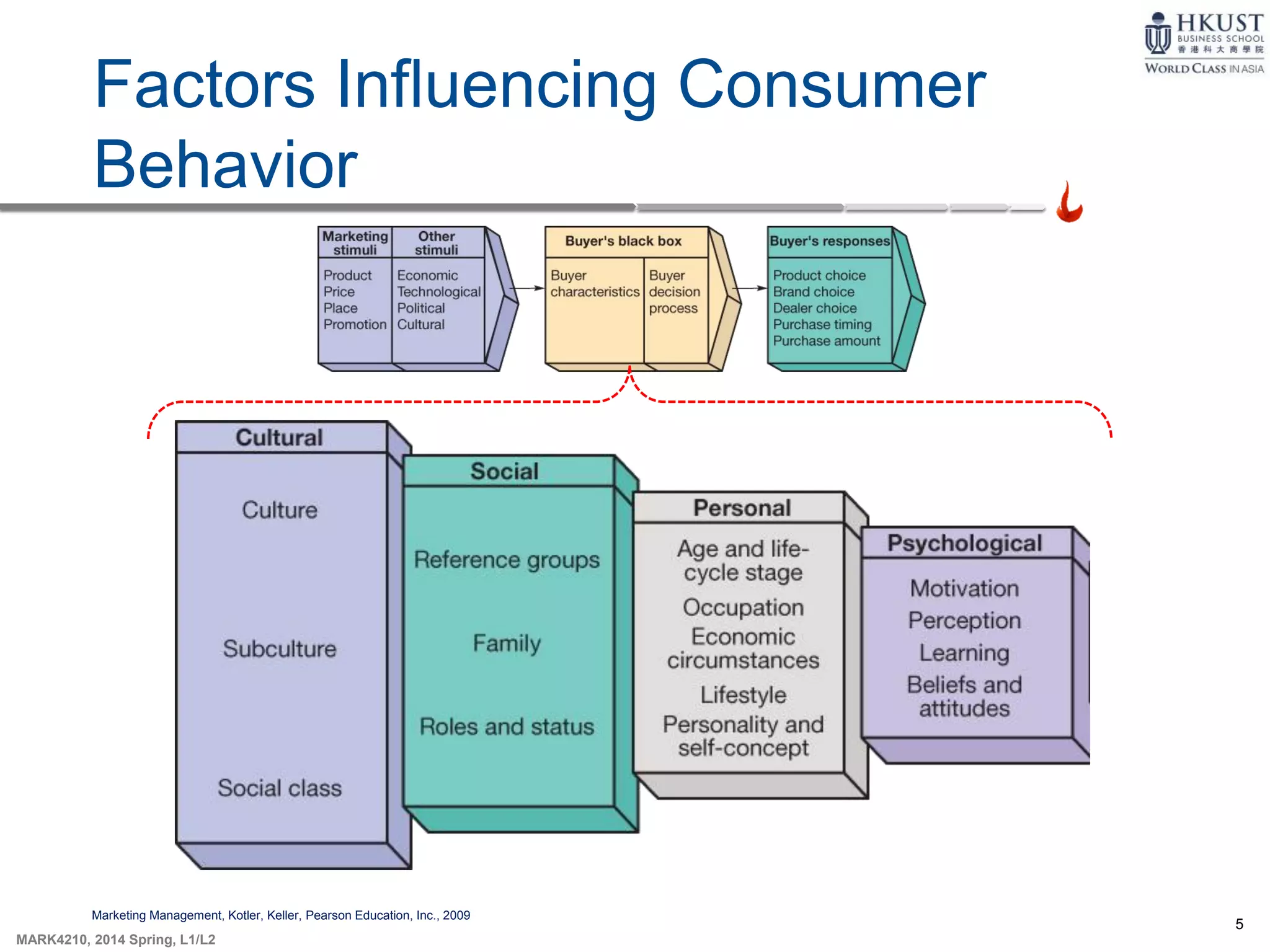
Factors Influencing Consumer
Behavior
Marketing Management, Kotler, Keller, Pearson Education, Inc., 2009
6
MARK4210, 2014 Spring, L1/L2
Influencing Consumer Behavior:
Cultural Factors
Marketing for Hospitality and Tourism, Kotler, Bowen, and Makens, Pearson Education, Inc.
 Culture: social heritage of a group (organized
community or society); the most basic determinant
of a person’s wants and behavior
 Subcultures: sub-groups of people with shared value
systems based on common life experiences and
situations
 Social classes: relatively permanent & ordered
divisions in a society whose members share similar
values, interests, and behaviors
7
MARK4210, 2014 Spring, L1/L2
Influencing Consumer Behavior:
Social Factors
Marketing for Hospitality and Tourism, Kotler, Bowen, and Makens, Pearson Education, Inc.
 Reference groups: influence the person’s attitudes
and self-concept; they also create pressures to
conform that may affect the person’s choices
 Family: consider the roles & influence of the
husband, wife, and children in the purchase decision
 Social roles: the activities a person is expected to
perform according to the people around him or her
 Status: the general esteem given to a role by
society; people often choose products that show
their status in society
8
MARK4210, 2014 Spring, L1/L2
Influencing Consumer Behavior:
Personal Factors
Marketing for Hospitality and Tourism, Kotler, Bowen, and Makens, Pearson Education, Inc.
 Age
 Life-Cycle Stage
 Occupation
 Economic Situation
 Lifestyle – a person’s pattern of living as expressed
in his or her activities, interests, and opinions
 Personality – a person’s distinguishing psychological
characteristics that lead to relatively consistent and
lasting responses to his or her environment
 Self-Concept – the complex mental pictures people
have of themselves; self-image
9
MARK4210, 2014 Spring, L1/L2
Influencing Consumer Behavior:
Psychological Factors – Motivation
Marketing Management, Kotler, Keller, Pearson Education, Inc., 2009
 Freud’s Theory
• Underlying psychology – psychological forces shaping
people’s behavior are largely unconscious, and that a
person cannot fully understand his or her own
motivations
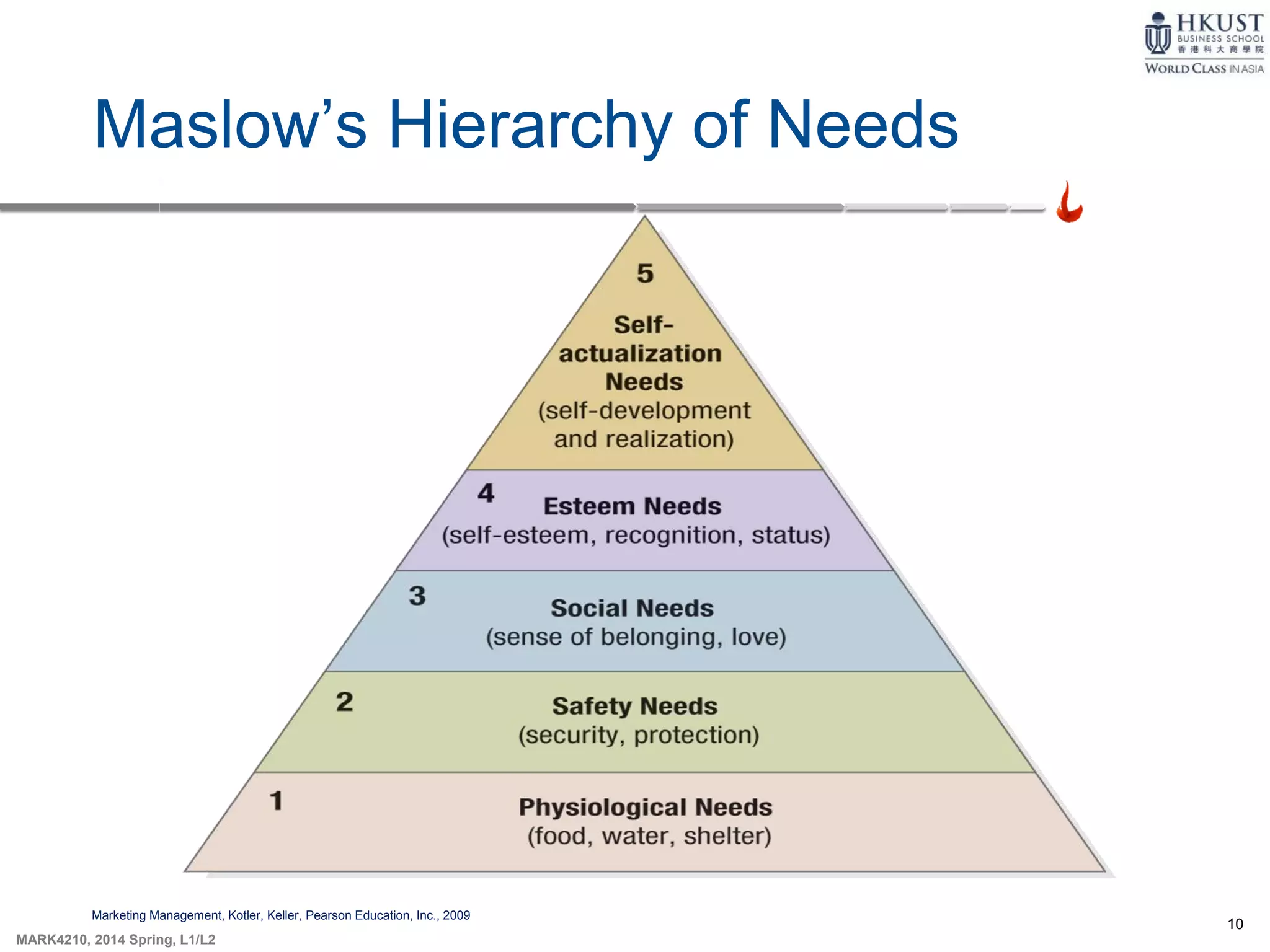
 Maslow’s Theory of Motivation
• Sought to explain why people are driven by particular
needs at particular times
 Herzberg’s Theory
• States that there are certain factors that cause
satisfaction, while a separate set of factors cause
dissatisfaction
10
MARK4210, 2014 Spring, L1/L2
Maslow’s Hierarchy of Needs
Marketing Management, Kotler, Keller, Pearson Education, Inc., 2009
11
MARK4210, 2014 Spring, L1/L2
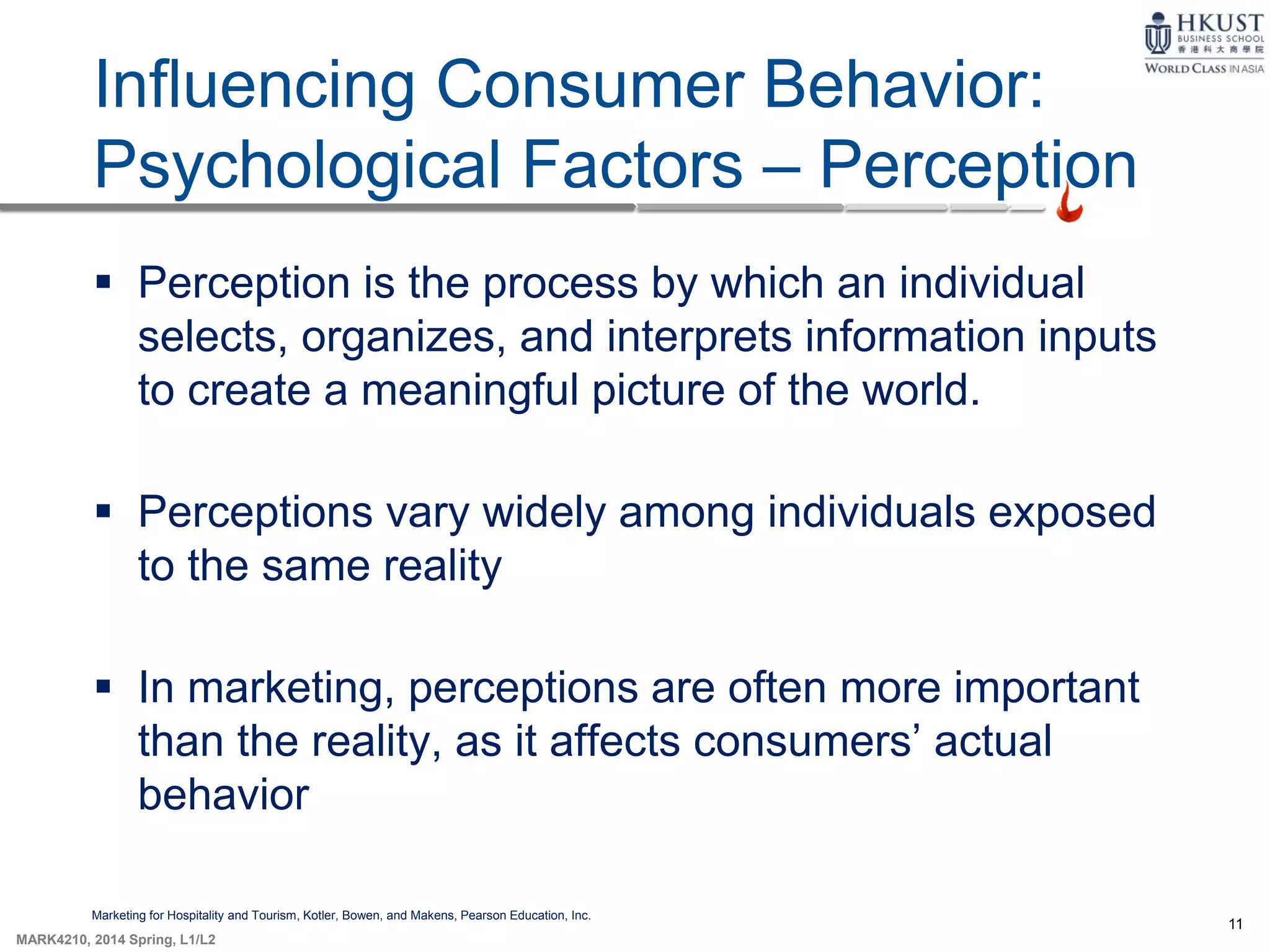
Influencing Consumer Behavior:
Psychological Factors – Perception
Marketing for Hospitality and Tourism, Kotler, Bowen, and Makens, Pearson Education, Inc.
 Perception is the process by which an individual
selects, organizes, and interprets information inputs
to create a meaningful picture of the world.
 Perceptions vary widely among individuals exposed
to the same reality
 In marketing, perceptions are often more important
than the reality, as it affects consumers’ actual
behavior
12
MARK4210, 2014 Spring, L1/L2
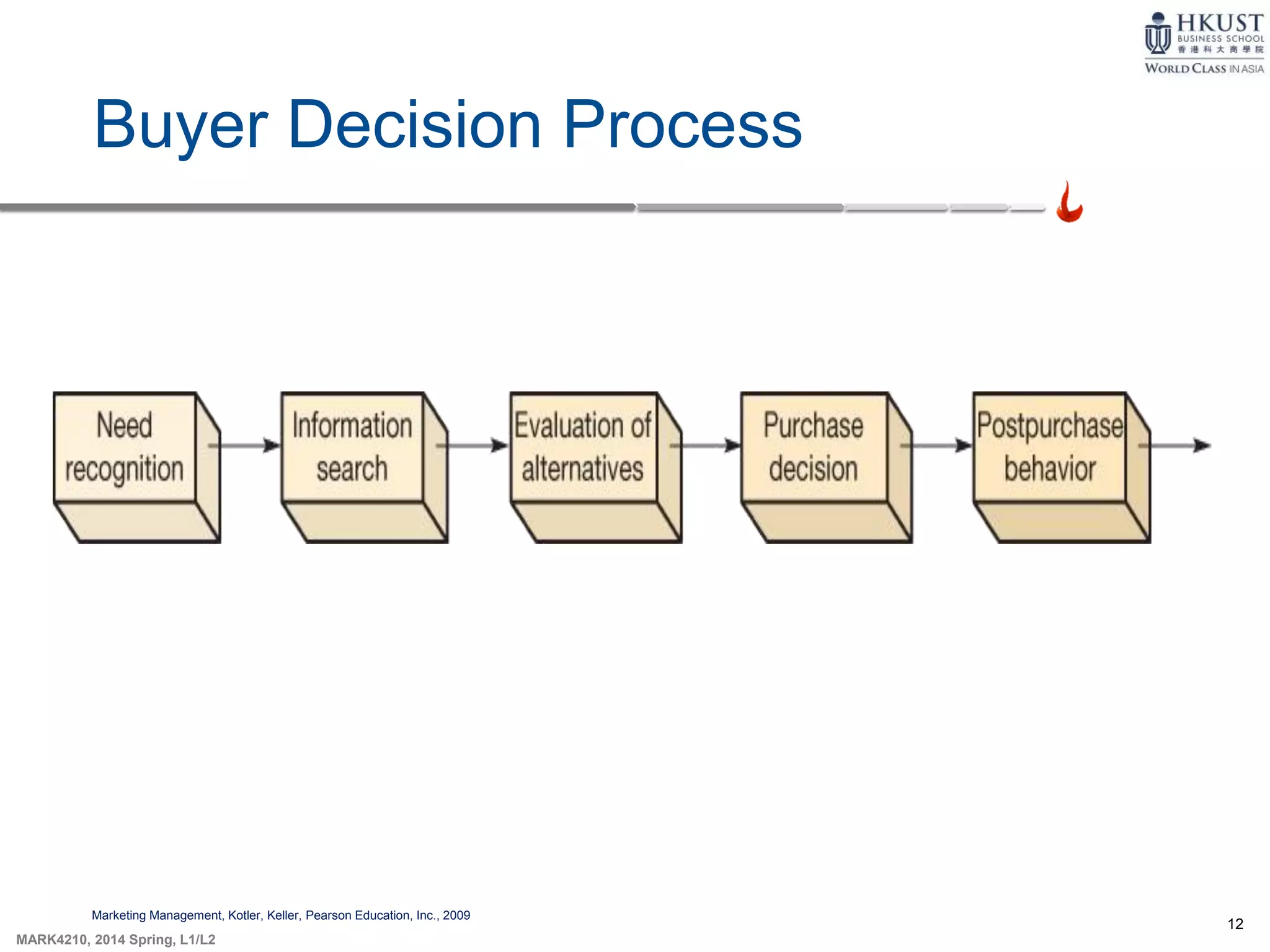
Buyer Decision Process
Marketing Management, Kotler, Keller, Pearson Education, Inc., 2009
13
MARK4210, 2014 Spring, L1/L2
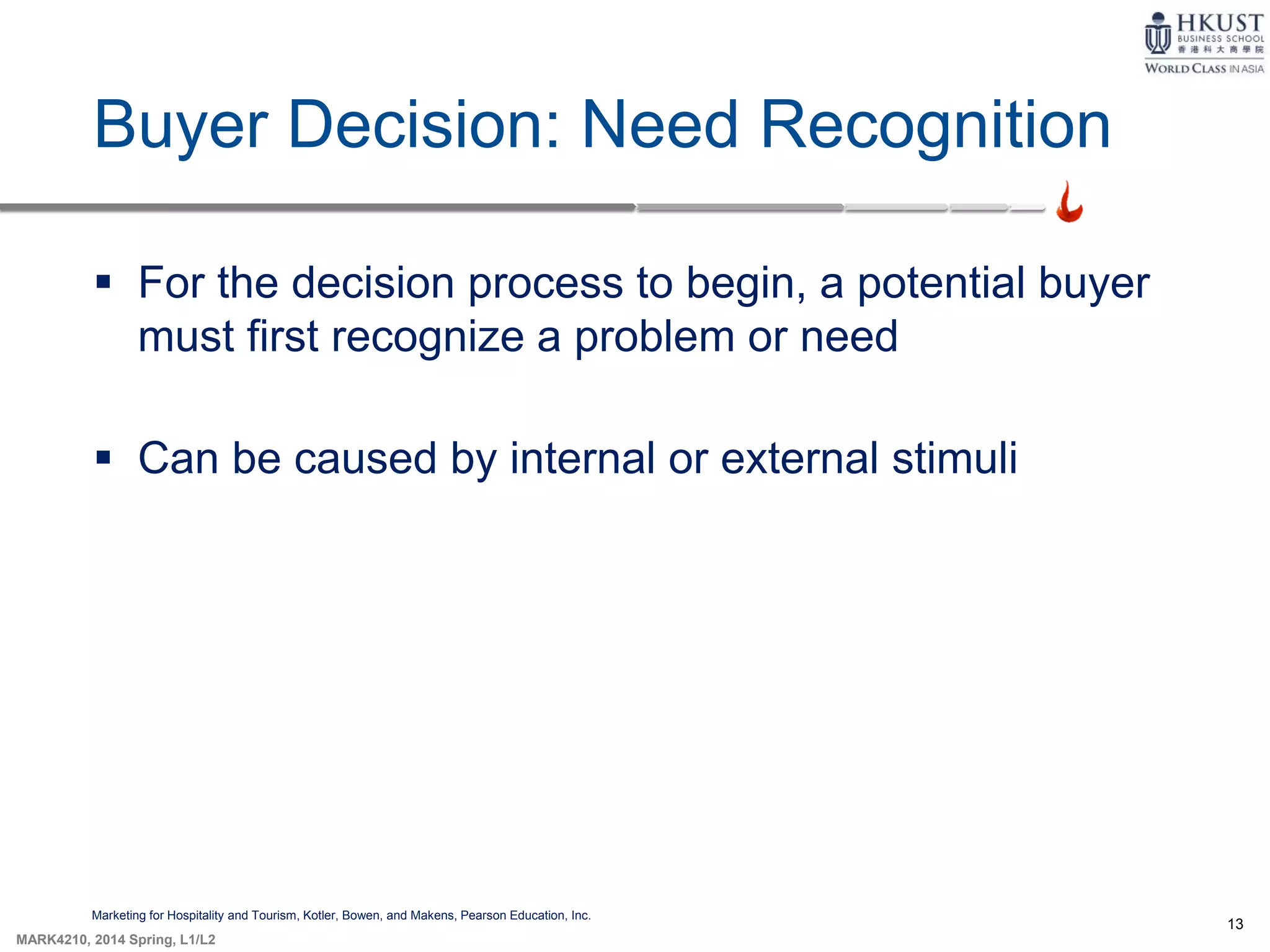
Buyer Decision: Need Recognition
Marketing for Hospitality and Tourism, Kotler, Bowen, and Makens, Pearson Education, Inc.
 For the decision process to begin, a potential buyer
must first recognize a problem or need
 Can be caused by internal or external stimuli
14
MARK4210, 2014 Spring, L1/L2
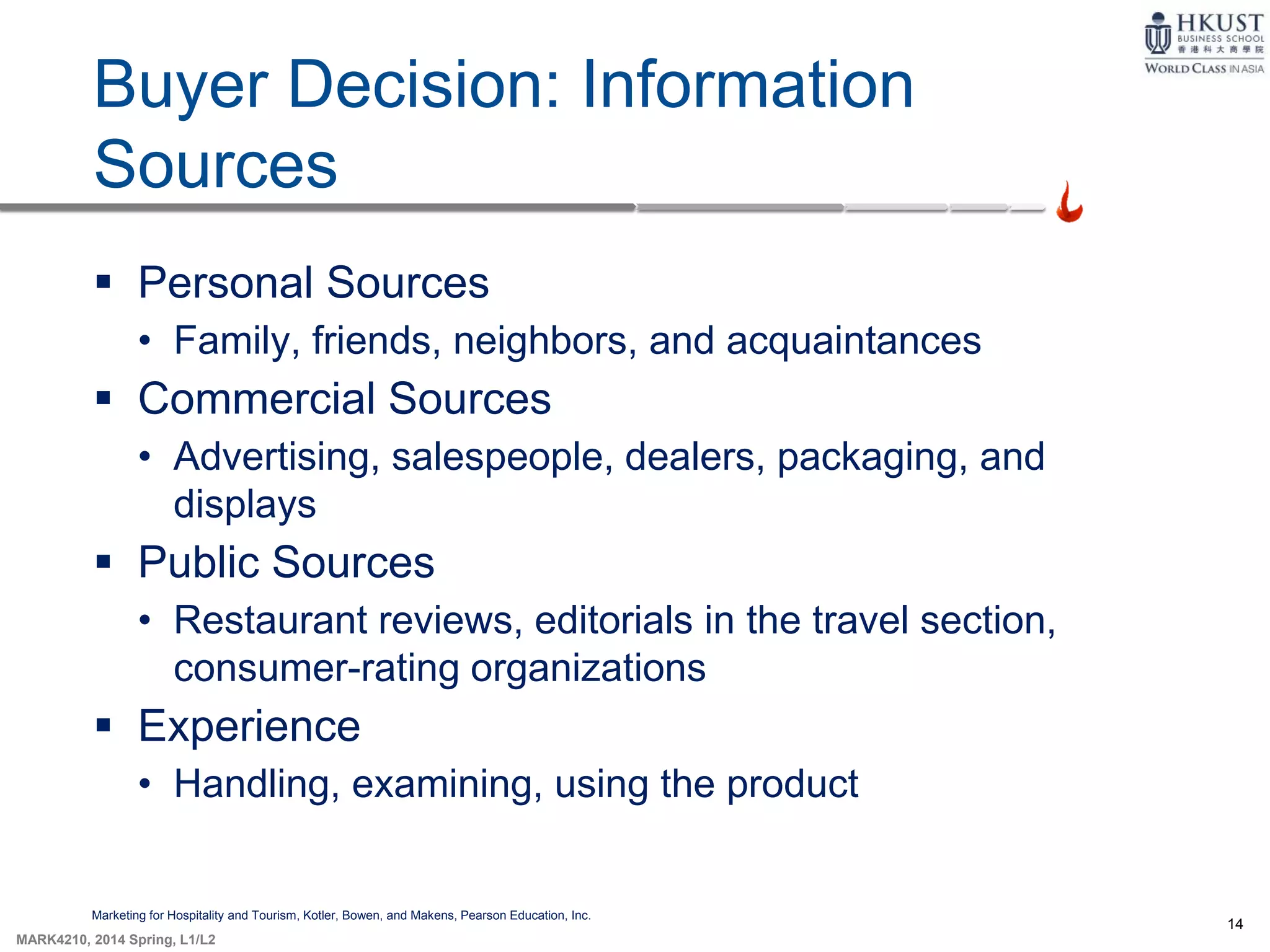
Buyer Decision: Information
Sources
Marketing for Hospitality and Tourism, Kotler, Bowen, and Makens, Pearson Education, Inc.
 Personal Sources
• Family, friends, neighbors, and acquaintances
 Commercial Sources
• Advertising, salespeople, dealers, packaging, and
displays
 Public Sources
• Restaurant reviews, editorials in the travel section,
consumer-rating organizations
 Experience
• Handling, examining, using the product
15
MARK4210, 2014 Spring, L1/L2
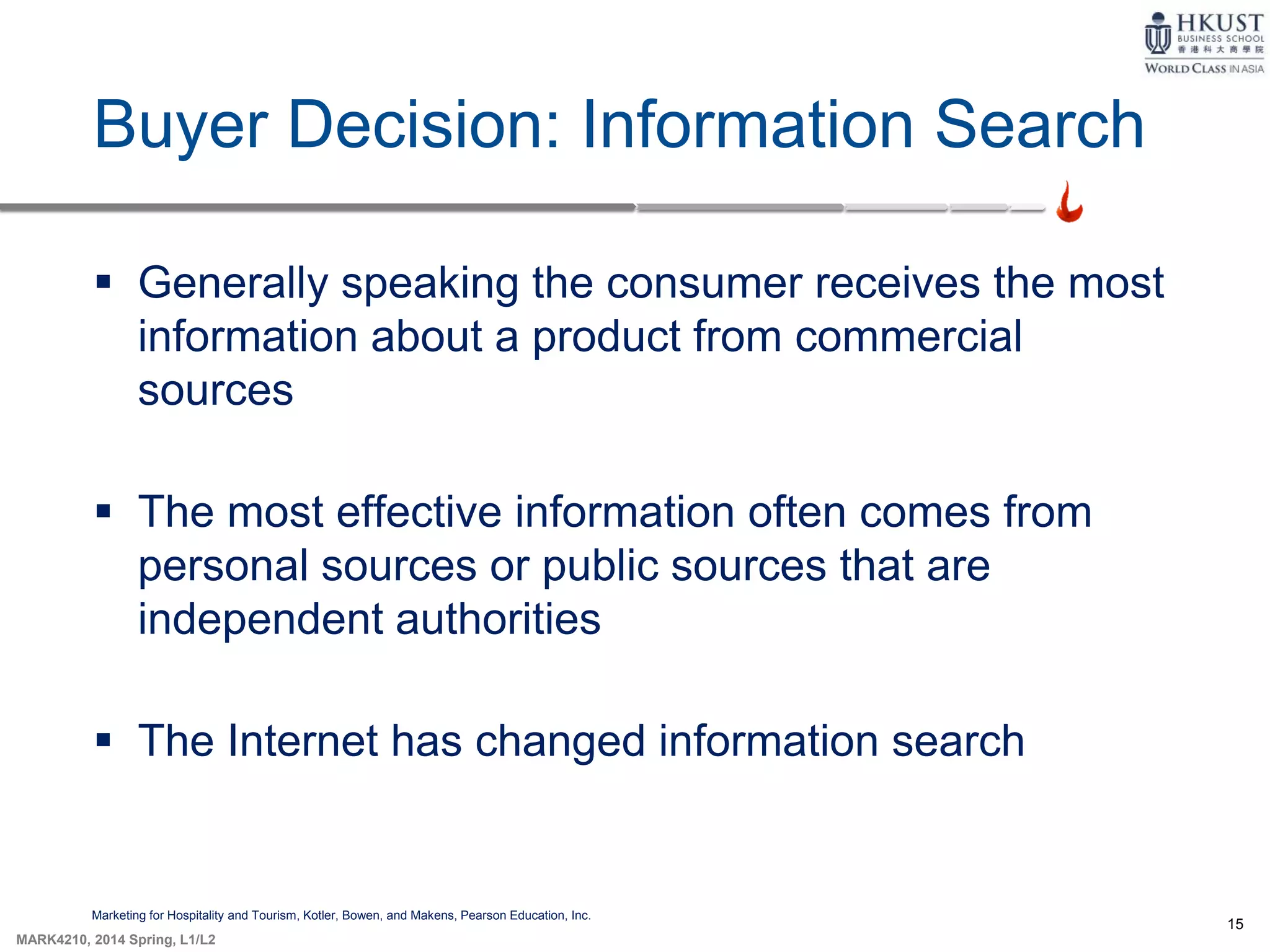
Buyer Decision: Information Search
Marketing for Hospitality and Tourism, Kotler, Bowen, and Makens, Pearson Education, Inc.
 Generally speaking the consumer receives the most
information about a product from commercial
sources
 The most effective information often comes from
personal sources or public sources that are
independent authorities
 The Internet has changed information search
16
MARK4210, 2014 Spring, L1/L2
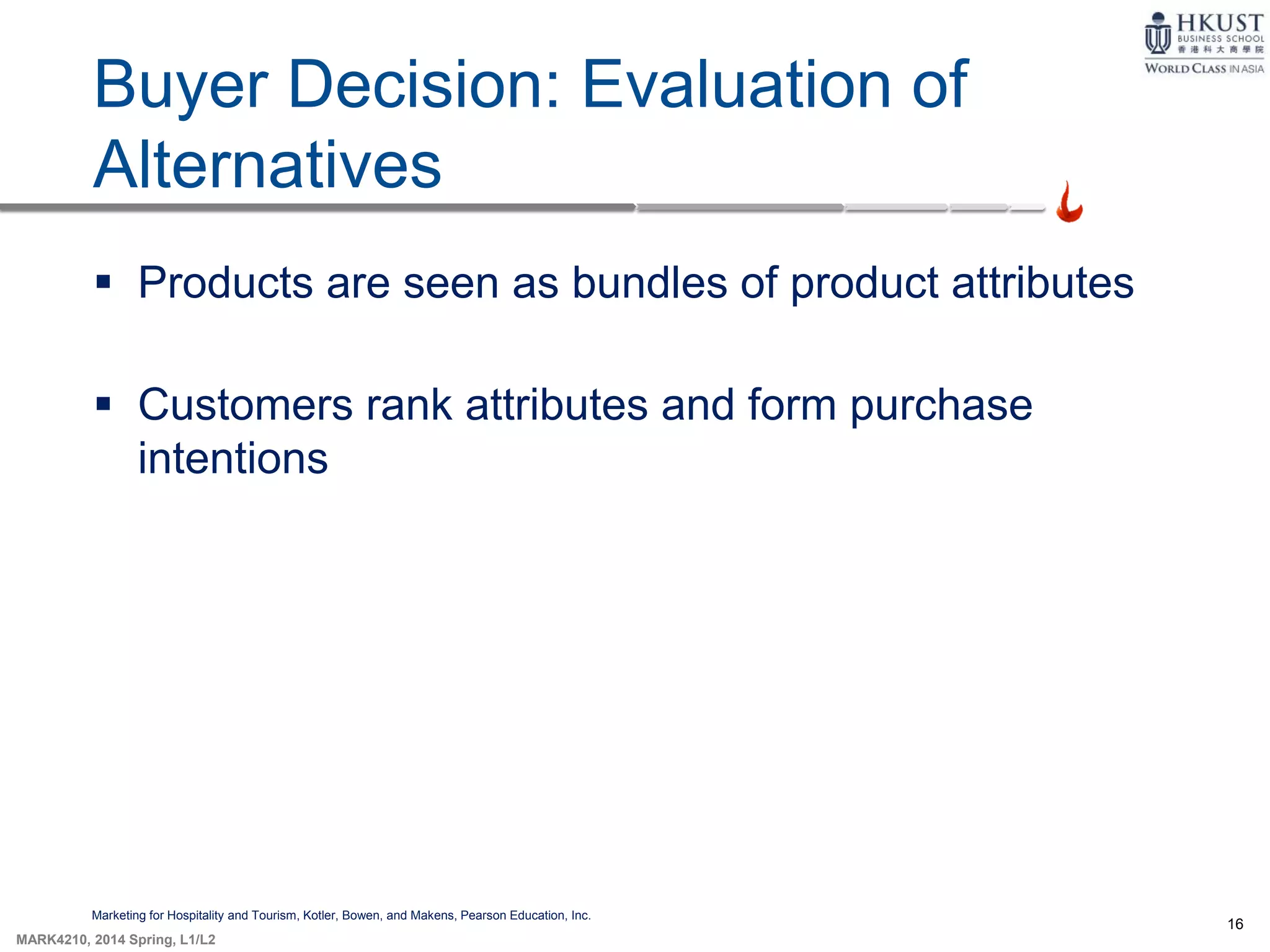
Buyer Decision: Evaluation of
Alternatives
Marketing for Hospitality and Tourism, Kotler, Bowen, and Makens, Pearson Education, Inc.
 Products are seen as bundles of product attributes
 Customers rank attributes and form purchase
intentions
17
MARK4210, 2014 Spring, L1/L2
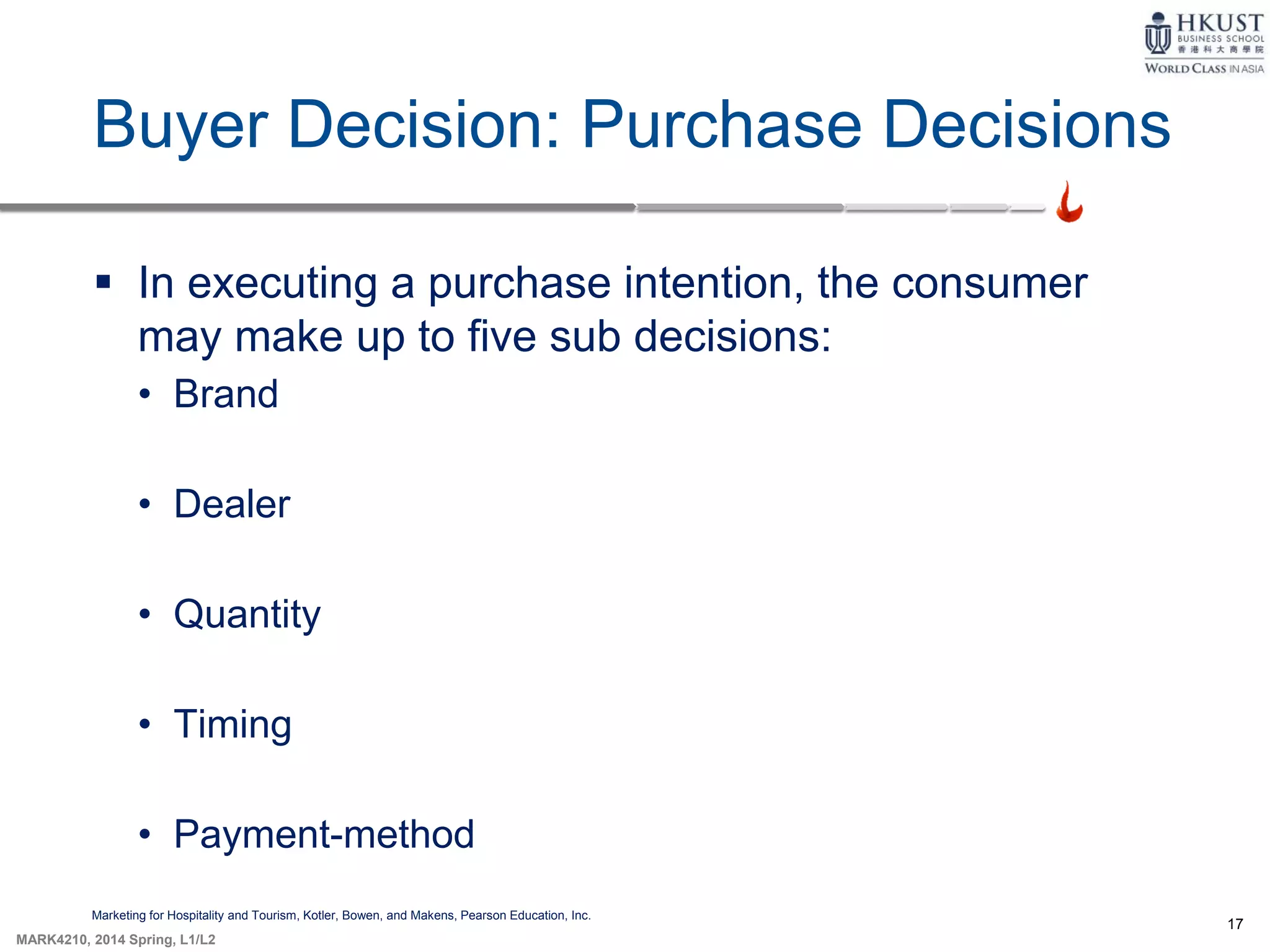
Buyer Decision: Purchase Decisions
Marketing for Hospitality and Tourism, Kotler, Bowen, and Makens, Pearson Education, Inc.
 In executing a purchase intention, the consumer
may make up to five sub decisions:
• Brand
• Dealer
• Quantity
• Timing
• Payment-method
18
MARK4210, 2014 Spring, L1/L2
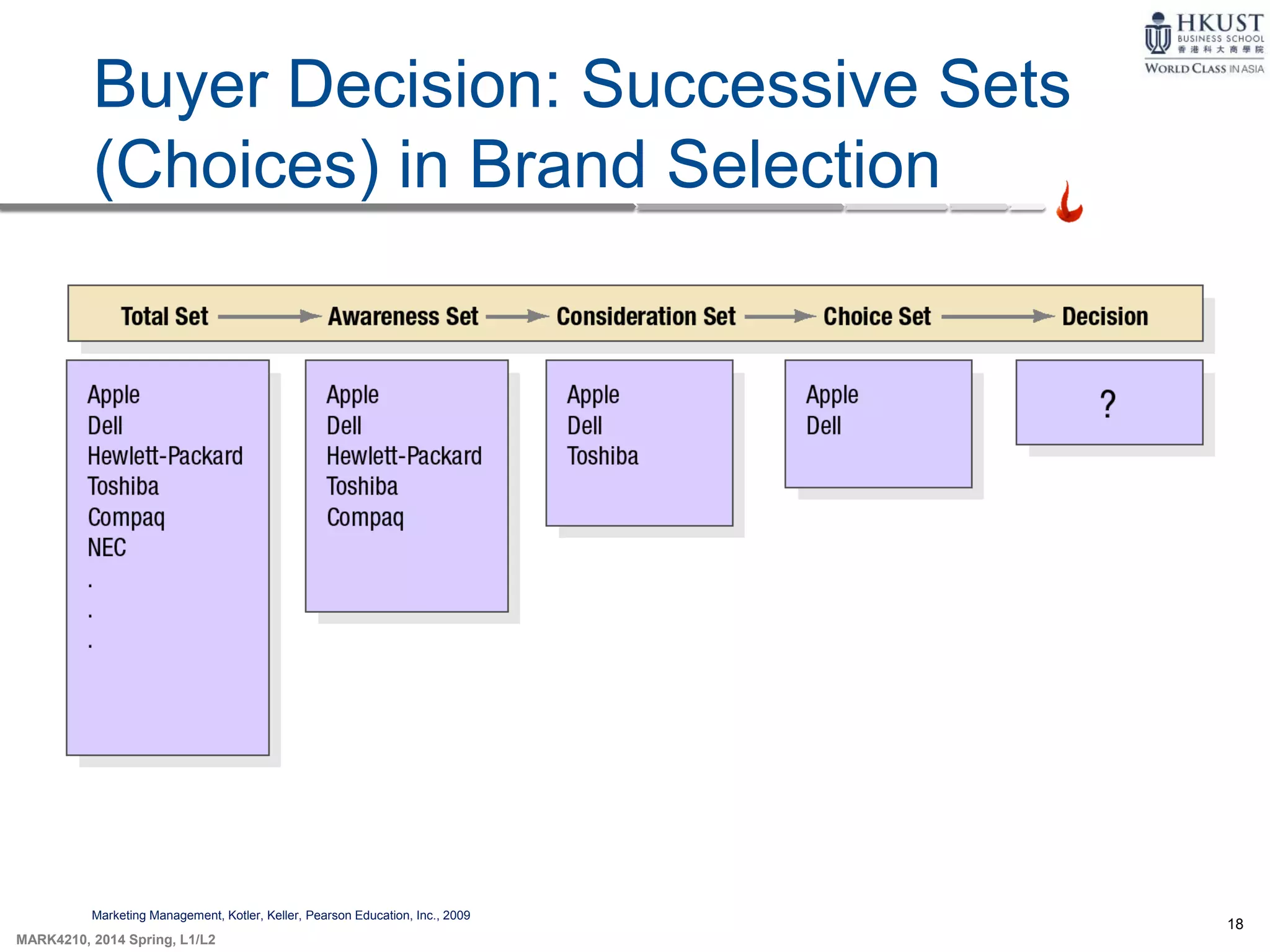
Buyer Decision: Successive Sets
(Choices) in Brand Selection
Marketing Management, Kotler, Keller, Pearson Education, Inc., 2009
19
MARK4210, 2014 Spring, L1/L2
Buyer Decision: Purchase Decision
Perceived Risks
Marketing for Hospitality and Tourism, Kotler, Bowen, and Makens, Pearson Education, Inc.
 Consumer’s decision to modify, postpone, or avoid a
purchase decision is heavily influenced by perceived
risk
 Types of risks perceived by consumers:
• Functional risk
• Physical risk
• Financial risk
• Social risk
• Psychological risk
• Time risk
20
MARK4210, 2014 Spring, L1/L2
Buyer Decision: Post Purchase
Behavior
Marketing for Hospitality and Tourism, Kotler, Bowen, and Makens, Pearson Education, Inc.
 The smaller the gap between customer expectations
and perceived performance, the greater the
customer’s satisfaction
 "Cognitive dissonance" is buyer discomfort caused
by post purchase conflict
21
MARK4210, 2014 Spring, L1/L2
Other Key Points on Buyer Decision
Marketing for Hospitality and Tourism, Kotler, Bowen, and Makens, Pearson Education, Inc.
 Consumers often view price as an indication of
quality (“price-quality inference”)
 Dissatisfied customers may not complain (staff must
seek out consumer dissatisfaction)
 Beyond minimizing dissatisfaction, consumers must
be motivated to purchase

consumer behavior(4210)

  • 1.
    MARK4210, 2014 Spring,L1/L2 MARK4210: Strategic Marketing 2014 Spring, Section L1/L2 [Class #24] Consumer Behavior
  • 2.
    2 MARK4210, 2014 Spring,L1/L2 Consumer Buying Behavior Marketing for Hospitality and Tourism, Kotler, Bowen, and Makens, Pearson Education, Inc.  Consumer Buying Behavior refers to the buying behavior of final consumers – individuals & households who buy goods and services for personal consumption  The central question for marketers is: “How do consumers respond to various marketing efforts the company might use?”
  • 3.
    3 MARK4210, 2014 Spring,L1/L2 Five ‘Premises’ of Consumer Behavior – Basis for Analysis Marketing Management, Kotler, Keller, Pearson Education, Inc., 2009  Consumer behavior is purposeful and goal-oriented  Consumer has free choice  Consumer behavior is a process  Consumer behavior can be influenced  Consumers need to be educated
  • 4.
    4 MARK4210, 2014 Spring,L1/L2 A Model of Consumer Behavior Marketing Management, Kotler, Keller, Pearson Education, Inc., 2009
  • 5.
    5 MARK4210, 2014 Spring,L1/L2 Factors Influencing Consumer Behavior Marketing Management, Kotler, Keller, Pearson Education, Inc., 2009
  • 6.
    6 MARK4210, 2014 Spring,L1/L2 Influencing Consumer Behavior: Cultural Factors Marketing for Hospitality and Tourism, Kotler, Bowen, and Makens, Pearson Education, Inc.  Culture: social heritage of a group (organized community or society); the most basic determinant of a person’s wants and behavior  Subcultures: sub-groups of people with shared value systems based on common life experiences and situations  Social classes: relatively permanent & ordered divisions in a society whose members share similar values, interests, and behaviors
  • 7.
    7 MARK4210, 2014 Spring,L1/L2 Influencing Consumer Behavior: Social Factors Marketing for Hospitality and Tourism, Kotler, Bowen, and Makens, Pearson Education, Inc.  Reference groups: influence the person’s attitudes and self-concept; they also create pressures to conform that may affect the person’s choices  Family: consider the roles & influence of the husband, wife, and children in the purchase decision  Social roles: the activities a person is expected to perform according to the people around him or her  Status: the general esteem given to a role by society; people often choose products that show their status in society
  • 8.
    8 MARK4210, 2014 Spring,L1/L2 Influencing Consumer Behavior: Personal Factors Marketing for Hospitality and Tourism, Kotler, Bowen, and Makens, Pearson Education, Inc.  Age  Life-Cycle Stage  Occupation  Economic Situation  Lifestyle – a person’s pattern of living as expressed in his or her activities, interests, and opinions  Personality – a person’s distinguishing psychological characteristics that lead to relatively consistent and lasting responses to his or her environment  Self-Concept – the complex mental pictures people have of themselves; self-image
  • 9.
    9 MARK4210, 2014 Spring,L1/L2 Influencing Consumer Behavior: Psychological Factors – Motivation Marketing Management, Kotler, Keller, Pearson Education, Inc., 2009  Freud’s Theory • Underlying psychology – psychological forces shaping people’s behavior are largely unconscious, and that a person cannot fully understand his or her own motivations  Maslow’s Theory of Motivation • Sought to explain why people are driven by particular needs at particular times  Herzberg’s Theory • States that there are certain factors that cause satisfaction, while a separate set of factors cause dissatisfaction
  • 10.
    10 MARK4210, 2014 Spring,L1/L2 Maslow’s Hierarchy of Needs Marketing Management, Kotler, Keller, Pearson Education, Inc., 2009
  • 11.
    11 MARK4210, 2014 Spring,L1/L2 Influencing Consumer Behavior: Psychological Factors – Perception Marketing for Hospitality and Tourism, Kotler, Bowen, and Makens, Pearson Education, Inc.  Perception is the process by which an individual selects, organizes, and interprets information inputs to create a meaningful picture of the world.  Perceptions vary widely among individuals exposed to the same reality  In marketing, perceptions are often more important than the reality, as it affects consumers’ actual behavior
  • 12.
    12 MARK4210, 2014 Spring,L1/L2 Buyer Decision Process Marketing Management, Kotler, Keller, Pearson Education, Inc., 2009
  • 13.
    13 MARK4210, 2014 Spring,L1/L2 Buyer Decision: Need Recognition Marketing for Hospitality and Tourism, Kotler, Bowen, and Makens, Pearson Education, Inc.  For the decision process to begin, a potential buyer must first recognize a problem or need  Can be caused by internal or external stimuli
  • 14.
    14 MARK4210, 2014 Spring,L1/L2 Buyer Decision: Information Sources Marketing for Hospitality and Tourism, Kotler, Bowen, and Makens, Pearson Education, Inc.  Personal Sources • Family, friends, neighbors, and acquaintances  Commercial Sources • Advertising, salespeople, dealers, packaging, and displays  Public Sources • Restaurant reviews, editorials in the travel section, consumer-rating organizations  Experience • Handling, examining, using the product
  • 15.
    15 MARK4210, 2014 Spring,L1/L2 Buyer Decision: Information Search Marketing for Hospitality and Tourism, Kotler, Bowen, and Makens, Pearson Education, Inc.  Generally speaking the consumer receives the most information about a product from commercial sources  The most effective information often comes from personal sources or public sources that are independent authorities  The Internet has changed information search
  • 16.
    16 MARK4210, 2014 Spring,L1/L2 Buyer Decision: Evaluation of Alternatives Marketing for Hospitality and Tourism, Kotler, Bowen, and Makens, Pearson Education, Inc.  Products are seen as bundles of product attributes  Customers rank attributes and form purchase intentions
  • 17.
    17 MARK4210, 2014 Spring,L1/L2 Buyer Decision: Purchase Decisions Marketing for Hospitality and Tourism, Kotler, Bowen, and Makens, Pearson Education, Inc.  In executing a purchase intention, the consumer may make up to five sub decisions: • Brand • Dealer • Quantity • Timing • Payment-method
  • 18.
    18 MARK4210, 2014 Spring,L1/L2 Buyer Decision: Successive Sets (Choices) in Brand Selection Marketing Management, Kotler, Keller, Pearson Education, Inc., 2009
  • 19.
    19 MARK4210, 2014 Spring,L1/L2 Buyer Decision: Purchase Decision Perceived Risks Marketing for Hospitality and Tourism, Kotler, Bowen, and Makens, Pearson Education, Inc.  Consumer’s decision to modify, postpone, or avoid a purchase decision is heavily influenced by perceived risk  Types of risks perceived by consumers: • Functional risk • Physical risk • Financial risk • Social risk • Psychological risk • Time risk
  • 20.
    20 MARK4210, 2014 Spring,L1/L2 Buyer Decision: Post Purchase Behavior Marketing for Hospitality and Tourism, Kotler, Bowen, and Makens, Pearson Education, Inc.  The smaller the gap between customer expectations and perceived performance, the greater the customer’s satisfaction  "Cognitive dissonance" is buyer discomfort caused by post purchase conflict
  • 21.
    21 MARK4210, 2014 Spring,L1/L2 Other Key Points on Buyer Decision Marketing for Hospitality and Tourism, Kotler, Bowen, and Makens, Pearson Education, Inc.  Consumers often view price as an indication of quality (“price-quality inference”)  Dissatisfied customers may not complain (staff must seek out consumer dissatisfaction)  Beyond minimizing dissatisfaction, consumers must be motivated to purchase