
MARKET PRICING Prepared by:  GREGAR DONAVEN E. VALDEHUEZA, MBA   Lourdes College Instructor
Learning Objectives Identifies the different factors influencing pricing. Comprehends the considerations in pricing analysis. Differentiates the pricing models base on their significance. Illustrate the supply chain in discounted pricing.
Several Factors Influence Pricing Strategic goals Demand of the products Competitor pricing
Considerations in Pricing Analysis Is your business recouping your costs (time, money, materials, etc.) to provide it? Is it affordable to customers? What about volume or other forms of discounts? What should be the new prices, if any? How do you know?
Pricing Models Cost Plus A predetermined margin ( an amount beyond the minimum necessary ) was added to product cost to form the price.
Advantages Easy to calculate Minimal information requirements Easy to administer Tends to stabilize markets – insulated from demand variations and competitive factors Ensures seller against unpredictable, or unexpected later costs Ethical advantages (just price – set standards of fairness in transaction) Disadvantages Provides no incentive for efficiency Tends to ignore the role of consumers Tends to ignore the role of competitors Use of historical accounting costs rather than replacement value Use of “normal” or “standard” output level to allocate fixed costs Inclusion of sunk costs rather than just using incremental (marginal) costs Ignores opportunity costs Contractors may not focus on performance because the cost is always covered by the client
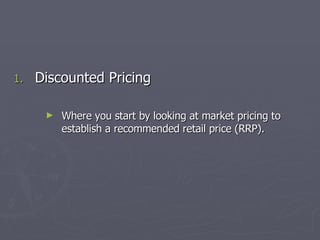
Market Pricing Involves establishing the value of the market and its trends, the unit prices being paid within the market, finding a credible position within that range which is consistent with your offering and your strategy, and deducing the margins and volumes which should be available from different channels into the market.
Options of Market Pricing Backward Pricing (Demand-Backward Pricing) Method in which costs are deducted from what consumers are willing to pay, to see if an adequate profit margin is possible. Psychological Pricing Setting prices according to the psychographics ( analysis of consumer lifestyles to create a detailed customer profile ) of the aimed-at market segment. Price Lining or Product Line Pricing Method that primarily uses price to create the separation between the different models.
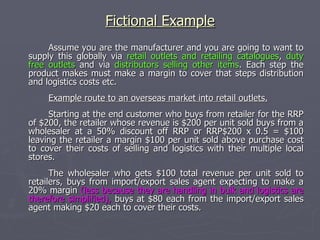
Fictional Example of Backward/Discounted Pricing Assume you are the manufacturer and you are going to want to supply this globally via  retail outlets and retailing catalogues ,  duty free outlets  and via  distributors selling other items . Each step the product makes must make a margin to cover that steps distribution and logistics costs etc.   Example route to an overseas market into retail outlets.   Starting at the end customer who buys from retailer for the RRP of $200, the retailer whose revenue is $200 per unit sold buys from a wholesaler at a 50% discount off RRP or RRP$200 x 0.5 = $100 leaving the retailer a margin $100 per unit sold above purchase cost to cover their costs of selling and logistics with their multiple local stores.  The wholesaler who gets $100 total revenue per unit sold to retailers, buys from import/export sales agent expecting to make a 20% margin  (less because they are handling in bulk and logistics are therefore simplified),  buys at $80 each from the import/export sales agent making $20 each to cover their costs.
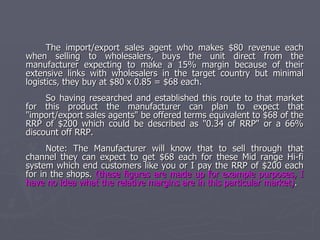
The import/export sales agent who makes $80 revenue each when selling to wholesalers, buys the unit direct from the manufacturer expecting to make a 15% margin because of their extensive links with wholesalers in the target country but minimal logistics, they buy at $80 x 0.85 = $68 each.  So having researched and established this route to that market for this product the manufacturer can plan to expect that "import/export sales agents" be offered terms equivalent to $68 of the RRP of $200 which could be described as "0.34 of RRP" or a 66% discount off RRP.  Note: The Manufacturer will know that to sell through that channel they can expect to get $68 each for these Mid range Hi-fi system which end customers like you or I pay the RRP of $200 each for in the shops.  (these figures are made up for example purposes, I have no idea what the relative margins are in this particular market) .
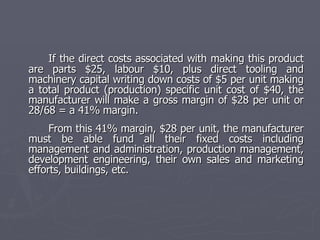
If the direct costs associated with making this product are parts $25, labour $10, plus direct tooling and machinery capital writing down costs of $5 per unit making a total product (production) specific unit cost of $40, the manufacturer will make a gross margin of $28 per unit or 28/68 = a 41% margin.  From this 41% margin, $28 per unit, the manufacturer must be able fund all their fixed costs including management and administration, production management, development engineering, their own sales and marketing efforts, buildings, etc.
Competitive Pricing basing pricing decisions on how competitors are setting their price .
Options of Competitive Pricing Below Competition Pricing A marketer attempting to reach objectives that require high sales levels (e.g., market share objective) may monitor the market to ensure their price remains below competitors.  Above Competition Pricing Marketers using this approach are likely to be perceived as market leaders in terms of product features, brand image or other characteristics that support a price that is higher than what competitors offer.  Parity Pricing A simple method for setting the initial price at the same level of competitors’ price.
References http://managementhelp.org/mrktng/pricing/pricing.htm http://en.wikipedia.org/wiki/Cost-plus_pricing http://www.knowthis.com/tutorials/principles-of-marketing/setting-price/8.htm http://www.businessdictionary.com/
GOOD DAY!!!  

Market Pricing

  • 1.
    MARKET PRICING Preparedby: GREGAR DONAVEN E. VALDEHUEZA, MBA Lourdes College Instructor
  • 2.
    Learning Objectives Identifiesthe different factors influencing pricing. Comprehends the considerations in pricing analysis. Differentiates the pricing models base on their significance. Illustrate the supply chain in discounted pricing.
  • 3.
    Several Factors InfluencePricing Strategic goals Demand of the products Competitor pricing
  • 4.
    Considerations in PricingAnalysis Is your business recouping your costs (time, money, materials, etc.) to provide it? Is it affordable to customers? What about volume or other forms of discounts? What should be the new prices, if any? How do you know?
  • 5.
    Pricing Models CostPlus A predetermined margin ( an amount beyond the minimum necessary ) was added to product cost to form the price.
  • 6.
    Advantages Easy tocalculate Minimal information requirements Easy to administer Tends to stabilize markets – insulated from demand variations and competitive factors Ensures seller against unpredictable, or unexpected later costs Ethical advantages (just price – set standards of fairness in transaction) Disadvantages Provides no incentive for efficiency Tends to ignore the role of consumers Tends to ignore the role of competitors Use of historical accounting costs rather than replacement value Use of “normal” or “standard” output level to allocate fixed costs Inclusion of sunk costs rather than just using incremental (marginal) costs Ignores opportunity costs Contractors may not focus on performance because the cost is always covered by the client
  • 7.
    Market Pricing Involvesestablishing the value of the market and its trends, the unit prices being paid within the market, finding a credible position within that range which is consistent with your offering and your strategy, and deducing the margins and volumes which should be available from different channels into the market.
  • 8.
    Options of MarketPricing Backward Pricing (Demand-Backward Pricing) Method in which costs are deducted from what consumers are willing to pay, to see if an adequate profit margin is possible. Psychological Pricing Setting prices according to the psychographics ( analysis of consumer lifestyles to create a detailed customer profile ) of the aimed-at market segment. Price Lining or Product Line Pricing Method that primarily uses price to create the separation between the different models.
  • 9.
    Fictional Example ofBackward/Discounted Pricing Assume you are the manufacturer and you are going to want to supply this globally via retail outlets and retailing catalogues , duty free outlets and via distributors selling other items . Each step the product makes must make a margin to cover that steps distribution and logistics costs etc. Example route to an overseas market into retail outlets. Starting at the end customer who buys from retailer for the RRP of $200, the retailer whose revenue is $200 per unit sold buys from a wholesaler at a 50% discount off RRP or RRP$200 x 0.5 = $100 leaving the retailer a margin $100 per unit sold above purchase cost to cover their costs of selling and logistics with their multiple local stores. The wholesaler who gets $100 total revenue per unit sold to retailers, buys from import/export sales agent expecting to make a 20% margin (less because they are handling in bulk and logistics are therefore simplified), buys at $80 each from the import/export sales agent making $20 each to cover their costs.
  • 10.
    The import/export salesagent who makes $80 revenue each when selling to wholesalers, buys the unit direct from the manufacturer expecting to make a 15% margin because of their extensive links with wholesalers in the target country but minimal logistics, they buy at $80 x 0.85 = $68 each. So having researched and established this route to that market for this product the manufacturer can plan to expect that "import/export sales agents" be offered terms equivalent to $68 of the RRP of $200 which could be described as "0.34 of RRP" or a 66% discount off RRP. Note: The Manufacturer will know that to sell through that channel they can expect to get $68 each for these Mid range Hi-fi system which end customers like you or I pay the RRP of $200 each for in the shops. (these figures are made up for example purposes, I have no idea what the relative margins are in this particular market) .
  • 11.
    If the directcosts associated with making this product are parts $25, labour $10, plus direct tooling and machinery capital writing down costs of $5 per unit making a total product (production) specific unit cost of $40, the manufacturer will make a gross margin of $28 per unit or 28/68 = a 41% margin. From this 41% margin, $28 per unit, the manufacturer must be able fund all their fixed costs including management and administration, production management, development engineering, their own sales and marketing efforts, buildings, etc.
  • 12.
    Competitive Pricing basingpricing decisions on how competitors are setting their price .
  • 13.
    Options of CompetitivePricing Below Competition Pricing A marketer attempting to reach objectives that require high sales levels (e.g., market share objective) may monitor the market to ensure their price remains below competitors. Above Competition Pricing Marketers using this approach are likely to be perceived as market leaders in terms of product features, brand image or other characteristics that support a price that is higher than what competitors offer. Parity Pricing A simple method for setting the initial price at the same level of competitors’ price.
  • 14.
    References http://managementhelp.org/mrktng/pricing/pricing.htm http://en.wikipedia.org/wiki/Cost-plus_pricinghttp://www.knowthis.com/tutorials/principles-of-marketing/setting-price/8.htm http://www.businessdictionary.com/
  • 15.