Managerial Accounting
The difference Financial   accounting  provides information to shareholders, gov’t, creditors (a/c pay) and people  outside   the business. Managerial   accounting  provides information for managers  inside   a business for planning, directing, monitoring and controlling operations.
The difference Financial   accounting  reports for an arbitrary time period, e.g. financial year Managerial   accounting  day-to-day reporting reports can be run at anytime, any date What are the benefits?
The difference Financial   accounting  Information is based on  historical  data Managerial   accounting  Decisions project into the  future
The difference Financial   accounting  Measures: Performance Stability Liquidity Managerial   accounting  Answers questions: Increase selling price? Remove product line? How many units must be sold to break even?
The difference Financial   accounting  Reports conform to prescribed rules set by governing bodies. Managerial   accounting  Reports can be more descriptive and explanatory catering to different audiences. Make recommendations
Decision-making tools  Contribution margin Break-even point
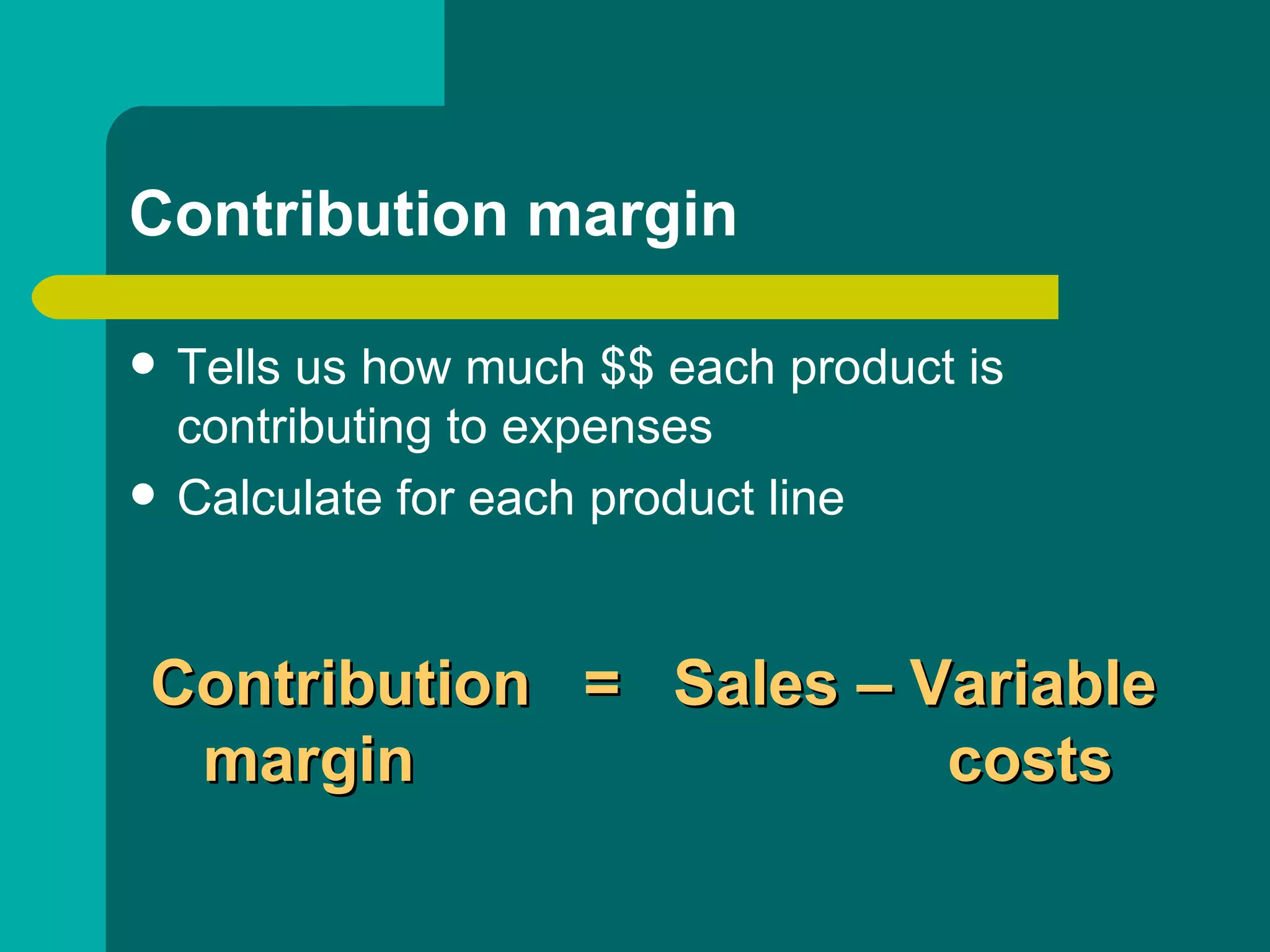
Contribution margin Tells us how much $$ each product is contributing to expenses Calculate for each product line Contribution  =  Sales – Variable   margin    costs
Contribution margin Compare different product lines Is this product line worth keeping? Should we delete it? Contribution  =  Sales – Variable   margin    costs
Contribution margin Express as $ per unit Businesses can set a minimum contribution margin per item Variable costs = associated with selling that item Contribution  =  Sales – Variable   margin    costs
Contribution margin ratio Contribution Margin  =  (Sales – Variable costs)   Ratio    Sales Tells us what portion of Sales goes towards fixed costs. Express as %
Calculating contribution margin You sell CDs on the internet for $25 each (inc. postage)  Your variable costs per CD are: COGS: $18.75 Packaging: $1.00 Postage: $2.00 Calculate contribution margin & ratio
Contribution margin Contribution margin = $3.25  Cont. margin ratio = 13% of selling price What does this mean? Each time you sell a CD at $25, you have $3.25 left over to cover all of your fixed expenses. Or 13% of your sale price contributes to your fixed expenses.
Contribution Margin Work out the contribution margin & ratio for the following business: You sell concert T-shirts for $50 each. Each t-shirt costs $9 from the manufacturer. Your other variable costs are freight at 30c per t-shirt.
Multiple product lines Work out the contribution margin & ratio of each Plasma TV brands sold at a hi-fi retailer: Sony TV Toshiba TV LG TV Selling price $1400 $1100 $1200 COGS $750 $610 $620 Delivery expense $23 $23 $23 Cont margin 627 467 557 CM ratio 44% 42% 46%
Contribution margin Which product line is contributing the most to fixed costs? The least? What would you recommend…
Break-even analysis Also known as Cost-Volume-Profit (CVP) The break-even point is the point at which: Total Sales = Total Costs Profit is $0 Until break-even is reached business operates at a loss Calculated in product units or $$
Purpose of break-even point Know what level of sales (volume) is needed to cover costs Evaluate current price structure
Calculating Break-even-point Units  =   Fixed Costs   Contribution Margin Dollars =  Break-even  x  Selling price    in units    per unit
Spreadsheets Using spreadsheet for break-even analysis  Variables required: Variable cost per unit Fixed costs Expected sales Price per unit

Managerial accounting

  • 1.
  • 2.
    The difference Financial accounting provides information to shareholders, gov’t, creditors (a/c pay) and people outside the business. Managerial accounting provides information for managers inside a business for planning, directing, monitoring and controlling operations.
  • 3.
    The difference Financial accounting reports for an arbitrary time period, e.g. financial year Managerial accounting day-to-day reporting reports can be run at anytime, any date What are the benefits?
  • 4.
    The difference Financial accounting Information is based on historical data Managerial accounting Decisions project into the future
  • 5.
    The difference Financial accounting Measures: Performance Stability Liquidity Managerial accounting Answers questions: Increase selling price? Remove product line? How many units must be sold to break even?
  • 6.
    The difference Financial accounting Reports conform to prescribed rules set by governing bodies. Managerial accounting Reports can be more descriptive and explanatory catering to different audiences. Make recommendations
  • 7.
    Decision-making tools Contribution margin Break-even point
  • 8.
    Contribution margin Tellsus how much $$ each product is contributing to expenses Calculate for each product line Contribution = Sales – Variable margin costs
  • 9.
    Contribution margin Comparedifferent product lines Is this product line worth keeping? Should we delete it? Contribution = Sales – Variable margin costs
  • 10.
    Contribution margin Expressas $ per unit Businesses can set a minimum contribution margin per item Variable costs = associated with selling that item Contribution = Sales – Variable margin costs
  • 11.
    Contribution margin ratioContribution Margin = (Sales – Variable costs) Ratio Sales Tells us what portion of Sales goes towards fixed costs. Express as %
  • 12.
    Calculating contribution marginYou sell CDs on the internet for $25 each (inc. postage) Your variable costs per CD are: COGS: $18.75 Packaging: $1.00 Postage: $2.00 Calculate contribution margin & ratio
  • 13.
    Contribution margin Contributionmargin = $3.25 Cont. margin ratio = 13% of selling price What does this mean? Each time you sell a CD at $25, you have $3.25 left over to cover all of your fixed expenses. Or 13% of your sale price contributes to your fixed expenses.
  • 14.
    Contribution Margin Workout the contribution margin & ratio for the following business: You sell concert T-shirts for $50 each. Each t-shirt costs $9 from the manufacturer. Your other variable costs are freight at 30c per t-shirt.
  • 15.
    Multiple product linesWork out the contribution margin & ratio of each Plasma TV brands sold at a hi-fi retailer: Sony TV Toshiba TV LG TV Selling price $1400 $1100 $1200 COGS $750 $610 $620 Delivery expense $23 $23 $23 Cont margin 627 467 557 CM ratio 44% 42% 46%
  • 16.
    Contribution margin Whichproduct line is contributing the most to fixed costs? The least? What would you recommend…
  • 17.
    Break-even analysis Alsoknown as Cost-Volume-Profit (CVP) The break-even point is the point at which: Total Sales = Total Costs Profit is $0 Until break-even is reached business operates at a loss Calculated in product units or $$
  • 18.
    Purpose of break-evenpoint Know what level of sales (volume) is needed to cover costs Evaluate current price structure
  • 19.
    Calculating Break-even-point Units = Fixed Costs Contribution Margin Dollars = Break-even x Selling price in units per unit
  • 20.
    Spreadsheets Using spreadsheetfor break-even analysis Variables required: Variable cost per unit Fixed costs Expected sales Price per unit

Editor's Notes

  • #13 Contribution Margin = Sales – Variable Costs 25.00 – 21.75 = 3.25 Contribution Margin Ratio = (Sales – Variable Costs) / Sales 3.25/25.00 = 13%
  • #15 Sales – Variable Costs 50 – 9.30 = 40.70 40.70/50 = 81.4%
  • #17 EXPECTED RESPONSE Detete line? Add line? Accept contract? 1 Calculate the contribution margin 2 Define the contribution margin and explain its purpose 3 re-state the issue eg: the business is considering deleting a line … 4 Explain result - compare line under consideration with existing lines Make a recommendation and justify; use figures, plus any additional considerations which the manager should keep in mind eg turnover, impact of deleting a line on existing sales