MARK4210, 2014 Spring, L1/L2
[Class #2]
Overview of Marketing
Strategy
MARK4210: Strategic Marketing
2014 Spring, Section L1/L2
2
MARK4210, 2014 Spring, L1/L2
Agenda
 Context
 Case Example of Marketing Strategy – Optical
Distortion, Inc. (ODI)
 Case Analysis Methodology
3
MARK4210, 2014 Spring, L1/L2
Strategic Marketing Decisions
 Where to compete – i.e., definition of the market
 How to compete – i.e., means for competing
 When to compete – i.e., timing of market
movements, planning
Source: Strategic Marketing Asia Edition, Jain & Haley, Cengage Learning, 2009
4
MARK4210, 2014 Spring, L1/L2
Failings in Strategic Marketing
 Too much emphasis on “where” to compete and not
enough on “how” to compete
 Too little focus on uniqueness and adaptability in
strategy
 Inadequate emphasis on “when” to compete
 Lack of objectivity and/or inherent bias
Source: Strategic Marketing Asia Edition, Jain & Haley, Cengage Learning, 2009
5
MARK4210, 2014 Spring, L1/L2
Addressing Failings of Strategic
Marketing
 Develop attainable goals and objectives
 Involve key operating personnel
 Avoid becoming engrossed in current problems
 Avoid formality in strategy formulation – make it
practical
 Do not separate marketing strategy from the rest of
management process
Source: Strategic Marketing Asia Edition, Jain & Haley, Cengage Learning, 2009
6
MARK4210, 2014 Spring, L1/L2
Situation Analysis
(Customer, Competitor, Company)
Market Selection
(Segmentation, Targeting, Positioning)
Marketing Mix Formulation
(Product, Price, Place, Promotion)
Quantitative Analysis
Consumer Behavior
Simulation Game
-- PharmaSim
Elements of
Marketing Strategy
Fundamentals Application
Course Roadmap
7
MARK4210, 2014 Spring, L1/L2
Marketing Strategy Case Example –
Optical Distortion, Inc. (ODI)
8
MARK4210, 2014 Spring, L1/L2
Chicken Sociology
 Social structure: “Pecking order”
 Dominant versus submissive chickens – submissive
chickens get pecked:
• If they hold their heads high
• If they enter the territory of a dominant bird
 Associated costs
• Death
• Less feeding time and hence poorer egg production
• Replacement of dead chickens
• Upset pecking order
 Cannibalism was greater for more productive flocks
9
MARK4210, 2014 Spring, L1/L2
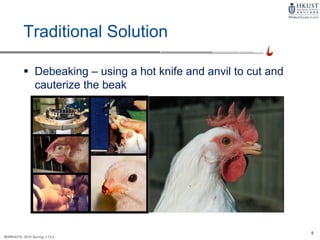
Traditional Solution
 Debeaking – using a hot knife and anvil to cut and
cauterize the beak
10
MARK4210, 2014 Spring, L1/L2
Traditional Solution
 Debeaking reduces mortality from 25% to 9%
 Costs associated with debeaking
• Trauma (weight loss, reduced egg production)
• Higher feed trough levels (at least 3/8” deep)
• Labor costs ($2.50/hr x 3 people) - 220 birds per hour
11
MARK4210, 2014 Spring, L1/L2
Optical Distortion, Inc. (ODI)
 Solution
• Contact lenses for chicken
• Unlike contact lenses for humans that improve eyesight,
the ODI lens was made to partially blind the chickens
 How it works
• Blurred vision makes it harder to waste feed
• Birds had to walk with their heads low
• Peck order disturbed, hence reducing cannibalization
12
MARK4210, 2014 Spring, L1/L2
Company
 Product invented in 1965
 ODI corporation founded in 1966
 Product difficulties solved by 1969, patent awarded
 In 1973, ODI licensed production of lenses to New
World Plastics (cost =$0.032 / pair)
 Limited financial and management resources
13
MARK4210, 2014 Spring, L1/L2
Company
 What are the advantages of ODI lenses over
debeaking?
• Further reduce chicken mortality
• Reduce egg production loss due to trauma caused by
debeaking
• Reduce feeding cost
14
MARK4210, 2014 Spring, L1/L2
Customers
 Facts
• 1974 Chicken census: 300,000 farms, 440 million birds
• 80% of these housed on 3% of farms
 Characteristics???
• Large base
• Highly concentrated
15
MARK4210, 2014 Spring, L1/L2
Competition
 Who are the competitors???
• Debeaking is considered as indirect competition.
• Patent and license protection should hold off the entry of
other competitors for at least three years.
16
MARK4210, 2014 Spring, L1/L2
Segmentation (STP)
 What are the possible ways to segment the
customers???
• Geography
• California
• South Central
• Southern Atlantic
• Farm Size
• Small (<10,000 birds): Family operated, sells eggs locally
• Medium (10,000-50,000 birds): Professionally run, farmer
owned, sells eggs to middlemen
• Large (>50,000 birds): “Corporation”
17
MARK4210, 2014 Spring, L1/L2
Targeting (STP)
 Who should ODI target?
By size (small, medium, large)???
• Large farms
• Potential savings bigger for large farms
• More economical use of ODI’s sales and technical
personnel
• Managers of larger farms may be less conservative
• Can easily test the lens on a segment of their chicken
18
MARK4210, 2014 Spring, L1/L2
Targeting (STP)
 Who should ODI target?
By geography (California, No. Carolina, Georgia)
• California area
• ODI has been doing their testing in California
• High concentration (13% of all US chicken population)
• Less conservative
19
MARK4210, 2014 Spring, L1/L2
4P’s
 Pricing
• What pricing strategy?
• Skimming vs. penetration?
 Promotion
• What promotional method to use?
• How much should you allocate to each method?
 Product
• How to improve the product?
 Place
• Where should regional office & warehouse be located?
20
MARK4210, 2014 Spring, L1/L2
What Happened?
 1975 Limited testing in California
 1976 Expand distribution in California and began
limited testing in the Southern Atlantic or South
Central areas
 1977 Large scale distribution in California
 1978 Expand into entire Southern US
 1979 Go national
 Mid-80s Achieve national roll-out
21
MARK4210, 2014 Spring, L1/L2
Reinforcement: Case Analysis
Methodology
22
MARK4210, 2014 Spring, L1/L2
How to Read a Case
 Skim through the case and identify the key issue
 With the question in mind, re-read the case carefully
and highlight relevant information
 Think about what analyses the information might be
used for and what other information you might need
23
MARK4210, 2014 Spring, L1/L2
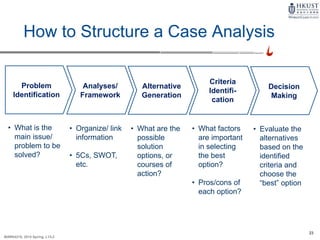
How to Structure a Case Analysis
Problem
Identification
Analyses/
Framework
Alternative
Generation
Criteria
Identifi-
cation
Decision
Making
• What is the
main issue/
problem to be
solved?
• Organize/ link
information
• 5Cs, SWOT,
etc.
• What are the
possible
solution
options, or
courses of
action?
• What factors
are important
in selecting
the best
option?
• Pros/cons of
each option?
• Evaluate the
alternatives
based on the
identified
criteria and
choose the
“best” option
24
MARK4210, 2014 Spring, L1/L2
Hints
 Try to see the big picture as you read the case
• Do not get hung up on complicated terminology
• Avoid theory fitting and think intuitively
 Not all information there is useful, and not all useful
information is there
 Make reasonable assumptions when necessary, and
state these assumptions clearly
 The goal is not to find the “right” answer, but to learn
the approach to thinking and problem solving

overview of marketing strategy(4210)

  • 1.
    MARK4210, 2014 Spring,L1/L2 [Class #2] Overview of Marketing Strategy MARK4210: Strategic Marketing 2014 Spring, Section L1/L2
  • 2.
    2 MARK4210, 2014 Spring,L1/L2 Agenda  Context  Case Example of Marketing Strategy – Optical Distortion, Inc. (ODI)  Case Analysis Methodology
  • 3.
    3 MARK4210, 2014 Spring,L1/L2 Strategic Marketing Decisions  Where to compete – i.e., definition of the market  How to compete – i.e., means for competing  When to compete – i.e., timing of market movements, planning Source: Strategic Marketing Asia Edition, Jain & Haley, Cengage Learning, 2009
  • 4.
    4 MARK4210, 2014 Spring,L1/L2 Failings in Strategic Marketing  Too much emphasis on “where” to compete and not enough on “how” to compete  Too little focus on uniqueness and adaptability in strategy  Inadequate emphasis on “when” to compete  Lack of objectivity and/or inherent bias Source: Strategic Marketing Asia Edition, Jain & Haley, Cengage Learning, 2009
  • 5.
    5 MARK4210, 2014 Spring,L1/L2 Addressing Failings of Strategic Marketing  Develop attainable goals and objectives  Involve key operating personnel  Avoid becoming engrossed in current problems  Avoid formality in strategy formulation – make it practical  Do not separate marketing strategy from the rest of management process Source: Strategic Marketing Asia Edition, Jain & Haley, Cengage Learning, 2009
  • 6.
    6 MARK4210, 2014 Spring,L1/L2 Situation Analysis (Customer, Competitor, Company) Market Selection (Segmentation, Targeting, Positioning) Marketing Mix Formulation (Product, Price, Place, Promotion) Quantitative Analysis Consumer Behavior Simulation Game -- PharmaSim Elements of Marketing Strategy Fundamentals Application Course Roadmap
  • 7.
    7 MARK4210, 2014 Spring,L1/L2 Marketing Strategy Case Example – Optical Distortion, Inc. (ODI)
  • 8.
    8 MARK4210, 2014 Spring,L1/L2 Chicken Sociology  Social structure: “Pecking order”  Dominant versus submissive chickens – submissive chickens get pecked: • If they hold their heads high • If they enter the territory of a dominant bird  Associated costs • Death • Less feeding time and hence poorer egg production • Replacement of dead chickens • Upset pecking order  Cannibalism was greater for more productive flocks
  • 9.
    9 MARK4210, 2014 Spring,L1/L2 Traditional Solution  Debeaking – using a hot knife and anvil to cut and cauterize the beak
  • 10.
    10 MARK4210, 2014 Spring,L1/L2 Traditional Solution  Debeaking reduces mortality from 25% to 9%  Costs associated with debeaking • Trauma (weight loss, reduced egg production) • Higher feed trough levels (at least 3/8” deep) • Labor costs ($2.50/hr x 3 people) - 220 birds per hour
  • 11.
    11 MARK4210, 2014 Spring,L1/L2 Optical Distortion, Inc. (ODI)  Solution • Contact lenses for chicken • Unlike contact lenses for humans that improve eyesight, the ODI lens was made to partially blind the chickens  How it works • Blurred vision makes it harder to waste feed • Birds had to walk with their heads low • Peck order disturbed, hence reducing cannibalization
  • 12.
    12 MARK4210, 2014 Spring,L1/L2 Company  Product invented in 1965  ODI corporation founded in 1966  Product difficulties solved by 1969, patent awarded  In 1973, ODI licensed production of lenses to New World Plastics (cost =$0.032 / pair)  Limited financial and management resources
  • 13.
    13 MARK4210, 2014 Spring,L1/L2 Company  What are the advantages of ODI lenses over debeaking? • Further reduce chicken mortality • Reduce egg production loss due to trauma caused by debeaking • Reduce feeding cost
  • 14.
    14 MARK4210, 2014 Spring,L1/L2 Customers  Facts • 1974 Chicken census: 300,000 farms, 440 million birds • 80% of these housed on 3% of farms  Characteristics??? • Large base • Highly concentrated
  • 15.
    15 MARK4210, 2014 Spring,L1/L2 Competition  Who are the competitors??? • Debeaking is considered as indirect competition. • Patent and license protection should hold off the entry of other competitors for at least three years.
  • 16.
    16 MARK4210, 2014 Spring,L1/L2 Segmentation (STP)  What are the possible ways to segment the customers??? • Geography • California • South Central • Southern Atlantic • Farm Size • Small (<10,000 birds): Family operated, sells eggs locally • Medium (10,000-50,000 birds): Professionally run, farmer owned, sells eggs to middlemen • Large (>50,000 birds): “Corporation”
  • 17.
    17 MARK4210, 2014 Spring,L1/L2 Targeting (STP)  Who should ODI target? By size (small, medium, large)??? • Large farms • Potential savings bigger for large farms • More economical use of ODI’s sales and technical personnel • Managers of larger farms may be less conservative • Can easily test the lens on a segment of their chicken
  • 18.
    18 MARK4210, 2014 Spring,L1/L2 Targeting (STP)  Who should ODI target? By geography (California, No. Carolina, Georgia) • California area • ODI has been doing their testing in California • High concentration (13% of all US chicken population) • Less conservative
  • 19.
    19 MARK4210, 2014 Spring,L1/L2 4P’s  Pricing • What pricing strategy? • Skimming vs. penetration?  Promotion • What promotional method to use? • How much should you allocate to each method?  Product • How to improve the product?  Place • Where should regional office & warehouse be located?
  • 20.
    20 MARK4210, 2014 Spring,L1/L2 What Happened?  1975 Limited testing in California  1976 Expand distribution in California and began limited testing in the Southern Atlantic or South Central areas  1977 Large scale distribution in California  1978 Expand into entire Southern US  1979 Go national  Mid-80s Achieve national roll-out
  • 21.
    21 MARK4210, 2014 Spring,L1/L2 Reinforcement: Case Analysis Methodology
  • 22.
    22 MARK4210, 2014 Spring,L1/L2 How to Read a Case  Skim through the case and identify the key issue  With the question in mind, re-read the case carefully and highlight relevant information  Think about what analyses the information might be used for and what other information you might need
  • 23.
    23 MARK4210, 2014 Spring,L1/L2 How to Structure a Case Analysis Problem Identification Analyses/ Framework Alternative Generation Criteria Identifi- cation Decision Making • What is the main issue/ problem to be solved? • Organize/ link information • 5Cs, SWOT, etc. • What are the possible solution options, or courses of action? • What factors are important in selecting the best option? • Pros/cons of each option? • Evaluate the alternatives based on the identified criteria and choose the “best” option
  • 24.
    24 MARK4210, 2014 Spring,L1/L2 Hints  Try to see the big picture as you read the case • Do not get hung up on complicated terminology • Avoid theory fitting and think intuitively  Not all information there is useful, and not all useful information is there  Make reasonable assumptions when necessary, and state these assumptions clearly  The goal is not to find the “right” answer, but to learn the approach to thinking and problem solving