Randomization AND BLINDING -Dr.ravikiran
1
RANDOMIZATION (SELECTION OF STUDY AND CONTROL GROUP)
INTRODUCTION
Potential Errors in Epidemiological Studies
1. Random errors: SAMPLING ERRORS
 Is ‘divergence due to chance alone’ of an observation on a sample from true
population value, leading to ‘lack of precision’ in measurement
 Random error ‘cannot be completely eliminated’
 Random errors can be reduced by: careful measurement of exposure and outcome,
thus making individual measurements precise
 Best way of reducing sampling errors (increasing precision): Increase the sample size
in the study
2. Systematic errors: BIASES
 Occur whenever there is a tendency to produce results that differ in systematic
manner from the true values
 Bias is any ‘systematic error’ in an epidemiological study, occurring during data
collection, compilation, analysis and interpretation
BIAS
It Is any ‘systematic error’ in an epidemiological study, occurring during data collection,
compilation, analysis and interpretation.
• Predominantly biases are of 3 types:
1. Subject bias: Error introduced by study subjects.
Examples:
Hawthorne effect
Recall bias
2. Investigator bias: Error introduced by investigator: Selection bias
3. Analyzer bias: Error introduced by analyzer
Some Important Types of Biases in Epidemiological Studies
Randomization AND BLINDING -Dr.ravikiran
2
1. Apprehension bias: Certain levels (pulse, blood pressure) may alter
systematically from their usual levels when the subject is apprehensive
2. Attention bias (Hawthorne effect): Study subjects may systematically alter their
behaviour when they know they are being observed
3. Berkesonian bias (Admission rate bias): Bias due to hospital cases and controls
being systematically different from each other
4. Interviewer bias: Interviewer devotes more time of interview with cases as
compared to controls
5. Lead time bias (Zero time shift bias): Bias of over-estimation of survival time,
due to backward shift in starting point, as by screening procedures
6. Memory/ Recall bias: Cases are more likely to remember exposure more correctly
than controls
7. Neymann Bias (Prevalence-incidence bias): Bias due to missing of fatal cases,
mild/ silent cases and cases of short duration of episodes from the study
8. Selection bias (Susceptibility bias): Groups to be compared are differentially
susceptible to the outcome of interest, even before the experimental maneuver is
performed
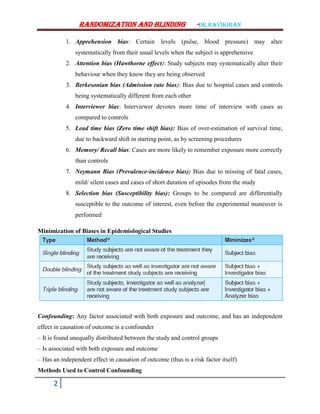
Minimization of Biases in Epidemiological Studies
Confounding: Any factor associated with both exposure and outcome, and has an independent
effect in causation of outcome is a confounder
– It is found unequally distributed between the study and control groups
– Is associated with both exposure and outcome
– Has an independent effect in causation of outcome (thus is a risk factor itself)
Methods Used to Control Confounding
Randomization AND BLINDING -Dr.ravikiran
3
1. Randomization Most ideal method
2. Restriction Limiting study to people who have particular characteristics
3. Matching Mostly useful in case control studies
4. Stratification Useful for larger studies
5. Statistical modeling When many confounding variables exist simultaneously
Matching
Matching: Process of selecting controls in a such a way that they are similar to cases (with regard
to certain pertinent selected variables which may influence the outcome of disease, thereby
distorting the results)
Matching eliminates confounding: Matching distributes known confounding factors equally in
two groups
Types of matching:
– Caliper matching: Process of matching comparison group subjects to study group
subjects within a specified distance for a continuous variable (matching age to within 2
years)
– Frequency matching: Frequency distributions of matched variable(s) are similar in
study and comparison groups
– Category matching: Process of matching study and control group subjects in broad
classes (e.g. occupational groups)
– Individual matching: Relies on identifying individual subjects for comparison, each
resembling a study subject for matched variable(s)
– Pair matching: Individual matching in which study & comparison subjects are Paired
Randomization is Superior to BOTH Matching and Blinding
Randomization AND BLINDING -Dr.ravikiran
4
Randomisation in Randomized Controlled trial (RCT) is a statistical procedure by which
participants are allocated into either of two groups, viz., ‘Experimental Group’ (in which
intervention is given) and ‘Reference Group’ (in which intervention is not given)
• Randomisation is best done by ‘Random number tables’
• The essential purposes of randomization in a randomized controlled trial:
1. Participants have ‘Equal and Known Chance’ of falling into either ‘Experimental
Group’ or ‘Reference Group’
2. To eliminate Selection Bias
3. To ensure comparability among two groups
4. To have ‘similar prognostic factors’ among two groups
Randomization ‘removes both confounding and bias’
Randomisation IS SUPERIOR to Matching: Randomization ensures ‘both known and unknown’
confounding factors are distributed equally among the two groups, thereby nullifying their effect
on result (whereas matching is useful for only known confounding factors)
This is the ‘Heart’ of the clinical trial.
Every individual has an equal chance of being selected into either study group or control group,
from the reference population.
• Selection of study group (Experimental group):
It is the actual population (or volunteers) derived from the reference population randomly,
participating in the experiment, still retaining the same characteristics as the reference
population.
Randomization eliminates bias and allows comparability.
The study group should fulfill the following three criteria:
1. It should be ‘Representative’ of the reference population.
2. They must give ‘informed consent’, after being fully informed about the procedure and
possible dangers of the trial.
3. They must be ‘Susceptible’ to the disease under study. (i.e. qualified or eligible)
Example: Suppose the trial is on the effect of a new drug for Anemia, the volunteers must
be anemic.
Randomization AND BLINDING -Dr.ravikiran
5
The study group receives the intervention (experimental procedure).
• Selection of control group.
Another group of the same size as that of the study group is selected at random from the
reference population, maintaining the similar characteristics (e.g. age, sex, occupation, literacy
level, income, etc.) as that of the study group but they do not receive intervention.
One group should not be made of old, frail, malnourished patients in advanced stage and the
other young, well nourished and in early stage of illness.
Randomization techniques
The commonest method is simple randomization, which allocates patients in such a way that
each has an equal chance of being allocated to any particular group and that process is not
affected by previous allocations. This is usually guided by referring to a table of random
numbers or a computer-generated list. This commonly used method has the value of simplicity,
but may result in unequal numbers of patients allocated to each group or unequal distribution of
potential confounding factors (particularly in smaller studies).
Block randomization is a method used to keep the number of patients in each group
approximately the same (usually in blocks with random sizes of 4, 6 or 8). As each block of
patients is completed, the number in each group will then be equal.
Stratification is a very useful method to minimize confounding. The identified confounding
factors act as criteria for separate randomization schedules, ensuring that the confounding
variables are equalized between groups. Here, the presence of a confounding variable divides
patients into separate blocks (with and without the confounder), and each block of patients is
separately randomized into groups, so that ultimately equal numbers of patients with that
particular confounder will be allocated to each group. This allows a clearer interpretation of the
Randomization AND BLINDING -Dr.ravikiran
6
effect of an intervention on eventual outcome. Common stratifying variables include gender,
patient age, risk strata, smoking status (these depend on whether it is considered they may have
an effect on a particular outcome) and, for multi-centred research, each institution. For example,
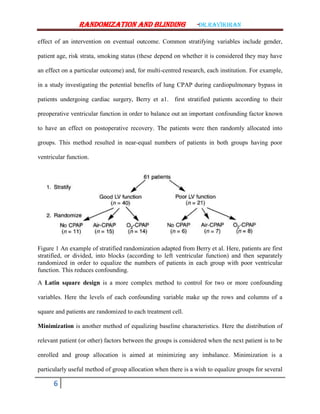
in a study investigating the potential benefits of lung CPAP during cardiopulmonary bypass in
patients undergoing cardiac surgery, Berry et a1. first stratified patients according to their
preoperative ventricular function in order to balance out an important confounding factor known
to have an effect on postoperative recovery. The patients were then randomly allocated into
groups. This method resulted in near-equal numbers of patients in both groups having poor
ventricular function.
Figure 1 An example of stratified randomization adapted from Berry et al. Here, patients are first
stratified, or divided, into blocks (according to left ventricular function) and then separately
randomized in order to equalize the numbers of patients in each group with poor ventricular
function. This reduces confounding.
A Latin square design is a more complex method to control for two or more confounding
variables. Here the levels of each confounding variable make up the rows and columns of a
square and patients are randomized to each treatment cell.
Minimization is another method of equalizing baseline characteristics. Here the distribution of
relevant patient (or other) factors between the groups is considered when the next patient is to be
enrolled and group allocation is aimed at minimizing any imbalance. Minimization is a
particularly useful method of group allocation when there is a wish to equalize groups for several
Randomization AND BLINDING -Dr.ravikiran
7
confounding variables. Minimization also has advantages in situations where randomization is
unacceptable because of ethical concerns.
However, because group allocation is no longer randomly determined, minimization may expose
a trial to bias. For example, a selection bias may occur whereby 'sicker' patients are placed into a
control group. A solution to this can be achieved by retaining random allocation, but modifying
the ratio of random allocation (from 1:1 to, say, 1:4), to increase the chance the next patient will
be allocated to the desired group. Knowledge of group allocation should be kept secure (blind)
until after the patient is enrolled in a trial. Prior knowledge may affect the decision to recruit a
particular patient and so distort the eventual generalizability of the trial results. The commonest
method is to use sealed, opaque envelopes.
Types of Sampling
Types of Random Sampling
• Simple Random Sampling
–– Every unit of population has equal and known chance of being selected
–– Is also known as ‘unrestricted random sampling’
–– Applicable for small, homogenous and readily available populations
–– Used in clinical trials
–– Methods of Simple random sampling:
* Lottery method
* Random no. tables
* Computer software.
Randomization AND BLINDING -Dr.ravikiran
8
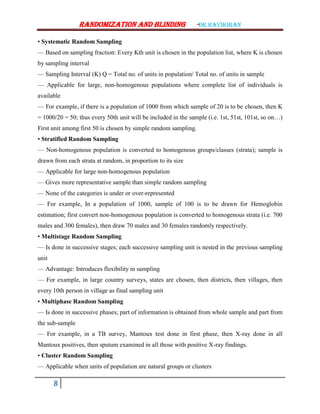
• Systematic Random Sampling
–– Based on sampling fraction: Every Kth unit is chosen in the population list, where K is chosen
by sampling interval
–– Sampling Interval (K) Q = Total no. of units in population/ Total no. of units in sample
–– Applicable for large, non-homogenous populations where complete list of individuals is
available
–– For example, if there is a population of 1000 from which sample of 20 is to be chosen, then K
= 1000/20 = 50; thus every 50th unit will be included in the sample (i.e. 1st, 51st, 101st, so on…)
First unit among first 50 is chosen by simple random sampling.
• Stratified Random Sampling
–– Non-homogenous population is converted to homogenous groups/classes (strata); sample is
drawn from each strata at random, in proportion to its size
–– Applicable for large non-homogenous population
–– Gives more representative sample than simple random sampling
–– None of the categories is under or over-represented
–– For example, In a population of 1000, sample of 100 is to be drawn for Hemoglobin
estimation; first convert non-homogenous population is converted to homogenous strata (i.e. 700
males and 300 females), then draw 70 males and 30 females randomly respectively.
• Multistage Random Sampling
–– Is done in successive stages; each successive sampling unit is nested in the previous sampling
unit
–– Advantage: Introduces flexibility in sampling
–– For example, in large country surveys, states are chosen, then districts, then villages, then
every 10th person in village as final sampling unit
• Multiphase Random Sampling
–– Is done in successive phases; part of information is obtained from whole sample and part from
the sub-sample
–– For example, in a TB survey, Mantoux test done in first phase, then X-ray done in all
Mantoux positives, then sputum examined in all those with positive X-ray findings.
• Cluster Random Sampling
–– Applicable when units of population are natural groups or clusters
Randomization AND BLINDING -Dr.ravikiran
9
–– Use in India: Evaluation of immunization coverage
–– WHO technique used: 30 × 7 technique (total = 210 children)
–– WHO technique used in CRS: 30 × 7 technique (total = 210 children)
* 30 clusters, each containing
* 7 children who are 12 – 23 months age and are completely immunized for primary
immunization (till Measles vaccine)
* Clusters are heterogeneous within themselves but homogenous with respect to each other
* Sampling interval is also calculated in CRS
–– Accuracy: Low error rate of only ± 5%
–– Limitation: Clusters cannot be compared with each other
Types of Non-Random Sampling
• Convenience Sampling
–– Patients are selected, in part or in whole, at the convenience of the researcher; no/limited
attempt to ensure that sample is an accurate representation of population
–– For example, standing at a shopping mall and selecting shoppers as they walk by to fill out a
survey.
• Quota Sampling
–– Population is first segmented into mutually exclusive sub-groups (quotas), just as in stratified
sampling; then judgment is used to select the units from each group non-randomly
–– Is a type of convenience sampling.
• Snow-ball Sampling
–– A technique for developing a research sample where existing study subjects recruit future
subjects from among their acquaintances; thus the sample group appears to grow like a rolling
snowball
–– Is often used in hidden populations which are difficult for researchers to access, e.g. drug
users or commercial sex workers.
• Clinical Trial Sampling.
NONRANDOMIZED TRIALS
Randomization AND BLINDING -Dr.ravikiran
10
Since it is not always possible to resort to randomized controlled trial in human beings due to
ethical, administrative and other reasons, (e.g. smoking and lung cancer, long period of follow up
of thousands of people for more than a decade when the disease frequency is low as in cancer of
cervix, etc.) we can resort to other study designs, such as nonrandomized (or nonexperimental)
trials.
But compared to randomized controlled trials, these are crude, with more frequent spurious
results and of less validity. So, vital decisions are not made.
These nonrandomized trials are uncontrolled trials, natural experiments and before and after
trials.
Uncontrolled Trials
These are the trials without controls, (comparison group) because necessity is not felt due
to peculiar nature of the outcome. For example, in human rabies, the mortality is 100 percent. If
a new drug for human rabies is invented, control group is not required. In other words, ‘historical
controls’ (i.e. experience of earlier untreated patients) are used.
Natural Experiments
In this type, the ‘natural circumstances’ such as earthquake, famine, floods, etc are
identified as the experiment, because such events cannot be artificially created for the sake of the
experiments. Famous example is John Snow’s discovery that cholera is a water borne disease,
was the outcome of the cholera epidemic in London in 1852. This was demonstrated much
before the organisms were identified as the causative agent.
Before and After Comparison Trials
In this type, the group receiving the intervention (experiment) itself serves as control.
Classical examples are prevention of scurvy among sailors by James Lind in 1750, by providing
fresh fruit. Introduction of seat-belt legislation for prevention of deaths and injuries caused by
motor vehicle accidents, in Victoria (Australia) (1971). It was observed that therewas definite
fall in the number of deaths and injuries in occupants of car after the introduction of compulsory
seatbelt legislation.
Randomization AND BLINDING -Dr.ravikiran
11
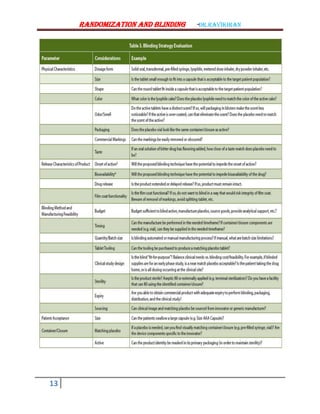
Randomization AND BLINDING -Dr.ravikiran
12
Randomization AND BLINDING -Dr.ravikiran
13
Randomization AND BLINDING -Dr.ravikiran
14
Randomization AND BLINDING -Dr.ravikiran
15
Randomization AND BLINDING -Dr.ravikiran
16
References:
1. Suryakantha community medicine-3rd
edition
2. PSM MCQ BOOK-VIVEK JAIN
3. Paul’s statstics for anesthesia
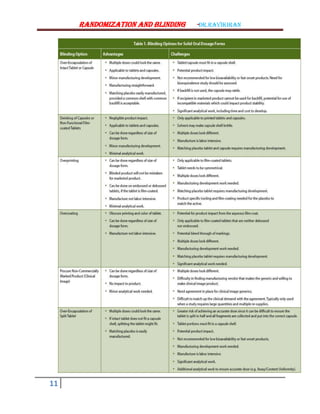
4. https://www.pharmoutsourcing.com/Featured-Articles/178382-Techniques-Challenges-and
Strategies-in-Comparator-Blinding/

Randomization, Bias, Blinding

  • 1.
    Randomization AND BLINDING-Dr.ravikiran 1 RANDOMIZATION (SELECTION OF STUDY AND CONTROL GROUP) INTRODUCTION Potential Errors in Epidemiological Studies 1. Random errors: SAMPLING ERRORS  Is ‘divergence due to chance alone’ of an observation on a sample from true population value, leading to ‘lack of precision’ in measurement  Random error ‘cannot be completely eliminated’  Random errors can be reduced by: careful measurement of exposure and outcome, thus making individual measurements precise  Best way of reducing sampling errors (increasing precision): Increase the sample size in the study 2. Systematic errors: BIASES  Occur whenever there is a tendency to produce results that differ in systematic manner from the true values  Bias is any ‘systematic error’ in an epidemiological study, occurring during data collection, compilation, analysis and interpretation BIAS It Is any ‘systematic error’ in an epidemiological study, occurring during data collection, compilation, analysis and interpretation. • Predominantly biases are of 3 types: 1. Subject bias: Error introduced by study subjects. Examples: Hawthorne effect Recall bias 2. Investigator bias: Error introduced by investigator: Selection bias 3. Analyzer bias: Error introduced by analyzer Some Important Types of Biases in Epidemiological Studies
  • 2.
    Randomization AND BLINDING-Dr.ravikiran 2 1. Apprehension bias: Certain levels (pulse, blood pressure) may alter systematically from their usual levels when the subject is apprehensive 2. Attention bias (Hawthorne effect): Study subjects may systematically alter their behaviour when they know they are being observed 3. Berkesonian bias (Admission rate bias): Bias due to hospital cases and controls being systematically different from each other 4. Interviewer bias: Interviewer devotes more time of interview with cases as compared to controls 5. Lead time bias (Zero time shift bias): Bias of over-estimation of survival time, due to backward shift in starting point, as by screening procedures 6. Memory/ Recall bias: Cases are more likely to remember exposure more correctly than controls 7. Neymann Bias (Prevalence-incidence bias): Bias due to missing of fatal cases, mild/ silent cases and cases of short duration of episodes from the study 8. Selection bias (Susceptibility bias): Groups to be compared are differentially susceptible to the outcome of interest, even before the experimental maneuver is performed Minimization of Biases in Epidemiological Studies Confounding: Any factor associated with both exposure and outcome, and has an independent effect in causation of outcome is a confounder – It is found unequally distributed between the study and control groups – Is associated with both exposure and outcome – Has an independent effect in causation of outcome (thus is a risk factor itself) Methods Used to Control Confounding
  • 3.
    Randomization AND BLINDING-Dr.ravikiran 3 1. Randomization Most ideal method 2. Restriction Limiting study to people who have particular characteristics 3. Matching Mostly useful in case control studies 4. Stratification Useful for larger studies 5. Statistical modeling When many confounding variables exist simultaneously Matching Matching: Process of selecting controls in a such a way that they are similar to cases (with regard to certain pertinent selected variables which may influence the outcome of disease, thereby distorting the results) Matching eliminates confounding: Matching distributes known confounding factors equally in two groups Types of matching: – Caliper matching: Process of matching comparison group subjects to study group subjects within a specified distance for a continuous variable (matching age to within 2 years) – Frequency matching: Frequency distributions of matched variable(s) are similar in study and comparison groups – Category matching: Process of matching study and control group subjects in broad classes (e.g. occupational groups) – Individual matching: Relies on identifying individual subjects for comparison, each resembling a study subject for matched variable(s) – Pair matching: Individual matching in which study & comparison subjects are Paired Randomization is Superior to BOTH Matching and Blinding
  • 4.
    Randomization AND BLINDING-Dr.ravikiran 4 Randomisation in Randomized Controlled trial (RCT) is a statistical procedure by which participants are allocated into either of two groups, viz., ‘Experimental Group’ (in which intervention is given) and ‘Reference Group’ (in which intervention is not given) • Randomisation is best done by ‘Random number tables’ • The essential purposes of randomization in a randomized controlled trial: 1. Participants have ‘Equal and Known Chance’ of falling into either ‘Experimental Group’ or ‘Reference Group’ 2. To eliminate Selection Bias 3. To ensure comparability among two groups 4. To have ‘similar prognostic factors’ among two groups Randomization ‘removes both confounding and bias’ Randomisation IS SUPERIOR to Matching: Randomization ensures ‘both known and unknown’ confounding factors are distributed equally among the two groups, thereby nullifying their effect on result (whereas matching is useful for only known confounding factors) This is the ‘Heart’ of the clinical trial. Every individual has an equal chance of being selected into either study group or control group, from the reference population. • Selection of study group (Experimental group): It is the actual population (or volunteers) derived from the reference population randomly, participating in the experiment, still retaining the same characteristics as the reference population. Randomization eliminates bias and allows comparability. The study group should fulfill the following three criteria: 1. It should be ‘Representative’ of the reference population. 2. They must give ‘informed consent’, after being fully informed about the procedure and possible dangers of the trial. 3. They must be ‘Susceptible’ to the disease under study. (i.e. qualified or eligible) Example: Suppose the trial is on the effect of a new drug for Anemia, the volunteers must be anemic.
  • 5.
    Randomization AND BLINDING-Dr.ravikiran 5 The study group receives the intervention (experimental procedure). • Selection of control group. Another group of the same size as that of the study group is selected at random from the reference population, maintaining the similar characteristics (e.g. age, sex, occupation, literacy level, income, etc.) as that of the study group but they do not receive intervention. One group should not be made of old, frail, malnourished patients in advanced stage and the other young, well nourished and in early stage of illness. Randomization techniques The commonest method is simple randomization, which allocates patients in such a way that each has an equal chance of being allocated to any particular group and that process is not affected by previous allocations. This is usually guided by referring to a table of random numbers or a computer-generated list. This commonly used method has the value of simplicity, but may result in unequal numbers of patients allocated to each group or unequal distribution of potential confounding factors (particularly in smaller studies). Block randomization is a method used to keep the number of patients in each group approximately the same (usually in blocks with random sizes of 4, 6 or 8). As each block of patients is completed, the number in each group will then be equal. Stratification is a very useful method to minimize confounding. The identified confounding factors act as criteria for separate randomization schedules, ensuring that the confounding variables are equalized between groups. Here, the presence of a confounding variable divides patients into separate blocks (with and without the confounder), and each block of patients is separately randomized into groups, so that ultimately equal numbers of patients with that particular confounder will be allocated to each group. This allows a clearer interpretation of the
  • 6.
    Randomization AND BLINDING-Dr.ravikiran 6 effect of an intervention on eventual outcome. Common stratifying variables include gender, patient age, risk strata, smoking status (these depend on whether it is considered they may have an effect on a particular outcome) and, for multi-centred research, each institution. For example, in a study investigating the potential benefits of lung CPAP during cardiopulmonary bypass in patients undergoing cardiac surgery, Berry et a1. first stratified patients according to their preoperative ventricular function in order to balance out an important confounding factor known to have an effect on postoperative recovery. The patients were then randomly allocated into groups. This method resulted in near-equal numbers of patients in both groups having poor ventricular function. Figure 1 An example of stratified randomization adapted from Berry et al. Here, patients are first stratified, or divided, into blocks (according to left ventricular function) and then separately randomized in order to equalize the numbers of patients in each group with poor ventricular function. This reduces confounding. A Latin square design is a more complex method to control for two or more confounding variables. Here the levels of each confounding variable make up the rows and columns of a square and patients are randomized to each treatment cell. Minimization is another method of equalizing baseline characteristics. Here the distribution of relevant patient (or other) factors between the groups is considered when the next patient is to be enrolled and group allocation is aimed at minimizing any imbalance. Minimization is a particularly useful method of group allocation when there is a wish to equalize groups for several
  • 7.
    Randomization AND BLINDING-Dr.ravikiran 7 confounding variables. Minimization also has advantages in situations where randomization is unacceptable because of ethical concerns. However, because group allocation is no longer randomly determined, minimization may expose a trial to bias. For example, a selection bias may occur whereby 'sicker' patients are placed into a control group. A solution to this can be achieved by retaining random allocation, but modifying the ratio of random allocation (from 1:1 to, say, 1:4), to increase the chance the next patient will be allocated to the desired group. Knowledge of group allocation should be kept secure (blind) until after the patient is enrolled in a trial. Prior knowledge may affect the decision to recruit a particular patient and so distort the eventual generalizability of the trial results. The commonest method is to use sealed, opaque envelopes. Types of Sampling Types of Random Sampling • Simple Random Sampling –– Every unit of population has equal and known chance of being selected –– Is also known as ‘unrestricted random sampling’ –– Applicable for small, homogenous and readily available populations –– Used in clinical trials –– Methods of Simple random sampling: * Lottery method * Random no. tables * Computer software.
  • 8.
    Randomization AND BLINDING-Dr.ravikiran 8 • Systematic Random Sampling –– Based on sampling fraction: Every Kth unit is chosen in the population list, where K is chosen by sampling interval –– Sampling Interval (K) Q = Total no. of units in population/ Total no. of units in sample –– Applicable for large, non-homogenous populations where complete list of individuals is available –– For example, if there is a population of 1000 from which sample of 20 is to be chosen, then K = 1000/20 = 50; thus every 50th unit will be included in the sample (i.e. 1st, 51st, 101st, so on…) First unit among first 50 is chosen by simple random sampling. • Stratified Random Sampling –– Non-homogenous population is converted to homogenous groups/classes (strata); sample is drawn from each strata at random, in proportion to its size –– Applicable for large non-homogenous population –– Gives more representative sample than simple random sampling –– None of the categories is under or over-represented –– For example, In a population of 1000, sample of 100 is to be drawn for Hemoglobin estimation; first convert non-homogenous population is converted to homogenous strata (i.e. 700 males and 300 females), then draw 70 males and 30 females randomly respectively. • Multistage Random Sampling –– Is done in successive stages; each successive sampling unit is nested in the previous sampling unit –– Advantage: Introduces flexibility in sampling –– For example, in large country surveys, states are chosen, then districts, then villages, then every 10th person in village as final sampling unit • Multiphase Random Sampling –– Is done in successive phases; part of information is obtained from whole sample and part from the sub-sample –– For example, in a TB survey, Mantoux test done in first phase, then X-ray done in all Mantoux positives, then sputum examined in all those with positive X-ray findings. • Cluster Random Sampling –– Applicable when units of population are natural groups or clusters
  • 9.
    Randomization AND BLINDING-Dr.ravikiran 9 –– Use in India: Evaluation of immunization coverage –– WHO technique used: 30 × 7 technique (total = 210 children) –– WHO technique used in CRS: 30 × 7 technique (total = 210 children) * 30 clusters, each containing * 7 children who are 12 – 23 months age and are completely immunized for primary immunization (till Measles vaccine) * Clusters are heterogeneous within themselves but homogenous with respect to each other * Sampling interval is also calculated in CRS –– Accuracy: Low error rate of only ± 5% –– Limitation: Clusters cannot be compared with each other Types of Non-Random Sampling • Convenience Sampling –– Patients are selected, in part or in whole, at the convenience of the researcher; no/limited attempt to ensure that sample is an accurate representation of population –– For example, standing at a shopping mall and selecting shoppers as they walk by to fill out a survey. • Quota Sampling –– Population is first segmented into mutually exclusive sub-groups (quotas), just as in stratified sampling; then judgment is used to select the units from each group non-randomly –– Is a type of convenience sampling. • Snow-ball Sampling –– A technique for developing a research sample where existing study subjects recruit future subjects from among their acquaintances; thus the sample group appears to grow like a rolling snowball –– Is often used in hidden populations which are difficult for researchers to access, e.g. drug users or commercial sex workers. • Clinical Trial Sampling. NONRANDOMIZED TRIALS
  • 10.
    Randomization AND BLINDING-Dr.ravikiran 10 Since it is not always possible to resort to randomized controlled trial in human beings due to ethical, administrative and other reasons, (e.g. smoking and lung cancer, long period of follow up of thousands of people for more than a decade when the disease frequency is low as in cancer of cervix, etc.) we can resort to other study designs, such as nonrandomized (or nonexperimental) trials. But compared to randomized controlled trials, these are crude, with more frequent spurious results and of less validity. So, vital decisions are not made. These nonrandomized trials are uncontrolled trials, natural experiments and before and after trials. Uncontrolled Trials These are the trials without controls, (comparison group) because necessity is not felt due to peculiar nature of the outcome. For example, in human rabies, the mortality is 100 percent. If a new drug for human rabies is invented, control group is not required. In other words, ‘historical controls’ (i.e. experience of earlier untreated patients) are used. Natural Experiments In this type, the ‘natural circumstances’ such as earthquake, famine, floods, etc are identified as the experiment, because such events cannot be artificially created for the sake of the experiments. Famous example is John Snow’s discovery that cholera is a water borne disease, was the outcome of the cholera epidemic in London in 1852. This was demonstrated much before the organisms were identified as the causative agent. Before and After Comparison Trials In this type, the group receiving the intervention (experiment) itself serves as control. Classical examples are prevention of scurvy among sailors by James Lind in 1750, by providing fresh fruit. Introduction of seat-belt legislation for prevention of deaths and injuries caused by motor vehicle accidents, in Victoria (Australia) (1971). It was observed that therewas definite fall in the number of deaths and injuries in occupants of car after the introduction of compulsory seatbelt legislation.
  • 11.
  • 12.
  • 13.
  • 14.
  • 15.
  • 16.
    Randomization AND BLINDING-Dr.ravikiran 16 References: 1. Suryakantha community medicine-3rd edition 2. PSM MCQ BOOK-VIVEK JAIN 3. Paul’s statstics for anesthesia 4. https://www.pharmoutsourcing.com/Featured-Articles/178382-Techniques-Challenges-and Strategies-in-Comparator-Blinding/