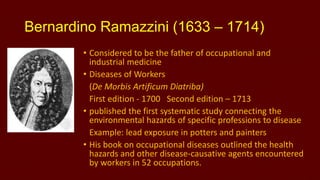
Bernardino Ramazzini (1633 – 1714)
• Considered to be the father of occupational and
industrial medicine
• Diseases of Workers
(De Morbis Artificum Diatriba)
First edition - 1700 Second edition – 1713
• published the first systematic study connecting the
environmental hazards of specific professions to disease
Example: lead exposure in potters and painters
• His book on occupational diseases outlined the health
hazards and other disease-causative agents encountered
by workers in 52 occupations.
Sir Percivall Pott (1714 – 1788)
• Chimney Sweepers’ Cancer of
the scrotum
• first to associate cancer with
occupational exposure (1775)
Occupational health

 refers to the potential risks to health and safety
work outside the home

for those who

Hazard

 something that can cause harm if not controlled.

Occupational disease

 Disease directly caused by a person’s occupation. Thus 2 main
things are there in its definition.
1. The causal relationship between the specific working
environment exposure and a specific disease.
2. frequency of disease occurrence is above average morbidity in
the rest of population.
Ecological approach
 it seeks to ensure a dynamic equilibrium
between the industrial worker and his
occupational environment.
Workplace
 setting in which many people spend the
largest proportion of their time.
 exposes many workers to health hazards
HISTORICAL
PERSPECTIVE ON
OCCUPATIONAL
DISEASE
BIRTH OF OCCUPATIONAL MEDICINE
Occupational Environment
• Sum of external conditions and influences prevailing at the
place of work which have a bearing on the health of the
working population.
Three types of interactions in the work place:
Man and physical, chemical, & biological agents.
Man and machine.
Man and man.-
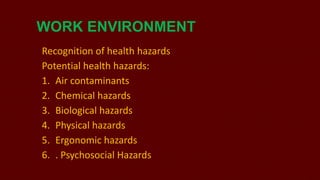
WORK ENVIRONMENT
Recognition of health hazards
Potential health hazards:
1. Air contaminants
2. Chemical hazards
3. Biological hazards
4. Physical hazards
5. Ergonomic hazards
6. . Psychosocial Hazards
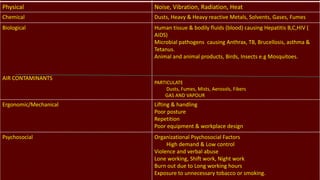
Physical

Noise, Vibration, Radiation, Heat

Chemical

Dusts, Heavy & Heavy reactive Metals, Solvents, Gases, Fumes

Biological

Human tissue & bodily fluids (blood) causing Hepatitis B,C,HIV (
AIDS)
Microbial pathogens causing Anthrax, TB, Brucellosis, asthma &
Tetanus.
Animal and animal products, Birds, Insects e.g Mosquitoes.

AIR CONTAMINANTS

PARTICULATE
Dusts, Fumes, Mists, Aerosols, Fibers
GAS AND VAPOUR

Ergonomic/Mechanical

Lifting & handling
Poor posture
Repetition
Poor equipment & workplace design

Psychosocial

Organizational Psychosocial Factors
High demand & Low control
Violence and verbal abuse
Lone working, Shift work, Night work
Burn out due to Long working hours
Exposure to unnecessary tobacco or smoking.
Ways of acquiring Chemical Hazards
A. Local action: irritants, sensitizers
B. Inhalation:
Dusts – organic , Inorganic
Gases – Simple asphyxiants : Methane, Nitrogen, CO2.
– Chemical asphyxiants : CO, Hydrogen sulphide, HCN
– Irritant gases: Ammonia, SO2,
– Anesthetic gases: Chloroform, Ether, Trichloroethylene.
Metallic compounds

C. Ingestion:
Metallic compounds: Arsenic, Antimony, Beryllium, Chromium,
Cadmium, Cobalt, Lead, Mercury, Manganese, Zinc.
Diseases due to chemical agents
• Gases – gas poisoning.
• Inorganic dusts:
 Coal dust - Anthracosis
 Silica
- Silicosis.
 Asbestos - Asbestosis.
 Iron
- Siderosis
• Organic dusts :
 Cane fiber - Bagassosis.
 Cotton dust – Byssinosis.
 Hay or grain dust – Farmer’s lung.
• Chemicals – Burns, dermatitis, cancer, respiratory illness
• Metals – lead, mercury, arsenic, chromium cause poisoning
OCCUPATIONAL HAZARDS
1. Physical hazards
Heat – Direct & indirect effect of high temperature, radiant heat,
heat stagnation.
Cold – General & local cold injury
Light – Acute & chronic effect of bright & dim light & glare.
Radiation
a.
b.

Ionizing - X-rays, gamma rays, beta particles, alpha particles
Non-ionizing - microwaves, infrared, and ultra-violet light

Noise – Auditory & non auditory effect.
Vibration – hazardous in the frequency range of 10- 500Hz
Diseases due to Physical agents
Heat – Heat stroke, Heat hyperpyrexia, Heat
syncope, Heat Exhaustion, Heat rash.
Light – Occupational cataract, Miners nystagmus.
Cold – Hypothermia, Frost bite, Trench foot.
Pressure – Air embolism, Blast injuries.
Vibration – Osteoarthritis, Reynaud's disease [white
fingers]
Noise – Occupational deafness.
Radiation- Cancer, genetic changes, Aplastic anaemia.
Diseases due to Biological Agents
Hepatitis B Virus
Hepatitis C Virus
Tuberculosis – particularly among Healthcare
Workers
Asthma – among persons exposed to organic dust
Blood-borne Diseases – HIV/AIDS
Anthrax
Brucellosis
Tetanus
Leptospirosis
OCCUPATIONAL HAZARDS
4. Psychosocial hazards
Work-related stress – excessive working time and overwork
Violence – from outside the organization
Bullying – emotional and verbal abuse
Sexual Harassment
Mobbing
Burnout
Exposure to unhealthy elements – tobacco,
uncontrolled alcohol
Disorders due to Psychosocial Agents
MSDs and work-related psychosocial factors such as
high workload/demands, high perceived stress levels,
low social support, low job control, low job satisfaction
and monotonous work.

Musculoskeletal disorders (MSDs)
• can affect the body’s muscles, joints, tendons,
ligaments and nerves. As well as the back, neck,
shoulders and upper limbs; less often they affect the
lower limbs.
• develop over time and are caused either by the work
itself or by the employees' working environment.
Disorders due to Psychological
Agents
Psychological Hazards resulting from stress & strain:
Depression
Discouragement
Boredom
Anxiety
Memory loss
Dissatisfaction
Frustration
Irritability
Discouragement
Pessimism
PREVENTION OF OCCUPATIONAL DISEASES.
MEASURES FOR HEALTH PROTECTION OF WORKERS.

1. Nutrition.
2. Communicable disease control.
3. Environmental sanitation.
•
•
•
•
•
•
•
•
•

Water supply
Food
Toilet
Proper garbage & waste disposal.
General plant cleanliness.
Sufficient space.
Lighting.
Ventilation.
Protection against hazards.
PREVENTION OF OCCUPATIONAL DISEASES.
MEASURES FOR HEALTH PROTECTION OF WORKERS.

4. Mental health:
GOALS:
To promote health and happiness of workers.

To detect signs of stress and strain and take necessary
measures.
Treatment of employees suffering from mental illnesses.
Rehabilitation of those who become ill.
5. Measures for women and children.
6. Family planning services
7. Health education.
PREVENTION OF OCCUPATIONAL DISEASES
MEDICAL MEASURES:
1.
2.
3.
4.

•
•
•
•
•
•

Pre –placement examination.
Periodical health check up.
Medical and health care facilities.
Supervision of work environment.

Water supply , food, general plant cleanliness
Toilet. Proper garbage & waste disposal.
Sufficient space.
Lighting.
Ventilation.
Protection against hazards.

5. Notification
6. Maintenance and analysis of records.
7. Health education and counseling.
Any Questions !!!!!!

•

Thank You

Introduction to occupational diseases

  • 2.
    Bernardino Ramazzini (1633– 1714) • Considered to be the father of occupational and industrial medicine • Diseases of Workers (De Morbis Artificum Diatriba) First edition - 1700 Second edition – 1713 • published the first systematic study connecting the environmental hazards of specific professions to disease Example: lead exposure in potters and painters • His book on occupational diseases outlined the health hazards and other disease-causative agents encountered by workers in 52 occupations.
  • 3.
    Sir Percivall Pott(1714 – 1788) • Chimney Sweepers’ Cancer of the scrotum • first to associate cancer with occupational exposure (1775)
  • 4.
    Occupational health  refersto the potential risks to health and safety work outside the home for those who Hazard  something that can cause harm if not controlled. Occupational disease  Disease directly caused by a person’s occupation. Thus 2 main things are there in its definition. 1. The causal relationship between the specific working environment exposure and a specific disease. 2. frequency of disease occurrence is above average morbidity in the rest of population.
  • 5.
    Ecological approach  itseeks to ensure a dynamic equilibrium between the industrial worker and his occupational environment. Workplace  setting in which many people spend the largest proportion of their time.  exposes many workers to health hazards
  • 6.
  • 7.
    Occupational Environment • Sumof external conditions and influences prevailing at the place of work which have a bearing on the health of the working population. Three types of interactions in the work place: Man and physical, chemical, & biological agents. Man and machine. Man and man.-
  • 8.
    WORK ENVIRONMENT Recognition ofhealth hazards Potential health hazards: 1. Air contaminants 2. Chemical hazards 3. Biological hazards 4. Physical hazards 5. Ergonomic hazards 6. . Psychosocial Hazards
  • 9.
    Physical Noise, Vibration, Radiation,Heat Chemical Dusts, Heavy & Heavy reactive Metals, Solvents, Gases, Fumes Biological Human tissue & bodily fluids (blood) causing Hepatitis B,C,HIV ( AIDS) Microbial pathogens causing Anthrax, TB, Brucellosis, asthma & Tetanus. Animal and animal products, Birds, Insects e.g Mosquitoes. AIR CONTAMINANTS PARTICULATE Dusts, Fumes, Mists, Aerosols, Fibers GAS AND VAPOUR Ergonomic/Mechanical Lifting & handling Poor posture Repetition Poor equipment & workplace design Psychosocial Organizational Psychosocial Factors High demand & Low control Violence and verbal abuse Lone working, Shift work, Night work Burn out due to Long working hours Exposure to unnecessary tobacco or smoking.
  • 10.
    Ways of acquiringChemical Hazards A. Local action: irritants, sensitizers B. Inhalation: Dusts – organic , Inorganic Gases – Simple asphyxiants : Methane, Nitrogen, CO2. – Chemical asphyxiants : CO, Hydrogen sulphide, HCN – Irritant gases: Ammonia, SO2, – Anesthetic gases: Chloroform, Ether, Trichloroethylene. Metallic compounds C. Ingestion: Metallic compounds: Arsenic, Antimony, Beryllium, Chromium, Cadmium, Cobalt, Lead, Mercury, Manganese, Zinc.
  • 11.
    Diseases due tochemical agents • Gases – gas poisoning. • Inorganic dusts:  Coal dust - Anthracosis  Silica - Silicosis.  Asbestos - Asbestosis.  Iron - Siderosis • Organic dusts :  Cane fiber - Bagassosis.  Cotton dust – Byssinosis.  Hay or grain dust – Farmer’s lung. • Chemicals – Burns, dermatitis, cancer, respiratory illness • Metals – lead, mercury, arsenic, chromium cause poisoning
  • 12.
    OCCUPATIONAL HAZARDS 1. Physicalhazards Heat – Direct & indirect effect of high temperature, radiant heat, heat stagnation. Cold – General & local cold injury Light – Acute & chronic effect of bright & dim light & glare. Radiation a. b. Ionizing - X-rays, gamma rays, beta particles, alpha particles Non-ionizing - microwaves, infrared, and ultra-violet light Noise – Auditory & non auditory effect. Vibration – hazardous in the frequency range of 10- 500Hz
  • 13.
    Diseases due toPhysical agents Heat – Heat stroke, Heat hyperpyrexia, Heat syncope, Heat Exhaustion, Heat rash. Light – Occupational cataract, Miners nystagmus. Cold – Hypothermia, Frost bite, Trench foot. Pressure – Air embolism, Blast injuries. Vibration – Osteoarthritis, Reynaud's disease [white fingers] Noise – Occupational deafness. Radiation- Cancer, genetic changes, Aplastic anaemia.
  • 14.
    Diseases due toBiological Agents Hepatitis B Virus Hepatitis C Virus Tuberculosis – particularly among Healthcare Workers Asthma – among persons exposed to organic dust Blood-borne Diseases – HIV/AIDS Anthrax Brucellosis Tetanus Leptospirosis
  • 15.
    OCCUPATIONAL HAZARDS 4. Psychosocialhazards Work-related stress – excessive working time and overwork Violence – from outside the organization Bullying – emotional and verbal abuse Sexual Harassment Mobbing Burnout Exposure to unhealthy elements – tobacco, uncontrolled alcohol
  • 16.
    Disorders due toPsychosocial Agents MSDs and work-related psychosocial factors such as high workload/demands, high perceived stress levels, low social support, low job control, low job satisfaction and monotonous work. Musculoskeletal disorders (MSDs) • can affect the body’s muscles, joints, tendons, ligaments and nerves. As well as the back, neck, shoulders and upper limbs; less often they affect the lower limbs. • develop over time and are caused either by the work itself or by the employees' working environment.
  • 17.
    Disorders due toPsychological Agents Psychological Hazards resulting from stress & strain: Depression Discouragement Boredom Anxiety Memory loss Dissatisfaction Frustration Irritability Discouragement Pessimism
  • 18.
    PREVENTION OF OCCUPATIONALDISEASES. MEASURES FOR HEALTH PROTECTION OF WORKERS. 1. Nutrition. 2. Communicable disease control. 3. Environmental sanitation. • • • • • • • • • Water supply Food Toilet Proper garbage & waste disposal. General plant cleanliness. Sufficient space. Lighting. Ventilation. Protection against hazards.
  • 19.
    PREVENTION OF OCCUPATIONALDISEASES. MEASURES FOR HEALTH PROTECTION OF WORKERS. 4. Mental health: GOALS: To promote health and happiness of workers. To detect signs of stress and strain and take necessary measures. Treatment of employees suffering from mental illnesses. Rehabilitation of those who become ill. 5. Measures for women and children. 6. Family planning services 7. Health education.
  • 20.
    PREVENTION OF OCCUPATIONALDISEASES MEDICAL MEASURES: 1. 2. 3. 4. • • • • • • Pre –placement examination. Periodical health check up. Medical and health care facilities. Supervision of work environment. Water supply , food, general plant cleanliness Toilet. Proper garbage & waste disposal. Sufficient space. Lighting. Ventilation. Protection against hazards. 5. Notification 6. Maintenance and analysis of records. 7. Health education and counseling.
  • 21.

Editor's Notes

  • #13 Cold: General & local cold injury general –hypothermia – numbness, loss of sensation, desire to sleep, hallucination, coma, death.Trench foot [ wet – cold injury] in temp above freezing point, Frost bite –[ Dry - cold injury] below freezing point, tissues freeze and ice crystals form between the cells, leads to tissue damage in prolonged exposure, part may need amputation.Prevention: adequate clothing. Affected part can be warmed using water at 44 deg. C, WARMING FOR 20 MIN. AT A TIME, DRINKING HOT FLUID.
  • #14 Heat stroke: Failure of heat regulating mechanism. temp – upto 110 deg F [ 44 deg. C, Skin dry, hot , no perspiration, delirium, convulsions partial / complete loss of consciousness, death in 40 % cases if not treated in time. TREATMENT : Rapid cooling of body in ice water till rectal temp falls to 39 deg C [ 102 deg F.]Heat hyperpyrexia : This is also due to impaired functioning of temp regulation mechanism but less severe than H. stroke.Heat exhaustion: Milder condition due toinadequate replacement of water and salt due to excessive perspiration / sweating. Occurs afterseveral days of exposure to high temp. Body temp may be normal or mod. High, not more than 102 deg F. – DIZZINESS, WEAKNESS, FATIGUE. Treatment NORMALISING FLUID AND ELECTROLYTE BALANCE. Heat cramps : occur in people who are doing heavy muscular work in high temp.
  • #20 5. Measures for women and children.Developing embryo is more susceptible to noxious agents than the xposed mother.Females are less suited for some tasks and pregnancy put certain limitaions on work capacity.Females tend to restrict their nourishment in difficult economic circumstances.Infant mortality is higher among the children of women employed in industries.