Autoimmune Diseases,
Tolerance and
Hypersensitivity
Dr. Muhammad Yahya Noori
BDS
Based Upon Warren Levinson 1
Hypersensitivity
An exaggerated or inappropriate immune reaction
harmful to the host
Based Upon Warren Levinson 2
• The clinical manifestations of these reactions are typical in a given individual.
• They occur on contact with the specific antigen to which the individual is
hypersensitive.
• The first contact of the individual with the antigen sensitizes, i.e., induces the
antibody and the subsequent contacts elicit the allergic response.
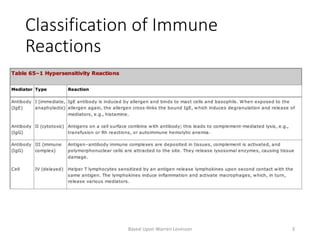
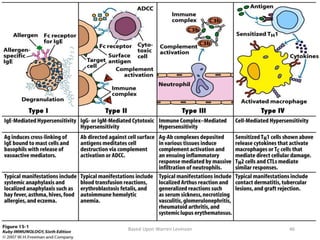
Classification of Immune
Reactions
Based Upon Warren Levinson 3
Type 1 Hypersensitivity Reactions
• Atopy
• Anaphylaxis
• Asthma
Based Upon Warren Levinson 4
Type I Hypersensitivity
(Anaphylactic) Reactions/Allergy
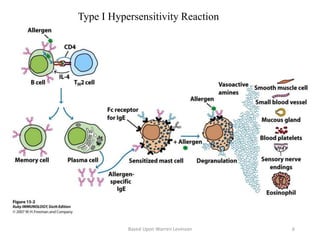
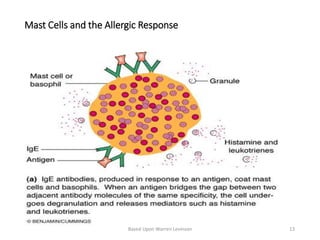
• Occur within minutes of exposure to antigen
• Antigens combine with IgE antibodies
• IgE binds to mast cells and basophils, causing them to
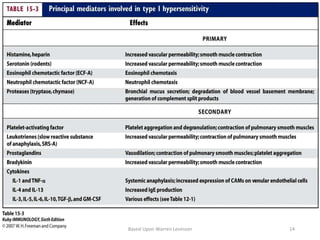
undergo degranulation and release several mediators:
• Histamine
• Prostaglandins
• Leukotrienes
• Exposure to an allergen activates B cells to form IgE
secreting plasma cells
• Secreted IgE molecules bind to Fce receptors on mast cells
• A subsequent exposure to the allergen results in crosslinking
of the bound IgE which triggers the release of various
compounds
Based Upon Warren Levinson 5
Type I Hypersensitivity Reaction
Based Upon Warren Levinson 6
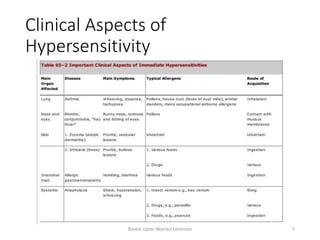
Clinical Aspects of
Hypersensitivity
Based Upon Warren Levinson 7
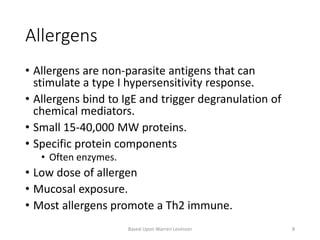
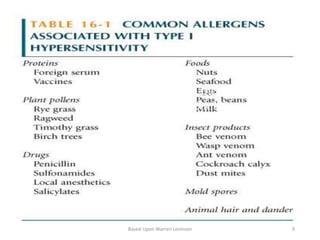
Allergens
• Allergens are non-parasite antigens that can
stimulate a type I hypersensitivity response.
• Allergens bind to IgE and trigger degranulation of
chemical mediators.
• Small 15-40,000 MW proteins.
• Specific protein components
• Often enzymes.
• Low dose of allergen
• Mucosal exposure.
• Most allergens promote a Th2 immune.
Based Upon Warren Levinson 8
In the US ---
36 million people
said to have hay fever!
Based Upon Warren Levinson 9
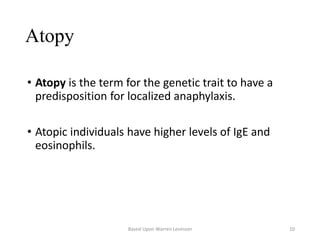
Atopy
• Atopy is the term for the genetic trait to have a
predisposition for localized anaphylaxis.
• Atopic individuals have higher levels of IgE and
eosinophils.
Based Upon Warren Levinson 10
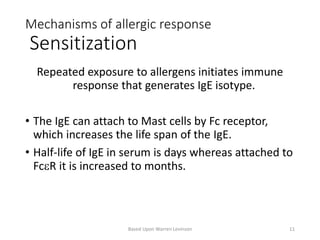
Mechanisms of allergic response
Sensitization
Repeated exposure to allergens initiates immune
response that generates IgE isotype.
• The IgE can attach to Mast cells by Fc receptor,
which increases the life span of the IgE.
• Half-life of IgE in serum is days whereas attached to
FceR it is increased to months.
Based Upon Warren Levinson 11
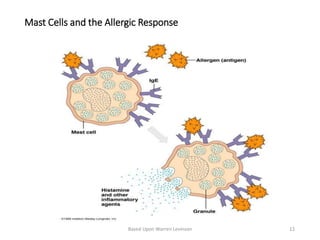
Mast Cells and the Allergic Response
Based Upon Warren Levinson 12
Mast Cells and the Allergic Response
Based Upon Warren Levinson 13
Based Upon Warren Levinson 14
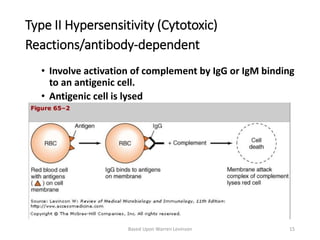
Type II Hypersensitivity (Cytotoxic)
Reactions/antibody-dependent
• Involve activation of complement by IgG or IgM binding
to an antigenic cell.
• Antigenic cell is lysed
Based Upon Warren Levinson 15
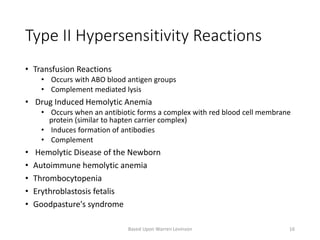
Type II Hypersensitivity Reactions
• Transfusion Reactions
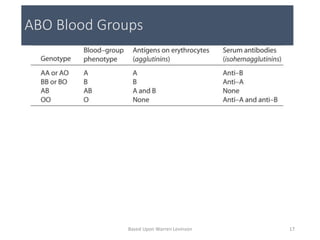
• Occurs with ABO blood antigen groups
• Complement mediated lysis
• Drug Induced Hemolytic Anemia
• Occurs when an antibiotic forms a complex with red blood cell membrane
protein (similar to hapten carrier complex)
• Induces formation of antibodies
• Complement
• Hemolytic Disease of the Newborn
• Autoimmune hemolytic anemia
• Thrombocytopenia
• Erythroblastosis fetalis
• Goodpasture's syndrome
Based Upon Warren Levinson 16
ABO Blood Groups
Based Upon Warren Levinson 17
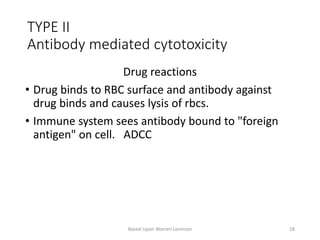
Drug reactions
• Drug binds to RBC surface and antibody against
drug binds and causes lysis of rbcs.
• Immune system sees antibody bound to "foreign
antigen" on cell. ADCC
TYPE II
Antibody mediated cytotoxicity
Based Upon Warren Levinson 18
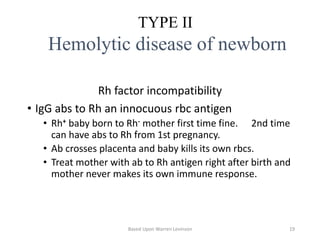
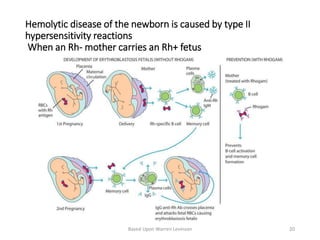
Rh factor incompatibility
• IgG abs to Rh an innocuous rbc antigen
• Rh+ baby born to Rh- mother first time fine. 2nd time
can have abs to Rh from 1st pregnancy.
• Ab crosses placenta and baby kills its own rbcs.
• Treat mother with ab to Rh antigen right after birth and
mother never makes its own immune response.
TYPE II
Hemolytic disease of newborn
Based Upon Warren Levinson 19
Hemolytic disease of the newborn is caused by type II
hypersensitivity reactions
When an Rh- mother carries an Rh+ fetus
Based Upon Warren Levinson 20
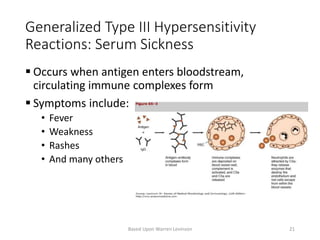
Generalized Type III Hypersensitivity
Reactions: Serum Sickness
 Occurs when antigen enters bloodstream,
circulating immune complexes form
 Symptoms include:
• Fever
• Weakness
• Rashes
• And many others
Based Upon Warren Levinson 21
TYPE III
Antigen antibody immune complexes. IgG
mediated
Immune Complex Disease
• Large amount of antigen and antibodies form
complexes in blood.
• If not eliminated can deposit in capillaries or joints
and trigger inflammation.
Based Upon Warren Levinson 22
TYPE III
Immune Complexes
• PMNs and macrophages bind to immune complexes via
FcR and phagocytize the complexes.
BUT
• If unable to phagocytize the immune complexes can
cause inflammation via C’ activation ---> C3a C4a, C5a
and "frustrated phagocytes".
Based Upon Warren Levinson 23
TYPE III
Immune Complex Disease
"Frustrated Phagocytes"
• If neutrophils and macrophages are unable to
phagocytize the immune complexes these cells will
degranulate in the area of immune complex deposition
and trigger inflammation.
• Unable to eat -------try to digest outside cell.
Based Upon Warren Levinson 24
TYPE III
Immune Complex Disease
Localized disease
• Deposited in joints causing local inflammation =
arthritis.
• Deposited in kidneys = glomerulonephritis.
Based Upon Warren Levinson 25
TYPE III
Immune Complex Disease
• Serum sickness from large amounts of antigen such as
injection of foreign serum.
• Serum sickness is usually transient immune complex disease with
removal of antigen source.
Based Upon Warren Levinson 26
Type III Hypersensitivity (Immune
Complex) Reactions
• Involve reactions against soluble antigens circulating in
serum.
• Usually involve IgA antibodies.
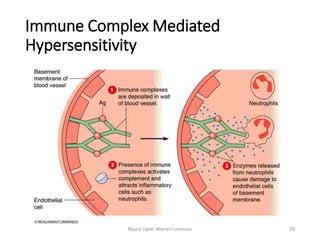
• Antibody-Antigen immune complexes are deposited in
organs, activate complement, and cause inflammatory
damage.
• Glomerulonephritis: Inflammatory kidney damage.
• Occurs with slightly high antigen-antibody ratio is
present.
Based Upon Warren Levinson 27
Immune Complex Mediated
Hypersensitivity
Based Upon Warren Levinson 28
Examples of type III
• Serum sickness
• Arthus reaction
• Systemic lupus erythematosus (SLE)
Based Upon Warren Levinson 29
Type IV Hypersensitivity Reaction
• The response is "delayed," i.e., it starts hours (or
days) after contact with the antigen and often lasts
for days.
• Delayed hypersensitivity is a function of T
lymphocytes, not antibody (Figure 65–4). It can be
transferred by immunologically committed
(sensitized) T cells, not by serum.
Based Upon Warren Levinson 30
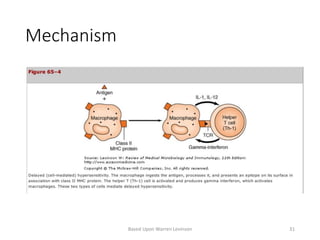
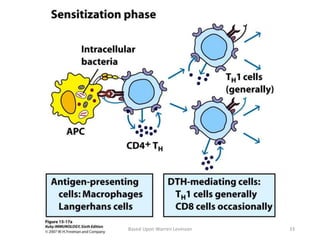
Mechanism
Based Upon Warren Levinson 31
Based Upon Warren Levinson 32
Based Upon Warren Levinson 33
Based Upon Warren Levinson 34
Based Upon Warren Levinson 35
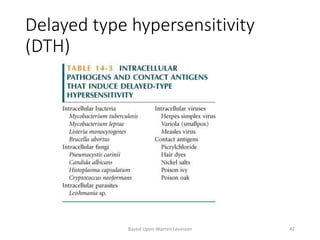
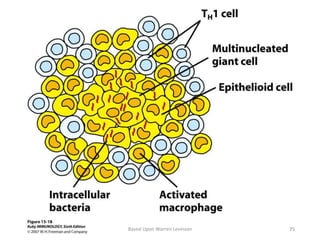
Delayed type hypersensitivity
Th1 cells and macrophages
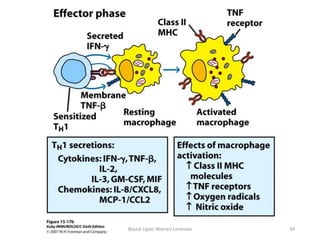
• DTH response is from:
• Th1 cells release cytokines to activate macrophages causing
inflammation and tissue damage.
• Continued macrophage activation can cause chronic
inflammation resulting in tissue lesions, scarring, and
granuloma formation.
• Delayed is relative because DTH response arise 24-72
hours after exposure rather than within minutes.
Based Upon Warren Levinson 36
Stages of Type IV DTH
Sensitization stage
• Memory Th1 cells against DTH antigens are
generated by dendritic cells during the sensitization
stage.
• These Th1 cells can activate macrophages and
trigger inflammatory response.
Based Upon Warren Levinson 37
Stages of Type IV DTH
Effector stage
• Secondary contact yields what we call DTH.
• Th1 memory cells are activated and produce cytokines.
• IFN-g, TNF-a, and TNF-b which cause tissue destruction,
inflammation.
• IL-2 that activates T cells and CTLs.
• Chemokines- for macrophage recruitment.
• IL-3, GM-CSF for increased monocyte/macrophage
Based Upon Warren Levinson 38
Stages of Type IV DTH
Effector stage
Secondary exposure to antigen
• Inflamed area becomes red and fluid filled can form
lesion.
• From tissue damage there is activation of clotting cascades and
tissue repair.
• Continued exposure to antigen can cause chronic
inflammation and result in granuloma formation.
Based Upon Warren Levinson 39
Type IV DTH
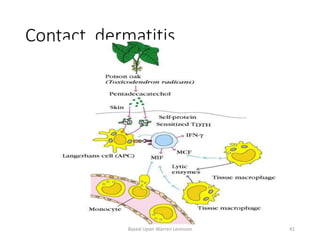
Contact dermatitis
• The response to poison oak is a classic Type IV.
• Small molecules act as haptens and complex with skin proteins
to be taken up by APCs and presented to Th1 cells to get
sensitization.
• During secondary exposure Th1 memory cells become activated
to cause DTH.
Based Upon Warren Levinson 40
Contact dermatitis
Based Upon Warren Levinson 41
Delayed type hypersensitivity
(DTH)
DTH is a type of immune
response classified by
Th1 and macrophage
activation that results in
tissue damage.
DTH can be the result of
Chronic infection or
Exposure to some antigens.
Based Upon Warren Levinson 42
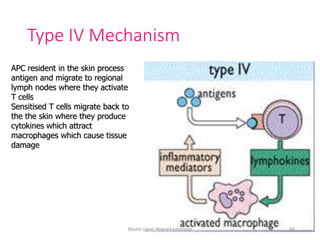
Type IV Mechanism
APC resident in the skin process
antigen and migrate to regional
lymph nodes where they activate
T cells
Sensitised T cells migrate back to
the the skin where they produce
cytokines which attract
macrophages which cause tissue
damage
Based Upon Warren Levinson 43
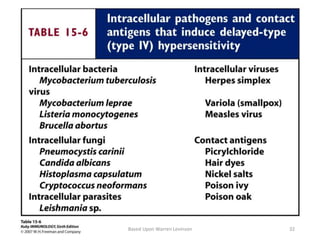
Examples of Type IV
• Contact dermatitis
• Mantoux test
• Chronic transplant rejection
• Multiple sclerosis
Based Upon Warren Levinson 44
Recap
Based Upon Warren Levinson 45
Based Upon Warren Levinson 46
Autoimmunity
Immune reactions against self antigens
Based Upon Warren Levinson 47
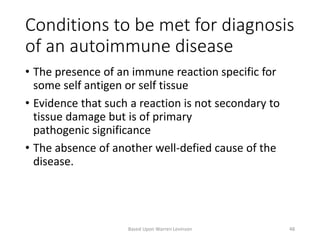
Conditions to be met for diagnosis
of an autoimmune disease
• The presence of an immune reaction specific for
some self antigen or self tissue
• Evidence that such a reaction is not secondary to
tissue damage but is of primary
pathogenic significance
• The absence of another well-defied cause of the
disease.
Based Upon Warren Levinson 48
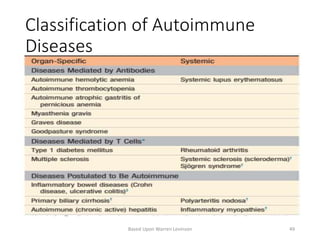
Classification of Autoimmune
Diseases
Based Upon Warren Levinson 49
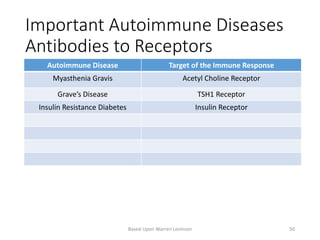
Important Autoimmune Diseases
Antibodies to Receptors
Autoimmune Disease Target of the Immune Response
Myasthenia Gravis Acetyl Choline Receptor
Grave’s Disease TSH1 Receptor
Insulin Resistance Diabetes Insulin Receptor
Based Upon Warren Levinson 50
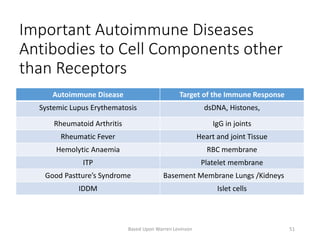
Important Autoimmune Diseases
Antibodies to Cell Components other
than Receptors
Autoimmune Disease Target of the Immune Response
Systemic Lupus Erythematosis dsDNA, Histones,
Rheumatoid Arthritis IgG in joints
Rheumatic Fever Heart and joint Tissue
Hemolytic Anaemia RBC membrane
ITP Platelet membrane
Good Pastture’s Syndrome Basement Membrane Lungs /Kidneys
IDDM Islet cells
Based Upon Warren Levinson 51
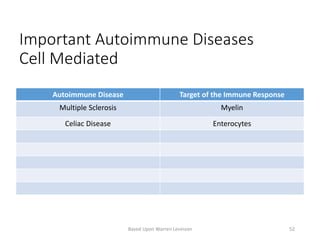
Important Autoimmune Diseases
Cell Mediated
Autoimmune Disease Target of the Immune Response
Multiple Sclerosis Myelin
Celiac Disease Enterocytes
Based Upon Warren Levinson 52
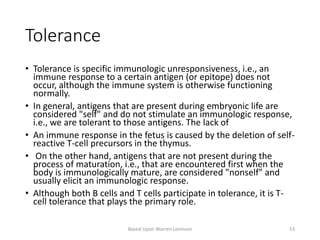
Tolerance
• Tolerance is specific immunologic unresponsiveness, i.e., an
immune response to a certain antigen (or epitope) does not
occur, although the immune system is otherwise functioning
normally.
• In general, antigens that are present during embryonic life are
considered "self" and do not stimulate an immunologic response,
i.e., we are tolerant to those antigens. The lack of
• An immune response in the fetus is caused by the deletion of self-
reactive T-cell precursors in the thymus.
• On the other hand, antigens that are not present during the
process of maturation, i.e., that are encountered first when the
body is immunologically mature, are considered "nonself" and
usually elicit an immunologic response.
• Although both B cells and T cells participate in tolerance, it is T-
cell tolerance that plays the primary role.
Based Upon Warren Levinson 53
T Cell Tolerance
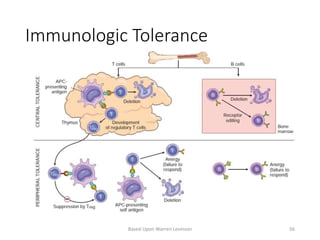
• The main process by which T lymphocytes acquire the
ability to distinguish self from nonself occurs in the
fetal thymus.
• This process, called clonal deletion involves the killing
of T cells ("negative selection") that react against
antigens (primarily self MHC proteins) present in the
fetus at that time.
• The self-reactive cells die by a process of programmed
cell death called apoptosis.
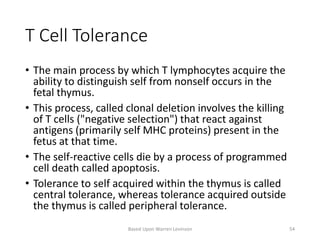
• Tolerance to self acquired within the thymus is called
central tolerance, whereas tolerance acquired outside
the thymus is called peripheral tolerance.
Based Upon Warren Levinson 54
B Cell Tolerance
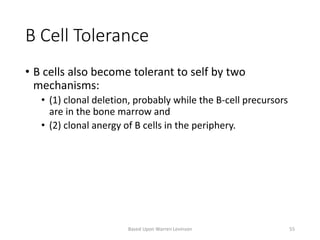
• B cells also become tolerant to self by two
mechanisms:
• (1) clonal deletion, probably while the B-cell precursors
are in the bone marrow and
• (2) clonal anergy of B cells in the periphery.
Based Upon Warren Levinson 55
Immunologic Tolerance
Based Upon Warren Levinson 56
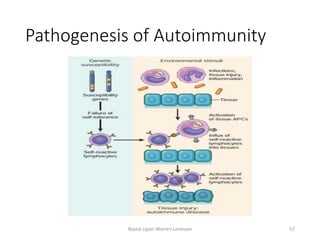
Pathogenesis of Autoimmunity
Based Upon Warren Levinson 57
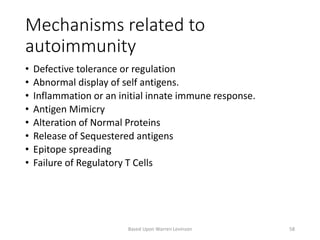
Mechanisms related to
autoimmunity
• Defective tolerance or regulation
• Abnormal display of self antigens.
• Inflammation or an initial innate immune response.
• Antigen Mimicry
• Alteration of Normal Proteins
• Release of Sequestered antigens
• Epitope spreading
• Failure of Regulatory T Cells
Based Upon Warren Levinson 58
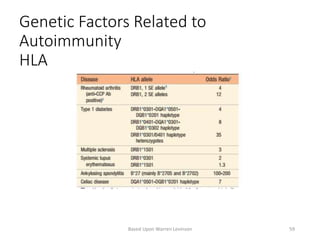
Genetic Factors Related to
Autoimmunity
HLA
Based Upon Warren Levinson 59
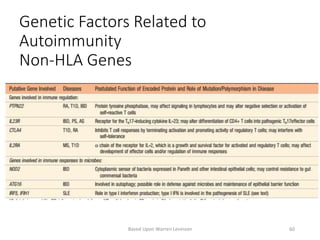
Genetic Factors Related to
Autoimmunity
Non-HLA Genes
Based Upon Warren Levinson 60
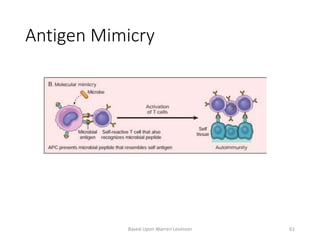
Antigen Mimicry
Based Upon Warren Levinson 61
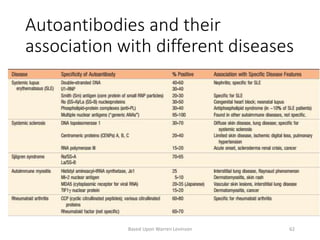
Autoantibodies and their
association with different diseases
Based Upon Warren Levinson 62
General Features of Autoimmune
Disease
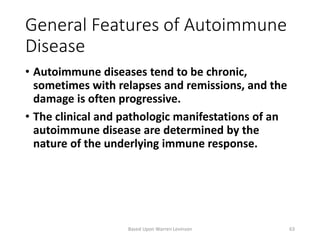
• Autoimmune diseases tend to be chronic,
sometimes with relapses and remissions, and the
damage is often progressive.
• The clinical and pathologic manifestations of an
autoimmune disease are determined by the
nature of the underlying immune response.
Based Upon Warren Levinson 63
Thank you
Based Upon Warren Levinson 64

Hypersensitivity, Tolerance and autoimmunity

  • 1.
    Autoimmune Diseases, Tolerance and Hypersensitivity Dr.Muhammad Yahya Noori BDS Based Upon Warren Levinson 1
  • 2.
    Hypersensitivity An exaggerated orinappropriate immune reaction harmful to the host Based Upon Warren Levinson 2 • The clinical manifestations of these reactions are typical in a given individual. • They occur on contact with the specific antigen to which the individual is hypersensitive. • The first contact of the individual with the antigen sensitizes, i.e., induces the antibody and the subsequent contacts elicit the allergic response.
  • 3.
  • 4.
    Type 1 HypersensitivityReactions • Atopy • Anaphylaxis • Asthma Based Upon Warren Levinson 4
  • 5.
    Type I Hypersensitivity (Anaphylactic)Reactions/Allergy • Occur within minutes of exposure to antigen • Antigens combine with IgE antibodies • IgE binds to mast cells and basophils, causing them to undergo degranulation and release several mediators: • Histamine • Prostaglandins • Leukotrienes • Exposure to an allergen activates B cells to form IgE secreting plasma cells • Secreted IgE molecules bind to Fce receptors on mast cells • A subsequent exposure to the allergen results in crosslinking of the bound IgE which triggers the release of various compounds Based Upon Warren Levinson 5
  • 6.
    Type I HypersensitivityReaction Based Upon Warren Levinson 6
  • 7.
  • 8.
    Allergens • Allergens arenon-parasite antigens that can stimulate a type I hypersensitivity response. • Allergens bind to IgE and trigger degranulation of chemical mediators. • Small 15-40,000 MW proteins. • Specific protein components • Often enzymes. • Low dose of allergen • Mucosal exposure. • Most allergens promote a Th2 immune. Based Upon Warren Levinson 8
  • 9.
    In the US--- 36 million people said to have hay fever! Based Upon Warren Levinson 9
  • 10.
    Atopy • Atopy isthe term for the genetic trait to have a predisposition for localized anaphylaxis. • Atopic individuals have higher levels of IgE and eosinophils. Based Upon Warren Levinson 10
  • 11.
    Mechanisms of allergicresponse Sensitization Repeated exposure to allergens initiates immune response that generates IgE isotype. • The IgE can attach to Mast cells by Fc receptor, which increases the life span of the IgE. • Half-life of IgE in serum is days whereas attached to FceR it is increased to months. Based Upon Warren Levinson 11
  • 12.
    Mast Cells andthe Allergic Response Based Upon Warren Levinson 12
  • 13.
    Mast Cells andthe Allergic Response Based Upon Warren Levinson 13
  • 14.
    Based Upon WarrenLevinson 14
  • 15.
    Type II Hypersensitivity(Cytotoxic) Reactions/antibody-dependent • Involve activation of complement by IgG or IgM binding to an antigenic cell. • Antigenic cell is lysed Based Upon Warren Levinson 15
  • 16.
    Type II HypersensitivityReactions • Transfusion Reactions • Occurs with ABO blood antigen groups • Complement mediated lysis • Drug Induced Hemolytic Anemia • Occurs when an antibiotic forms a complex with red blood cell membrane protein (similar to hapten carrier complex) • Induces formation of antibodies • Complement • Hemolytic Disease of the Newborn • Autoimmune hemolytic anemia • Thrombocytopenia • Erythroblastosis fetalis • Goodpasture's syndrome Based Upon Warren Levinson 16
  • 17.
    ABO Blood Groups BasedUpon Warren Levinson 17
  • 18.
    Drug reactions • Drugbinds to RBC surface and antibody against drug binds and causes lysis of rbcs. • Immune system sees antibody bound to "foreign antigen" on cell. ADCC TYPE II Antibody mediated cytotoxicity Based Upon Warren Levinson 18
  • 19.
    Rh factor incompatibility •IgG abs to Rh an innocuous rbc antigen • Rh+ baby born to Rh- mother first time fine. 2nd time can have abs to Rh from 1st pregnancy. • Ab crosses placenta and baby kills its own rbcs. • Treat mother with ab to Rh antigen right after birth and mother never makes its own immune response. TYPE II Hemolytic disease of newborn Based Upon Warren Levinson 19
  • 20.
    Hemolytic disease ofthe newborn is caused by type II hypersensitivity reactions When an Rh- mother carries an Rh+ fetus Based Upon Warren Levinson 20
  • 21.
    Generalized Type IIIHypersensitivity Reactions: Serum Sickness  Occurs when antigen enters bloodstream, circulating immune complexes form  Symptoms include: • Fever • Weakness • Rashes • And many others Based Upon Warren Levinson 21
  • 22.
    TYPE III Antigen antibodyimmune complexes. IgG mediated Immune Complex Disease • Large amount of antigen and antibodies form complexes in blood. • If not eliminated can deposit in capillaries or joints and trigger inflammation. Based Upon Warren Levinson 22
  • 23.
    TYPE III Immune Complexes •PMNs and macrophages bind to immune complexes via FcR and phagocytize the complexes. BUT • If unable to phagocytize the immune complexes can cause inflammation via C’ activation ---> C3a C4a, C5a and "frustrated phagocytes". Based Upon Warren Levinson 23
  • 24.
    TYPE III Immune ComplexDisease "Frustrated Phagocytes" • If neutrophils and macrophages are unable to phagocytize the immune complexes these cells will degranulate in the area of immune complex deposition and trigger inflammation. • Unable to eat -------try to digest outside cell. Based Upon Warren Levinson 24
  • 25.
    TYPE III Immune ComplexDisease Localized disease • Deposited in joints causing local inflammation = arthritis. • Deposited in kidneys = glomerulonephritis. Based Upon Warren Levinson 25
  • 26.
    TYPE III Immune ComplexDisease • Serum sickness from large amounts of antigen such as injection of foreign serum. • Serum sickness is usually transient immune complex disease with removal of antigen source. Based Upon Warren Levinson 26
  • 27.
    Type III Hypersensitivity(Immune Complex) Reactions • Involve reactions against soluble antigens circulating in serum. • Usually involve IgA antibodies. • Antibody-Antigen immune complexes are deposited in organs, activate complement, and cause inflammatory damage. • Glomerulonephritis: Inflammatory kidney damage. • Occurs with slightly high antigen-antibody ratio is present. Based Upon Warren Levinson 27
  • 28.
  • 29.
    Examples of typeIII • Serum sickness • Arthus reaction • Systemic lupus erythematosus (SLE) Based Upon Warren Levinson 29
  • 30.
    Type IV HypersensitivityReaction • The response is "delayed," i.e., it starts hours (or days) after contact with the antigen and often lasts for days. • Delayed hypersensitivity is a function of T lymphocytes, not antibody (Figure 65–4). It can be transferred by immunologically committed (sensitized) T cells, not by serum. Based Upon Warren Levinson 30
  • 31.
  • 32.
    Based Upon WarrenLevinson 32
  • 33.
    Based Upon WarrenLevinson 33
  • 34.
    Based Upon WarrenLevinson 34
  • 35.
    Based Upon WarrenLevinson 35
  • 36.
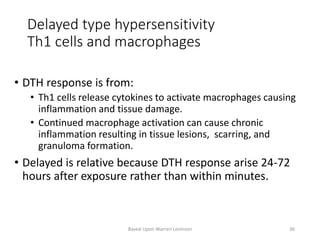
    Delayed type hypersensitivity Th1cells and macrophages • DTH response is from: • Th1 cells release cytokines to activate macrophages causing inflammation and tissue damage. • Continued macrophage activation can cause chronic inflammation resulting in tissue lesions, scarring, and granuloma formation. • Delayed is relative because DTH response arise 24-72 hours after exposure rather than within minutes. Based Upon Warren Levinson 36
  • 37.
    Stages of TypeIV DTH Sensitization stage • Memory Th1 cells against DTH antigens are generated by dendritic cells during the sensitization stage. • These Th1 cells can activate macrophages and trigger inflammatory response. Based Upon Warren Levinson 37
  • 38.
    Stages of TypeIV DTH Effector stage • Secondary contact yields what we call DTH. • Th1 memory cells are activated and produce cytokines. • IFN-g, TNF-a, and TNF-b which cause tissue destruction, inflammation. • IL-2 that activates T cells and CTLs. • Chemokines- for macrophage recruitment. • IL-3, GM-CSF for increased monocyte/macrophage Based Upon Warren Levinson 38
  • 39.
    Stages of TypeIV DTH Effector stage Secondary exposure to antigen • Inflamed area becomes red and fluid filled can form lesion. • From tissue damage there is activation of clotting cascades and tissue repair. • Continued exposure to antigen can cause chronic inflammation and result in granuloma formation. Based Upon Warren Levinson 39
  • 40.
    Type IV DTH Contactdermatitis • The response to poison oak is a classic Type IV. • Small molecules act as haptens and complex with skin proteins to be taken up by APCs and presented to Th1 cells to get sensitization. • During secondary exposure Th1 memory cells become activated to cause DTH. Based Upon Warren Levinson 40
  • 41.
  • 42.
    Delayed type hypersensitivity (DTH) DTHis a type of immune response classified by Th1 and macrophage activation that results in tissue damage. DTH can be the result of Chronic infection or Exposure to some antigens. Based Upon Warren Levinson 42
  • 43.
    Type IV Mechanism APCresident in the skin process antigen and migrate to regional lymph nodes where they activate T cells Sensitised T cells migrate back to the the skin where they produce cytokines which attract macrophages which cause tissue damage Based Upon Warren Levinson 43
  • 44.
    Examples of TypeIV • Contact dermatitis • Mantoux test • Chronic transplant rejection • Multiple sclerosis Based Upon Warren Levinson 44
  • 45.
  • 46.
    Based Upon WarrenLevinson 46
  • 47.
    Autoimmunity Immune reactions againstself antigens Based Upon Warren Levinson 47
  • 48.
    Conditions to bemet for diagnosis of an autoimmune disease • The presence of an immune reaction specific for some self antigen or self tissue • Evidence that such a reaction is not secondary to tissue damage but is of primary pathogenic significance • The absence of another well-defied cause of the disease. Based Upon Warren Levinson 48
  • 49.
  • 50.
    Important Autoimmune Diseases Antibodiesto Receptors Autoimmune Disease Target of the Immune Response Myasthenia Gravis Acetyl Choline Receptor Grave’s Disease TSH1 Receptor Insulin Resistance Diabetes Insulin Receptor Based Upon Warren Levinson 50
  • 51.
    Important Autoimmune Diseases Antibodiesto Cell Components other than Receptors Autoimmune Disease Target of the Immune Response Systemic Lupus Erythematosis dsDNA, Histones, Rheumatoid Arthritis IgG in joints Rheumatic Fever Heart and joint Tissue Hemolytic Anaemia RBC membrane ITP Platelet membrane Good Pastture’s Syndrome Basement Membrane Lungs /Kidneys IDDM Islet cells Based Upon Warren Levinson 51
  • 52.
    Important Autoimmune Diseases CellMediated Autoimmune Disease Target of the Immune Response Multiple Sclerosis Myelin Celiac Disease Enterocytes Based Upon Warren Levinson 52
  • 53.
    Tolerance • Tolerance isspecific immunologic unresponsiveness, i.e., an immune response to a certain antigen (or epitope) does not occur, although the immune system is otherwise functioning normally. • In general, antigens that are present during embryonic life are considered "self" and do not stimulate an immunologic response, i.e., we are tolerant to those antigens. The lack of • An immune response in the fetus is caused by the deletion of self- reactive T-cell precursors in the thymus. • On the other hand, antigens that are not present during the process of maturation, i.e., that are encountered first when the body is immunologically mature, are considered "nonself" and usually elicit an immunologic response. • Although both B cells and T cells participate in tolerance, it is T- cell tolerance that plays the primary role. Based Upon Warren Levinson 53
  • 54.
    T Cell Tolerance •The main process by which T lymphocytes acquire the ability to distinguish self from nonself occurs in the fetal thymus. • This process, called clonal deletion involves the killing of T cells ("negative selection") that react against antigens (primarily self MHC proteins) present in the fetus at that time. • The self-reactive cells die by a process of programmed cell death called apoptosis. • Tolerance to self acquired within the thymus is called central tolerance, whereas tolerance acquired outside the thymus is called peripheral tolerance. Based Upon Warren Levinson 54
  • 55.
    B Cell Tolerance •B cells also become tolerant to self by two mechanisms: • (1) clonal deletion, probably while the B-cell precursors are in the bone marrow and • (2) clonal anergy of B cells in the periphery. Based Upon Warren Levinson 55
  • 56.
  • 57.
    Pathogenesis of Autoimmunity BasedUpon Warren Levinson 57
  • 58.
    Mechanisms related to autoimmunity •Defective tolerance or regulation • Abnormal display of self antigens. • Inflammation or an initial innate immune response. • Antigen Mimicry • Alteration of Normal Proteins • Release of Sequestered antigens • Epitope spreading • Failure of Regulatory T Cells Based Upon Warren Levinson 58
  • 59.
    Genetic Factors Relatedto Autoimmunity HLA Based Upon Warren Levinson 59
  • 60.
    Genetic Factors Relatedto Autoimmunity Non-HLA Genes Based Upon Warren Levinson 60
  • 61.
    Antigen Mimicry Based UponWarren Levinson 61
  • 62.
    Autoantibodies and their associationwith different diseases Based Upon Warren Levinson 62
  • 63.
    General Features ofAutoimmune Disease • Autoimmune diseases tend to be chronic, sometimes with relapses and remissions, and the damage is often progressive. • The clinical and pathologic manifestations of an autoimmune disease are determined by the nature of the underlying immune response. Based Upon Warren Levinson 63
  • 64.
    Thank you Based UponWarren Levinson 64