Presented by
   Somen Kumar Mistri
Department of Microbiology
   University of Dhaka
    Dhaka, Bangladesh
 How does the immune system provide a high degree of
  sensitivity and specificity to the broad array of pathogens
  without attacking self?
 How does a T-cell know whether to be CD4+ T-cell or
  CD8+ T-cell?
 How does T-cells come in contact with all the self
  antigens in thymus?
 What is the role of IgD in the development of B-cell
  tolerance?
Tolerance


      Central                Peripheral
(Bone marrow ,          (Spleen , Lymph
Thymus)                 node etc)
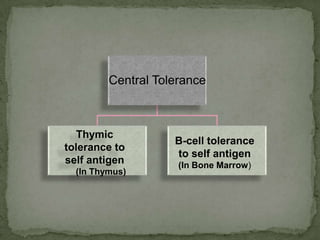
Central Tolerance


   Thymic
                    B-cell tolerance
tolerance to
                    to self antigen
self antigen         (In Bone Marrow)
  (In Thymus)
Thymus - Site of T-cell
     Maturation


                          Cortex


                          Medulla
 In a young mouse , the thymus contains around
    108 to 2×10⁸ T-cells.
   Each day about 5×10⁷ new T-cells are generated.
   Only 106 to 2×10⁶ (Roughly 2 - 4%) of these will
    leave the thymus each day as mature T-cells
    So approximately 98% of T-cells that develop in
    thymus also die within the thymus.
   Death is usually by apoptosis.
Positive Selection
   Recognition of Self -MHC


Negative Selection
  Avoid strong binding to self antigen
1   2   3   4
 Particular combinations of cell surface proteins can be
    used as markers for T-cells at different stages of
    differentiation.
   Two distinct lineages of T-cell: α:β and γ:δ.
   When progenitor cells first enter the thymus from bone
    marrow, they lack most of the surface molecules
    characteristic of mature T-cells. Their TCR genes are not
    rearranged at that time.
    In fact, proteins such as RAG1 and RAG2
    (Recombination Activating Gene ) are not expressed that
    are required for rearrangement.
   At first T-cells do not contain :
                                CD3 : TCR complex
                                  CD4 or CD8
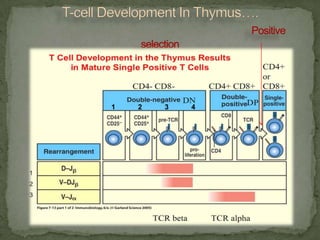
 Once     DN1 cells encounter the thymic
  environment , they begin to proliferate and
  express CD25.
 During DN2 stage , rearrangement of the genes
  for TCR γ , δ , β chains begins. RAG expression
  gets turned on at this stage.
 Cells destined to become γδ T-cells (˂   5% of
  mature lymphocytes) diverge at the transition
  between DN2 and DN3.
 After DN3 stage DN4 stage comes. RAG
  expression stops here and proliferation of DN4
  cells occurs.
 Formation    of
                pre-TCR activates a signal
 transduction  pathway  that   has several
 consequences :

     Indicates that a cell has made a productive TCR β-chain
      rearrangement and signals its further proliferation and
      maturation.
     Suppresses further rearrangement of TCR β-chain genes,
      resulting in allelic exclusion.
     Renders the cell permissive for rearrangement of the
      TCR α-chain.
     Induces the developmental progression to the CD4+ 8+
      double positive (DP) state.
 Newly formed DP cells reactivate RAG genes allowing
    rearrangement of the α-chain.
   Pairing of α and β-chains allow T-cells to recognize a wide
    range of antigens (Both self and foreign).
   At this point positive selection occurs.
   Cells that recognize MHC with moderate affinity on
    cortical epithelial cells survive.
   Cells whose TCR interacts with MHC class I becomes
    CD4+ T-cell (SP).
   Cells whose TCR interacts with MHC class II becomes
    CD8+ T-cells(SP).
   Cells whose TCR fails to engage either a class I or class II
    MHC molecule undergo programmed cell death.
Proliferatio
                         n


                             Positive
                             selectio
                             n


                                        Negative
                                        Selection

•Positive selection involves recognition of self MHC at cortical epithelial cells.
Mechanism not really known.
•Negative selection predominantly in medulla (Medullary epithelial cells)
Positive selection for thymocytes bearing receptors capable of
binding self-MHC molecules, which results in MHC
restriction. Cells that fail positive selection are eliminated
within the thymus by apoptosis.


Negative selection that eliminates T-cells bearing high affinity
receptors for self-MHC molecules alone or self antigen
presented by self-MHC, which results in self-tolerance.
POSITIVE                              NEGATIVE SELECTION
 SELECTION


         APC                        APC                      APC

 MHC                          MHC                      MHC
                                               Self
                                              antige
  TCR                                           n
                              TCR                      TCR


        T-cell                      T-cell                   T-cell
Binding of TCR and MHC        Weak binding of TCR       Strong binding of
(weak), results in positive    and MHC-Peptide           TCR and MHC-
   selection of T-cells        complex :T-cell is      peptide complex : T-
                               positively selected      cell is negatively
                                                             selected
 Engagement of TCR by the MHC-peptide complex on some
  type of antigen presenting cell underlies both positive and
  negative selection. Positive and negative selection may occur at
  low and high degrees of TCR ligation, respectively.
 Experiments show that the same peptide will induce positive
  selection at low concentration and negative selection at high
  concentration.
 This has led to the avidity model, which postulates that a
  functionally low avidity interaction between T-cell and peptide-
  MHC involving a relatively low number of TCRs will
  positively select Double positive (DP) CD4+8+ thymocytes,
  while a high avidity interaction will lead to clonal deletion.
 The overall avidity of the T-cell interaction is a function of :
          Ligand Density TCR Density Affinity
It is postulated that a low avidity interaction between the T-cell and
APC will give positive selection and that high avidity will give
deletion.
* Refers to affinity of peptide for the MHC or of the MHC-peptide
complex for the TCR
 The autoimmune regulator (AIRE) is a protein that in humans
  is encoded by the AIRE gene. AIRE is a transcription factor
  expressed in the medulla of the thymus and controls the
  mechanism that prevents the immune system from attacking
  the body itself.
 AIRE allows endothelial cells in thymus as well as dendritic
  cells to express other proteins that they normally do not
  express.
 Due to the presence of AIRE medullary epithelial cells as well
  as dendritic cells present self peptides in low amount to T-cells.
  This serves the negative selection purpose.
 Mutation in AIRE results in Autoimmune Polyendocrinopathy–
  Candidiasis–Ectodermal Dystrophy (APECED).
 B-cell development shows similar features to T-cell
  development, but takes place largely in the bone marrow.
 Checkpoints in B-cell development include :
         Successful expression of Igα and Igβ in late pro-B
          cells.
         Successful rearrangement at the heavy chain locus in
          pre B-cells.
         Successful rearrangement at the light chain locus and
          receptor editing.
 Mature B-cells express IgD at higher levels than IgM.
 Self tolerance begins when IgM first appears at the surface
  of the developing cell.
/ Immature B
 Expression of IgD is an important checkpoint in terms
  of eliminating self reactive B-cells.
 Normally in a mature B-cell, when Antigen binds to
  mIg of that B-cell, it turns the B-cell on.
 However, before IgD is expressed, if antigen (Self)
  binds to mIg then the B-cell gets turned off. Further
  development of that B-cell does not occur, but light
  chain rearrangement can continue.
If in bone marrow,
IgM binds to a non-
cross linking      self
molecule it can not
give strong signal to
the B-cell to die,
instead it generates a
B-cell that may not be
as    responsive     or
clonally ignorant.
 Allowing light chain rearrangement to continue among
  immature cells permits the B-cell to edit its receptor and
  rescue potentially autoreactive cells from inevitable death.
 Thus by changing the light chain, a self reactive B-cell can
  be converted to a non-self reactive one.
 After making a new light chain, the mIgM is again tested
  to see if this is also self reactive.
 If the heavy chains association with antigen is very strong,
  then light chain rearrangement alone can not alter self
  reactivity. Ultimately that B-cell would not be allowed to
  leave the bone marrow.
 If cross linking occurs, but least
sufficiently to produce strong
signal, the B-cell does not die by
apoptosis.
 It migrates to the periphery and
actually become anergic B-cells.
 Even though they are self
reactive they won’t           make
antibodies. Therefore they won’t
cause any kind of autoimmune
diseases.
Central immunological tolerance

Central immunological tolerance

  • 1.
    Presented by Somen Kumar Mistri Department of Microbiology University of Dhaka Dhaka, Bangladesh
  • 2.
     How doesthe immune system provide a high degree of sensitivity and specificity to the broad array of pathogens without attacking self?  How does a T-cell know whether to be CD4+ T-cell or CD8+ T-cell?  How does T-cells come in contact with all the self antigens in thymus?  What is the role of IgD in the development of B-cell tolerance?
  • 3.
    Tolerance Central Peripheral (Bone marrow , (Spleen , Lymph Thymus) node etc)
  • 4.
    Central Tolerance Thymic B-cell tolerance tolerance to to self antigen self antigen (In Bone Marrow) (In Thymus)
  • 7.
    Thymus - Siteof T-cell Maturation Cortex Medulla
  • 9.
     In ayoung mouse , the thymus contains around 108 to 2×10⁸ T-cells.  Each day about 5×10⁷ new T-cells are generated.  Only 106 to 2×10⁶ (Roughly 2 - 4%) of these will leave the thymus each day as mature T-cells  So approximately 98% of T-cells that develop in thymus also die within the thymus.  Death is usually by apoptosis.
  • 10.
    Positive Selection Recognition of Self -MHC Negative Selection Avoid strong binding to self antigen
  • 14.
    1 2 3 4
  • 15.
     Particular combinationsof cell surface proteins can be used as markers for T-cells at different stages of differentiation.  Two distinct lineages of T-cell: α:β and γ:δ.  When progenitor cells first enter the thymus from bone marrow, they lack most of the surface molecules characteristic of mature T-cells. Their TCR genes are not rearranged at that time.  In fact, proteins such as RAG1 and RAG2 (Recombination Activating Gene ) are not expressed that are required for rearrangement.  At first T-cells do not contain : CD3 : TCR complex CD4 or CD8
  • 16.
     Once DN1 cells encounter the thymic environment , they begin to proliferate and express CD25.  During DN2 stage , rearrangement of the genes for TCR γ , δ , β chains begins. RAG expression gets turned on at this stage.  Cells destined to become γδ T-cells (˂ 5% of mature lymphocytes) diverge at the transition between DN2 and DN3.  After DN3 stage DN4 stage comes. RAG expression stops here and proliferation of DN4 cells occurs.
  • 17.
     Formation of pre-TCR activates a signal transduction pathway that has several consequences :  Indicates that a cell has made a productive TCR β-chain rearrangement and signals its further proliferation and maturation.  Suppresses further rearrangement of TCR β-chain genes, resulting in allelic exclusion.  Renders the cell permissive for rearrangement of the TCR α-chain.  Induces the developmental progression to the CD4+ 8+ double positive (DP) state.
  • 18.
     Newly formedDP cells reactivate RAG genes allowing rearrangement of the α-chain.  Pairing of α and β-chains allow T-cells to recognize a wide range of antigens (Both self and foreign).  At this point positive selection occurs.  Cells that recognize MHC with moderate affinity on cortical epithelial cells survive.  Cells whose TCR interacts with MHC class I becomes CD4+ T-cell (SP).  Cells whose TCR interacts with MHC class II becomes CD8+ T-cells(SP).  Cells whose TCR fails to engage either a class I or class II MHC molecule undergo programmed cell death.
  • 19.
    Proliferatio n Positive selectio n Negative Selection •Positive selection involves recognition of self MHC at cortical epithelial cells. Mechanism not really known. •Negative selection predominantly in medulla (Medullary epithelial cells)
  • 20.
    Positive selection forthymocytes bearing receptors capable of binding self-MHC molecules, which results in MHC restriction. Cells that fail positive selection are eliminated within the thymus by apoptosis. Negative selection that eliminates T-cells bearing high affinity receptors for self-MHC molecules alone or self antigen presented by self-MHC, which results in self-tolerance.
  • 21.
    POSITIVE NEGATIVE SELECTION SELECTION APC APC APC MHC MHC MHC Self antige TCR n TCR TCR T-cell T-cell T-cell Binding of TCR and MHC Weak binding of TCR Strong binding of (weak), results in positive and MHC-Peptide TCR and MHC- selection of T-cells complex :T-cell is peptide complex : T- positively selected cell is negatively selected
  • 23.
     Engagement ofTCR by the MHC-peptide complex on some type of antigen presenting cell underlies both positive and negative selection. Positive and negative selection may occur at low and high degrees of TCR ligation, respectively.  Experiments show that the same peptide will induce positive selection at low concentration and negative selection at high concentration.  This has led to the avidity model, which postulates that a functionally low avidity interaction between T-cell and peptide- MHC involving a relatively low number of TCRs will positively select Double positive (DP) CD4+8+ thymocytes, while a high avidity interaction will lead to clonal deletion.  The overall avidity of the T-cell interaction is a function of : Ligand Density TCR Density Affinity
  • 24.
    It is postulatedthat a low avidity interaction between the T-cell and APC will give positive selection and that high avidity will give deletion. * Refers to affinity of peptide for the MHC or of the MHC-peptide complex for the TCR
  • 25.
     The autoimmuneregulator (AIRE) is a protein that in humans is encoded by the AIRE gene. AIRE is a transcription factor expressed in the medulla of the thymus and controls the mechanism that prevents the immune system from attacking the body itself.  AIRE allows endothelial cells in thymus as well as dendritic cells to express other proteins that they normally do not express.  Due to the presence of AIRE medullary epithelial cells as well as dendritic cells present self peptides in low amount to T-cells. This serves the negative selection purpose.  Mutation in AIRE results in Autoimmune Polyendocrinopathy– Candidiasis–Ectodermal Dystrophy (APECED).
  • 30.
     B-cell developmentshows similar features to T-cell development, but takes place largely in the bone marrow.  Checkpoints in B-cell development include :  Successful expression of Igα and Igβ in late pro-B cells.  Successful rearrangement at the heavy chain locus in pre B-cells.  Successful rearrangement at the light chain locus and receptor editing.  Mature B-cells express IgD at higher levels than IgM.  Self tolerance begins when IgM first appears at the surface of the developing cell.
  • 31.
  • 32.
     Expression ofIgD is an important checkpoint in terms of eliminating self reactive B-cells.  Normally in a mature B-cell, when Antigen binds to mIg of that B-cell, it turns the B-cell on.  However, before IgD is expressed, if antigen (Self) binds to mIg then the B-cell gets turned off. Further development of that B-cell does not occur, but light chain rearrangement can continue.
  • 33.
    If in bonemarrow, IgM binds to a non- cross linking self molecule it can not give strong signal to the B-cell to die, instead it generates a B-cell that may not be as responsive or clonally ignorant.
  • 36.
     Allowing lightchain rearrangement to continue among immature cells permits the B-cell to edit its receptor and rescue potentially autoreactive cells from inevitable death.  Thus by changing the light chain, a self reactive B-cell can be converted to a non-self reactive one.  After making a new light chain, the mIgM is again tested to see if this is also self reactive.  If the heavy chains association with antigen is very strong, then light chain rearrangement alone can not alter self reactivity. Ultimately that B-cell would not be allowed to leave the bone marrow.
  • 37.
     If crosslinking occurs, but least sufficiently to produce strong signal, the B-cell does not die by apoptosis.  It migrates to the periphery and actually become anergic B-cells.  Even though they are self reactive they won’t make antibodies. Therefore they won’t cause any kind of autoimmune diseases.