
Date:6/26/2021 www. qadricohs.edu.pk FB Page: Qadri College of Health Sciences, Karachi, Sindh, Pakistan. 1
QADRI COLLEGE OF HEALTH SCIENCES, KARACHI
U-3, 5 OF 5
“DEFENSE MECHANISMS OF THE BODY”
By: Aftab H. Abbasi
RN, DCHN, BSN, MA, LL.B
Lecturer Nursing
Qadri College of Health Sciences Karachi
QADRI COLLEGE OF HEALTH SCIENCES, KARACHI
Date:6/26/2021 www. qadricohs.edu.pk FB Page: Qadri College of Health Sciences, Karachi, Sindh, Pakistan. 2
“DEFENSE MECHANISM OF THE BODY”
- This unit focuses on the resistance of the
body which microorganism’s encounter
where they enter in the human body.
- This unit highlights the importance of the
resistance or defense of the body which
will help learners in understanding that
why infection occurs sometimes and not
always.
Date:6/26/2021 www. qadricohs.edu.pk FB Page: Qadri College of Health Sciences, Karachi, Sindh, Pakistan. 3
“DEFENSE MECHANISM OF THE BODY”
At the completion of this unit learners will
be able to:
1- Explain the role of good health in protection against the microbial
infection.
2- Define Resistance and Susceptibility.
3- Define Nonspecific Resistance.
4- Describe the role of the skin and mucous membrane in nonspecific
Resistance.
5- Explain the process of Phagocytosis.
6- Define the Specific Resistance, Innate Resistance and Immunity.
7- Explain four types of acquired Immunity.
Date:6/26/2021 www. qadricohs.edu.pk FB Page: Qadri College of Health Sciences, Karachi, Sindh, Pakistan. 4
“DEFENSE MECHANISM OF THE BODY”
At the completion of this unit learners will be
able to:
8- Differentiate between humoral and cell mediated immunity.
9- Define Antigens, hapten and antibodies.
10- List the five classes of antibodies and their functions.
11- Explain the role of memory, tolerance and specificity in immunity.
12- Distinguish between primary and secondary immune response.
13- Define Hypersensitivity.
14- Differentiate between i.e. delayed and immediate Hypersensitivity.
Date:6/26/2021 www. qadricohs.edu.pk FB Page: Qadri College of Health Sciences, Karachi, Sindh, Pakistan. 5
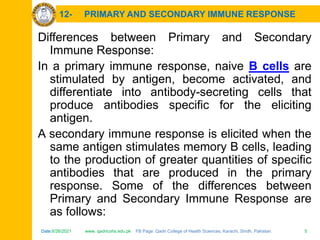
12- PRIMARY AND SECONDARY IMMUNE RESPONSE
Differences between Primary and Secondary
Immune Response:
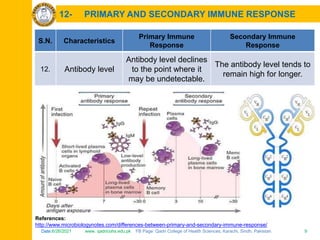
In a primary immune response, naive B cells are
stimulated by antigen, become activated, and
differentiate into antibody-secreting cells that
produce antibodies specific for the eliciting
antigen.
A secondary immune response is elicited when the
same antigen stimulates memory B cells, leading
to the production of greater quantities of specific
antibodies that are produced in the primary
response. Some of the differences between
Primary and Secondary Immune Response are
as follows:
Date:6/26/2021 www. qadricohs.edu.pk FB Page: Qadri College of Health Sciences, Karachi, Sindh, Pakistan. 6
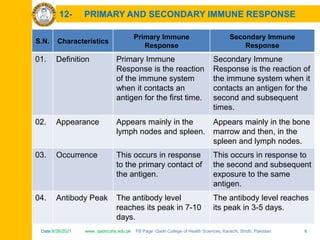
12- PRIMARY AND SECONDARY IMMUNE RESPONSE
S.N. Characteristics
Primary Immune
Response
Secondary Immune
Response
01. Definition Primary Immune
Response is the reaction
of the immune system
when it contacts an
antigen for the first time.
Secondary Immune
Response is the reaction of
the immune system when it
contacts an antigen for the
second and subsequent
times.
02. Appearance Appears mainly in the
lymph nodes and spleen.
Appears mainly in the bone
marrow and then, in the
spleen and lymph nodes.
03. Occurrence This occurs in response
to the primary contact of
the antigen.
This occurs in response to
the second and subsequent
exposure to the same
antigen.
04. Antibody Peak The antibody level
reaches its peak in 7-10
days.
The antibody level reaches
its peak in 3-5 days.
Date:6/26/2021 www. qadricohs.edu.pk FB Page: Qadri College of Health Sciences, Karachi, Sindh, Pakistan. 7
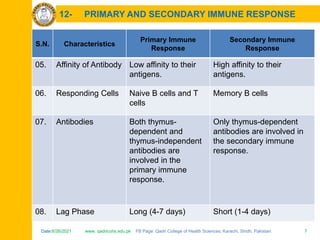
12- PRIMARY AND SECONDARY IMMUNE RESPONSE
S.N. Characteristics
Primary Immune
Response
Secondary Immune
Response
05. Affinity of Antibody Low affinity to their
antigens.
High affinity to their
antigens.
06. Responding Cells Naive B cells and T
cells
Memory B cells
07. Antibodies Both thymus-
dependent and
thymus-independent
antibodies are
involved in the
primary immune
response.
Only thymus-dependent
antibodies are involved in
the secondary immune
response.
08. Lag Phase Long (4-7 days) Short (1-4 days)
Date:6/26/2021 www. qadricohs.edu.pk FB Page: Qadri College of Health Sciences, Karachi, Sindh, Pakistan. 8
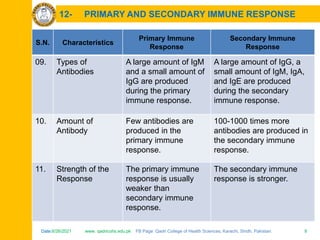
12- PRIMARY AND SECONDARY IMMUNE RESPONSE
S.N. Characteristics
Primary Immune
Response
Secondary Immune
Response
09. Types of
Antibodies
A large amount of IgM
and a small amount of
IgG are produced
during the primary
immune response.
A large amount of IgG, a
small amount of IgM, IgA,
and IgE are produced
during the secondary
immune response.
10. Amount of
Antibody
Few antibodies are
produced in the
primary immune
response.
100-1000 times more
antibodies are produced in
the secondary immune
response.
11. Strength of the
Response
The primary immune
response is usually
weaker than
secondary immune
response.
The secondary immune
response is stronger.
Date:6/26/2021 www. qadricohs.edu.pk FB Page: Qadri College of Health Sciences, Karachi, Sindh, Pakistan. 9
12- PRIMARY AND SECONDARY IMMUNE RESPONSE
S.N. Characteristics
Primary Immune
Response
Secondary Immune
Response
12. Antibody level
Antibody level declines
to the point where it
may be undetectable.
The antibody level tends to
remain high for longer.
References:
http://www.microbiologynotes.com/differences-between-primary-and-secondary-immune-response/
Date:6/26/2021 www. qadricohs.edu.pk FB Page: Qadri College of Health Sciences, Karachi, Sindh, Pakistan. 10
13- Define Hypersensitivity
Hypersensitivity (Immunological reaction)
refers to:
- Undesirable immune reactions produced by
the normal immune system.
Hypersensitivity reactions:
- When an immune response result in
exaggerated OR in appropriate reactions
harmful to the host the term hypersensitivity
OR allergy used.
Date:6/26/2021 www. qadricohs.edu.pk FB Page: Qadri College of Health Sciences, Karachi, Sindh, Pakistan. 11
13- Define Hypersensitivity
Hypersensitivity reactions:
Four types; based on the mechanisms
involved and time taken for the reaction, a
particular clinical condition (disease) may
involve more than one type of reaction.
Classification of Hypersensitivity:
- Type I Type I, II and III Antibody Mediated
- Type II
- Type III
- Type IV Type IV Cell Mediated
Date:6/26/2021 www. qadricohs.edu.pk FB Page: Qadri College of Health Sciences, Karachi, Sindh, Pakistan. 12
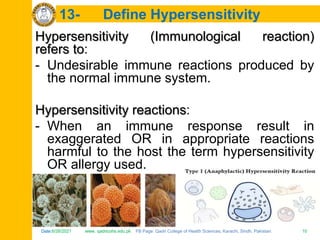
Type I (Immediate) Hypersensitivity
- Commonly called allergy.
- Mediated by IgE antibodies produced by plasma
cells in response to stimulation of Th2 cells by an
antigens.
- The antigens that stimulate it are called allergens
(i.e. House dust, Pollens, Cosmetics, Insects,
Clothing and Drug).
- Exposure may be ingested, inhalation, injection or
direct contact.
- Type I hypersensitivity reactions can be systemic
(e.g., systemic anaphylaxis) or localized to a
specific target tissue or organ (e.g., allergic
rhinitis, asthma).
Date:6/26/2021 www. qadricohs.edu.pk FB Page: Qadri College of Health Sciences, Karachi, Sindh, Pakistan. 13
Type II (Cytotoxic) Hypersensitivity
- Cytotoxic
- Type II hypersensitivity involves IgG or
IgM antibody-mediated.
- IgM or IgG immunoglobulin react with cell-
surface antigens to activate the
complements system and produce direct
damage of the sell surface.
- Transfusion reactions and hemolytic
disease of the newborn are examples of
type II hypersensitivity.
Date:6/26/2021 www. qadricohs.edu.pk FB Page: Qadri College of Health Sciences, Karachi, Sindh, Pakistan. 14
Type III (ICM) Hypersensitivity
Type III (Immune Complex–Mediated) Hypersensitivity:
- Type III hypersensitivity is also known as immune
complex hypersensitivity.
- The reaction may take 3 - 10 hours after exposure to
the antigen (as in Arhus reaction).
- The reaction may be general (e.g., serum sickness)
or may involve individual organs including or other
organs.
- Antigens causing immune complex mediated injury
are:
Exogenous
Endogenous
Date:6/26/2021 www. qadricohs.edu.pk FB Page: Qadri College of Health Sciences, Karachi, Sindh, Pakistan. 15
Type IV (Cell Mediated) Hypersensitivity
Type IV (Delayed or Cell-Mediated) Hypersensitivity:
- Delayed hypersensitivity is a function of T Lymphocytes, not
antibody.
- It starts hours (or Days) after contact with the antigen and
often lasts for days.
- It can be transferred by immunologically committed
(Sensitized) T cells, not by serum.
- Principal pattern of immunologic response to variety of intra
cellular microbiologic agents
i.e.: Mycobacterium Tuberculosis
Viruses
Fungi
Parasites
Date:6/26/2021 www. qadricohs.edu.pk FB Page: Qadri College of Health Sciences, Karachi, Sindh, Pakistan. 16
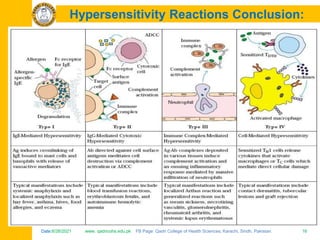
Hypersensitivity Reactions Conclusion:
Date:6/26/2021 www. qadricohs.edu.pk FB Page: Qadri College of Health Sciences, Karachi, Sindh, Pakistan. 17
14- Delayed VERSUS immediate Hypersensitivity
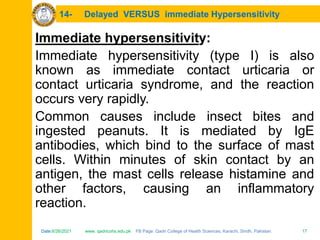
Immediate hypersensitivity:
Immediate hypersensitivity (type I) is also
known as immediate contact urticaria or
contact urticaria syndrome, and the reaction
occurs very rapidly.
Common causes include insect bites and
ingested peanuts. It is mediated by IgE
antibodies, which bind to the surface of mast
cells. Within minutes of skin contact by an
antigen, the mast cells release histamine and
other factors, causing an inflammatory
reaction.
Date:6/26/2021 www. qadricohs.edu.pk FB Page: Qadri College of Health Sciences, Karachi, Sindh, Pakistan. 18
Immediate Hypersensitivity
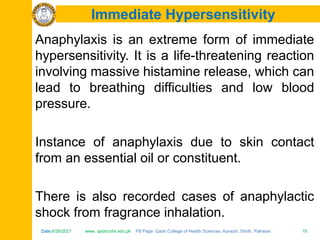
Anaphylaxis is an extreme form of immediate
hypersensitivity. It is a life-threatening reaction
involving massive histamine release, which can
lead to breathing difficulties and low blood
pressure.
Instance of anaphylaxis due to skin contact
from an essential oil or constituent.
There is also recorded cases of anaphylactic
shock from fragrance inhalation.
Date:6/26/2021 www. qadricohs.edu.pk FB Page: Qadri College of Health Sciences, Karachi, Sindh, Pakistan. 19
Delayed VERSUS immediate Hypersensitivity
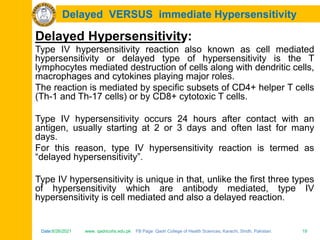
Delayed Hypersensitivity:
Type IV hypersensitivity reaction also known as cell mediated
hypersensitivity or delayed type of hypersensitivity is the T
lymphocytes mediated destruction of cells along with dendritic cells,
macrophages and cytokines playing major roles.
The reaction is mediated by specific subsets of CD4+ helper T cells
(Th-1 and Th-17 cells) or by CD8+ cytotoxic T cells.
Type IV hypersensitivity occurs 24 hours after contact with an
antigen, usually starting at 2 or 3 days and often last for many
days.
For this reason, type IV hypersensitivity reaction is termed as
“delayed hypersensitivity”.
Type IV hypersensitivity is unique in that, unlike the first three types
of hypersensitivity which are antibody mediated, type IV
hypersensitivity is cell mediated and also a delayed reaction.
Date:6/26/2021 www. qadricohs.edu.pk FB Page: Qadri College of Health Sciences, Karachi, Sindh, Pakistan. 20
Delayed VERSUS immediate Hypersensitivity
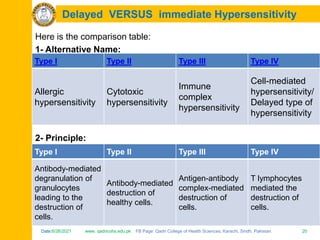
Here is the comparison table:
1- Alternative Name:
Type I Type II Type III Type IV
Allergic
hypersensitivity
Cytotoxic
hypersensitivity
Immune
complex
hypersensitivity
Cell-mediated
hypersensitivity/
Delayed type of
hypersensitivity
2- Principle:
Type I Type II Type III Type IV
Antibody-mediated
degranulation of
granulocytes
leading to the
destruction of
cells.
Antibody-mediated
destruction of
healthy cells.
Antigen-antibody
complex-mediated
destruction of
cells.
T lymphocytes
mediated the
destruction of
cells.
Date:6/26/2021 www. qadricohs.edu.pk FB Page: Qadri College of Health Sciences, Karachi, Sindh, Pakistan. 21
Delayed VERSUS immediate Hypersensitivity
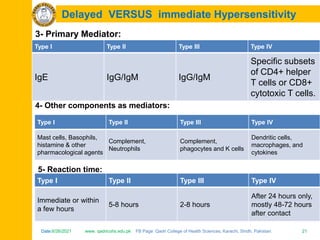
3- Primary Mediator:
Type I Type II Type III Type IV
IgE IgG/IgM IgG/IgM
Specific subsets
of CD4+ helper
T cells or CD8+
cytotoxic T cells.
4- Other components as mediators:
Type I Type II Type III Type IV
Immediate or within
a few hours
5-8 hours 2-8 hours
After 24 hours only,
mostly 48-72 hours
after contact
Type I Type II Type III Type IV
Mast cells, Basophils,
histamine & other
pharmacological agents
Complement,
Neutrophils
Complement,
phagocytes and K cells
Dendritic cells,
macrophages, and
cytokines
5- Reaction time:
Date:6/26/2021 www. qadricohs.edu.pk FB Page: Qadri College of Health Sciences, Karachi, Sindh, Pakistan. 22
Delayed VERSUS immediate Hypersensitivity
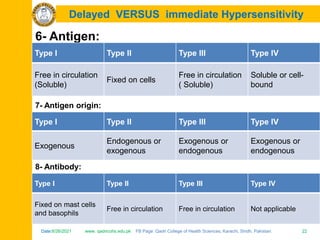
6- Antigen:
Type I Type II Type III Type IV
Free in circulation
(Soluble)
Fixed on cells
Free in circulation
( Soluble)
Soluble or cell-
bound
7- Antigen origin:
Type I Type II Type III Type IV
Exogenous
Endogenous or
exogenous
Exogenous or
endogenous
Exogenous or
endogenous
8- Antibody:
Type I Type II Type III Type IV
Fixed on mast cells
and basophils
Free in circulation Free in circulation Not applicable
Date:6/26/2021 www. qadricohs.edu.pk FB Page: Qadri College of Health Sciences, Karachi, Sindh, Pakistan. 23
Delayed VERSUS immediate Hypersensitivity
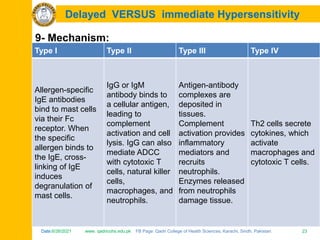
9- Mechanism:
Type I Type II Type III Type IV
Allergen-specific
IgE antibodies
bind to mast cells
via their Fc
receptor. When
the specific
allergen binds to
the IgE, cross-
linking of IgE
induces
degranulation of
mast cells.
IgG or IgM
antibody binds to
a cellular antigen,
leading to
complement
activation and cell
lysis. IgG can also
mediate ADCC
with cytotoxic T
cells, natural killer
cells,
macrophages, and
neutrophils.
Antigen-antibody
complexes are
deposited in
tissues.
Complement
activation provides
inflammatory
mediators and
recruits
neutrophils.
Enzymes released
from neutrophils
damage tissue.
Th2 cells secrete
cytokines, which
activate
macrophages and
cytotoxic T cells.
Date:6/26/2021 www. qadricohs.edu.pk FB Page: Qadri College of Health Sciences, Karachi, Sindh, Pakistan. 24
Delayed VERSUS immediate Hypersensitivity
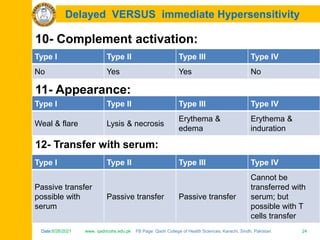
10- Complement activation:
Type I Type II Type III Type IV
No Yes Yes No
11- Appearance:
Type I Type II Type III Type IV
Weal & flare Lysis & necrosis
Erythema &
edema
Erythema &
induration
12- Transfer with serum:
Type I Type II Type III Type IV
Passive transfer
possible with
serum
Passive transfer Passive transfer
Cannot be
transferred with
serum; but
possible with T
cells transfer
Date:6/26/2021 www. qadricohs.edu.pk FB Page: Qadri College of Health Sciences, Karachi, Sindh, Pakistan. 25
Delayed VERSUS immediate Hypersensitivity
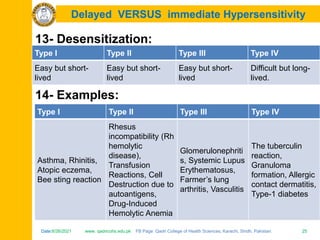
13- Desensitization:
Type I Type II Type III Type IV
Easy but short-
lived
Easy but short-
lived
Easy but short-
lived
Difficult but long-
lived.
14- Examples:
Type I Type II Type III Type IV
Asthma, Rhinitis,
Atopic eczema,
Bee sting reaction
Rhesus
incompatibility (Rh
hemolytic
disease),
Transfusion
Reactions, Cell
Destruction due to
autoantigens,
Drug-Induced
Hemolytic Anemia
Glomerulonephriti
s, Systemic Lupus
Erythematosus,
Farmer’s lung
arthritis, Vasculitis
The tuberculin
reaction,
Granuloma
formation, Allergic
contact dermatitis,
Type-1 diabetes
Date:6/26/2021 www. qadricohs.edu.pk FB Page: Qadri College of Health Sciences, Karachi, Sindh, Pakistan. 26
Delayed VERSUS immediate Hypersensitivity
References:
• https://courses.lumenlearning.com/microbiology/chapt
er/hypersensitivities/
• http://www.biologydiscussion.com/immunology/4-main-
types-of-hypersensitivity-immunology/61851
• https://www.slideshare.net/drsomeshwaranamsana/hy
persensitivity-reactions-dr-somesh-microbiology
• http://www.yourarticlelibrary.com/immunology/type-iii-
hypersensitivity-and-its-mechanism-human-
immunology/28081
• Lydyard, P.M., Whelan,A.,& Fanger,M.W.
(2005).Immunology (2 ed.).London: BIOS Scientific
Publishers.
• Owen, J. A., Punt, J., & Stranford, S. A. (2013). Kuby
Immunology (7 ed.). New York: W.H. Freeman and
Company.
Date:6/26/2021 www. qadricohs.edu.pk FB Page: Qadri College of Health Sciences, Karachi, Sindh, Pakistan. 27
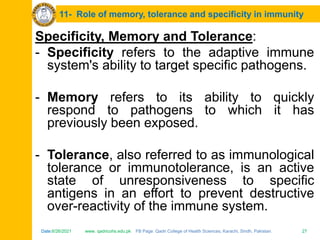
11- Role of memory, tolerance and specificity in immunity
Specificity, Memory and Tolerance:
- Specificity refers to the adaptive immune
system's ability to target specific pathogens.
- Memory refers to its ability to quickly
respond to pathogens to which it has
previously been exposed.
- Tolerance, also referred to as immunological
tolerance or immunotolerance, is an active
state of unresponsiveness to specific
antigens in an effort to prevent destructive
over-reactivity of the immune system.
Date:6/26/2021 www. qadricohs.edu.pk FB Page: Qadri College of Health Sciences, Karachi, Sindh, Pakistan. 28
DEFENSE MECHANISMS OF THE BODY
Date:6/26/2021 www. qadricohs.edu.pk FB Page: Qadri College of Health Sciences, Karachi, Sindh, Pakistan. 29
QADRI COLLEGE OF HEALTH SCIENCES, KARACHI
By: Aftab H. Abbasi
RN, DCHN, BSN, MA, LL.B
Lecturer Nursing
Qadri College of Health Sciences Karachi

primary and secondary immune response

  • 1.
    Date:6/26/2021 www. qadricohs.edu.pkFB Page: Qadri College of Health Sciences, Karachi, Sindh, Pakistan. 1 QADRI COLLEGE OF HEALTH SCIENCES, KARACHI U-3, 5 OF 5 “DEFENSE MECHANISMS OF THE BODY” By: Aftab H. Abbasi RN, DCHN, BSN, MA, LL.B Lecturer Nursing Qadri College of Health Sciences Karachi QADRI COLLEGE OF HEALTH SCIENCES, KARACHI
  • 2.
    Date:6/26/2021 www. qadricohs.edu.pkFB Page: Qadri College of Health Sciences, Karachi, Sindh, Pakistan. 2 Date:6/26/2021 www. qadricohs.edu.pk FB Page: Qadri College of Health Sciences, Karachi, Sindh, Pakistan. 2 “DEFENSE MECHANISM OF THE BODY” - This unit focuses on the resistance of the body which microorganism’s encounter where they enter in the human body. - This unit highlights the importance of the resistance or defense of the body which will help learners in understanding that why infection occurs sometimes and not always.
  • 3.
    Date:6/26/2021 www. qadricohs.edu.pkFB Page: Qadri College of Health Sciences, Karachi, Sindh, Pakistan. 3 Date:6/26/2021 www. qadricohs.edu.pk FB Page: Qadri College of Health Sciences, Karachi, Sindh, Pakistan. 3 “DEFENSE MECHANISM OF THE BODY” At the completion of this unit learners will be able to: 1- Explain the role of good health in protection against the microbial infection. 2- Define Resistance and Susceptibility. 3- Define Nonspecific Resistance. 4- Describe the role of the skin and mucous membrane in nonspecific Resistance. 5- Explain the process of Phagocytosis. 6- Define the Specific Resistance, Innate Resistance and Immunity. 7- Explain four types of acquired Immunity.
  • 4.
    Date:6/26/2021 www. qadricohs.edu.pkFB Page: Qadri College of Health Sciences, Karachi, Sindh, Pakistan. 4 Date:6/26/2021 www. qadricohs.edu.pk FB Page: Qadri College of Health Sciences, Karachi, Sindh, Pakistan. 4 “DEFENSE MECHANISM OF THE BODY” At the completion of this unit learners will be able to: 8- Differentiate between humoral and cell mediated immunity. 9- Define Antigens, hapten and antibodies. 10- List the five classes of antibodies and their functions. 11- Explain the role of memory, tolerance and specificity in immunity. 12- Distinguish between primary and secondary immune response. 13- Define Hypersensitivity. 14- Differentiate between i.e. delayed and immediate Hypersensitivity.
  • 5.
    Date:6/26/2021 www. qadricohs.edu.pkFB Page: Qadri College of Health Sciences, Karachi, Sindh, Pakistan. 5 Date:6/26/2021 www. qadricohs.edu.pk FB Page: Qadri College of Health Sciences, Karachi, Sindh, Pakistan. 5 12- PRIMARY AND SECONDARY IMMUNE RESPONSE Differences between Primary and Secondary Immune Response: In a primary immune response, naive B cells are stimulated by antigen, become activated, and differentiate into antibody-secreting cells that produce antibodies specific for the eliciting antigen. A secondary immune response is elicited when the same antigen stimulates memory B cells, leading to the production of greater quantities of specific antibodies that are produced in the primary response. Some of the differences between Primary and Secondary Immune Response are as follows:
  • 6.
    Date:6/26/2021 www. qadricohs.edu.pkFB Page: Qadri College of Health Sciences, Karachi, Sindh, Pakistan. 6 Date:6/26/2021 www. qadricohs.edu.pk FB Page: Qadri College of Health Sciences, Karachi, Sindh, Pakistan. 6 12- PRIMARY AND SECONDARY IMMUNE RESPONSE S.N. Characteristics Primary Immune Response Secondary Immune Response 01. Definition Primary Immune Response is the reaction of the immune system when it contacts an antigen for the first time. Secondary Immune Response is the reaction of the immune system when it contacts an antigen for the second and subsequent times. 02. Appearance Appears mainly in the lymph nodes and spleen. Appears mainly in the bone marrow and then, in the spleen and lymph nodes. 03. Occurrence This occurs in response to the primary contact of the antigen. This occurs in response to the second and subsequent exposure to the same antigen. 04. Antibody Peak The antibody level reaches its peak in 7-10 days. The antibody level reaches its peak in 3-5 days.
  • 7.
    Date:6/26/2021 www. qadricohs.edu.pkFB Page: Qadri College of Health Sciences, Karachi, Sindh, Pakistan. 7 Date:6/26/2021 www. qadricohs.edu.pk FB Page: Qadri College of Health Sciences, Karachi, Sindh, Pakistan. 7 12- PRIMARY AND SECONDARY IMMUNE RESPONSE S.N. Characteristics Primary Immune Response Secondary Immune Response 05. Affinity of Antibody Low affinity to their antigens. High affinity to their antigens. 06. Responding Cells Naive B cells and T cells Memory B cells 07. Antibodies Both thymus- dependent and thymus-independent antibodies are involved in the primary immune response. Only thymus-dependent antibodies are involved in the secondary immune response. 08. Lag Phase Long (4-7 days) Short (1-4 days)
  • 8.
    Date:6/26/2021 www. qadricohs.edu.pkFB Page: Qadri College of Health Sciences, Karachi, Sindh, Pakistan. 8 Date:6/26/2021 www. qadricohs.edu.pk FB Page: Qadri College of Health Sciences, Karachi, Sindh, Pakistan. 8 12- PRIMARY AND SECONDARY IMMUNE RESPONSE S.N. Characteristics Primary Immune Response Secondary Immune Response 09. Types of Antibodies A large amount of IgM and a small amount of IgG are produced during the primary immune response. A large amount of IgG, a small amount of IgM, IgA, and IgE are produced during the secondary immune response. 10. Amount of Antibody Few antibodies are produced in the primary immune response. 100-1000 times more antibodies are produced in the secondary immune response. 11. Strength of the Response The primary immune response is usually weaker than secondary immune response. The secondary immune response is stronger.
  • 9.
    Date:6/26/2021 www. qadricohs.edu.pkFB Page: Qadri College of Health Sciences, Karachi, Sindh, Pakistan. 9 Date:6/26/2021 www. qadricohs.edu.pk FB Page: Qadri College of Health Sciences, Karachi, Sindh, Pakistan. 9 12- PRIMARY AND SECONDARY IMMUNE RESPONSE S.N. Characteristics Primary Immune Response Secondary Immune Response 12. Antibody level Antibody level declines to the point where it may be undetectable. The antibody level tends to remain high for longer. References: http://www.microbiologynotes.com/differences-between-primary-and-secondary-immune-response/
  • 10.
    Date:6/26/2021 www. qadricohs.edu.pkFB Page: Qadri College of Health Sciences, Karachi, Sindh, Pakistan. 10 Date:6/26/2021 www. qadricohs.edu.pk FB Page: Qadri College of Health Sciences, Karachi, Sindh, Pakistan. 10 13- Define Hypersensitivity Hypersensitivity (Immunological reaction) refers to: - Undesirable immune reactions produced by the normal immune system. Hypersensitivity reactions: - When an immune response result in exaggerated OR in appropriate reactions harmful to the host the term hypersensitivity OR allergy used.
  • 11.
    Date:6/26/2021 www. qadricohs.edu.pkFB Page: Qadri College of Health Sciences, Karachi, Sindh, Pakistan. 11 Date:6/26/2021 www. qadricohs.edu.pk FB Page: Qadri College of Health Sciences, Karachi, Sindh, Pakistan. 11 13- Define Hypersensitivity Hypersensitivity reactions: Four types; based on the mechanisms involved and time taken for the reaction, a particular clinical condition (disease) may involve more than one type of reaction. Classification of Hypersensitivity: - Type I Type I, II and III Antibody Mediated - Type II - Type III - Type IV Type IV Cell Mediated
  • 12.
    Date:6/26/2021 www. qadricohs.edu.pkFB Page: Qadri College of Health Sciences, Karachi, Sindh, Pakistan. 12 Date:6/26/2021 www. qadricohs.edu.pk FB Page: Qadri College of Health Sciences, Karachi, Sindh, Pakistan. 12 Type I (Immediate) Hypersensitivity - Commonly called allergy. - Mediated by IgE antibodies produced by plasma cells in response to stimulation of Th2 cells by an antigens. - The antigens that stimulate it are called allergens (i.e. House dust, Pollens, Cosmetics, Insects, Clothing and Drug). - Exposure may be ingested, inhalation, injection or direct contact. - Type I hypersensitivity reactions can be systemic (e.g., systemic anaphylaxis) or localized to a specific target tissue or organ (e.g., allergic rhinitis, asthma).
  • 13.
    Date:6/26/2021 www. qadricohs.edu.pkFB Page: Qadri College of Health Sciences, Karachi, Sindh, Pakistan. 13 Date:6/26/2021 www. qadricohs.edu.pk FB Page: Qadri College of Health Sciences, Karachi, Sindh, Pakistan. 13 Type II (Cytotoxic) Hypersensitivity - Cytotoxic - Type II hypersensitivity involves IgG or IgM antibody-mediated. - IgM or IgG immunoglobulin react with cell- surface antigens to activate the complements system and produce direct damage of the sell surface. - Transfusion reactions and hemolytic disease of the newborn are examples of type II hypersensitivity.
  • 14.
    Date:6/26/2021 www. qadricohs.edu.pkFB Page: Qadri College of Health Sciences, Karachi, Sindh, Pakistan. 14 Date:6/26/2021 www. qadricohs.edu.pk FB Page: Qadri College of Health Sciences, Karachi, Sindh, Pakistan. 14 Type III (ICM) Hypersensitivity Type III (Immune Complex–Mediated) Hypersensitivity: - Type III hypersensitivity is also known as immune complex hypersensitivity. - The reaction may take 3 - 10 hours after exposure to the antigen (as in Arhus reaction). - The reaction may be general (e.g., serum sickness) or may involve individual organs including or other organs. - Antigens causing immune complex mediated injury are: Exogenous Endogenous
  • 15.
    Date:6/26/2021 www. qadricohs.edu.pkFB Page: Qadri College of Health Sciences, Karachi, Sindh, Pakistan. 15 Date:6/26/2021 www. qadricohs.edu.pk FB Page: Qadri College of Health Sciences, Karachi, Sindh, Pakistan. 15 Type IV (Cell Mediated) Hypersensitivity Type IV (Delayed or Cell-Mediated) Hypersensitivity: - Delayed hypersensitivity is a function of T Lymphocytes, not antibody. - It starts hours (or Days) after contact with the antigen and often lasts for days. - It can be transferred by immunologically committed (Sensitized) T cells, not by serum. - Principal pattern of immunologic response to variety of intra cellular microbiologic agents i.e.: Mycobacterium Tuberculosis Viruses Fungi Parasites
  • 16.
    Date:6/26/2021 www. qadricohs.edu.pkFB Page: Qadri College of Health Sciences, Karachi, Sindh, Pakistan. 16 Date:6/26/2021 www. qadricohs.edu.pk FB Page: Qadri College of Health Sciences, Karachi, Sindh, Pakistan. 16 Hypersensitivity Reactions Conclusion:
  • 17.
    Date:6/26/2021 www. qadricohs.edu.pkFB Page: Qadri College of Health Sciences, Karachi, Sindh, Pakistan. 17 Date:6/26/2021 www. qadricohs.edu.pk FB Page: Qadri College of Health Sciences, Karachi, Sindh, Pakistan. 17 14- Delayed VERSUS immediate Hypersensitivity Immediate hypersensitivity: Immediate hypersensitivity (type I) is also known as immediate contact urticaria or contact urticaria syndrome, and the reaction occurs very rapidly. Common causes include insect bites and ingested peanuts. It is mediated by IgE antibodies, which bind to the surface of mast cells. Within minutes of skin contact by an antigen, the mast cells release histamine and other factors, causing an inflammatory reaction.
  • 18.
    Date:6/26/2021 www. qadricohs.edu.pkFB Page: Qadri College of Health Sciences, Karachi, Sindh, Pakistan. 18 Date:6/26/2021 www. qadricohs.edu.pk FB Page: Qadri College of Health Sciences, Karachi, Sindh, Pakistan. 18 Immediate Hypersensitivity Anaphylaxis is an extreme form of immediate hypersensitivity. It is a life-threatening reaction involving massive histamine release, which can lead to breathing difficulties and low blood pressure. Instance of anaphylaxis due to skin contact from an essential oil or constituent. There is also recorded cases of anaphylactic shock from fragrance inhalation.
  • 19.
    Date:6/26/2021 www. qadricohs.edu.pkFB Page: Qadri College of Health Sciences, Karachi, Sindh, Pakistan. 19 Date:6/26/2021 www. qadricohs.edu.pk FB Page: Qadri College of Health Sciences, Karachi, Sindh, Pakistan. 19 Delayed VERSUS immediate Hypersensitivity Delayed Hypersensitivity: Type IV hypersensitivity reaction also known as cell mediated hypersensitivity or delayed type of hypersensitivity is the T lymphocytes mediated destruction of cells along with dendritic cells, macrophages and cytokines playing major roles. The reaction is mediated by specific subsets of CD4+ helper T cells (Th-1 and Th-17 cells) or by CD8+ cytotoxic T cells. Type IV hypersensitivity occurs 24 hours after contact with an antigen, usually starting at 2 or 3 days and often last for many days. For this reason, type IV hypersensitivity reaction is termed as “delayed hypersensitivity”. Type IV hypersensitivity is unique in that, unlike the first three types of hypersensitivity which are antibody mediated, type IV hypersensitivity is cell mediated and also a delayed reaction.
  • 20.
    Date:6/26/2021 www. qadricohs.edu.pkFB Page: Qadri College of Health Sciences, Karachi, Sindh, Pakistan. 20 Date:6/26/2021 www. qadricohs.edu.pk FB Page: Qadri College of Health Sciences, Karachi, Sindh, Pakistan. 20 Delayed VERSUS immediate Hypersensitivity Here is the comparison table: 1- Alternative Name: Type I Type II Type III Type IV Allergic hypersensitivity Cytotoxic hypersensitivity Immune complex hypersensitivity Cell-mediated hypersensitivity/ Delayed type of hypersensitivity 2- Principle: Type I Type II Type III Type IV Antibody-mediated degranulation of granulocytes leading to the destruction of cells. Antibody-mediated destruction of healthy cells. Antigen-antibody complex-mediated destruction of cells. T lymphocytes mediated the destruction of cells.
  • 21.
    Date:6/26/2021 www. qadricohs.edu.pkFB Page: Qadri College of Health Sciences, Karachi, Sindh, Pakistan. 21 Date:6/26/2021 www. qadricohs.edu.pk FB Page: Qadri College of Health Sciences, Karachi, Sindh, Pakistan. 21 Delayed VERSUS immediate Hypersensitivity 3- Primary Mediator: Type I Type II Type III Type IV IgE IgG/IgM IgG/IgM Specific subsets of CD4+ helper T cells or CD8+ cytotoxic T cells. 4- Other components as mediators: Type I Type II Type III Type IV Immediate or within a few hours 5-8 hours 2-8 hours After 24 hours only, mostly 48-72 hours after contact Type I Type II Type III Type IV Mast cells, Basophils, histamine & other pharmacological agents Complement, Neutrophils Complement, phagocytes and K cells Dendritic cells, macrophages, and cytokines 5- Reaction time:
  • 22.
    Date:6/26/2021 www. qadricohs.edu.pkFB Page: Qadri College of Health Sciences, Karachi, Sindh, Pakistan. 22 Date:6/26/2021 www. qadricohs.edu.pk FB Page: Qadri College of Health Sciences, Karachi, Sindh, Pakistan. 22 Delayed VERSUS immediate Hypersensitivity 6- Antigen: Type I Type II Type III Type IV Free in circulation (Soluble) Fixed on cells Free in circulation ( Soluble) Soluble or cell- bound 7- Antigen origin: Type I Type II Type III Type IV Exogenous Endogenous or exogenous Exogenous or endogenous Exogenous or endogenous 8- Antibody: Type I Type II Type III Type IV Fixed on mast cells and basophils Free in circulation Free in circulation Not applicable
  • 23.
    Date:6/26/2021 www. qadricohs.edu.pkFB Page: Qadri College of Health Sciences, Karachi, Sindh, Pakistan. 23 Date:6/26/2021 www. qadricohs.edu.pk FB Page: Qadri College of Health Sciences, Karachi, Sindh, Pakistan. 23 Delayed VERSUS immediate Hypersensitivity 9- Mechanism: Type I Type II Type III Type IV Allergen-specific IgE antibodies bind to mast cells via their Fc receptor. When the specific allergen binds to the IgE, cross- linking of IgE induces degranulation of mast cells. IgG or IgM antibody binds to a cellular antigen, leading to complement activation and cell lysis. IgG can also mediate ADCC with cytotoxic T cells, natural killer cells, macrophages, and neutrophils. Antigen-antibody complexes are deposited in tissues. Complement activation provides inflammatory mediators and recruits neutrophils. Enzymes released from neutrophils damage tissue. Th2 cells secrete cytokines, which activate macrophages and cytotoxic T cells.
  • 24.
    Date:6/26/2021 www. qadricohs.edu.pkFB Page: Qadri College of Health Sciences, Karachi, Sindh, Pakistan. 24 Date:6/26/2021 www. qadricohs.edu.pk FB Page: Qadri College of Health Sciences, Karachi, Sindh, Pakistan. 24 Delayed VERSUS immediate Hypersensitivity 10- Complement activation: Type I Type II Type III Type IV No Yes Yes No 11- Appearance: Type I Type II Type III Type IV Weal & flare Lysis & necrosis Erythema & edema Erythema & induration 12- Transfer with serum: Type I Type II Type III Type IV Passive transfer possible with serum Passive transfer Passive transfer Cannot be transferred with serum; but possible with T cells transfer
  • 25.
    Date:6/26/2021 www. qadricohs.edu.pkFB Page: Qadri College of Health Sciences, Karachi, Sindh, Pakistan. 25 Date:6/26/2021 www. qadricohs.edu.pk FB Page: Qadri College of Health Sciences, Karachi, Sindh, Pakistan. 25 Delayed VERSUS immediate Hypersensitivity 13- Desensitization: Type I Type II Type III Type IV Easy but short- lived Easy but short- lived Easy but short- lived Difficult but long- lived. 14- Examples: Type I Type II Type III Type IV Asthma, Rhinitis, Atopic eczema, Bee sting reaction Rhesus incompatibility (Rh hemolytic disease), Transfusion Reactions, Cell Destruction due to autoantigens, Drug-Induced Hemolytic Anemia Glomerulonephriti s, Systemic Lupus Erythematosus, Farmer’s lung arthritis, Vasculitis The tuberculin reaction, Granuloma formation, Allergic contact dermatitis, Type-1 diabetes
  • 26.
    Date:6/26/2021 www. qadricohs.edu.pkFB Page: Qadri College of Health Sciences, Karachi, Sindh, Pakistan. 26 Date:6/26/2021 www. qadricohs.edu.pk FB Page: Qadri College of Health Sciences, Karachi, Sindh, Pakistan. 26 Delayed VERSUS immediate Hypersensitivity References: • https://courses.lumenlearning.com/microbiology/chapt er/hypersensitivities/ • http://www.biologydiscussion.com/immunology/4-main- types-of-hypersensitivity-immunology/61851 • https://www.slideshare.net/drsomeshwaranamsana/hy persensitivity-reactions-dr-somesh-microbiology • http://www.yourarticlelibrary.com/immunology/type-iii- hypersensitivity-and-its-mechanism-human- immunology/28081 • Lydyard, P.M., Whelan,A.,& Fanger,M.W. (2005).Immunology (2 ed.).London: BIOS Scientific Publishers. • Owen, J. A., Punt, J., & Stranford, S. A. (2013). Kuby Immunology (7 ed.). New York: W.H. Freeman and Company.
  • 27.
    Date:6/26/2021 www. qadricohs.edu.pkFB Page: Qadri College of Health Sciences, Karachi, Sindh, Pakistan. 27 Date:6/26/2021 www. qadricohs.edu.pk FB Page: Qadri College of Health Sciences, Karachi, Sindh, Pakistan. 27 11- Role of memory, tolerance and specificity in immunity Specificity, Memory and Tolerance: - Specificity refers to the adaptive immune system's ability to target specific pathogens. - Memory refers to its ability to quickly respond to pathogens to which it has previously been exposed. - Tolerance, also referred to as immunological tolerance or immunotolerance, is an active state of unresponsiveness to specific antigens in an effort to prevent destructive over-reactivity of the immune system.
  • 28.
    Date:6/26/2021 www. qadricohs.edu.pkFB Page: Qadri College of Health Sciences, Karachi, Sindh, Pakistan. 28 Date:6/26/2021 www. qadricohs.edu.pk FB Page: Qadri College of Health Sciences, Karachi, Sindh, Pakistan. 28 DEFENSE MECHANISMS OF THE BODY
  • 29.
    Date:6/26/2021 www. qadricohs.edu.pkFB Page: Qadri College of Health Sciences, Karachi, Sindh, Pakistan. 29 Date:6/26/2021 www. qadricohs.edu.pk FB Page: Qadri College of Health Sciences, Karachi, Sindh, Pakistan. 29 QADRI COLLEGE OF HEALTH SCIENCES, KARACHI By: Aftab H. Abbasi RN, DCHN, BSN, MA, LL.B Lecturer Nursing Qadri College of Health Sciences Karachi