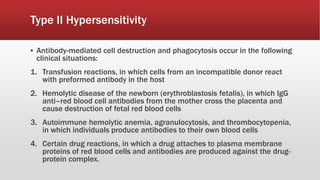
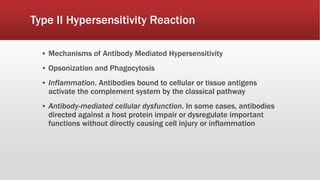
Hypersensitivity reactions occur when the immune system mounts an excessive or inappropriate response against antigens. There are four main types of hypersensitivity reactions:
Type I reactions are immediate and antigen-specific, mediated by IgE antibodies and mast cells. Type II reactions are caused by antibodies against antigens on cells, targeting them for destruction. Type III reactions involve immune complex deposition in tissues, activating complement and causing inflammation. Type IV reactions are T-cell mediated, characterized by cytokine-induced inflammation or direct cytotoxicity by CD8+ T cells. Each type can result in different clinical manifestations and tissue damage.