ORAL
MICROBIOLOGY
&
IMMUNOLOGY
Delayed
Hypersensitivity
A case of Tuberculin Test
Presentor:
Dr. Carlos T. Capitan II
Hypersensitivity (also called
hypersensitivity reaction or intolerance)
refers to undesirable reactions produced by
the normal immune system, including allergies
and autoimmunity. They are usually referred to
as an over-reaction of the immune system and
these reactions may be damaging and
uncomfortable.
Type I hypersensitivity (or immediate hypersensitivity), in the Gell and
Coombs classification of allergic reactions, is an allergic reaction
provoked by re-exposure to a specific type of antigen referred to as an
allergen.[1] Type I is distinct from type II, type III and type IV
hypersensitivities.
1. med/1101 at eMedicine
2. Descotes, Jacques; Choquet-Kastylevsky, Geneviève (February 2001). "Gell and Coombs's classification: is it still valid?". Toxicology. 158 (1–2):
43–49. doi:10.1016/S0300-483X(00)00400-5. PMID 11164991.
The relevance of the Gell and Coombs classification of allergic reactions
has been questioned in the modern-day understanding of allergy, and it
has limited utility in clinical practice.[2]
Exposure may be by ingestion, inhalation, injection, or direct contact.
In type I hypersensitivity, B cells are stimulated (by CD4+ Th2 cells) to produce IgE
antibodies specific to an antigen. The difference between a normal infectious
immune response and a type 1 hypersensitivity response is that in type 1
hypersensitivity, the antibody is IgE instead of IgA, IgG, or IgM. During sensitization,
the IgE antibodies bind to FcεRI receptors on the surface of tissue mast cells and
blood basophils.[4]
Mast cells and basophils coated by IgE antibodies are "sensitized". Later exposure
to the same allergen cross-links the bound IgE on sensitized cells, resulting in
anaphylactic degranulation, which is the immediate and explosive release of
pharmacologically active pre-formed mediators from storage granules and
concurrent synthesis of inflammatory lipid mediators from arachidonic acid;[5]
some of these mediators include histamine, leukotriene (LTC4 and LTD4 and
LTB4), and prostaglandin, which act on proteins (e.g., G-protein coupled receptors)
located on surrounding tissues.[5] The principal effects of these products are
vasodilation and smooth-muscle contraction.
"The Adaptive Immune System: Type I Immediate Hypersensitivity". Archived from the original on 2010-07-27. Retrieved 2008-09-22.
TYPE I HYPERSENSITIVITY
ALTERNATE NAMES:
Allergy
Immediate
Anaphylactic
ANTIBODIES OR CELL MEDIATOR: IgE
IMMUNOLOGIC REACTION:
Fast response which occurs in minutes, rather than multiple hours or days.
Free antigens cross link the IgE on mast cells and basophils which causes
a release of vasoactive biomolecules. Testing can be done via skin test for
specific IgE.[5]
EXAMPLES: Atopy, Anaphylaxis, Asthma, Churg–Strauss Syndrome
5. Black, C. A. (1999). "Delayed type hypersensitivity: Current theories with an historic perspective". Dermatology Online Journal. 5 (1):
7. doi:10.5070/D32FW0G1XX. PMID 10673450.
Type II hypersensitivity reaction refers to an antibody-mediated immune
reaction in which antibodies (IgG or IgM) are directed against cellular or
extracellular matrix antigens with the resultant cellular destruction,
functional loss, or damage to tissues.[citation needed.
Type II hypersensitivity
Damage can be accomplished via three different mechanisms:
Antibody binding to cell surface receptors and altering its activity
Activation of the complement pathway.
Antibody-dependent cellular cytotoxicity
The pathophysiology of type II hypersensitivity reactions can be broadly
classified into three types:
Cell depletion or destruction without inflammation
Inflammation mediated by complement or Fc receptor
Cellular dysfunction by antibodies
The process involves a series of immune-mediated events that might take
different forms.[12]
TYPE II HYPERSENSITIVITY
ALTERNATE NAMES:
Antibody- dependent
ANTIBODIES OR CELL MEDIATOR: Antibody IgM, Antibody IgG,
Complement, MAC
IMMUNOLOGIC REACTION:
Antibody (IgM or IgG) binds to antigen on a target cell, which is actually a
host cell that is perceived by the immune system as foreign, leading to
cellular destruction via the MAC. Testing includes both the direct and indirect
Coombs test.[6]
EXAMPLES:Autoimmune hemolytic anemia, Rheumatic heart disease,
Thrombocytopenia, Erythroblastosis fetalis, Goodpasture's syndrome
Graves' disease, Myasthenia gravis, Pemphigus vulgaris
6. Delayed Hypersensitivity Reactions at eMedicine
In type III hypersensitivity reaction, an abnormal immune response is mediated by the
formation of antigen-antibody aggregates called "immune complexes". They can
precipitate in various tissues such as skin, joints, vessels, or glomeruli, and trigger the
classical complement pathway. Complement activation leads to the recruitment of
inflammatory cells (monocytes and neutrophils) that release lysosomal enzymes and
free radicals at the site of immune complexes, causing tissue damage.[citation needed]
2. Usman, Norina; Annamaraju, Pavan (2021), "Type III Hypersensitivity Reaction", StatPearls, Treasure Island (FL): StatPearls
Publishing, PMID 32644548, retrieved 2021-07-05 This article incorporates text available under the CC BY 4.0 license.
The most common diseases involving a type III hypersensitivity reaction are serum
sickness, post-streptococcal glomerulonephritis, systemic lupus erythematosus,
farmers' lung (hypersensitivity pneumonitis), and rheumatoid arthritis.[citation needed]
The principal feature that separates type III reactions from other hypersensitivity
reactions is that in type III reaction, the antigen-antibody complexes are pre-formed in
the circulation before their deposition in tissues.[2]
TYPE III HYPERSENSITIVITY
ALTERNATE NAMES:
Immune complex
ANTIBODIES OR CELL MEDIATOR:Antibody IgG, Complement.
Neutrophils
IMMUNOLOGIC REACTION:
Antibody (IgG) binds to soluble antigen, forming a circulating immune
complex. This is often deposited in the vessel walls of the joints and kidney,
initiating a local inflammatory reaction.[7]
EXAMPLES: Serum sickness, Rheumatoid arthritis, Arthus reaction,
Post streptococcal glomerulonephritis, Membranous nephropathy
Reactive arthritis, Lupus nephritis, Systemic lupus erythematosus,
Extrinsic allergic alveolitis (hypersensitivity pneumonitis)
7. Kumar, Vinay; Abbas, Abul K.; Aster, Jon C., eds. (2014). "Hypersensitivity: Immunologicaly Mediated Tissue Injury". Robbins & Cotran
Pathologic Basis of Disease (9th ed.). Elsevier Health Sciences. pp. 200–11. ISBN 978-0-323-29635-9.
Type four hypersensitivity reaction is a cell-mediated reaction that can
occur in response to contact with certain allergens resulting in what is
called contact dermatitis or in response to some diagnostic procedures
as in the tuberculin skin test. Certain allergens must be avoided to treat
this condition. This activity reviews the evaluation and management of
type four hypersensitivity reactions and highlights the role of the
interprofessional team in improving care for patients with this condition.
Type IV hypersensitivity reactions are, to some extent, normal
physiological events that help fight infections, and dysfunction in this
system can predispose to multiple opportunistic infections. Adverse events
can also occur due to these reactions when an undesirable interaction
between the immune system and an allergen happens.
A Type IV hypersensitivity reaction is mediated by T cells that provoke an inflammatory reaction
against exogenous or endogenous antigens. In certain situations, other cells, such as monocytes,
eosinophils, and neutrophils, can be involved. After antigen exposure, an initial local immune and
inflammatory response occurs that attracts leukocytes. The antigen engulfed by the macrophages
and monocytes is presented to T cells, which then becomes sensitized and activated. These cells
then release cytokines and chemokines, which can cause tissue damage and may result in
illnesses.[citation needed]
Examples of illnesses resulting from type IV hypersensitivity reactions include contact dermatitis
and drug hypersensitivity. Type IV reactions are further subdivided into type IVa, IVb, IVc, and IVd
based on the type of T cell (Th1, Th17 and CTLs) involved and the cytokines/chemokines
produced.[citation needed]
Delayed hypersensitivity plays a crucial role in our body's ability to fight various intracellular
pathogens such as mycobacteria and fungi. They also play a principal role in tumor immunity and
transplant rejection. Since patients with acquired immunodeficiency syndrome (AIDS) have a
progressive decline in the number of CD4 cells, they also have a defective type four hypersensitivity
reaction.[3]
TYPE IV HYPERSENSITIVITY
ALTERNATE NAMES:
Delayed,[5][6], cell-mediated immune memory response,
Antibody-independent, Cytotoxic
ANTIBODIES OR CELL MEDIATOR: T-cells
IMMUNOLOGIC REACTION:
CTL's and T helper cells (specifically Th1 and Th17 cells)[8] are activated by an antigen
presenting cell. When the antigen is presented again in the future, the memory Th1
cells will activate macrophages and cause an inflammatory response. This ultimately
can lead to tissue damage.[9]
EXAMPLES: Contact dermatitis, including Urushiol-induced contact, dermatitis (poison
ivy rash), Mantoux test, Chronic transplant rejection,
Multiple sclerosis[10], Coeliac disease, Hashimoto's thyroiditis,
Granuloma annulare
8. Abbas, Abul K. (6 May 2021). Cellular and Molecular Immunology. Elsevier. p. 444. ISBN 978-0-323-75748-5.
9. Le, Tau. First Aid for the USMLE Step 1 2013, p. 203-204
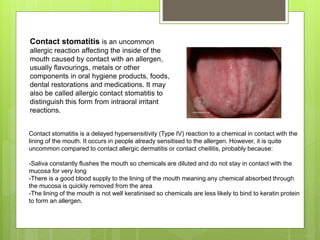
Contact stomatitis is an uncommon
allergic reaction affecting the inside of the
mouth caused by contact with an allergen,
usually flavourings, metals or other
components in oral hygiene products, foods,
dental restorations and medications. It may
also be called allergic contact stomatitis to
distinguish this form from intraoral irritant
reactions.
Contact stomatitis is a delayed hypersensitivity (Type IV) reaction to a chemical in contact with the
lining of the mouth. It occurs in people already sensitised to the allergen. However, it is quite
uncommon compared to contact allergic dermatitis or contact cheilitis, probably because:
-Saliva constantly flushes the mouth so chemicals are diluted and do not stay in contact with the
mucosa for very long
-There is a good blood supply to the lining of the mouth meaning any chemical absorbed through
the mucosa is quickly removed from the area
-The lining of the mouth is not well keratinised so chemicals are less likely to bind to keratin protein
to form an allergen.
The most severe hypersensitivity reaction is called
“anaphylaxis” and this allergic reaction usually
begins immediately after exposure to the allergen.
Hypersensitivity reactions in and around the mouth
may produce a wide range of clinical appearances
including redness or whiteness of the mucosa;
swelling of the lips, tongue and cheeks; and/or
ulcers and blisters.
Types of Oral Hypersensitivity Reactions
Stomatitis: Typical signs of stomatitis are redness
and swelling that may involve any part of the mouth
(see Right) including the tongue, roof of the mouth,
cheeks, and lips (cheilitis). There is occasional
formation of blisters and ulcers. Affected individuals
may complain of a burning sensation and mouth
sensitivity to cold, hot, and spicy foods.
Lichenoid reactions: These lesions resemble lichen
planus and consist of slightly raised, thin, whitish
lines that blend together to form a lacelike pattern.
Sometimes ulcers are located within the lesion and
surrounded by the whitish lines (see Right).
Lichenoid lesions are found most commonly on the
mucosa of the cheeks but may occur throughout the
mouth.
Angioedema: Angioedema is a soft, painless, non-itchy swelling that usually
involves the lips, tongue or cheeks. It typically develops rapidly and can
become a serious event requiring emergency treatment, if the swelling spreads
to the larynx and results in severe breathing difficulty.
Erythema multiforme: In erythema multiforme both the skin and the mouth
may be affected. Mouth lesions begin as swelling and redness of the oral
mucosa, followed by the formation of blisters which break and leave areas of
ulceration. The lips may become swollen and develop bloody crusts. The
typical skin lesion is the “target” or “iris lesion” which consists of concentric
rings of red skin surrounded by areas of normal colored skin (see Right). The
extent of involvement can be so severe as to require hospitalization.
Plasma cell gingivitis: Plasma cell gingivitis appears as a bright redness and
swelling of the gums without ulceration (loss of skin cells). This characteristic
appearance (see Right) is due to the gathering of specific white blood cells,
called plasma cells, in the gums. Other areas that may be involved include the
tongue or lips. This reversible condition is different than gum disease, and
symptoms resolve once the cause is removed.
Is Mantoux test delayed hypersensitivity?
The Mantoux Test (MT) is a classical delayed-type hypersensitivity
(DTH) response to the intradermal injection of tuberculin purified
protein derivative (PPD). It represents a cutaneous T cell mediated
memory recall immune response.
What type of hypersensitivity reaction is
tuberculosis?
Tuberculin-type hypersensitivity, initially described by Koch, occurs in
patients with tuberculosis (TB) or those vaccinated against tuberculosis
when they are injected subcutaneously with tuberculin (a product derived
from the tubercle bacillus). They react with skin induration, swelling, and
redness.
What is the difference between Mantoux and
PPD?
The terms Mantoux, TB skin test, tuberculin skin test, and
PPDs are often used interchangeably. Mantoux refers to the
technique for administering the test. Tuberculin (also called
purified protein derivative or PPD) is the solution used to
administer the test.
TREATMENT
Immediate hypersensitivity reactions
The treatment of immediate hypersensitivity reactions includes the management of anaphylaxis
with intramuscular adrenaline (epinephrine), oxygen, intravenous (IV) antihistamine, support blood
pressure with IV fluids, avoid latex gloves and equipment in patients who are allergic, and surgical
procedures such as tracheotomy if there is severe laryngeal edema.
Allergic bronchial asthma can be treated with any of the following: inhaled short- and long-acting
bronchodilators (anticholinergics) along with inhaled corticosteroids, leukotriene antagonists, use of
disodium cromoglycate, and environmental control. Experimentally, a low dose of methotrexate or
cyclosporin and omalizumab (a monoclonal anti-IgE antibody) has been used.
Treatment of autoimmune disorders (e.g., SLE) include one or a combination of NSAIDs and
hydroxychloroquine, azathioprine, methotrexate, mycophenolate, cyclophosphamide, low dose IL-
2, intravenous immunoglobulins, and belimumab.
Omalizumab is a monoclonal antibody that interacts with the binding site of the high-affinity IgE
receptor on mast cells. It is an engineered, humanized recombinant immunoglobulin. Moderate to
severe allergic bronchial asthma can improve with omalizumab.[13]
13. Justiz Vaillant, Angel A.; Vashisht, Rishik; Zito, Patrick M. (2021), "Immediate Hypersensitivity Reactions", StatPearls, Treasure Island
(FL): StatPearls Publishing, PMID 30020687, retrieved 2021-07-05 This article incorporates text available under the CC BY 4.0 license.
Delayed hypersensitivity reactions
Treatment of type 4 HR involves the treatment of the eliciting cause.
The most common drugs to treat tuberculosis include isoniazid, rifampin, ethambutol, and
pyrazinamide. For drug-resistant TB, a combination of antibiotics such as amikacin, kanamycin, or
capreomycin should be used.
The most common drugs to treat leprosy include rifampicin and clofazimine in combination with
dapsone for multibacillary leprosy. A single dose of antimicrobial combination to cure single lesion
paucibacillary leprosy comprises ofloxacin, rifampicin, and minocycline.
Praziquantel can be useful for treating infections caused by all Schistosoma species.
Hydroxychloroquine and chloroquine can use in the therapy of sarcoidosis involving the skin, lungs,
and the nervous system.
The use of anti-TNF monoclonal antibodies such as adalimumab and certolizumab have been
approved for Crohn disease.[14]
14. Justiz Vaillant, Angel A.; Zulfiqar, Hassam; Ramphul, Kamleshun (2021), "Delayed Hypersensitivity Reactions", StatPearls, Treasure
Island (FL): StatPearls Publishing, PMID 30085565, retrieved 2021-07-05 This article incorporates text available under the CC BY 4.0
license.
External links
Delayed Hypersensitivty Presentation.pptx

Delayed Hypersensitivty Presentation.pptx

  • 1.
    ORAL MICROBIOLOGY & IMMUNOLOGY Delayed Hypersensitivity A case ofTuberculin Test Presentor: Dr. Carlos T. Capitan II
  • 2.
    Hypersensitivity (also called hypersensitivityreaction or intolerance) refers to undesirable reactions produced by the normal immune system, including allergies and autoimmunity. They are usually referred to as an over-reaction of the immune system and these reactions may be damaging and uncomfortable.
  • 5.
    Type I hypersensitivity(or immediate hypersensitivity), in the Gell and Coombs classification of allergic reactions, is an allergic reaction provoked by re-exposure to a specific type of antigen referred to as an allergen.[1] Type I is distinct from type II, type III and type IV hypersensitivities. 1. med/1101 at eMedicine 2. Descotes, Jacques; Choquet-Kastylevsky, Geneviève (February 2001). "Gell and Coombs's classification: is it still valid?". Toxicology. 158 (1–2): 43–49. doi:10.1016/S0300-483X(00)00400-5. PMID 11164991. The relevance of the Gell and Coombs classification of allergic reactions has been questioned in the modern-day understanding of allergy, and it has limited utility in clinical practice.[2] Exposure may be by ingestion, inhalation, injection, or direct contact.
  • 6.
    In type Ihypersensitivity, B cells are stimulated (by CD4+ Th2 cells) to produce IgE antibodies specific to an antigen. The difference between a normal infectious immune response and a type 1 hypersensitivity response is that in type 1 hypersensitivity, the antibody is IgE instead of IgA, IgG, or IgM. During sensitization, the IgE antibodies bind to FcεRI receptors on the surface of tissue mast cells and blood basophils.[4] Mast cells and basophils coated by IgE antibodies are "sensitized". Later exposure to the same allergen cross-links the bound IgE on sensitized cells, resulting in anaphylactic degranulation, which is the immediate and explosive release of pharmacologically active pre-formed mediators from storage granules and concurrent synthesis of inflammatory lipid mediators from arachidonic acid;[5] some of these mediators include histamine, leukotriene (LTC4 and LTD4 and LTB4), and prostaglandin, which act on proteins (e.g., G-protein coupled receptors) located on surrounding tissues.[5] The principal effects of these products are vasodilation and smooth-muscle contraction. "The Adaptive Immune System: Type I Immediate Hypersensitivity". Archived from the original on 2010-07-27. Retrieved 2008-09-22.
  • 7.
    TYPE I HYPERSENSITIVITY ALTERNATENAMES: Allergy Immediate Anaphylactic ANTIBODIES OR CELL MEDIATOR: IgE IMMUNOLOGIC REACTION: Fast response which occurs in minutes, rather than multiple hours or days. Free antigens cross link the IgE on mast cells and basophils which causes a release of vasoactive biomolecules. Testing can be done via skin test for specific IgE.[5] EXAMPLES: Atopy, Anaphylaxis, Asthma, Churg–Strauss Syndrome 5. Black, C. A. (1999). "Delayed type hypersensitivity: Current theories with an historic perspective". Dermatology Online Journal. 5 (1): 7. doi:10.5070/D32FW0G1XX. PMID 10673450.
  • 8.
    Type II hypersensitivityreaction refers to an antibody-mediated immune reaction in which antibodies (IgG or IgM) are directed against cellular or extracellular matrix antigens with the resultant cellular destruction, functional loss, or damage to tissues.[citation needed. Type II hypersensitivity Damage can be accomplished via three different mechanisms: Antibody binding to cell surface receptors and altering its activity Activation of the complement pathway. Antibody-dependent cellular cytotoxicity
  • 9.
    The pathophysiology oftype II hypersensitivity reactions can be broadly classified into three types: Cell depletion or destruction without inflammation Inflammation mediated by complement or Fc receptor Cellular dysfunction by antibodies The process involves a series of immune-mediated events that might take different forms.[12]
  • 10.
    TYPE II HYPERSENSITIVITY ALTERNATENAMES: Antibody- dependent ANTIBODIES OR CELL MEDIATOR: Antibody IgM, Antibody IgG, Complement, MAC IMMUNOLOGIC REACTION: Antibody (IgM or IgG) binds to antigen on a target cell, which is actually a host cell that is perceived by the immune system as foreign, leading to cellular destruction via the MAC. Testing includes both the direct and indirect Coombs test.[6] EXAMPLES:Autoimmune hemolytic anemia, Rheumatic heart disease, Thrombocytopenia, Erythroblastosis fetalis, Goodpasture's syndrome Graves' disease, Myasthenia gravis, Pemphigus vulgaris 6. Delayed Hypersensitivity Reactions at eMedicine
  • 11.
    In type IIIhypersensitivity reaction, an abnormal immune response is mediated by the formation of antigen-antibody aggregates called "immune complexes". They can precipitate in various tissues such as skin, joints, vessels, or glomeruli, and trigger the classical complement pathway. Complement activation leads to the recruitment of inflammatory cells (monocytes and neutrophils) that release lysosomal enzymes and free radicals at the site of immune complexes, causing tissue damage.[citation needed] 2. Usman, Norina; Annamaraju, Pavan (2021), "Type III Hypersensitivity Reaction", StatPearls, Treasure Island (FL): StatPearls Publishing, PMID 32644548, retrieved 2021-07-05 This article incorporates text available under the CC BY 4.0 license. The most common diseases involving a type III hypersensitivity reaction are serum sickness, post-streptococcal glomerulonephritis, systemic lupus erythematosus, farmers' lung (hypersensitivity pneumonitis), and rheumatoid arthritis.[citation needed] The principal feature that separates type III reactions from other hypersensitivity reactions is that in type III reaction, the antigen-antibody complexes are pre-formed in the circulation before their deposition in tissues.[2]
  • 12.
    TYPE III HYPERSENSITIVITY ALTERNATENAMES: Immune complex ANTIBODIES OR CELL MEDIATOR:Antibody IgG, Complement. Neutrophils IMMUNOLOGIC REACTION: Antibody (IgG) binds to soluble antigen, forming a circulating immune complex. This is often deposited in the vessel walls of the joints and kidney, initiating a local inflammatory reaction.[7] EXAMPLES: Serum sickness, Rheumatoid arthritis, Arthus reaction, Post streptococcal glomerulonephritis, Membranous nephropathy Reactive arthritis, Lupus nephritis, Systemic lupus erythematosus, Extrinsic allergic alveolitis (hypersensitivity pneumonitis) 7. Kumar, Vinay; Abbas, Abul K.; Aster, Jon C., eds. (2014). "Hypersensitivity: Immunologicaly Mediated Tissue Injury". Robbins & Cotran Pathologic Basis of Disease (9th ed.). Elsevier Health Sciences. pp. 200–11. ISBN 978-0-323-29635-9.
  • 13.
    Type four hypersensitivityreaction is a cell-mediated reaction that can occur in response to contact with certain allergens resulting in what is called contact dermatitis or in response to some diagnostic procedures as in the tuberculin skin test. Certain allergens must be avoided to treat this condition. This activity reviews the evaluation and management of type four hypersensitivity reactions and highlights the role of the interprofessional team in improving care for patients with this condition. Type IV hypersensitivity reactions are, to some extent, normal physiological events that help fight infections, and dysfunction in this system can predispose to multiple opportunistic infections. Adverse events can also occur due to these reactions when an undesirable interaction between the immune system and an allergen happens.
  • 14.
    A Type IVhypersensitivity reaction is mediated by T cells that provoke an inflammatory reaction against exogenous or endogenous antigens. In certain situations, other cells, such as monocytes, eosinophils, and neutrophils, can be involved. After antigen exposure, an initial local immune and inflammatory response occurs that attracts leukocytes. The antigen engulfed by the macrophages and monocytes is presented to T cells, which then becomes sensitized and activated. These cells then release cytokines and chemokines, which can cause tissue damage and may result in illnesses.[citation needed] Examples of illnesses resulting from type IV hypersensitivity reactions include contact dermatitis and drug hypersensitivity. Type IV reactions are further subdivided into type IVa, IVb, IVc, and IVd based on the type of T cell (Th1, Th17 and CTLs) involved and the cytokines/chemokines produced.[citation needed] Delayed hypersensitivity plays a crucial role in our body's ability to fight various intracellular pathogens such as mycobacteria and fungi. They also play a principal role in tumor immunity and transplant rejection. Since patients with acquired immunodeficiency syndrome (AIDS) have a progressive decline in the number of CD4 cells, they also have a defective type four hypersensitivity reaction.[3]
  • 15.
    TYPE IV HYPERSENSITIVITY ALTERNATENAMES: Delayed,[5][6], cell-mediated immune memory response, Antibody-independent, Cytotoxic ANTIBODIES OR CELL MEDIATOR: T-cells IMMUNOLOGIC REACTION: CTL's and T helper cells (specifically Th1 and Th17 cells)[8] are activated by an antigen presenting cell. When the antigen is presented again in the future, the memory Th1 cells will activate macrophages and cause an inflammatory response. This ultimately can lead to tissue damage.[9] EXAMPLES: Contact dermatitis, including Urushiol-induced contact, dermatitis (poison ivy rash), Mantoux test, Chronic transplant rejection, Multiple sclerosis[10], Coeliac disease, Hashimoto's thyroiditis, Granuloma annulare 8. Abbas, Abul K. (6 May 2021). Cellular and Molecular Immunology. Elsevier. p. 444. ISBN 978-0-323-75748-5. 9. Le, Tau. First Aid for the USMLE Step 1 2013, p. 203-204
  • 16.
    Contact stomatitis isan uncommon allergic reaction affecting the inside of the mouth caused by contact with an allergen, usually flavourings, metals or other components in oral hygiene products, foods, dental restorations and medications. It may also be called allergic contact stomatitis to distinguish this form from intraoral irritant reactions. Contact stomatitis is a delayed hypersensitivity (Type IV) reaction to a chemical in contact with the lining of the mouth. It occurs in people already sensitised to the allergen. However, it is quite uncommon compared to contact allergic dermatitis or contact cheilitis, probably because: -Saliva constantly flushes the mouth so chemicals are diluted and do not stay in contact with the mucosa for very long -There is a good blood supply to the lining of the mouth meaning any chemical absorbed through the mucosa is quickly removed from the area -The lining of the mouth is not well keratinised so chemicals are less likely to bind to keratin protein to form an allergen.
  • 17.
    The most severehypersensitivity reaction is called “anaphylaxis” and this allergic reaction usually begins immediately after exposure to the allergen. Hypersensitivity reactions in and around the mouth may produce a wide range of clinical appearances including redness or whiteness of the mucosa; swelling of the lips, tongue and cheeks; and/or ulcers and blisters.
  • 18.
    Types of OralHypersensitivity Reactions Stomatitis: Typical signs of stomatitis are redness and swelling that may involve any part of the mouth (see Right) including the tongue, roof of the mouth, cheeks, and lips (cheilitis). There is occasional formation of blisters and ulcers. Affected individuals may complain of a burning sensation and mouth sensitivity to cold, hot, and spicy foods. Lichenoid reactions: These lesions resemble lichen planus and consist of slightly raised, thin, whitish lines that blend together to form a lacelike pattern. Sometimes ulcers are located within the lesion and surrounded by the whitish lines (see Right). Lichenoid lesions are found most commonly on the mucosa of the cheeks but may occur throughout the mouth.
  • 19.
    Angioedema: Angioedema isa soft, painless, non-itchy swelling that usually involves the lips, tongue or cheeks. It typically develops rapidly and can become a serious event requiring emergency treatment, if the swelling spreads to the larynx and results in severe breathing difficulty. Erythema multiforme: In erythema multiforme both the skin and the mouth may be affected. Mouth lesions begin as swelling and redness of the oral mucosa, followed by the formation of blisters which break and leave areas of ulceration. The lips may become swollen and develop bloody crusts. The typical skin lesion is the “target” or “iris lesion” which consists of concentric rings of red skin surrounded by areas of normal colored skin (see Right). The extent of involvement can be so severe as to require hospitalization. Plasma cell gingivitis: Plasma cell gingivitis appears as a bright redness and swelling of the gums without ulceration (loss of skin cells). This characteristic appearance (see Right) is due to the gathering of specific white blood cells, called plasma cells, in the gums. Other areas that may be involved include the tongue or lips. This reversible condition is different than gum disease, and symptoms resolve once the cause is removed.
  • 20.
    Is Mantoux testdelayed hypersensitivity? The Mantoux Test (MT) is a classical delayed-type hypersensitivity (DTH) response to the intradermal injection of tuberculin purified protein derivative (PPD). It represents a cutaneous T cell mediated memory recall immune response. What type of hypersensitivity reaction is tuberculosis? Tuberculin-type hypersensitivity, initially described by Koch, occurs in patients with tuberculosis (TB) or those vaccinated against tuberculosis when they are injected subcutaneously with tuberculin (a product derived from the tubercle bacillus). They react with skin induration, swelling, and redness.
  • 21.
    What is thedifference between Mantoux and PPD? The terms Mantoux, TB skin test, tuberculin skin test, and PPDs are often used interchangeably. Mantoux refers to the technique for administering the test. Tuberculin (also called purified protein derivative or PPD) is the solution used to administer the test.
  • 22.
    TREATMENT Immediate hypersensitivity reactions Thetreatment of immediate hypersensitivity reactions includes the management of anaphylaxis with intramuscular adrenaline (epinephrine), oxygen, intravenous (IV) antihistamine, support blood pressure with IV fluids, avoid latex gloves and equipment in patients who are allergic, and surgical procedures such as tracheotomy if there is severe laryngeal edema. Allergic bronchial asthma can be treated with any of the following: inhaled short- and long-acting bronchodilators (anticholinergics) along with inhaled corticosteroids, leukotriene antagonists, use of disodium cromoglycate, and environmental control. Experimentally, a low dose of methotrexate or cyclosporin and omalizumab (a monoclonal anti-IgE antibody) has been used. Treatment of autoimmune disorders (e.g., SLE) include one or a combination of NSAIDs and hydroxychloroquine, azathioprine, methotrexate, mycophenolate, cyclophosphamide, low dose IL- 2, intravenous immunoglobulins, and belimumab. Omalizumab is a monoclonal antibody that interacts with the binding site of the high-affinity IgE receptor on mast cells. It is an engineered, humanized recombinant immunoglobulin. Moderate to severe allergic bronchial asthma can improve with omalizumab.[13] 13. Justiz Vaillant, Angel A.; Vashisht, Rishik; Zito, Patrick M. (2021), "Immediate Hypersensitivity Reactions", StatPearls, Treasure Island (FL): StatPearls Publishing, PMID 30020687, retrieved 2021-07-05 This article incorporates text available under the CC BY 4.0 license.
  • 23.
    Delayed hypersensitivity reactions Treatmentof type 4 HR involves the treatment of the eliciting cause. The most common drugs to treat tuberculosis include isoniazid, rifampin, ethambutol, and pyrazinamide. For drug-resistant TB, a combination of antibiotics such as amikacin, kanamycin, or capreomycin should be used. The most common drugs to treat leprosy include rifampicin and clofazimine in combination with dapsone for multibacillary leprosy. A single dose of antimicrobial combination to cure single lesion paucibacillary leprosy comprises ofloxacin, rifampicin, and minocycline. Praziquantel can be useful for treating infections caused by all Schistosoma species. Hydroxychloroquine and chloroquine can use in the therapy of sarcoidosis involving the skin, lungs, and the nervous system. The use of anti-TNF monoclonal antibodies such as adalimumab and certolizumab have been approved for Crohn disease.[14] 14. Justiz Vaillant, Angel A.; Zulfiqar, Hassam; Ramphul, Kamleshun (2021), "Delayed Hypersensitivity Reactions", StatPearls, Treasure Island (FL): StatPearls Publishing, PMID 30085565, retrieved 2021-07-05 This article incorporates text available under the CC BY 4.0 license. External links