BY
Dr KHALED SALEH ALGARIRI
2014
 A defensive system consisting of over 30 proteins
produced by the liver and found in circulating blood
serum.
 These proteins are not immunoglobulins and their
concentrations in serum do not increase after
immunization
 Complement activation (fixation) leads to lysis of cells
and to the generation of many powerful biologically active
substances
A Cascade system
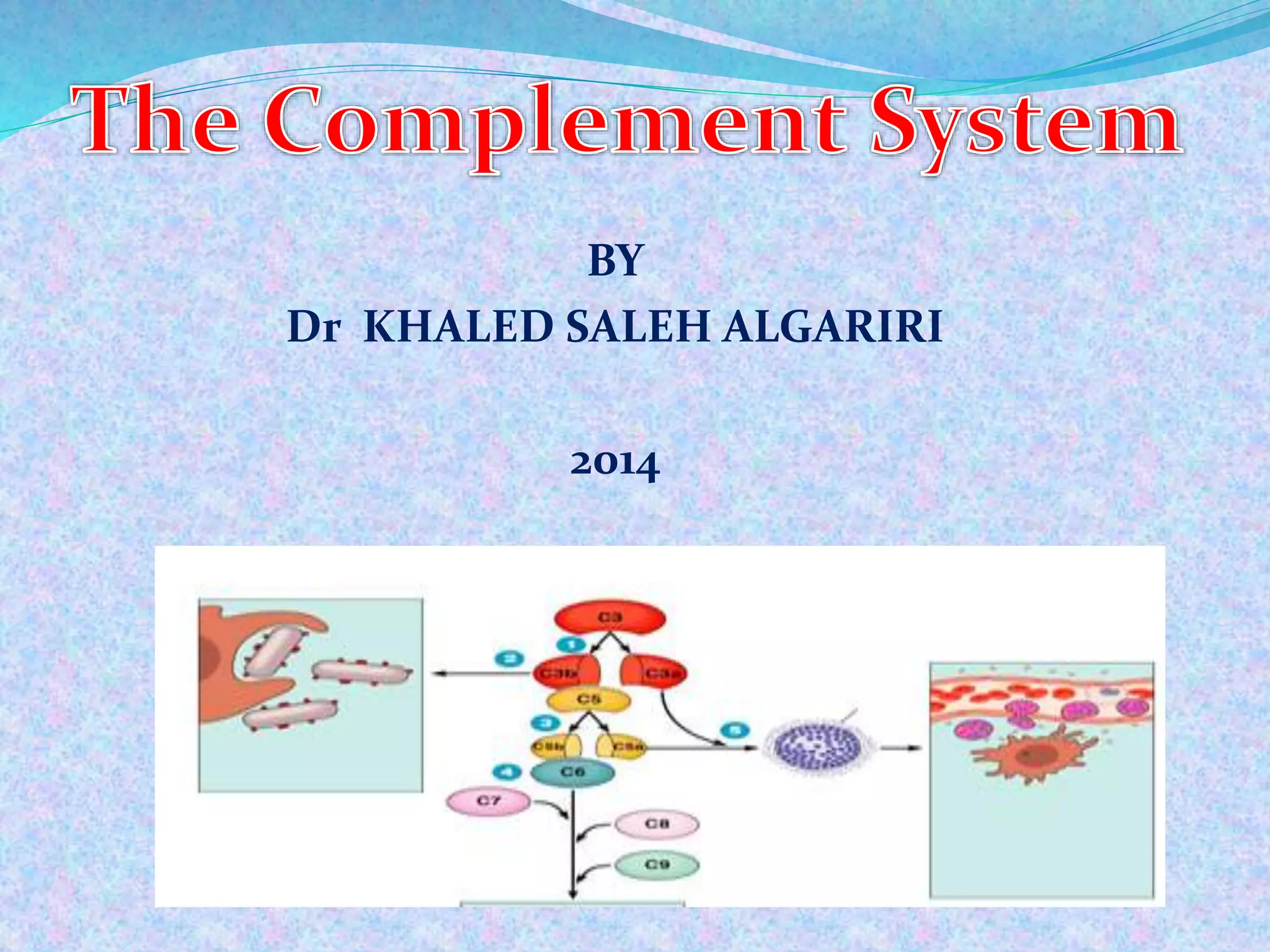
 The complement works as a cascade system.
 Cascade is when one reaction triggers another reaction
which trigger others and so on. These types of systems
can grow exponentially very fast.
Role of Complement in Disease
 The complement system plays a critical role in
inflammation and defence against some
bacterial infections.
 Complement may also be activated during reactions
against incompatible blood transfusions, and
during the damaging immune responses that
accompany autoimmune disease.
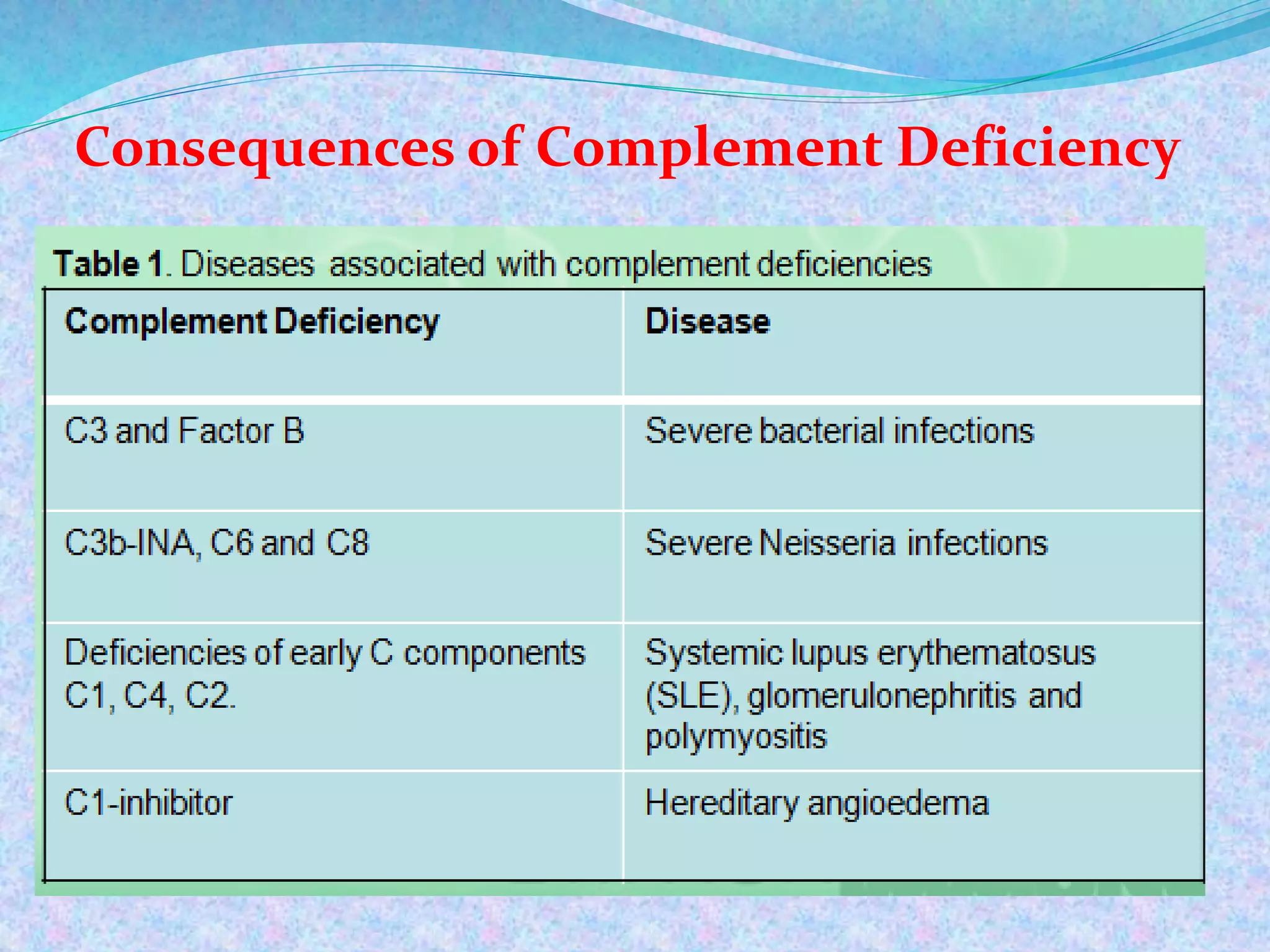
 Deficiencies of individual complement components
or inhibitors of the system can lead to a variety of
diseases
Cascade Activation
 Complement proteins are often designated by an
uppercase letter C and are inactive until they are split
into products.
 Example: C1
 When the products are split they become active. The
active products are usually designated with a lower
case a or b.
 Example: C1a and C1b
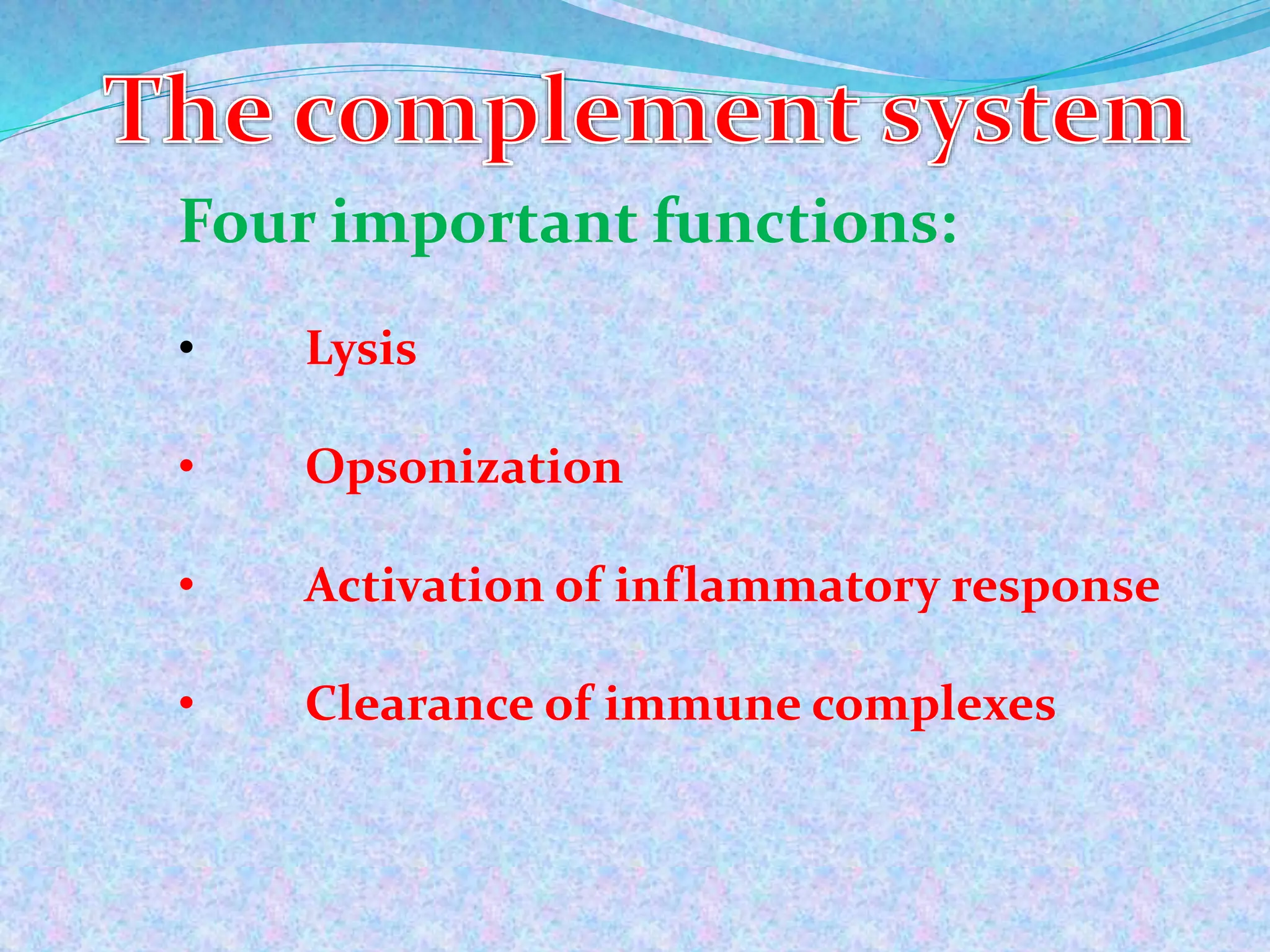
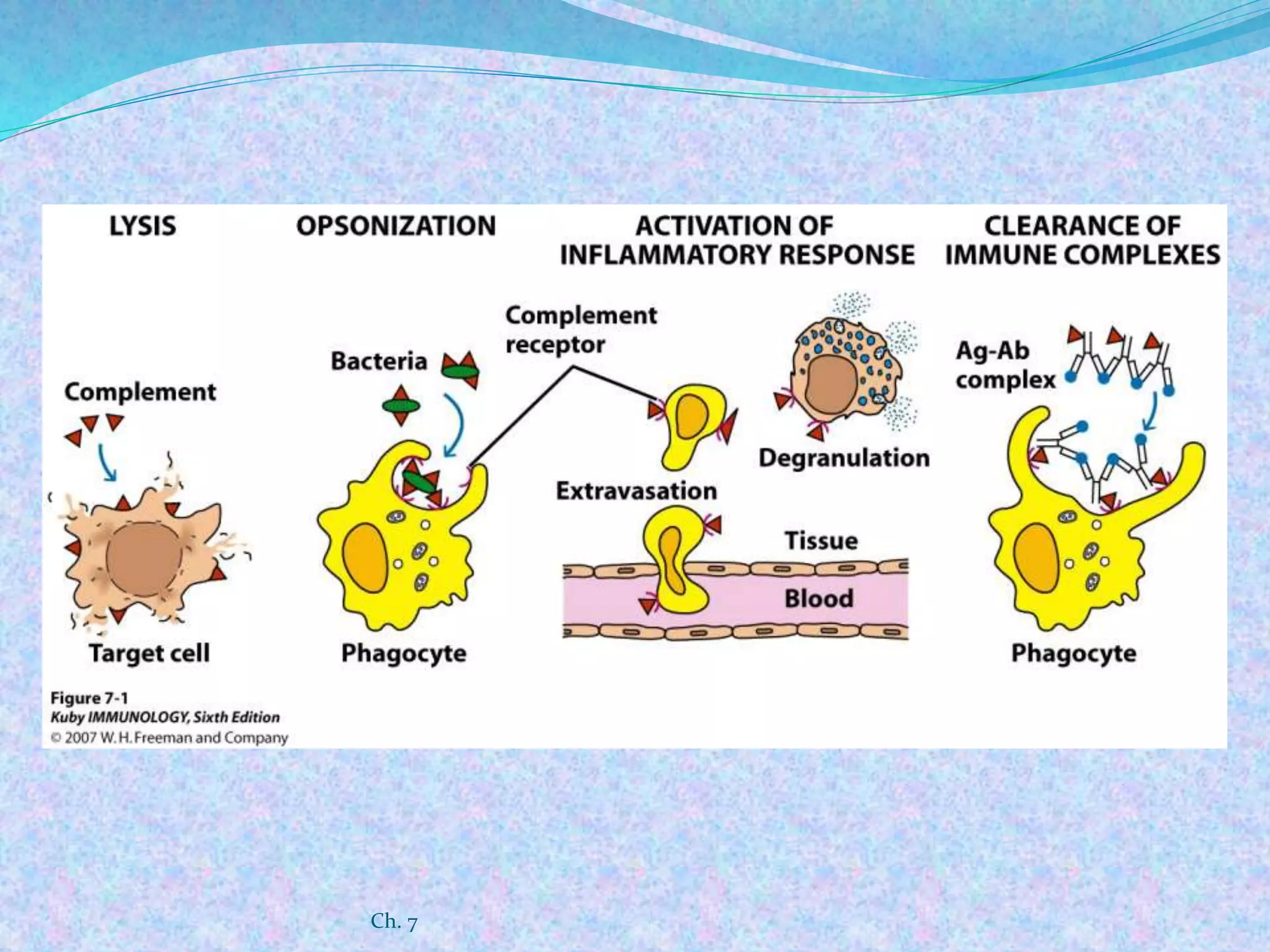
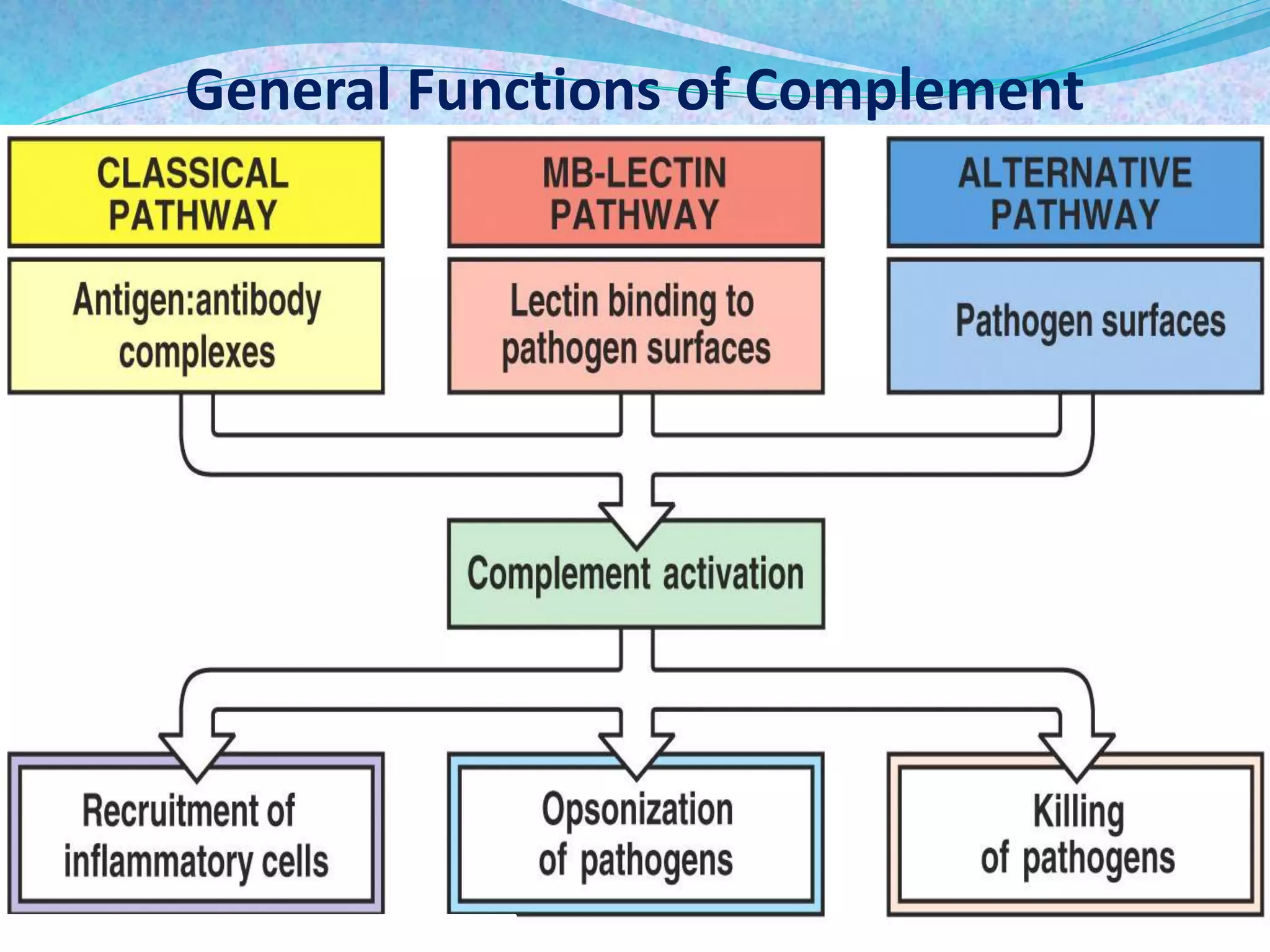
Four important functions:
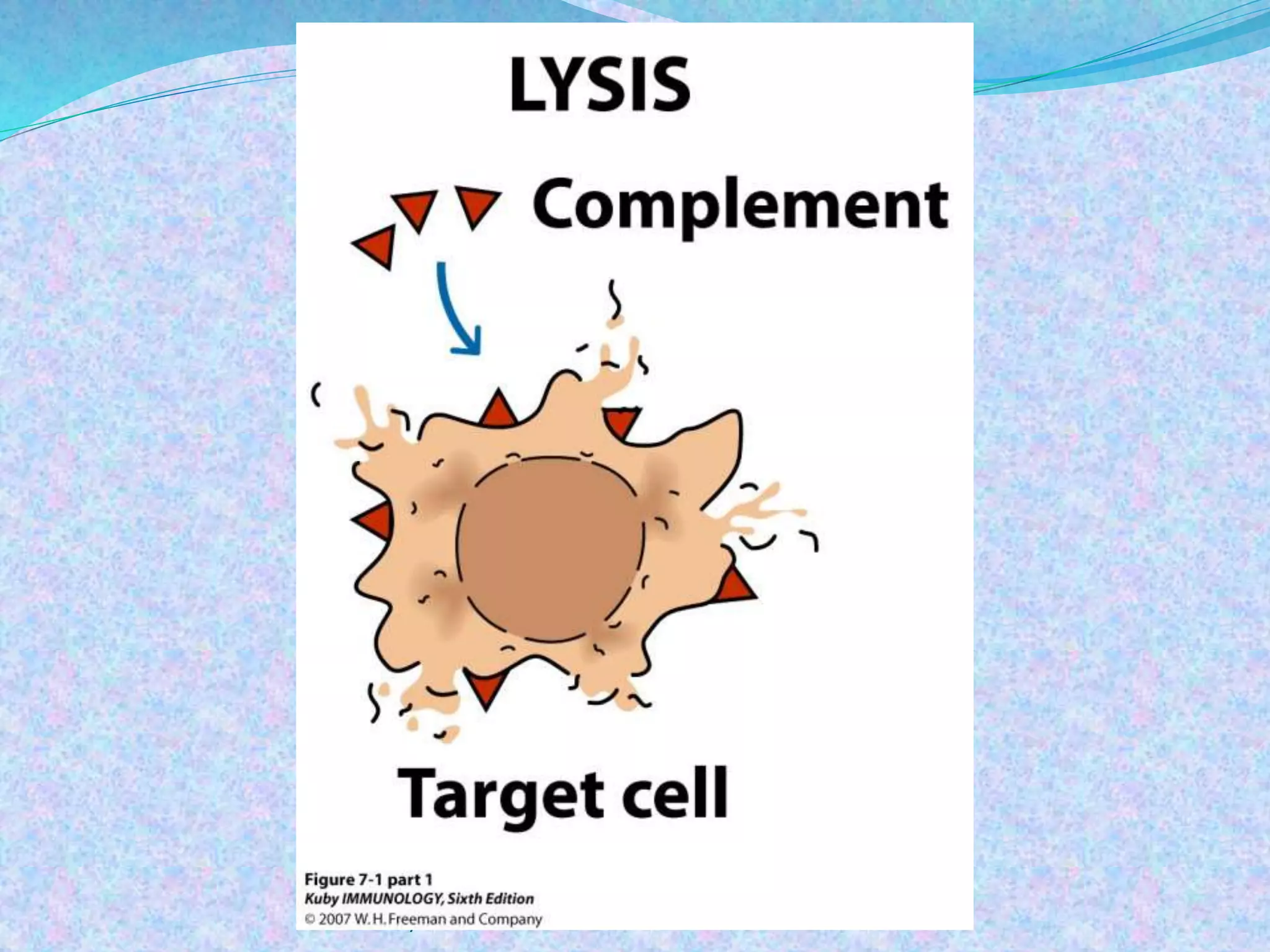
• Lysis
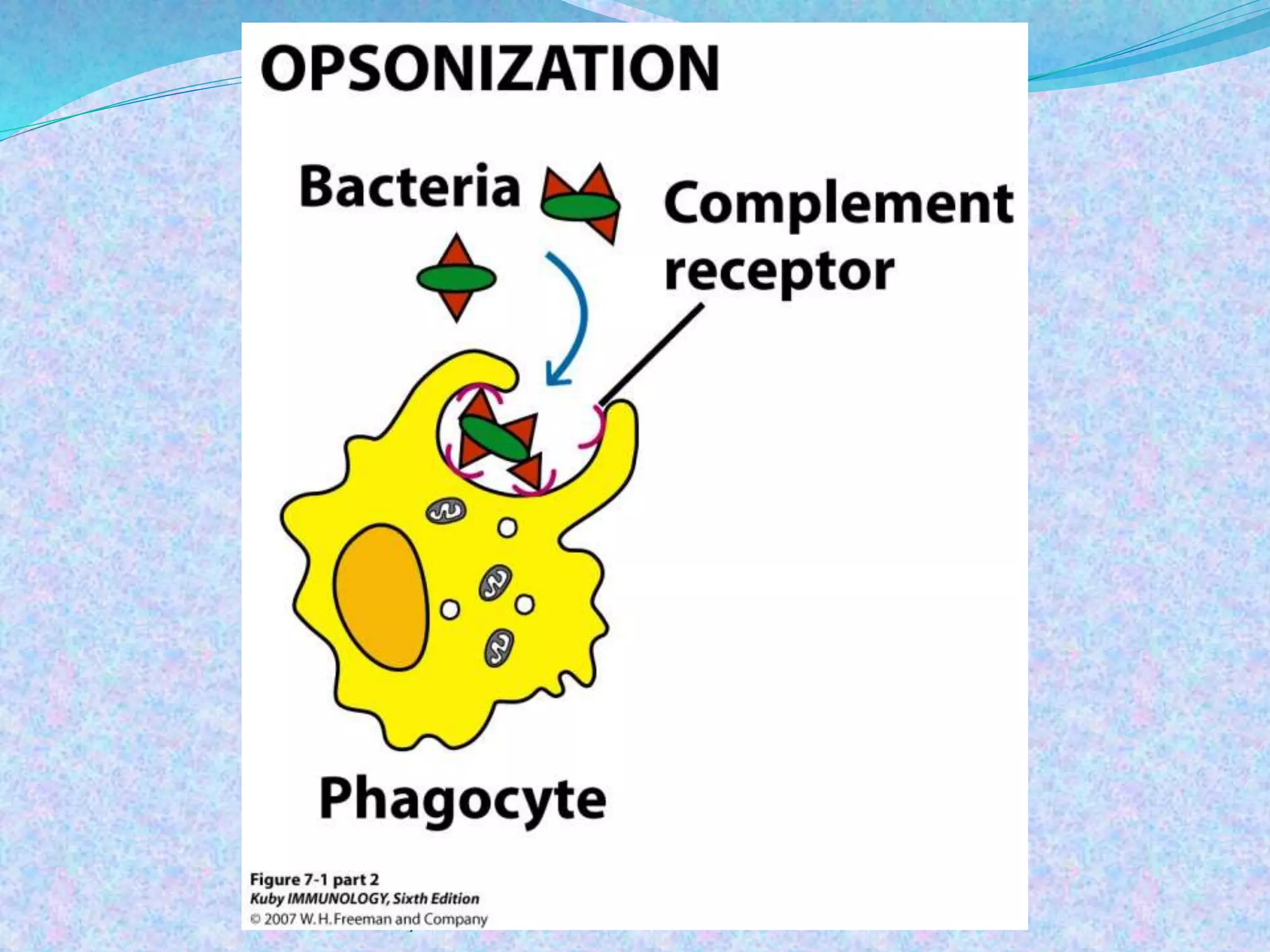
• Opsonization
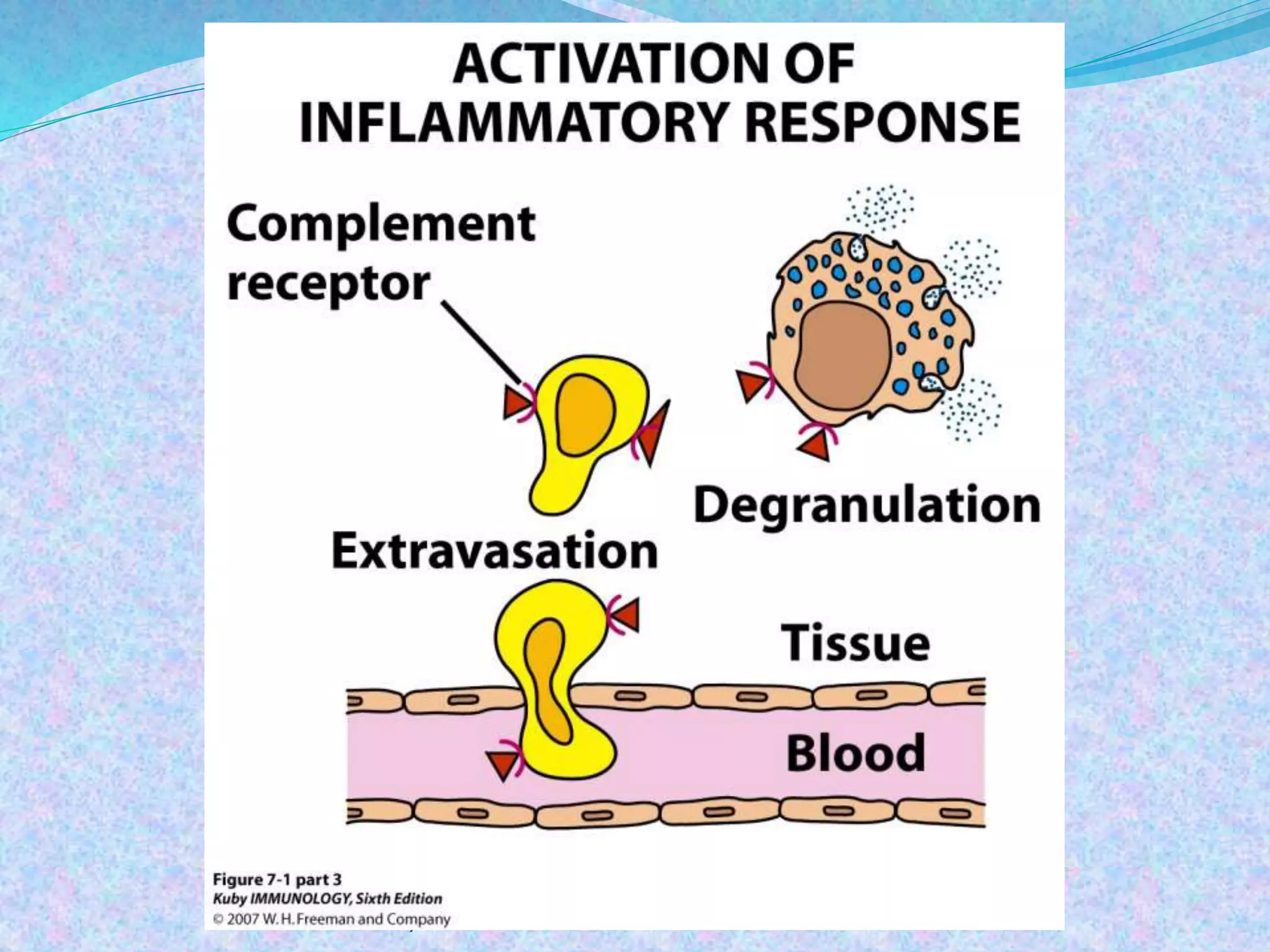
• Activation of inflammatory response
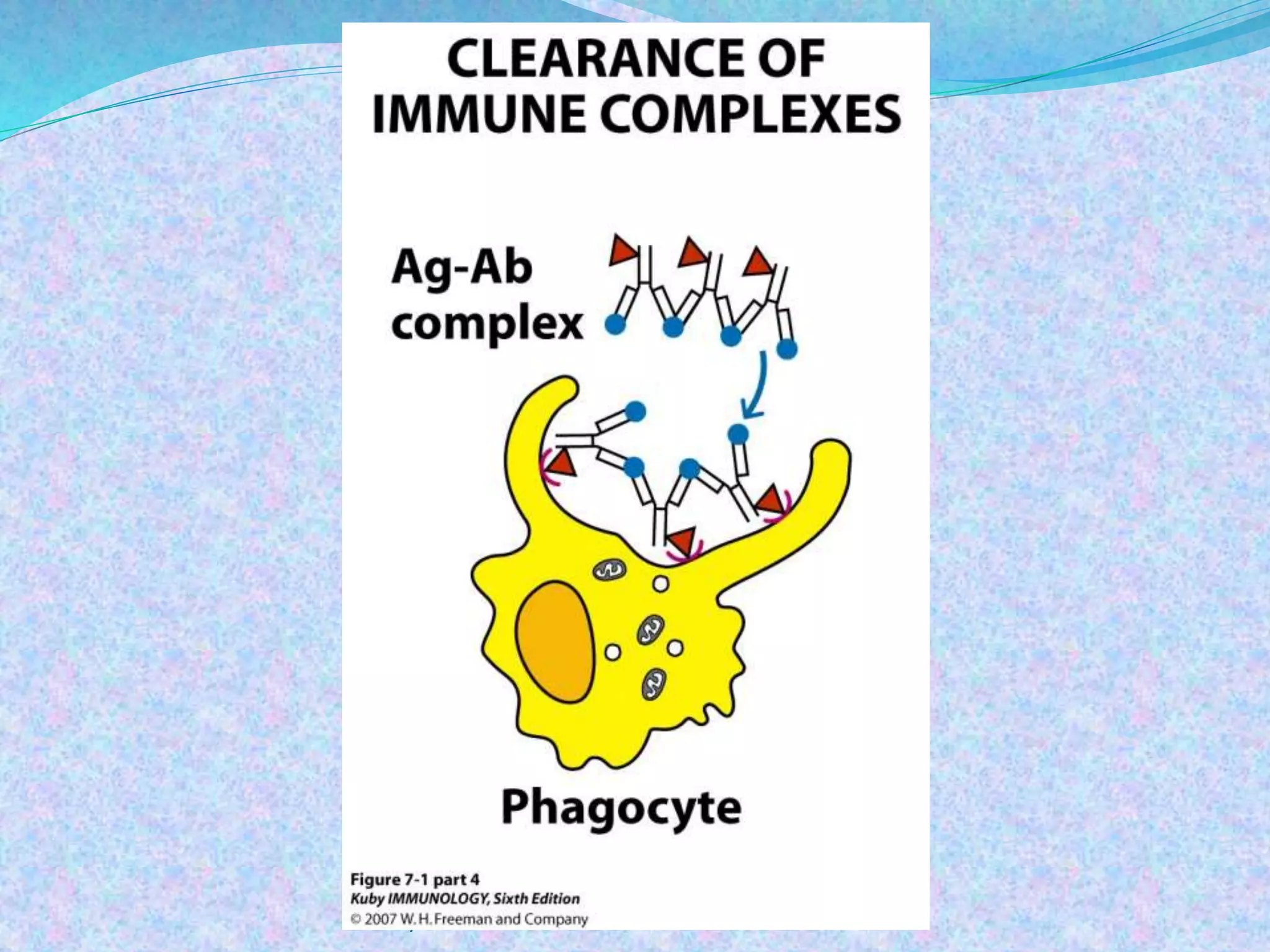
• Clearance of immune complexes
Ch. 7
Ch. 7
Ch. 7
Ch. 7
Ch. 7
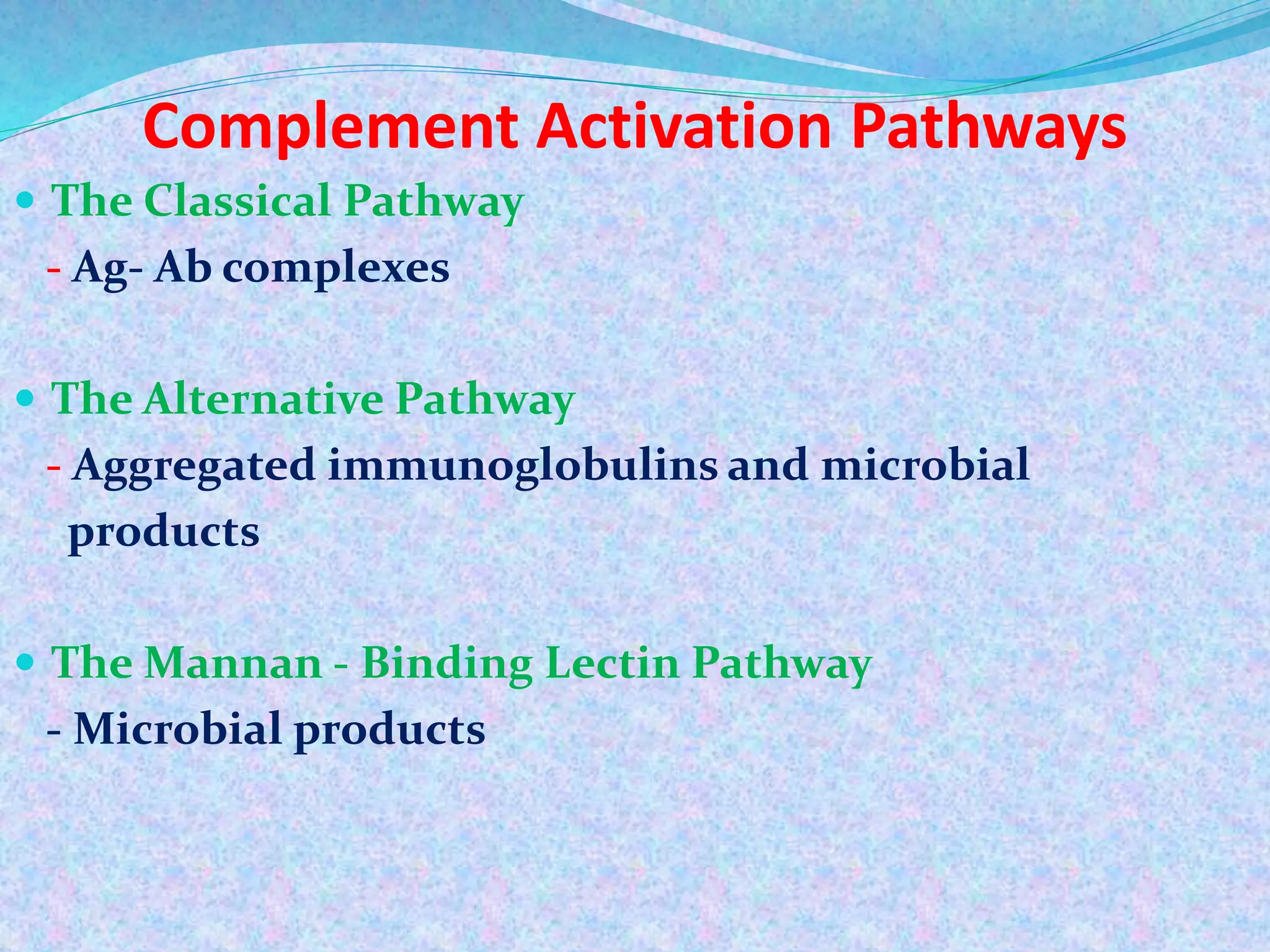
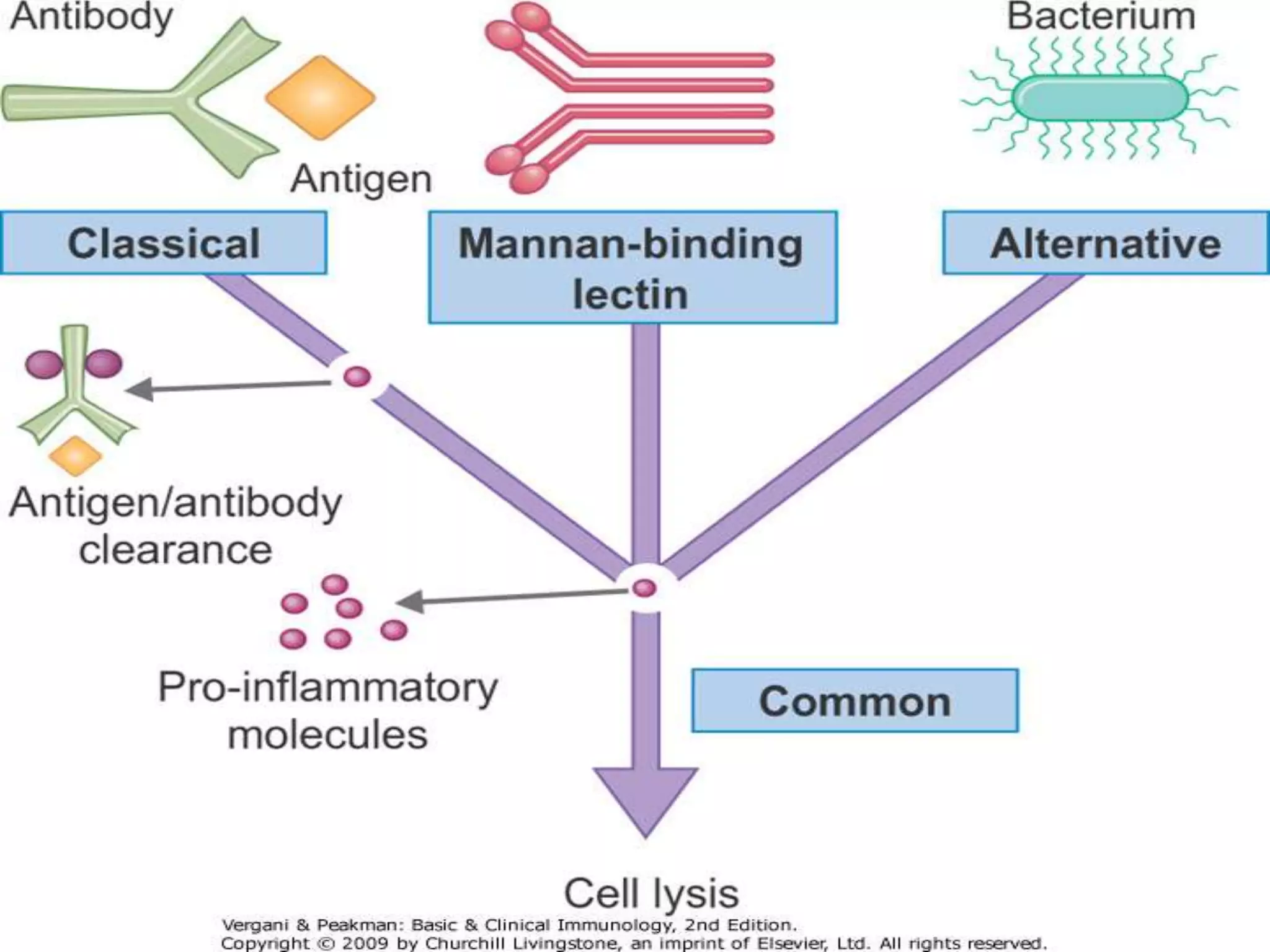
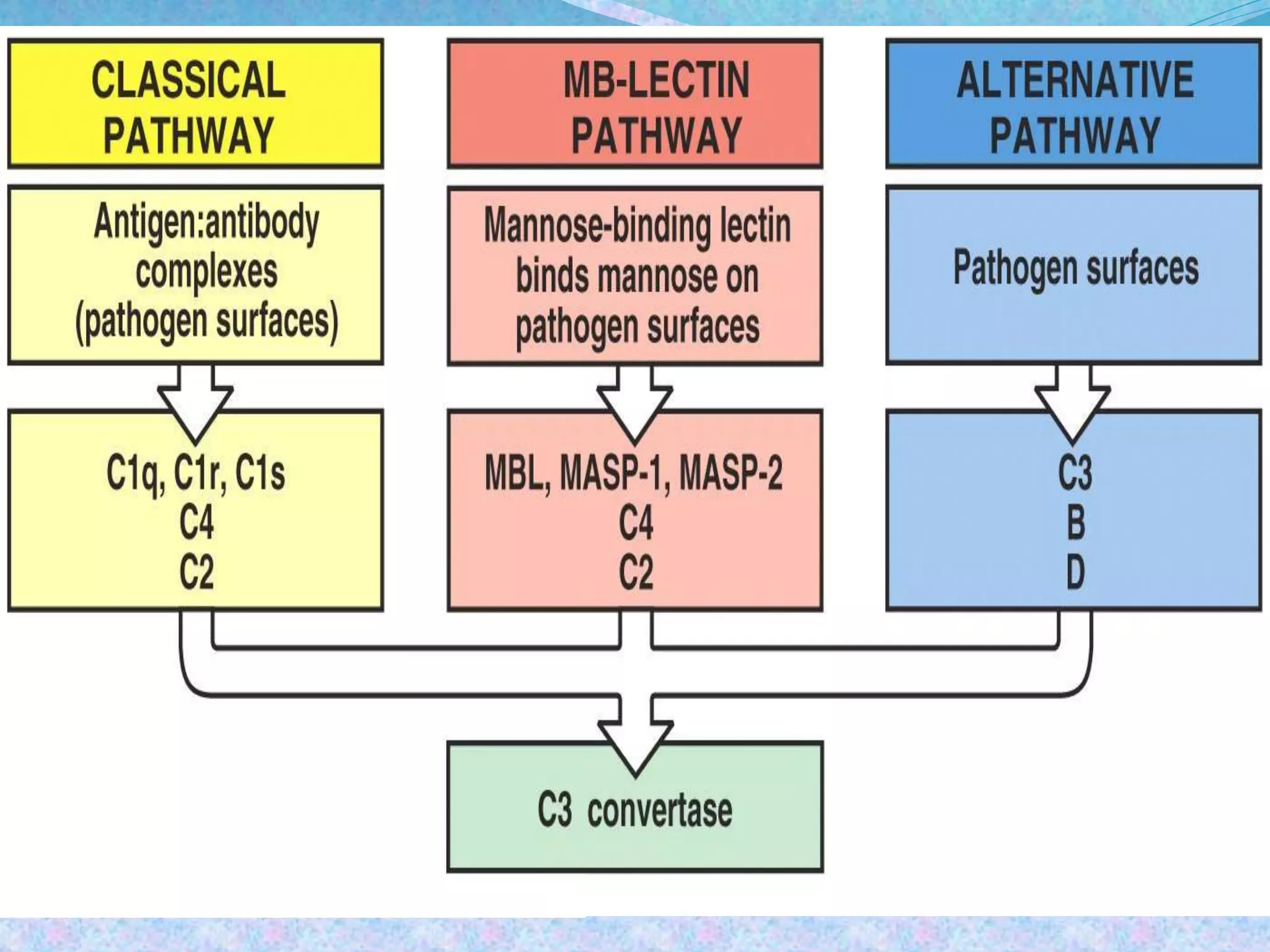
Complement Activation Pathways
 The Classical Pathway
- Ag- Ab complexes
 The Alternative Pathway
- Aggregated immunoglobulins and microbial
products
 The Mannan - Binding Lectin Pathway
- Microbial products
The Classical Pathway
 Activators: Ag – Ab complexes
 Antibodies involved: IgG and IgM
 Activation in an orderly fashion of nine major protein
components; C1 – C9
 Products of activation are enzymes that catalyze the
subsequent step
The Classical Pathway
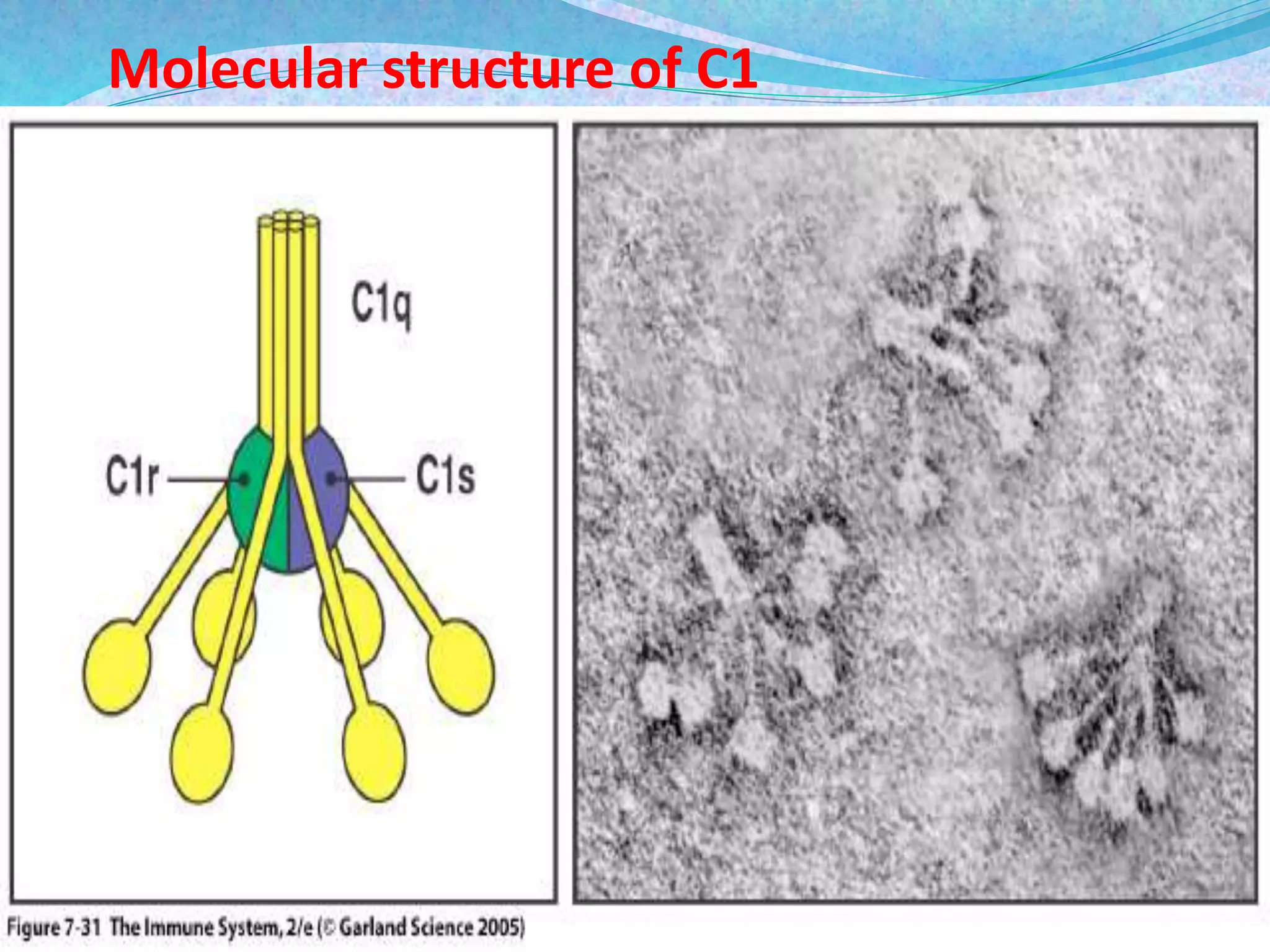
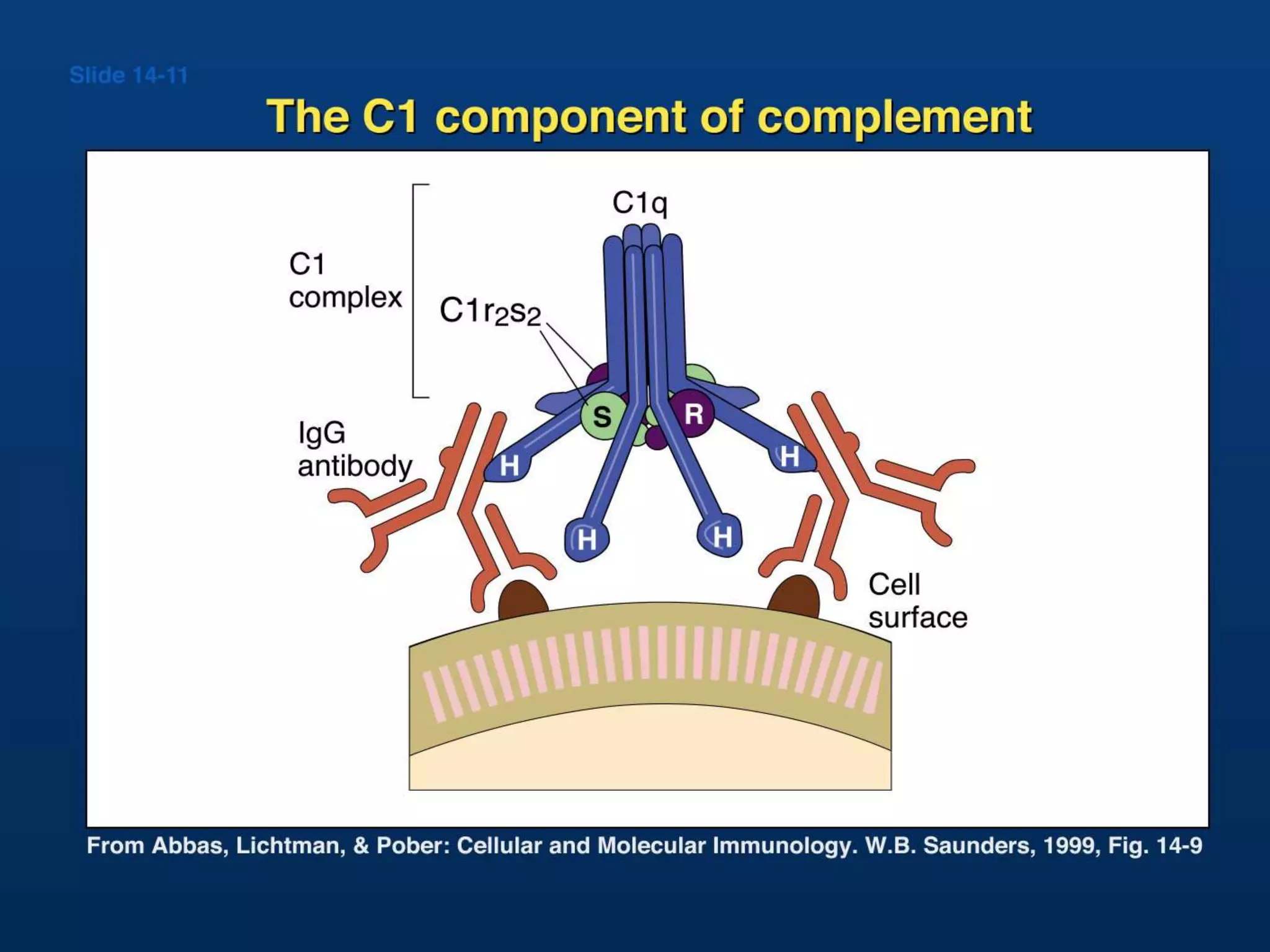
 Activation of C1:
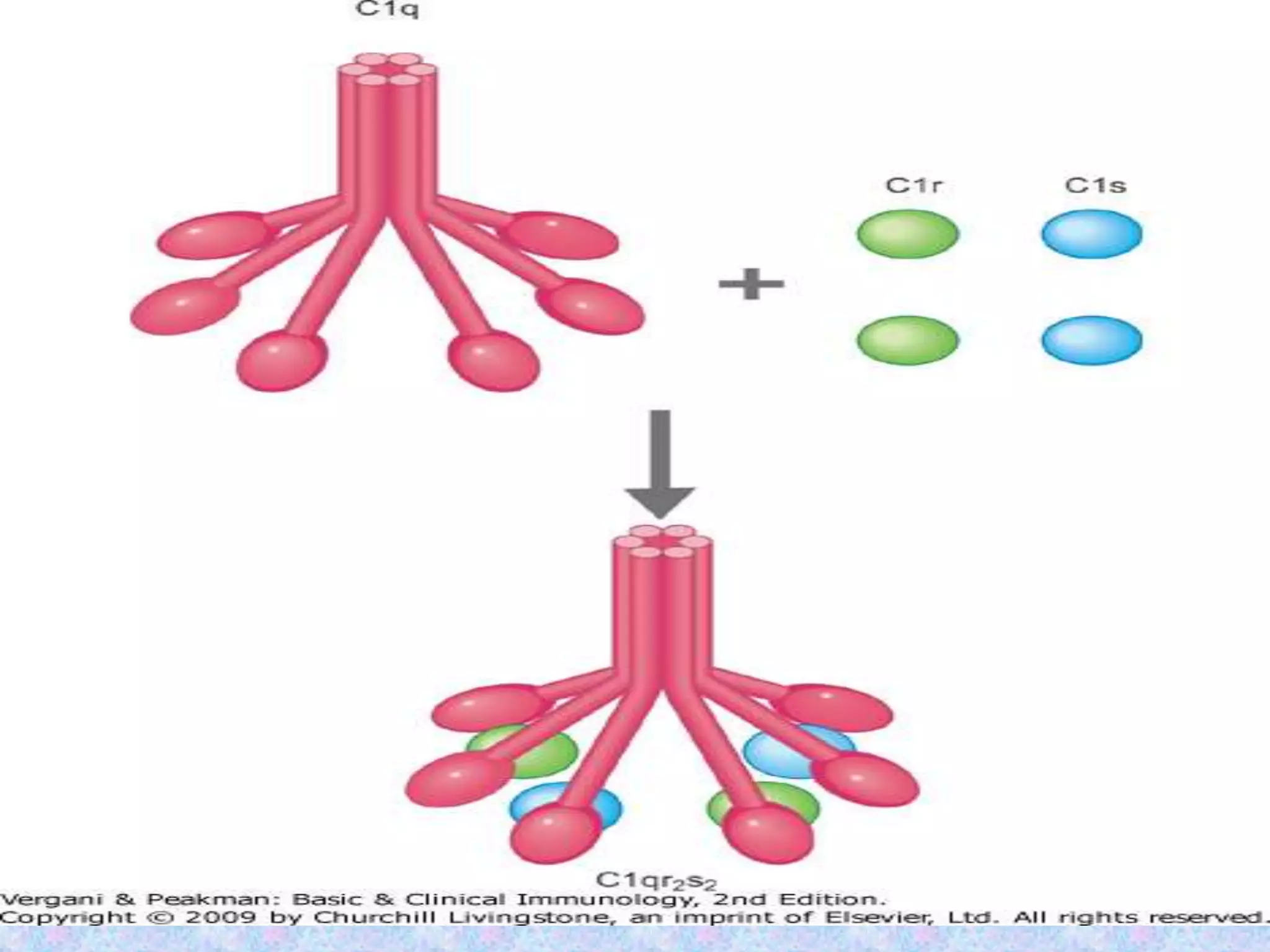
 C1 consists of C1q (400.000 Daltons), C1r (95000
Daltons), and C1s (85000 Daltons)
 Subunits are held together by Calcium ions
 C1q is a polymer of 6 identical units
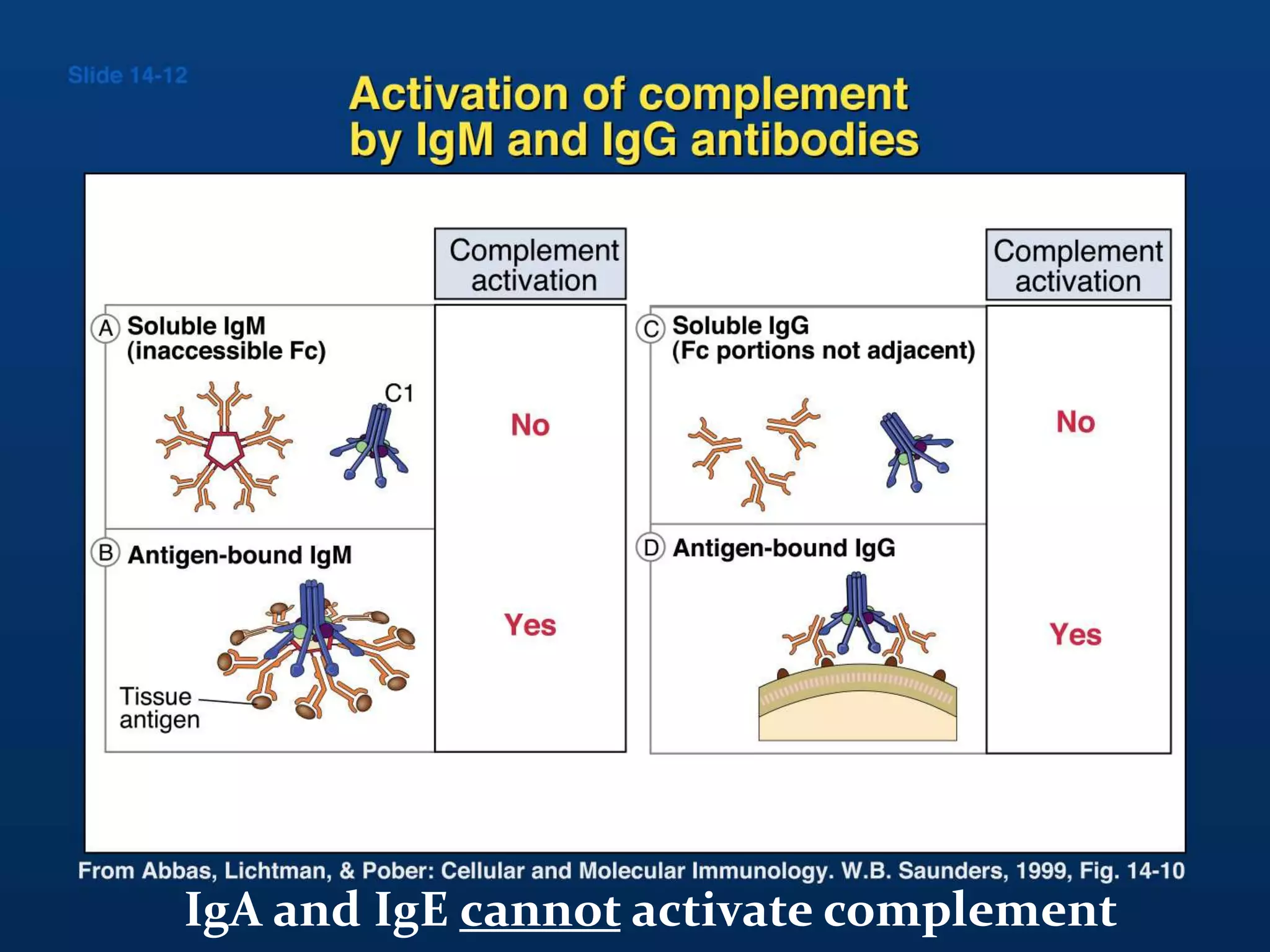
 C1q activation requires binding to a c1q- specific receptor
on the FC region of at least 2 adjacent molecules of IgG
or a single molecule of IgM, a reaction that requires
Calcium ions
Molecular structure of C1
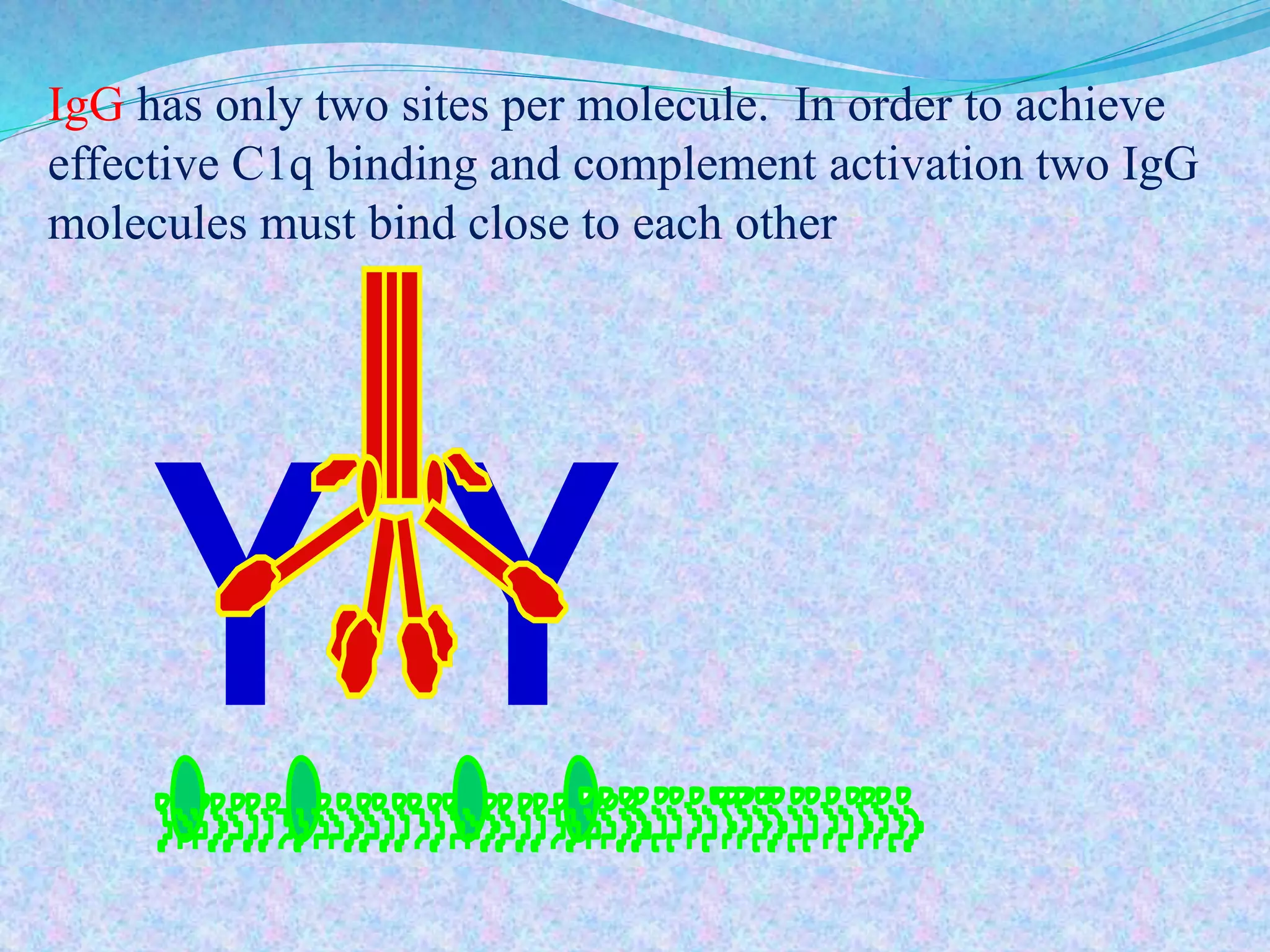
Y Y
IgG has only two sites per molecule. In order to achieve
effective C1q binding and complement activation two IgG
molecules must bind close to each other
IgA and IgE cannot activate complement
The Classical Pathway
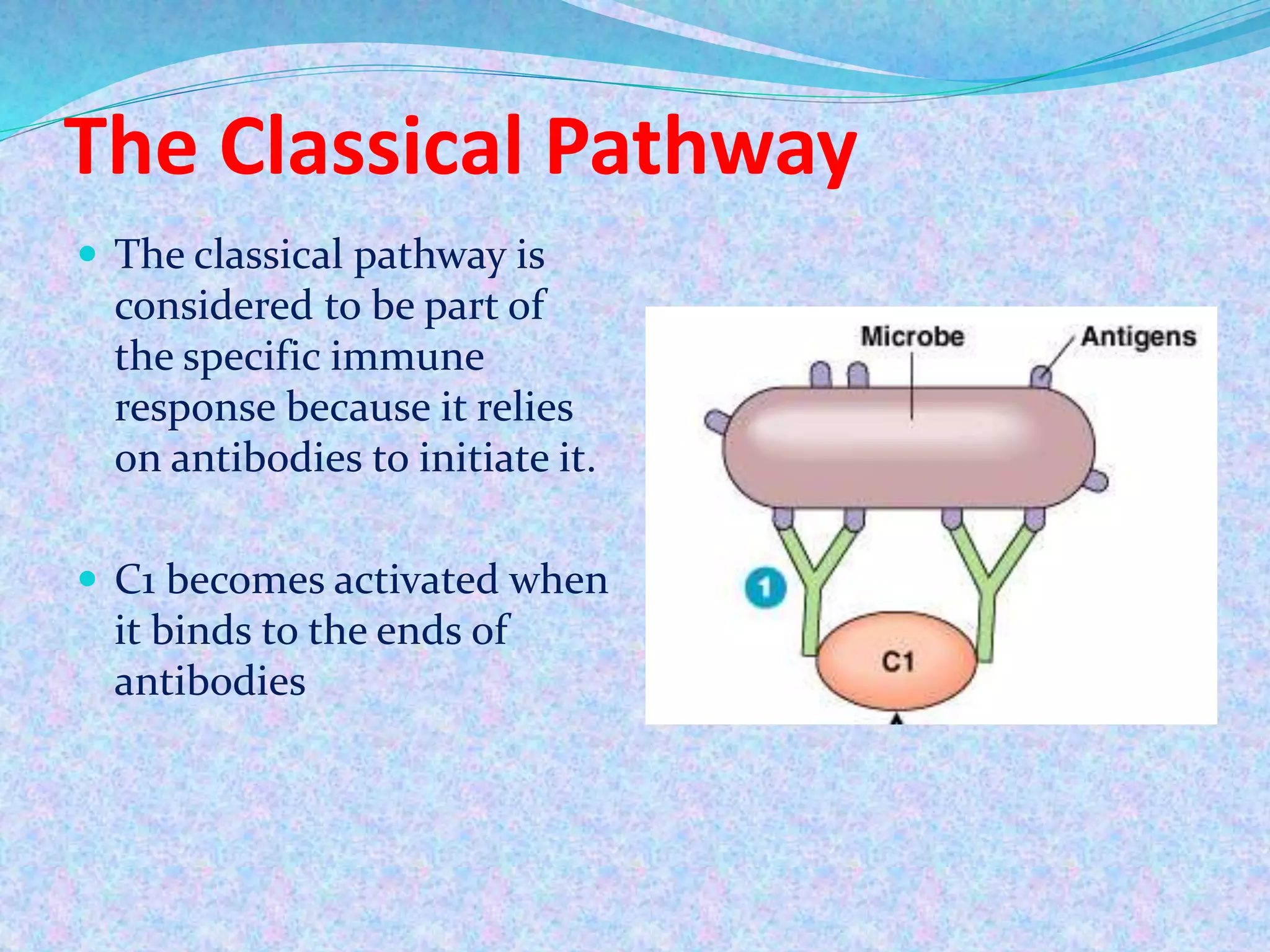
 The classical pathway is
considered to be part of
the specific immune
response because it relies
on antibodies to initiate it.
 C1 becomes activated when
it binds to the ends of
antibodies
The Building of a C3 Activation Complex
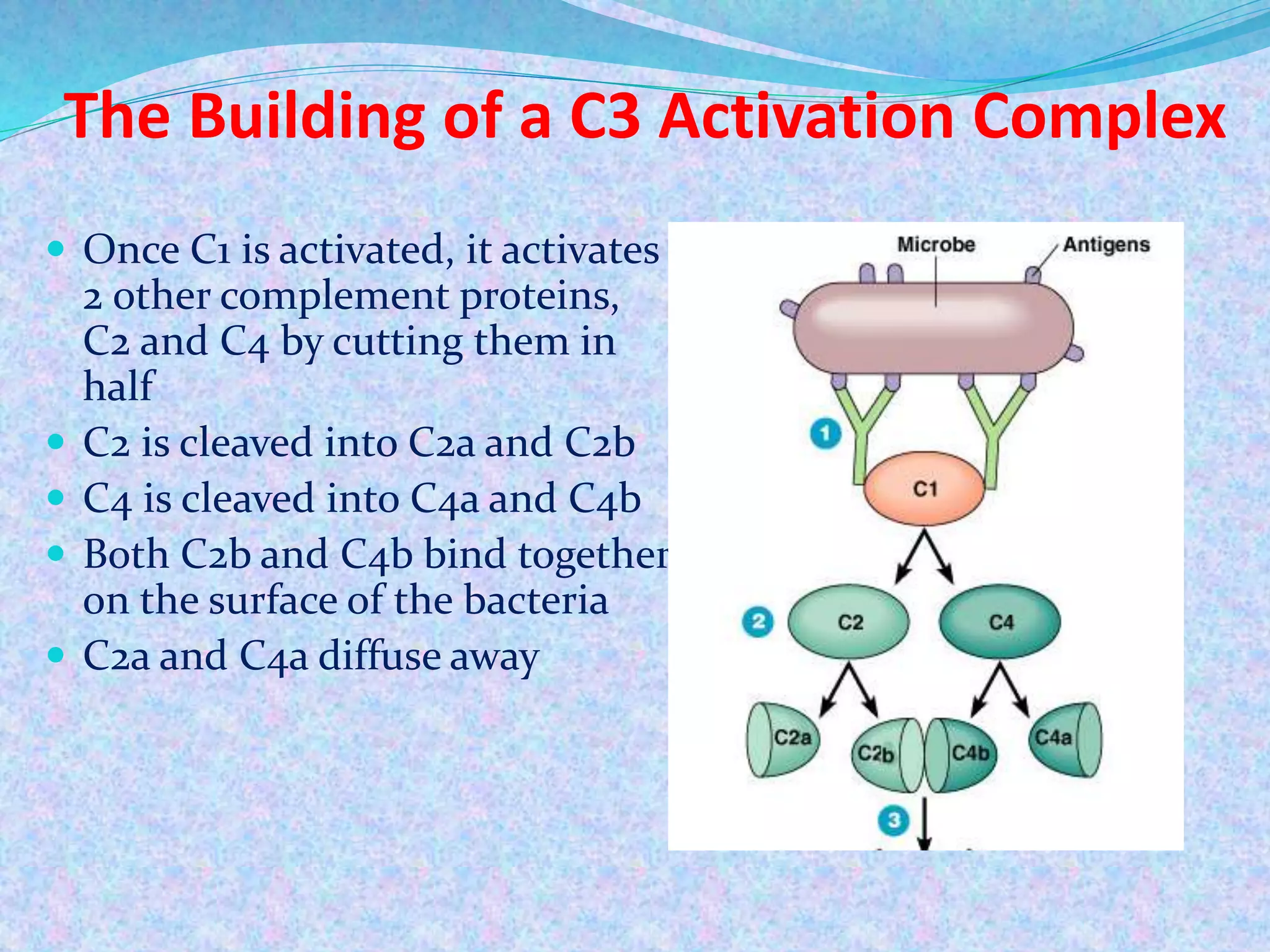
 Once C1 is activated, it activates
2 other complement proteins,
C2 and C4 by cutting them in
half
 C2 is cleaved into C2a and C2b
 C4 is cleaved into C4a and C4b
 Both C2b and C4b bind together
on the surface of the bacteria
 C2a and C4a diffuse away
C3 Activation Complex
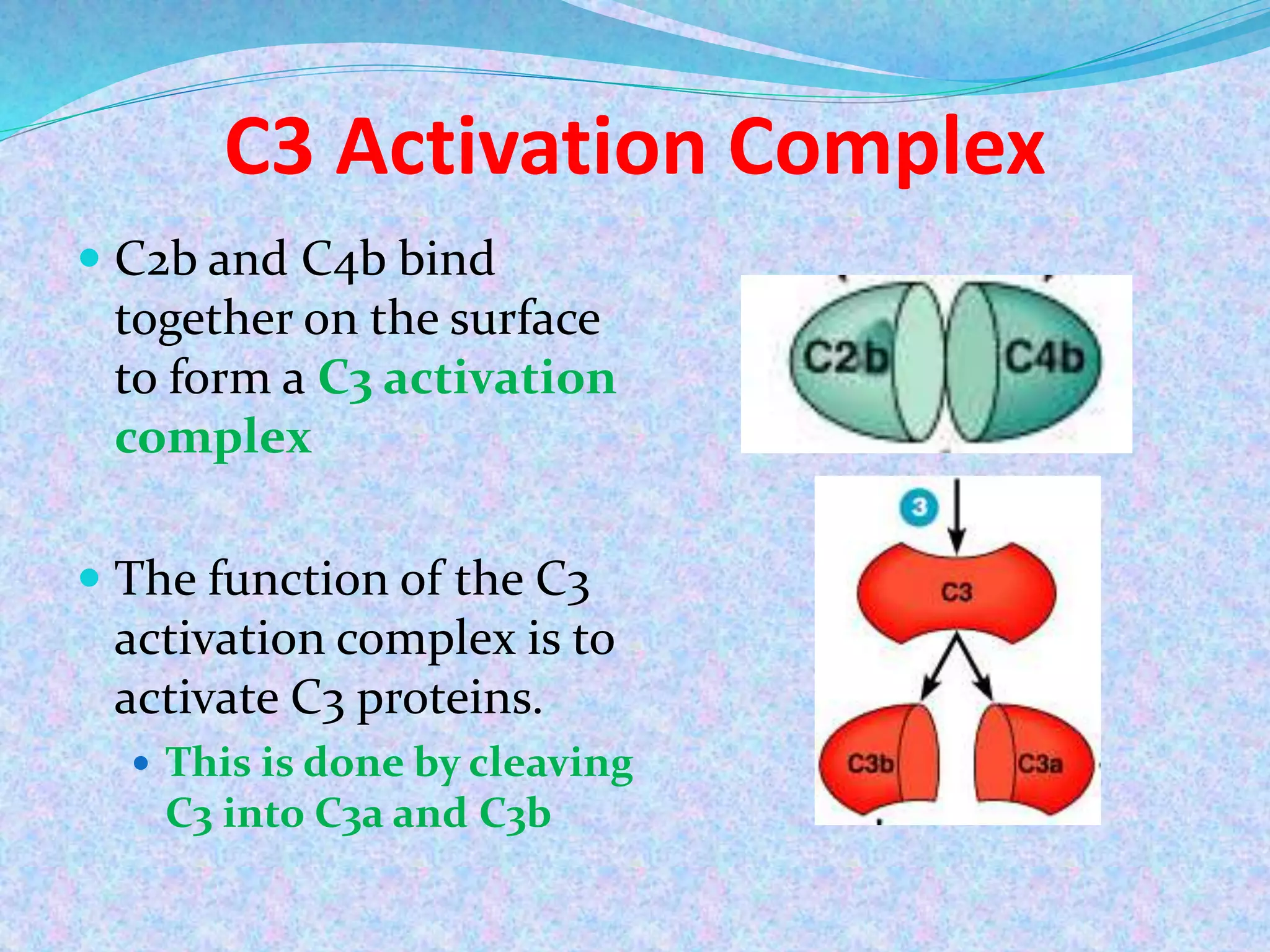
 C2b and C4b bind
together on the surface
to form a C3 activation
complex
 The function of the C3
activation complex is to
activate C3 proteins.
 This is done by cleaving
C3 into C3a and C3b
C3b
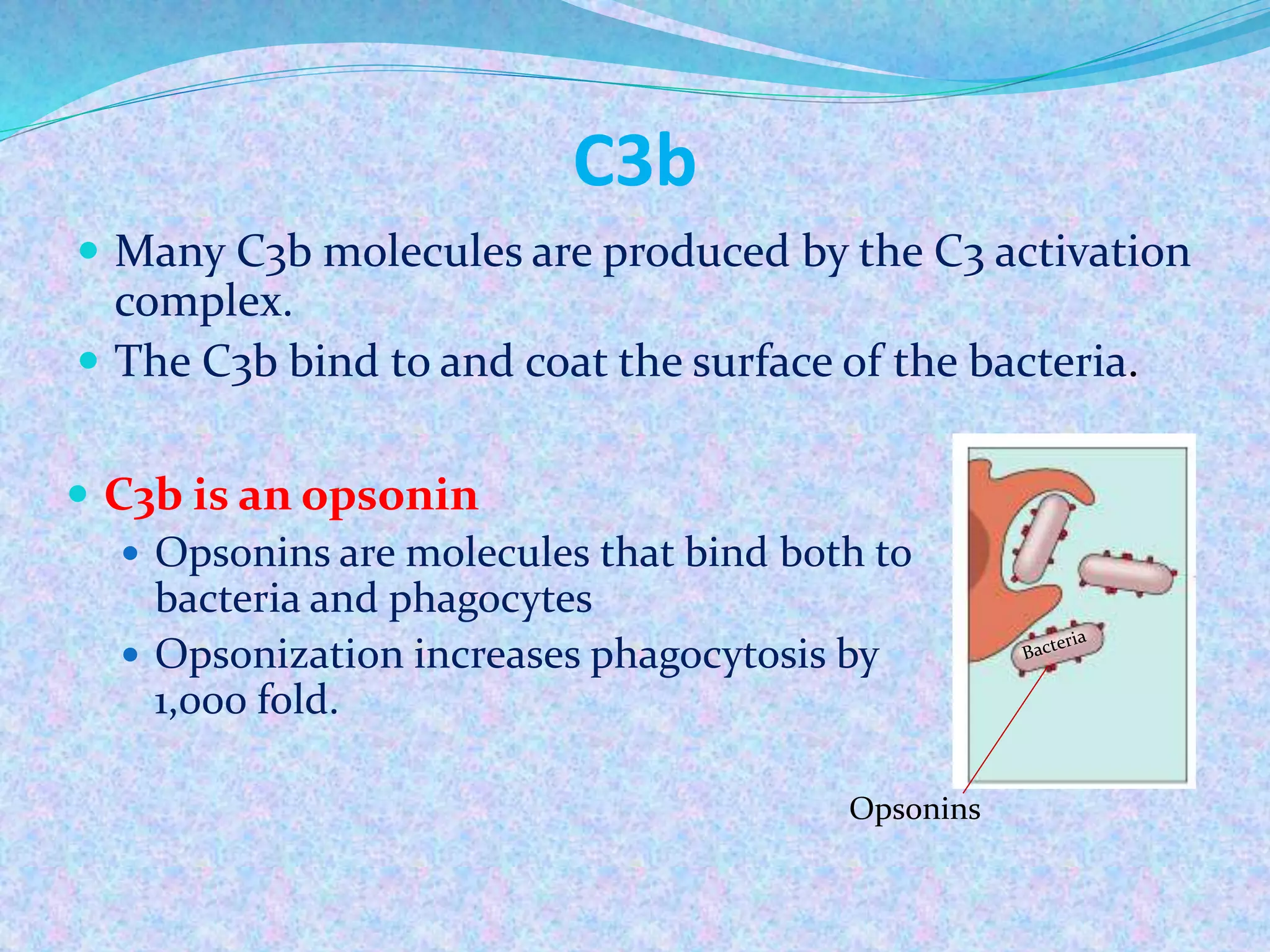
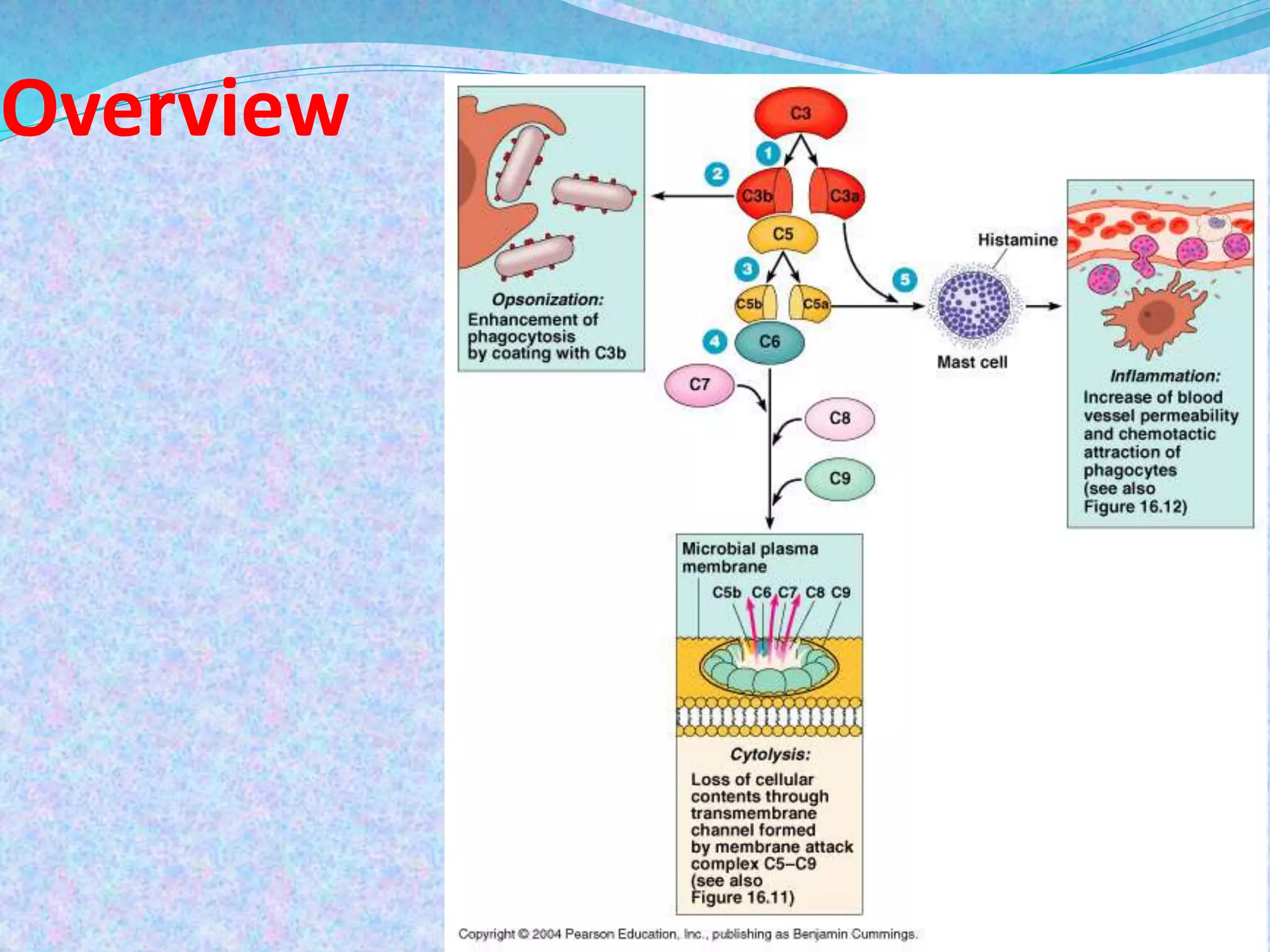
 Many C3b molecules are produced by the C3 activation
complex.
 The C3b bind to and coat the surface of the bacteria.
 C3b is an opsonin
 Opsonins are molecules that bind both to
bacteria and phagocytes
 Opsonization increases phagocytosis by
1,000 fold.
Opsonins
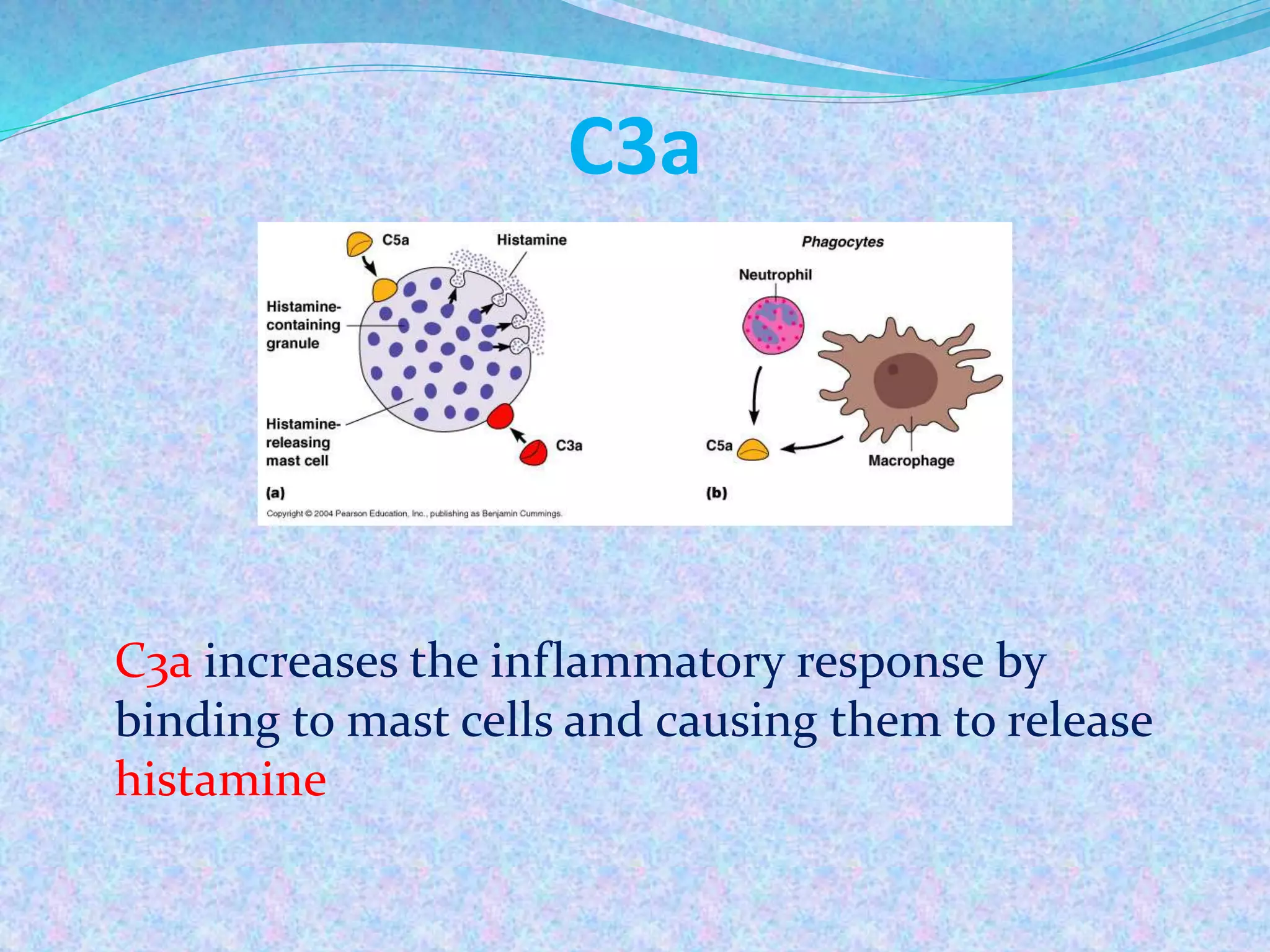
C3a
C3a increases the inflammatory response by
binding to mast cells and causing them to release
histamine
Building the C5 Activation Complex
 Eventially enough C3b is cleaved that the surface of the
bacteria begins to become saturated with it.
 C2b and C4b which make up the C3 activation
complex has a slight affinity for C3b and C3b binds to
them
 When C3b binds to C2b and C4b it forms a new
complex referred to as the C5 activation complex
The C5 Activation Complex
 The C5 activation complex (C2b, C4b, C3b) activates
C5 proteins by cleaving them into C5a and C5b
 Many C5b proteins are produced by the C5activation
complex. These C5b begin to coat the surface of the
bacteria.
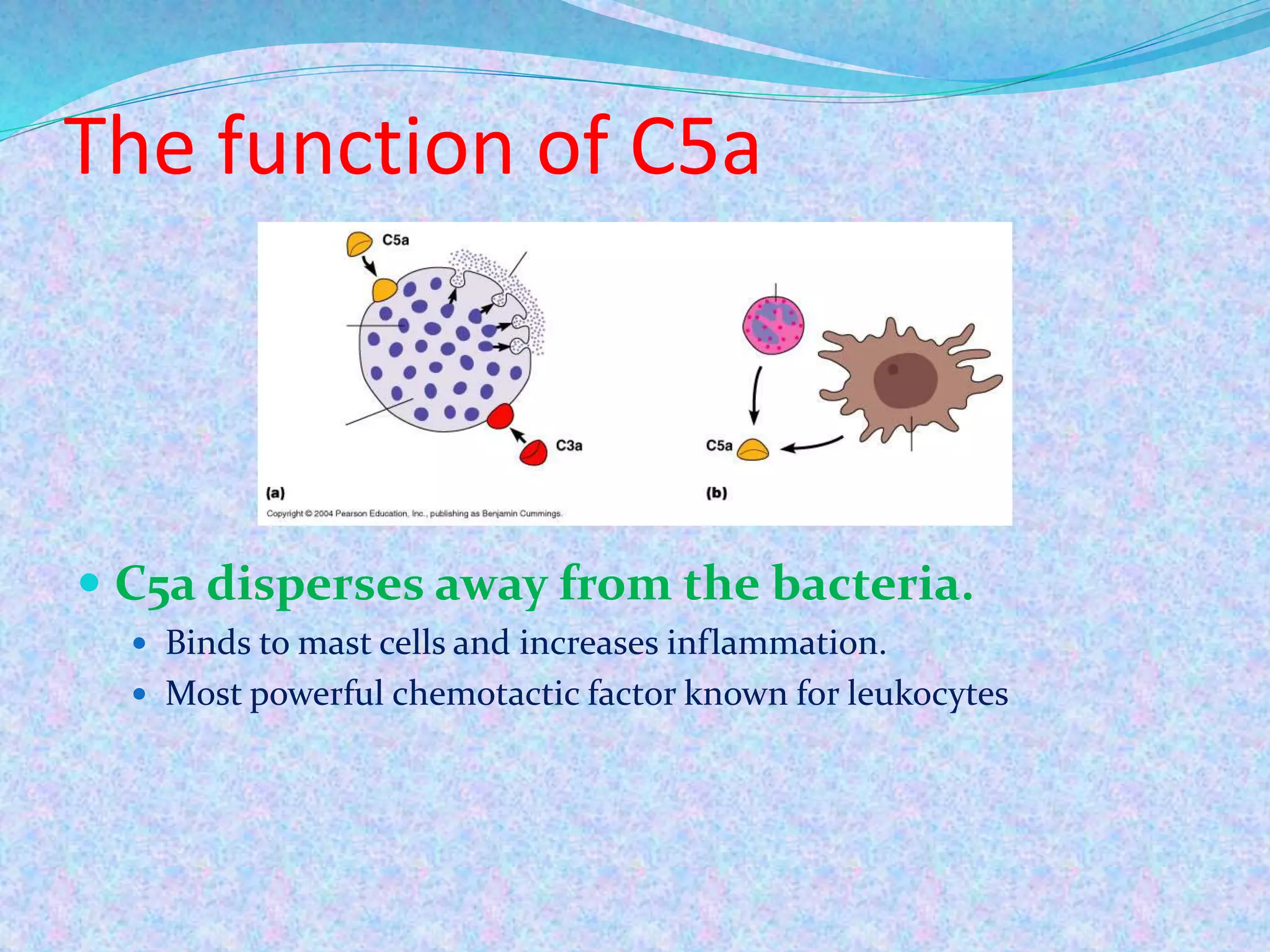
The function of C5a
 C5a disperses away from the bacteria.
 Binds to mast cells and increases inflammation.
 Most powerful chemotactic factor known for leukocytes
Building the Membrane Attack Complex
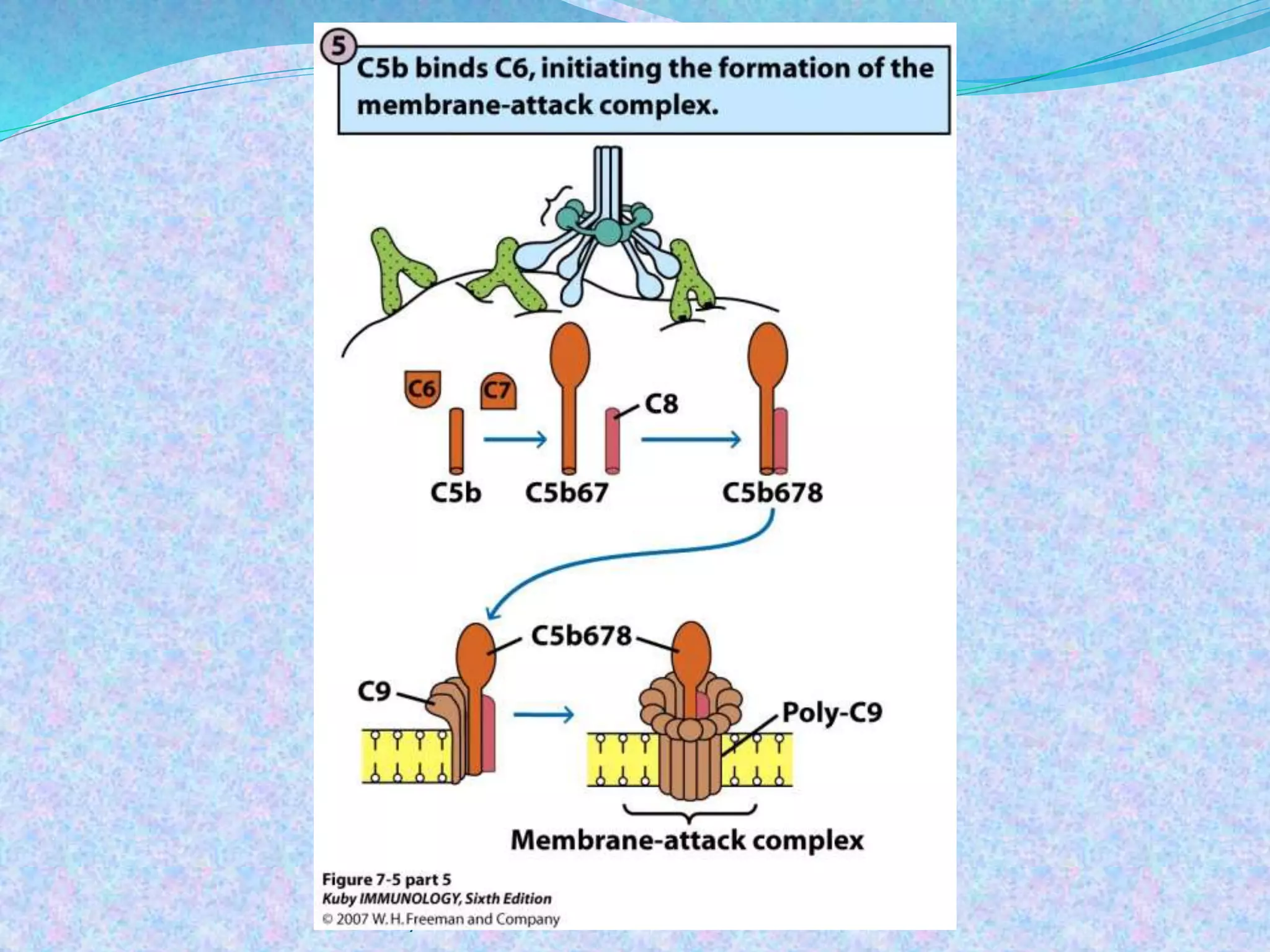
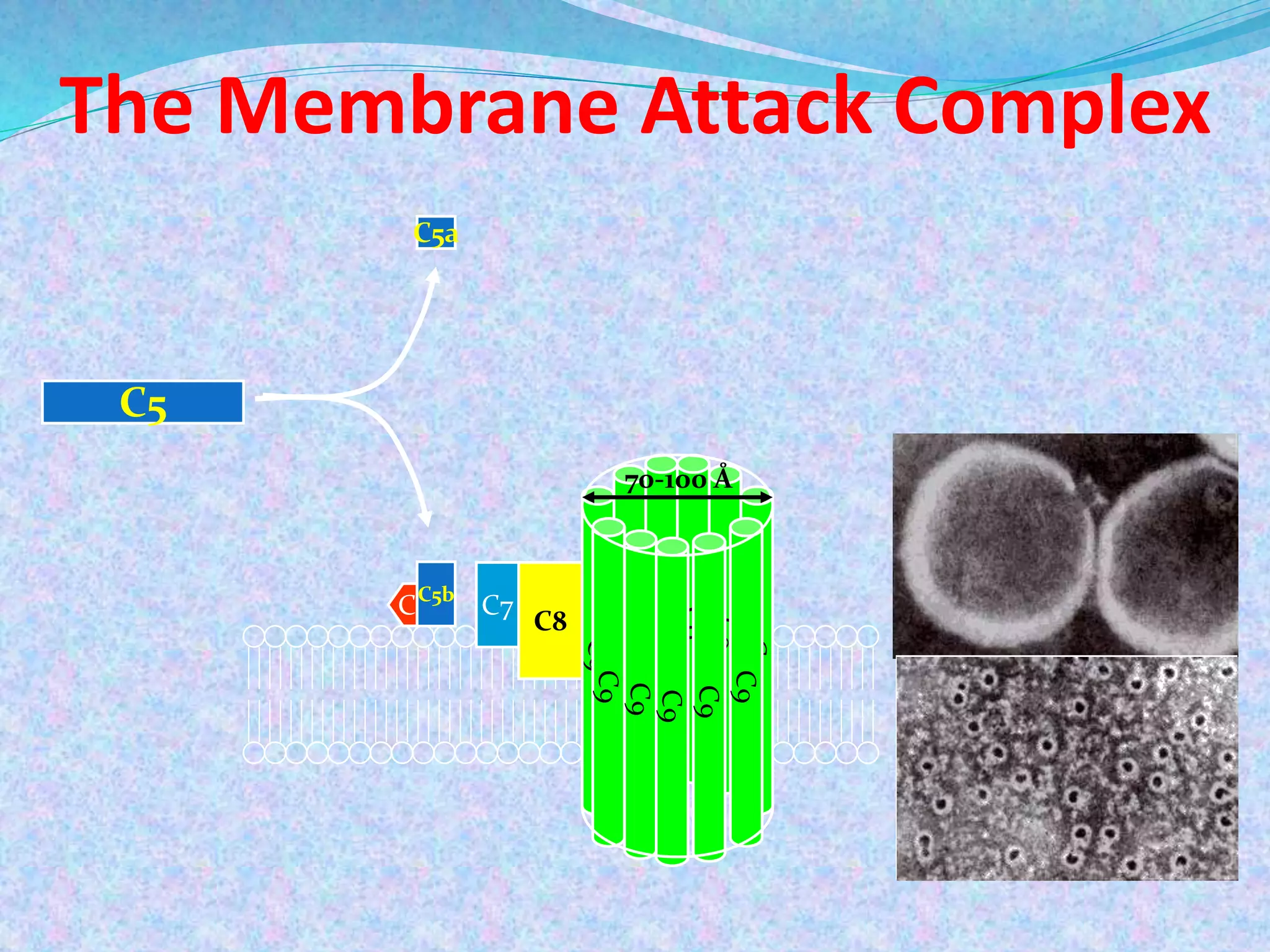
 C5b on the surface of bacteria binds to C6
 The binding of C6 to C5b activates C6 so that it can
bind to C7
 C7 binds to C8 which in turn binds to many C9’s
 Together these proteins form a circular complex called
the Membrane attack complex (MAC)
Ch. 7
The Membrane Attack Complex
C6 C7
C8 C9
C9
C9
C9
C9
C9C9
C9
C9
C9
C9
C5
C5b
C5a
70-100 Å
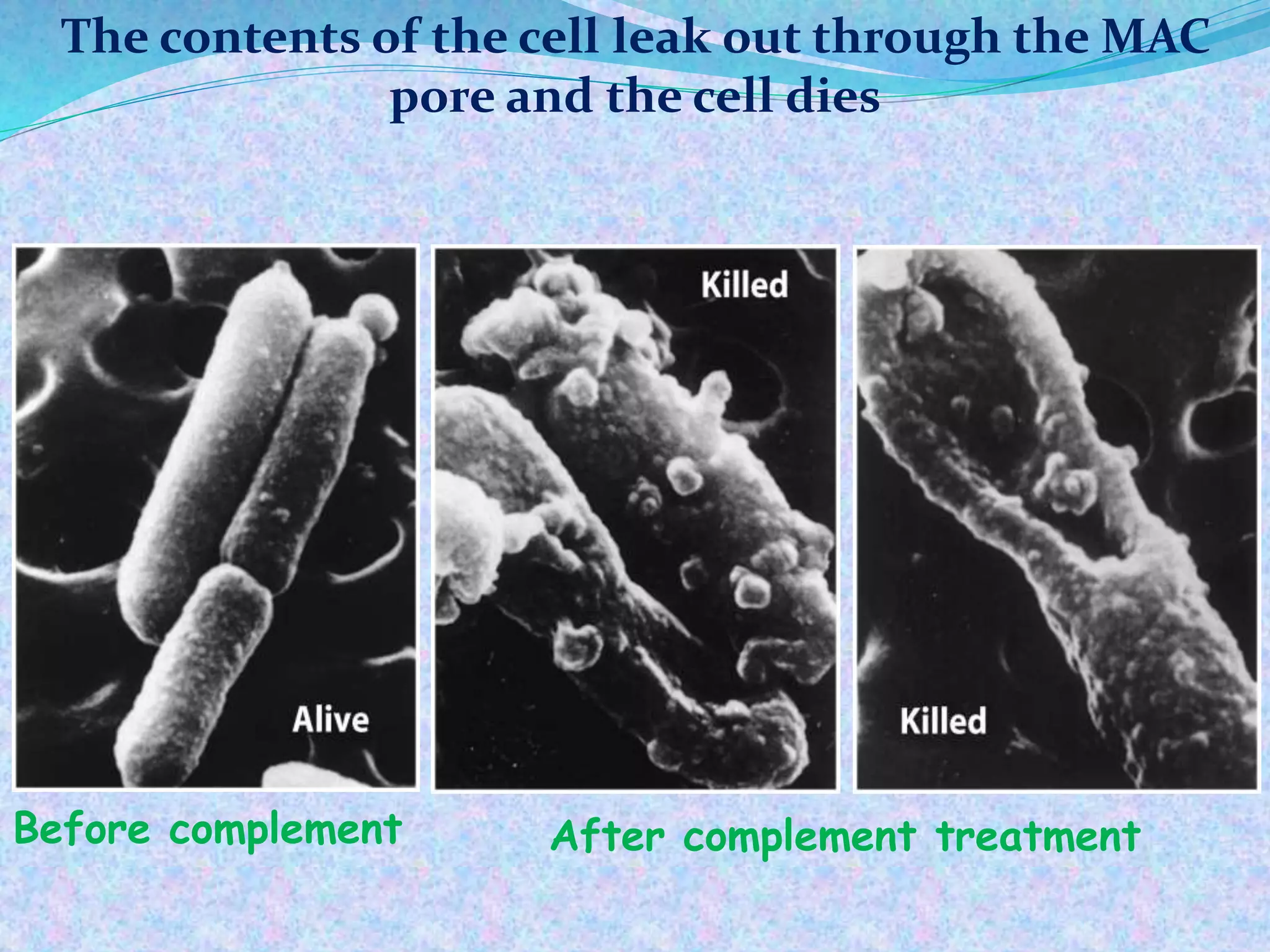
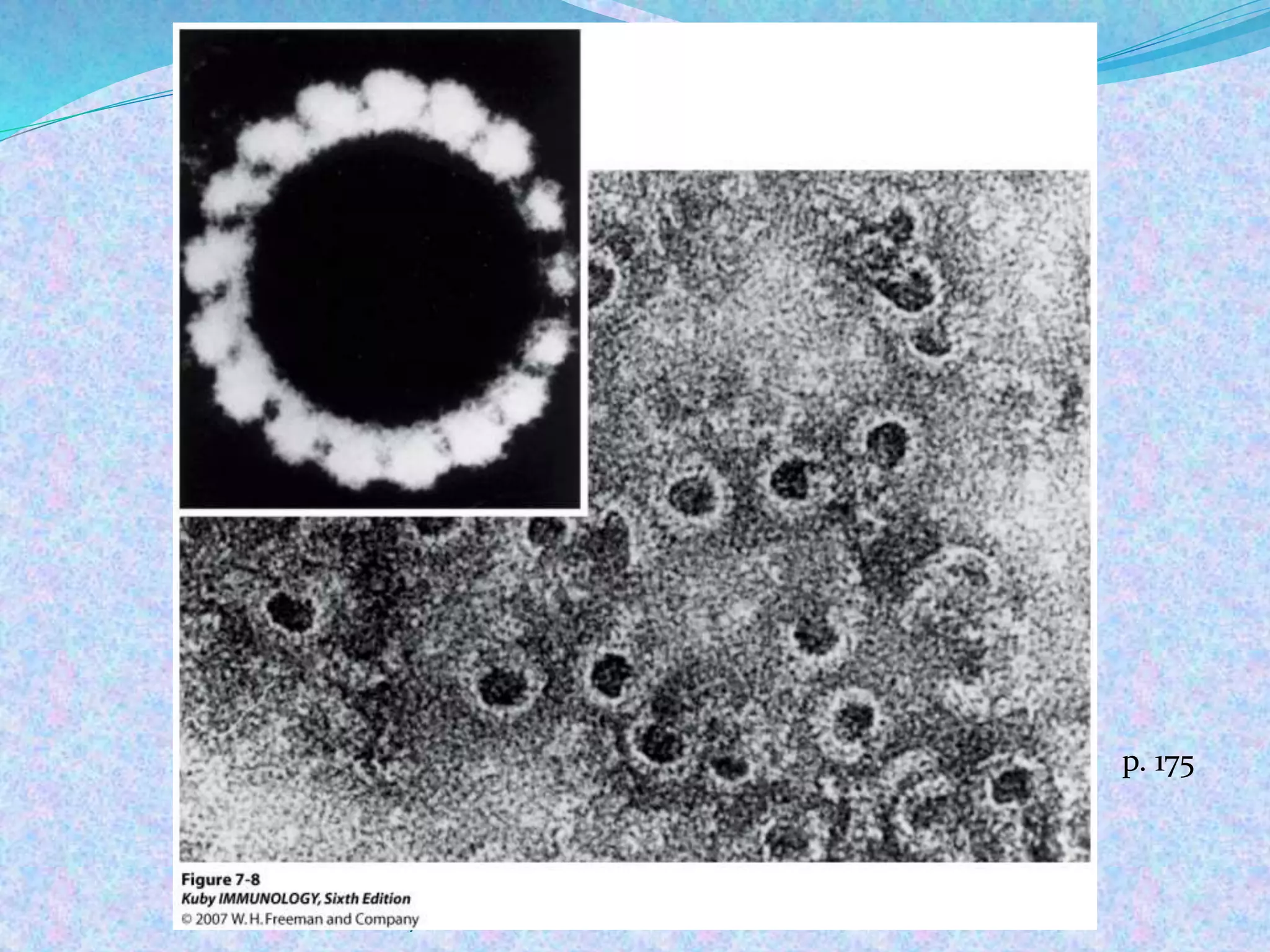
Before complement After complement treatment
The contents of the cell leak out through the MAC
pore and the cell dies
Ch. 7
p. 175
Membrane Attack Complex
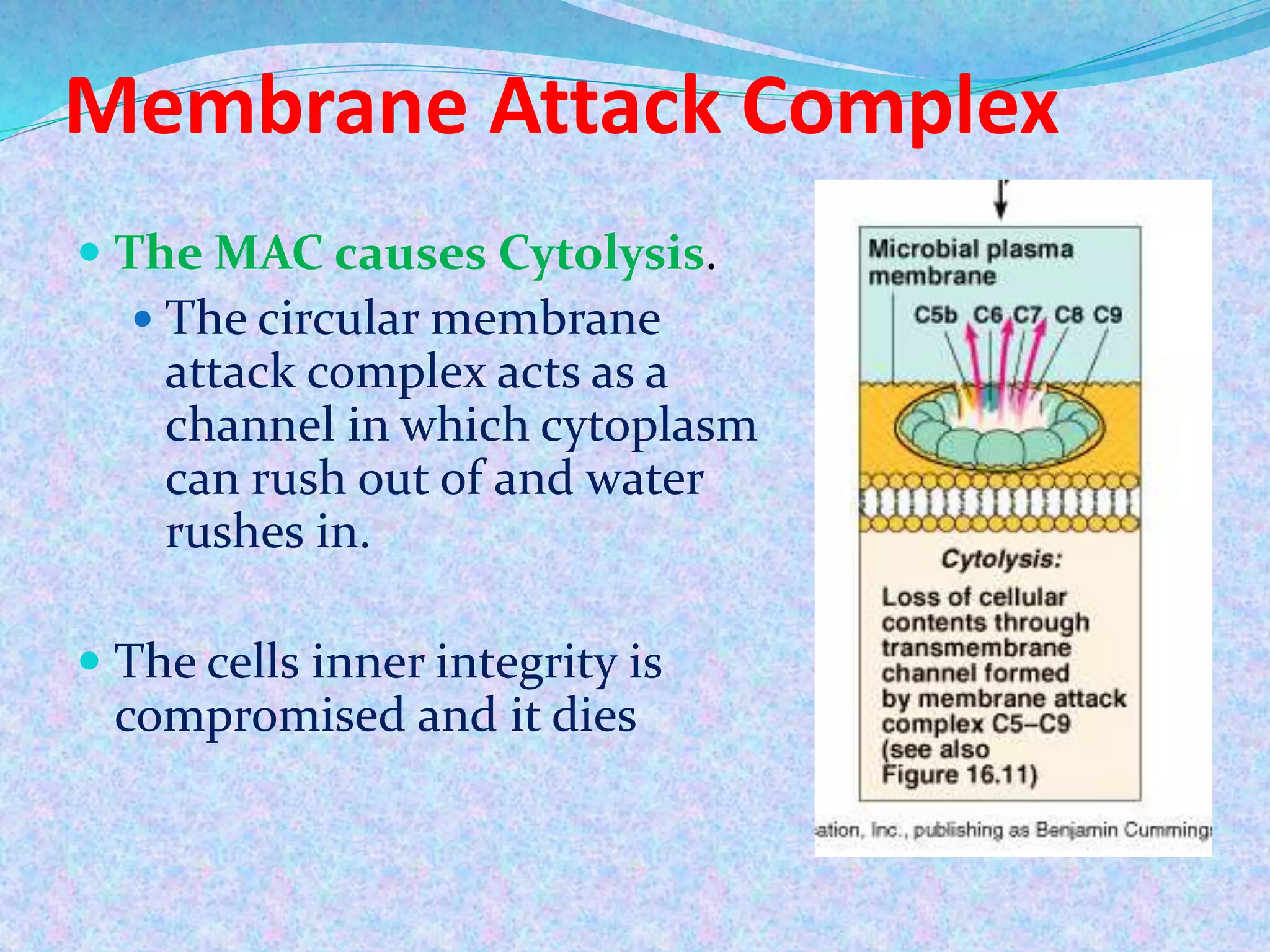
 The MAC causes Cytolysis.
 The circular membrane
attack complex acts as a
channel in which cytoplasm
can rush out of and water
rushes in.
 The cells inner integrity is
compromised and it dies
Overview
Ch. 7
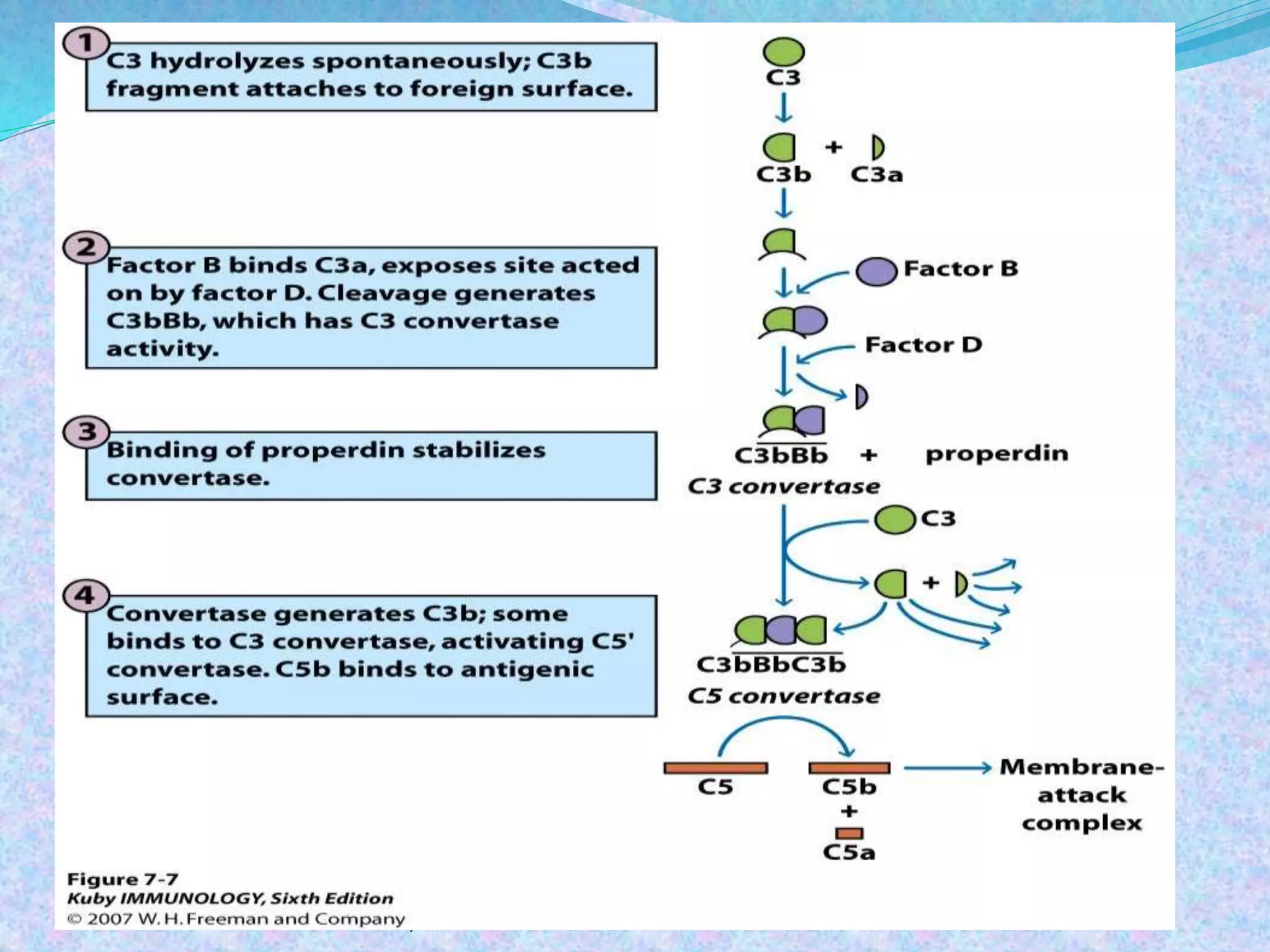
Alternative Pathway
Four components: C3, factor B, factor D, and
properdin
Triggering substances may be pathogens or
Nonpathogens bacterial cell wall components, fungi,
viruses, parasites immune complexes, RBCs, polymers
Ch. 7
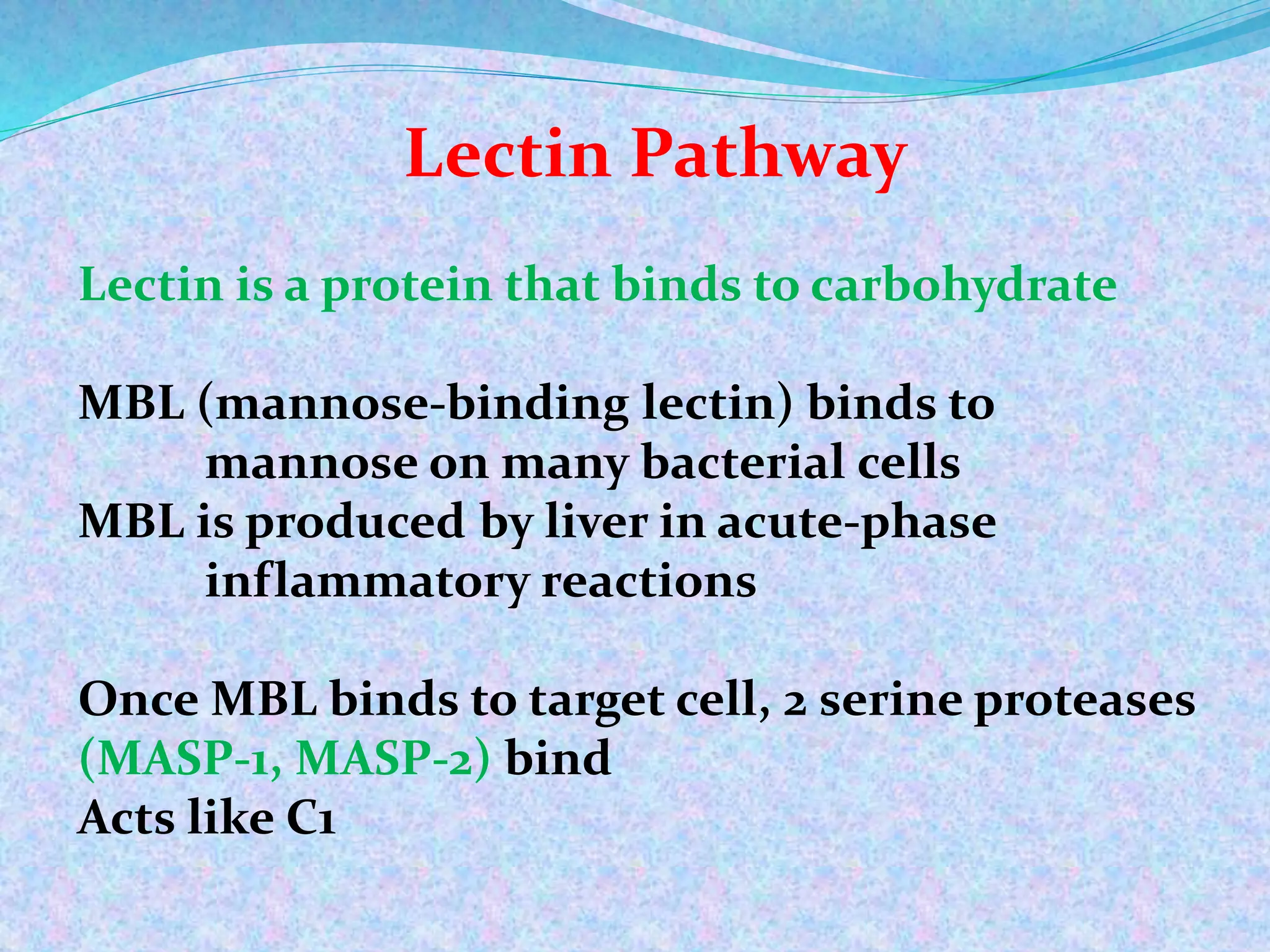
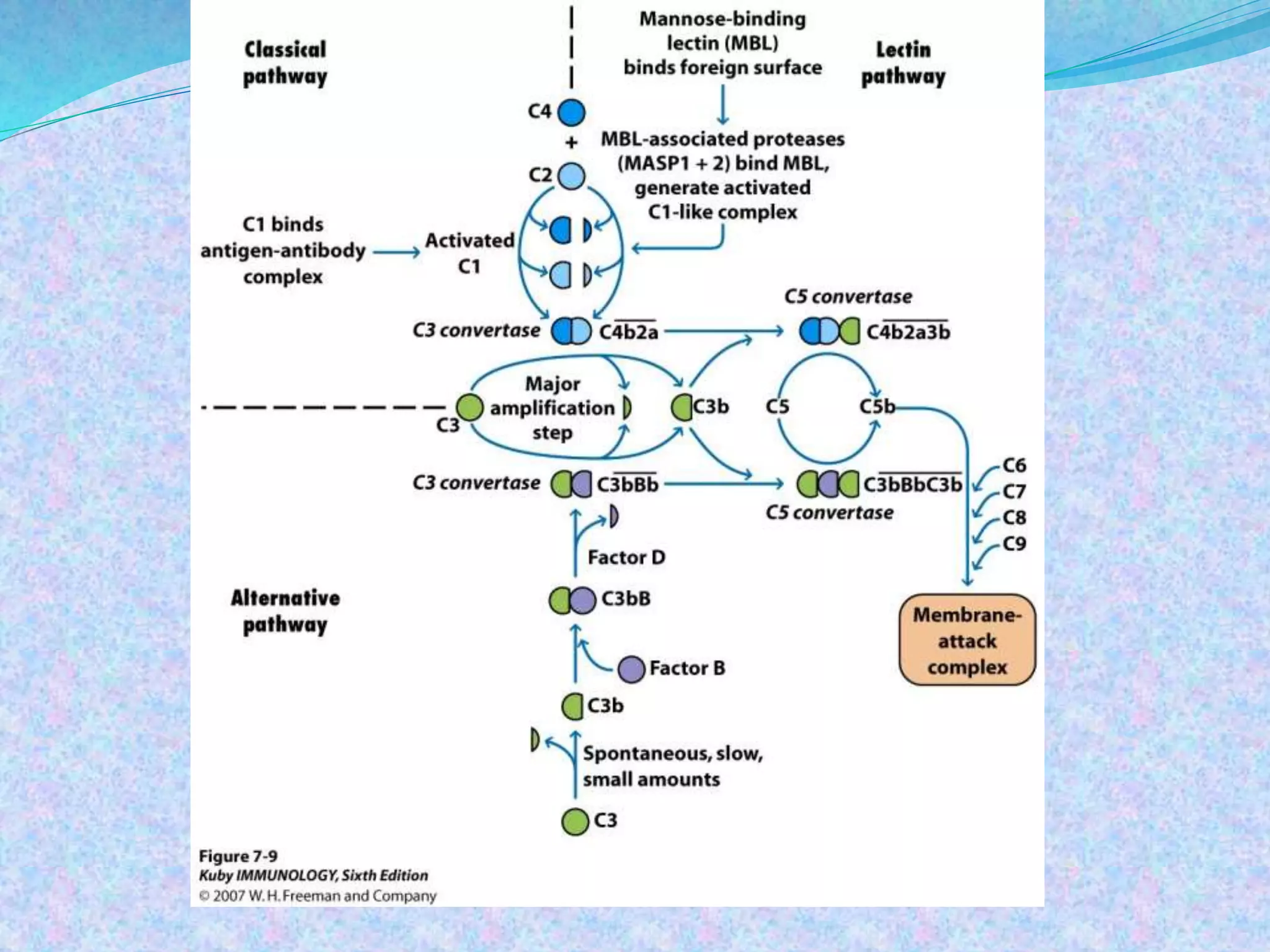
Lectin Pathway
Lectin is a protein that binds to carbohydrate
MBL (mannose-binding lectin) binds to
mannose on many bacterial cells
MBL is produced by liver in acute-phase
inflammatory reactions
Once MBL binds to target cell, 2 serine proteases
(MASP-1, MASP-2) bind
Acts like C1
General Functions of Complement
Consequences of Complement Deficiency
Complement system

Complement system

  • 1.
    BY Dr KHALED SALEHALGARIRI 2014
  • 2.
     A defensivesystem consisting of over 30 proteins produced by the liver and found in circulating blood serum.  These proteins are not immunoglobulins and their concentrations in serum do not increase after immunization  Complement activation (fixation) leads to lysis of cells and to the generation of many powerful biologically active substances
  • 3.
    A Cascade system The complement works as a cascade system.  Cascade is when one reaction triggers another reaction which trigger others and so on. These types of systems can grow exponentially very fast.
  • 4.
    Role of Complementin Disease  The complement system plays a critical role in inflammation and defence against some bacterial infections.  Complement may also be activated during reactions against incompatible blood transfusions, and during the damaging immune responses that accompany autoimmune disease.  Deficiencies of individual complement components or inhibitors of the system can lead to a variety of diseases
  • 5.
    Cascade Activation  Complementproteins are often designated by an uppercase letter C and are inactive until they are split into products.  Example: C1  When the products are split they become active. The active products are usually designated with a lower case a or b.  Example: C1a and C1b
  • 6.
    Four important functions: •Lysis • Opsonization • Activation of inflammatory response • Clearance of immune complexes
  • 7.
  • 8.
  • 9.
  • 10.
  • 11.
  • 12.
    Complement Activation Pathways The Classical Pathway - Ag- Ab complexes  The Alternative Pathway - Aggregated immunoglobulins and microbial products  The Mannan - Binding Lectin Pathway - Microbial products
  • 14.
    The Classical Pathway Activators: Ag – Ab complexes  Antibodies involved: IgG and IgM  Activation in an orderly fashion of nine major protein components; C1 – C9  Products of activation are enzymes that catalyze the subsequent step
  • 15.
    The Classical Pathway Activation of C1:  C1 consists of C1q (400.000 Daltons), C1r (95000 Daltons), and C1s (85000 Daltons)  Subunits are held together by Calcium ions  C1q is a polymer of 6 identical units  C1q activation requires binding to a c1q- specific receptor on the FC region of at least 2 adjacent molecules of IgG or a single molecule of IgM, a reaction that requires Calcium ions
  • 17.
  • 18.
    Y Y IgG hasonly two sites per molecule. In order to achieve effective C1q binding and complement activation two IgG molecules must bind close to each other
  • 20.
    IgA and IgEcannot activate complement
  • 21.
    The Classical Pathway The classical pathway is considered to be part of the specific immune response because it relies on antibodies to initiate it.  C1 becomes activated when it binds to the ends of antibodies
  • 22.
    The Building ofa C3 Activation Complex  Once C1 is activated, it activates 2 other complement proteins, C2 and C4 by cutting them in half  C2 is cleaved into C2a and C2b  C4 is cleaved into C4a and C4b  Both C2b and C4b bind together on the surface of the bacteria  C2a and C4a diffuse away
  • 23.
    C3 Activation Complex C2b and C4b bind together on the surface to form a C3 activation complex  The function of the C3 activation complex is to activate C3 proteins.  This is done by cleaving C3 into C3a and C3b
  • 24.
    C3b  Many C3bmolecules are produced by the C3 activation complex.  The C3b bind to and coat the surface of the bacteria.  C3b is an opsonin  Opsonins are molecules that bind both to bacteria and phagocytes  Opsonization increases phagocytosis by 1,000 fold. Opsonins
  • 25.
    C3a C3a increases theinflammatory response by binding to mast cells and causing them to release histamine
  • 26.
    Building the C5Activation Complex  Eventially enough C3b is cleaved that the surface of the bacteria begins to become saturated with it.  C2b and C4b which make up the C3 activation complex has a slight affinity for C3b and C3b binds to them  When C3b binds to C2b and C4b it forms a new complex referred to as the C5 activation complex
  • 27.
    The C5 ActivationComplex  The C5 activation complex (C2b, C4b, C3b) activates C5 proteins by cleaving them into C5a and C5b  Many C5b proteins are produced by the C5activation complex. These C5b begin to coat the surface of the bacteria.
  • 28.
    The function ofC5a  C5a disperses away from the bacteria.  Binds to mast cells and increases inflammation.  Most powerful chemotactic factor known for leukocytes
  • 29.
    Building the MembraneAttack Complex  C5b on the surface of bacteria binds to C6  The binding of C6 to C5b activates C6 so that it can bind to C7  C7 binds to C8 which in turn binds to many C9’s  Together these proteins form a circular complex called the Membrane attack complex (MAC)
  • 30.
  • 31.
    The Membrane AttackComplex C6 C7 C8 C9 C9 C9 C9 C9 C9C9 C9 C9 C9 C9 C5 C5b C5a 70-100 Å
  • 32.
    Before complement Aftercomplement treatment The contents of the cell leak out through the MAC pore and the cell dies
  • 33.
  • 34.
    Membrane Attack Complex The MAC causes Cytolysis.  The circular membrane attack complex acts as a channel in which cytoplasm can rush out of and water rushes in.  The cells inner integrity is compromised and it dies
  • 35.
  • 36.
    Ch. 7 Alternative Pathway Fourcomponents: C3, factor B, factor D, and properdin Triggering substances may be pathogens or Nonpathogens bacterial cell wall components, fungi, viruses, parasites immune complexes, RBCs, polymers
  • 37.
  • 38.
    Lectin Pathway Lectin isa protein that binds to carbohydrate MBL (mannose-binding lectin) binds to mannose on many bacterial cells MBL is produced by liver in acute-phase inflammatory reactions Once MBL binds to target cell, 2 serine proteases (MASP-1, MASP-2) bind Acts like C1
  • 41.
  • 42.