


SUBMITTED TO SUBMITTED BY
Er. Aarti Nimesh
MSC Food Technology
Riya sharma
Department of Food Technology
SURAJMAL UNIVERSITY
HURDLE
TECHNOLOGY
•
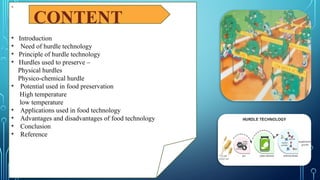
• Introduction
• Need of hurdle technology
• Principle of hurdle technology
• Hurdles used to preserve –
Physical hurdles
Physico-chemical hurdle
• Potential used in food preservation
High temperature
low temperature
• Applications used in food technology
• Advantages and disadvantages of food technology
• Conclusion
• Reference
CONTENT
INTRODUCTION
FATHER OF HURDLE TECHNOLOGY- LEISTNER (1976)
• What is hurdle technology ?
Combination of preservation / process / methods / techniques
which employ the use of two or more hurdles to spoilage
microorganism to produce safe, shelf stable and nutritious food.
• Used For shelf stable food products and IMF
For example - In jam , high solid content and acidification . In
vegetable fermentation, salt and acidification
NEED OF HURDLE TECHNOLOGY
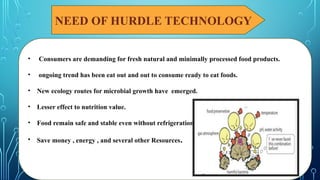
• Consumers are demanding for fresh natural and minimally processed food products.
• ongoing trend has been eat out and out to consume ready to eat foods.
• New ecology routes for microbial growth have emerged.
• Lesser effect to nutrition value.
• Food remain safe and stable even without refrigeration.
• Save money , energy , and several other Resources.
PRINCIPLES OF HURDLE TECHNOLOGY
Preservation factors or hurdles disturb
the homeostasis of the microorganisms
Micro-organisms should not be able to
‘’ jump over’’ all the hurdles present in
the food
Prevents the micro-organisms from
multiplying and causing them to remain
inactive or even die
Complex interactions of temperature ,
pH , aw etc. are significant to the
microbial to the microbial stability
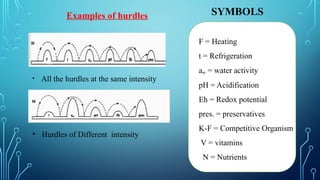
SYMBOLS
F = Heating
t = Refrigeration
aw = water activity
pH = Acidification
Eh = Redox potential
pres. = preservatives
K-F = Competitive Organism
V = vitamins
N = Nutrients
Examples of hurdles
• All the hurdles at the same intensity
• Hurdles of Different intensity
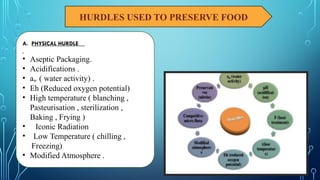
HURDLES USED TO PRESERVE FOOD
A. PHYSICAL HURDLE
• Aseptic Packaging.
• Acidifications .
• aw ( water activity) .
• Eh (Reduced oxygen potential)
• High temperature ( blanching ,
Pasteurisation , sterilization ,
Baking , Frying )
• Iconic Radiation
• Low Temperature ( chilling ,
Freezing)
• Modified Atmosphere .
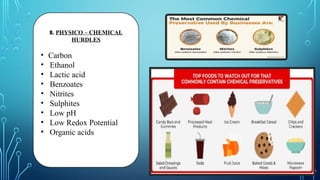
B. PHYSICO – CHEMICAL
HURDLES
• Carbon
• Ethanol
• Lactic acid
• Benzoates
• Nitrites
• Sulphites
• Low pH
• Low Redox Potential
• Organic acids
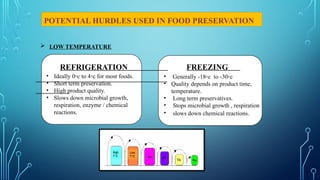
REFRIGERATION
POTENTIAL HURDLES USED IN FOOD PRESERVATION
FREEZING
 LOW TEMPERATURE
• Ideally 0◦c to 4◦c for most foods.
• Short term preservation.
• High product quality.
• Slows down microbial growth,
respiration, enzyme / chemical
reactions.
• Generally -18◦c to -30◦c
• Quality depends on product time,
temperature.
• Long term preservatives.
• Stops microbial growth , respiration
• slows down chemical reactions.
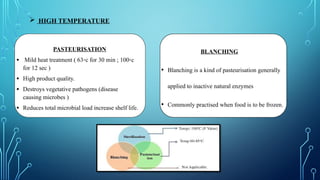
PASTEURISATION
• Mild heat treatment ( 63◦c for 30 min ; 100◦c
for 12 sec )
• High product quality.
• Destroys vegetative pathogens (disease
causing microbes )
• Reduces total microbial load increase shelf life.
 HIGH TEMPERATURE
BLANCHING
• Blanching is a kind of pasteurisation generally
applied to inactive natural enzymes
• Commonly practised when food is to be frozen.
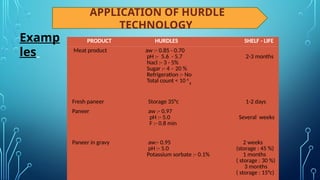
APPLICATION OF HURDLE
TECHNOLOGY
Examp
les
PRODUCT HURDLES SHELF - LIFE
Meat product aw :- 0.85 - 0.70
pH :- 5.6 - 5.7
Nacl :- 3 - 5%
Sugar :- 4 – 20 %
Refrigeration :- No
Total count < 10 6
g
2-3 months
Fresh paneer Storage 35°c 1-2 days
Paneer aw :- 0.97
pH :- 5.0
F :- 0.8 min
Several weeks
Paneer in gravy aw:- 0.95
pH :- 5.0
Potassium sorbate :- 0.1%
2 weeks
(storage : 45 %)
1 months
( storage : 30 %)
3 months
( storage : 15°c)
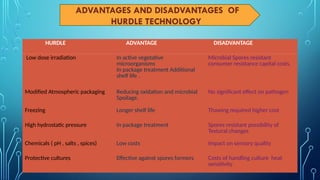
ADVANTAGES AND DISADVANTAGES OF
HURDLE TECHNOLOGY
HURDLE ADVANTAGE DISADVANTAGE
Low dose irradiation In active vegetative
microorganisms
In package treatment Additional
shelf life .
Microbial Spores resistant
consumer resistance capital costs.
Modified Atmospheric packaging Reducing oxidation and microbial
Spoilage.
No significant effect on pathogen
Freezing Longer shelf life Thawing required higher cost
High hydrostatic pressure In package treatment Spores resistant possibility of
Textural changes
Chemicals ( pH , salts , spices) Low costs Impact on sensory quality
Protective cultures Effective against spores formers Costs of handling culture heat
sensitivity
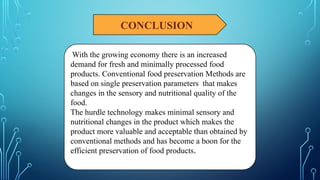
CONCLUSION
With the growing economy there is an increased
demand for fresh and minimally processed food
products. Conventional food preservation Methods are
based on single preservation parameters that makes
changes in the sensory and nutritional quality of the
food.
The hurdle technology makes minimal sensory and
nutritional changes in the product which makes the
product more valuable and acceptable than obtained by
conventional methods and has become a boon for the
efficient preservation of food products.
REFERENCES
 https://www.slideshare.net
 https://en.m.wikepedia.org
 foodinfotech.com/hurdle-
technology
T

HURDLE TECHNOLOGY AND ITS EFFECTS ON MICROBIAL GROWTH

  • 1.
    SUBMITTED TO SUBMITTEDBY Er. Aarti Nimesh MSC Food Technology Riya sharma Department of Food Technology SURAJMAL UNIVERSITY HURDLE TECHNOLOGY
  • 2.
    • • Introduction • Needof hurdle technology • Principle of hurdle technology • Hurdles used to preserve – Physical hurdles Physico-chemical hurdle • Potential used in food preservation High temperature low temperature • Applications used in food technology • Advantages and disadvantages of food technology • Conclusion • Reference CONTENT
  • 3.
    INTRODUCTION FATHER OF HURDLETECHNOLOGY- LEISTNER (1976) • What is hurdle technology ? Combination of preservation / process / methods / techniques which employ the use of two or more hurdles to spoilage microorganism to produce safe, shelf stable and nutritious food. • Used For shelf stable food products and IMF For example - In jam , high solid content and acidification . In vegetable fermentation, salt and acidification
  • 4.
    NEED OF HURDLETECHNOLOGY • Consumers are demanding for fresh natural and minimally processed food products. • ongoing trend has been eat out and out to consume ready to eat foods. • New ecology routes for microbial growth have emerged. • Lesser effect to nutrition value. • Food remain safe and stable even without refrigeration. • Save money , energy , and several other Resources.
  • 5.
    PRINCIPLES OF HURDLETECHNOLOGY Preservation factors or hurdles disturb the homeostasis of the microorganisms Micro-organisms should not be able to ‘’ jump over’’ all the hurdles present in the food Prevents the micro-organisms from multiplying and causing them to remain inactive or even die Complex interactions of temperature , pH , aw etc. are significant to the microbial to the microbial stability
  • 6.
    SYMBOLS F = Heating t= Refrigeration aw = water activity pH = Acidification Eh = Redox potential pres. = preservatives K-F = Competitive Organism V = vitamins N = Nutrients Examples of hurdles • All the hurdles at the same intensity • Hurdles of Different intensity
  • 7.
    HURDLES USED TOPRESERVE FOOD A. PHYSICAL HURDLE • Aseptic Packaging. • Acidifications . • aw ( water activity) . • Eh (Reduced oxygen potential) • High temperature ( blanching , Pasteurisation , sterilization , Baking , Frying ) • Iconic Radiation • Low Temperature ( chilling , Freezing) • Modified Atmosphere .
  • 8.
    B. PHYSICO –CHEMICAL HURDLES • Carbon • Ethanol • Lactic acid • Benzoates • Nitrites • Sulphites • Low pH • Low Redox Potential • Organic acids
  • 9.
    REFRIGERATION POTENTIAL HURDLES USEDIN FOOD PRESERVATION FREEZING  LOW TEMPERATURE • Ideally 0◦c to 4◦c for most foods. • Short term preservation. • High product quality. • Slows down microbial growth, respiration, enzyme / chemical reactions. • Generally -18◦c to -30◦c • Quality depends on product time, temperature. • Long term preservatives. • Stops microbial growth , respiration • slows down chemical reactions.
  • 10.
    PASTEURISATION • Mild heattreatment ( 63◦c for 30 min ; 100◦c for 12 sec ) • High product quality. • Destroys vegetative pathogens (disease causing microbes ) • Reduces total microbial load increase shelf life.  HIGH TEMPERATURE BLANCHING • Blanching is a kind of pasteurisation generally applied to inactive natural enzymes • Commonly practised when food is to be frozen.
  • 11.
    APPLICATION OF HURDLE TECHNOLOGY Examp les PRODUCTHURDLES SHELF - LIFE Meat product aw :- 0.85 - 0.70 pH :- 5.6 - 5.7 Nacl :- 3 - 5% Sugar :- 4 – 20 % Refrigeration :- No Total count < 10 6 g 2-3 months Fresh paneer Storage 35°c 1-2 days Paneer aw :- 0.97 pH :- 5.0 F :- 0.8 min Several weeks Paneer in gravy aw:- 0.95 pH :- 5.0 Potassium sorbate :- 0.1% 2 weeks (storage : 45 %) 1 months ( storage : 30 %) 3 months ( storage : 15°c)
  • 12.
    ADVANTAGES AND DISADVANTAGESOF HURDLE TECHNOLOGY HURDLE ADVANTAGE DISADVANTAGE Low dose irradiation In active vegetative microorganisms In package treatment Additional shelf life . Microbial Spores resistant consumer resistance capital costs. Modified Atmospheric packaging Reducing oxidation and microbial Spoilage. No significant effect on pathogen Freezing Longer shelf life Thawing required higher cost High hydrostatic pressure In package treatment Spores resistant possibility of Textural changes Chemicals ( pH , salts , spices) Low costs Impact on sensory quality Protective cultures Effective against spores formers Costs of handling culture heat sensitivity
  • 13.
    CONCLUSION With the growingeconomy there is an increased demand for fresh and minimally processed food products. Conventional food preservation Methods are based on single preservation parameters that makes changes in the sensory and nutritional quality of the food. The hurdle technology makes minimal sensory and nutritional changes in the product which makes the product more valuable and acceptable than obtained by conventional methods and has become a boon for the efficient preservation of food products.
  • 14.
  • 15.