HURDLE
TECHNOLOGY
SUBMITTED BY: NIYAZ ALI
SUBMITTED TO: MS. G. NAVYA
DEFINITIO
N
Hurdle technology is an
approach in food
preservation where
multiple preservation
methods are combined
to inhibit microbial
growth. Each method (or
'hurdle') weakens the
microorganisms,
creating a cumulative
effect that enhances
food safety and extends
shelf life.
ers to
stable
asis can
lead to
hurdles
s,
sms in a
to
s
1
ce
es
a
e
2
3
4
PRINCIPLES
OF HURDLE TECHNOLOGY
Microbial
homeostasis refers to
the maintenance of stable
internal conditions.
Disrupting homeostasis can
prevent growth and lead to
cell death.
The use of multiple hurdles
disrupts homeostasis,
placing microorganisms in a
lag phase or leading to
death before repair is
possible. 1
ce
es
a
e
2
3
4
P
R
I
N
C
I
P
L
E
S
Microbial
homeostasis refers to
the maintenance of stable
internal conditions.
Disrupting homeostasis can
prevent growth and lead to
cell death.
The use of multiple hurdles
disrupts homeostasis,
placing microorganisms in a
lag phase or leading to
death before repair is
possible. 1
When microorganisms face
multiple hurdles, they
undergo metabolic
exhaustion.
This occurs when microbes
deplete their energy
reserves in an attempt to
maintain homeostasis in a
hostile environment.
This leads to auto
sterilization, where stable
foods become safer over
time as microbial activity
declines.
2
3
4
P
R
I
N
C
I
P
L
E
S
Microbial
homeostasis refers to
the maintenance of stable
internal conditions.
Disrupting homeostasis can
prevent growth and lead to
cell death.
The use of multiple hurdles
disrupts homeostasis,
placing microorganisms in a
lag phase or leading to
death before repair is
possible. 1
When microorganisms face
multiple hurdles, they
undergo metabolic
exhaustion.
This occurs when microbes
deplete their energy
reserves in an attempt to
maintain homeostasis in a
hostile environment.
This leads to auto
sterilization, where stable
foods become safer over
time as microbial activity
declines.
2
Some bacteria become more
resistant and virulent under
stress due to the generation of
stress shock proteins. These
proteins are produced in
response to stressful
conditions like heat, pH, water
activity (aw), ethanol, oxidative
compounds, cold, UV light, and
starvation, inducing a stress
reaction.
Simultaneous exposure to
multiple stressors forces
microorganisms to produce
more protective proteins,
which can lead to metabolic
3
4
P
R
I
N
C
I
P
L
E
S
Microbial
homeostasis refers to
the maintenance of stable
internal conditions.
Disrupting homeostasis can
prevent growth and lead to
cell death.
The use of multiple hurdles
disrupts homeostasis,
placing microorganisms in a
lag phase or leading to
death before repair is
possible. 1
When microorganisms face
multiple hurdles, they
undergo metabolic
exhaustion.
This occurs when microbes
deplete their energy
reserves in an attempt to
maintain homeostasis in a
hostile environment.
This leads to auto
sterilization, where stable
foods become safer over
time as microbial activity
declines.
2
Some bacteria become more
resistant and virulent under
stress due to the generation of
stress shock proteins. These
proteins are produced in
response to stressful
conditions like heat, pH, water
activity (aw), ethanol, oxidative
compounds, cold, UV light, and
starvation, inducing a stress
reaction.
Simultaneous exposure to
multiple stressors forces
microorganisms to produce
more protective proteins,
which can lead to metabolic
3
A recent advancement
in food preservation is
the multitarget
approach, which
aims to apply multiple
hurdles that attack
different microbial
targets (e.g., cell
membrane, DNA)
simultaneously. This
method offers a more
effective way to
preserve food by
creating a synergistic
effect between different
preservation factors.
4
P
R
I
N
C
I
P
L
E
S
TYPES OF HURDLES
PHYSICAL HURDLES
1.Heat-based treatments:
pasteurization, sterilization,
evaporation, extrusion, baking,
frying
2.Low-temperature treatments:
chilling, freezing
3.Electromagnetic energy
treatments: microwave, radio
frequency, pulsed magnetic fields,
high electric fields
4.Pressure-based treatments:
ultra-high pressures,
ultrasonication
5.Atmosphere and packaging:
PHYSICO-CHEMICAL
HURDLES
Carbon dioxide, ethanol,
low pH, low redox
potential, low water
activity, organic acids,
ozone, salt, smoking,
sodium nitrite/nitrate,
sodium or potassium
sulphite, spices and
herbs, surface
treatment agents.
Microbially derived hurdles
include bacteriocins,
competitive flora, and protective
cultures. Bacteriocins like nisin
inhibit harmful microbes, while
competitive flora and protective
cultures outcompete pathogens
through nutrient competition
and acid production.
EXAMPLES OF
HURLDES
SYMBOLS
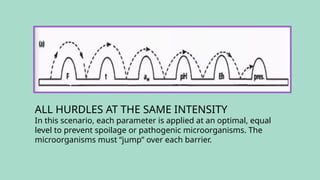
1. F = Heating
2. t = Refrigeration
3. aw = Water activity
4. pH = Acidification
5. Eh = Redox potential
6. pres. = Preservatives
7. K-F = Competitive
organisms
8. V = Vitamins
9. N = Nutrients
ALL HURDLES AT THE SAME INTENSITY
In this scenario, each parameter is applied at an optimal, equal
level to prevent spoilage or pathogenic microorganisms. The
microorganisms must “jump” over each barrier.
HURDLES AT DIFFERENT INTENSITY
This indicates that some preservation techniques are used more
intensively than others, depending on the food product and the
microorganisms involved.
L
W
s
m
"
LOW MICROBIAL LOAD
When only a small number of microorganisms are present at the
start, the risk of spoilage or foodborne illness is lower. The
microorganisms are already limited in number, so they need fewer
"hurdles" to be kept in check.
HIGH MICROBIAL LOAD
When there is a high microbial load at the start of food
production, more intensive or numerous hurdles are required to
ensure the safety and stability of the product.
THE BOOSTER OR TRAMPOLINE EFFECT
When a product is rich in nutrients and vitamins, it can act as an
excellent medium for the growth of microorganisms, leading to
what is referred to as the booster or trampoline effect. The
presence of abundant nutrients and vitamins can "boost" or
"accelerate" microbial growth, making the product more
susceptible to spoilage and microbial contamination.
PRACTICAL
APPLICATIONS
COCONUT WATER
The combination of natural
antimicrobials vanillin and
cinnamaldehyde with low-
temperature storage
significantly reduced the growth
of Salmonella Typhimurium in
coconut water. In a more severe
treatment, a 7-minute UV-C
exposure, combined with the
aforementioned antimicrobials
and storage at 5°C, completely
eliminated Salmonella growth
over 30 days.
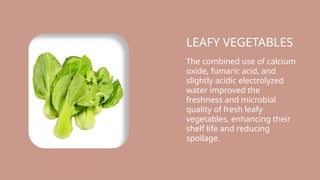
LEAFY VEGETABLES
The combined use of calcium
oxide, fumaric acid, and
slightly acidic electrolyzed
water improved the
freshness and microbial
quality of fresh leafy
vegetables, enhancing their
shelf life and reducing
spoilage.
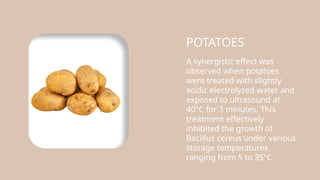
POTATOES
A synergistic effect was
observed when potatoes
were treated with slightly
acidic electrolyzed water and
exposed to ultrasound at
40°C for 3 minutes. This
treatment effectively
inhibited the growth of
Bacillus cereus under various
storage temperatures
ranging from 5 to 35°C.
MEAT
A combination of 1%
lemongrass oil and UV-C light
exposure (200 uW/cm² for 2
minutes) to reduce
Escherichia coli populations
in meat to below detectable
levels. The synergistic effects
of this combination were far
higher than using individual
treatments.
MILK
Mild heat treatment (50°C)
combined with pulsed
electric fields (30 kV at 50°C
for 6 minutes) significantly
reduced microbial load and
alkaline phosphatase activity
in milk. This hurdle
combination extended the
shelf life of milk by 22 days.
CHICKEN SAUSAGES
By lowering water activity
using textured soy protein
and reducing pH with lactic
acid, the shelf life of chicken
sausages could be extended
to six days. This method
reduced microbial activity
and improved product
stability without the use of
extreme preservation
techniques.
LIMITATIONS
Complexity in Implementation
•Difficult to determine the right combination and
intensity of hurdles.
•Extensive trial-and-error required for optimization.
Impact on Sensory Quality
•Can alter taste, texture, color, or aroma, affecting
consumer acceptability.
Regulatory and Safety Concerns
•Novel methods may face regulatory hurdles and
require extensive testing.
•Improper application can pose safety risks.
Need for Precise Knowledge and Expertise
•Effective hurdle technology requires "a precise
knowledge of the effectiveness of each hurdle for a given
commodity"
CONCLUSION
In conclusion, hurdle technology is a highly
effective and innovative approach in food
processing that combines multiple
preservation techniques to enhance food
safety, quality, and shelf-life while retaining
nutritional and sensory characteristics. By
applying a combination of mild preservation
methods—such as heat, pH control, water
activity reduction, and fermentation—hurdle
technology can achieve the same or superior
results compared to traditional methods, but
often with reduced reliance on extreme
conditions such as high temperatures or
REFERENCE
 Gómez, P. L., Welti-Chanes, J., & Alzamora, S. M. (2011). Hurdle Technology in Fruit Processing. Annual Review of Food Science and
Technology, 2(1), 447–465. https://doi.org/10.1146/annurev-food-022510-133619
 Khan, I., Tango, C. N., Miskeen, S., Lee, B. H., & Oh, D.-H. (2017). Hurdle technology: A novel approach for enhanced food quality and safety –
A review. Food Control, 73, 1426–1444. https://doi.org/10.1016/j.foodcont.2016.11.010
 Leistner, L. (1994). Further Developments in the Utilization of Hurdle Technology for Food Preservation. In Water in Foods (pp. 421–432).
Elsevier. https://doi.org/10.1016/B978-1-85861-037-5.50029-1
 Leistner, L. (1995). Principles and applications of hurdle technology. In G. W. Gould (Ed.), New Methods of Food Preservation (pp. 1–21).
Springer US. https://doi.org/10.1007/978-1-4615-2105-1_1
 Leistner, L. (2000). Basic aspects of food preservation by hurdle technology. International Journal of Food Microbiology, 55(1–3), 181–186.
https://doi.org/10.1016/S0168-1605(00)00161-6
 Leistner, L., & Gorris, L. G. M. (1995). Food preservation by hurdle technology. Trends in Food Science & Technology, 6(2), 41–46.
https://doi.org/10.1016/S0924-2244(00)88941-4
 Singh, S., & Shalini, R. (2016). Effect of Hurdle Technology in Food Preservation: A Review. Critical Reviews in Food Science and Nutrition, 56(4),
641–649. https://doi.org/10.1080/10408398.2012.761594

hurdletechnology_foodscience_presentation.pptx

  • 1.
    HURDLE TECHNOLOGY SUBMITTED BY: NIYAZALI SUBMITTED TO: MS. G. NAVYA
  • 2.
    DEFINITIO N Hurdle technology isan approach in food preservation where multiple preservation methods are combined to inhibit microbial growth. Each method (or 'hurdle') weakens the microorganisms, creating a cumulative effect that enhances food safety and extends shelf life.
  • 3.
    ers to stable asis can leadto hurdles s, sms in a to s 1 ce es a e 2 3 4 PRINCIPLES OF HURDLE TECHNOLOGY
  • 4.
    Microbial homeostasis refers to themaintenance of stable internal conditions. Disrupting homeostasis can prevent growth and lead to cell death. The use of multiple hurdles disrupts homeostasis, placing microorganisms in a lag phase or leading to death before repair is possible. 1 ce es a e 2 3 4 P R I N C I P L E S
  • 5.
    Microbial homeostasis refers to themaintenance of stable internal conditions. Disrupting homeostasis can prevent growth and lead to cell death. The use of multiple hurdles disrupts homeostasis, placing microorganisms in a lag phase or leading to death before repair is possible. 1 When microorganisms face multiple hurdles, they undergo metabolic exhaustion. This occurs when microbes deplete their energy reserves in an attempt to maintain homeostasis in a hostile environment. This leads to auto sterilization, where stable foods become safer over time as microbial activity declines. 2 3 4 P R I N C I P L E S
  • 6.
    Microbial homeostasis refers to themaintenance of stable internal conditions. Disrupting homeostasis can prevent growth and lead to cell death. The use of multiple hurdles disrupts homeostasis, placing microorganisms in a lag phase or leading to death before repair is possible. 1 When microorganisms face multiple hurdles, they undergo metabolic exhaustion. This occurs when microbes deplete their energy reserves in an attempt to maintain homeostasis in a hostile environment. This leads to auto sterilization, where stable foods become safer over time as microbial activity declines. 2 Some bacteria become more resistant and virulent under stress due to the generation of stress shock proteins. These proteins are produced in response to stressful conditions like heat, pH, water activity (aw), ethanol, oxidative compounds, cold, UV light, and starvation, inducing a stress reaction. Simultaneous exposure to multiple stressors forces microorganisms to produce more protective proteins, which can lead to metabolic 3 4 P R I N C I P L E S
  • 7.
    Microbial homeostasis refers to themaintenance of stable internal conditions. Disrupting homeostasis can prevent growth and lead to cell death. The use of multiple hurdles disrupts homeostasis, placing microorganisms in a lag phase or leading to death before repair is possible. 1 When microorganisms face multiple hurdles, they undergo metabolic exhaustion. This occurs when microbes deplete their energy reserves in an attempt to maintain homeostasis in a hostile environment. This leads to auto sterilization, where stable foods become safer over time as microbial activity declines. 2 Some bacteria become more resistant and virulent under stress due to the generation of stress shock proteins. These proteins are produced in response to stressful conditions like heat, pH, water activity (aw), ethanol, oxidative compounds, cold, UV light, and starvation, inducing a stress reaction. Simultaneous exposure to multiple stressors forces microorganisms to produce more protective proteins, which can lead to metabolic 3 A recent advancement in food preservation is the multitarget approach, which aims to apply multiple hurdles that attack different microbial targets (e.g., cell membrane, DNA) simultaneously. This method offers a more effective way to preserve food by creating a synergistic effect between different preservation factors. 4 P R I N C I P L E S
  • 8.
  • 9.
    PHYSICAL HURDLES 1.Heat-based treatments: pasteurization,sterilization, evaporation, extrusion, baking, frying 2.Low-temperature treatments: chilling, freezing 3.Electromagnetic energy treatments: microwave, radio frequency, pulsed magnetic fields, high electric fields 4.Pressure-based treatments: ultra-high pressures, ultrasonication 5.Atmosphere and packaging:
  • 10.
    PHYSICO-CHEMICAL HURDLES Carbon dioxide, ethanol, lowpH, low redox potential, low water activity, organic acids, ozone, salt, smoking, sodium nitrite/nitrate, sodium or potassium sulphite, spices and herbs, surface treatment agents.
  • 11.
    Microbially derived hurdles Microbiallyderived hurdles include bacteriocins, competitive flora, and protective cultures. Bacteriocins like nisin inhibit harmful microbes, while competitive flora and protective cultures outcompete pathogens through nutrient competition and acid production.
  • 12.
    EXAMPLES OF HURLDES SYMBOLS 1. F= Heating 2. t = Refrigeration 3. aw = Water activity 4. pH = Acidification 5. Eh = Redox potential 6. pres. = Preservatives 7. K-F = Competitive organisms 8. V = Vitamins 9. N = Nutrients
  • 13.
    ALL HURDLES ATTHE SAME INTENSITY In this scenario, each parameter is applied at an optimal, equal level to prevent spoilage or pathogenic microorganisms. The microorganisms must “jump” over each barrier.
  • 14.
    HURDLES AT DIFFERENTINTENSITY This indicates that some preservation techniques are used more intensively than others, depending on the food product and the microorganisms involved. L W s m "
  • 15.
    LOW MICROBIAL LOAD Whenonly a small number of microorganisms are present at the start, the risk of spoilage or foodborne illness is lower. The microorganisms are already limited in number, so they need fewer "hurdles" to be kept in check.
  • 16.
    HIGH MICROBIAL LOAD Whenthere is a high microbial load at the start of food production, more intensive or numerous hurdles are required to ensure the safety and stability of the product.
  • 17.
    THE BOOSTER ORTRAMPOLINE EFFECT When a product is rich in nutrients and vitamins, it can act as an excellent medium for the growth of microorganisms, leading to what is referred to as the booster or trampoline effect. The presence of abundant nutrients and vitamins can "boost" or "accelerate" microbial growth, making the product more susceptible to spoilage and microbial contamination.
  • 18.
  • 19.
    COCONUT WATER The combinationof natural antimicrobials vanillin and cinnamaldehyde with low- temperature storage significantly reduced the growth of Salmonella Typhimurium in coconut water. In a more severe treatment, a 7-minute UV-C exposure, combined with the aforementioned antimicrobials and storage at 5°C, completely eliminated Salmonella growth over 30 days.
  • 20.
    LEAFY VEGETABLES The combineduse of calcium oxide, fumaric acid, and slightly acidic electrolyzed water improved the freshness and microbial quality of fresh leafy vegetables, enhancing their shelf life and reducing spoilage.
  • 21.
    POTATOES A synergistic effectwas observed when potatoes were treated with slightly acidic electrolyzed water and exposed to ultrasound at 40°C for 3 minutes. This treatment effectively inhibited the growth of Bacillus cereus under various storage temperatures ranging from 5 to 35°C.
  • 22.
    MEAT A combination of1% lemongrass oil and UV-C light exposure (200 uW/cm² for 2 minutes) to reduce Escherichia coli populations in meat to below detectable levels. The synergistic effects of this combination were far higher than using individual treatments.
  • 23.
    MILK Mild heat treatment(50°C) combined with pulsed electric fields (30 kV at 50°C for 6 minutes) significantly reduced microbial load and alkaline phosphatase activity in milk. This hurdle combination extended the shelf life of milk by 22 days.
  • 24.
    CHICKEN SAUSAGES By loweringwater activity using textured soy protein and reducing pH with lactic acid, the shelf life of chicken sausages could be extended to six days. This method reduced microbial activity and improved product stability without the use of extreme preservation techniques.
  • 25.
    LIMITATIONS Complexity in Implementation •Difficultto determine the right combination and intensity of hurdles. •Extensive trial-and-error required for optimization. Impact on Sensory Quality •Can alter taste, texture, color, or aroma, affecting consumer acceptability. Regulatory and Safety Concerns •Novel methods may face regulatory hurdles and require extensive testing. •Improper application can pose safety risks. Need for Precise Knowledge and Expertise •Effective hurdle technology requires "a precise knowledge of the effectiveness of each hurdle for a given commodity"
  • 26.
    CONCLUSION In conclusion, hurdletechnology is a highly effective and innovative approach in food processing that combines multiple preservation techniques to enhance food safety, quality, and shelf-life while retaining nutritional and sensory characteristics. By applying a combination of mild preservation methods—such as heat, pH control, water activity reduction, and fermentation—hurdle technology can achieve the same or superior results compared to traditional methods, but often with reduced reliance on extreme conditions such as high temperatures or
  • 27.
    REFERENCE  Gómez, P.L., Welti-Chanes, J., & Alzamora, S. M. (2011). Hurdle Technology in Fruit Processing. Annual Review of Food Science and Technology, 2(1), 447–465. https://doi.org/10.1146/annurev-food-022510-133619  Khan, I., Tango, C. N., Miskeen, S., Lee, B. H., & Oh, D.-H. (2017). Hurdle technology: A novel approach for enhanced food quality and safety – A review. Food Control, 73, 1426–1444. https://doi.org/10.1016/j.foodcont.2016.11.010  Leistner, L. (1994). Further Developments in the Utilization of Hurdle Technology for Food Preservation. In Water in Foods (pp. 421–432). Elsevier. https://doi.org/10.1016/B978-1-85861-037-5.50029-1  Leistner, L. (1995). Principles and applications of hurdle technology. In G. W. Gould (Ed.), New Methods of Food Preservation (pp. 1–21). Springer US. https://doi.org/10.1007/978-1-4615-2105-1_1  Leistner, L. (2000). Basic aspects of food preservation by hurdle technology. International Journal of Food Microbiology, 55(1–3), 181–186. https://doi.org/10.1016/S0168-1605(00)00161-6  Leistner, L., & Gorris, L. G. M. (1995). Food preservation by hurdle technology. Trends in Food Science & Technology, 6(2), 41–46. https://doi.org/10.1016/S0924-2244(00)88941-4  Singh, S., & Shalini, R. (2016). Effect of Hurdle Technology in Food Preservation: A Review. Critical Reviews in Food Science and Nutrition, 56(4), 641–649. https://doi.org/10.1080/10408398.2012.761594