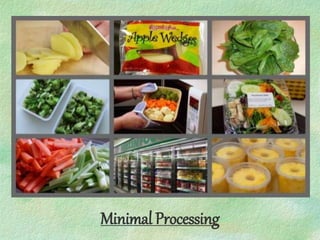
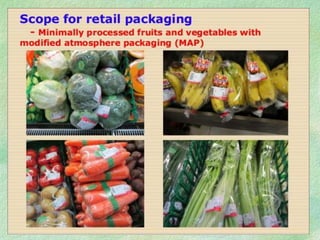
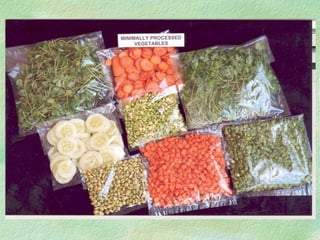

Minimal Processing
WHAT IS MINIMAL PROCESSING
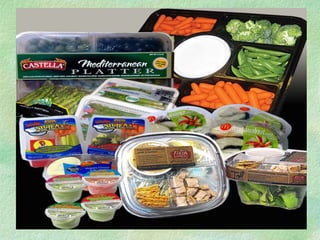
• Minimally Processed Foods are those which
minimally influences the quality characteristic of a
food, which at the same time giving the food
sufficient shelf life during storage and distribution.
• Minimally processed technologies are techniques
that preserve foods, but also retain to a certain
extent their nutritional quality and sensory
characteristics by reducing the reliance on heat as
the main preservative action.
WHY MINIMAL PROCESSING?
• Studies show that consumers need for
convenience are correlated with food choice,
therefore the fresh cut fruit and vegetable
industry is working to increase the assortment
of minimally processed vegetable products that
meets the consumers needs for quick and
convenient products that preserve their
nutritional value, retain a natural and fresh
colour, flavour and texture and contain fewer
additives such as preservatives.
 Minimally or light processing refers to:
 trimming
 peeling
 sectioning of fruits and vegetables
 slicing
 coring
 Demand for minimally processed (MP) fruits
and vegetables has increased due to
• busy life style
• increased purchasing power
• health conscious trends
 Consumers are increasingly demanding
* convenient,
* ready-to-use fruits and
* ready-to-eat vegetables
* with a fresh-like quality
* containing only natural
ingredients
 Europe (France & UK) markets for MP fruits and
vegetable grow explosively in the start of the 1990’s.
 USA - market share of fresh-cut produce accounts
for 25% of all produce sales in the retail market.
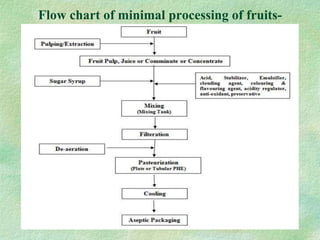
Flow chart of minimal processing of fruits-
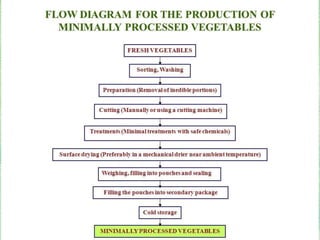
Flow chart of minimal processing of vegetables-
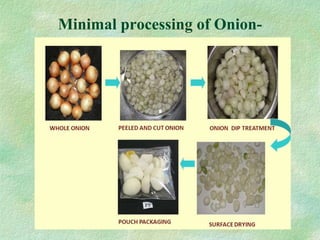
Minimal processing of Onion-
Minimally processing of raw fruits and
vegetables has two purposes:
 It is important to keep the produce fresh, yet
supply it in a convenient form without losing its
nutritional quality.
 The product should have a shelf life sufficient
to make its distribution feasible to its intended
consumers.
 In an ideal case, minimal processing can be
seen as “invisible” processing
 The microbiological, sensory and nutritional
shelf life of MP fruits or vegetables should be
at least 4 - 7 days but preferably even longer up
to 21 days depending on the market
 Loss of ascorbic acid and carotenes is the main
limiting factor of nutritional quality.
 MP fruits and vegetables are products that
contain live tissues or those that have been only
slightly modified from the fresh-condition and
are fresh-like in character.
 The tissues do not exhibit the same
physiological responses as the normal (raw)
untreated live plant tissues.
 Respiration greatly increased in MP fruits and
vegetables.
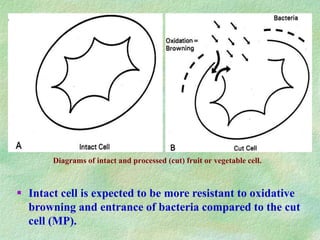
Diagrams of intact and processed (cut) fruit or vegetable cell.
 Intact cell is expected to be more resistant to oxidative
browning and entrance of bacteria compared to the cut
cell (MP).
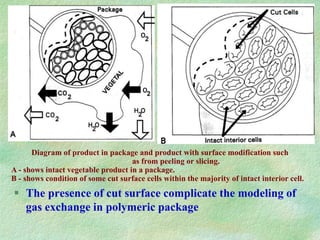
 The presence of cut surface complicate the modeling of
gas exchange in polymeric package
Diagram of product in package and product with surface modification such
as from peeling or slicing.
A - shows intact vegetable product in a package.
B - shows condition of some cut surface cells within the majority of intact interior cell.
Reasons for quality changes in MP produce
 MP produce deteriorates because of :
* physiological ageing which may result in
* biochemical changes degradation of the colour,
* microbial spoilage texture, flavour of the
produce
 During peeling and grating operations,
* many cells are ruptured
* intracellular products such as oxidizing enzymes are
released.
 Main spoilage characteristics indicating loss of
quality include:
* development of soft rots
* mould growth
* fermentation
* browning
* production of off-odours
 To minimize physiological decay, both quality
of raw materials and manufacturing processes
must be optimized.
1. Physiological and Biochemical
Changes
 Most important enzyme with regard to MP fruits and
vegetables is
polyphenol oxidase (PPO)
which causes
browning
 Enzymatic browning requires the present of four
different components:
- oxygen - oxidizing enzyme
- copper - a suitable substrate
 To prevent browning, at least one of these components
must be removed from the system.
Lipoxidase
 Another important enzyme which catalyzes
peroxidation reactions
causes
formation of numerous bad smelling aldehydes
and ketones
Ethylene production
 Minimal processing increases ethylene (C2H4)
production
 C2H4 involves in the biosynthesis of enzymes
involved in fruit maturation
partially responsible for softening of sliced
fruit.
Respiration activity
 Respiration activity of MP produce will increase
1.2 - 7 fold or even more depending on
* type of produce
* cutting grade
* temperature
If packaging condition are anaerobic
leads to anaerobic respiration
formation of ethanol, aldehydes and ketones
2. Microbiological Changes
 Minimal processing damages tissues of produce
resulting in leakage of cellular fluids containing
nutrients and intercellular enzymes
creates a favourable environment
for microbial growth
 Minimal processing (peeling, cutting and shredding)
expose surface of produce
* to air
* possible contamination with bacteria, yeast and
moulds.
Factors Affecting the Microbial Stability
and Quality of MP Vegetable Salads
 Intrinsic factors
 Processing factors
 Extrinsic factors
 Implicit factors
Effect of unit operations of commercial processing lines on
aerobic microbial plate counts from various vegetables
Minimal processing
Minimal processing
Minimal processing

Minimal processing

  • 1.
  • 2.
    WHAT IS MINIMALPROCESSING • Minimally Processed Foods are those which minimally influences the quality characteristic of a food, which at the same time giving the food sufficient shelf life during storage and distribution. • Minimally processed technologies are techniques that preserve foods, but also retain to a certain extent their nutritional quality and sensory characteristics by reducing the reliance on heat as the main preservative action.
  • 3.
    WHY MINIMAL PROCESSING? •Studies show that consumers need for convenience are correlated with food choice, therefore the fresh cut fruit and vegetable industry is working to increase the assortment of minimally processed vegetable products that meets the consumers needs for quick and convenient products that preserve their nutritional value, retain a natural and fresh colour, flavour and texture and contain fewer additives such as preservatives.
  • 4.
     Minimally orlight processing refers to:  trimming  peeling  sectioning of fruits and vegetables  slicing  coring  Demand for minimally processed (MP) fruits and vegetables has increased due to • busy life style • increased purchasing power • health conscious trends
  • 5.
     Consumers areincreasingly demanding * convenient, * ready-to-use fruits and * ready-to-eat vegetables * with a fresh-like quality * containing only natural ingredients  Europe (France & UK) markets for MP fruits and vegetable grow explosively in the start of the 1990’s.  USA - market share of fresh-cut produce accounts for 25% of all produce sales in the retail market.
  • 6.
    Flow chart ofminimal processing of fruits-
  • 7.
    Flow chart ofminimal processing of vegetables-
  • 8.
  • 9.
    Minimally processing ofraw fruits and vegetables has two purposes:  It is important to keep the produce fresh, yet supply it in a convenient form without losing its nutritional quality.  The product should have a shelf life sufficient to make its distribution feasible to its intended consumers.
  • 10.
     In anideal case, minimal processing can be seen as “invisible” processing  The microbiological, sensory and nutritional shelf life of MP fruits or vegetables should be at least 4 - 7 days but preferably even longer up to 21 days depending on the market  Loss of ascorbic acid and carotenes is the main limiting factor of nutritional quality.
  • 11.
     MP fruitsand vegetables are products that contain live tissues or those that have been only slightly modified from the fresh-condition and are fresh-like in character.  The tissues do not exhibit the same physiological responses as the normal (raw) untreated live plant tissues.  Respiration greatly increased in MP fruits and vegetables.
  • 12.
    Diagrams of intactand processed (cut) fruit or vegetable cell.  Intact cell is expected to be more resistant to oxidative browning and entrance of bacteria compared to the cut cell (MP).
  • 13.
     The presenceof cut surface complicate the modeling of gas exchange in polymeric package Diagram of product in package and product with surface modification such as from peeling or slicing. A - shows intact vegetable product in a package. B - shows condition of some cut surface cells within the majority of intact interior cell.
  • 15.
    Reasons for qualitychanges in MP produce  MP produce deteriorates because of : * physiological ageing which may result in * biochemical changes degradation of the colour, * microbial spoilage texture, flavour of the produce  During peeling and grating operations, * many cells are ruptured * intracellular products such as oxidizing enzymes are released.
  • 16.
     Main spoilagecharacteristics indicating loss of quality include: * development of soft rots * mould growth * fermentation * browning * production of off-odours  To minimize physiological decay, both quality of raw materials and manufacturing processes must be optimized.
  • 17.
    1. Physiological andBiochemical Changes  Most important enzyme with regard to MP fruits and vegetables is polyphenol oxidase (PPO) which causes browning  Enzymatic browning requires the present of four different components: - oxygen - oxidizing enzyme - copper - a suitable substrate  To prevent browning, at least one of these components must be removed from the system.
  • 18.
    Lipoxidase  Another importantenzyme which catalyzes peroxidation reactions causes formation of numerous bad smelling aldehydes and ketones
  • 19.
    Ethylene production  Minimalprocessing increases ethylene (C2H4) production  C2H4 involves in the biosynthesis of enzymes involved in fruit maturation partially responsible for softening of sliced fruit.
  • 20.
    Respiration activity  Respirationactivity of MP produce will increase 1.2 - 7 fold or even more depending on * type of produce * cutting grade * temperature If packaging condition are anaerobic leads to anaerobic respiration formation of ethanol, aldehydes and ketones
  • 21.
    2. Microbiological Changes Minimal processing damages tissues of produce resulting in leakage of cellular fluids containing nutrients and intercellular enzymes creates a favourable environment for microbial growth  Minimal processing (peeling, cutting and shredding) expose surface of produce * to air * possible contamination with bacteria, yeast and moulds.
  • 22.
    Factors Affecting theMicrobial Stability and Quality of MP Vegetable Salads  Intrinsic factors  Processing factors  Extrinsic factors  Implicit factors
  • 23.
    Effect of unitoperations of commercial processing lines on aerobic microbial plate counts from various vegetables