
Presented By: Dr. Irshad A
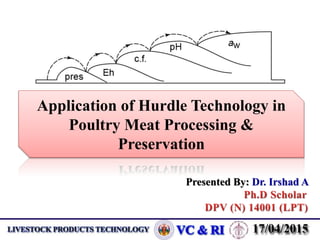
Application of Hurdle Technology in
Poultry Meat Processing &
Preservation
Introduction
1
Hurdle Technology
2
Characteristics of Hurdles
3
Examples of Hurdle Technology in Products
4
Overview
Introduction
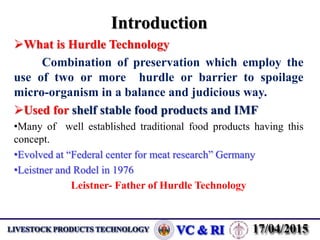
What is Hurdle Technology
Combination of preservation which employ the
use of two or more hurdle or barrier to spoilage
micro-organism in a balance and judicious way.
Used for shelf stable food products and IMF
•Many of well established traditional food products having this
concept.
•Evolved at “Federal center for meat research” Germany
•Leistner and Rodel in 1976
Leistner- Father of Hurdle Technology
Hurdle Technology
• It is the process/technology used for the preservation
provide shelf stability to a food product by laying hurdle
which are difficult to overcome by the micro-organism
causing food spoilage and poisoning. (Berwal, 1994)
• Also called
 combined process,
 combined methods,
 combination preservation,
 combination technique or
 barrier technology
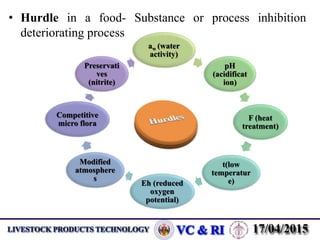
• Hurdle in a food- Substance or process inhibition
deteriorating process
aw (water
activity)
pH
(acidificat
ion)
F (heat
treatment)
t(low
temperatur
e)Eh (reduced
oxygen
potential)
Modified
atmosphere
s
Competitive
micro flora
Preservati
ves
(nitrite)
Hurdle Technology
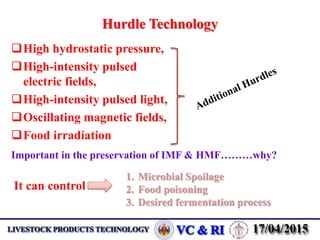
High hydrostatic pressure,
High-intensity pulsed
electric fields,
High-intensity pulsed light,
Oscillating magnetic fields,
Food irradiation
Important in the preservation of IMF & HMF………why?
It can control
1. Microbial Spoilage
2. Food poisoning
3. Desired fermentation process
Significance of Hurdle Technology
• An intelligent application of hurdle contributes to both
improvement in product quality and sustainability.
• Calculated application of hurdles could result into saving
money, energy and several resources
• Each hurdle contribute to the safety net against the micro-
organism
• Since SSPs do not require refrigeration, they travel long
distance for finding place in the market to reach the
consumers
• Able to use in products for defense force
• Perishability can be reduced.
Physical Hurdles
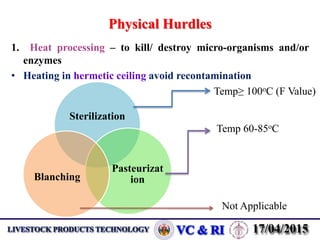
1. Heat processing – to kill/ destroy micro-organisms and/or
enzymes
• Heating in hermetic ceiling avoid recontamination
Sterilization
Pasteurizat
ionBlanching
Temp≥ 100oC (F Value)
Temp 60-85oC
Not Applicable
Physical Hurdles
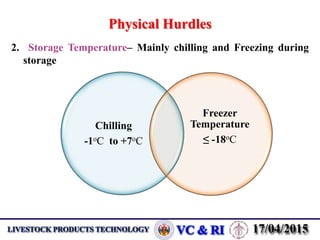
2. Storage Temperature– Mainly chilling and Freezing during
storage
Chilling
-1oC to +7oC
Freezer
Temperature
≤ -18oC
Physical Hurdles
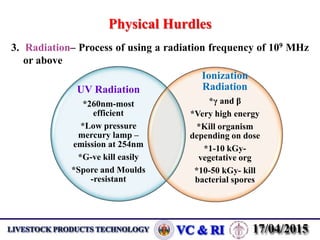
3. Radiation– Process of using a radiation frequency of 109 MHz
or above
UV Radiation
*260nm-most
efficient
*Low pressure
mercury lamp –
emission at 254nm
*G-ve kill easily
*Spore and Moulds
-resistant
Ionization
Radiation
*γ and β
*Very high energy
*Kill organism
depending on dose
*1-10 kGy-
vegetative org
*10-50 kGy- kill
bacterial spores
Physical Hurdles
4. Electro-magnetic energy (EME)– results from high voltage
electric fields
Oscillating magnetic field pulses
2-5 T, oscillation frequency 5 to
500 MHz
No temperature raise, single
pulse destroy 99%
Radio frequency energy
1-500 MHz- mild preservation Applied to heat processed food
Microwave Energy
Alternate electric field -500 to
1000 MHz
Fast heating by internal
molecular vibrations
Physical Hurdles
5. High Electric field– electric potential of 15Kv/cm *reverse
membrane potential of cell
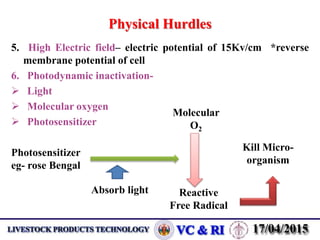
6. Photodynamic inactivation-
 Light
 Molecular oxygen
 Photosensitizer
Photosensitizer
eg- rose Bengal
Absorb light
Molecular
O2
Reactive
Free Radical
Kill Micro-
organism
Physical Hurdles
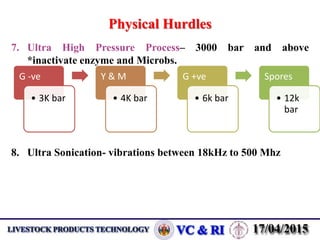
7. Ultra High Pressure Process– 3000 bar and above
*inactivate enzyme and Microbs.
8. Ultra Sonication- vibrations between 18kHz to 500 Mhz
G -ve
• 3K bar
Y & M
• 4K bar
G +ve
• 6k bar
Spores
• 12k
bar
Physical Hurdles
9. Packaging
 Vacuum packaging
 Moderate Vacuum packaging
 Active packaging
 Edible coating
 Modified atmospheric packaging
 Controlled atmospheric packaging
 Hypobaric storage
 Aseptic packaging
1. Prevent the entry of
microorganism, dirt,
insects, etc
2. Act as a barrier for
transfer the water
vapour, gas and
aroma
Physico-chemical Hurdles
1. aw –Water activity
 Reduced by dehydration
 Adding solutes such as salts, sugar, etc…
 By lowering temperature
2. pH
3. Redox Potential (Eh)- Denote oxidation reduction potential of
food system, Express in mV, +300 to -200mV
4. Nitrate (NaNO2)
5. CO2 – above 20%, spoilage bacterial inhibited
6. O2
Physico-chemical Hurdles
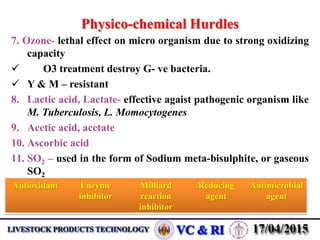
7. Ozone- lethal effect on micro organism due to strong oxidizing
capacity
 O3 treatment destroy G- ve bacteria.
 Y & M – resistant
8. Lactic acid, Lactate- effective agaist pathogenic organism like
M. Tuberculosis, L. Momocytogenes
9. Acetic acid, acetate
10. Ascorbic acid
11. SO2 – used in the form of Sodium meta-bisulphite, or gaseous
SO2
Antioxidant Enzyme
inhibitor
Milliard
reaction
inhibitor
Reducing
agent
Antimicrobial
agent
Physico-chemical Hurdles
12. Smoking:- important concept in poultry products
13. Phosphates
14. Glucono-d- lactone (GDL) – adding in cured meat
GDL Gluconic acid
Hydrolysis
Lowering
the pH
Product
Safety and
stability
Physico-chemical Hurdles
15. Phenols- Mainly used to prevent oxidative deterioration of
food- used in combination with other hurdles
eg- BHA, BHT, TBHQ
16. Spices and herbs
17. Lactoperoxides
18. Lysozymes
Microbially Derived Hurdles
1. Competitive flora- in fresh meat competitive flora inhibit L.
monocytogenes
2. Starter culture-
3. bacteriocins- Nicin, best known from lactic acid bacteria
* Number of bacteriocins are used experimentally in poultry
meat and meat products along with other Hurdle (Harris et al.,
1992; Kim, 1993)
4. Antibiotics- in poultry tetracycline are accepted
Hurdle Undesirable effect
Refrigeration Chilling injuries, weight loss
Freezing Discoloration, Texture loss, enzymatic
browning
CAP Softening, discoloration, slow spoilage
Pasteurization Nutritional losses, sensory losses
Drying Discoloration, Flavour change, mould
growth
Preservatives Consumer aversion resistance
Characteristics of A Hurdle alone
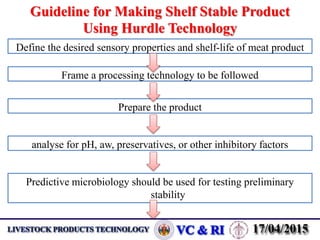
Guideline for Making Shelf Stable Product
Using Hurdle Technology
Define the desired sensory properties and shelf-life of meat product
Frame a processing technology to be followed
Prepare the product
analyse for pH, aw, preservatives, or other inhibitory factors
Predictive microbiology should be used for testing preliminary
stability
Guideline for Making Shelf Stable Product
Using Hurdle Technology
The product is then challenged with relevant food poisoning and
spoilage organisms, using somewhat higher inocula and
storage temperatures than would be ‘normal’ for the products.
If appropriate, the hurdles in the product are modified, taking multi-
target preservation and the sensory and nutritional quality of the
product (i.e. ‘total quality’) into consideration.
The food is again challenged with relevant microorganisms and, if
necessary, the hurdles in the food are modified again.
Predictive microbiology is helpful at this stage for assessing the
safety of the food.
Guideline for Making Shelf Stable Product Using
Hurdle Technology
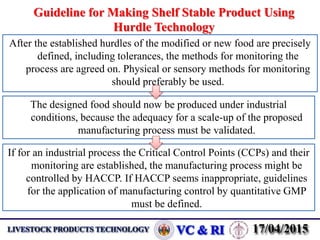
After the established hurdles of the modified or new food are precisely
defined, including tolerances, the methods for monitoring the
process are agreed on. Physical or sensory methods for monitoring
should preferably be used.
The designed food should now be produced under industrial
conditions, because the adequacy for a scale-up of the proposed
manufacturing process must be validated.
If for an industrial process the Critical Control Points (CCPs) and their
monitoring are established, the manufacturing process might be
controlled by HACCP. If HACCP seems inappropriate, guidelines
for the application of manufacturing control by quantitative GMP
must be defined.
Examples
Theoretical
Practical
Unwanted
hurdles
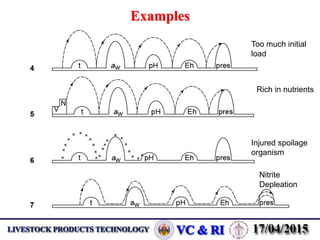
F, heating; t, chilling; aw, water activity; pH, acidity; Eh, redox potential;
pres., preservatives; V, vitamins; N, nutrients; c.f., competitive flora.
Examples
Examples
Too much initial
load
Rich in nutrients
Injured spoilage
organism
Nitrite
Depleation
Examples
Fermentation of
salami
Synergetic
effect of hurdle
Products with Hurdle Technology
For a greener
Environment

Application of hurdle technology in poultry meat processing & preservation

  • 2.
    Presented By: Dr.Irshad A Application of Hurdle Technology in Poultry Meat Processing & Preservation
  • 3.
    Introduction 1 Hurdle Technology 2 Characteristics ofHurdles 3 Examples of Hurdle Technology in Products 4 Overview
  • 4.
    Introduction What is HurdleTechnology Combination of preservation which employ the use of two or more hurdle or barrier to spoilage micro-organism in a balance and judicious way. Used for shelf stable food products and IMF •Many of well established traditional food products having this concept. •Evolved at “Federal center for meat research” Germany •Leistner and Rodel in 1976 Leistner- Father of Hurdle Technology
  • 5.
    Hurdle Technology • Itis the process/technology used for the preservation provide shelf stability to a food product by laying hurdle which are difficult to overcome by the micro-organism causing food spoilage and poisoning. (Berwal, 1994) • Also called  combined process,  combined methods,  combination preservation,  combination technique or  barrier technology
  • 6.
    • Hurdle ina food- Substance or process inhibition deteriorating process aw (water activity) pH (acidificat ion) F (heat treatment) t(low temperatur e)Eh (reduced oxygen potential) Modified atmosphere s Competitive micro flora Preservati ves (nitrite)
  • 7.
    Hurdle Technology High hydrostaticpressure, High-intensity pulsed electric fields, High-intensity pulsed light, Oscillating magnetic fields, Food irradiation Important in the preservation of IMF & HMF………why? It can control 1. Microbial Spoilage 2. Food poisoning 3. Desired fermentation process
  • 8.
    Significance of HurdleTechnology • An intelligent application of hurdle contributes to both improvement in product quality and sustainability. • Calculated application of hurdles could result into saving money, energy and several resources • Each hurdle contribute to the safety net against the micro- organism • Since SSPs do not require refrigeration, they travel long distance for finding place in the market to reach the consumers • Able to use in products for defense force • Perishability can be reduced.
  • 9.
    Physical Hurdles 1. Heatprocessing – to kill/ destroy micro-organisms and/or enzymes • Heating in hermetic ceiling avoid recontamination Sterilization Pasteurizat ionBlanching Temp≥ 100oC (F Value) Temp 60-85oC Not Applicable
  • 10.
    Physical Hurdles 2. StorageTemperature– Mainly chilling and Freezing during storage Chilling -1oC to +7oC Freezer Temperature ≤ -18oC
  • 11.
    Physical Hurdles 3. Radiation–Process of using a radiation frequency of 109 MHz or above UV Radiation *260nm-most efficient *Low pressure mercury lamp – emission at 254nm *G-ve kill easily *Spore and Moulds -resistant Ionization Radiation *γ and β *Very high energy *Kill organism depending on dose *1-10 kGy- vegetative org *10-50 kGy- kill bacterial spores
  • 12.
    Physical Hurdles 4. Electro-magneticenergy (EME)– results from high voltage electric fields Oscillating magnetic field pulses 2-5 T, oscillation frequency 5 to 500 MHz No temperature raise, single pulse destroy 99% Radio frequency energy 1-500 MHz- mild preservation Applied to heat processed food Microwave Energy Alternate electric field -500 to 1000 MHz Fast heating by internal molecular vibrations
  • 13.
    Physical Hurdles 5. HighElectric field– electric potential of 15Kv/cm *reverse membrane potential of cell 6. Photodynamic inactivation-  Light  Molecular oxygen  Photosensitizer Photosensitizer eg- rose Bengal Absorb light Molecular O2 Reactive Free Radical Kill Micro- organism
  • 14.
    Physical Hurdles 7. UltraHigh Pressure Process– 3000 bar and above *inactivate enzyme and Microbs. 8. Ultra Sonication- vibrations between 18kHz to 500 Mhz G -ve • 3K bar Y & M • 4K bar G +ve • 6k bar Spores • 12k bar
  • 15.
    Physical Hurdles 9. Packaging Vacuum packaging  Moderate Vacuum packaging  Active packaging  Edible coating  Modified atmospheric packaging  Controlled atmospheric packaging  Hypobaric storage  Aseptic packaging 1. Prevent the entry of microorganism, dirt, insects, etc 2. Act as a barrier for transfer the water vapour, gas and aroma
  • 16.
    Physico-chemical Hurdles 1. aw–Water activity  Reduced by dehydration  Adding solutes such as salts, sugar, etc…  By lowering temperature 2. pH 3. Redox Potential (Eh)- Denote oxidation reduction potential of food system, Express in mV, +300 to -200mV 4. Nitrate (NaNO2) 5. CO2 – above 20%, spoilage bacterial inhibited 6. O2
  • 17.
    Physico-chemical Hurdles 7. Ozone-lethal effect on micro organism due to strong oxidizing capacity  O3 treatment destroy G- ve bacteria.  Y & M – resistant 8. Lactic acid, Lactate- effective agaist pathogenic organism like M. Tuberculosis, L. Momocytogenes 9. Acetic acid, acetate 10. Ascorbic acid 11. SO2 – used in the form of Sodium meta-bisulphite, or gaseous SO2 Antioxidant Enzyme inhibitor Milliard reaction inhibitor Reducing agent Antimicrobial agent
  • 18.
    Physico-chemical Hurdles 12. Smoking:-important concept in poultry products 13. Phosphates 14. Glucono-d- lactone (GDL) – adding in cured meat GDL Gluconic acid Hydrolysis Lowering the pH Product Safety and stability
  • 19.
    Physico-chemical Hurdles 15. Phenols-Mainly used to prevent oxidative deterioration of food- used in combination with other hurdles eg- BHA, BHT, TBHQ 16. Spices and herbs 17. Lactoperoxides 18. Lysozymes
  • 20.
    Microbially Derived Hurdles 1.Competitive flora- in fresh meat competitive flora inhibit L. monocytogenes 2. Starter culture- 3. bacteriocins- Nicin, best known from lactic acid bacteria * Number of bacteriocins are used experimentally in poultry meat and meat products along with other Hurdle (Harris et al., 1992; Kim, 1993) 4. Antibiotics- in poultry tetracycline are accepted
  • 21.
    Hurdle Undesirable effect RefrigerationChilling injuries, weight loss Freezing Discoloration, Texture loss, enzymatic browning CAP Softening, discoloration, slow spoilage Pasteurization Nutritional losses, sensory losses Drying Discoloration, Flavour change, mould growth Preservatives Consumer aversion resistance Characteristics of A Hurdle alone
  • 22.
    Guideline for MakingShelf Stable Product Using Hurdle Technology Define the desired sensory properties and shelf-life of meat product Frame a processing technology to be followed Prepare the product analyse for pH, aw, preservatives, or other inhibitory factors Predictive microbiology should be used for testing preliminary stability
  • 23.
    Guideline for MakingShelf Stable Product Using Hurdle Technology The product is then challenged with relevant food poisoning and spoilage organisms, using somewhat higher inocula and storage temperatures than would be ‘normal’ for the products. If appropriate, the hurdles in the product are modified, taking multi- target preservation and the sensory and nutritional quality of the product (i.e. ‘total quality’) into consideration. The food is again challenged with relevant microorganisms and, if necessary, the hurdles in the food are modified again. Predictive microbiology is helpful at this stage for assessing the safety of the food.
  • 24.
    Guideline for MakingShelf Stable Product Using Hurdle Technology After the established hurdles of the modified or new food are precisely defined, including tolerances, the methods for monitoring the process are agreed on. Physical or sensory methods for monitoring should preferably be used. The designed food should now be produced under industrial conditions, because the adequacy for a scale-up of the proposed manufacturing process must be validated. If for an industrial process the Critical Control Points (CCPs) and their monitoring are established, the manufacturing process might be controlled by HACCP. If HACCP seems inappropriate, guidelines for the application of manufacturing control by quantitative GMP must be defined.
  • 25.
    Examples Theoretical Practical Unwanted hurdles F, heating; t,chilling; aw, water activity; pH, acidity; Eh, redox potential; pres., preservatives; V, vitamins; N, nutrients; c.f., competitive flora.
  • 26.
  • 27.
    Examples Too much initial load Richin nutrients Injured spoilage organism Nitrite Depleation
  • 28.
  • 29.
  • 30.
  • 31.